Yet More From Philip Mernick’s Collection
In sharp contrast to Horace Warner’s Spitalfields Nippers, this latest selection from Philip Mernick‘s collection of cartes de visite by nineteenth century East End photographers, gathered over the past twenty years, shows the offspring of the bourgeois professional classes. No doubt the doting parents delighted in these portraits of their little darlings trussed up like turkeys in their fancy outfits, but there is not a single smile among them.

1865
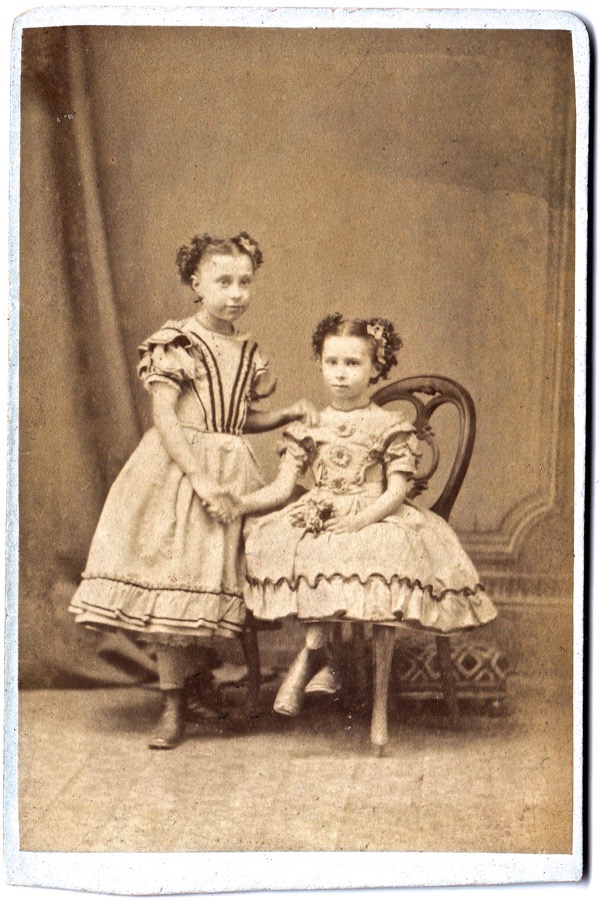
1870

1870

1870

1870s

1870s

1880

1885

1880s

1880s

1880s

1898

1890
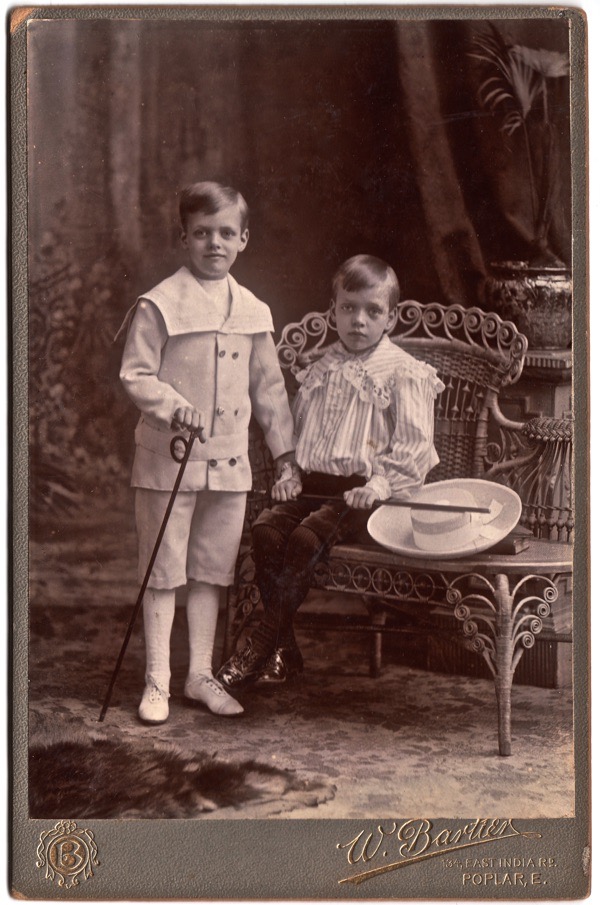
1900

1900

1900

1910

1910

1910
Photographs reproduced courtesy of Philip Mernick
You may also like to take a look at
Portraits from Philip Mernick’s Collection
So Long, Alfons Jedrzejewski Of Puma Court
I publish this as a tribute to Alfons Jedrzejewski – widely known as Alec – who lived in the Norton Folgate Almshouses for forty-five years and died there last week aged eighty-nine. I used to meet him regularly, coming and going through the gates, and now I shall always think of him when I walk through Puma Court.
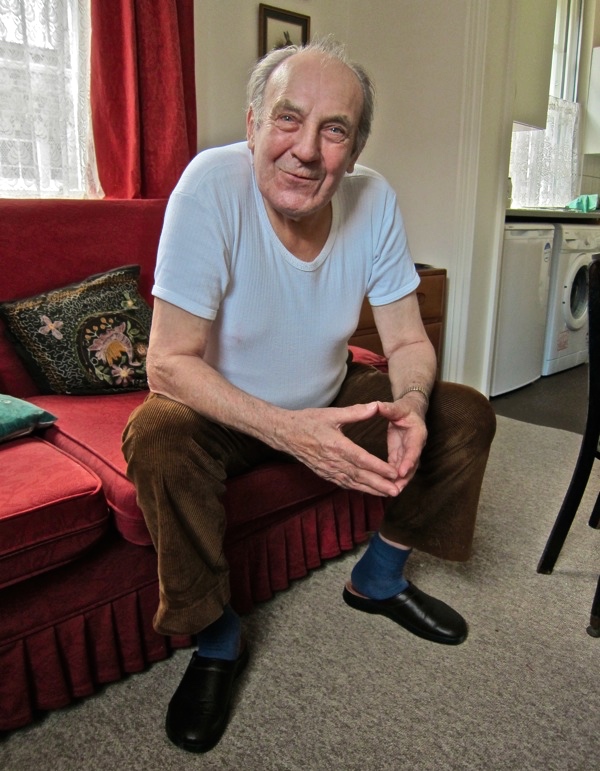
Alfons Jedrzejewski (1926-2015)
I met Alfons Jedrzejewski – widely known as Alec – just over two years ago, when he returned to the Norton Folgate Almshouses in Puma Court, off Commercial St, after a ten month sojourn in Shepherds Bush, while the hundred and fifty year old dwellings underwent a renovation. He invited me round for tea in his newly-painted flat where I found him toying with the novelty of the new controls for his heating and hot water. Primarily, Alec was relieved to be back in the place he had lived for the more than forty years. “I prefer to be here,” he confided to me in understatement, rolling his eyes to communicate the alien nature of life in West London, “I feel more happy here.”
Hale and healthy then at eighty-six, Alec was born in 1926 in Tors in Poland. He served in the Polish army during World War II and came to London in May 1946 to start a new life after he discovered that all his relatives in Poland had been killed by Stalin. Just a few snaps and photobooth portraits in a frame upon the wall of Alec’s living room attested to the existence of his family, yet his flat also contained the memory of the last twenty-three years of his marriage to his wife, Halina, who had died nineteen years earlier.
When he first came to London, Alec worked as a house painter until – following Halina’s prudent advice – he took a job on the railway that would give him a pension, working for twenty-one years in the parcels office at Liverpool St Station. “A friend of mine, who worked at Kings Cross and lived at 8 Wilkes St, told me about these flats,” explained Alec, emphasising the importance he placed upon mobility, “you have good transport links here, underground, buses and British Rail.”
This was a significant detail because the unfailing highlight of Alec’s week was a trip to Leytonstone to visit his long-term girlfriend, Maria, and take her the fresh fish that she loved so much, which he bought for her at Asda. Like so many refugees before him, Alec discovered in Spitalfields a safe haven from the brutality of the wider world and lived out his existence peacefully here until the end. After my interview, I met Alec and Maria once or twice, strolling together arm-in-arm in the Bethnal Green Rd like a couple of teenage sweethearts.
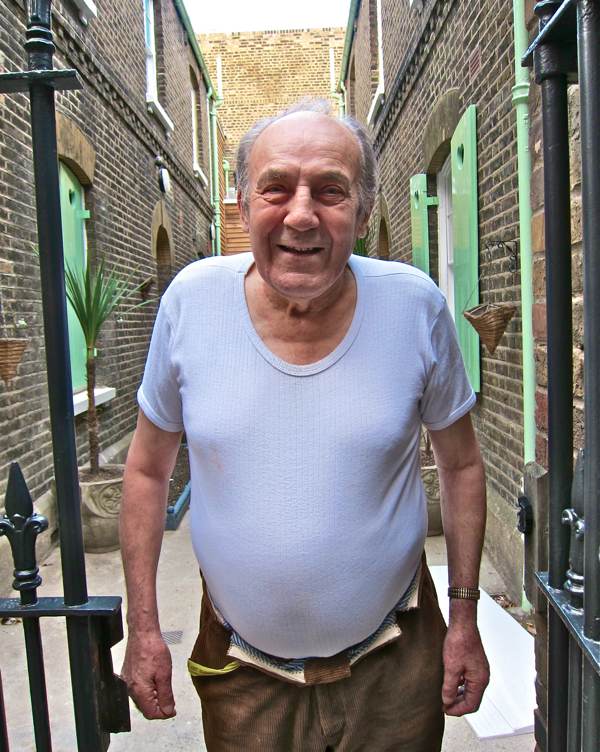
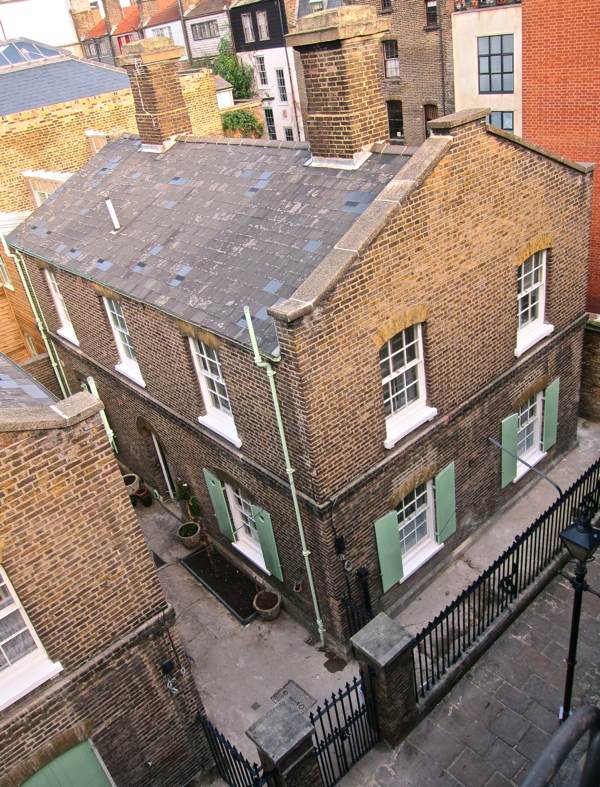

For many years I passed the railings of the almshouses daily as I walked through Puma Court, leaving the clamor of Commercial St behind me and entering the peaceful streets of eighteenth century houses beyond. So I was eager to step through the old iron gates at last, when I visited Alec in this appealing backwater in the midst of the city.
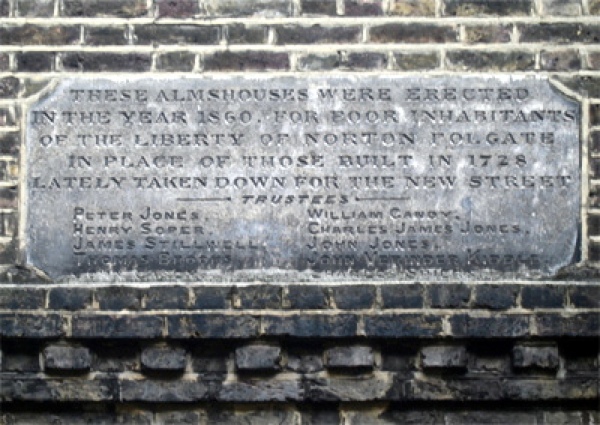
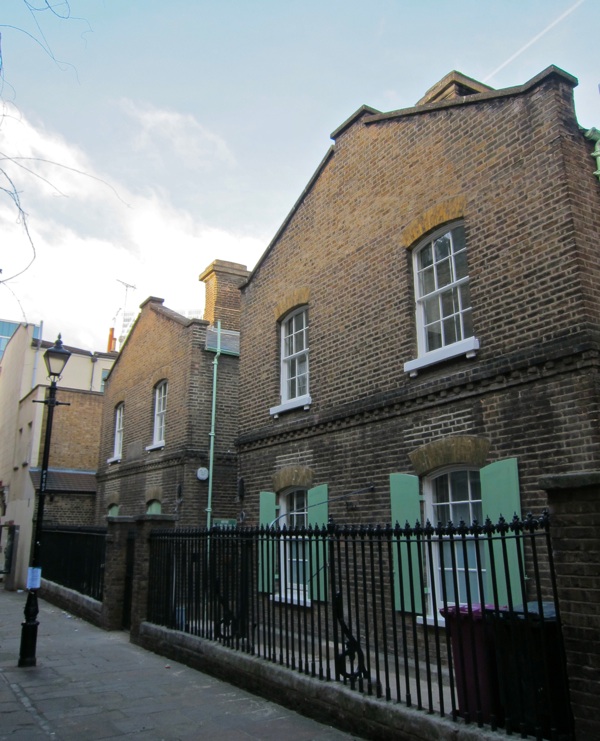
Established at first in Blossom St in 1728, the current site for the Norton Folgate Almshouses was purchased in 1851 when the widening of Commercial St – to permit the increasing traffic from the London Docks – required the demolition of the former premises.
This neatly proportioned pair of brick houses in Puma Court, each containing eight rooms on two storeys, were built by architect T. E. Knightley in 1860. The first residents received two shillings and sixpence a month, a ticket for a quartern loaf of bread per week, six hundredweight of coal on 21st December and materials for dinner on Christmas Day. There were fifteen single people and one married couple living there in 1897, they each had one room and the average age was sixty-four. It was a humane endeavour, offering a secure refuge for those who could no longer earn a living and existing in sharp contrast to the poverty which prevailed ein Spitalfields at that time.
Over one hundred and fifty years, the Norton Folgate Almshouses in Puma Court have offered a safe harbour for life – as Alec’s story attests – and these thoughtfully-conceived dwellings continue to serve their purpose into another century, as the need for good quality housing at an affordable price in Spitalfields becomes ever more pressing.
Sophie Charalambous, Artist
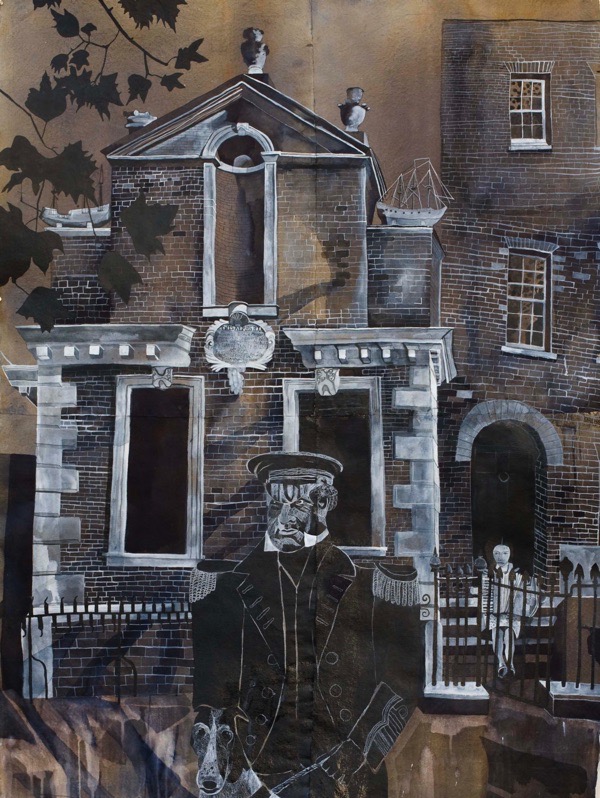
Trinity Green Almshouses, Mile End
You only have until this Sunday 8th March to catch Sophie Charalambous‘ exhibition at Jessica Carlisle Gallery. I was captivated by the soulful melancholy beauty of Sophie’s paintings of London from the moment I saw them, so Contributing Photographer Sarah Ainslie & I went over to visit her yesterday at her studio in London Fields where she has been working in an old garment factory for the past fifteen years. While her faithful hound who sneaks his way into many of the paintings dozed on the sofa, Sophie showed us her sketchbooks and I recognised a kindred spirit in Sophie’s love of the Thames – a romance nurtured by regular visits to the foreshore at Wapping and finding expression in magnificent moody paintings.
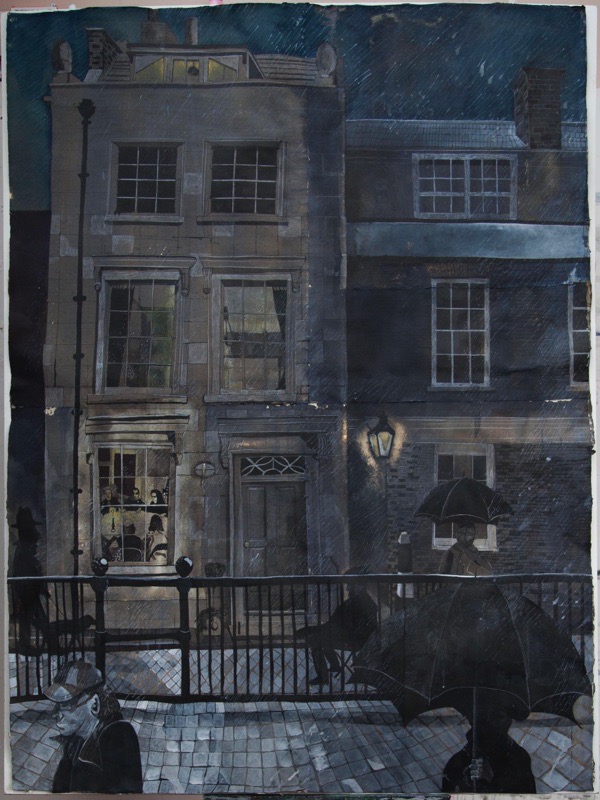
House by the Thames at Bankside
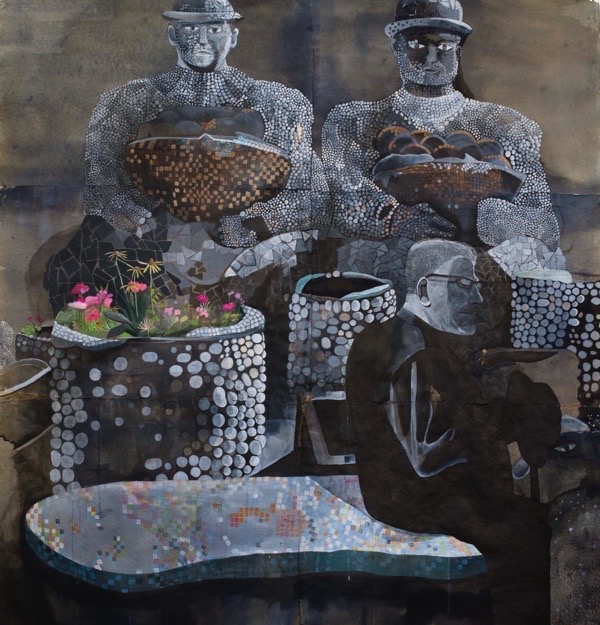
Drovers in London Fields
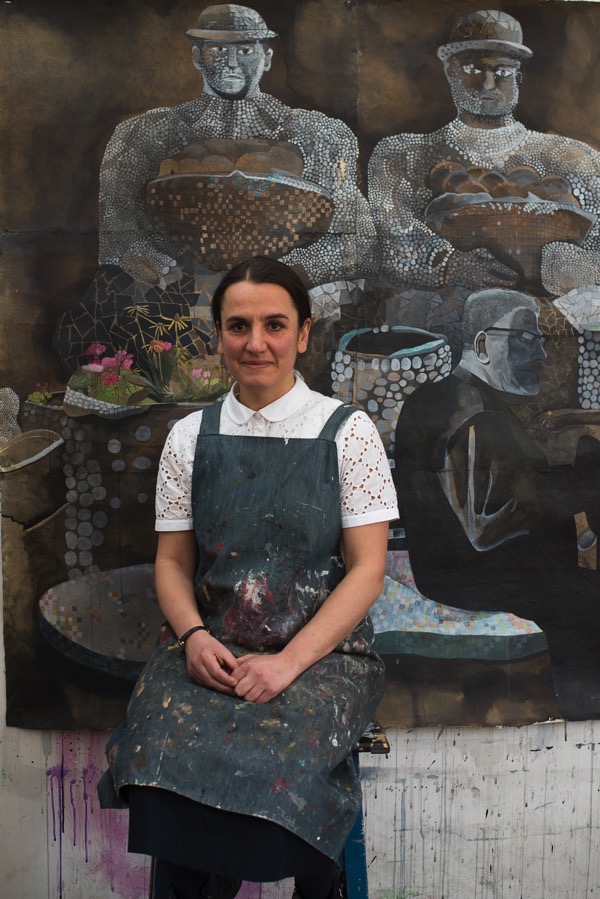
Sophie Charalambous
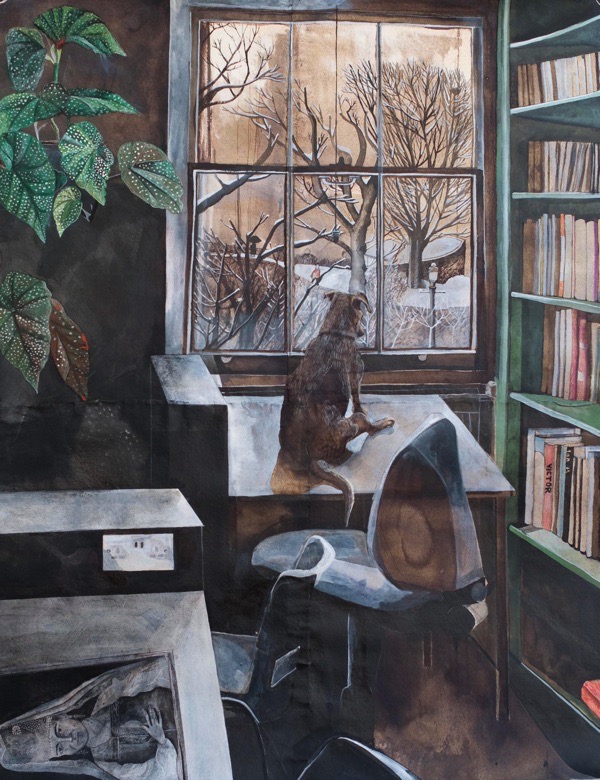
Life, Still, Winter
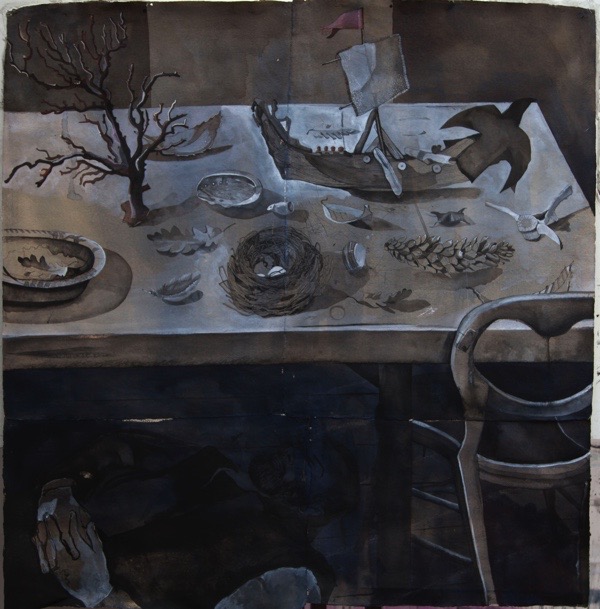
Pageant
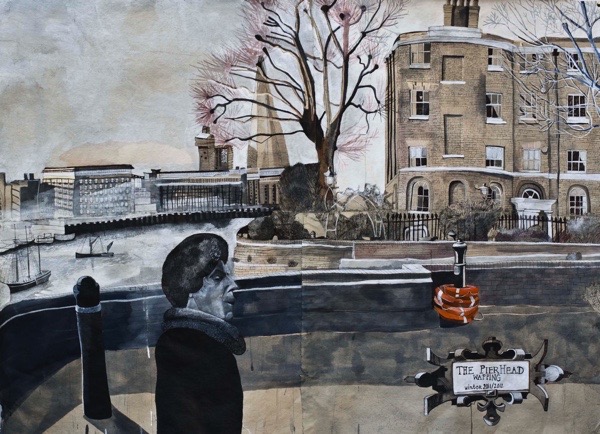
Wapping Pierhead
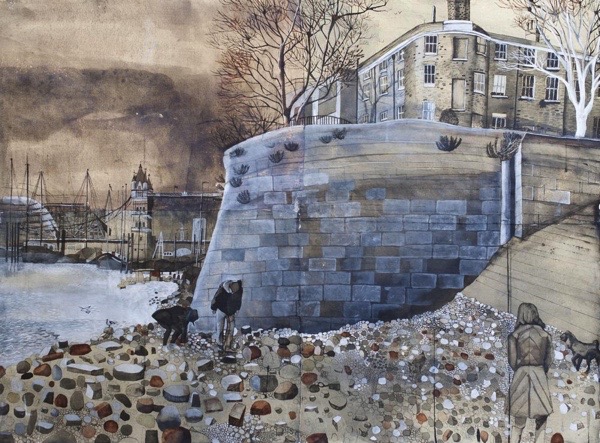
On the Beach at Wapping Pierhead
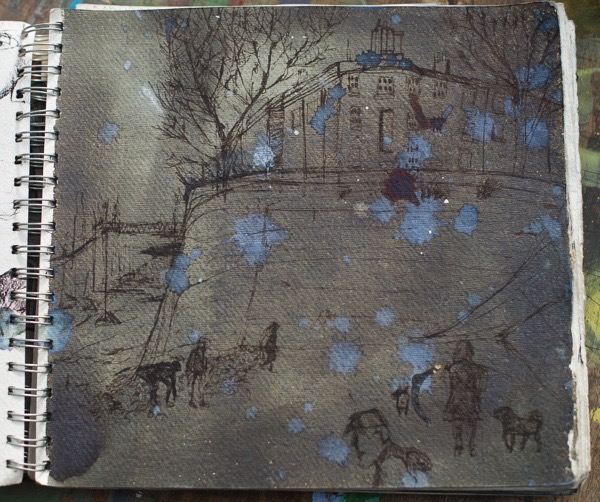
Sketch for Wapping Pierhead, with raindrops
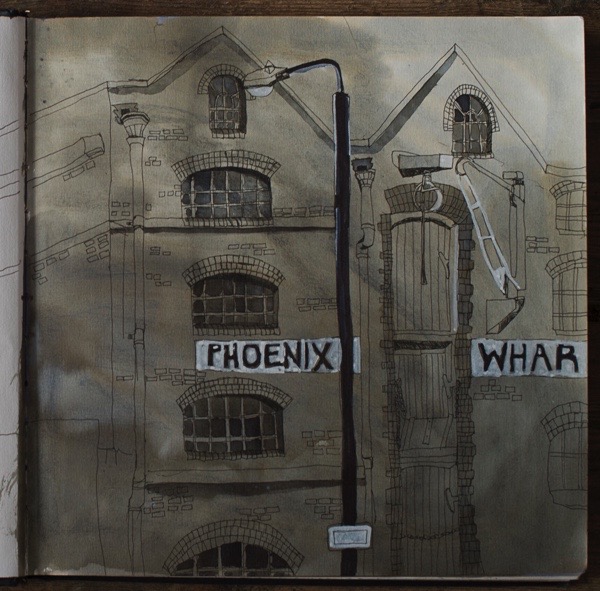
Warehouses in Wapping
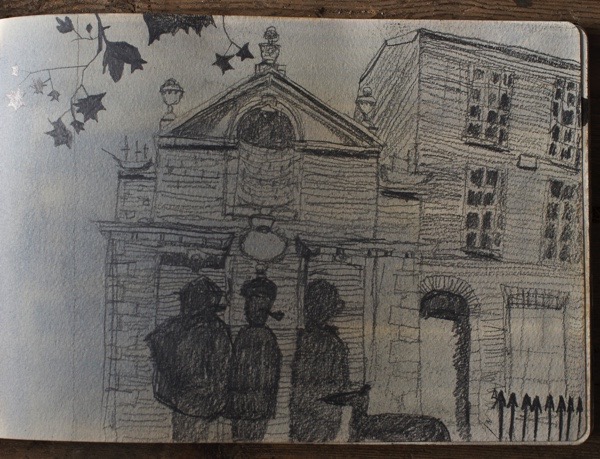
Sketch for Trinity Green Almshouses, Whitechapel
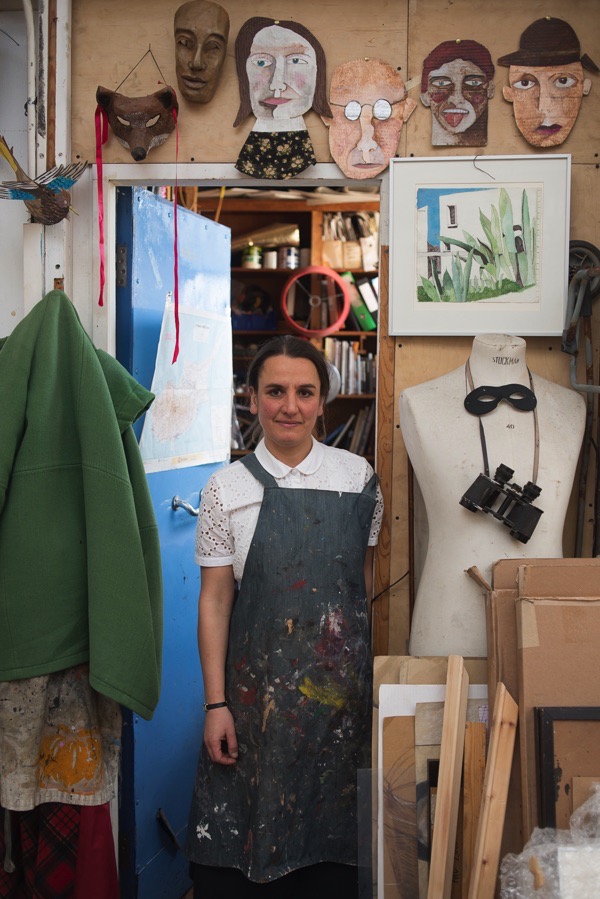
Sophie Charalambous in her studio in London Fields
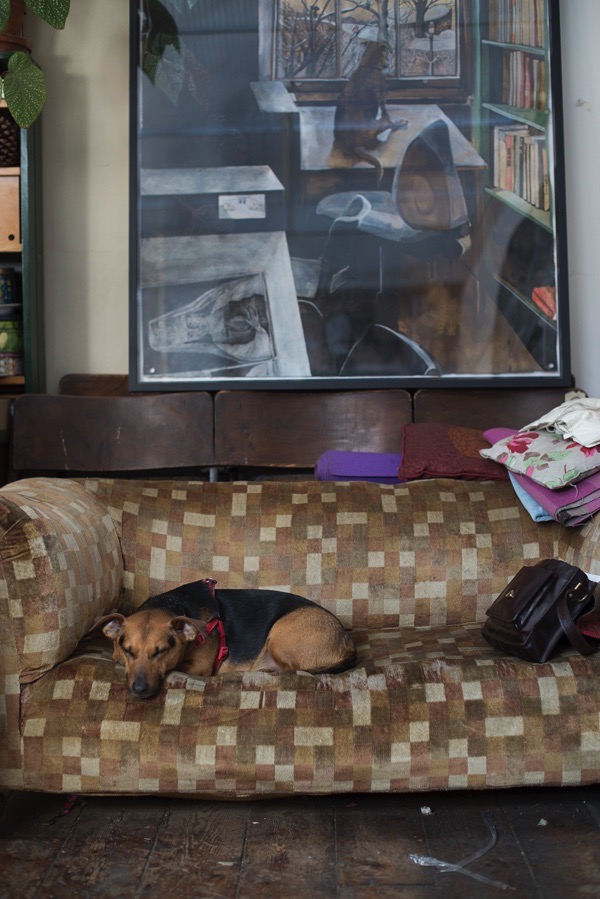
Paintings copyright © Sophie Charalambous
Photographs copyright © Sarah Ainslie
Sophie Charalambous’ exhibition is at Jessica Carlisle Gallery, 83 Kinnerton St, SW1X 8ED, until Sunday 8th March at 6pm
You may also like to read about
Madge Darby, Historian of Wapping
Adam Dant’s Stories Of Hackney Old & New

Contributing Artist Adam Dant presents this map of Hackney that he has created as a complement to his maps of Shoreditch & Clerkenwell
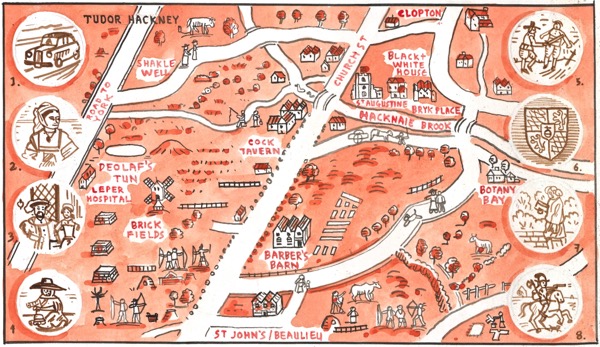
1. In the sixteenth century, Hackney is the first village near London accommodated with coaches for occasional passengers, hence the name of Hackney carriages.
2. 1521 – Thomas More’s third daughter Cecilia marries Giles Herond in ‘Shackelwell’ & resides at an ancient manor there.
3. 1536 – Henry VIII is reconciled with his daughter Mary at Brook House, Hackney. Mary had not spoken to her father in five years.
4. 1559 – London’s last case of leprosy is recorded at St Bart’s isolation house, ‘The Lock Hospital.’ Established in 1280, it was Hackney’s first hospital.
5. 1598 – Playwright Ben Jonson kills fellow actor Gabriel Spencer in a duel in the fields at Shoreditch and receives a felon’s brand on this thumb.
6. 1647 – The presence of Elizabeth of Bohemia & The Elector Palatine at an entertainment at ‘The Black & White house’ is commemorated in a window bearing their arms.
7. 1654 – Diarist John Evelyn visits Lady Brook’s celebrated garden at Brook’s House, Hackney.
8. 1682 – Prince Rupert discovers a new and excellent method of boring guns at his watermill in Homerton, but the secret of Prince Rupert’s metal dies with him.

9. 1701 – A bull baited by twelve dogs breaks loose at Temple Mills. Confusion and uproar ensue amongst the crowd of three thousand and a nine year old girl barely survives being tossed by the enraged animal.
10. 1750 – Legislature obliges people not to keep any other dogs but ‘such that are really useful’ after Charles Issacs at Hackney is bit by a dog and dies raving mad.
11. In the seventeenth century, the noted ‘Hackeny Buns’ of Goldsmith’s Row are as well regarded as those of ‘The Bun House’ at Chelsea.
12. 1665 – To be seen at Cooper’s Gardens for sixpence a person, the greatest curiosity that was ever seen, a white Dutch radish two feet and two inches round.
13. 1667 – In the church of St Augustine, Samuel Pepys eyes Abigail Vyner ‘a lady rich in Jewels but mostly in beauty, almost the finest woman that I ever saw.’
14. 1788 – In Cat & Mutton fields is seen the inhuman sport where any contestant catching ‘a soapy pig by the tail & holding it over his head’ wins a gold laced hat.
15. 1797 – The Hackney Militia gain a reputation for bumbling incompetence during the Napoleonic Wars.
16. 1811 – At The Mermaid Tavern pleasure gardens James Sadler & Captain Paget Royal Navy ascend in a balloon decorated in honour of The Prince Regent on his birthday.

17. 1787 – Plants from ‘Loddige’s Gardens’, originally owned by John Busch, gardener to Catherine the Great, are transferred to Crystal Palace.
18. 1805 – A stagecoach is broken to pieces and two ladies suffer severely when the vehicle overturns on the edge of a precipice at Hackney Wick.
19. 1816 – Brooke House, former home of Lady Brookes and Balmes House at Hoxton are opened as private lunatic asylums.
20. 1821 – Repairs are made at Hackney’s oldest brewery, Mrs Addison’s Woolpack Brewery on the Hackney Brook.
21. 1848 – Prince Albert opens The Hospital for Diseases of the Chest and in 1867 Princess Louise opens the North-Eastern Hospital for Sick Children in the Hackney Rd
22. 1850 – The construction of Victoria Park sweeps way hovels, formerly known as‘Botany Bay,’ and the inhabitants who are sent to another place bearing the same name.
23. 1866 – At the Parkesine Works in Wallis Rd and Berkshire Rd, Alexander Parkes manufactures the world’s first plastic.
24. 1880. – Hackney Wick firm Carless Capel & Leonard claim to have invented the term ‘petrol’ (St Peter’s Oil).

25. 1902 – Smallpox re-surfaces in Hackney with contagion found in a family of costermongers living in filthy conditions in Sanford Lane.
26. 1959 – Richard Burton films a scene for John Osborne’s ‘Look Back in Anger’ at Dalston Junction Railway Station.
27. 1952 – The great fog causes death and chaos in Hackney when a motor-cyclist collides with a bus, a man dies on a railway line and crime has a little hey-day.
28. 1964 – Teenagers at The Dalston Dance Hall adopt the ‘purple heart’ pill popping craze.
29. 1970 – M.O.D investigates the sighting of a U.F.O over Hackney by Mr Douglas Lockhart, gliding across a clear sky at 11.35pm on a Saturday night.
30. 2007 – Terry Castle and volunteers at Bethune Rd unearth a hoard of Nazi twenty dollar gold coins whilst digging a frog pond.
31. 2011 – Grandmother Pauline Pearce ‘Hero of Hackney’ bravely stands up to a gang of looting rioters at the Pembury Estate.
32. Thousands of ‘booze fuelled revellers’ leave a trail of destruction along the Regents Canal ‘Canalival’ floating party.

The map of Hackney Old & New was commissioned from Adam Dant by James Goff who has been a patron of artists in Hackney since the eighties and you may see the original displayed in the Hackney office of Stirling Ackroyd in Mare St.
You may also like to take a look at
Adam Dant’s Stories of Shoreditch Old & New
Adam Dant’s Stories of Clerkenwell Old & New
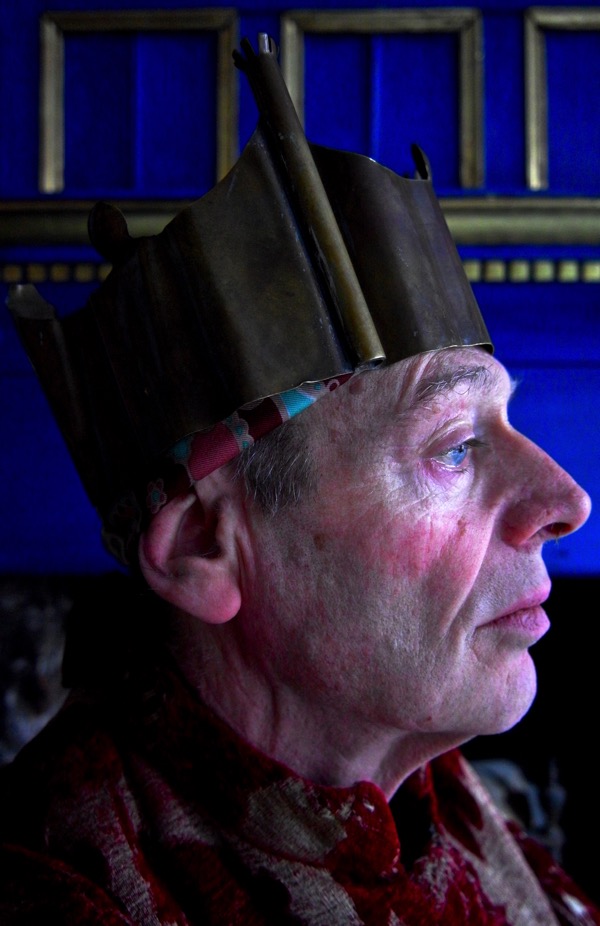
Rodney Archer Plays Edward II
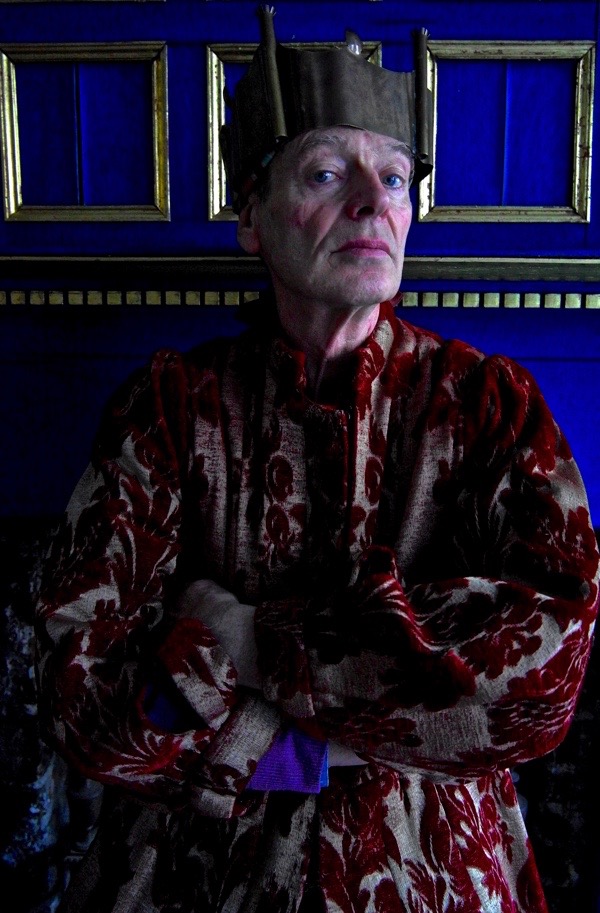
Rodney Archer as Edward II
I am proud to announce that I have persuaded Rodney Archer, the Aesthete of Fournier St, to take the title role of Christopher Marlowe’s Edward II in a public reading of the play next Sunday 8th March at 6:30pm at The Water Poet in Folgate St, cast with a mixture of local people and luminaries of the theatrical profession, as part of the SAVE NORTON FOLGATE Cultural Festival.
We know Christopher Marlowe lived in Norton Folgate in 1589 and it seems likely that he wrote many of his most famous plays there including Edward II, Doctor Faustus, The Jew of Malta and The Massacre of Paris, some of which may have been performed at The Theatre and The Curtain nearby. Recent research into Elizabethan sewers and textual analysis of Edward II, published by the Journal of Early Modern Literary Studies – focussing upon the multiplicity of images of watercourses and drains in Marlowe’s script – suggests that it was written for The Theatre in Shoreditch and makes play upon the watery topography surrounding the building, as illustrated in the map below.
Click here to book your free ticket to see Rodney Archer in Marlowe’s Edward II

Christopher Marlowe lived in Norton Folgate
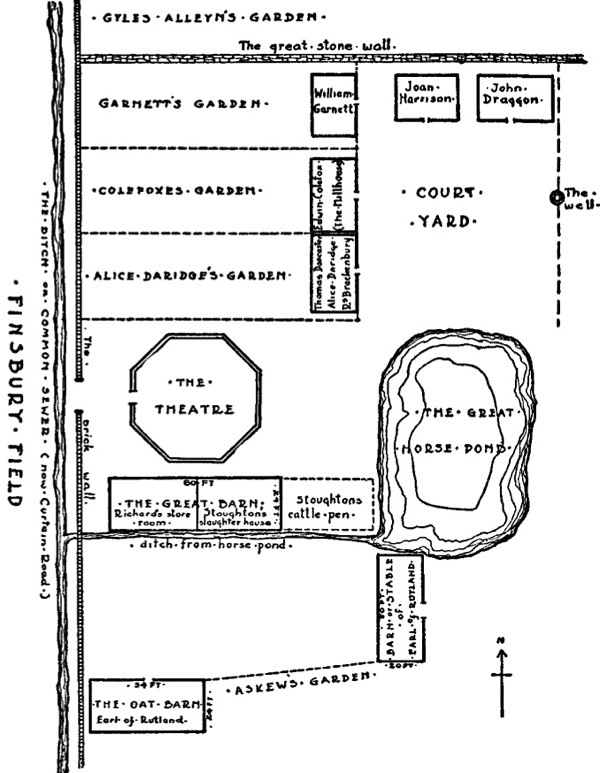
Map showing the position of The Theatre and the Soerditch by Joseph Quincy Adams, 1917
You may also like to read about
Dan Cruickshank In Norton Folgate
On Sunday, Contributing Film-Maker Sebastian Sharples took a walk around Norton Folgate with Architectural Historian and Local Resident Dan Cruickshank, and this film is the result
[youtube UMQBhsJCU7Y nolink]
Click here for a simple guide to HOW TO OBJECT EFFECTIVELY prepared by The Spitalfields Trust
Follow the Campaign at facebook/savenortonfolgate
Follow Spitalfields Trust on twitter @SpitalfieldsT
The Spitalfields Trust’s SAVE NORTON FOLGATE exhibition curated by The Gentle Author is open today at Dennis Severs House and runs until March 15th
The Hackney Yearbook 1906
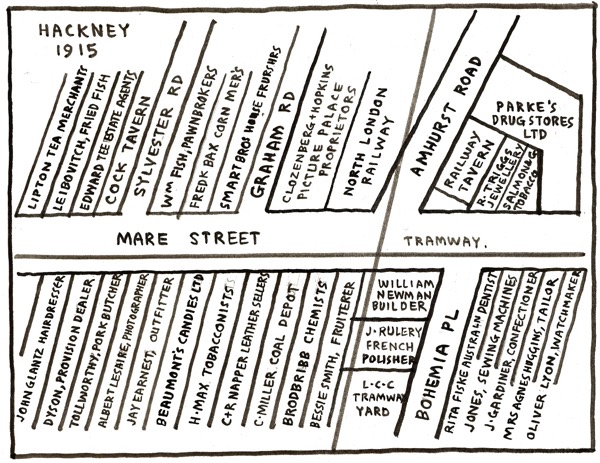
Behold the wonders of commerce and retail over a century ago, courtesy of the Hackney Year Book 1906 from the archive at the Bishopsgate Institute!

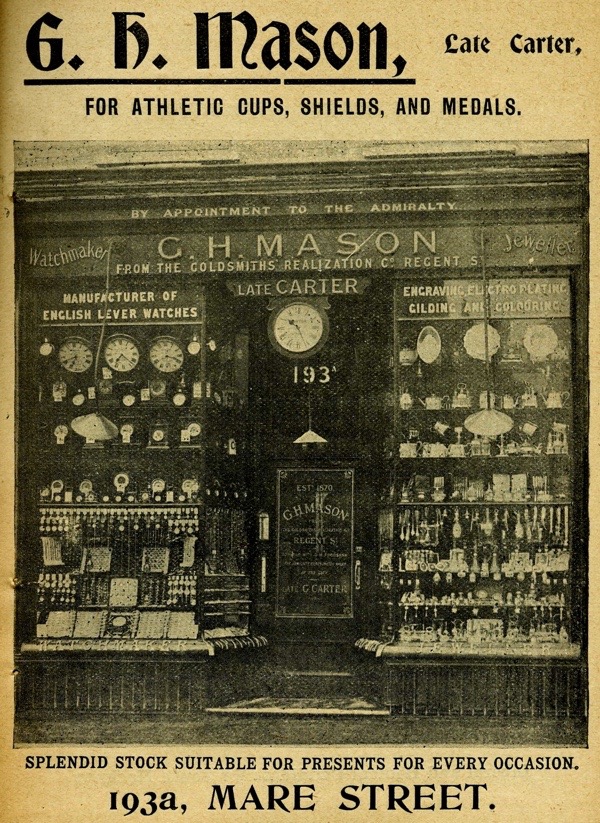


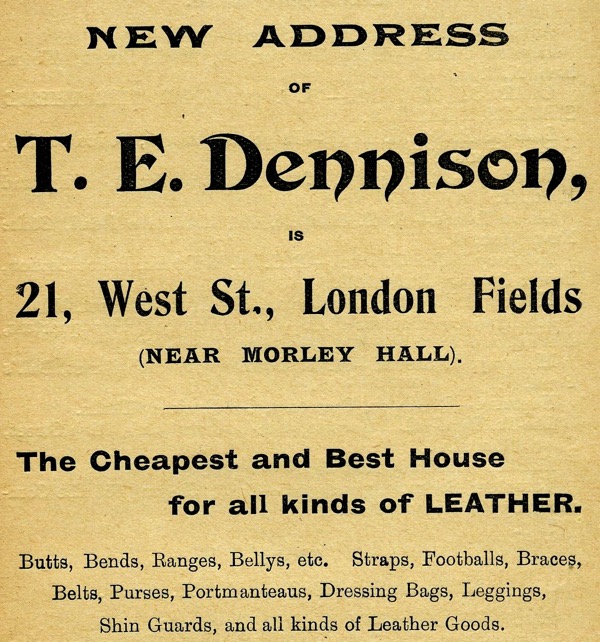
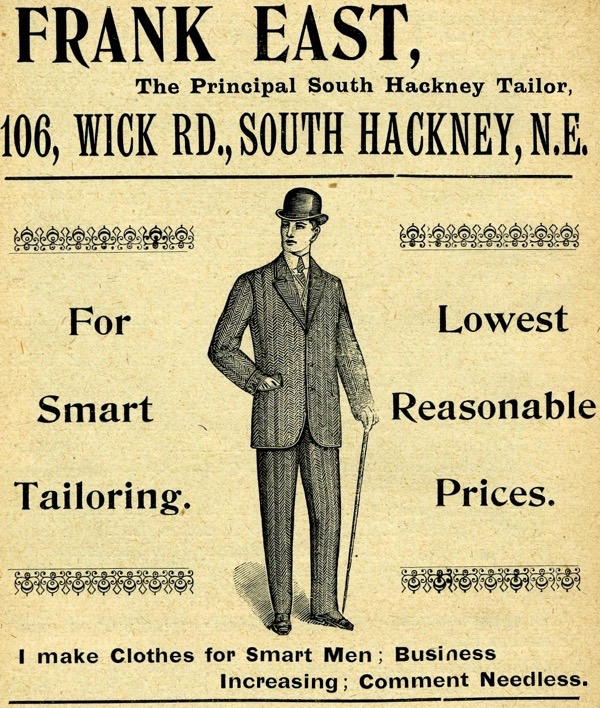


Images courtesy Bishopsgate Institute
You may also like to take a look at
Adverts from Shoreditch Borough Guide