
At Caird & Rayner
In January, I published photographs by Paul Talling of Derelict London of the abandoned Caird & Rayner building in Limehouse and today, thanks to historian Tom Ridge, I am able to reveal the proud story of innovation and enterprise that lies behind the current state of sorry dereliction


In 1893, Edward Bonar Caird & Thomas J Rayner patented a design for device that could evaporate seawater and produce drinkable freshwater. It was an essential piece of nautical apparatus that was to sustain the company for more than a century. Rayner was an inventor of considerable talent and Caird had the financial resources to develop the commercial potential.
They set up a partnership in 1889 and took a lease upon 777 Commercial Rd, a former sailmakers, spending more than fifteen hundred pounds in equipping it with machinery for their purposes. The company prospered and in 1893 – the year of their patent – Caird & Rayner, were described in a publication entitled ‘The Thames, Waterway of the World’ as ‘Gentlemen of Conspicuous Endeavour.’
With minor diversions into swimming pool filters and sewage treatment, Caird & Rayner carried on through the twentieth century supplying distillation and filtration equipment to the maritime industry, both naval vessels and grand liners, from their factory in Commercial Rd until 1972. During World War II, a plant was established in Watford away from the bombing of London and eventually all manufacturing was transferred there, leaving the factory in the Limehouse empty all these years.

Artists impression of Caird & Rayner offices in 1890

The Caird & Rayner building today

777 Commercial Rd in the early twentieth century


On the shop floor in Limehouse in the sixties


Percy Martin in the drawing office in the thirties

Plant to produce 25 gallons per hour

Plant to produce 100 gallons per hour

Diagram of secret communication system in World War II


A beano in 1949 for the company’s sixtieth birthday celebrations

The ladies of Caird & Rayner photographed on the roof of 777 Commercial Rd

The Watford factory opened in 1941, away from the bombing of the East End
Colour photographs copyright © Paul Talling
You may also like to take a look at
At Time For Tea

Johnny Vercoutre
I had always assumed the words ‘Time for Tea’ emblazoned upon the fascia of a narrow building in Shoreditch High St indicated that it was an occasional tea shop. But when I enquired the meaning of this sign from Johnny Vercoutre, who has lived there for the past twenty years and who painted the text in question, he gave an unexpected reply. “It’s my philosophy of life,” he declared with a swagger and a smile, brushing his languid moustache with a forefinger as a mischievously pleasurable thought popped into his mind, “I’d like to drive a long truck with a line of dancing girls into the middle of the street and stop all traffic, and serve tea to everybody.”
Johnny came to the East End as child to buy a tortoise at the erstwhile animal market in Club Row. He likes to brag of his early prowess at splayed brickwork, which was a matter of pride to his father who was a builder in Kilburn and proved to be an invaluable asset in the restoration of his eighteenth century house. Originally constructed as the London Savings Bank, it served as the premises of Andrews the Clockmakers who supplied the timepiece to St Leonard’s Shoreditch next door, before becoming a pawnbroker and finally Clarkes the Stationers, when Johnny first visited to purchase envelopes.
The upper floors had been unoccupied since the forties when Johnny moved in twenty years ago. He has preserved the eighteenth century fabric and reinstated lost panelling, using vintage doors and windows in the restoration, yet pursuing a pre-war style of interior design with an Eau-de- Nil and black colour scheme that would make the last residents feel at home if they were ever to return, transported magically through time.
At street level, one door opens into an ancient flagged alley that once led through from Shoreditch High St to the Old Nichol, the notorious slum which was replaced by the Boundary Estate at the end of the nineteenth century. A side door here retains its metal grille from when the building was a pawn shop and a narrow staircase winds up through three storeys. A series of curious intermediary spaces are lit by skylights with stained glass and, at the first floor, the kitchen leads onto an attractive yard enclosed by age-old railings and overlooked by iron fire escapes. In the living room at the front, a box protrudes from the wall containing the mechanics of the clock on the exterior, installed by Andrews the Clockmakers.
Johnny boasts the last of the Nicholls & Clarke Eau-de-Nil ceramic suites in Shoreditch, imparting an underwater atmosphere to his third floor bathroom. Up above, the attic resembles the weavers’ lofts of Spitalfields with long windows granting views towards the City on one side and over the rooftops of Shoreditch on the other. Names painstakingly carved upon the beams and an elaborate anchor motif marked out in nails upon the a floorboard bear witness to those who passed through here in the eighteenth and nineteenth century.
Johnny’ s labour over past decades has brought this unique building back to life and every inch speaks of the history of old Shoreditch. Yet such are the changes in the neighbourhood in recent years – now that Shoreditch has grown rich – he can no longer afford the upkeep and has to sell. Developers are circling and, since the building is not listed, they would be free to gut it to maximize their return on the property and destroy its historic fabric. But perhaps there is someone out there who would like to buy it and cherish it for what it is? If so, Johnny Vercoutre would like to hear from you itstimefortea@googlemail.com
I was concerned how Johnny will occupy himself in future without his house to renovate. “I have a motor yacht that once belonged to Donald Campbell,” he confessed to me. In response to my exclamation of wonder at this information, he revealed it was sunk. “Oh dear,” I exclaimed. “I still have the pieces,” he reassured me, stroking his moustache thoughtfully, “I can put them back together again.”

One of Johnny’s collection of veteran vehicles

The first floor living room


The attic bedroom

The hidden eighteenth century alley with its original flags


A grille from the building’s days as a pawnbroker

An eighteenth century house in Shoreditch High St
You might also like to take a look at
At Boughton House

In the Great Hall at Boughton
To celebrate the plaster being cut off my arm, Charlie de Wet, Director of the Huguenots of Spitalfields Festival, took me on an Easter trip away from the East End to visit her pal the Duke of Buccleuch & Queensberry, and explore Boughton House, his palatial seventeenth century mansion known as ‘The English Versailles.’
The Duke’s ancestor Ralph Montagu was Ambassador to Paris at the end of the seventeenth century and a Huguenot sympathiser, subsequently employing hundreds of refugee Huguenot artists and craftsmen upon the embellishment of Boughton, creating a lavish country house in the French style in the English countryside. Astonishingly, the house and its contents have survived largely unaltered through the centuries, and it stands today as a showcase of the superlative creative talents of the Huguenot artisans.
There was a bitter wind blowing across the Northamptonshire park land as we arrived and we were relieved to enter the warmth of the kitchen, yet the Duke cautioned us not to remove our overcoats. The chill of the old house has contributed to the preservation of its furnishings all these years and as we stepped into the gloom of the vast shuttered rooms, there was a tangible drop in air temperature below the level of the exterior courtyards where pale sunlight was already encouraging spring flowers into bloom.
Sequestered in darkness since the death of Ralph Montagu in 1749, Boughton has been almost frozen in time and the eternal chill of the tomb prevails in the state rooms where I was able to wander alone – opening single shutters to admit a ray of daylight, illuminating ancient tapestries and refracting in clouded seventeenth century mirrors.
Among myriad treasures, I came upon Britain’s oldest woven carpet with a date of 1585 woven into it and the portrait of Shakespeare’s patron, Henry Wriothesley, Earl of Southampton with his cat. Entire galleries of family portraits by Lely gleamed in the half light and extravagant painted ceilings populated by gods and goddesses desporting themselves in cloudscapes glimmered overhead. From my brief stroll through this overwhelming labyrinth of riches, I offer these glimpses I was able to snatch with my camera.

In Fish Court


The Audit Room with paintings by Anthony Van Dyck, Godfrey Kneller and Peter Lely


The state bed was donated to the V&A in 1918 and returned ninety years later

In the unfinished wing – this door leads from one of the state bedrooms

Seventeenth century pagoda, once painted by Canaletto on the Thames-side terrace of Montagu House

The limed staircase

The Duke once kept his pet lion in this yard

The stable block


Britain’s oldest carpet, dated 1585 in the border

Shakespeare’s patron the Earl of Southampton and his cat, seen here confined in the Tower
You may also like to read about
Viscountess Boudica’s Easter Celebrations
I cannot celebrate Easter without a return visit to our dearly-beloved Viscountess Boudica also known as ‘Old Mother Goose of Bethnal Green’

She may be no Spring chicken but that does not stop the indefatigable Viscountess Boudica of Bethnal Green from dressing up as an Easter chick!
As is her custom at each of the festivals which mark our passage through the year, Boudica embraces the spirit of the occasion wholeheartedly – festooning her tiny flat with seasonal decor and contriving a special outfit for herself that suits the tenor of the day. “Easter’s about renewal – birth, life and death – the end of one thing and the beginning of another,” she assured me when I arrived, getting right to the heart of it at once with characteristic forthrightness.
I feel like a child visiting a beloved grandmother or favourite aunt whenever I call round to see Viscountess Boudica because, although I never know what treats lie in store, I am never disappointed. Even as I walk in the door, I know that days of preparation have preceded my visit. Naturally for Easter there were a great many fluffy creatures in evidence, ducks and rabbits recalling her rural childhood. “When my uncle had his farm, I used to put the little chicks in my pocket and carry them round with me,” she confided with a nostalgic grin, as she led me over to admire the wonder of her Easter garden where yellow creatures of varying sizes were gathering upon a small mat of greengrocer’s grass, around a tree hung with glass eggs, as if in expectation of a sacred ritual.
I cast my eyes around at the plethora of Easter cards, testifying to the popularity of the Viscountess, and her Easter bunting and Easter fairy lights that adorned the walls. There could be no question that the festival was anything other than Easter in this place. “As a child, I used to get a twig and spray it with paint and hang eggs from it,” she explained, recalling the modest origin of the current extravaganza and adding, “I hope this will inspire others to decorate their homes.”
“Cadbury’s Dairy Milk is my favourite,” she confessed to me, chuckling in excited anticipation and patting her waistline warily, “I probably will eat a lot of chocolate on Easter Monday – once I start eating chocolate, I can’t stop.” And then, just like that beloved grandmother or favourite aunt, Viscountess Boudica kindly slipped a chocolate egg into my hands as I said my farewell, and I carried it off under my arm back to Spitalfields as a proud trophy of the day.


Viscountess Boudica writes her Easter cards


“yellow creatures of varying sizes were gathering upon a small mat of greengrocer’s grass, around a tree hung with glass eggs, as if in expectation of a sacred ritual”

Viscountess Boudica turns Weather Girl to present the forecast for the Easter Bank Holiday – “I predict a dull start with a few patches of sunshine and some isolated showers. In the West Country, it will be nice all day with temperatures between sixty and eighty degrees Farenheit. There will be a small breeze on the coast and sea temperature of around fifty-nine degrees Farenheit.”


Easter blessings to you from Viscountess Boudica!

Viscountess Boudica and her fluffy friends
Be sure to follow Viscountess Boudica’s blog There’s More To Life Than Heaven & Earth
Take a look at
Viscountess Boudica’s Domestic Appliances
Viscountess Boudica’s Halloween
Viscountess Boudica’s Christmas
Viscountess Boudica’s Valentine’s Day
Viscountess Boudica’s St Patrick’s Day
Read my original profile of Mark Petty, Trendsetter
and take a look at Mark Petty’s Multicoloured Coats
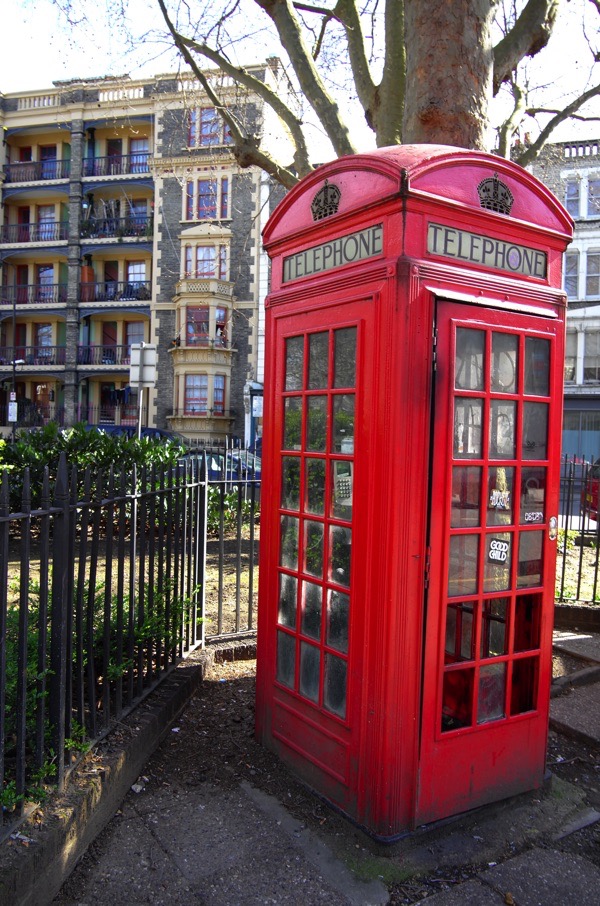
The Inescapable Melancholy Of Phone Boxes

Red phone boxes are a cherished feature of my personal landscape because, in my childhood, we never had a telephone at home and, when I first made a phone call at the age of fifteen, it was from a box. In fact, for the major part of my life, all my calls were made from boxes – thus telephone calls and phone boxes were synonymous for me. I grew up with the understanding that you went out to make a phone call just as you went out to post a letter.
Yet the culture of mobile phones is now so pervasive I was shocked to discover I had hardly noticed as the red telephone boxes have vanished from our streets and those few that remain stand redundant and unused. So I set out with my camera to photograph the last of them, lest they should disappear without anybody noticing. It was a curious and lonely pilgrimage because, whereas they were once on every street, they have now almost all gone and I had to walk miles to find enough specimens to photograph.
Reluctantly, I must reveal that on my pitiful quest in search of phone boxes, I never saw anyone use one though I did witnessed the absurd spectacle of callers standing beside boxes to make calls on their mobiles several times. The door has fallen off the one in Spitalfields, which is perhaps for the best as it has been co-opted into service as a public toilet while the actual public toilet nearby is now a vintage boutique.
Although I must confess I have not used one myself for years, I still appreciate phone boxes as fond locations of emotional memory where I once experienced joy and grief at life-changing news delivered down the line. But like the horse troughs that accompany them on Clerkenwell Green and outside Christ Church, Spitalfields, phone boxes are now vestiges of a time that has passed forever. I imagine children must ask their mothers what these quaint red boxes are for.
The last phone boxes still stand proud in their red livery but like sad clowns they are weeping inside. Along with pumps, milestones, mounting blocks and porters’ rests these redundant pieces of street furniture serve now merely as arcane reminders of a lost age – except that era was the greater part of my life. This is the inescapable melancholy of phone boxes.

Redundant in Whitechapel

Ignored in Whitechapel

Abandoned in Whitechapel

Rejected in Bow

Abused in Spitalfields

Irrelevant in Bethnal Green

Shunned in Bethnal Green

Empty outside York Hall
Desolate in Hackney Rd

Pointless in St John’s Sq

Irrelevant on Clerkenwell Green

Invisible in Smithfield

Forgotten outside St Bartholomew’s Hospital

In service outside St Paul’s as a quaint location for tourist shots
You may also like to take a look at
John Thomas Smith’s Antiquities Of London
For good reason John Thomas Smith acquired the nickname ‘Antiquity Smith’ – while working as Keeper of Drawings at the British Museum, between 1790 & 1800, he produced a large series of etchings recording all the antiquities of London, from which I publish this selection of favourites today

Old houses in the Butcher Row near Clement’s Inn, taken down 30th March 1798 – the right hand corner house is suggested to have been the one in which the Gunpowder Plot was determined and sworn

A Curious Pump – in the yard of the Leathersellers’ Hall, Bishopsgate

Sir Paul Pindar’s Lodge, Half Moon Alley, Bishopsgate

A Curious Gate in Stepney – traditionally called King John’s Gate, it is the oldest house in Stepney

London Stone – supposed to be the Millinarium of the Romans from which they measured distances

The Queen’s Nursery, Golden Lane, Barbican

Pye Corner, Smithfield – this memorialises the Great Fire of 1666 which ended at Pye Corner

Old house in King St, Westminster – traditionally believed to have been a residence of Oliver Cromwell

Lollards’ Prison – a stone staircase leads to a room at the very top of a tower on the north side of Lambeth Palace, known as Lollard’s Tower

Old house on Little Tower Hill

Principal gate of the Priory of St Bartholomew, Smithfield

Savoy Prison – occupied by the army for their deserters and transports

Mr Salmon’s, Fleet St

Gate of St Saviour’s Abbey, Bermondsey

Rectorial House, Newington Butts

Bloody Tower – the bones of the two murdered princes were found within the right hand window

Traitors’ Gate

The Old Fountain in the Minories – taken down 1793

The White Hart, Bishopsgate

The Conduit, Bayswater

Staple’s Inn, Holborn

The Old Manor House, Hackney

Dissenting Meeting House at the entrance to Little St Helen’s, taken down 1799

Remains of Winchester House, Southwark

London Wall in the churchyard of St Giles Cripplegate

London Wall in the churchyard of St Giles’ Cripplegate

Figures of King Lud and his two sons, taken down from Ludgate and now deposited at St Dunstan’s, Fleet St, in the Bone House
Images courtesy Bishopsgate Institute
You may also like to take a look at
John Thomas Smith’s Ancient Topography
John Thomas Smith’s Vagabondiana
London’s Oldest Buns
I am continuing the festive Easter theme today with my story of London’s oldest hot cross buns

London’s oldest buns photographed by London & Middlesex Archaeological Society in the 1940s
A net of Hot Cross Buns hangs above the bar at The Widow’s Son in Bromley by Bow and each year a sailor comes to add another bun to the collection. Yet no Hot Cross Buns are eaten in the ceremony, they are purely for symbolic purposes – left to dry out and gather dust and hang in the net for eternity, London’s oldest buns exist as metaphors to represent the passing years and talismans to bring good luck but, more than this, they tell a story.
On Good Friday, what could be more appropriate to the equivocal nature of the day than an event which involves both celebration of Hot Cross Buns and the remembrance of the departed in a single custom – such is the ceremony of the Widow’s Buns at Bow.
The Widow’s Son was built in 1848 upon the former site of an old widow’s cottage, so the tale goes. When her only son left to be a sailor, she promised to bake him a Hot Cross Bun and keep it for his return. But although he drowned at sea, the widow refused to give up hope, preserving the bun upon his return and making a fresh one each year to add to the collection. This annual tradition has been continued in the pub as a remembrance of the widow and her son, and of the bond between all those on land and sea, with sailors of the Royal Navy coming to place the bun in the net every year.
Behind this custom lies the belief that Hot Cross Buns baked on Good Friday will never decay, reflected in the tradition of nailing a Hot Cross Bun to the wall so that the cross may bring good luck to the household – though what appeals to me about the story of the widow is the notion of baking as an act of faith, incarnating a mother’s hope that her son lives. I interpret the widow’s persistence in making the bun each year as a beautiful gesture, not of self-deception but of longing for wish-fulfilment, manifesting her love for her son. So I especially like the clever image upon the inn sign outside the Widow’s Son, illustrating an apocryphal scene in the story when the son returns from the sea many years later to discover a huge net of buns hanging behind the door, demonstrating that his mother always expected him back.
When I arrived at the Widow’s Son, I had the good fortune to meet Frederick Beckett who first came here for the ceremony in 1958 when his brother Alan placed the Hot Cross Bun in the net, and he had the treasured photo in his hand to show me. Frederick moved out from Bow to Dagenham fifteen years ago, but he still comes back each year to visit the Widow’s Son, one of many in this community and further afield who delight to converge here on Good Friday for old times’ sake. Already, there was a tangible sense of anticipation, with spirits uplifted by the sunshine and the flags hung outside.
The landlady proudly showed me the handsome fresh Hot Cross Bun, baked by Mr Bunn of Mr Bunn’s Bakery in Chadwell Heath who always makes the special bun each year -” fabulous buns!”declared Kathy, almost succumbing to a swoon, as he she held up her newest sweetest darling that would shortly join its fellows in the net over the bar. There were many more ancient buns, she explained, until a fire destroyed most of them fifteen years ago, and those burnt ones in the net today are merely those few which were salvaged by the firemen from the wreckage of the pub. Remarkably, having opened their hearts to the emotional poetry of Hot Cross Buns, at the Widow’s Son they even cherish those cinders which the rest of the world would consign to a bin.
The effect of several hours drinking beer upon a pub full of sailors and thirsty locals became apparent in the pervasive atmosphere of collective euphoria, heightened by a soundtrack of pounding rock, and, in the thick of it, I was delighted to meet my old pal Lenny Hamilton, the jewel thief. “I’m not here for the buns, I’m here for the bums!” he confided to me with a sip of his Corvoisier and lemonade, making a lewd gesture and breaking in to a wide grin of salacious enjoyment as various Bow belles, in off-the-shoulder dresses with flowing locks and wearing festive corsages, came over enthusiastically to shower this legendary rascal with kisses.
I stood beside Lenny as three o’ clock approached, enjoying the high spirits as the sailors gathered in front of the bar. The landlord handed over the Hot Cross Bun to widespread applause and the sailors lifted up their smallest recruit. Then, with a mighty cheer from the crowd and multiple camera flashes, the recruit placed the bun in the net. Once this heroic task was accomplished, and the landlady had removed the tinfoil covers from the dishes of food laid out upon the billiard table, all the elements were in place for a knees-up to last the rest of the day. As they like to say in Bromley by Bow, it was “Another year, another Good Friday, another bun.”

Baked at Mr Bunn’s Bakery in Chadwell Heath

Peter Gracey, Nick Edelshain and Roddy Urquhart raise a pint to the Widow’s Buns.

Tony Scott and Debbie Willis of HMS President with Frederick Beckett holding the photograph of his brother placing the bun in the net in 1958.

Alan Beckett places the bun on Good Friday, 4th April 1958.

3 pm, Good Friday, 22nd April 2011.

My pal Lenny Hamilton, the jewel thief, at home at The Widow’s Son


A Widow’s Son of Bromley by Bow
by Harold Adshead
A widow had an only son, The sea was his concern, His parting wish an Easter Bun Be kept for his return. But when it came to Eastertide No sailor came her way To claim the bun she set aside Against the happy day. They say the ship was lost at sea, The son came home no more But still with humble piety The widow kept her store. So year by year a humble bun Was charm against despair, A loving task that once began Became her livelong care. The Widow’s Son is now an inn That stands upon the site And signifies its origin Each year by Easter rite The buns hang up for all to see, A blackened mass above, A truly strange epitome Of patient mother love.
Archive photograph of buns courtesy Bishopsgate Institute
You may also like to read about


