
A Petition Against The Goodsyard Towers
Just recently, Hammerson & Ballymore, who want to build the monster development on the Bishopsgate Goodsyard that threatens to blight the neighbourhood for generations to come, have submitted their revised proposals which make only token response to concerns about the overblown height of the towers, the pitiful amount of social housing and lack of any real commitment to provision for smaller businesses. In response, More Light More Power have launched a petition against the scheme which has already gained a thousand signatures and you can sign it by clicking here.


You may also like to read about
Objecting to the Goodsyard Proposals
At St Pancras Old Churchyard

The Hardy Tree
As I arrived at Old St Pancras Churchyard yesterday, the Verger was sweeping leaves from the steps and she informed me there was a wedding taking place inside the church. Yet I was more than happy to explore this most ancient of central London churchyards for an hour while the nuptials were in progress.
The churchyard itself is upon a raised mound that is the result of all the hundreds of thousands of burials upon this ground which is claimed to be one of the earliest sites of Christian worship in London, recorded by the Maximilian Mission as already established by the year 324. Such is the proximity of St Pancras Station, you can hear the announcements from the platforms even as you wander among the tombs, yet an age-old atmosphere of tranquillity prevails here that cannot be dispelled by the chaos and cacophony of contemporary King’s Cross and St Pancras.
However, the railway has encroached upon the churchyard increasingly over the years and, in the eighteen-sixties, architect Arthur Blomfield, employed Thomas Hardy as his deputy, responsible for exhumations of the dead. Tombstones were arranged around an ash tree which has absorbed some of them into its trunk over time and acquired the name ‘The Hardy Tree,’ commemorating this unlikely employment for the young novelist whose subsequent literary works express such an inescapable morbidity.
Once the bride and groom emerged from the church door, the Verger ushered me in through the back and I was delighted by the intimate quality of the church interior, studded with some impressive old monuments. The Verger relished telling the tale of St Pancras, beheaded by the Emperor Diocletian in Rome in 304 at the age of fourteen for refusing to renounce his faith.
When the cloth had been removed from the altar after the ceremony, I was able to view the small sixth century altar stone, marked with five crosses of curious design, of which the only other examples are upon the tomb of Eithne, mother of St Columba, on the Hebridean island of Luing, dated to 567. A modest piece of Kentish rag stone, there is a legend this once served as an altar for St Augustine.
“We try to fall down every two hundred years,” explained the Verger breezily, drawing my attention to the alarming cracks in the wall and outlining the elaborate history of collapse and rebuilding that has produced the appealing architectural palimpsest you discover today.
Outside in the June sunshine, the newly-married couple were getting their wedding photographs taken, while rough sleepers slumbered among the graves just as the long-gone rested beneath the grass. A text carved nearby the entrance of the church reads “And I am here in a place beyond desire and fear,” expressing the quality of this mysterious enclave in the heart of London perfectly.


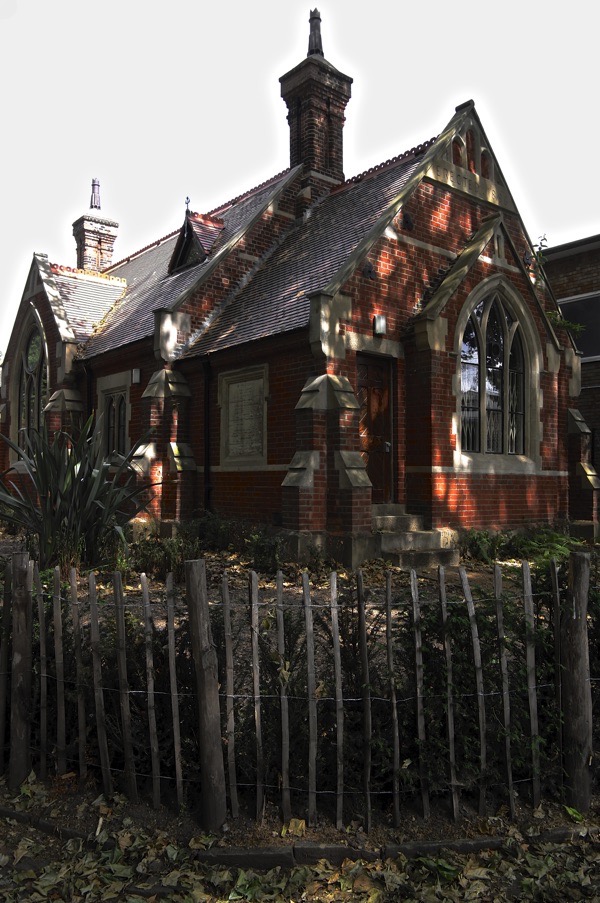
The Vestry


St Pancras Coroners

Sir John Soane’s tomb of 1837 inspired Giles Gilbert Scott’s design for the telephone box


Baroness Burdett Coutts was responsible for the vast gothic memorial sundial


Mary Wollstonecraft, born in Spitalfields and buried in Bournemouth, but commemorated here with her husband William Godwin

The grave of Charles Dickens’ school teacher, William Jones, believed to be the inspiration for the ferocious Mr Creakle in David Copperfield. “By far the most ignorant man I have ever had the pleasure to know … one of the worst tempered men perhaps that ever lived.”


Norman stonework uncovered in the renovation of 1848


The seventh century altar stone is incised with crosses of Celtic design


“O passenger, pray list and catch
Our sighs and piteous groans,
Half stifled in this jumbled patch
Of wrenched memorial stones!”
“We late-lamented, resting here,
Are mixed to human jam,
And each to each exclaims in fear,
‘I know not which I am!’”
Thomas Hardy, The Levelled Churchyard (1882)
You may also like to read about
Visit Norton Folgate’s Victorian Warehouses
This weekend, Norton Folgate hosts Best of Britannia, a pop-up department store showcasing the best of British manufacturing and permitting the opportunity to visit the wonderful nineteenth century warehouse interiors that British Land want to destroy.
This event illustrates the flexibility of the existing spaces and proposes one possible use for the buildings if they can escape demolition. Tower Hamlets Planning Committee vote on British Land’s proposal to obliterate Norton Folgate under a hideous corporate plaza on July 21st, so there is still time to object – and you have until 8pm today and 6pm this Sunday to take a look for yourself at what could be lost.
In 2010, Photographer Rachael Marshall took these atmospheric pictures of the buildings which were the headquarters of Nicholls & Clarke from 1875 until quite recently, supplying hardware and ironmongery of all kinds.


Photographs copyright © Rachael Marshall.


Follow the Campaign at facebook/savenortonfolgate
Follow Spitalfields Trust on twitter @SpitalfieldsT
You may also like to read about
Dan Cruikshank in Norton Folgate
Restoration At Wilton’s Music Hall
Yesterday, I spent the morning exploring Wilton’s Music Hall and visiting all the secret corners to record the progress of the major restoration project which aims to preserve as much of the original fabric and patina as possible, whilst also securing the building and delivering the requirements of a working theatre to ensure the long-term future of this magnificently atmospheric survival.

Where Champagne Charlie once played


Marc Almond lingers in the foyer


In a secret workshop in the basement


The space between the former terrace of houses and the music hall that was built behind them


Old lamp stored in the cellar

Nineteenth century boiler beneath the auditorium

In the Mahogany Bar


Visit Wilton’s Music Hall, Grace’s Alley, E1 8JB
You may also like to read about
Nik Strangelove’s Brick Lane
Nik Strangelove‘s father’s family originated from Bow but Nik first came to Brick Lane to take photographs in 1993, when he was studying photography, as picture editor of The London Student. In 1997, Nik returned under commission to photograph Brick Lane for the Express on Sunday but these pictures were never published and are revealed for the first time here today.


Photographs copyright © Nik Strangelove
You might also like to to look at
Human Remains At Christ Church
Dr Margaret Clegg Keeper of Human Remains at the Natural History Museum will be giving a lecture at Christ Church Spitalfields on Thursday July 2nd at 7pm, talking about exhumations from the crypt thirty years go and subsequent research upon these bones

“They were once living, breathing people – they are you.”
In Spitalfields, people often talk of the human remains that were removed from the crypt – nearly a thousand bodies that were once packed in tight during the eighteenth century, safe from resurrectionists and on their way to eternal bliss.
During the nineteen eighties, they were exhumed and transferred to the Natural History Museum where they rest today under the supervision of Dr Margaret Clegg, Head of the Human Remains Unit, who guards them both with loving attention and scholarly rigour, unravelling the stories that these long-ago residents of Spitalfields have to tell us about the quality of their lives and the nature of the human species.
“From the very first lecture I attended on the subject as an undergraduate, I became fascinated by what human remains can tell us about ourselves,” Dr Clegg admitted to me enthusiastically, “You can’t help but feel some kind of relationship when you are working with them. They were once living, breathing people – they are you.”
Dr Clegg led me through the vast cathedral-like museum and we negotiated the swarming mass of humanity that crowded the galleries on that frosty morning, until we entered a private door into the dusty netherworld where the lights were dimmer and the atmosphere was calm. Next week, Dr Clegg is making the trip to Spitalfields to deliver a report on the human remains – a venerable message home from these ex-residents in the form of a lecture at Christ Church – and thus our brief conversation served as a modest preamble to set the scene for this hotly-anticipated event.
“Dr Theya Mollison did the original excavation of the remains in the nineteen-eighties. There were more than nine hundred and for about half we know their age, sex, and when they were born and when they died, from the coffin plates. After they were removed, the remains were brought here to the Natural History Museum for longer-term analysis and study of the effects of occupation and the types of diseases they suffered. We had a large amount of information and could tell who was related to who. We could also tell who died in childbirth, and we have juveniles so we got information on childhood mortality and the funerary practices for children and babies, for example.
We have a special store for human remains at the museum, where each individual is stored in a separate box – it’s primarily bones but some have fingernails and hair. Any bodies that had been preserved were cremated when they were exhumed. The museum applied for a faculty from the Diocese of London to store the bones, the remains are not part of our permanent collection. The first faculty was for ten years and over time a second and third faculty were granted, but this will be the final one during which a decision will be made about the final disposition of the bones. During these years, the bones have been studied intensively. They are quite rare, there are very few such collections in which we know the age and sex of so many. They are probably our most visited and most researched collection. We have our own internal research and visiting researchers come from all over the world – for a wide variety of research purposes, including important work in forensics and evolutionary studies.
I am by training a biological anthropologist, and I am interested in the study of human archaeological remains from the perspective of how they grew and developed and what that can tell us about them.
In Spitalfields, you can compare families of the same age – one that ages quickly and one that ages slowly, which tells us something about the variables when we try to calibrate the date of remains at other sites. You can’t always tell what they did but you can tell, for example, that they used their upper body or that they developed muscles in their arms or legs as a direct result of their occupation. My dad was a printer and when he started out he used a hand press and developed a muscle in his arm as a consequence of using it. He’s seventy-nine and it’s still there. In those days, people started work at twelve or thirteen while the muscles were still developing and these traits quickly became established based upon their occupation. They were the ordinary working people of eighteenth century Spitalfields.
We get half a dozen emails a year from families who want to know if their ancestor who was buried in Christ Church is in the collection, but often I can’t help because they were buried in the churchyard or another part of the church. Occasionally, relatives ask if they can come and see them.”

Bonnet collected during excavations at Christ Church.

Shroud collected during excavations at Christ Church.

Cotton winding sheet collected during excavations at Christ Church.

Gold lower denture formed from a sheet of gold which was cut and folded around the lower molars.

Medicine bottle found in a child’s coffin during excavations at Christ Church.

Archaeological excavations in the crypt of Christ Church, Spitalfields, London, 1984-1986.
Excavation images © Natural History Museum
Portrait of Dr Clegg © Sarah Ainslie
Click here to book tickets for Dr Margaret Clegg’s lecture at Christ Church on 2nd July
You may also like to read about
The Huguenot Map Of Spitalfields Unveiled
Last week, the Huguenots came from far and wide to converge at Townhouse, 5 Fournier St, to see the completed Huguenot Map of Spitalfields drawn by Adam Dant.
Brainchild of Fiona Atkins, proprietor of Townhouse, the project has seen more than three hundred and fifty descendants of Huguenots in Spitalfields submit the addresses of their refugee ancestors to compose a street map with all the names in place. The unveiling was undertaken by Clifford Atkins & Stanley Rondeau whose Huguenot forebears lived in Spitalfields and likely knew each other three hundred years ago.


Click on the map to enlarge

Gathering of just a few of the current descendants of the Huguenots of Spitalfields featured on the map

Stanley Rondeau points out his ancestor Jean Rondeau, who came to Spitalfields in 1685, to Adam Dant
Photographs copyright © Jeremy Freedman
Copies of the limited edition of The Huguenot Map are available from Townhouse
Click for details of the HUGUENOT SUMMER festival which continues until September
You can view The Huguenot Map at Townhouse for the next few weeks
You may also like to read about


