
At Cable St Community Gardens
In September 2003, photographer Chris Kelly was invited to the open day of Cable Street Community Gardens and the result was a year-long project which culminated in an exhibition and a book. Fifty-two plot holders took part, aged from seven to eighty and originating from a dozen different countries, yet all unified by a love of gardening and the need for a haven where they could cultivate flowers, grow vegetables, chat to neighbours or enjoy solitude. Today, it is my delight to publish a selection of Chris Kelly’s beautiful portraits of the Cable St Gardeners. “Some of the old faces are no longer there,” Chris told me,“but the gardens thrive, new people have joined and it is still a magical place.”

Bill Wren – I was born in Wapping and I moved to Shadwell nine years ago. I’ve had the plot for about fifteen years. We never had a garden when I was young. The nearest I came to gardening was picking hops in Kent. Later I had a friend in Burgess Hill and I used to grow things in her garden. That’s where the greenhouse came from, I put it on the roof of the car and brought it up from Sussex. I’ve built a shed here and a pond. There are plenty of frogs and newts, and I’ve planted a bank next to the road. It’s a wildlife haven now.

Jane Sill – I was born in Liverpool. My grandfather had an allotment in County Durham and my father was a very good gardener. I helped with weeding and cultivated sunflowers. I was living in Cable Street in the late seventies in a top floor flat with no balcony. One day I went to a community festival and Friends of the Earth were offering plots here. I was given one in 1980 and I knew straight away how important it was to establish ourselves as an organisation. We’ve had a two year waiting list since 1981. At one time I was working in a Job Centre and people used to come in and put their names down for a plot.

Mohammed Rahmat Ali Pathni – I have always been a gardener. I started on my father’s land in Bangladesh and when I came to live in Birmingham in 1978 I had a garden behind the back yard. I have lived in Wapping since 1983 and started gardening in Cable Street ten years ago. I’m enjoying myself and it helps my frozen shoulder. I taught my children to garden and my wife often works here too. Many gardeners provide food for other people and I regularly give vegetables to friends. I also write poetry which is printed in the Eurobangla News Weekly, and I am a member of a writers’ group.

Alison Cochran – I moved to Shadwell five years ago because of the allotments and I live just across the road. I noticed them when I was living in Bethnal Green. I was born in Salisbury on a hill fort. I was keen on gardening when I was a child but when I came here I hadn’t gardened for years. I knew I wanted lots of flowers, but now I also grow salad vegetables and leeks, tomatoes, carrots and radishes. The soil is wonderful, everything seems to thrive here. I’ve used Victorian bricks for the paths because I wanted my plot to be in keeping with nearby housing.

Monir Uddin – I’ve lived in the borough for twenty years and I’ve gardened here for eight or nine years. The plot was completely wild at first. I had to uproot everything and it took about two years to get the soil right. I used to grow about sixty different plants and vegetables, including huge pumpkins. I love experimenting with plants and growing them for their medicinal properties. I’m a photographer and I also wanted to produce plants to photograph. I’ve done many different types of work including weddings and portraits. I was involved in the Bollywood film industry, I’ve photographed celebrities and at one time I had a restaurant.

Agatha Athanaze – I’ve been gardening here for twelve years. I was born in Dominica and came to Tower Hamlets in 1961. I’ve done different jobs. I’ve been a machinist and a cleaner. I live in Wapping now. I had a garden in Dominica so I did have some experience. The vegetables came first – I grow cabbages, onions, spring onions, runner beans, carrots, tomatoes, rhubarb and kidney beans. I like flowers too. I’ve ordered roses from Holland and from Spalding. I just like to come here and grow things. There are two benches but I haven’t time to sit down.

John Kelly – I was born in Cork City and I wasn’t a gardener. I came to this country in 1943 to work in the construction industry and started gardening as a hobby and to feed the family. I’ve had the plot here for seventeen years. I didn’t know much but I picked it up as I went along. I’ve always grown vegetables, never flowers. I can’t spend too much time here because I have to look after my wife and I have health problems too. I hate the sight of weeds but I don’t throw them out. I leave them on the ground to let them rot and they form green manure.

Manda Helal – I’m from Hertfordshire and I’ve lived in Tower Hamlets for twenty-six years. I’ve always been keen on gardening. We had a big garden when I was a child and I was given a section of my own. I’ve had my plot here for three years. My flat in Whitechapel is small and dark, so it’s wonderful to come here. The wheels are a frame for pumpkins. Squashes and pumpkins are so versatile. I grow artichokes and rocket, garlic, kale, cabbage, cauliflower, spinach and climbing purple beans. I’ve taught pottery in the borough for years and more recently I became a compost educator for the Women’s Environmental Network.

John Stokes – I’ve been gardening at Cable Street since I retired six years ago. I asked one of the nuns in the convent across the road and she said the allotments were for local people. I had no experience but I was brought up on a farm and I found I had an instinct for gardening. I came over from Ireland fifty years ago. I worked for London Transport for thirty-six years and missed only nine days. Now I’m at the gardens almost every day in summer and twice a week in winter. I grow vegetables for myself and my cousin and an aunt.

Anna Gaudion – I was born in Guernsey. I’ve lived in Stepney for the last ten years and I work as a midwife in Peckham. I was brought up in the country and I love being outside, hearing birds and growing things. I like allotments too, even just seeing them from trains. I’ve had this plot for three years now. My shed is made from a packing case used to take an object abroad from the British Museum where I was a curator. I enjoy cultivating flowers so I planted a nature garden. I share my plot with Claire who grows vegetables. Mine is the higgledy-piggledy part.

Andy Pickin – I grew up in Finchley and we moved to Shadwell twenty years ago. We spent eight years in Huntingdon when the firm moved there but most of us came back to London. I wanted an allotment because I’d always had great fun sharing one with my dad. I’ve had the plot for fourteen years. I grew vegetables because money was tight and the first year’s crop was fantastic. Our thirteen children all liked coming here when they were young. The older ones grow their own vegetables now. My wife likes the gardens too, she knows I sometimes come here to get away from the telly or the kids arguing.

Robin & Maria Albert – Robin was in catering before becoming a gardener eight years ago. He was born in Mile End and he’s lived in London all his life. I was born in London too and brought up in Margate. My family is always trying to persuade us to move out to Kent but we like living in Bethnal Green. We grow flowers at home but we wanted somewhere separate for vegetables. The fact that everything is organic is part of the appeal. Producing your own pure food is very satisfying. We have some flowers too and a pond that attracts frogs. I can’t do so much now but I still find gardening very therapeutic.

Ray Newton – I’ve always grown things. I share this plot with Agatha. We grow about a dozen different types of vegetables. It’s all organic. We don’t use pesticides. I retired last year from teaching business studies at Tower Hamlets College. Before that I worked in industry and at one time I was manager of a betting shop. I studied for O and A levels at evening classes and then took a degree course. I became a teacher and taught for twenty-five years. My other interests are local history and football. I’m the secretary of the History of Wapping Trust and a lifelong Millwall supporter.

Will Daly – I was a founder member of the gardens. I was in a nearby pub when Jane came in with another Irish chap and they persuaded me to have a plot. I’ve been in the borough for twenty-seven years. I was born in Ireland and I made a living salmon fishing on a tributary of the Shannon. I came to this country in 1951 and did building work. One of my brothers came over too but he missed the river and went home after a while. I still go back to Ireland but only for weddings and funerals. I can’t do very much gardening now but I love the peace of it.

Raymond Hussey – This is my second year. I live in one of the flats nearby. I’m growing vegetables and learning as I go along. What I’m most proud of is the brussels. And my runner beans were unbelievable. I don’t know whether it’s the soil or me talking to them. Weeds are a problem. Sometimes I’d like to use gallons of weedkiller but we’re not allowed. So I come in and have a chat. I call them everything but weeds. I was born on one of the estates off Brick Lane. I’ve done lots of things including acting. In my last job I was a dustman but I got trapped by the lorry. I still can’t do heavy work so the plot’s a bit of a mess but it’s my little world and I love it.

Robin, Yvonne and Katie Guess – We live at the other end of Cable Street. There’s a small courtyard garden but Yvonne and I were used to growing fruit and vegetables before we lived in London. We love soft fruit, we had a huge crop last year. We grow several vegetables and Yvonne has planted a mixed flower and herb bed. Our daughter Katie likes planting and picking but not weeding. We’re both from the south-east. I’ve been in the East End since 1968 and I worked on the Isle of Dogs as a quality control chemist. Now I’m with the Music Alliance in Oxford Street dealing with composer copyright.

Carl Vella – I came to Tower Hamlets from Malta in 1950 and worked for the NHS, mostly as a fitter and stoker. I’m retired and since I took over the plot four years ago I like to come here every day. I grow mostly vegetables – potatoes and cabbages. I’m on my own now so I give a lot of produce away to an elderly neighbour. I live in the flats nearby and there’s no garden. Coming here stops me getting fed up. I take my dog for a walk, go to the bookie’s and come here. I’d like to bring Pedro more often but he won’t stay in one place.

Sister Elizabeth O’Connor – Our Order has been part of the local community since 1859 and I came to the convent in 1949. After the houses here were demolished the site became a dumping ground until Friends of the Earth initiated the gardens project. When I retired from teaching in 1991, I started gardening here. All the sisters appreciate home grown vegetables and having fresh flowers for the chapel. As a child in County Clare I enjoyed helping my father in our kitchen garden. Apart from the practical use, the gardens are a great place for breaking down barriers and it’s especially good that women can feel safe here on their own.

Graham Kenlin – I was born in Bermuda. My father was a navy chef and had a land-based job working for an admiral. We came back to England when I was four and I grew up in Hackney. I’ve lived in Wapping for thirty-eight years and I’ve had a plot here for about fifteen years. My family have always had allotments. It’s very relaxing but I’m a lazy gardener. I’m an archaeologist and I work abroad sometimes so the plot gets neglected. I’ve had the odd good year but normally I do just enough to stay credible. I like growing large weeds, anything that’s interesting.

Sheila McQuaid – I came across the gardens at an open day. It was such an oasis of green and calm that I put my name down on the spot. Gardening is in the family. My parents were horticulturalists and I grew plants as a child but I’ve only become really interested in the last ten years. We decided on fruit because it’s expensive, especially if you want organic, and it doesn’t need constant attention. I was born and brought up in Cornwall and I’ve lived in Tower Hamlets for twenty-five years. I’m a housing adviser for Camden Council and I work for Stitches in Time on community textile projects.

Anna Girvan and John Griemsman – We’ve had the plot for about ten years. We’re in a 10th floor flat in Limehouse and we wanted somewhere to spend time outside and to grow vegetables. I’m from Belfast and I’ve lived in Limehouse for twenty-five years. John is from Wisconsin and he’s been here for almost thirty years. I work as a librarian in the West End and John is a special needs assistant. I’m more pleased by the flowers in the end than the vegetables. My favourite is a dahlia that Annemarie gave me. It’s a beautiful purple pink and it flowers for such a long time.

Mary Laurencin – I’ve been gardening here for about ten years. A cousin asked me to help then passed the plot on to me. I’d never gardened before but I was suffering from depression and sometimes it was the only place I felt comfortable. I learned to garden mainly by watching television. I’m from St Lucia and I’ve lived in Tower Hamlets for forty years. I came to England in 1962 and at one time I did four jobs every day – I worked in a cafe, had a job at Sainsbury’s, I was a machinist and I did some cleaning. I grow vegetables here. I love flowers but you can’t eat flowers.

Conrad, Donald and James Korek – I garden here with my wife Catherine and our two younger sons, Donald, ten, and James, six. Our eldest boy isn’t interested now. We’ve lived in the borough for fourteen years and started gardening at Cable Street about a year after we arrived. We have a flat nearby and we like to spend time outdoors. I was born in North London and Catherine was brought up on a farm in Scotland, so she has more experience of growing food. James likes weeding and he supports Arsenal. Donald is a West Ham supporter and he’s good at picking up stones and chatting to the other gardeners.

Annemarie Cooper – I’m a supply teacher and I write poetry. I’ve had a plot since 1986. I didn’t know anything about gardening but I love nature and being close to the earth. My dad was a very good vegetable gardener. He and my grandfather shared a plot and they were always arguing about it. I’ve lived in Tower Hamlets for twenty years. When I started here I thought I wanted to grow flowers then I got into vegetables. I love growing sweet peas and big flashy dahlias. Really I like anything that deigns to grow. I enjoy growing tomatoes and digging up potatoes.

Emir Hasham – I’m on the waiting list and until I have a plot I’ll be working on the communal area. My work is computer based graphics and special effects for television and what I like about gardening is the real honest labour and getting my hands dirty. It will be great to grow my own fruit and vegetables My parents used to garden and I helped as a child. I was born in Sheffield. My mum is a Yorkshire lass and my dad is mainly Asian. I’ve lived in Tower Hamlets for twelve years now. I haven’t a garden at home and there’s only so much you can grow on a balcony.

Anwara Begum – I was born in Bangladesh. My father was a businessman and had some land. My seven sisters and I helped mother with the farming. We never had to buy food from the market and we sold bamboo and bananas. When I was sixteen I came to live in Tower Hamlets and ten years ago I started gardening at Cable Street. The four children helped when they were younger but now they are busy with other things. They have to study and help with the housework. I’m studying too – IT, Childcare, Maths and English. And I’m taking Bengali GCSE as well as doing voluntary work in a nursery school.

Joseph Micallef – I first came to the borough from Malta in 1955 and settled here permanently in 1961. I’ve had the plot for ten years. I didn’t know anything about gardening but my father had a farm in Malta so I knew something about agriculture. The vegetables came first and my wife likes the flowers, but I just enjoy seeing things grow and passing the time here. A lot of the produce is given away. You do tend to get too much at once. People look at the plot and think I’m an expert but I’m not, I just plant things and they grow.
Photographs copyright © Chris Kelly
To learn more about Cable Street Community Gardens or buy copies of the Cable St Gardeners book, contact Jane Sill (janesill@aol.com) or visit www.cablestreetcommunitygardens.co.uk
You may also like to take a look at these other photographs by Chris Kelly
Chris Kelly’s Columbia School Portraits 1996
The Cats of Spitalfields (Part One)
At St Michael & All Angels, Shoreditch

You walk through the door and it as if you walked into the mansion of Charles Foster Kane – such is the overwhelming collection of unlikely paraphernalia that you encounter when you visit St Michael & All Angel’s, Shoreditch.
Deconsecrated long ago, the handsome High Victorian Gothic church of 1865, designed by James Brooks, has been a showroom for Westland architectural salvage since 1977 and the eclectic display of statues, fireplaces and chandeliers in this setting is a breathtaking spectacle to behold. In his ‘Buildings of England,’ Sir Niklaus Pevsner wrote, “The whole is an eminently picturesque fantasy and it is a great shame that it has fallen into such shocking neglect,” yet today it has found an alternative role that proposes a strange complement to its fanciful design.
The surrealism of multiple architectural elements from different eras arranged in random combination within a disorienting labyrinth of rooms on two floors within the church is as intoxicating as any film by Jean Cocteau. You feel you are walking through chambers in the unconscious mind of some deranged architect or a netherworld of architectural keepsakes assembled by an acquisitive time-traveller.


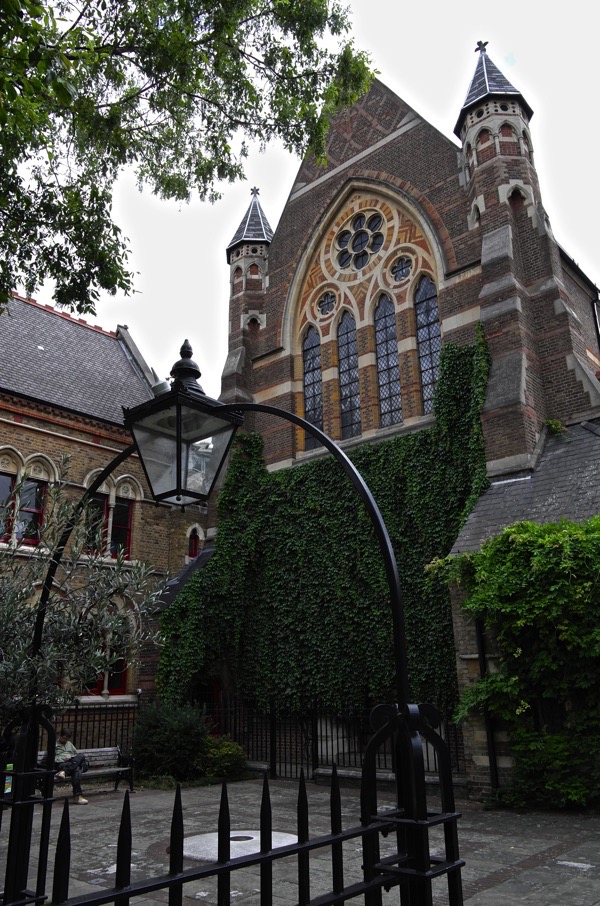
The church and adjoining clergy house

St Michael & All Angels, Leonard St, Shoreditch, 1865

In a strange precursor of its current use, this engraving of 1865 shows the makeshift church built within the structure while it was under construction.
Westland, St Michael & All Angels’ Church, Leonard St, EC2A 4QX
You may also like to read about
The Huguenots of Rochester
In celebration of the opening of the new Huguenot Museum in Rochester, I publish these portraits by Contributing Photographer Lucinda Douglas-Menzies (who is of Huguenot descent) taken at the French Hospital there which has offered accommodation for Huguenots since 1718.

La Providence, Rochester
“An interesting community of Huguenot refugees had its centre in Spitalfields. Their forebears had come over from France in the years following the Revocation of the Edict of Nantes in 1685. They had become naturalized in England yet their descendants still formed a foreign community – a closed society with the intelligence that accompanies the easy use of two languages, along with the piety of a persecuted race and with the frugal wealth of Frenchmen who are, or have been, dependent upon their own exertions for a living.” – from ‘Time and Chance. The Story of Arthur Evans and his forebears’ by Joan Evans, Lucinda Douglas-Menzies’ great-great-aunt.

Jane Brown
“I am descended from Rev Francois Guillaume Durand who married Anne de Brueys de Fontcourverte. He was captured by soldiers and imprisoned in the castle in Sommieres with other pastors, but he managed to escape and lived in the woods where his parishioners brought him food and clothing. Eventually he left to Savoy and helped raise two Huguenot regiments to fight for William III, and he became the first pastor of the Walloon Church in Nijmegen – but his wife, Anne, was captured and put in a convent and died there, and his three children were seized by Jesuits and brought up as Roman Catholic. He made a bargain with God that if he got out of France alive, he’d devote his sons to the church and subsequently his grandson became a clergymen. Eventually, he came to England and was the first pastor at the Dutch Church in Norwich and then in Canterbury.
It was my grandmother, Helen Durand who was the Huguenot and I was brought up on it. I thought I had better put my name down for the French Hospital, so I sent an enquiry and got a reply back within half an hour saying we’ve got a flat for you. I was a Public Relations practitioner in race relations for a long time and I learnt that knowing your roots is quite important. My husband was from Jamaica and was very proud of his background. I teach journalism and publishing, and I edit the quarterly magazine ‘Rotary in London.'”

Jack Minett & Poppy
“I’m seventy-five, I haven’t got my teeth in and I’m not going to put them in because I am an old fellow. I’ve always known I was a Huguenot, but I didn’t know what it meant. My Huguenot ancestry was researched by my aunt – I believe there were two brothers who came over as refugees before all the chopping went on. One went to Gloucestershire and became a farmer, and the other was a doctor who set up a clinic in Camberwell.
My grandfather was a butcher in Forest Hill and I was born in Peckham. I’ve been very poorly and they sent me home to die – that was seventeen years ago when I came here to the Hospital with my wife Maureen, and I am still alive! I have two sons and a grandson, so the name continues. The founder of the Huguenot Society was a Minett and Charles Dickens has a Dr Manet in ‘Tale of Two Cities.’ And you’ve got to realise that Poppy, my little dog, is now a Huguenot too.”

Doreen Chaundy
“Chaundy is the family name and it goes back twelve generations to a small village called Chauny, north of Paris – a little before the Huguenots. They are recorded in the parish records of Ascott-under-Wychwood in 1548, but my branch ends with me because I have no children and my brother died in the war. He was shot down in the North Sea when he was nineteen. I have no relations. I am eighty-six years old and I have been here twenty-four years.
I was a secretary and I passed my insurance exams but I was a bit early – I realise I was forty years too soon when I see what girls are able to do now, in those days we were just secretaries. I was born in Glasgow but my father was a Londoner and, when I bought a house in Wembley in my early thirties, both my parents came to join me and they stayed for thirty years. Both of them lived into their nineties and my father lived to be ninety-eight. When I he died, I applied to come and live here. I have had two brain operations and survived them. I always say I am a refugee from the Glasgow rain.”

Jenny Turner
“My great-grandmother was Eleanor Grimmo of Spitalfields. Her great-grandfather was Peter Grimmo, a weaver, who in 1839 was living at 4 Fort St, Old Artillery Ground, Spitalfields. By January 1869, his son Peter was living at 10, Turville St, Church St (now Redchurch St), Shoreditch, when he married Mary Fulseer of Bethnal Green – and in July of that year, Mary gave birth to my great-grandmother Eleanor. She told me that her father Peter Grimmo was a seal fur dyer who invented the Silver Fox Fur. My grandmother spoke French and German and was an interpreter in the First World War. We weren’t a highly educated family, so we were amazed at this but her mother was also fluent in French and her grandparents were wholly French, so it all ties in.
I’m sixty-nine and I’m on my own these days. I was a primary school teacher for forty-two years and I retired four years ago. I’ve always known we had French relatives, but it has only been in the past ten years that my daughter has been researching the family ancestry and that’s how we found out about this place.”

Michael Oblein
“My ancestor Noe Oblein came to London in 1753. He was was weaver in Shoreditch and he married Marie Dupre at St Matthew’s Bethnal Green in 1774. My father did the family research and everyone called Oblein is a relative. There are about five hundred alive. We are in contact with others all over the world, in Australia and in Rochester in America – where they have reunions every year. My father went to one and I’d like to go.
I was firefighter in Deptford for thirteen years. We came here last August, it’s brilliant – they look after you so well. I was born in Deptford and lived in Plumstead and Chatham. We sold our house and we always said how nice it was here. I shall never forget how I felt when I first walked through the gates. On Friday and Saturday nights, it’s a riot out in the High St but it’s always peaceful in here.”

Christine Cordier
“It was my husband, Ray, that wanted to come here – he was the one with the Huguenot connection. I was a teacher and he was a dental hygienist, one of the first men to do that. We met in church and we were married in Gillingham United Reform Church in 1970.
I came here in 2007, we had planned to come here together. Five years earlier, we had moved to North Lincolnshire because we wanted to live in a small village and we had a lovely home. Then we decided it was time we put our names down here, but unfortunately he developed a brain tumour as we were in the process of moving and he died so I came here on my own. It can be lonely, but I spend a lot of time at Rochester Cathedral, working in the shop and the welcome desk, so I have got to know a lot of people that way.”

Nigel Marchment
“My Huguenot ancestor was Joseph Poitier who came from Lot to Bethnal Green in 1749, I think he was a carpenter. I’ve always known this since I was small because my father always said we were French, but he couldn’t remember how. So after I retired and I lost my wife, I decided to find out and I built up the family tree. Joseph’s son, George Poitier, was baptised in St Leonard’s, Shoreditch, in 1768.
During the war, when was five, I was evacuated to my grandparents in Eastbourne and the Huguenot Society paid for my education until I left school in Forest Gate at aged fifteen. I studied book-keeping and shorthand typing but never touched it from the day I left school. I started off as an office boy at Arnett & Co (cargo superintendents at Fenchurch St in the City) from 1949-50, then I became accounts clerk at Reliance Telephones in WC2 from 1950-56, I worked for the Cleveland Petroleum Co in Euston from 1956-58, then I was a despatch clerk at Silcock & Colling Ltd, Ford’s delivery agent in Dagenham from 1958-72 and finally I moved to Basildon where I worked for Standard telephone & cables from 1973-1977 and Morse Controls Ltd from 1977 -1997. I took early retirement to care for my wife until she passed away on April 3rd 2001 and then I had heart attack on the morning of April 4th. They said it was caused by stress. I came to live here in the French Hospital in August 2008.”

Ann Blyth
“The Huguenot was my grandfather, his name was Ravine. The family were based in Canterbury around the Via St Gregory. I’ve only traced them back as far as 1721 but when I pack up my job, I’m going to find out more. It wasn’t until my father died and my brother was chopping wood and breaking coal in Felstead in Essex and I was trying to bring my mother here, that I got to know the Steward. He said, ‘You’ve got to be a Huguenot,’ so I said, ‘We are!’
I was in my forties and she was in her seventies, and she moved in here in 1983 and she was here for fourteen and a half years. I came in August 2005. I teach T’ai Chi and I do a weekly session with ten regular students. One is ninety-seven and she can stand on one leg. I didn’t start until I was sixty and I’ve been doing it fourteen and a half years, and it’s made all the difference to my fitness and balance.”

Eileen Bell
“I’m ninety-one. I came here with my husband, Bill, thirty-three years ago because he wanted to get out of London. If he was here he could explain the Huguenot connection, but he died twelve years ago. I was born in Bermondsey and lived all my life in Bermondsey. I worked for twenty years for the gas board. I have one son and one grandson. I’ve never been back to Bermondsey.”

Bobby Bloyce
“My Huguenot ancestor, Alexander Bearnville de Blois, came in 1685 and settled in Spitalfields. I found out when my great-aunt found pieces of parchment in the attic and that was our family tree. I was the ‘baby’ when I moved into the French Hospital fifteen years ago. My grandmother and my great uncle lived here in the Hospital, so I’ve been visiting since I was seventeen. I was born in Rochester and I have lived most of my life in Rochester, and my son lives here as well. I love being here, I’ve always wanted to live here – it’s like a village.”

Jon Corrigan, Master Steward

Huguenot garden at the French Hospital in Rochester.

Weathervane of Elijah fed by the ravens in the wilderness, emblematic of ‘La Providence’ – the name of the Hospital.
Photographs copyright © Lucinda Douglas-Menzies
You may also like to read about
The Spitalfields Roman Woman
As part of HUGUENOT SUMMER, Caroline McDonald, Senior Curator of Prehistoric & Roman Collections, at the Museum of London will be giving a tour of the gallery with special attention to the Spitalfields Roman woman this Thursday 30th July at 1pm Click here to book a ticket

Curator of Human Osteology, Rebecca Redfern watches over her charge
In his Survey of London 1589, John Stow wrote about the discovery of pots of Roman gold coins buried in Spitalfields and it had long been understood that ancient tombs once lined the road approaching London, just as they did along the Appian Way in Rome. Yet it was only in the nineteen-nineties, when large scale excavations took place prior to the redevelopment of the Spitalfields Market, that the full extent of the Roman cemetery was uncovered.
In March 1999, a Roman stone sarcophagus containing a rare lead coffin decorated with scallop shells came to light, indicating the burial of someone of great wealth and high status. Grave goods of fine glass and jet were buried between the coffin and the sarcophagus. It was the first unopened sarcophagus to be found in London for over a century and when the entire assemblage was removed to the Museum of London, the coffin was opened to reveal the body of a young woman in her early twenties, buried in ceremonial fashion. In the week after the opening of the coffin, ten thousand Londoners came to pay their respects to the Spitalfields Roman woman. She was the most astonishing discovery of the excavations yet, as the years have passed and more has been learnt about her, the enigma of her identity has become the subject of increasing fascination.
Analysis of residue in the coffin revealed that her head lay upon a pillow of bay leaves, her body was embalmed with oils from the Arab world and the Mediterranean, and wrapped in silk which had been interwoven with fine gold thread. Traces of Tyrian purple were also found, perhaps from a blanket laid over the coffin. Such an elaborate presentation suggests she may have been displayed to her family and friends seventeen hundred years ago as part of funeral rites.
The sarcophagus and grave goods are on public exhibition at the Museum but, thanks to Rebecca Redfern, Curator of Human Osteology, Contributing Photographer Sarah Ainslie and I had the privilege to visit the Rotunda where the human remains are stored and view the skeleton of the Spitalfields Roman woman. Deep in a windowless concrete bunker filled with metal shelving stacked with cardboard boxes, containing the remains of thousands of Londoners from the past, lay the bones of the woman. We stood in silent reverence with just the sound of distant traffic echoing.
Rebecca is the informal guardian of the Spitalfields woman and remembers switching on the television to watch news of the discovery as a student. Today, she has a four-year-old daughter of her own. “The work went on for so many years that a lot of couples met working in Spitalfields,” Rebecca admitted to me, “and there is now a whole generation of ‘Spital babies’ born to those archaeologists.”
“She’s five foot three and delicately built, petite like a ballet dancer,” Rebecca continued, turning her attention swiftly from the living to the dead and gesturing protectively to the bones laid out upon the table. While some might objectify the skeleton as a specimen, Rebecca relates to the Spitalfields Roman woman and all the other twenty thousand remains in her care as human beings. “They’re able to tell us so much about themselves, it’s impossible not to regard them as people,” she assured me.
Recent research into the isotopes present in the teeth of the Spitalfields Roman woman have revealed an exact match with those found in Imperial Rome, which means that her origin can be traced not just to Italy but to Rome itself. “I find it very sad that she came so far and then died so young,” Rebecca confided, recognising the lack of any indication of the cause of death or whether the woman had given birth. Contemplating the presence of the skeleton with its delicate bones dyed brown by lead, it is apparent that the Spitalfields Roman woman holds her secrets and has many stories yet to tell.
More than seventy-five Roman burials were uncovered at the same time as the sarcophagus, many interred within wooden coffins and some only in shrouds. You might say these represented the earliest wave of immigration to arrive in Spitalfields.
“People were so mobile,” Rebecca explained to me, “We found a fourteen-year-old girl from North Africa whose mother was European. A legion from North Africa was sent to guard Hadrian’s Wall and we have found tagine cooking pots that may been theirs. I pity those men – how they must have suffered in the cold.”

The only Roman sarcophagus discovered in London in our time was uncovered in Spitalfields in 1999


Inside the stone sarcophagus an elaborately decorated lead coffin was discovered

At the Museum of London, the debris was removed to uncover the pattern of scallop shells

The lead coffin was opened to reveal the body of a young woman


Photographs of coffin & excavations copyright © Museum of London
Portrait of Rebecca Redfern & photographs of skeletal details copyright © Sarah Ainslie
You may also like to read about
Swan Upping With The Vintners’ Company
I publish my account at the conclusion of the season for swan upping and in sober recognition of the announcement by the Queen’s Swan Warden that the number of cygnets on the Thames has decreased from 120 in 2014 to 83 this year, as a consequence of the use of air rifles and vandals destroying nests

Since before records began, Swan Upping has taken place on the River Thames in the third week of July – chosen as the ideal moment to make a census of the swans, while the cob (as the male swan is known) is moulting and flightless, and before the cygnets of Spring take flight at the end of Summer. This ancient custom stems from a world when the ownership and husbandry of swans was a matter of consequence, and they were prized as roasting birds for special occasions.
Rights to the swans were granted as privileges by the sovereign and the annual Swan Upping was the opportunity to mark the bills of cygnets with a pattern of lines that indicated their provenance. It is a rare practice from medieval times that has survived into the modern era and I have always been keen to see it for myself – as a vision of an earlier world when the inter-relationship of man and beast was central to society and the handling of our fellow creatures was a important skill. So it was my good fortune to join the Swan Uppers of the Worshipful Company of Vintners’ for a day on the river from Cookham to Marlow, just one leg of their seventy-nine mile course from Sunbury to Abingdon over five days. The Vintners Company were granted their charter in 1363 and a document of 1509 records the payment of four shillings to James the under-swanherd “for upping the Master’s swans” at the time of the “great frost” – which means the Vintners have been Swan Upping for at least five hundred years.
Swan Upping would have once been a familiar sight in London itself, but the embankment of the Thames makes it an unsympathetic place for breeding swans these days and so the Swan Uppers have moved upriver. Apart from the Crown, today only the Dyers’ and Vintners’ Companies retain the ownership of swans on the Thames and each year they both send a team of Swan Uppers to join Her Majesty’s Swan Keeper for a week in pursuit of their quarry.
It was a heart-stopping moment when I saw the Swan Uppers for the first time, coming round the bend in the river, pulling swiftly upon their oars and with coloured flags flying, as their wooden skiffs slid across the surface of the water toward me. Attended by a flotilla of vessels and with a great backdrop of willow framing the dark water surrounding them, it was as if they had materialized from a dream. Yet as soon as I shook hands with the Swan Uppers at The Ferry in Cookham, I discovered they were men of this world, hardy, practical and experienced on the water. All but one made their living by working on the Thames as captains of pleasure boats and barges – and the one exception was a trader at the Billingsgate Fish Market.
There were seven in each of the teams, consisting of six rowers spread over two boats, and a Swan Marker. Some had begun on the water at seven or eight years old as coxswain, most had distinguished careers as competitive rowers as high as Olympic level, and all had won their Doggett’s coat and badge, earning the right to call themselves Watermen. But I would call them Rivermen, and they were the first of this proud breed that I had met, with weathered skin and eager brightly-coloured eyes, men who had spent their lives on the Thames and were experts in the culture and the nature of the river.
They were a tight knit crew – almost a family – with two pairs of brothers and a pair of cousins among them, but they welcomed me to their lunch table where, in between hungry mouthfuls, Bobby Prentice, the foreman of the uppers, told me tales of his attempts to row the Atlantic Ocean, which succeeded on the third try. “I felt I had to go back and do it,” he confessed to me, shaking his head in determination, “But, the third time, I couldn’t even tell my wife until I was on my way.” Bobby’s brother Paul told me he was apprenticed to his father, as a lighterman on the Thames at fifteen, and Roger Spencer revealed that after a night’s trading at Billingsgate, there was nothing he liked so much as to snatch an hour’s rowing on the river before going home for an hour’s nap. After such admissions, I realised that rowing up the river to count swans was a modest recreation for these noble gentlemen.
There is a certain strategy that is adopted when swans with cygnets are spotted by the uppers. The pattern of the “swan voyage” is well established, of rowing until the cry of “Aaall up!” is given by the first to spot a family of swans, instructing the crews to lift their oars and halt the boats. They move in to surround the swans and then, with expert swiftness, the birds are caught and their feet are tethered. Where once the bills were marked, now the cygnets are ringed. Then they are weighed and their health is checked, and any that need treatment are removed to a swan sanctuary. Today, the purpose of the operation is conservation, to ensure well being of the birds and keep close eye upon their numbers – which, until this year, have been increasing on the Thames since there just 54 cygnets in 1981 when the lead fishing weights that were lethal to swans were banned.
Swan Upping is a popular spectator sport as, all along the route, local people turn out to line the banks. In these river communities of the upper Thames, it has been witnessed for generations, marking the climax of Summer when children are allowed out of school in their last week before the holidays to watch the annual ritual.
Travelling up river from Cookham, between banks heavy with deep green foliage and fields of tall golden corn, it was a sublime way to pass a Summer’s afternoon. Yet before long, we passed through the lock to arrive in Marlow where the Mayor welcomed us by distributing tickets that we could redeem for pints of beer at the Two Brewers. It was timely gesture because – as you can imagine – after a day’s rowing up the Thames, the Swan Uppers had a mighty thirst.


Martin Spencer, Swan Marker


Foreman of the Uppers, Bobby Prentice


The Swan Uppers of the Worshipful Company of Vintners

The Swan Uppers of 1900


The Swan Uppers of the nineteen twenties.


In the nineteen thirties.


The Swan Uppers of the nineteen forties.


In the nineteen fifties.

Archive photographs copyright © Vintners’ Company
You may also like to read about
Derrick Porter, Poet Of Hoxton

Derrick Porter
This is the gentle face of Derrick Porter, craggy and wise, framed by snowy hair and punctuated with a pair of sharp eyes that reveal a hint of his imaginative capacity. Standing against a rural backdrop upon the banks of the river Ching in Essex not far from High Beach where John Clare was confined, Derrick looks every inch an English poet and he is quick to admit his love of nature. Yet, although he acquired an affection for the countryside at an early age and Chingford is his place of residence, the focus of Derrick’s literary landscape and centre of his personal universe is his place of origin – Hoxton.
“It was a place we all wanted to get out of – it was a tough place to live,” Derrick confessed to me, recalling his childhood, “but the the culture of Hoxton and that era was my imaginative education.”
“My interest in literature stems from spending so many years in hospital up to the age of thirteen and they used to read to us – I looked forward to it so much, I learnt to love reading stories,” he confided, explaining that he suffered from tuberculosis as a child and was exiled from London for long stretches in hospitals. “They made us stay out in the fresh air which was the worst possible thing because it actually helped the germs to flourish, when the foggy atmosphere of London was much more beneficial to sufferers – but they didn’t understand that in those days.
My dad worked at the Daily Mail as a printer and my mum was a housewife, but I never saw him until I was six when he returned from the war. He had been captured by the Japanese and was held in a prisoner of war camp. At first, they sent him to America which was where they kept them to build them up again before they came home.
Before the age of ten years old, I lived in a prefab in Vince St next to the Old St roundabout and then we moved to Fairchild House in Fanshawe St. The prefabs were made of asbestos without any insulation and were very cold in winter. As children, we used to break off pieces of asbestos and throw them on to the bonfire to watch them explode. Maybe that affected my health? We had free rein then and we played in the old bombed buildings at the back of Moorgate – that was our playground.
At thirteen, I had an operation to have half of my lung removed and they told my mother that they didn’t know if I would recover. From then on, I took care of my own health and I became a fitness and health junkie. When I left school I thought I’d like to go back to the countryside and, when the teacher asked my ambition, I said, ‘I’m going to work on a farm,’ he told me, ‘You won’t find many in ‘Oxton, Porter.’ My father got me a job as in the general printing trade but it did my lungs in.
I always had this compulsion to get away from Hoxton and write. So I decided to emigrate to Australia on my own. I knew I had to get away. I was nineteen when I went for two years. I was engaged to be married but I broke the engagement and emigrated. I went to writing workshops in Australia and my earliest poems were written while I was there. I got a job as a printer on the Sydney Morning Herald. At first, they told me I couldn’t get a job without a union card, but then there was a bit of skullduggery. They took pity on me and, when I got a job, they gave me a card.
After that, I travelled in the USA with this small bag of my poems. Then, in Las Vegas, I stayed in this $1-a-night fleapit for three nights while I was waiting for the coach to take me to Los Angeles. Twenty minutes after I had boarded the bus, I realised I had left my bag behind with all the poems I had written in the previous two years. I cried, I felt so dismayed. It was a significant loss.
On my return, I moved into Langbourne Buildings off Leonard St in Shoreditch. I was surrounded by my friends and family and this was where I first joined a writing group. It was in Dalston and I started to write regularly. After seven years, I began to write some decent poems and then I read in the Hackney Gazette about Centreprise Literary Trust. So I went along there and met Ken Worpole, and gave him some of my poems. Then he got back in touch and said he’d like to publish them, and that was the first work I ever had in print.
By now I was twenty-nine and married with two young children, and we were offered the opportunity of swapping our flat for a house in Orpington. It was a fabulous house with a garden and we couldn’t refuse, but the rent was three times the price. We lived there for thirty-odd years and my poetry developed, I became a member of the Poetry Society and had my works published in magazines, although I rarely send my poems out because I always think I can do better.
I bought paintings from D & J Simons & Sons Ltd, picture frame and moulding makers, in the Hackney Rd and, when I moved to Orpington, I bought all their ‘second’ picture frames off them and sold them there. I started working for myself, buying reproduction furniture and selling it in Orpington Village Hall and I earned a living from that for twenty years. But all the time I was writing, writing and I had a lot of encouragement from people.
I rework my poems a lot because I’d rather have one good one than a lot of mediocre ones. I have written a lot of poems and discarded most of them because I’d rather just keep my best. I love letter writing and I believe it can be an art if it is done well. As long as I live, I’ll carry on writing.”
Writing has always been at the centre of Derrick Porter’s life and, now in his seventies, he is to publish his first collection of poetry entitled Voices of Hoxton, from which I reprint three poems below.

Derrick and his childhood friend Roy Wild on the steps of the eighteenth century house in Charles Sq where they played as children
Sitting Under a Tree in Charles Square
The clear urgency of the voice caused me
to look up, my finger marking the place
in the newspaper I was then reading…
How old do you think this tree is? it asked.
I said it was here when I was a boy.
Well, it won’t be for much longer, it said.
The owner of the voice began to circle
the tree before running his hands over
the gnarled trunk as if in search of a precise spot.
From under his coat appeared a long-handled axe.
It would be better if you moved, he said.
But not before the tree had endured
several blows…and a large, older woman, shouted
Are we to suffer this nonsense again?
Come home and do something useful for once.
Instantly the attack ceased and – without
another word passing between them – his steps
quickened to reach, if not overtake, the other.
My thumb then lifted from the newspaper
returning my eye to the Middle East
where, as yet, no allaying voice can be heard.

Derrick standing outside the flat at Fairchild House in Fanshawe St where he grew up
Derby Day in Fairchild House
Walking along our third floor balcony
I can see – before I enter the door – the piano
blocking the view into our living room.
You are watching the TV, circling horses
in The Sporting Life as John Rickman
calls home another of those certainties
you always said you should have backed.
From the kitchen the clang of pots
tells me it’s a Friday and mum’s busy
preparing a stew. A day perhaps
when sand had been kicked into my face
and I’d come home to pump iron.
If so, my bedroom door will be locked
and I’ll be lifting sand-filled-petrol-cans
hung along an old broom handle.
It’s also possible it’s the evening
of the Pitfield Institute’s Weight-Lifting final
when I won my only trophy. Or the day
cash went missing and I bought my first watch.
But as I turn the key and enter the door
I want it to be the day when even
the piano joined in…and Gordon Richards
rode Pinza to victory in the Derby.

The Apprentice
When Mr Hounslow asked the class what jobs
we had in mind, I answered,
Working on a farm, sir. “You won’t find many
in Hoxton” the reply. Come summer
I started work for a musical instrument
supplier in Paul Street, close to the old Victorian
Fire Station later re-sited in Old Street.
For one day a week I was promoted
to van boy and helped deliver to the likes
of Ronnie Scott’s Jazz Club in Soho,
a world far removed from that of Hoxton.
Here I saw the upbeat side of the business,
the posh shiny part that could open doors
if you had the right kind of connections.
After a year working with men who enjoyed
nothing better than to send the new boys out
to buy rubber nails and glass hammers,
if never themselves discovering who put
the mouse droppings into their biscuit tin,
I began to question where I was heading.
That summer – while on holiday in Ostend
with the Lion Club – my dad handed in
my notice…and when I returned, was told
I had to start work in the Printing Trade.
Its every aspect – machinery, ink, oil,
noise and dust, the very air – a sort of
road taken, as old Hounslow might have said,
for there being no farms in Hoxton.

Derrick Porter at Fairchild House, Hoxton
Poems copyright © Derrick Porter
You may also like to read about
King Sour, Poet & Rapper of Bethnal Green
The Last Days Of London
At twelve years old, he photographed the end of the trams in 1952 and, since then, Spitalfields Life Contributing Photographer Colin O’Brien has become fascinated by recording the ‘last days’ of vanishing aspects of London Life …

Thames Embankment, 1952 “When I was twelve, the trams stopped running forever so I took this picture with my box camera while the driver posed for me. I loved going out with my dad on Sunday mornings for a ride through the Kingsway Tunnel and out on to the Embankment. It was even more exciting if we managed to get the front seat on the top deck where I could imagine I was driving the tram.”

Skinner St, Clerkenwell, 1952 “Long since demolished, the Rio Cinema was where we used to go as kids and watch films over and over again until we got bored. Westerns were my favourite and we all loved to mimic the actors and shout and clap at inappropriate moments”

Clerkenwell Rd, 1970s “After more than a century of use by hundreds of families, Victoria Dwellings – once my home – was demolished and I moved with my family to a flat on the twenty-third floor of the newly built Michael Cliffe House on the other side of Clerkenwell”

Covent Garden, 1973 “The fruit and vegetable market moved to the New Covent Garden Market between Vauxhall and Battersea in 1974”

Hackney, early 1980s “One of the last rag and bone men plying his trade by going door-to-door, picking up metal and scrap”

Regent’s Canal, Bethnal Green, 1987 “George Trewby’s magnificent gasometer constructed for the Gas Light and Coke Company in 1889 towers over the frozen canal”

Nightingale Estate, Hackney Downs, 1999 “Hackney Council decided that many of their high-rise blocks were failures as housing and decided to blow them up. Of the six towers that made up the estate, five were demolished. Since 2003, low-rise buildings have been constructed where the blocks once stood.”

Long Acre, Covent Garden, 1986 “The building was being demolished by a crane swinging an iron ball while two men stood on top of the ruin and finished the job with sledgehammers. There must be an easier way to earn a living”

The Griffin, Shoreditch, 30th June 2007 “Three smokers enjoy their last cigarettes on the final day of legal smoking in public places”

Highbury Corner, 7th May 2006 “Three men sit comatose after the last football match at Highbury Stadium before Arsenal moved to the new Emirates Stadium in Holloway Rd”

Chatsworth Rd, Hackney, 2010 “Suleyman bought this shoe repair shop in 1967, when it was like a time-capsule full of old leather sewing machines and calendars from the 1950s. Even pairs of shoes that were repaired more than ten years ago but never claimed by their owners were still lying around. He got up at 4am every morning and opened the shop between 7am and 4pm, until it closed recently.”

Mare St, Hackney, 2009 “I always had a soft spot for Woolworths. The first shop opened on the 6th November 1909 and I took this photograph on 6th January 2009, the last day of trading”

Chatsworth Rd, Hackney, 2008 “A friend took me for a meal one Saturday morning at Jim’s Cafe and it was the best breakfast I had eaten in a long time. I asked Dave, the proprietor, if I could take some pictures and I did shots of him standing in the doorway. When I returned about a month later with the prints, Dave’s wife told me he had died and the cafe closed soon after.”

Chatsworth Rd, Hackney, 2010 “Steve sits on his stock of tyres in the shop that he and his family ran for more than fifty years. It smelled of rubber and the Michelin man in the window was covered in dust. The shop closed on 2nd October 2010, shortly after I took this photograph.”

Clapton Pond, Hackney, 2005 “A group pose proudly to have their picture taken on the last day of the Routemaster buses running on the 38 route, from Clapton Pond to Victoria Station”

Clerkenwell Fire Station, Rosebery Avenue, 2014 “When Clerkenwell Fire Station closed in January 2014 after 142 years, I photographed the fire-fighters on their last day of service at Britain’s oldest operating fire station.”
Photographs copyright © Colin O’Brien
You may also like to take a look at

CLICK HERE TO ORDER YOUR COPY OF COLIN O’BRIEN’S LONDON LIFE
You may also like to read about


