
A Shadow Over Bunhill Fields

The Sick Rose by William Blake
Last year, Islington Council rejected an application for an eleven storey development in City Rd that would overshadow Bunhill Fields, the seventeenth century Dissenters’ burial ground that is the last resting place of William Blake, Daniel Defoe, John Bunyan and 120,000 other Londoners. The burial ground is a Grade I Registered Park & Garden of Special Historic Interest, and has seventy-five listed tombs within its boundary.
Subsequently, the Mayor of London called in the application to determine it himself at a hearing which takes place at City Hall this Monday 8th February. Disappointingly, Boris Johnson has decided all cases in favour of the developer over the past eight years, which makes next week’s outcome look predetermined. Read more about this case here

Novelist Sarah Winman & Photographer Patricia Niven visited Bunhill Fields to create this feature
As I walk through the familiar black metal gates, the moss on the headstones looks vivid green in the dull, wet gloom of February light. The sodden earth, fragrant and rich, is punctuated by thick clusters of daffodil stems – that precious moment when spring meets at the boundary of winter, the moment when we sigh, knowing the worst has passed, the short days have passed, and we, like nature, head towards the light.
I have always come to Bunhill Fields, since my early days of living in the City of London. But about three years ago I made a pact to come here every day for a year – my antidote to my father’s rampaging illness and those days spent on hospital wards – my need to understand the cyclical nature of life. And walking through these black iron gates, the markers of lives and stories past on either side, I breathe in the constancy and honesty of nature.
Over that year, I watched this small space adapt and change with the seasons. I went sometimes simply to listen out for the delicate drilling of a woodpecker. I watched the fig tree, once energised by encroaching spring and gloriously laden in the sweetness of summer, wilt heavily as autumn whispered across its branches, as its leaves drooped like shoulders, before falling to a frosty floor. I noted the multiple textures of light – the late evening buttery light of a summer day, the metallic light of a frost-covered morning, when my misted breath led me over to the graves of Daniel Defoe, John Bunyan, and to the uniquely cherished grave of William Blake, where trinkets and offerings and earrings and flowers lay beside, in front of, and on top – all in tribute and memory to a poet, artist and visionary, a man who continues to touch lives, and never more so than in this great City of ours.
“To see the world in a grain of sand/And heaven in a wild flower/Hold infinity in the palm of your hand/And eternity in an hour – This is what sums up Blake for me,” says Tom the Gardener, as he joins me on a bench for a quiet chat.
Tom has worked in Bunhill Fields for the last ten years, and he talks about the environment with passion, pride and wit – qualities all the best Irish storytellers share.
“You know this is supposed to be the most haunted graveyard in London. I haven’t seen anything yet, but I know people who have. Lots of women with big hats suddenly emerging,” he says, wryly smiling. “I love this place. I love the peace and tranquillity and because I am surrounded by history. I know it’s a graveyard but it’s all about people and their stories. All these histories add to what little knowledge we have.
The graves here are very simple, as you can see. Nonconformists are buried here so the stones are not really elaborate. These men and women were free thinkers, radical thinkers, seeking liberty away from church and government. Look over there,” says Tom, “the grave of Thomas Bayes. Statisticians from all over the world come to the grave to honour the man’s theories of probability.
Bunhill – Bonehill – This place is also known as God’s Acre because of the amount of preachers buried here. Lots of Americans make a pilgrimage here – Wesleyans, Baptists, Methodists. They all try and convert me!”
We wander through the stones. We pass thick layers of moss blanketing tombs like table cloths, and fox dens dug deep by the sides, their entrances curtained by hanging roots and an occasional spider’s web.
“I find lots of clay pipes in the dirt the foxes excavate, oysters too: the poor man’s food. I haven’t found anything Anglo Saxon yet. One day,” he says, with a glint in his eye.
“One of my favourite graves is over here – the grave of Thomas Miller – it has carved cherubs and skulls, and the face of the cherub really stands out” And as we approach, I can see that it does – the face peers through the dingy gloom like the serene face of a child, and I wonder if a moment like this has enhanced imagination and brought the realm of improbable into the realm of the real.
“The skulls too have an eerie feel,” continues Tom. “Skulls in the early eighteenth century were the symbol of mortality. This is another favourite,” he says, and leads me over to a grey slate stone – that of the departed Wheatlys from Ave Maria Lane – a carved tale featuring a globe, a cross, an anchor, and the words ashes to ashes, dust to dust. “People lived with death all the time then, early death, children’s deaths, they walked hand in hand with it. There was an acceptance of it. Not like today. We’re so scared of it,” he says, and his voice trails off into the fading light.
And we sit silently once again, as the City stills. There is no hush of breeze to stir the bare branches of the old plane trees, so self-consciously naked. And I look over the lawn as tufts of newly-seeded grass take hold, and the crocuses erupt in shuddering yellows and mauves: new life amidst this gentle setting of earthly departure, and I feel all is well. And all is just so.
A squirrel poses by a puddle before taking a drink. The sound of a faint siren draws us back to the present. Tom leans over towards me.
“Apparently Churchill came here during the war. A bomb had dropped just over there and the trees were on fire and he was fighting the flames with his hat…”
The stories continue.


Tom the Gardener.

Upon the wall in Tom’s hut.


The fox den under a tomb.


Photographs copyright © Patricia Niven
You may also like to read
Views Of Christ Church, Spitalfields

This church is so big that I can hardly see it. Omnipresent and looming over my existence – as I go about my daily business in the surrounding streets – Nicholas Hawksmoor’s towering masterpiece of English baroque, Christ Church, Spitalfields, has become so deeply integrated into my perception that I do not see it anymore. Yet I can never forget it either, because it continually interposes upon my conscious by surprise, appearing on the skyline in places where I am not expecting it.
Equally, I can never get accustomed to the size of it, and it never ceases to startle me when I turn the corner from Bishopsgate into Brushfield St and spy it there across Commercial St – always bigger than I expect, bigger than I remember it. The church’s gargantuan scale makes it appear it closer than it is and – even though my mind’s eye diminishes it – the reality of it always surpasses my expectation.
In this sense, Nicholas Hawksmoor’s masterpiece still fulfils its original function superlatively, which was to be an monumental marker pointing heavenwards and inducing awe among all those who dwell in its shadow. Constructed between 1714 and 1729 – by Act of Parliament – as one of an intended fifty new churches to serve London’s new communities, at a time when the population of Spitalfields was dominated by Huguenot immigrants, Christ Church’s superhuman scale embodied a majestic flourish of power.
Three centuries later this effect is undiminished, though now the nature of its presence is less bombastic and more elusive. Sometimes, especially at night, I look up at the great cliff face of it stretching up into the dark sky and I feel like an ant, but when I walk out from the portico and the vista of Brushfield St opens to me ahead, I experience a moment of elevation as if the world were a spectacle for my sole disposal. Mostly though, it is through the punctuations in my consciousness that I know it, like the finger of God poking into a painting in an illuminated manuscript. According to my own mood and the meteorological conditions, it conjures different meanings – whether berating me, instructing me, reminding me, teasing me or beckoning me – although the precise nature of the signal remains ever ambiguous, beyond the imperative to lift up my eyes to the sky.
Taking a stroll around the territory, I set out to photograph Christ Church from different places and record its ubiquitous nature in Spitalfields. Upon my circular walk, which I undertook clockwise, travelling south then west then north then east and south again, my path traced each of the contrasted social environments that exist within the bounds of this small parish. In turn, these locations proposed different relationships with my subject which I photographed through the window of a sushi bar, from an orange grove and rising from the ruins of a demolition site.
Once upon a time the spire of Christ Church had no competition – existing as the sole pinnacle – yet although it rises now to face its much taller neighbours in the City, it holds its own as undaunted and heroic as David facing Goliath. So this is how I choose to interpret this extraordinary building which is so big that I cannot see it anymore, as the manifestation of an indomitable spirit. A sentinel to inspire me in my own equivocal day-to-day existence.

From Bangla Town Cash & Carry

From the former Bangla City Continental Supermarket, Brick Lane

From the Seven Stars

From an orange grove in Flower & Dean St

From Petticoat Lane in the City of London

From Thrawl St

From Bell Lane
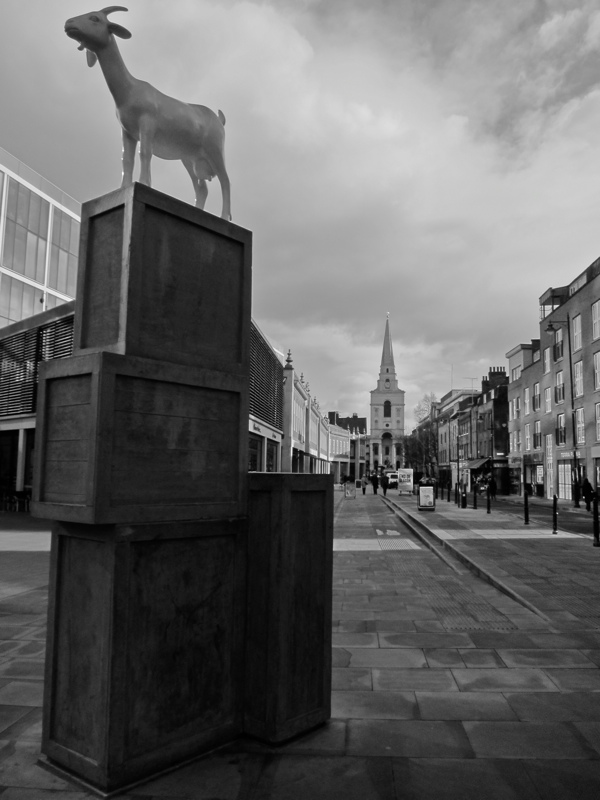
From Bishops Sq

From Itsu Sushi, Broadgate

From Shoreditch High St

From Quaker St

From the Truman Brewery

From Corbet Place

From Hanbury St

From Fournier St

From the ruins of the Fruit & Wool Exchange
You might also like to read about
The Creeping Plague Of Ghastly Facadism
As if I were being poked repeatedly in the eye with a blunt stick, I cannot avoid becoming increasingly aware of a painfully cynical trend in London architecture which threatens to turn the city into the backlot of an abandoned movie studio. If walls could speak, these would tell tales of bad compromises and angry developers who, dissatisfied with the meagre notion of repair and reuse, are driven solely by remorseless greed.
Meanwhile, bullied into sacrificing historic buildings of merit, cowed planning authorities must take consolation in the small mercy of retaining a facade. The result is that architects are humiliated into creating passive-aggressive structures, like the examples you see below – gross hybrids of conflicted intentions that scream ‘Look what you made me do!’ in bitter petulant resentment.
‘A kind of authenticity’ is British Land’s oxymoronical attempt to sell this approach in their Norton Folgate publicity, as if there were fifty-seven varieties of authenticity, when ‘authentic’ is not a relative term – something is either authentic or it is phoney.

An affront in Spitalfields

Shameless in Artillery Lane

Not even pretending in Gun St either

A sham marriage in Chiswell St

Lonely and full of dread in Smithfield

Can you spot the join in Fitzrovia?

Looming intimations of ugliness in Oxford St

A fracture in Hanway St

A hollow excuse in Central London

The veneer of luxury in the West End

A prize-winning abomination on the Caledonian Rd

Barely keeping up appearances at UCL Student Housing

In Gracechurch St, City of London

St Giles High St, Off Tottenham Court Rd

‘A kind of authenticity’ – the shape of things to come in Norton Folgate according to British Land
You may also like to take a look at
John Thomas Smith’s Antient Topography

Bethelem Hospital with London Wall in Foreground – Drawn June 1812
Two centuries ago, John Thomas Smith set out to record the last vestiges of ancient London that survived from before the Great Fire of 1666 but which were vanishing in his lifetime. Click on any of the images published here to enlarge them and study the tender human detail that Smith recorded in these splendid etchings he made from his own drawings, published as Antient Topography of London, 1815. My passion for John Thomas Smith’s work was first ignited by his portraits of raffish street sellers published as Vagabondiana and I was delighted to spot several of those familiar characters included here in these vivid streets scenes of long ago.

Bethel Hospital seen from London Wall – Drawn August 1844

Old House in Sweedon’s Passage, Grub St – Drawn July 1791, Taken Down March 1805

Old House in Sweedon’s Passage, Grub St – Drawn July 1791, Taken Down March 1805

London Wall in Churchyard of St Giles’ Cripplegate – Drawn 1793, Taken Down 1803

Houses on the Corner of Chancery Lane & Fleet St – Drawn August 1789, Taken Down May 1799

Houses in Leadenhall St – Drawn July 1796

Duke St, West Smithfield – Drawn July 1807, Taken Down October 1809

Corner of Hosier Lane, West Smithfield – Drawn April 1795

Houses on the South Side of London Wall – Drawn March 1808

Houses on West Side of Little Moorfields – Drawn May 1810

Magnificent Mansion in Hart St, Crutched Friars – Drawn May 1792, Taken Down 1801

Walls of the Convent of St Clare, Minories – Drawn April 1797

Watch Tower Discovered Near Ludgate Hill – Drawn June 1792

An Arch of London Bridge in the Great Frost – Drawn February 5th 1814
Images courtesy Bishopsgate Institute
You may also like to take a look at
John Thomas Smith’s Vagabondiana
Oranges & Lemons Churches
First published in 1722, there has been enormous speculation around the identity of the churches in ‘Oranges & Lemons.’ But since St Clement’s Eastcheap once stood in close proximity to St Martin Ongar within an area traditionally inhabited by moneylenders in the City of Lond0n, I deduce these are the two churches featured in the opening lines.
From here, the locations spiral out and around the City like a peal of bells blowing on the wind. The third line refers to St Sepulcre-without-Newgate which stands opposite the Old Bailey and close to the location of the Fleet Prison where debtors were held. The fourth line features St Leonard’s, Shoreditch, while the church in the fifth line is St Dunstan’s, Stepney, and rhyme culminates back in the City of London at St Mary-le-Bow, Cheapside.

St Clement’s, Eastcheap
“Oranges and lemons,” say the bells of St. Clement’s

Site of St Martin Orgar, Martin Lane
“You owe me five farthings,” say the bells of St. Martin’s

St Sepulchre-without-Newgate
“When will you pay me?” say the bells of Old Bailey

St Leonard’s, Shoreditch
“When I grow rich,” say the bells of Shoreditch

St Dunstan’s, Stepney
“When will that be?” say the bells of Stepney

St Mary Le Bow, Cheapside
“I do not know,” says the great bell of Bow
You may also like to take a look at
The Cries Of Old London
My CRIES OF LONDON exhibition designed by Adam Tuck at Bishopsgate Institute closed yesterday, so I am publishing some of the panels from the show today for those who were unable to visit. Meanwhile, there are just a few tickets left for my illustrated lecture at Wanstead Tap on Tuesday 9th February. (This event is now sold out but I will be giving a lecture at the National Portrait Gallery in the summer at a date yet to be announced.)

(Click on this image to enlarge and read the text)

(Click on this image to enlarge and read the text)

(Click on this image to enlarge and read the text)

(Click on this image to enlarge and read the text)

(Click on this image to enlarge and read the text)

(Click on this image to enlarge and read the text)

(Click on this image to enlarge and read the text)

(Click on this image to enlarge and read the text)

(Click on this image to enlarge and read the text)

CLICK TO BUY A SIGNED COPY OF CRIES OF LONDON FOR £20
Beware The Curse Of Norton Folgate!

Click on Adam Dant’s map to enlarge
After Henry VIII destroyed the Priory of St Mary Spital, the Spanish Mystic, Dona Luisa de Carvajal y Mendoza who resided in Spital Sq, placed a curse upon anyone who might seek to despoil Norton Folgate in future and this week the ancient curse is making itself felt.
Ever since Boris Johnson waved through British Land’s proposal to obliterate Norton Folgate under a hideous corporate plaza last week, there has been a cloud of gloom hanging over Spitalfields, as downcast residents trudge the streets with their eyes to the pavement and hands deep in pockets.
No-one was surprised when the Mayor overturned the Council’s unanimous decision in favour of the developer, since he has done it a dozen times before, yet everyone was sickened by his vanity and the British Land executives high-fiving each other in the chamber once they got their desired result.
But yesterday there was a sudden break in the cloud, as the joyous news circulated that The Spitalfields Trust has been granted a Judicial Review to challenge Boris Johnson on of each of the four grounds upon which they believe the Mayor erred in law by intervening in the Norton Folgate case in favour of British Land’s plans to destroy more than 70% of the fabric of their site in a Conservation Area.
As our shameless Mayor approaches the end of his tenure, we await the full hearing at the High Court in the Spring – but in the meantime you can read the full text of the Judicial Review documentation by clicking here.
Boris Johnson & British Land, Beware the Curse of Norton Folgate!

Adam Dant is producing a limited edition of thirty copies of his Map of Norton Folgate at £500 each – sized 30” x 22” and all hand-tinted by the artist. Contact AdamDant@gmail.com for purchase enquiries.
You may also like to read about


