Phil Maxwell In Hanbury St
Originally known as Browne’s Lane, at the end of the eighteenth century Hanbury St was named after Sampson Hanbury who ran the Truman Brewery from 1788. It traverses Spitalfields connecting Commercial St with Whitechapel and is less than a mile in length, yet all the contrasts of the neighbourhood are visible along its extent. Contributing Photographer Phil Maxwell knows this better than most since he began photographing it in 1982, observing the changes as he walked daily between his home in Pauline House at the Vallance Rd end and The Golden Heart on the corner of Commercial St to the west.
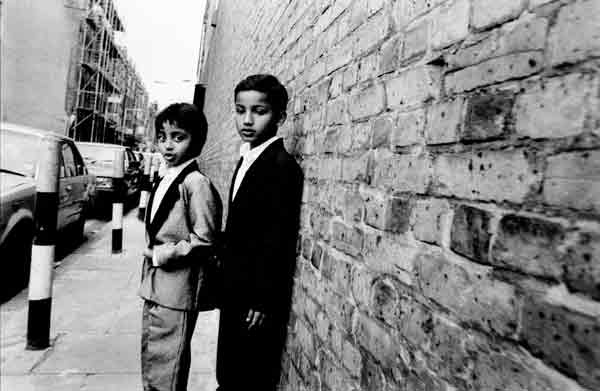
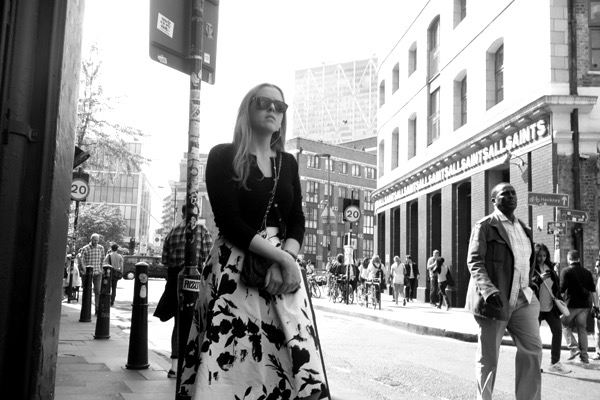
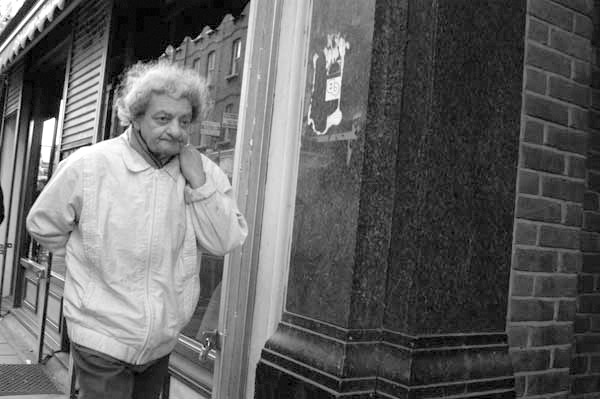
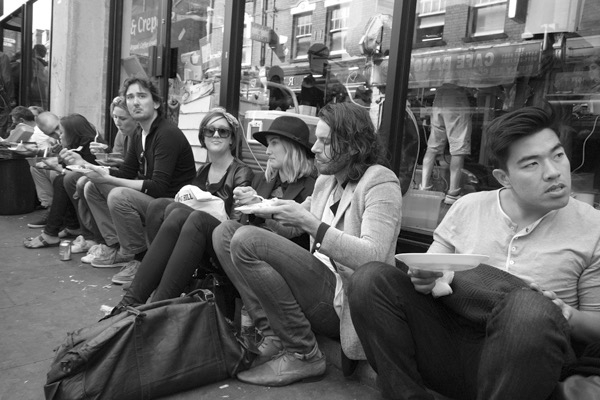
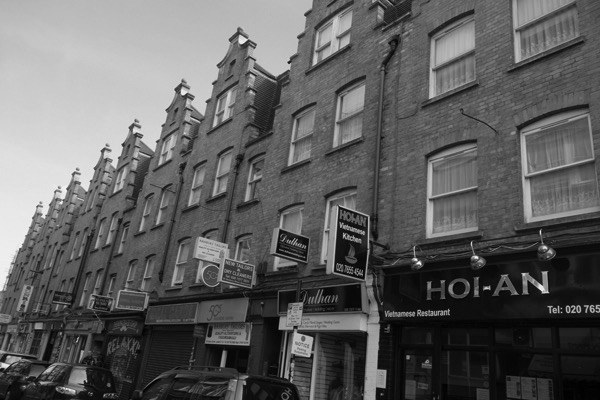
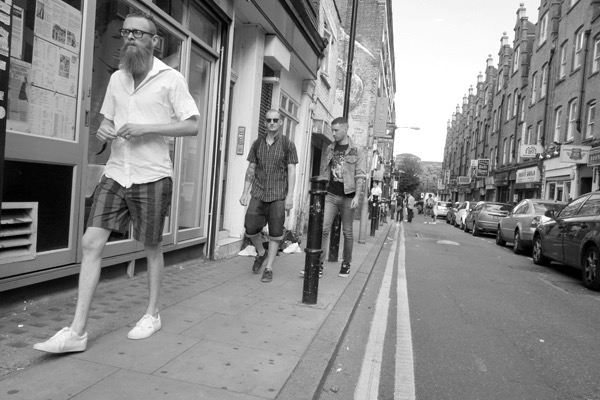
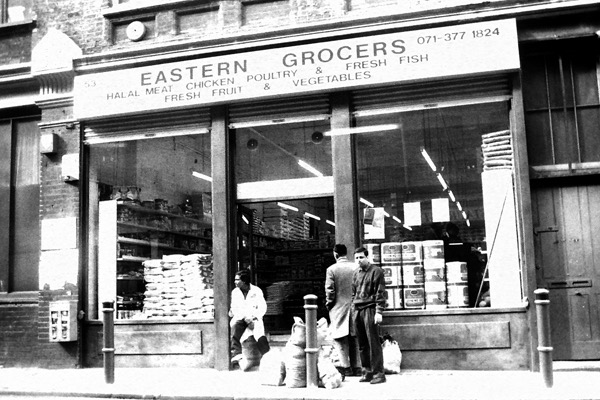

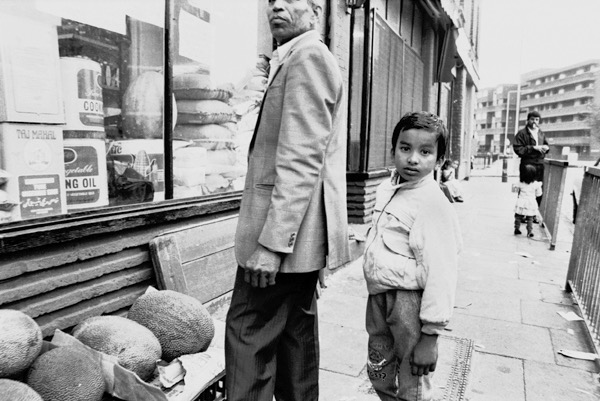
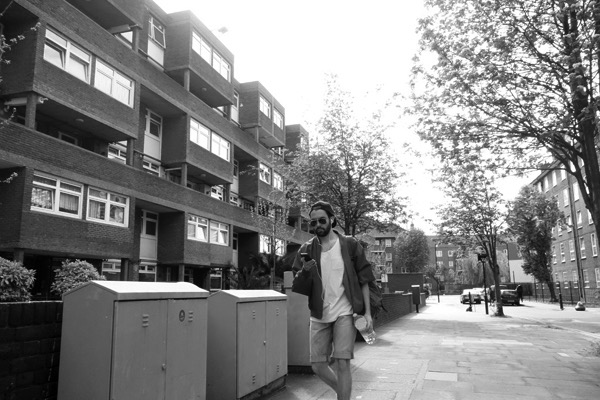
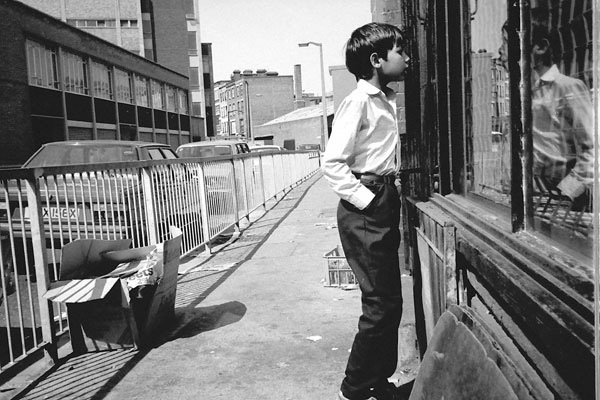
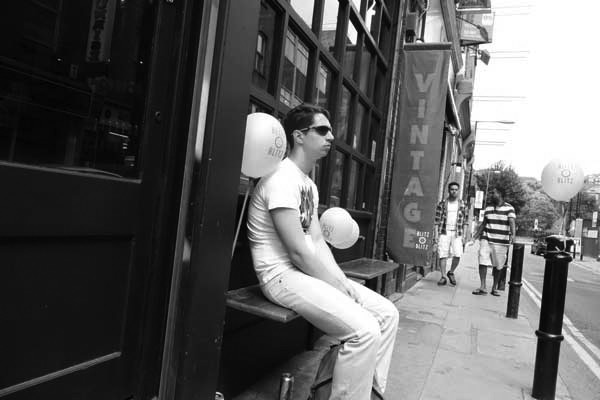
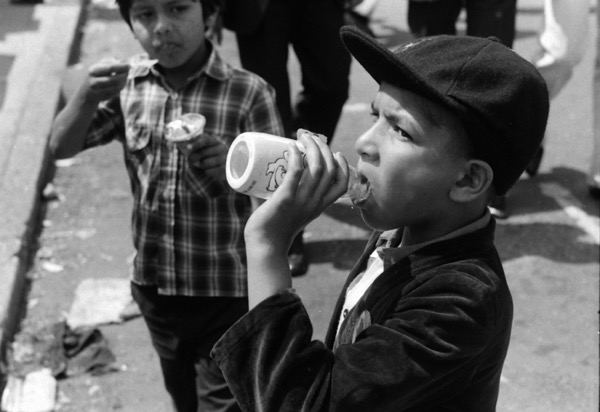
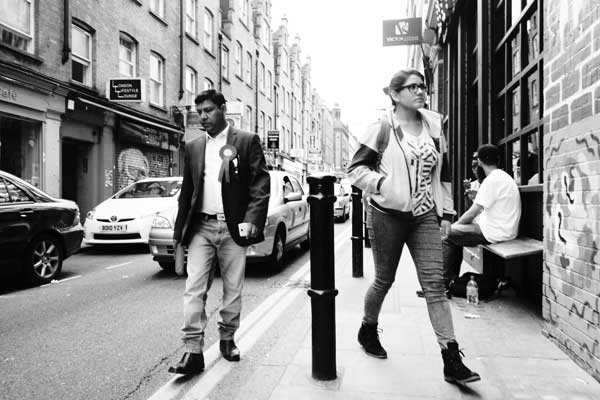
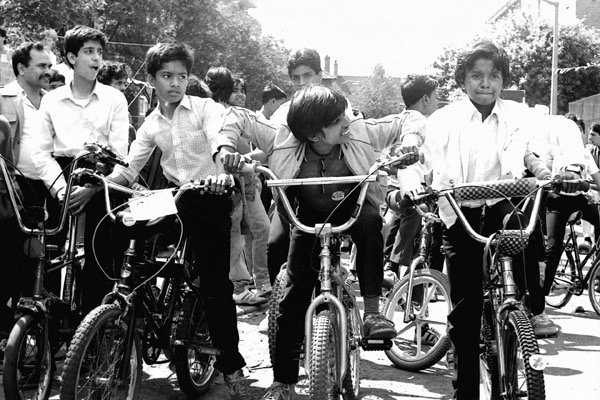
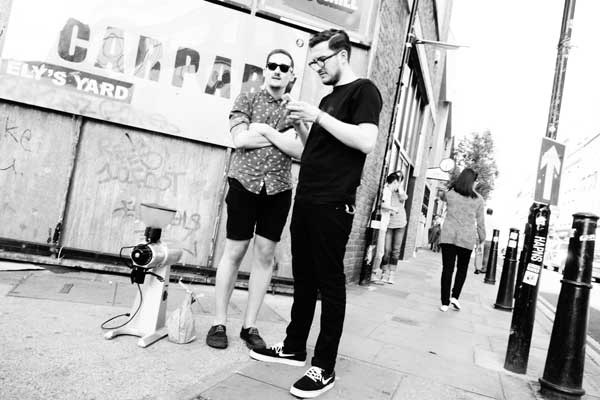
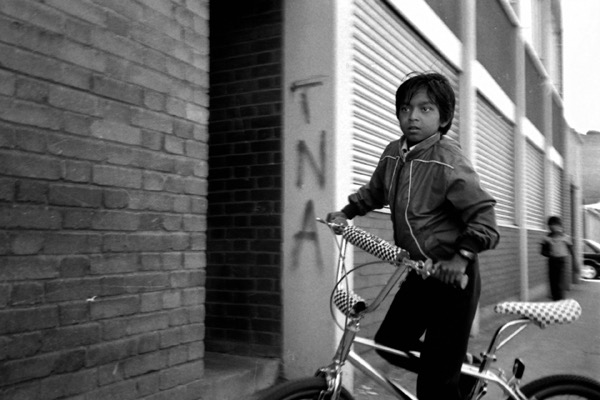
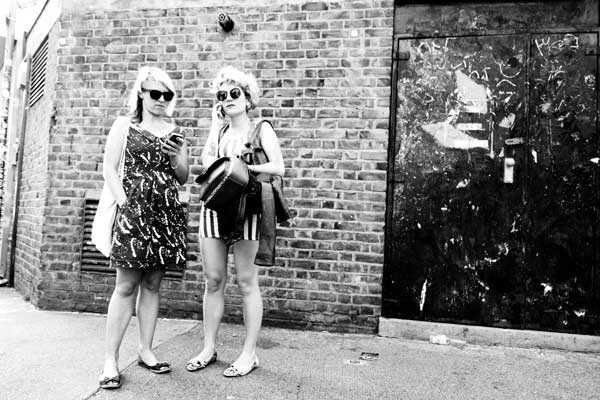
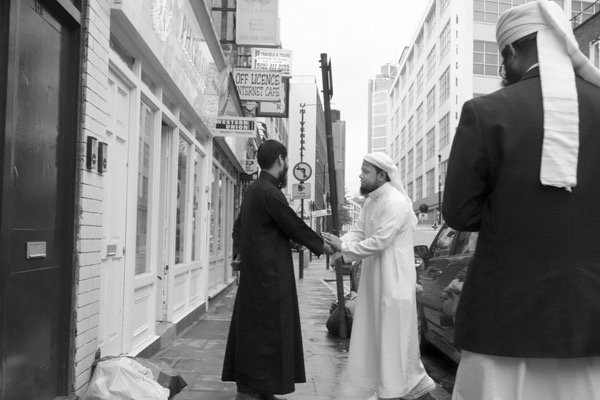
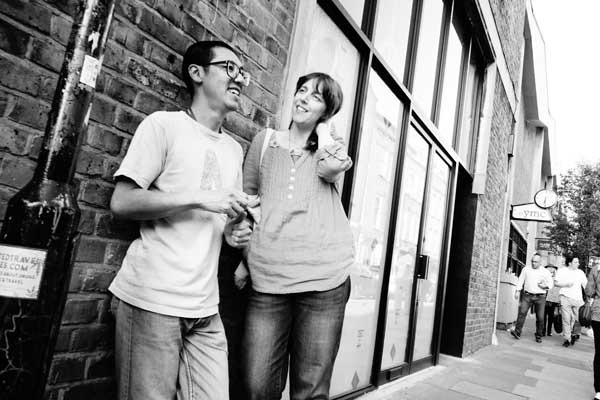
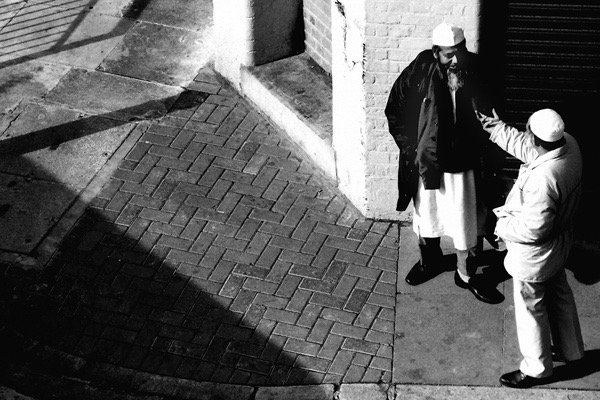
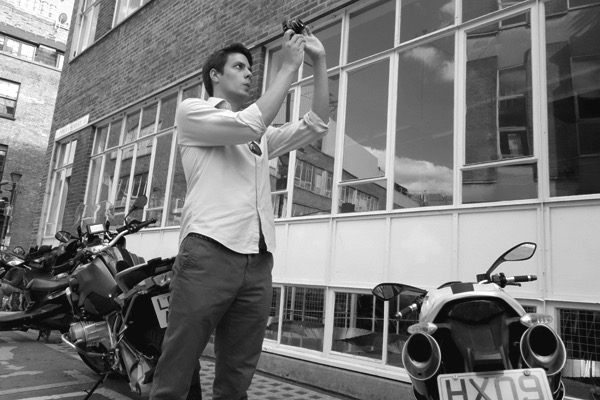
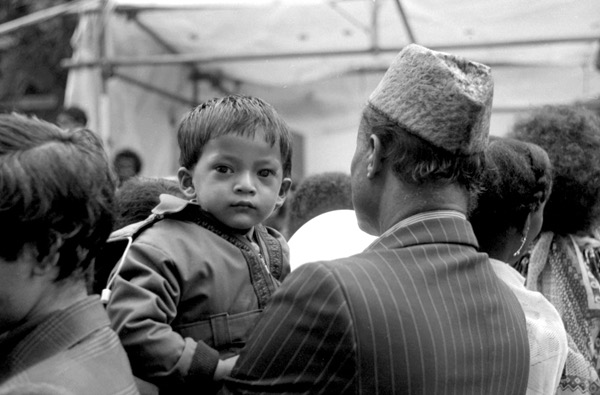
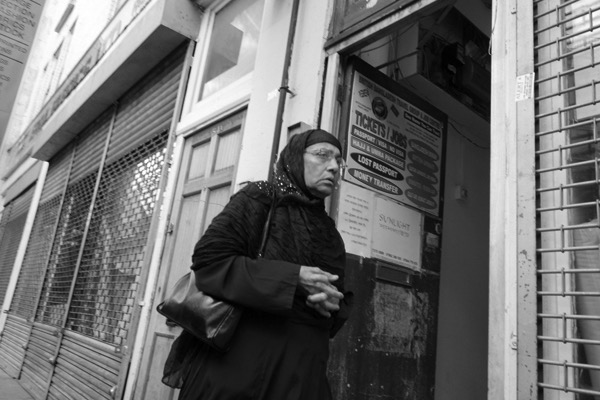
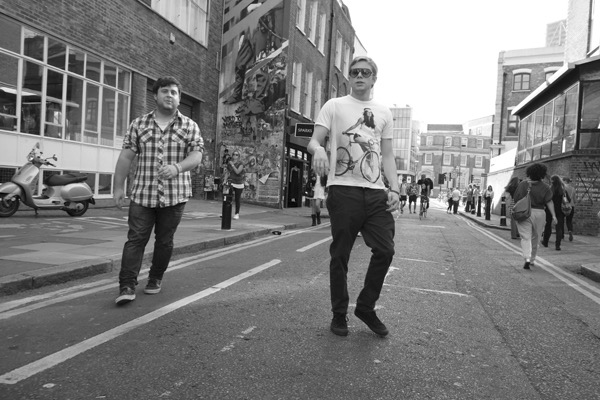
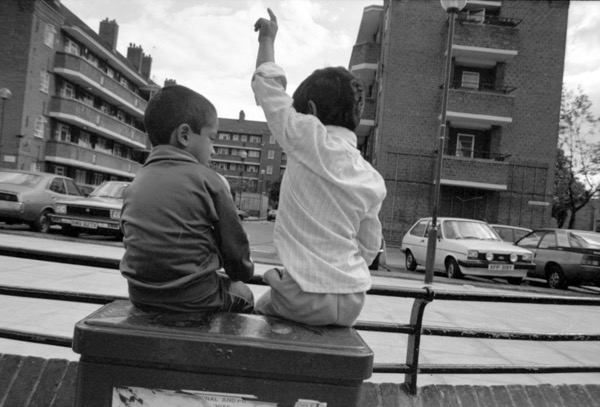
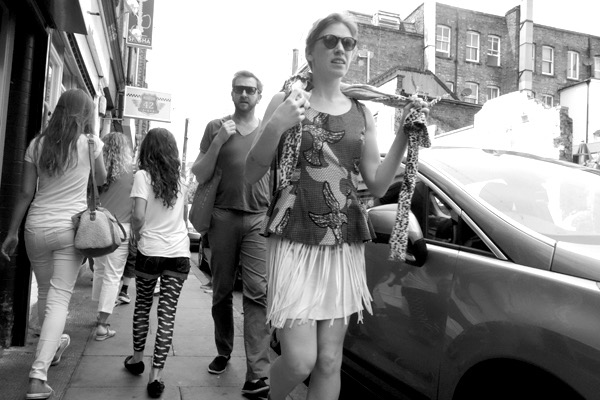
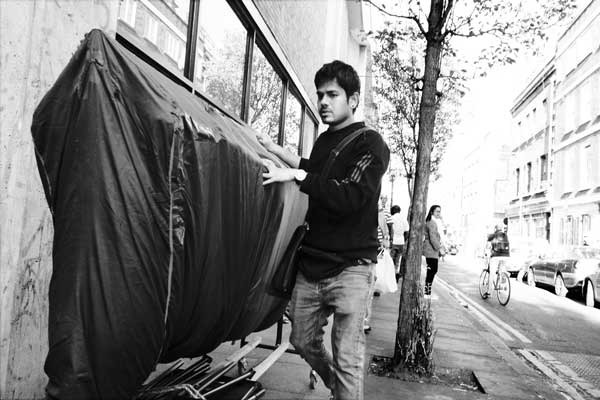
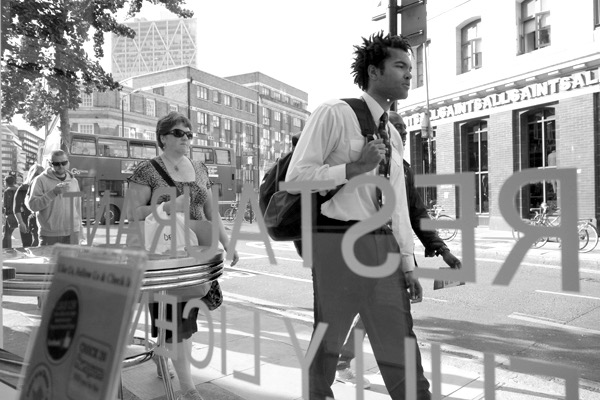
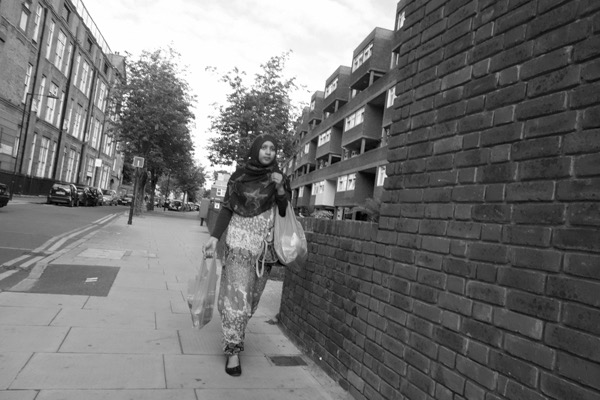
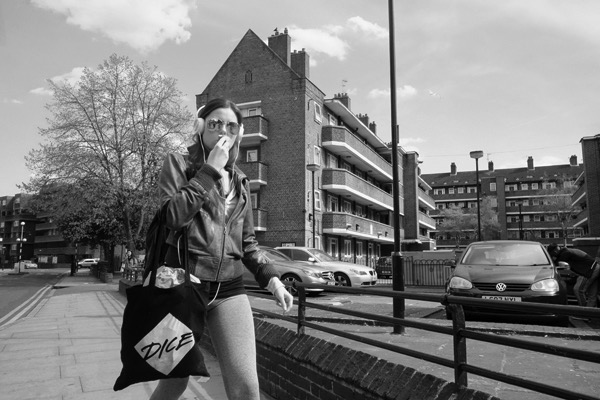
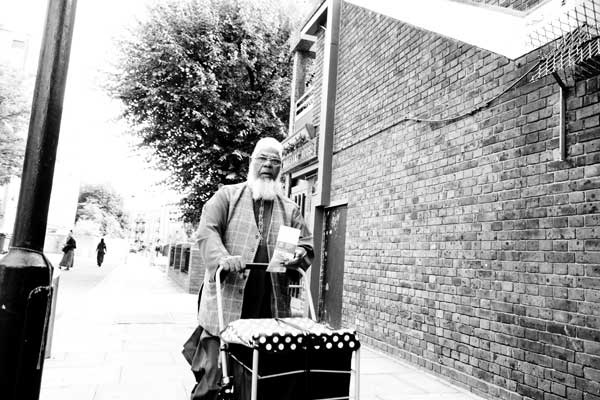
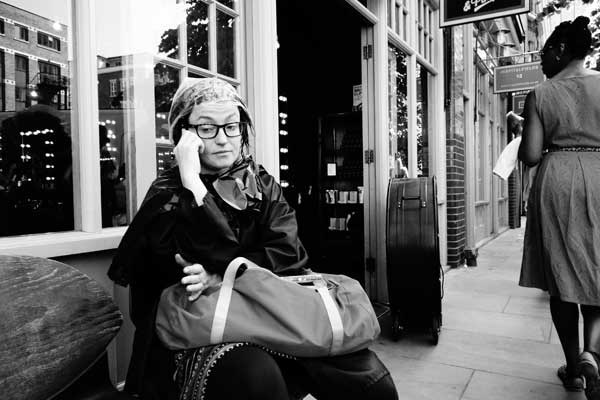
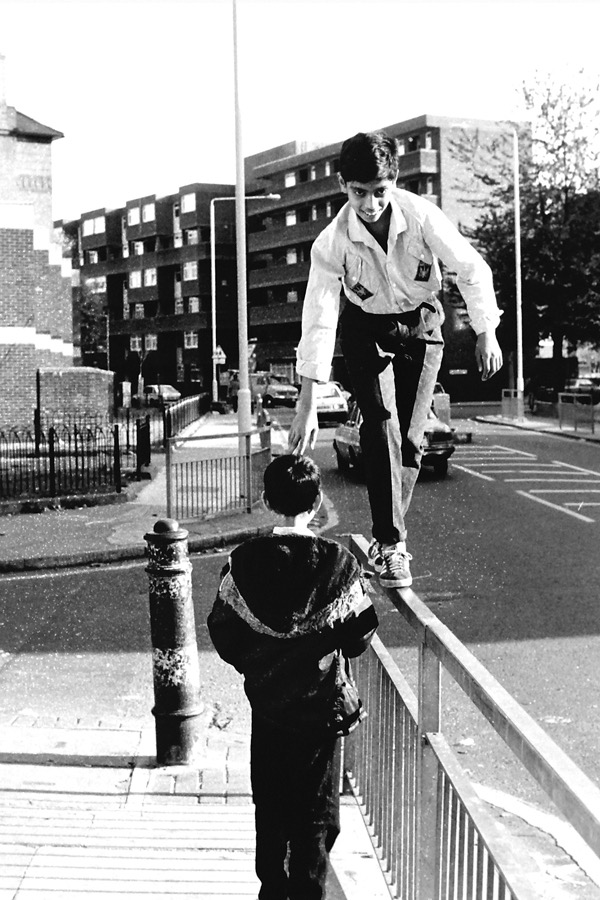
Photographs copyright © Phil Maxwell
You may also like to take a look at
Phil Maxwell in Bethnal Green Rd
Phil Maxwell in Bethnal Green Rd
The Costume & Mantle Worker
I spent an interesting afternoon in the Bishopsgate Institute archive recently studying copies The Costume & Mantle Worker, a bilingual journal in English and Yiddish for members of the United Ladies Tailors Trade Union. In Spitalfields, we are still aware of the former textile trade and I was especially fascinated by these adverts, reproduced below, which set me on a quest to discover which of these premises are still standing.
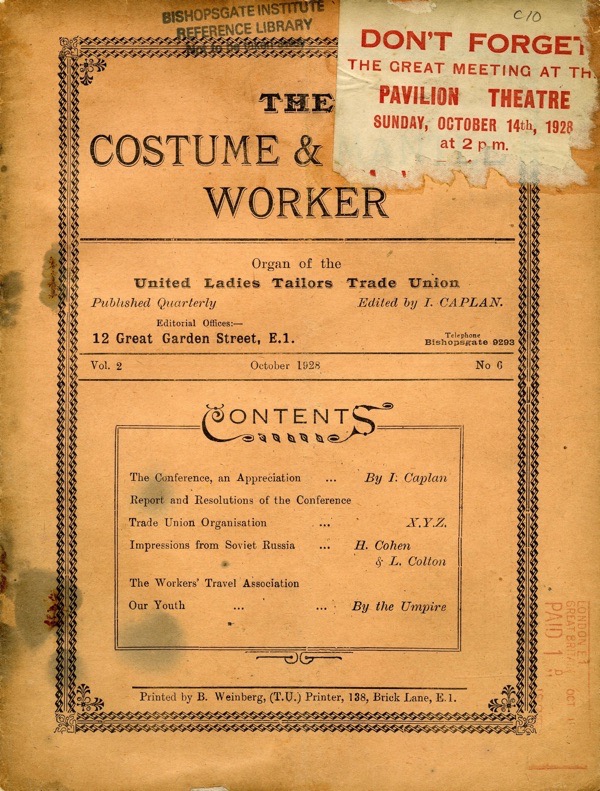
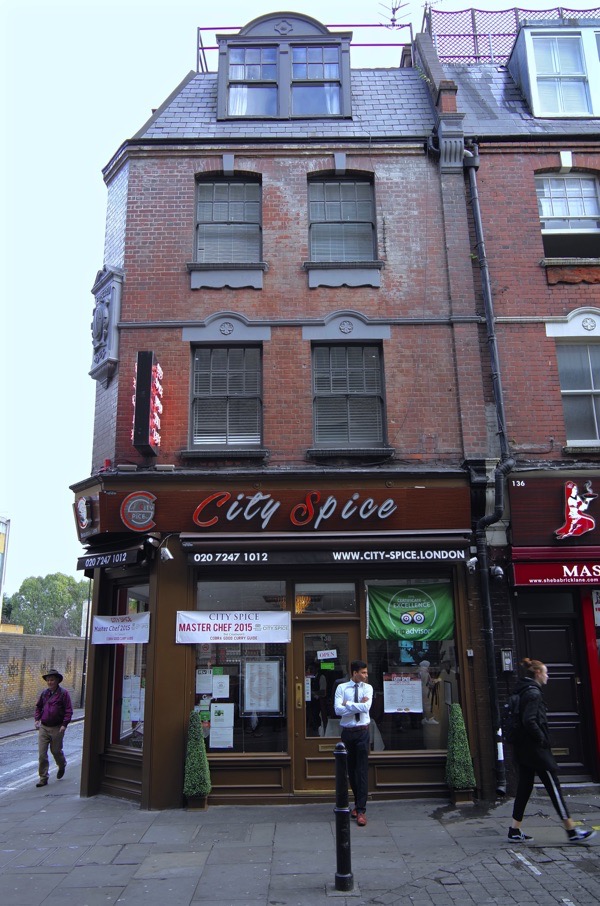
Formerly B. Weinberg, Printer, 138 Brick Lane
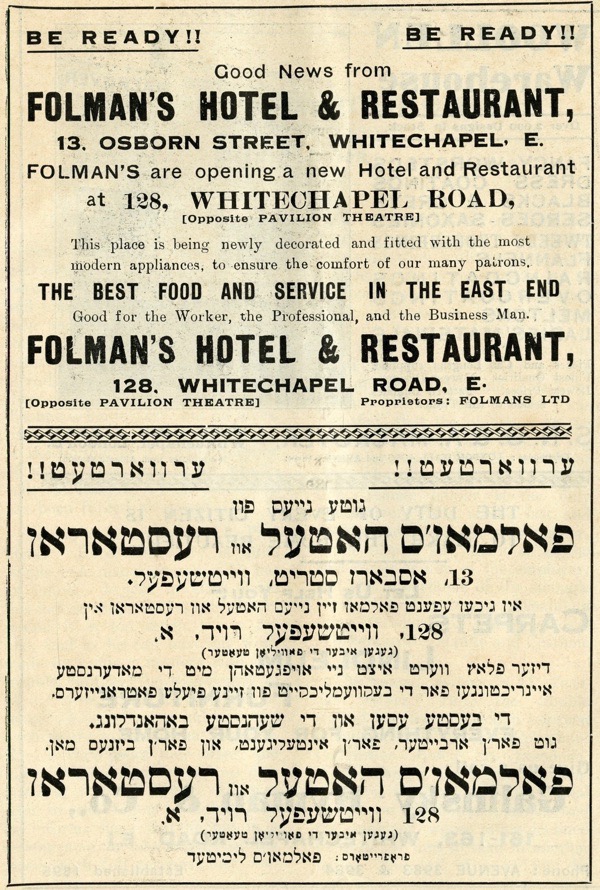
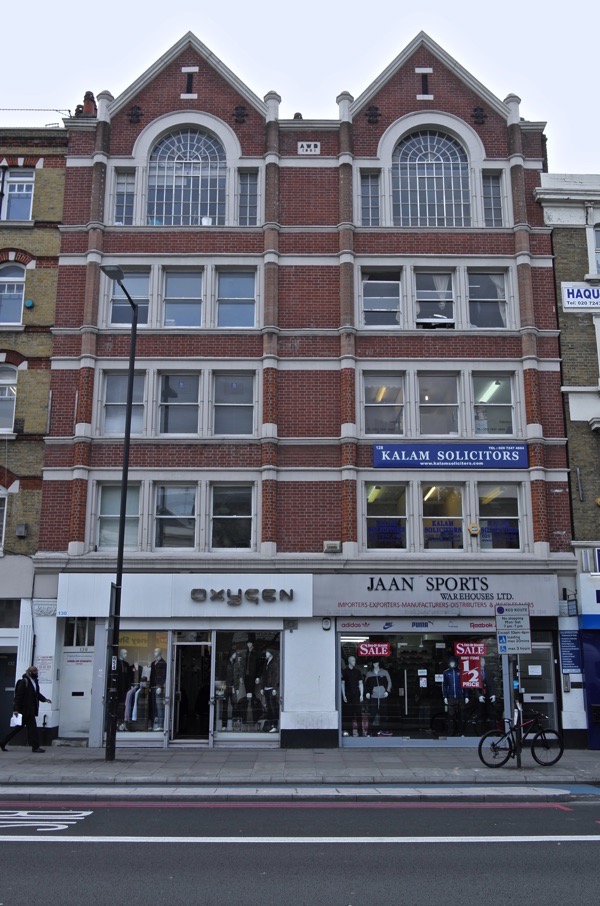
Formerly Folman’s Hotel & Restaurant, 128 Whitechapel Rd, Opposite Pavilion Theatre
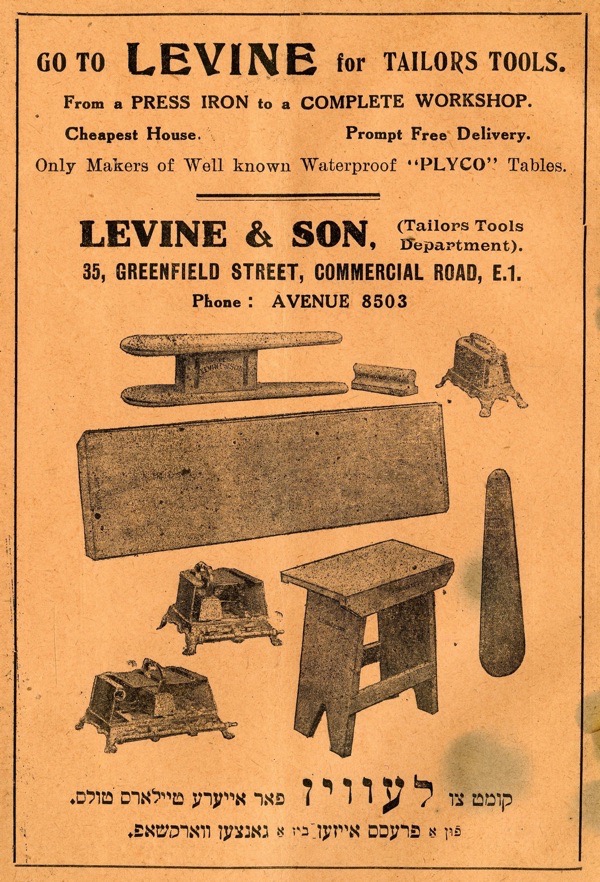

The Gentle Author’s tailors’ stool
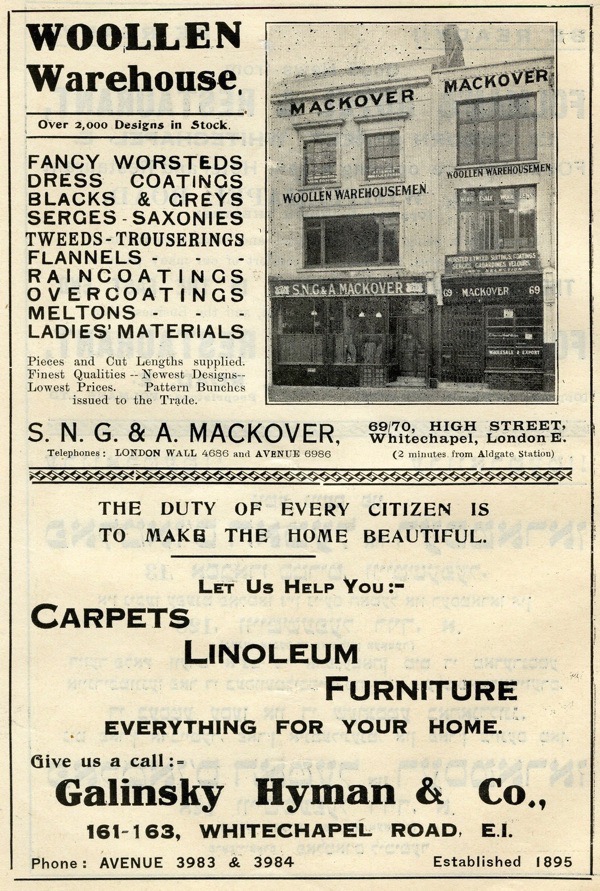
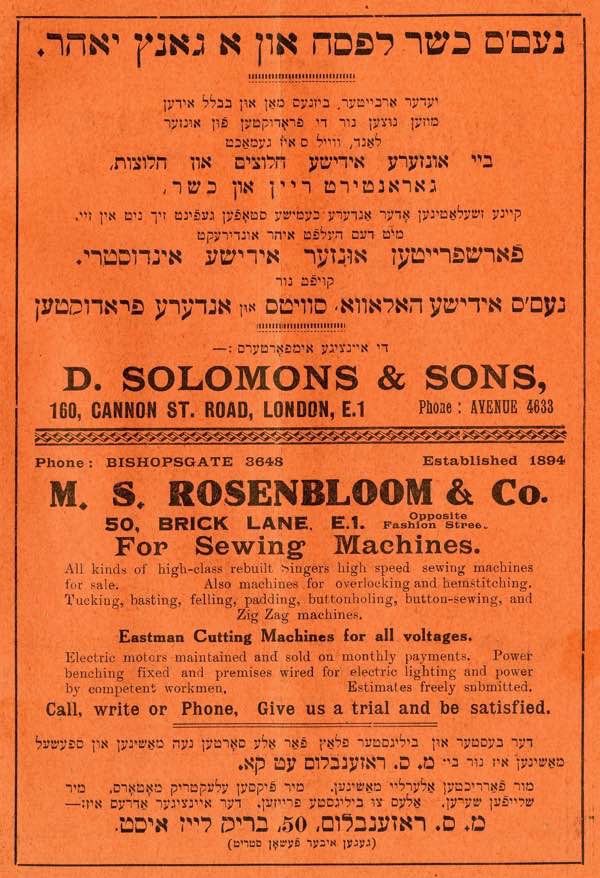
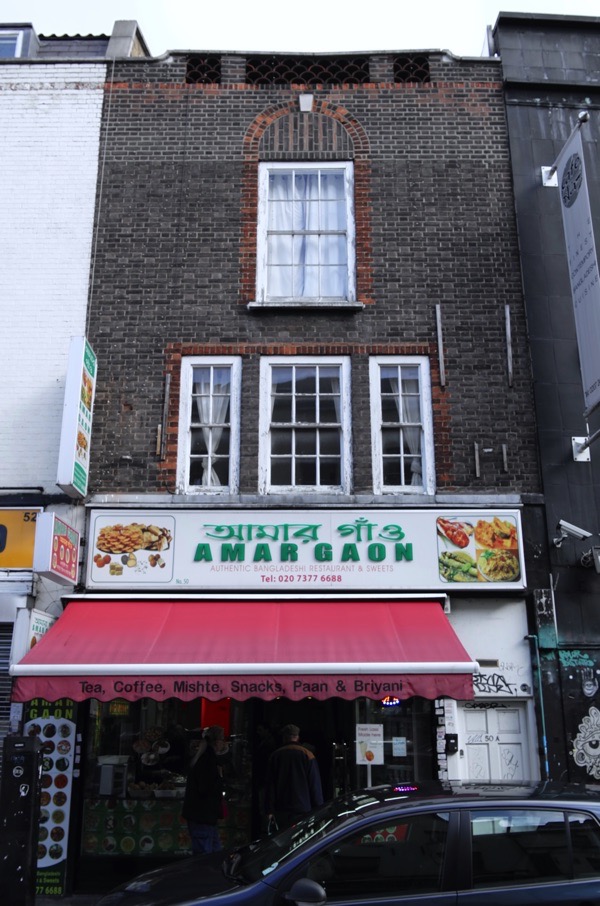
Formerly M. S. Rosenbloom & Co for sewing machines, 50 Brick Lane
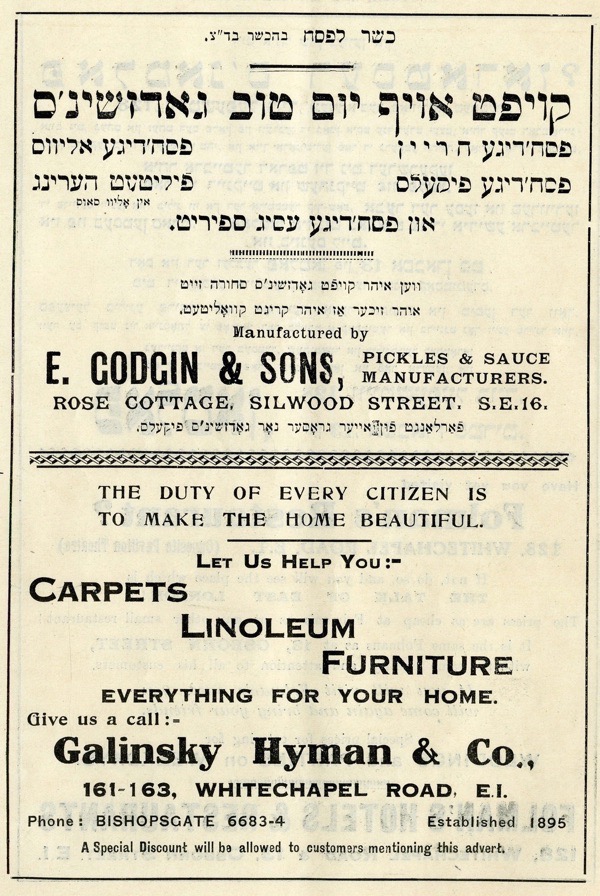
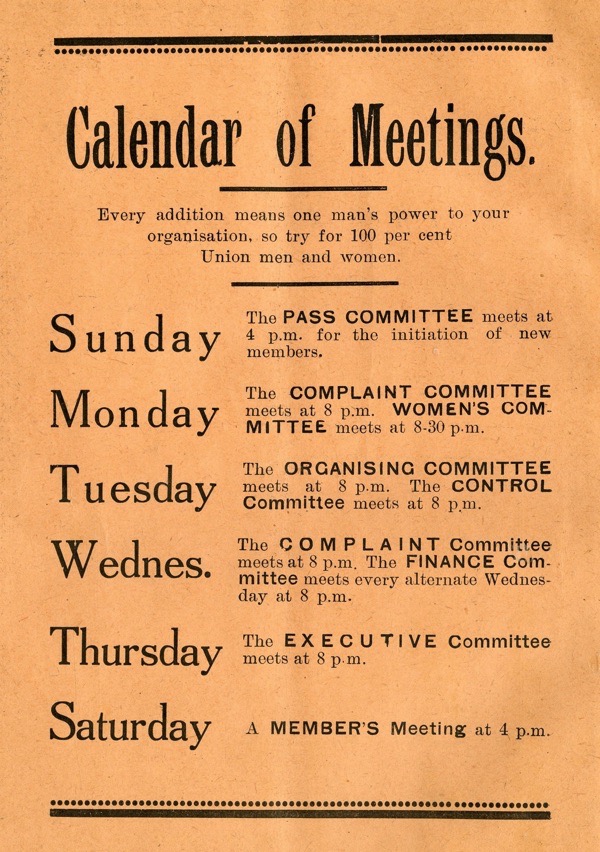
Pages of The Costume & Mantle Worker courtesy Bishopsgate Institute
You may also like to read about
Last Days Out With Colin O’Brien
Today, I look back at some of my favourite pictures by Contributing Photographer Colin O’Brien from 2013 – 2016. We clocked up over fifty assignments for Spitalfields Life working in partnership until his death in August this year, giving me cause to look back over all the adventures that we had together. Tonight at 6:30pm, I shall be reminiscing about my experiences working with Colin as part of his retrospective exhibition THIS ENGLAND at Unit G Gallery, 12a Collent St, E9 6SG.

Terry Smith, Envelope Cutter at Baddeley Brothers, July 2013

Anna Carter, Carters Steam Fair, August 2013
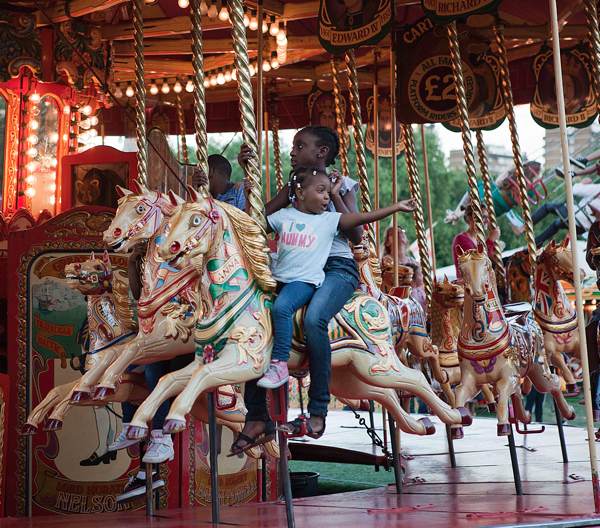
Carters Steam Fair, Victoria Park, August 2013

Savvas Kyriacou, Muscleworks Gym Bethnal Green, September 2013
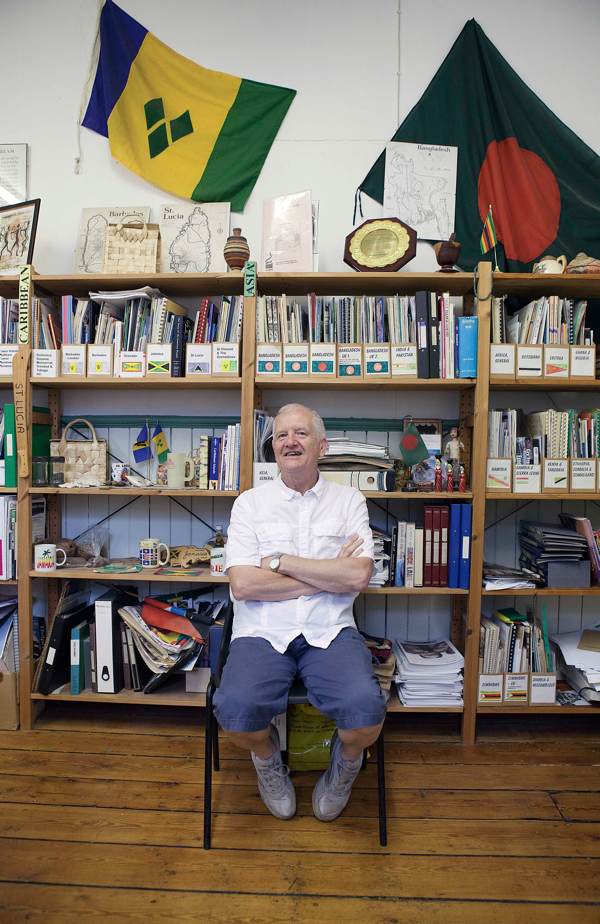
Tony Stevens, Daneford Trust, Bethnal Green, September 2013

Gerry Cottle, Gerry Cottle’s Circus, September 2013
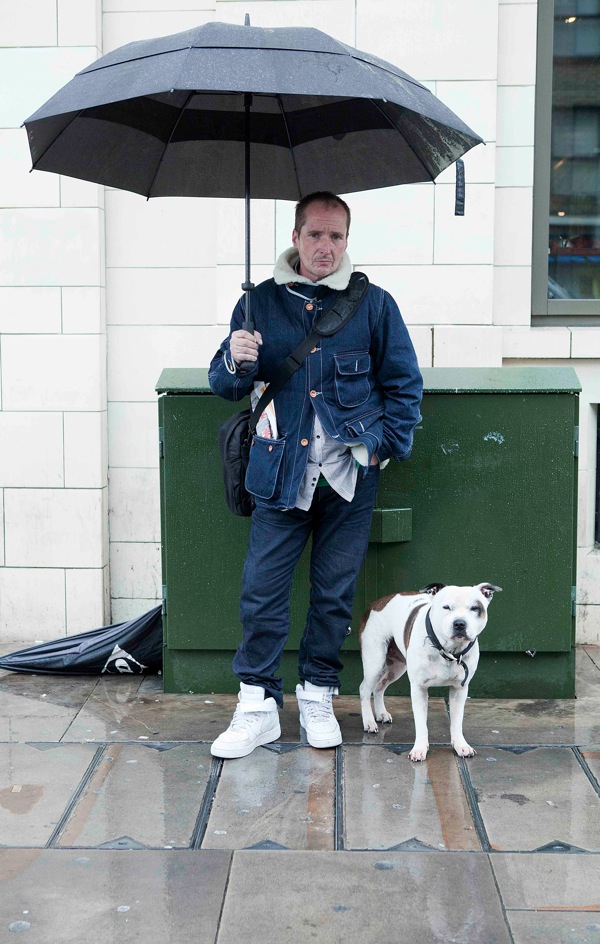
John Dolan & George the Dog, Shoreditch, October 2013
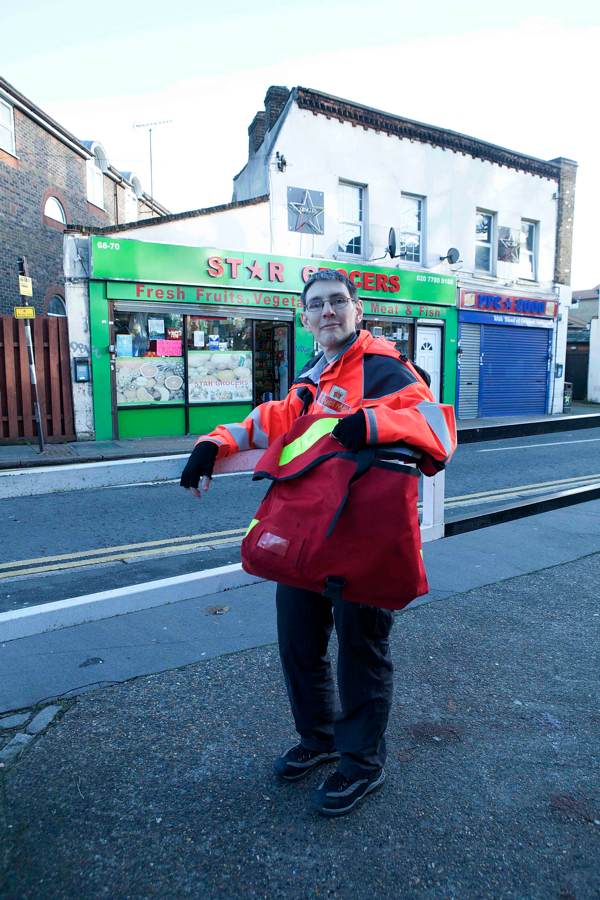
Steven Armstrong, Postman in Whitechapel, December 2013
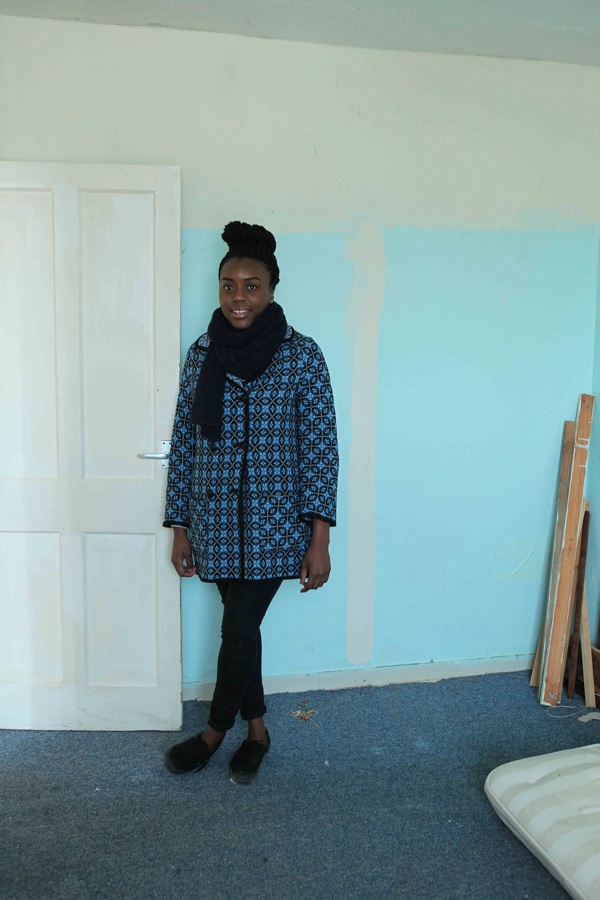
Elam Forrester says goodbye to her home in Samuel House, Haggerston, prior to demolition, February 2014
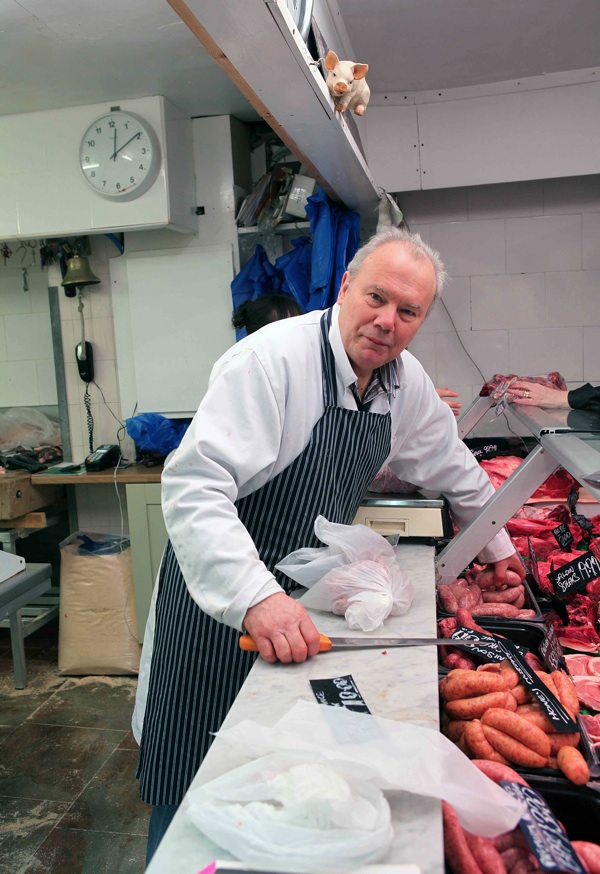
Peter Sargent, Butcher in Bethnal Green, February 2014
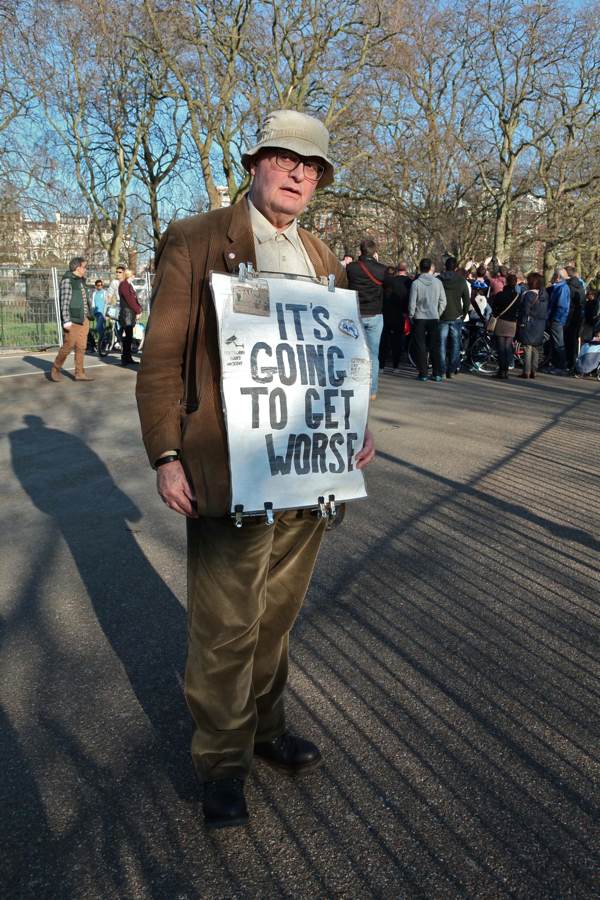
Bob Rogers, Speakers Corner, February 2014

David Dobson, Landlord of the Blind Beggar, Whitechapel, March 2014
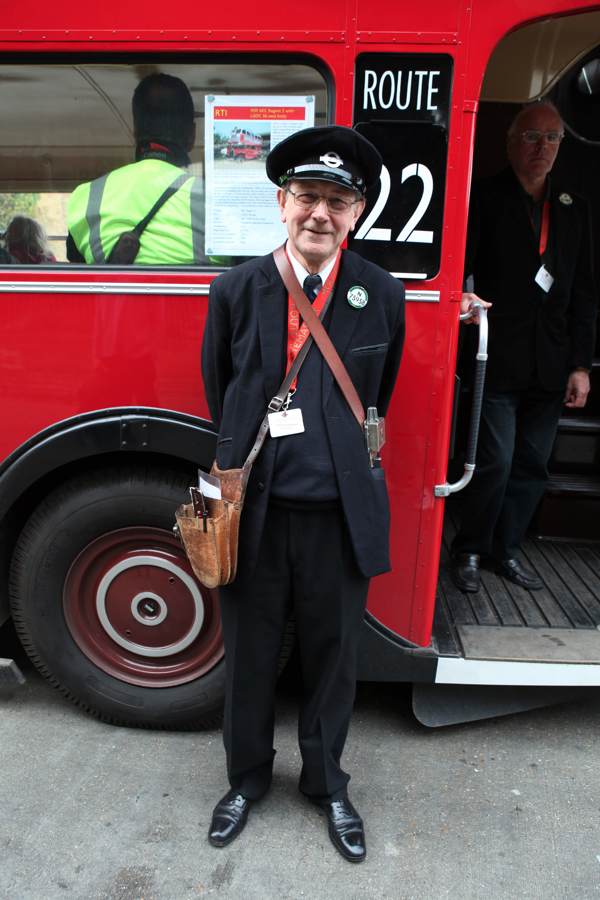
Ash Grove Bus Depot, Hackney, April 2014
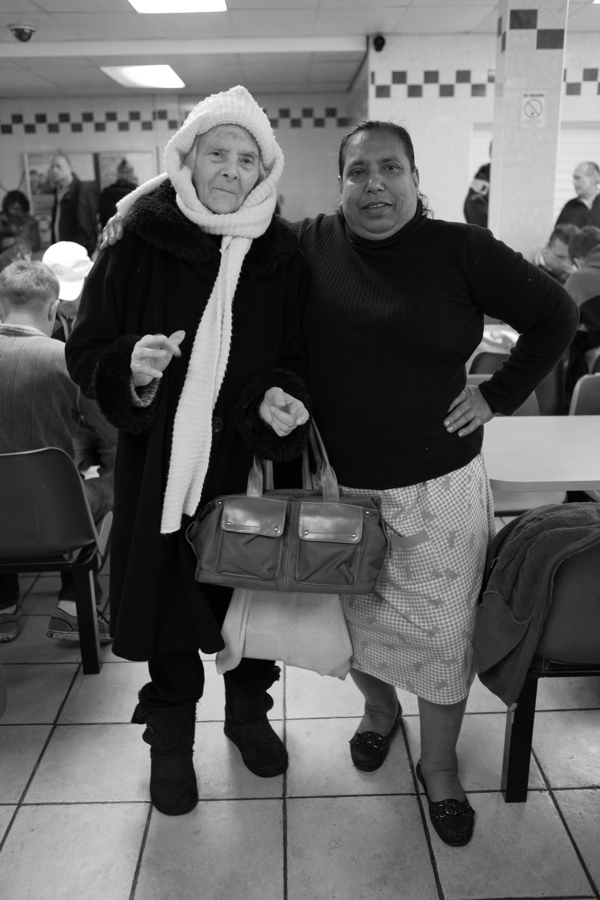
Whitechapel Mission, May 2014

Whitechapel Mission, May 2014

Bob Mazzer, Howard Griffin Gallery, Shoreditch, June 2014

Jay the Tailor, Druid of Wormwood Scrubs, Primrose Hill, Midsummer 2014

Brogan Ferron, Weavers Fields Adventure Playground, Bethnal Green, September, 2014
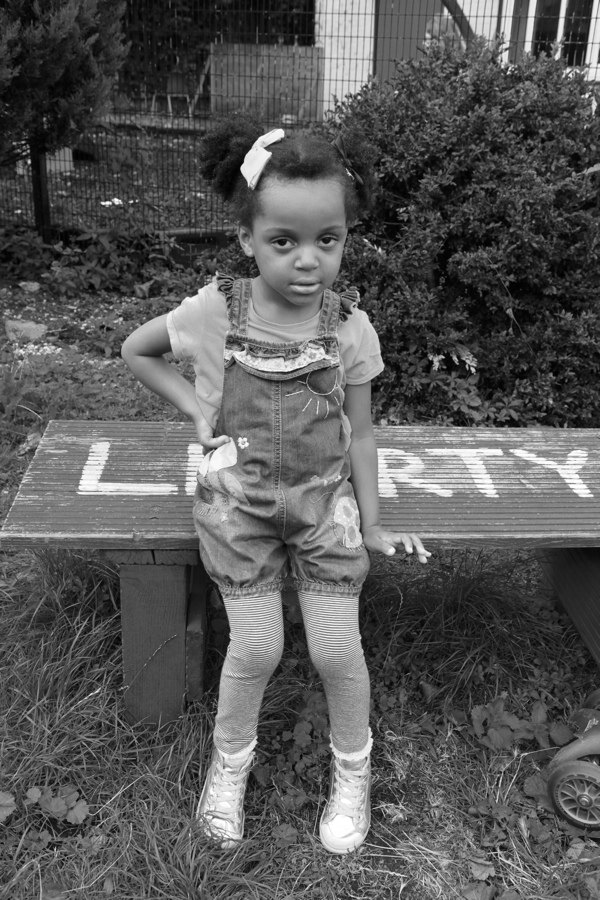
Lottie Ferron, Weavers Fields Adventure Playground, Bethnal Green, September 2014
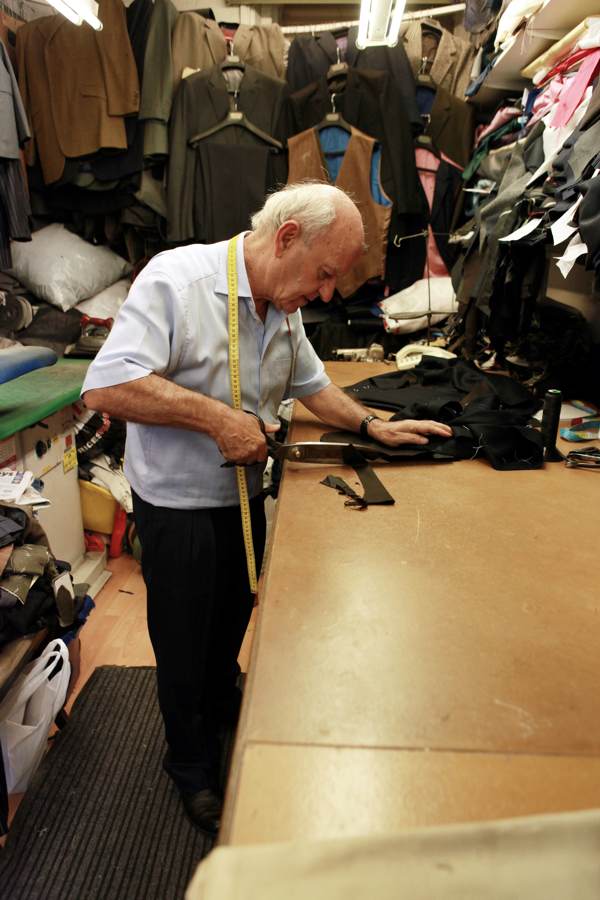
Chris Georgiou, Tailor, Kings Cross, September 2014

Jasmine Stone & her daughter Safia, Stratford, October 2014
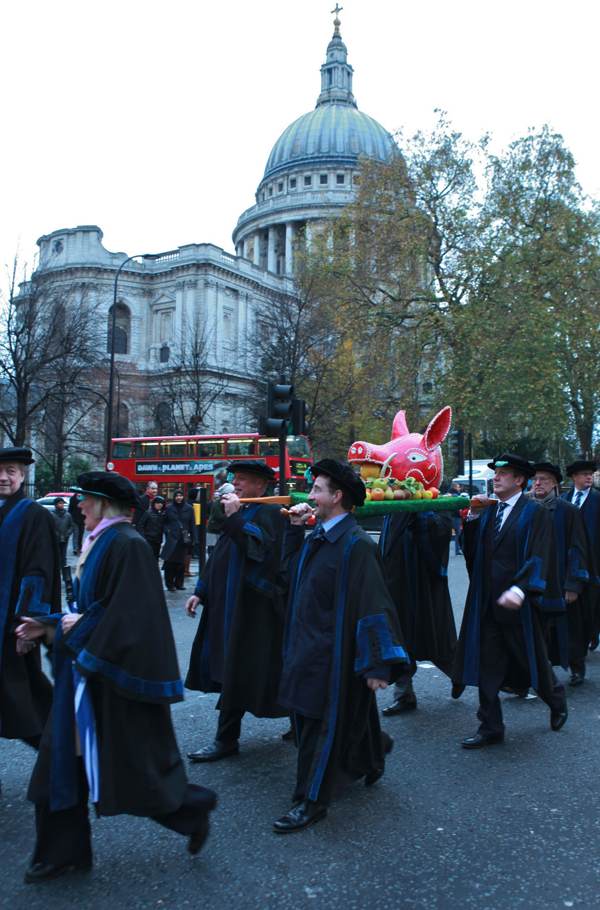
Boar’s Head Parade, City of London, December 2014
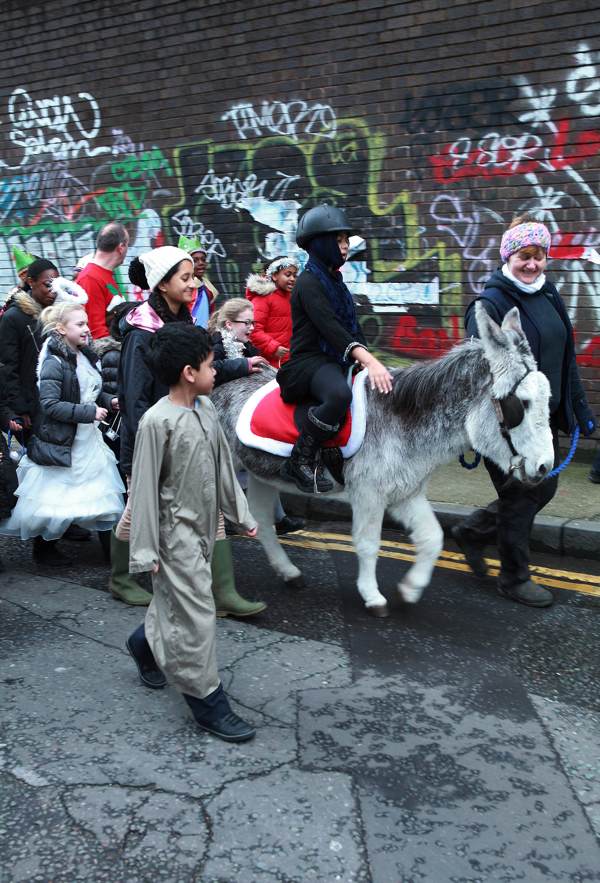
Nativity Procession, Spitalfields, December 2014
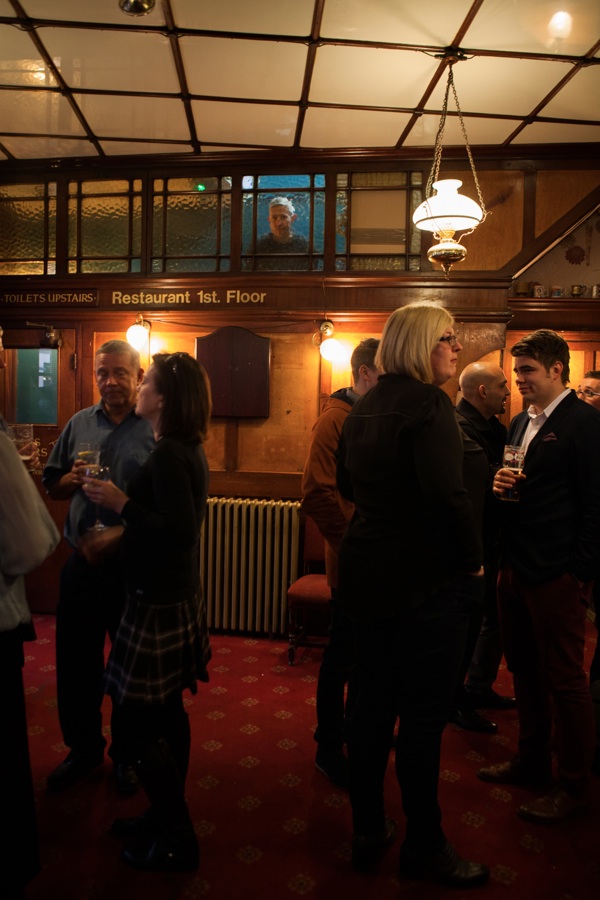
Last day of The Gun, Spitalfields, February 2015
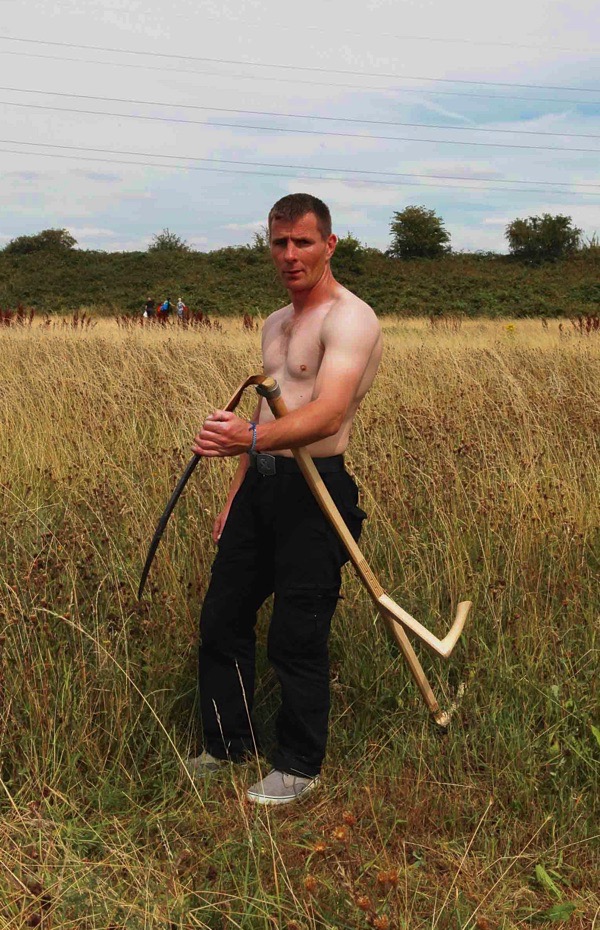
Walthamstow Marshes, August 2015
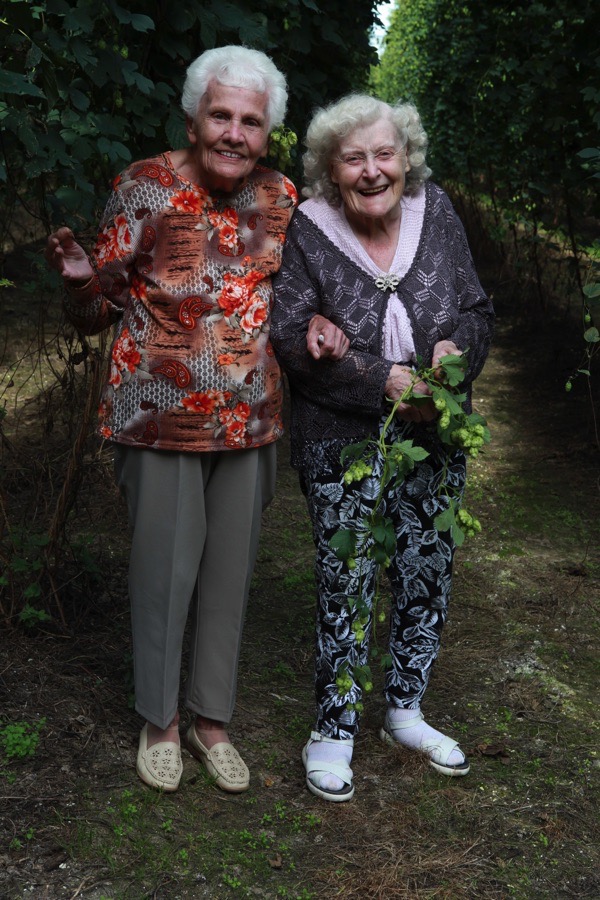
Flossie Reed & Vi Charlton, Hop-picking at Lamberhurst, Kent, September 2015
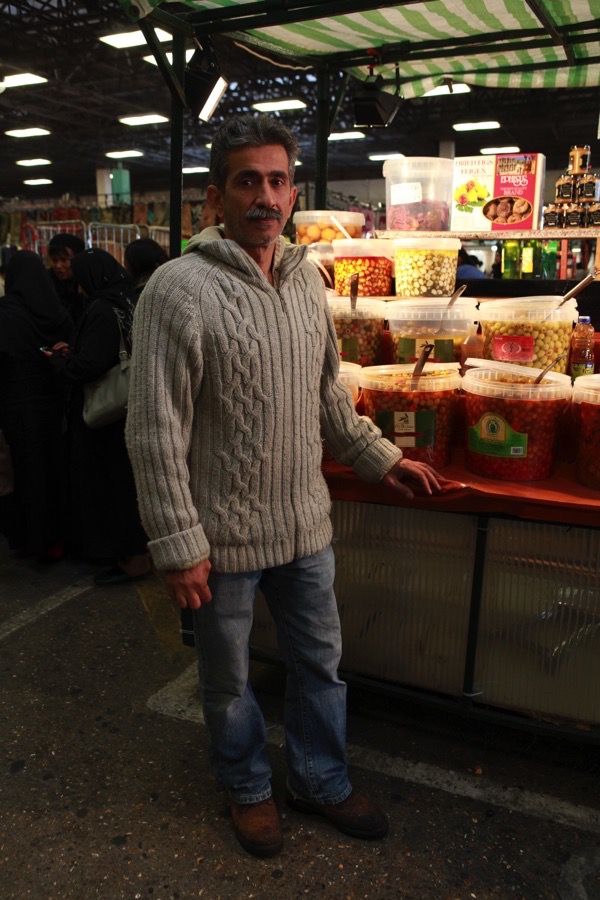
Ahmed Nassr, Olive Seller, Queen’s Market, Upton Park, October 2015

Lego Exhibition, Docklands, December 2015
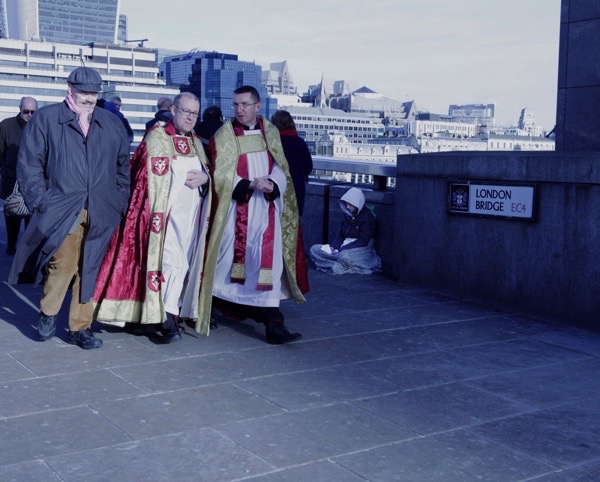
London Bridge, January 2016
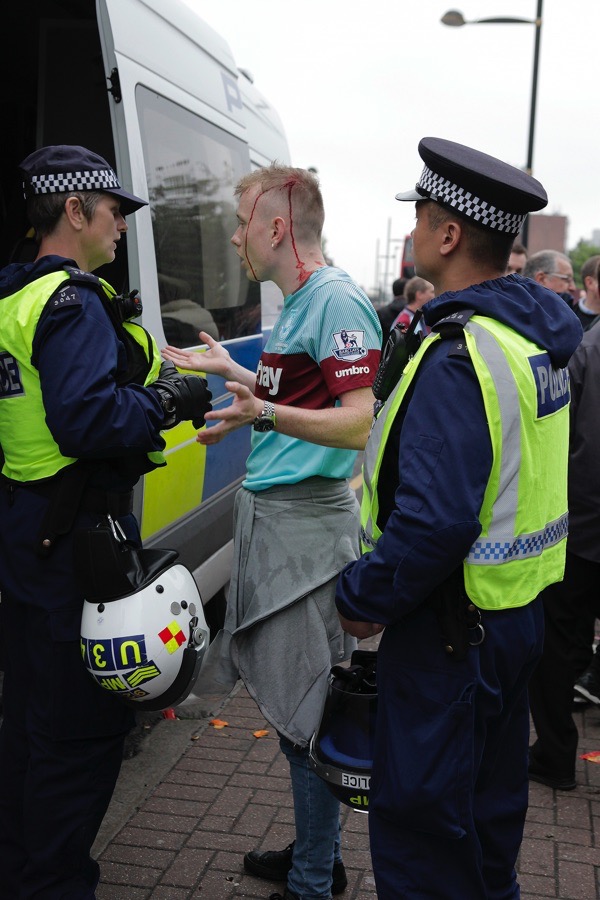
Upton Park, June 2016

George Parrin, Ice Cream Seller, Whitechapel, August 2016
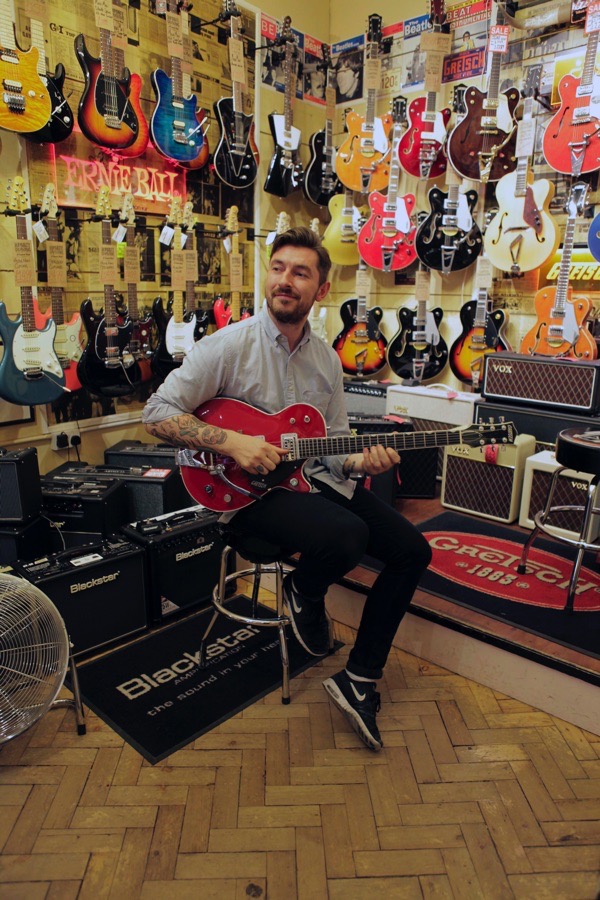
Leon Powell, Denmark St, August 2016
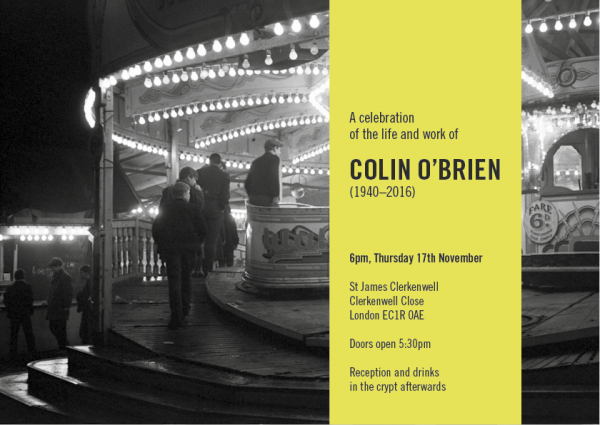
I hope as many readers as can do so will come along to St James Church, Clerkenwell, on Thursday 17th November. The bells will ring from 5:30pm and we will commence at 6:00pm. We will be showing photographs and there will be reminiscences, readings, music and films, and a big party in the crypt to celebrate our friend from Clerkenwell, COLIN O’BRIEN. Make it a date in your diary.
You may also like to take a look at
Richard Ardagh At Wilton’s Music Hall
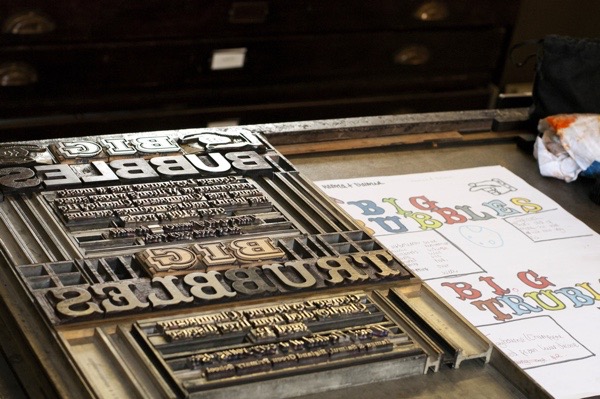
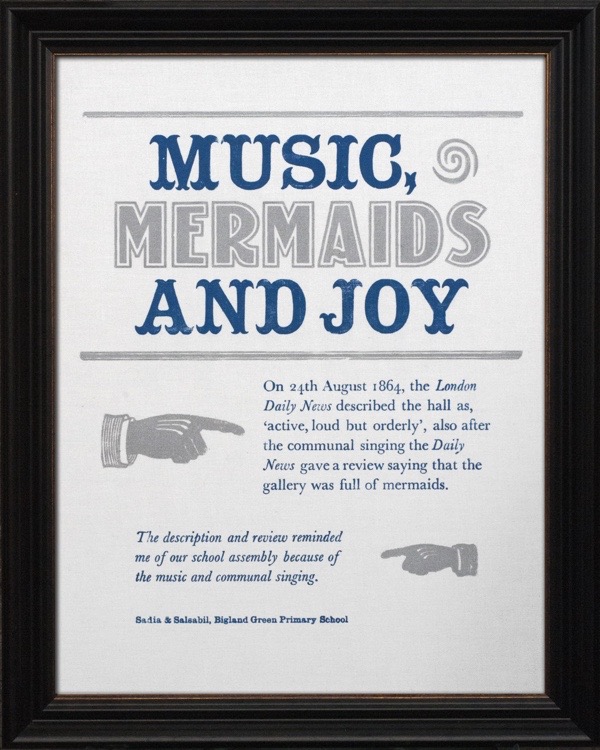
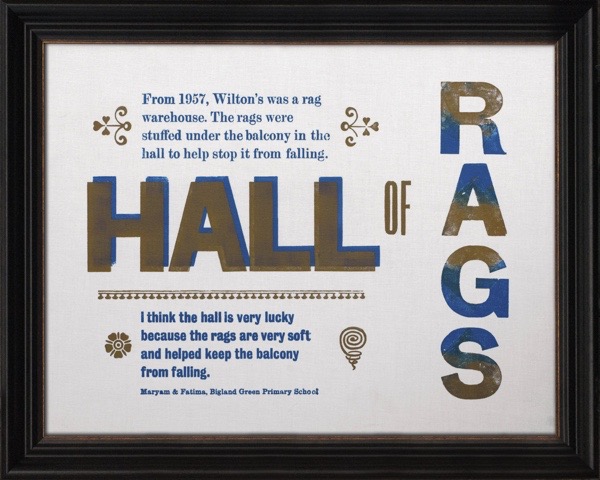
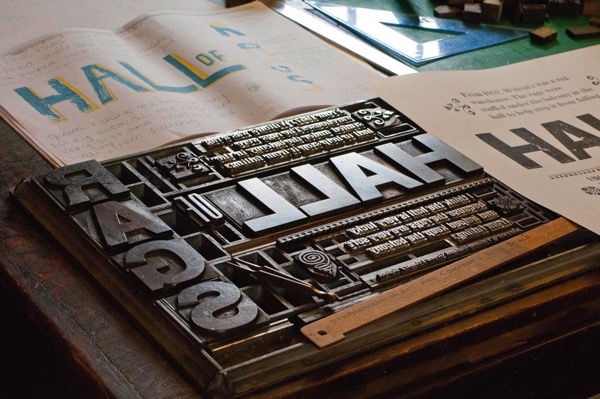
Designer, Typographer & Printer, Richard Ardagh of New North Press in Hoxton has collaborated with the pupils of Bigland School in Stepney to create these splendid letterpress signs for Wilton’s Music Hall, telling tales of its colourful history. Printed with wood blocks and metal type onto book cloth mounted on board in the nineteenth century manner, they are more than enough reason – should you ever require it – for a return trip to Wilton’s.
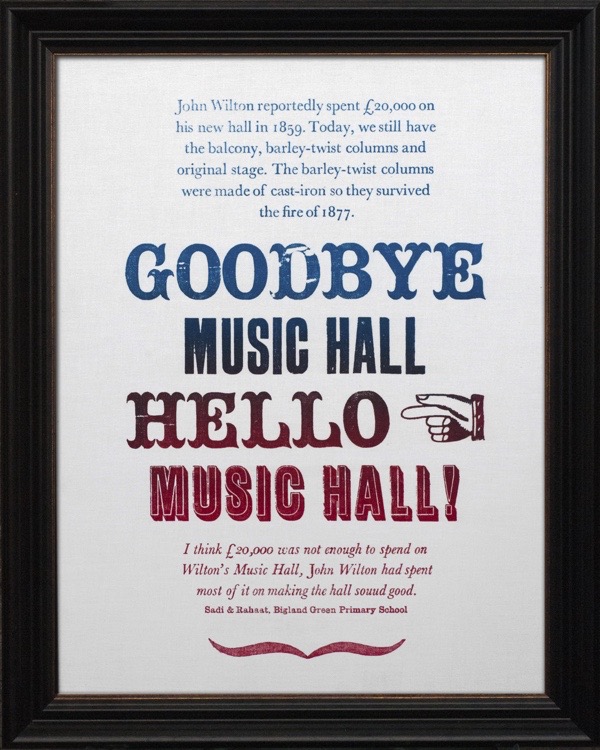
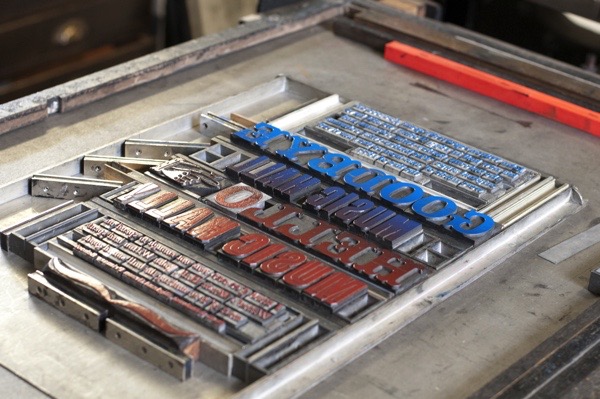
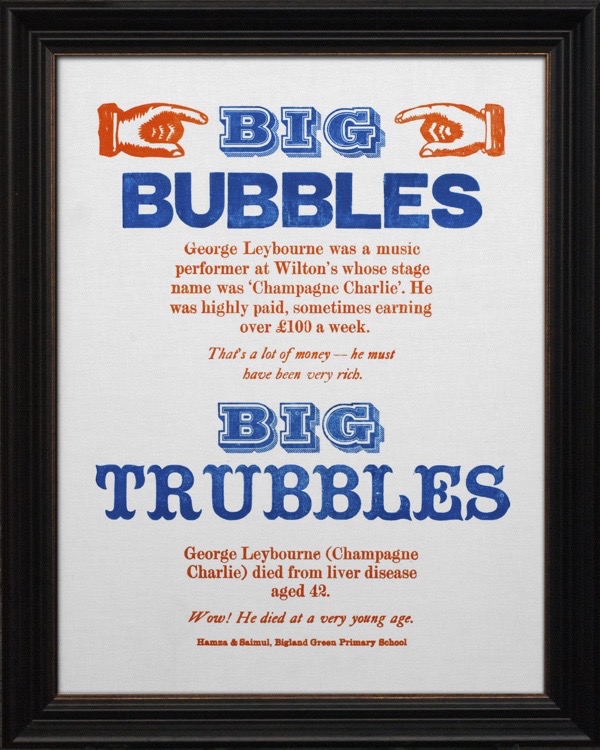
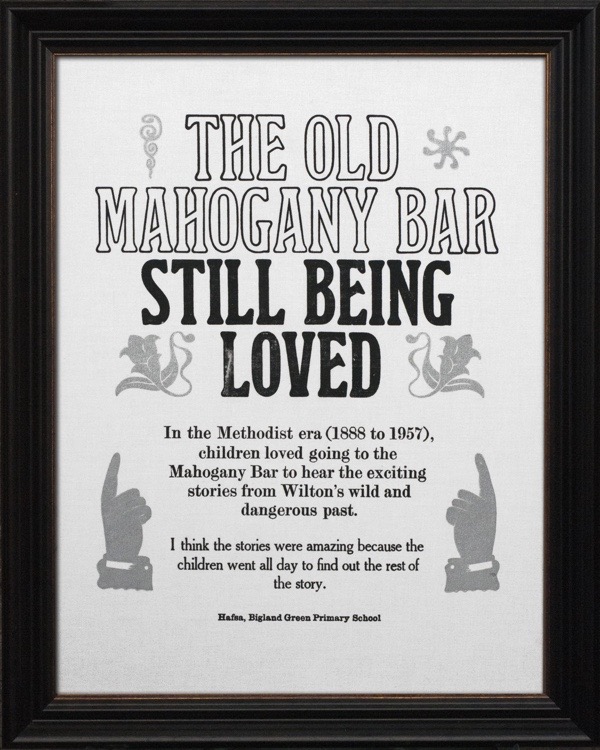
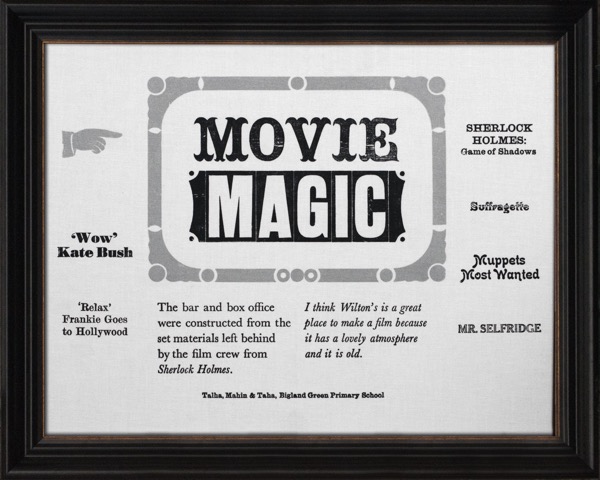
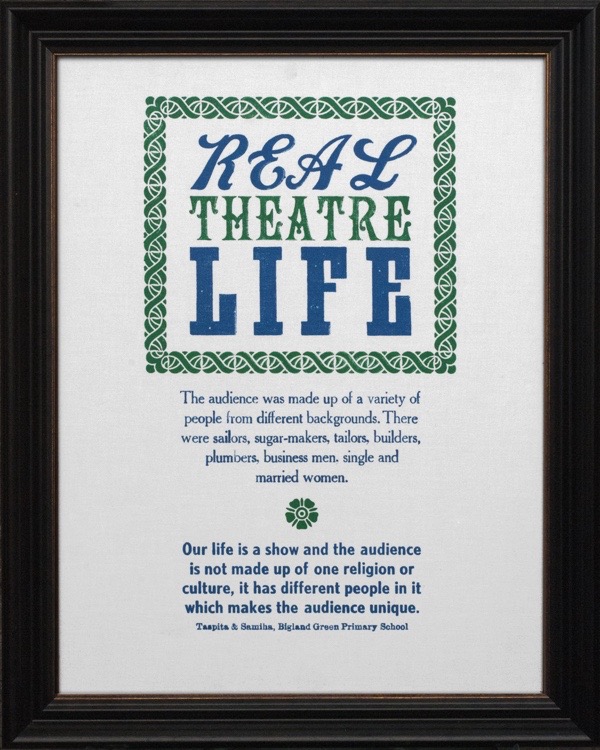
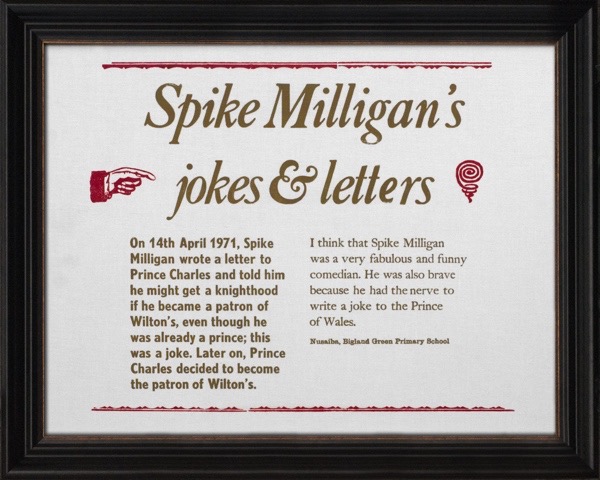
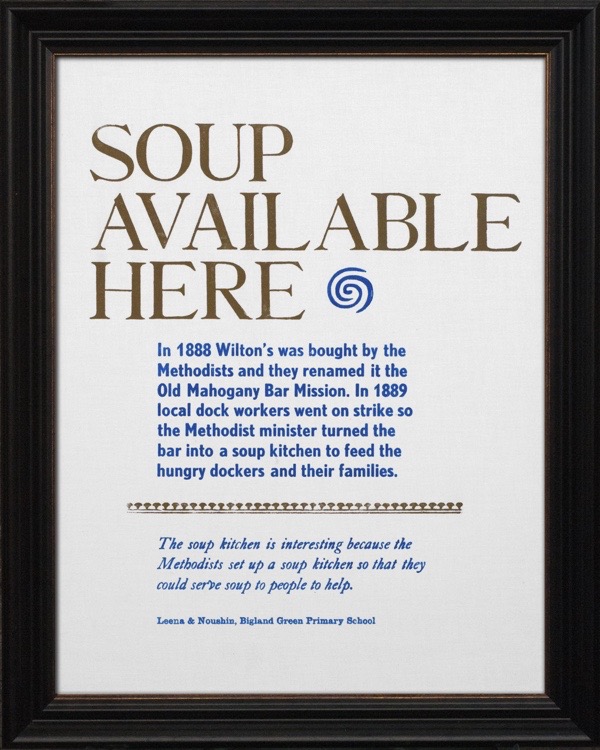
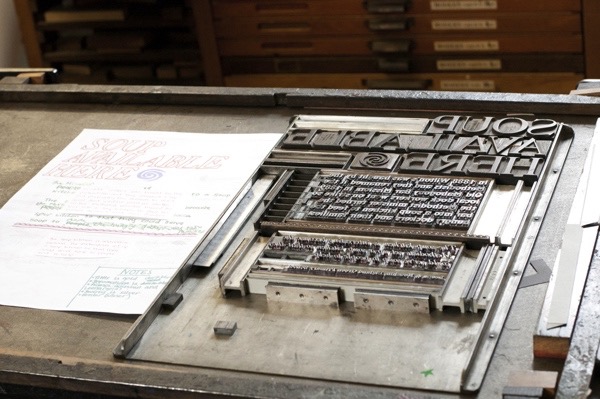
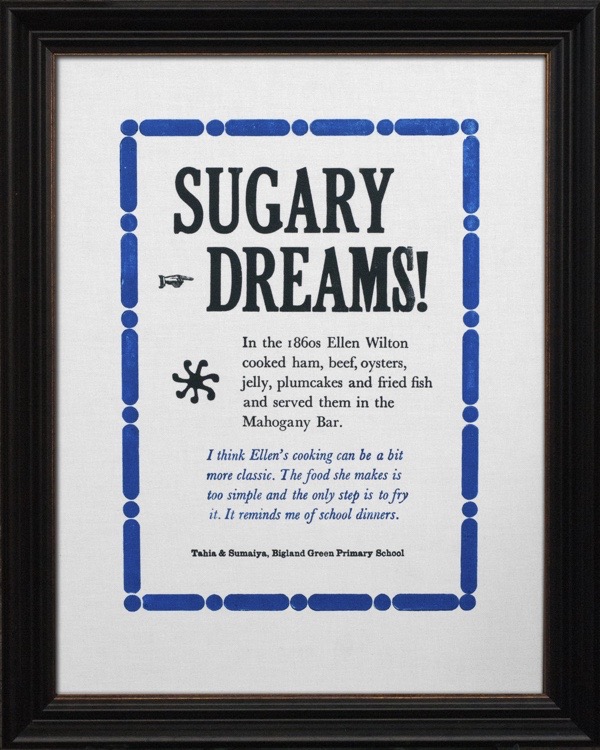
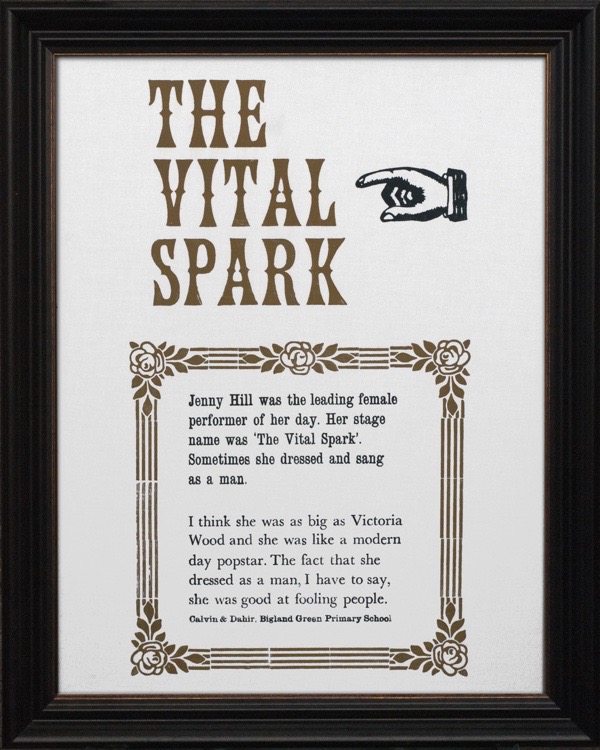
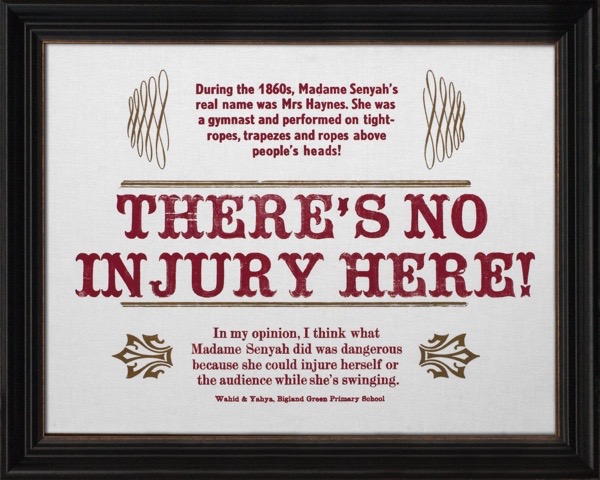
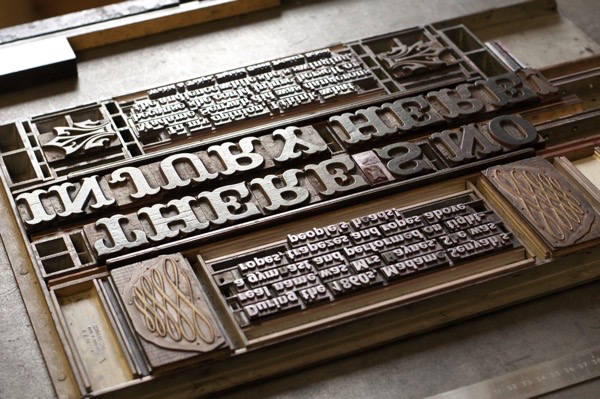
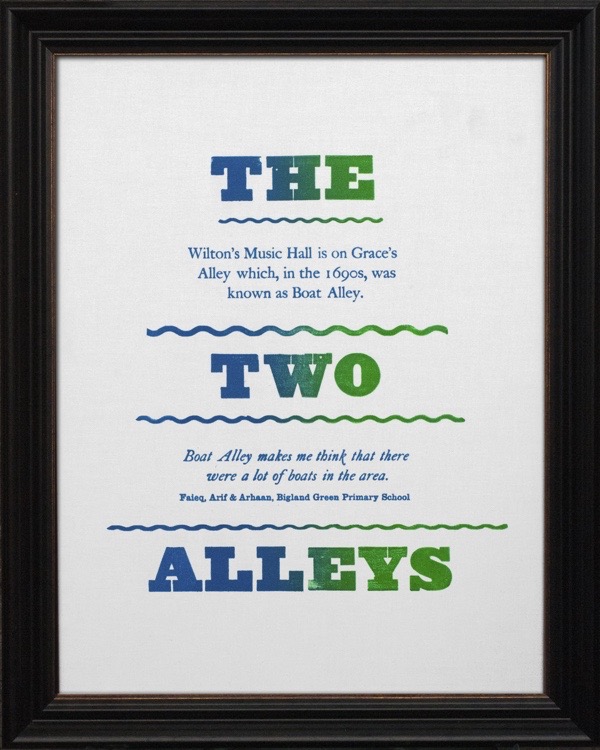
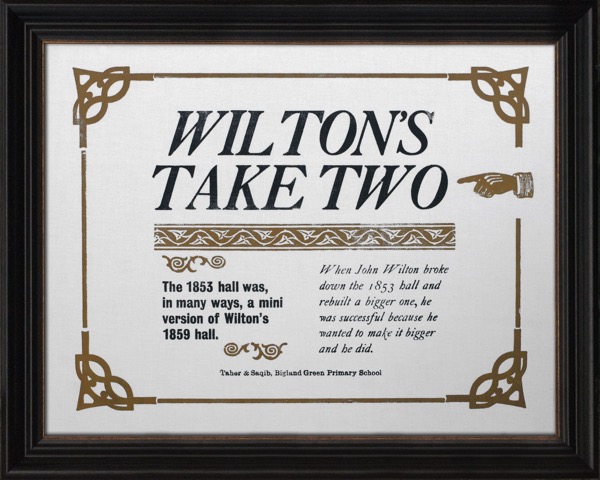
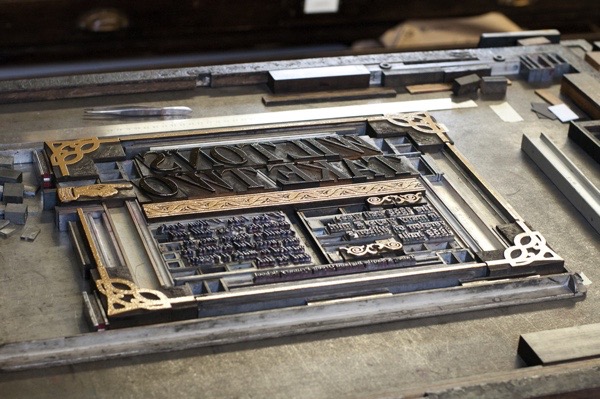
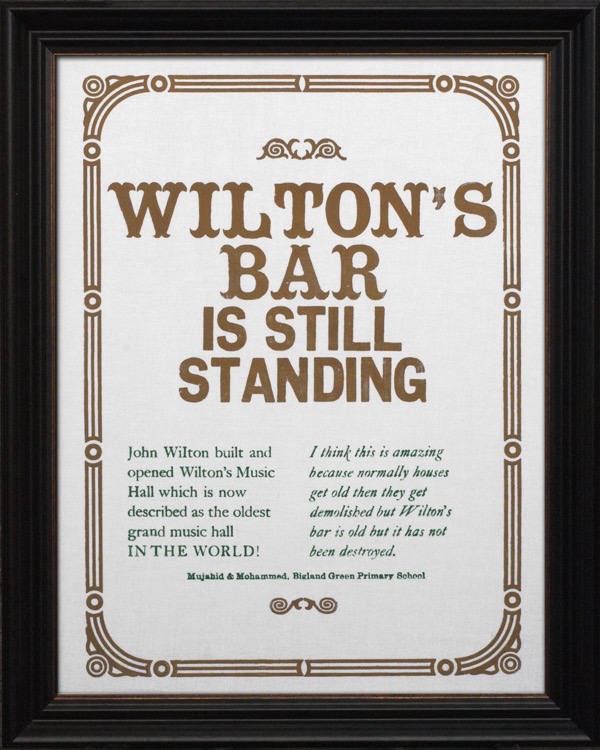
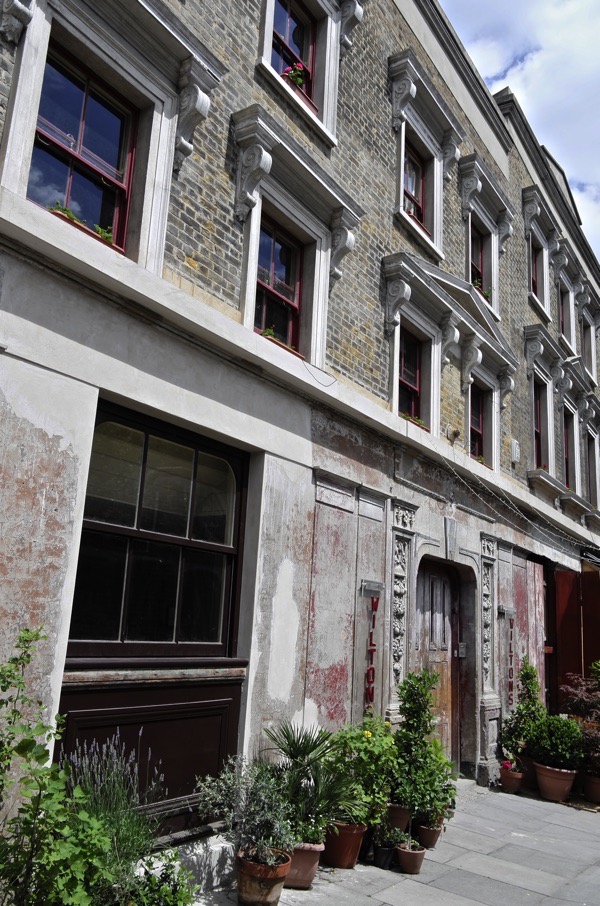
Visit Wilton’s Music Hall, Grace’s Alley, E1 8JB
You may also like to read about
Frances Mayhew, Wilton’s Music Hall
The Spitalfields Mulberry
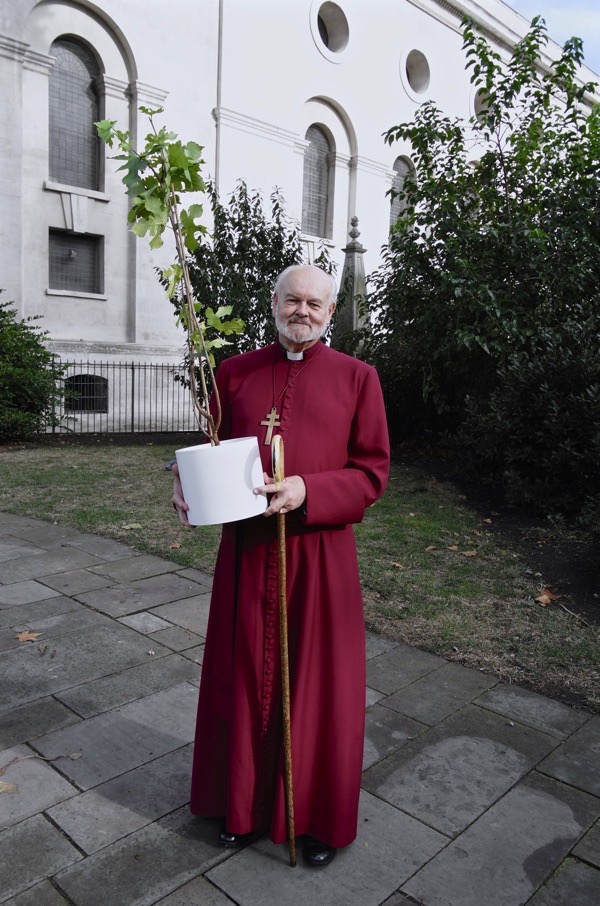
Yesterday, Richard Chartres, Bishop of London presented Christ Church, Spitalfields, with a Mulberry tree to plant in the churchyard in memory of the twenty-thousand Huguenot refugees that came here in the seventeenth century. It was both the eve of the anniversary of the Revocation of the Edict of Nantes on 18th October 1685, which became the catalyst for the mass migration of French Protestants, and the day upon which the United Kingdom accepted the first child refugees from the camp in Calais.
Of Huguenot descent himself, the Bishop was far from unaware of the significance of the timing of his action, describing the Mulberry tree as emblematic of the prosperity brought by migrants – as demonstrated by the affluence of the former Huguenot silk industry in Spitalfields. The Mulberry sapling itself was a scion of seventeenth century tree planted as one of London’s only functioning Mulberry plantation in Chelsea, offering homegrown sustenance to silk worms.
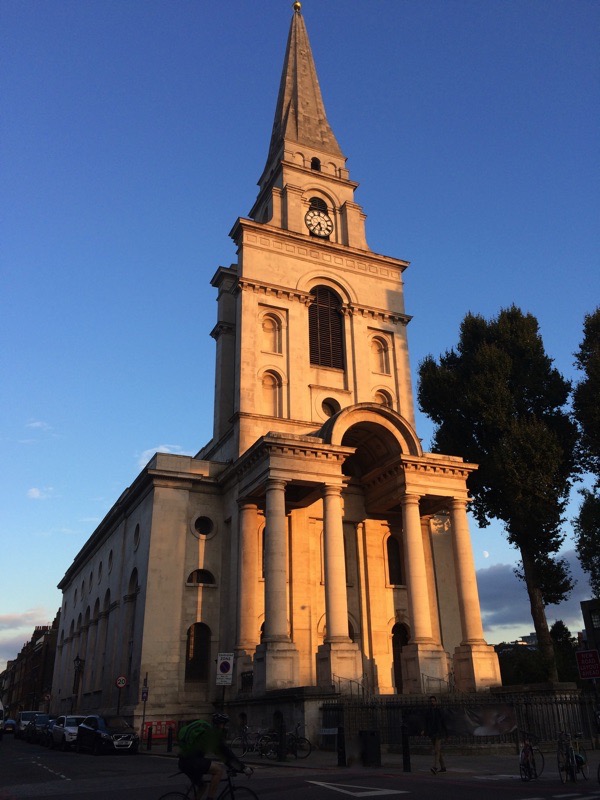
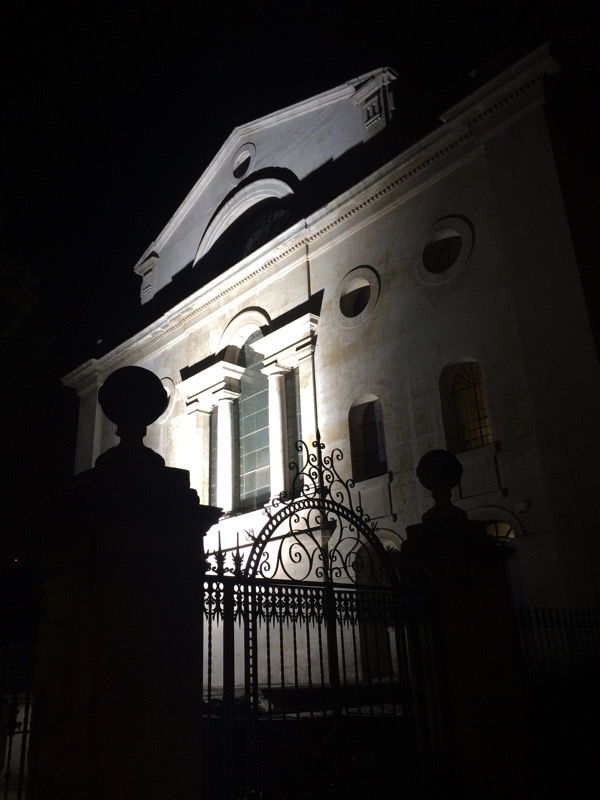
Christ Church, Spitalfields
You may like to read my other stories about Mulberry trees
The Oldest Mulberry in the East End
Happy Birthday, Mannie Blankett!
Please join me in sending many happy returns to Mannie on his ninety-nineth birthday today
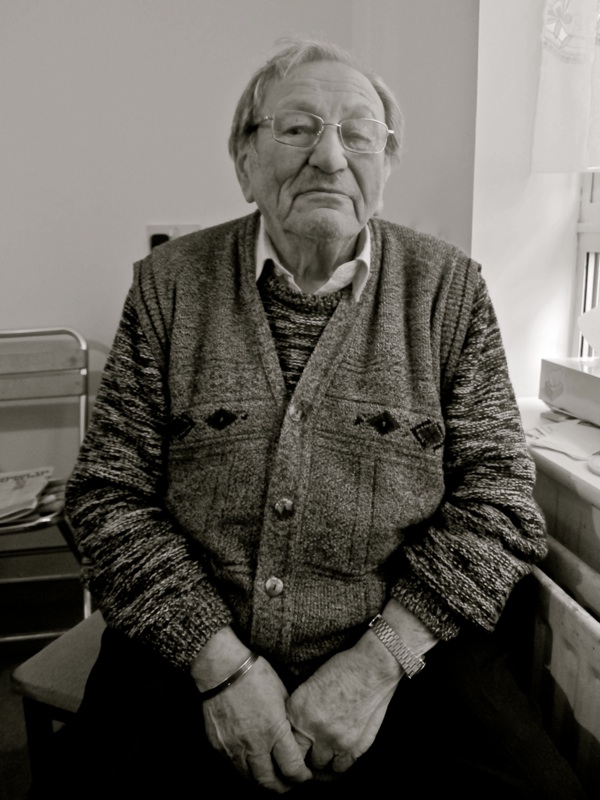
Mannie Blankett
“You can call me ‘Jack Of All Trades’ if you want,” suggested Mannie with a characteristic grin of self-effacement, when I asked his profession, as if he were more concerned to make things easier for me than to assert his accomplishments which include being a hairdresser, a furrier and lifeguard. Such is the philosophical detachment of one born in 1917, who saw the passage of the twentieth century, who is the last of a family of six children, and is a man at peace with himself.
While the afternoon light faded outside, I was privileged to spend a few hours with Mannie in the peace of his modern flat looking down upon the Petticoat Lane Market.
“As a youngster, I remember going to the Pavilion Theatre in the Whitechapel Rd and seeing the boxing and wrestling. It was full of people and very popular. That was a long time ago, the end of the thirties, so you can imagine how old I am. The boxing ring was in the middle of the theatre with seats all round and upon the stage. It can’t have been expensive because I didn’t have anything. It must have been pennies. I remember an American boxer came over called ‘Punchy’ Paul Shaffer who knocked out all his opponents in the first round and there was Max Krauser the wrestler, a heavyweight who won all his fights.
I was born in Jamaica St and I left the East End at twenty years old, when the family moved to Stamford Hill in 1937. Jamaica St had all these bug-ridden houses then. We used to call them ‘red bugs,’ and they came out in the summer. Six of us shared a three bedroom house and we had no back garden or bathroom, and we had an outside toilet. Opposite, there was company that did deliveries by horse and cart, collecting and transporting goods. There were few cars around then, very few people had them, just the milkman, the baker and the coalman. I wish I could remember more about the old days. As a kid, my mother used to take me up to Brick Lane to buy clothes and I remember the market in Whitechapel all along Mile End Waste
My parents came from Poland. My father Harry was a furrier who had his own business in the West End and my mother Sarah had six children to bring up. Blankett & Sons had workshops around Oxford St and Soho, and I had a brother who worked there with my father. I went to South St School, then I won a scholarship to Mile End School in Myrdle St and I was supposed to stay until sixteen, but my mother took me out at fourteen. I didn’t want to work as a furrier, instead I worked as a hairdresser all over the East End, before my mother sent me to a hairdressing school to learn my trade for three years but I wasn’t keen on that – the hours were very long, eight in the morning until eight at night – so I went into the family business after all.
I worked there for a couple of years and I learnt all the parts of the trade, making patterns, cutting and nailing. At lunchtimes, I used to go swimming and sunbathing at the Serpentine Lido and I got chatting with the attendant and he said there was a job going as a lifeguard and suggested I apply. I worked at the Lido for five years, it was a seasonal job from Easter until September. At school, I had learnt to swim and won a bronze medal for lifesaving. I was in my late teens and I loved that job. In our English summers, you get weeks of rain and we used to sit and play chess all day.
I always wanted to travel and, one day, I saw an advert in the London Times offering return tickets to India for seventy-five pounds. So I got a ticket and it was to travel overland, so it took a month just to get there! I met this young lady, Pat Evans, and we used to write to each other. When I went to India, I gave up my flat in Blandford St, so she said, ‘When you come back you can stay at my place in Croydon for a night, if you need somewhere.’ I stayed ten years until she died. She used to do a bit of writing, she wrote stories and poems for magazines and had quite a few published. In Croydon, I got a job at the swimming pool in Purley Way, opposite where the old airport and I was there for five years.
I got called up in 1943 for three years and, when I came out, I did a bit of hairdressing and part-time work in the family business to get by. In the sixties, I worked in Housman’s Radical Bookshop in the Caledonian Rd and I was in the Peace Movement. I joined Campaign for Nuclear Disarmament and became one of the Committee of One Hundred, including Bertrand Russell, Arnold Wesker, Christopher Logue and Vanessa Redgrave. We had demonstrations and, when they were arrested, we would step in to fill their places – I was arrested a number of times too.
When I was in Croydon, I got friendly with a guy who liked to dress up in uniform and do historical re-enactments, and he told me there was a VE Day Celebration coming up in the East End and they had two big bands playing including one led by Glenn Miller’s brother. So we went along and I met this woman who lived in Petticoat Sq. She was called Rene Rabin and that was twenty-five years ago. That was how I came back to the East End, to live in Middlesex St. Now I’ve lived in Petticoat Lane for twenty years and I like it round here. I have travelled a full circle in my life. “

Mannie with his sister Anne and their parents Sarah and Harry Blankett in the thirties
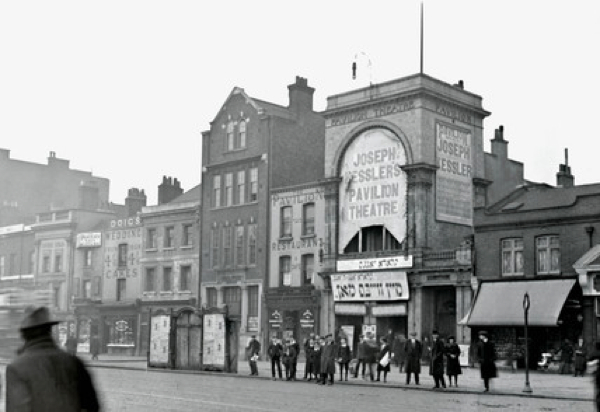
The Pavilion Theatre as Mannie knew it in the thirties
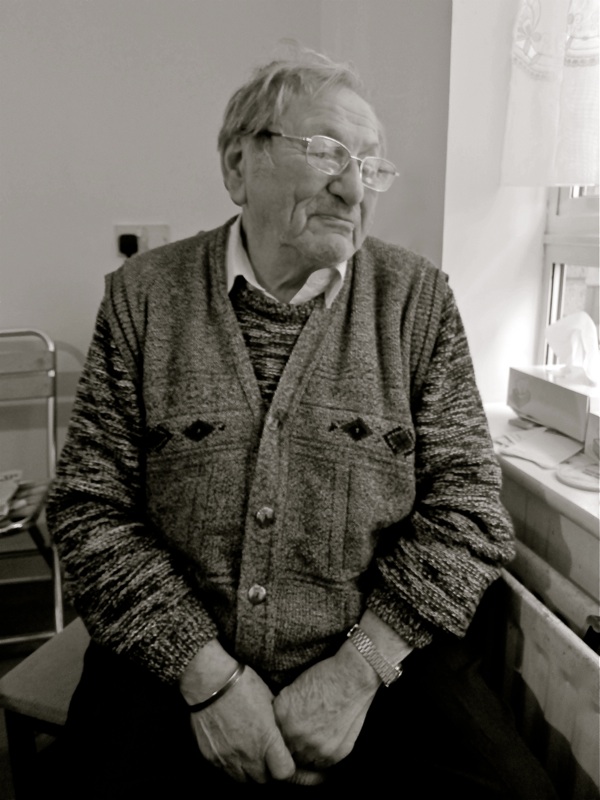
In his flat in Petticoat Sq, Mannie Blankett looks down upon the Petticoat Lane Market
You may also like to read these other Petticoat Lane Stories
Laurie Allen of Petticoat Lane
Two Favourite Blogs
With another of my Spitalfields Blog Courses coming up on November 19th & 20th, it is my pleasure to present recent work by two of my unashamedly favourite alumni – The Bug Woman and A London Inheritance. Click here for more information about the Course

BUG WOMAN, ADVENTURES IN LONDON, Because a Community is More Than Just People
THE FOX & THE MOURNER
I visited St Pancras & Islington cemetery on Sunday and, as usual, I found the human behaviour just as fascinating as that of the animals. For some, grave visiting has obviously just become a duty that cannot be shirked – I once saw somebody lob a bunch of flowers from their car window onto a grave and then drive off. For others, it is almost a social occasion, with people gathering by the grave for a chat and a party – this is the case with one lad who died when he was just a teenager. His mother, still a young woman herself, comes every weekend and assorted friends and relatives are always sitting next to her on the bench and chatting.
For the newly bereaved, dressed in tell-tale black, it is the bleakest of times, a period when not even the sun will make an impact. My heart goes out to these people as they trudge along the still-unfamiliar byways of the cemetery, sometimes getting lost. It always surprises me that the human body can sustain such sorrow without collapsing. Such a soul, wearing a black parka on this warm day, passed me as I walked towards the crematorium. I glanced at her to see if she wanted to speak but she was so deep in her thoughts that she passed without a word. In her, I saw all of us at some time in our lives and her misery touched me deeply.
I am not sure if it was my encounter with the mourner that coloured my perception but when I saw a lone man walking towards me, I was suddenly on my guard. He continued to approach and then stopped suddenly. There was no one else around. Why had he stopped and why was he looking at me? Then I saw the head of a fox less than twenty feet away, peeking round behind a gravestone. The man raised his eyebrows, gesticulated towards the fox and then to the camera around my neck. He was trying to tell me that there was something worth photographing.
The fox had the long legs and skinny body of this year’s cubs and I was sure that I had seen her before over at the feeding station. She seemed to be adept at finding her own food. There was an area between two graves that had been scratched to pieces – it could have been a site where the fox had been digging for worms, which make up a surprisingly high proportion of their diet at this time of year. Yet, as we watched – the man and I – the fox went to a nearby grave and carried off a small mouse, throwing the corpse into the air a few times and then tossed it about with her front paws, until finally chomping it down. All the time she kept her gaze on us, but made no attempt to run away.
A young woman walked down the road, tapping away on her phone. She looked up and stopped. Now, three of us were frozen looking at the fox which moved off and crossed the path. I squatted down and she paused, looking at me with nervous interest. The vixen walked in a circle, paused to squat and urinate, before crossing the road again and sitting down in some bushes less than a metre from the road. That was when I saw the mourner in the black parka again. She stopped when she saw us. Behind her spectacles, her eyes were bloodshot with crying.
‘How can I get to Lygoe Rd?’ she asked. I pointed her in the right direction – Lygoe Rd is one of the main thoroughfares in the cemetery. The fox watched the conversation with interest, even turning her head to look at where I was pointing.
Then the woman headed off to visit the grave of someone that she could barely believe was gone forever. I would like to say that she glanced at the fox and that its inquisitive face brought her the smallest of smiles or at least jolted her out of her sadness for a split-second. Yet one day, I hope that she will notice a frosted russet face watching her from a hedge and feel just the smallest of lifts, like the sudden warmth when sun breaks through the clouds. As I watched the black-coated shape turn the corner and disappear from view, I wished her strength and the slow-blooming of hope, and the birth of better days. I wish that for all of us.


A LONDON INHERITANCE, A Private History of a Public City
A VISIT TO THE LANSBURY ESTATE

Click image to enlarge
On the 29th May 1946, the London County Council applied to the Minister of Town & Country Planning for 1,945 acres of Stepney and Poplar to be declared an area of comprehensive development under the 1947 Town and Country Planning Act. The London Docks, plus the presence of industry and the density of population, meant that the East End was a prime target during the last war – with large areas in need of urgent reconstruction by the late forties. Of the total request, 1,312 acres were declared to be an area of ‘Comprehensive Development’ which meant that redevelopment of the area could be planned and implemented as an integrated project with zoning of space and allocation to specific functions such as shops, housing, schools etc.
The plans acknowledged that despite the way the city had grown, strong local communities had developed and it was important that these were retained during future development. Eleven new neighbourhoods were planned for Stepney and Poplar, each would be developed as if it were a small town with the appropriate local facilities of schools, shops, churches and public space.
An Exhibition of Architecture was planned for the Festival of Britain and in 1948 the Council for Architecture, Town Planning & Building Research proposed that one of the neighbourhoods to be developed in Stepney and Poplar would be an ideal site to demonstrate the latest approach to town planning, architecture and building.
The ‘Lansbury’ neighbourhood in Poplar was chosen, named after George Lansbury who had a long association with Poplar, as the Poplar member for the Board of Guardians of the Poor, on the Poplar Borough Council, the first Labour Mayor in 1919 and Labour MP for Poplar until his death in 1940
The ‘Lansbury Exhibition of Architecture’ would show how town planning and scientific building principles could provide a better environment in which to live and work, and how this could be applied to the redevelopment of London and the new towns planned across the country.
The map gives the impression that this was a fully-finished site. Although construction of many of the buildings had been rushed through ready for the start of the exhibition, work on many others was still in progress and did not reach completion until the closure of the exhibition. A criticism at the time was that the route around the site was hard to follow with lack of clear sign-posting, while the white direction lines painted on the ground became unclear. To explore the Exhibition of Architecture, I took my copy of the guide and arrived on the Dockland Light Railway at All Saints station to undertake the path of the 1951 Festival route.
The impact of the Lansbury development was unpopular with many existing residents. A large number were moved to allow for rebuilding to take place. By November 1950, five hundred and thirty-three people had gone and LCC policy was that people were relocated to the next available accommodation. This meant the residents of the Lansbury site were scattered across London. This situation was made worse when the new buildings were ready for occupation, since priority was not given to original residents – rather Lansbury became part of the overall LCC pool of housing.
The general view of the architecture at Lansbury at the time was that it was “worthy but dull.” Whilst the estate consisted of buildings ranging from two storey houses up to six storey flats, the overall design was almost uniform and use of the same coloured brick throughout resulted in a lack of architectural diversity.
Following closure of the Exhibition of Architecture, Lansbury became simply one among many LCC development sites, with construction continuing through the following decades, filling in the area between the Market and the East India Dock Rd, building north to the Limehouse Cut and west to Burdett Rd. Yet time does not stand still for Lansbury and today the Chrisp St Market area is itself threatened by new development.
[youtube KoRoxzhBP-Q nolink]
This Children’s Film Foundation film from the fifties shows Chrisp St Market and the Lansbury Estate
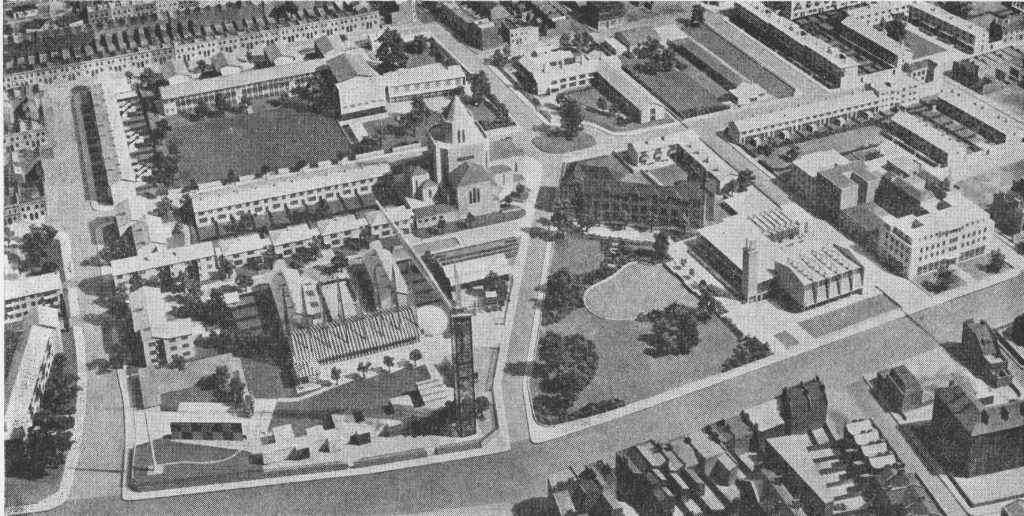
A model of the area
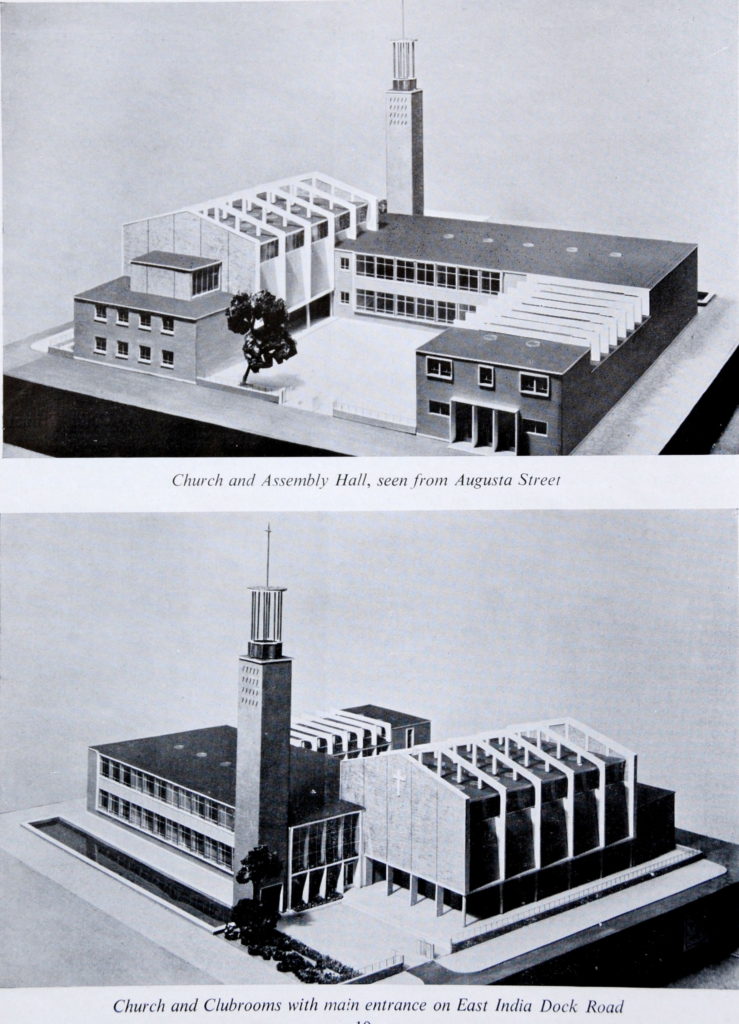
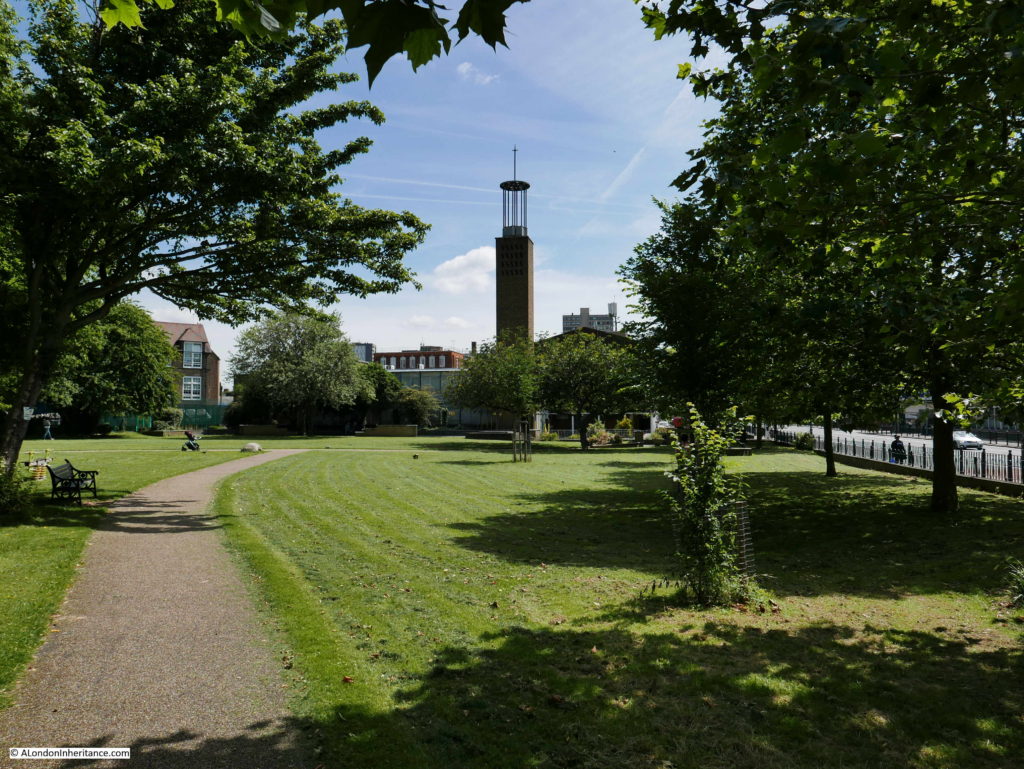
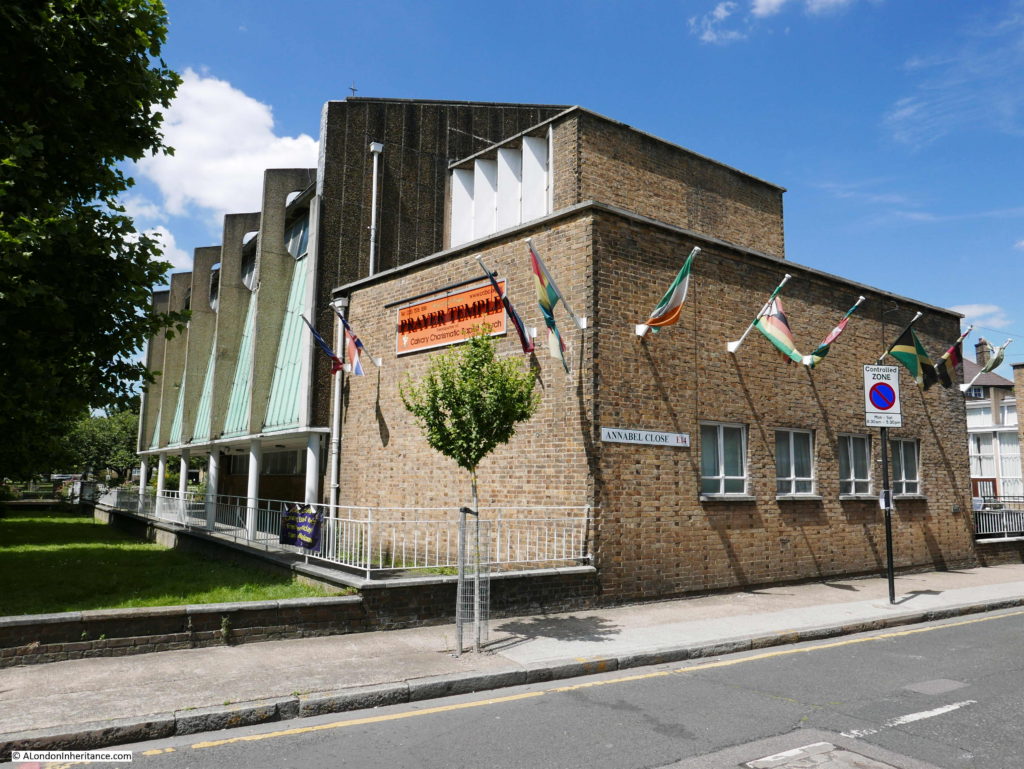
The church today
The assembly hall today
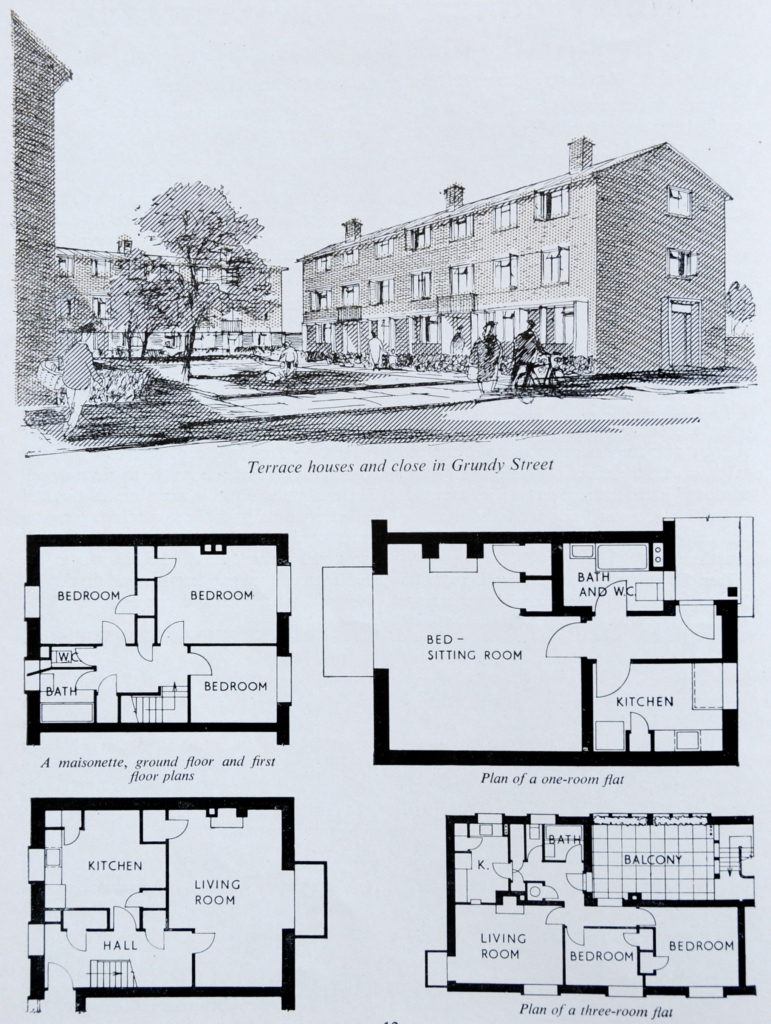
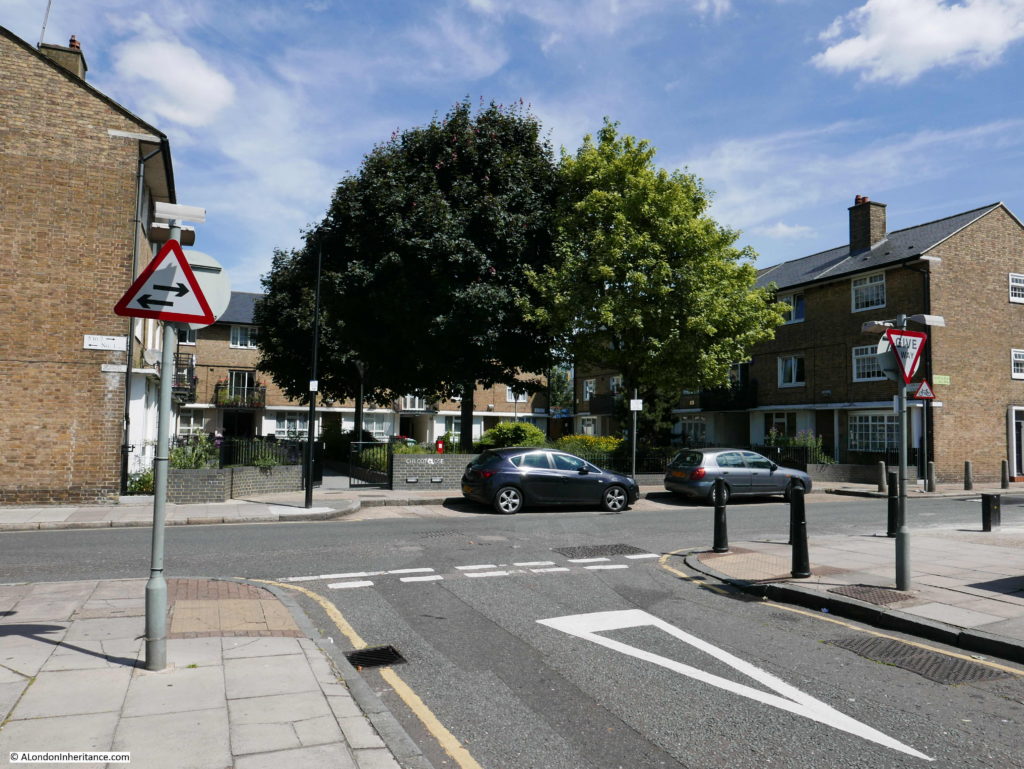
The same houses in Grundy St today
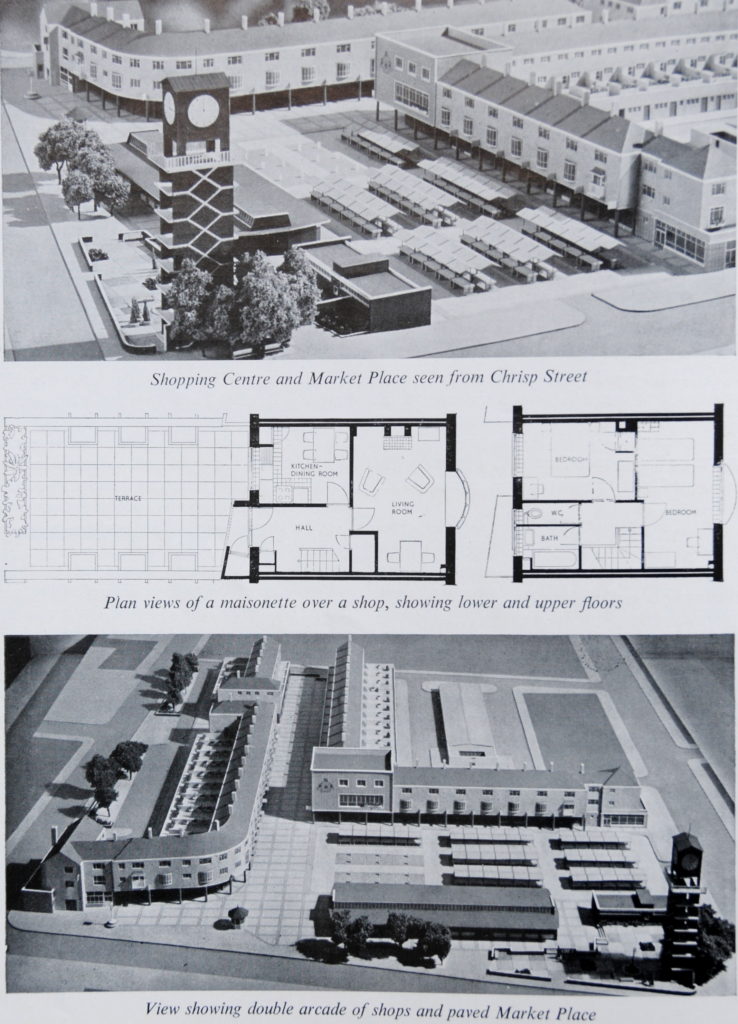
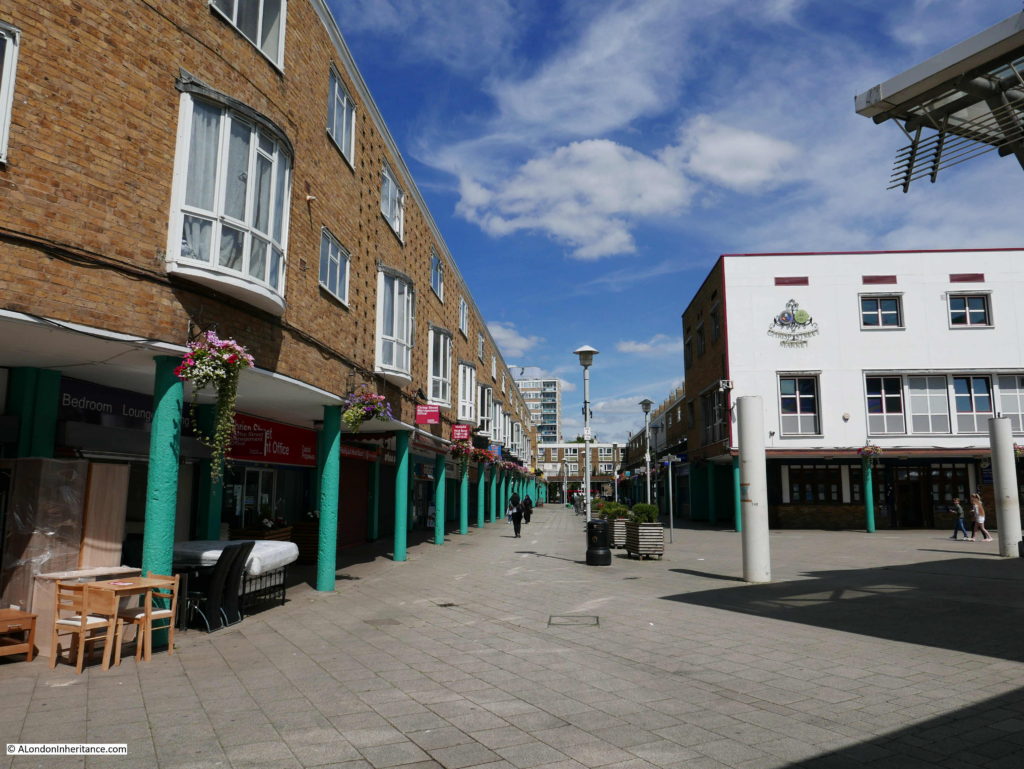
Chrisp St Market today
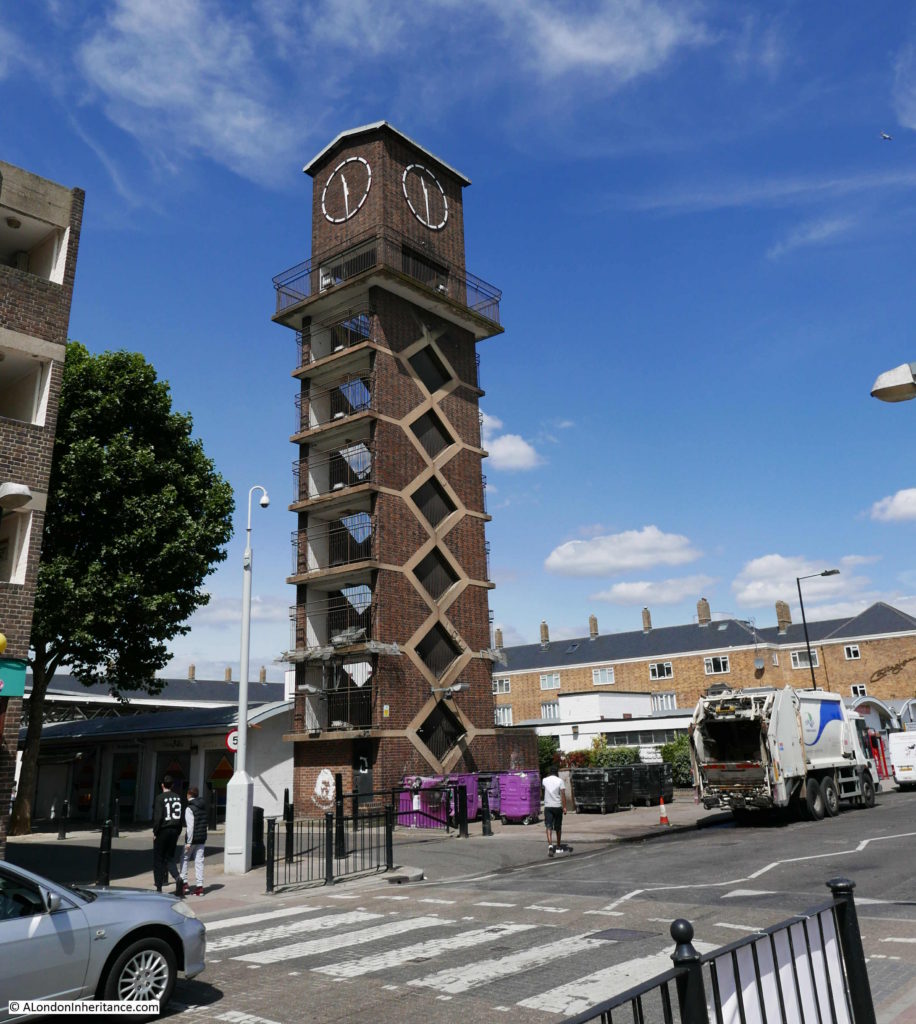
At the corner of the market, alongside Chrisp St is the clock tower built as a key feature of the market. Running up the centre of the tower are two interlocking staircases built of reinforced concrete leading up to the viewing gallery and clock mechanism. The two staircases only met at the top and bottom of the tower so that those walking up would use one staircase and those walking down would use the second – a clever design to avoid congestion on the stairs.
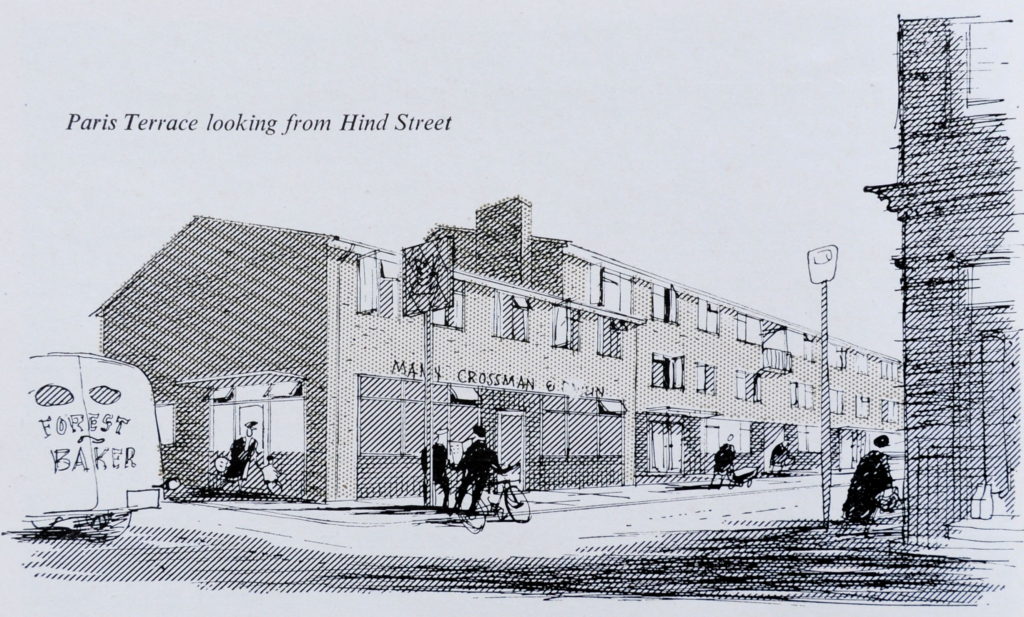
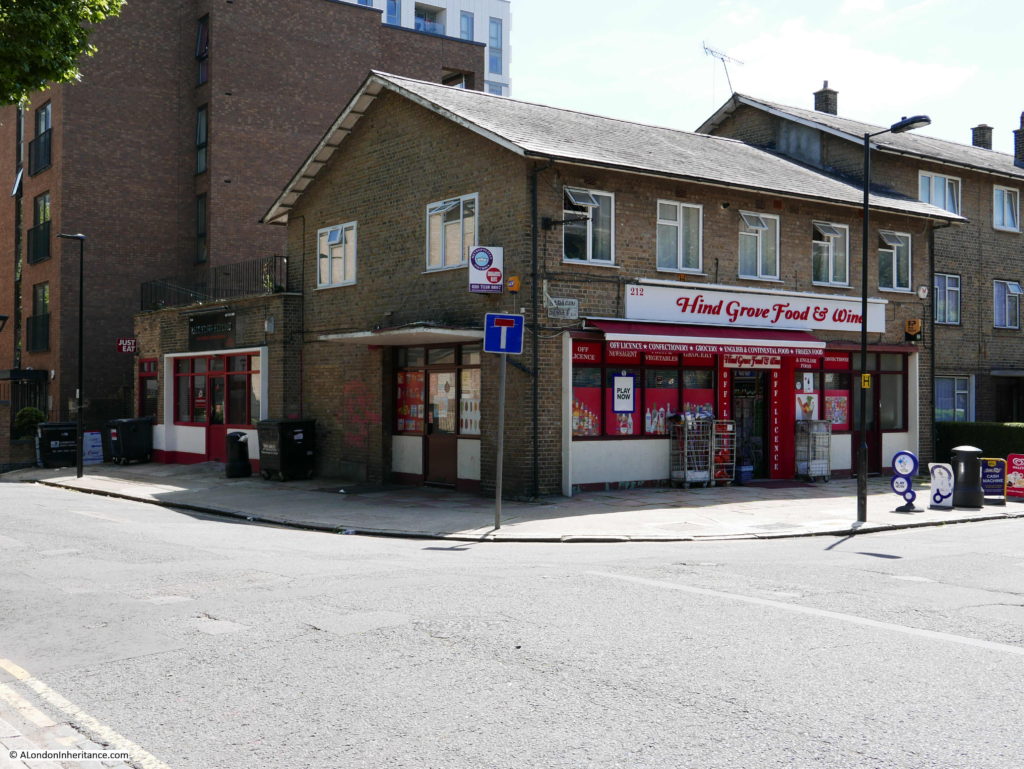
Paris Terrace today
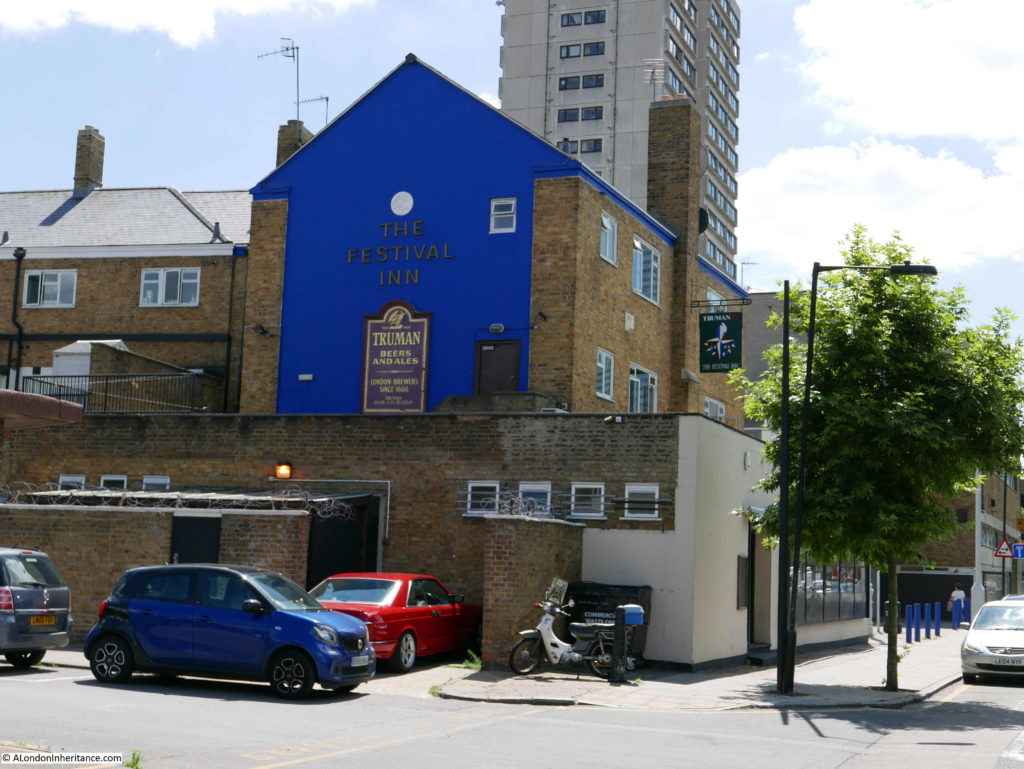
The Festival Inn is on the edge of the Shopping Centre and Chrisp St Market (point 16 on the map) Although the pub sign still uses the festival symbol, there was originally a free standing pub sign consisting of a pole with at the top the model of a group of Londoners dancing around the Skylon.

HOW TO WRITE A BLOG THAT PEOPLE WILL WANT TO READ – 19th & 20th NOVEMBER
Spend a weekend in an eighteenth century weaver’s house in Spitalfields and learn how to write a blog with The Gentle Author.
This course will examine the essential questions which need to be addressed if you wish to write a blog that people will want to read.
“Like those writers in fourteenth century Florence who discovered the sonnet but did not quite know what to do with it, we are presented with the new literary medium of the blog – which has quickly become omnipresent, with many millions writing online. For my own part, I respect this nascent literary form by seeking to explore its own unique qualities and potential.” – The Gentle Author
COURSE STRUCTURE
1. How to find a voice – When you write, who are you writing to and what is your relationship with the reader?
2. How to find a subject – Why is it necessary to write and what do you have to tell?
3. How to find the form – What is the ideal manifestation of your material and how can a good structure give you momentum?
4. The relationship of pictures and words – Which comes first, the pictures or the words? Creating a dynamic relationship between your text and images.
5. How to write a pen portrait – Drawing on The Gentle Author’s experience, different strategies in transforming a conversation into an effective written evocation of a personality.
6. What a blog can do – A consideration of how telling stories on the internet can affect the temporal world.
SALIENT DETAILS
The course will be held at 5 Fournier St, Spitalfields on 19th & 20th November from 10am -5pm on Saturday and 11am-5pm on Sunday. Lunch will be catered by Leila’s Cafe of Arnold Circus and tea, coffee & cakes by the Townhouse are included within the course fee of £300. Email spitalfieldslife@gmail.com to book a place on the course.