In A Dinghy With John Claridge
You have until July 21st to visit John Claridge’s EAST END photography exhibition at Vout-O-Reenee’s in Aldgate and there are still tickets available for the EAST END documentary film show introduced by David Collard at Vout-O-Reenees this Thursday 14th July at 7pm. (Email info@vout-o-reenees.co.uk to reserve your free ticket)

Ship maintenance, 1964
Take a trip down the Thames at a relaxed pace with Photographer John Claridge, in his tiny inflatable dinghy with outboard motor attached. The journey begins in 1961 when the London Docks were still working and ends in the nineteen eighties once they were closed for ever. This set of photographs – published here for the first time – are some of the views to be seen on that voyage.
Setting out at dawn, John’s photographic adventures led him through smog and smoke, through early morning mist, through winter fog and haze upon the river, all filtering and refracting the light to create infinite luminous effects upon the water. In the previous century, Joseph Mallord William Turner and James McNeill Whistler had attempted to evoke the distinctive quality of Thames light upon canvas, but in the mid-twentieth century it was John Claridge, kid photographer from Plaistow, who came drifting out of the London fog, alone in his dinghy with camera and long lens in hand to capture his visions of the river on film.
Look, there is a man scraping an entire boat by hand, balanced precariously over the water. Listen, there is the sound of the gulls echoing in the lonely dock. “It smells like it should,” said John, contemplating these pictures and reliving his escapades on the Thames, half a century later, “it has the atmosphere and feeling of what it was like.”
“You still had industry which created a lot of pollution, even after the Clean Air Act,” he recalled, “People still put their washing out and the dirt was hanging in the air. My mum used to say, ‘Bloody soot on my clean clothes again!'” But in a location characterised by industry, John was fascinated by the calm and quiet of the Thames. “I was in the drink, right in the middle of the river,” John remembered fondly, speaking of his trips in the dinghy, “it was somewhere you’d like to be.” John climbed onto bridges and into cranes to photograph the dock lands from every angle, and he did it all with an insider’s eye.
Generations of men in John’s family were dock workers or sailors, so John’s journey down the Thames in his dinghy became a voyage into a world of collective memory, where big ships always waited inviting him to depart for distant shores. Yet John’s little dinghy became his personal lifeboat, sailing on beyond Tower Bridge where in 1964, at nineteen years old, he opened his first photographic studio near St Paul’s Cathedral. John found a way to fulfil his wanderlust through a professional career that included photographic assignments in every corner of the globe, but these early pictures exist as a record of his maiden voyage on the Thames.

Across the River, 1965

Gulls, 1961

Quiet Evening, 1963

Smog, 1964

At Berth, 1962 – “It wills you to get on board and go somewhere.”

Three Cranes, 1968

Skyline, 1966 – “I climbed up into a crane and there was a ghostly noise that came out of it, from the pigeons roosting there.”

Steps, 1967

Crane & Chimney Stack, 1962

Spars, 1964


After the Rain, 1961

Capstan, 1968

From the Bridge, 1962

Across the River, 1965

Wapping Shoreline, 1961 – “I got terribly muddy, covered in it, sinking into it, and it smelled bad.”

Thames Barrier, 1982

At Daybreak, 1982

Warehouses, 1972
Photographs copyright © John Claridge
You may also like to take a look at
Along the Thames with John Claridge
At the Salvation Army with John Claridge

George Cruikshank’s London Summer

JULY 1838 – Flying Showers in Battersea Fields
Should you ever require it, here is evidence of the constant volatility of English summer weather, courtesy of George Cruikshank’s Comic Almanack published by Henry Tilt of Fleet St annually between 1835 & 1853, illustrating the continuum of festivals and seasons of the year for Londoners. (Click on any of these images to enlarge)

JUNE 1835 – At the Royal Academy

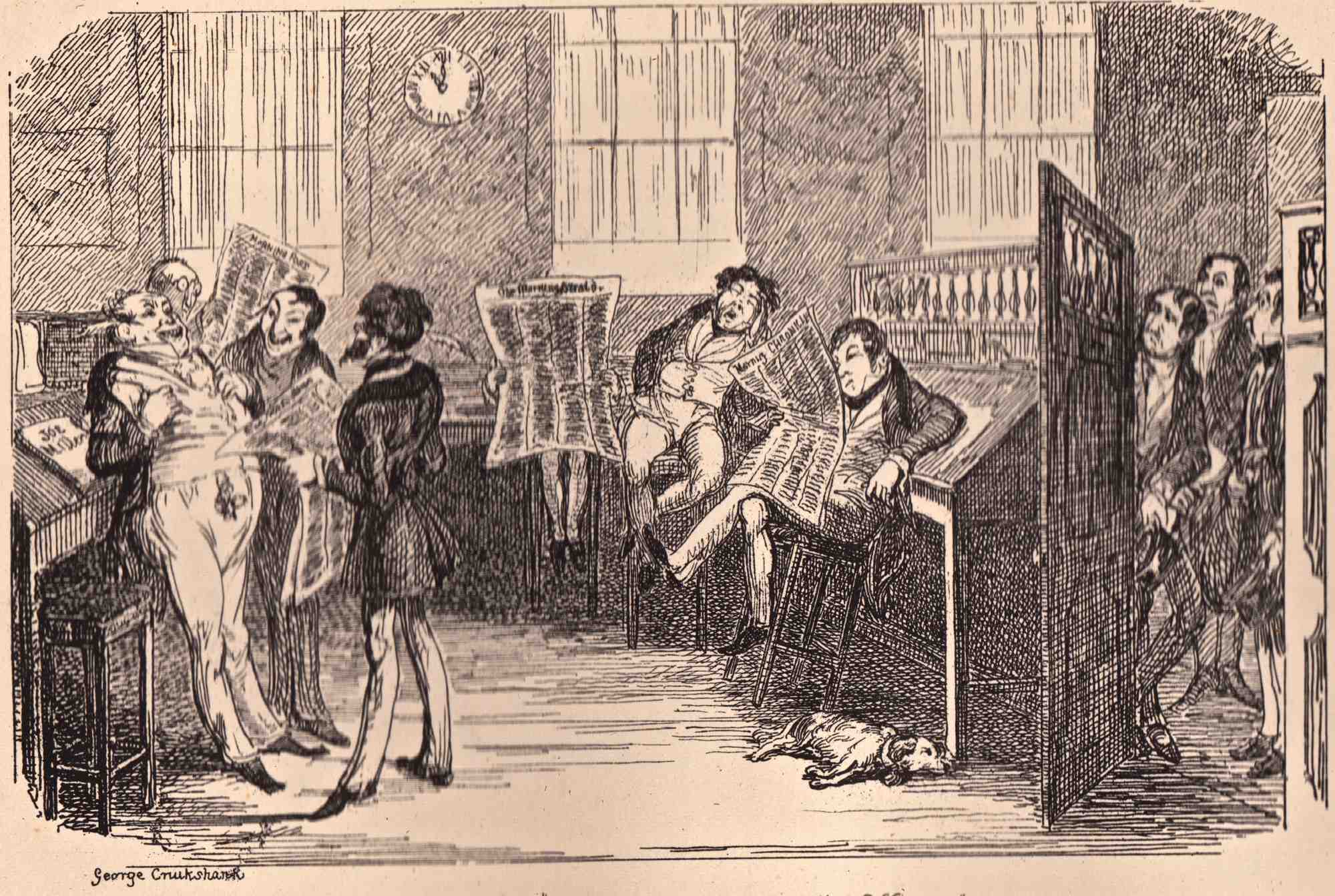
JUNE 1836 – Holidays at the Public Offices

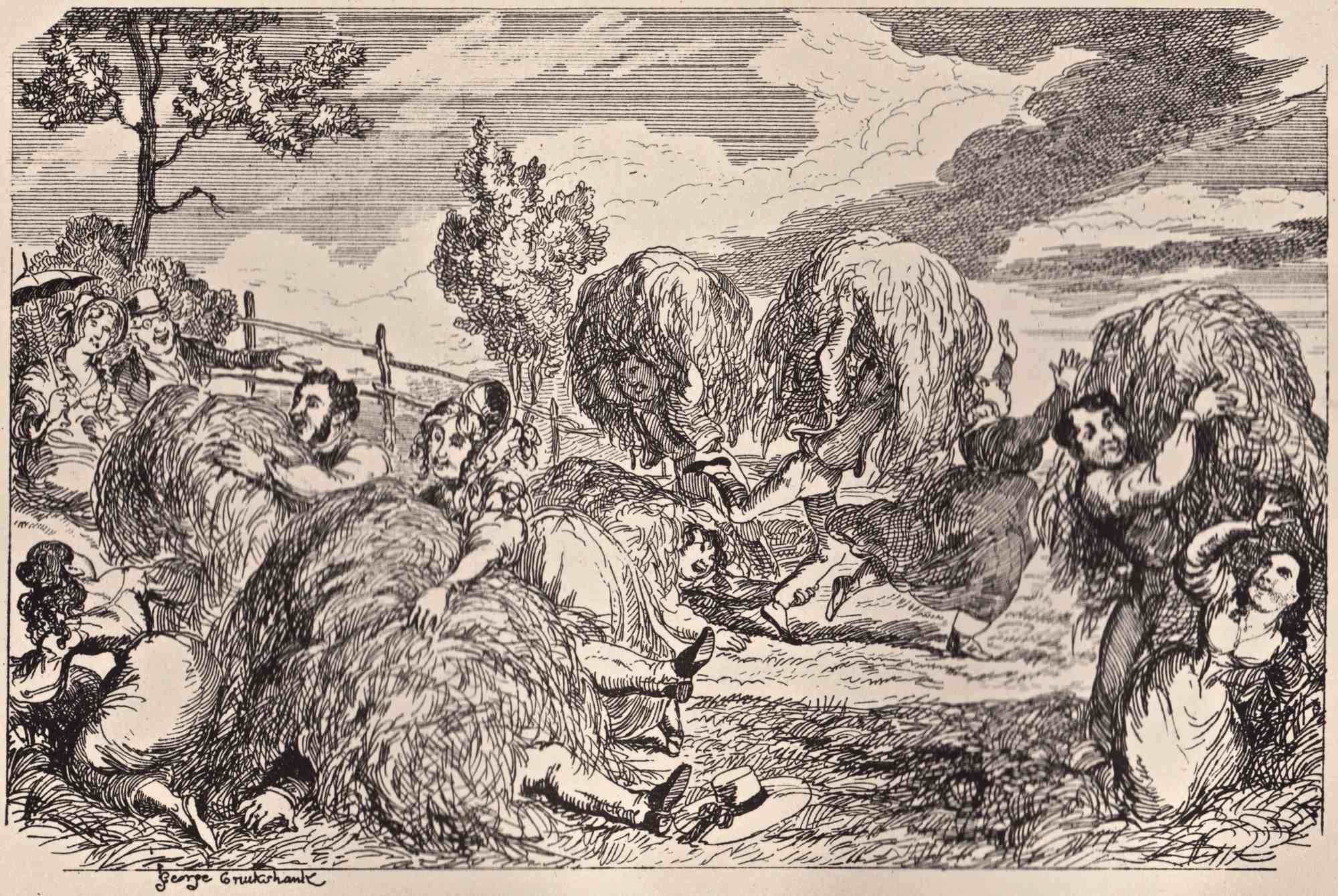
JUNE 1837 – Haymaking

JULY 1835 – At Vauxhall Gardens

JULY 1836 – Dog Days in Houndsditch

JULY 1837 – Fancy Fair

AUGUST 1836 – Bathing at Brighton

AUGUST 1837 – Regatta

SEPTEMBER 1835 – Bartholomew Fair

SEPTEMBER 1837 – Cockney Sportsmen
You may also like to take a look at
Richard Ivey In Toynbee St
Photographer Richard Ivey took these pictures recording the extravagant derelection evident in the buildings to the east of Toynbee St in Spitalfields, some of which have been decaying for forty years


Photographs copyright © Richard Ivey
These photographs are reproduced courtesy of Architeckton
You may also like to take a look at
Phil Maxwell in The Royal London Hospital
At Chatham Dockyard

Cliff, HMS Gannett
Behold the ancient mariner I met at Chatham Dockyard. After a long career navigating the seven seas, he now guides visitors around HMS Gannett permanently berthed in a dry dock on the Medway.
Over three hundred years, more than four hundred warships were constructed here and, during the eighteenth century, Chatham became one of this country’s largest industrial sites. Even today – thirty years after it ceased to be a working dockyard – the legacy of this endeavour over such a long period and on such a scale is awe-inspiring.
The vast wooden vault of the covered slipway, dating from 1834, is something akin to a cathedral or an aircraft hangar, and climbing up into the roof is a spatial experience of vertiginous amazement. At the other end of the dockyard, a ropewalk contains a room that is a quarter of a mile long for spinning yarn into cables. Midway between these two, I discovered the Commissioner’s Garden, offering a horticultural oasis in the midst of all this industry with a seventeenth century Mulberry at its heart.
Yet as my feet grew weary, my sense of wonder grew troubled by more complicated thoughts and emotions. The countless thousands that laboured long and hard in this dockyard through the centuries produced the maritime might which permitted Britain to wrestle control of the Atlantic from the French and the Spanish, and build its global empire, delivering incalculable wealth at the expense of the people in its colonial territories.
For better or worse, to see the machinery of this history made manifest at Chatham is an experience of wonder tinged with horror which cannot be easily reconciled, yet it is an inescapable part of this country’s identity that compels our attention if we are to understand our own past.

Horatio Nelson

HMS Gannet (1878)


The covered slipway (1838)

The covered slip was designed by Sir Robert Sebbings, Surveyor to the Navy Board & former Shipwright


HMS Ocelot (1962)


HMS Cavalier (1944)


Threads of yarn are twisted to make twine


Rope continues to be manufactured today in the ropewalk

Machinery from 1811 is still in use

The rope walk dates from 1729


Women were employed from 1864 when mechanisation was introduced

Officers’ houses (1722-33)

The Cashier’s Office where Charles Dickens’ father John Dickens worked as a clerk, 1817-22

Figures and coat of arms from HMS Chatham (1911) on the Admiral’s Offices

Sail & Colour Loft (1734) where the sails for HMS Victory were made

Admiral’s Offices (1808) with George III’s coat of arms

Entrance to the Commissioner’s Garden


Seventeenth century Mulberry tree in the Commissioner’s Garden


Richard Wellesley, brother of the Duke of Wellington, and Royal Dockyard Church (1755)

Main Gate (1720) with arms of George I
Visit CHATHAM HISTORIC DOCKYARD, open every day from February until November
You may also like to read about
The Mile End Mulberry

Mulberry in Mile End Place
A tip-off from a reader sent me down to Mile End Place to visit an ancient Mulberry tree there and I was delighted for the excuse to visit this appealing hidden enclave of old cottages where an atmosphere of peace prevails that feels almost rural.
A Mulberry tree stands conspicuously in the front garden of a house on the west side of the Place, with a pair of branches outstretched which give it the appearance of a monstrous creature about to reach out and grab you. Yet this was not the object of my quest but perhaps a younger relative of the venerable Mulberry I was seeking, that crouches in the back garden of a cottage on the east side of the street. Traversing the boundary of two gardens, this is a black Mulberry which still bears prolific fruit each summer.
My first thought was that this Mulberry might be contemporary with the cottages in Mile End Place which date from the early nineteenth century, until I climbed up and looked over the garden wall to discover the Velho Sephardic Cemetery on the other side. This is Britain’s oldest Jewish cemetery, which opened in 1657, a year after Cromwell’s re-admission of the Jews – while upon the west side of Mile End Place is the Alderney Rd Ashkenazi Cemetery, which dates from 1697.
The proximity of these hidden green spaces flanking Mile End Place accounts for the peaceful nature of this secluded street and may also explain the presence of the ancient Mulberry tree, dating it to the seventeenth century.
Elsewhere in London, I have discovered Mulberry trees which predate the houses around, speaking of an earlier time when these urban locations were gardens, and I like to think this specimen in Mile End is another example. This is the enigma of these charismatic trees laden with stories as well as fruit, if only we know how to gather them.

The ancient mulberry in the back garden

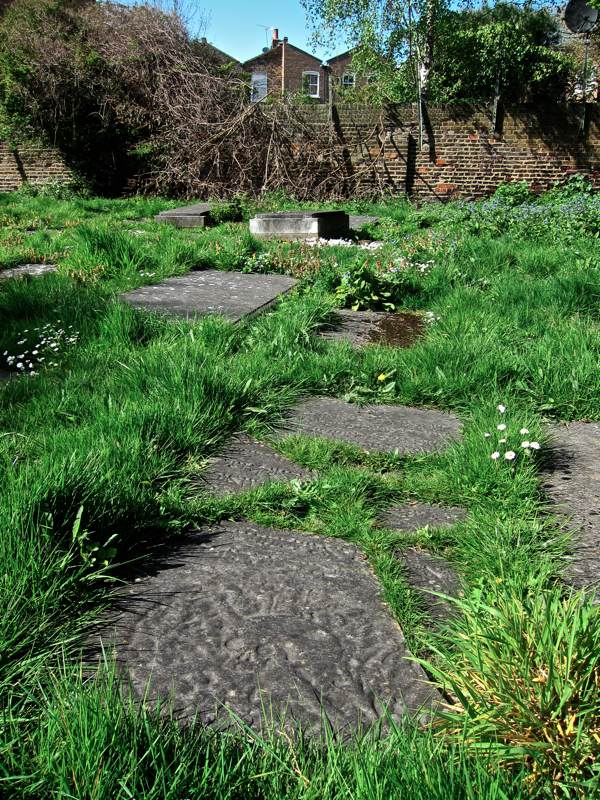
The gardens of Mile End Place seen from the Velho Cemetery

Mile End Place seen from Alderney Rd Cemetery
You may also like to read about
David O’Mara’s Spitalfields
I have published many pictures of renovations of old houses in Spitalfields but David O’Mara‘s candid photography reveals the other side of these stories, recording the back-breaking labour and human toil that is expended upon these endeavours

“For the past ten years I have worked as a painter & decorator in London, both as a means of surviving and also funding my artistic practice – but the roles of artist & decorator are not always easily reconciled, time demands and budgets often lead to a conflict of interests.
My work is described as ‘restoration,’ though I began to question the truth of this description. From the beginning, you strip back the layers of previous occupants. Cupboards, doors and walls that were later additions are all removed. At every turn and removal you notice the evidence of previous lives, all to be erased and replaced with freshly painted blank surfaces – everything is pared back to the tabula rasa.
This has a resonance with my own experience: the daily repetition of tasks erodes memory, time is distilled into but a few recollections. I started photographing my working life as a way of recording the disappearing history of the houses and also to combat the erosion of memory through the repetition of work.” – David O’Mara


Photographs copyright © David O’Mara
You may also like to read about
Tales From The Two Puddings
Tales From The Two Puddings, a documentary about Eddie Johnson’s legendary pub is being shown at Stratford Picture House on 14th July & Cafe 1001 in the Truman Brewery on 21st July

Shirley & Eddie Johnson on their first day behind the bar in 1962
Through four decades, from 1962 until 2000, Eddie Johnson was landlord of the celebrated Two Puddings in Stratford, becoming London’s longest serving licensee in the process and witnessing a transformation in the East End. When Eddie took it on, the Two Puddings was the most notorious pub in the area, known locally as the Butcher’s Shop on account of the amount of blood spilt. Yet he established the Puddings as a prime destination, opening Britain’s first disco and presenting a distinguished roll call of musicians including The Who – though the pub never quite shook off its violent notoriety.
“I’ve had a lot of blows,” Eddie confided to me with a crooked grin, his eyes glinting enigmatically. Even in his eighties, Eddie retains a powerful and charismatic demeanour – very tall, still limber and tanned with thick white hair. Of the old East End, yet confident to carry himself in any company, Eddie admitted to me he was the first from his side of town to make it into Peter Langan’s Brasserie in Stratton St, mixing with a very different clientele from that in Stratford Broadway. It was indicative of the possibility of class mobility at the time, and there were plenty from the West End who were persuaded to take the trip east and experience the vibrant culture on offer at the Puddings.
“I came from the Old Ford Rd and I suppose you’d refer to it as a slum by today’s standards, but I never thought that because I had a happy childhood, even if we had an outside toilet and went to the bath house each week. The public library was heaven to me, all polished wood and brass, and I got a great love of schoolboys’ adventure stories which made me wish I could go to public school though, of course, I’d have hated it if I did. After I got married and had a son and then another, I had a number of dead end jobs. When I came out of the army, I became involved with a rough crowd. I worked with my brother Kenny organising dances. I was a bit of a hooligan and I got stabbed in a dance hall. But then I found a job as a Tally-clerk in the docks and became involved with the Blue Union – the skilled workers and stevedores. I was the Tally-clerk on Jack Dash’s strike committee. I loved it down there and, though I didn’t make a lot of money, I didn’t care because I loved the freedom. We could more or less do what we wanted.
The licensee of the Two Puddings got in trouble with the police, so Kenny and I bought the lease because we were frightened of losing the dance hall. Since my brother couldn’t hold the licence owing to an earlier court case, I had to take it. Now I didn’t fancy managing a pub and I had been to the Old Bailey for GBH, so I had to be upfront with the police in Stratford but they were horrible. They said,‘We’ve seen you driving around in a flash car,’ and I said, ‘I’l tell you where you can stick your licence!’ But this butcher, Eddie Downes, a huge fat man with a completely bald head who looked like a cartoon butcher, he told me not to worry. He had a reputation as a grass and he was always boasting about his connections to the police. ‘You’ll still get your meat from me?’ he asked, and three months later we were granted a licence.
We moved into the Puddings and after the opening night, I said, ‘I can’t stand this,’ and then I stayed forty years. I used to come downstairs on a Friday night and look around hoping there weren’t going to be any fights and I’d get all tensed up, but after a few light ales I’d be happy as a sandboy. The place would be packed and we’d be serving beer in wet glasses – it was fairly clean and people didn’t mind. We sold four hundred dozen light ales in a week, nowadays a pub is lucky to sell two dozen. We worked six nights a week plus a fortnight holiday a year and, on Wednesdays, my wife and I used to go up to the West End for a night out – but after forty years, it was tough.
At the end of the sixties, they knocked down a lot of buildings and did a redevelopment in Stratford. We lost all our local trade, but we still had our music crowd. It was ear-splitting music really and we were the first pub to have UV. We called the club the Devil’s Kitchen and got a licence till two in the morning, and it was ever so popular. People came from far and wide.”
At the end of the last century, changes in the law required breweries to sell off many of their pubs and the Two Puddings changed hands, resulting in a controversy over discounts offered to publicans and a court case that saw Eddie Johnson thrown out of his job. Today, he lives peacefully in Suffolk and has organised his stories into an eloquent memoir. It is the outcome of lifetime’s fascination with writing that led Eddie to read the great novelists during his hours of employment in the London Docks. His first story was printed in The Tally-Clerk at that time, but he realised his ambition to become a writer with the publication of “Tales from the Two Puddings,” and in turn this became the basis for the documentary film premiering this summer in the East End.
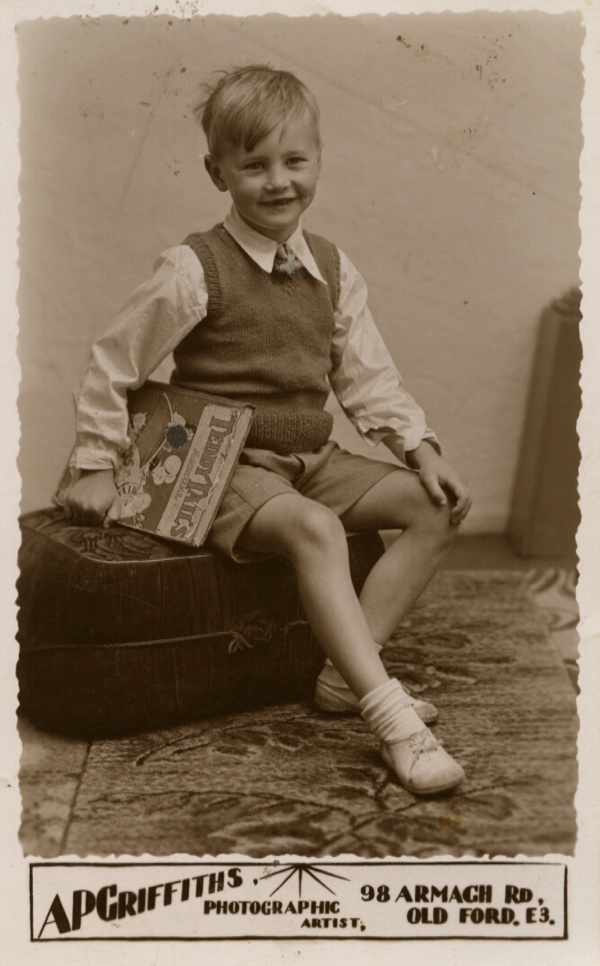
Eddie aged nine, 1941.

Eddie when he worked in the docks.


Early Saturday morning and preparing to open. Eddie behind the bar and George the potman to his right.

Old George the potman.


Shirley Johnson with Rose Doughty, the famous wise-cracking barmaid.


Eddie’s sister Doreen (second left) and friends heading upstairs to the Devil’s Kitchen, above the Puddings (photograph by Alf Shead)

Eddie and his brother Kenny with their beloved Uncle John in the Puddings.

Saturday night in the Puddings.

Joe and Sue, Eddie’s father-in-law and mother-in-law, enjoying a Saturday night in the Puddings.

Eddie Johnson
You may also like to read about