So Long, Whitechapel Bell Foundry
It is with deep regret that I announce the closure of Whitechapel Bell Foundry, the world’s most famous bell foundry and Britain’s oldest manufacturing company. Below you can read my interview with Alan Hughes, the last in a line of bell founders stretching back to 1420, who will retire next year at sixty-eight years old when the foundry closes in May 2017 and the building is sold – meanwhile, negotiations for the future ownership of the business are underway.

Arthur Hughes, Master Bellfounder from 1904

Albert Hughes, Master Bellfounder from 1916

William Hughes, Master Bellfounder from 1945

Portrait of Alan Hughes, Master Bellfounder from 1972 by Sarah Ainslie
“We have made this decision with a heavy heart, but in response to the changing realities of running a business of this kind. The Bell Foundry in Whitechapel has changed hands many times, but it has always been a family business. My own family has owned the foundry since 1904, but other families have run the firm through its history, which stretches back to 1570. The business has been at its present site over two hundred and fifty years. So it is probably about time it moved once again. We hope that this move will provide an opportunity for the business to move forward in a new direction.” Alan & Kathryn Hughes

If I confide that my favourite sound in all the world is that of bells pealing, you will understand why the Whitechapel Bell Foundry became such a source of fascination to me over all these years. Every time I walked past the ancient foundry walls (the oldest manufacturing company in the land – founded in 1570), I wondered about the alchemical mystery of bellfounding taking place inside. One day as I passed, walking down from Spitalfields to the Thames, the steel doors at the rear were open and, peeking in from the harsh sunlight outside, I was afforded a tantalising glimpse of huge bells glinting in the gloom of the engineering shop.
So you can imagine my excitement when I received the invitation to meet the current master bellfounder in an unbroken line of master bellfounders that stretches back to 1420. Stepping inside, out of the rain in Whitechapel Rd, I found myself in the foundry reception lined with old photographs and compelling artifacts, like the wooden template (displayed over the entrance as if it were the jaws of a whale) that was used when Big Ben was manufactured here. Among all the black and white photos, my eye was drawn by some recent colour pictures of a royal visit, with Her Majesty in a vivid shade of plum and Prince Philip looking uncharacteristically animated. I was thinking that the bell foundry must work a powerful magic upon its visitors, when a figure emerged from the office and I turned to shake the hand of Alan Hughes, the master bellfounder. Alan’s great-grandfather Arthur Hughes bought the business in 1884, which makes Alan a fourth generation bellfounder.
A sense of awe filled me as I shook hands with this unassuming man in a natty blue suit but I composed myself as best I could, while he led me through a modest office where two people worked behind neat desks and one of those fake cats dozed eternally in front of the stove, to arrive in the boardroom where a long table with a red cloth upon it occupied the centre of a modest but elegantly proportioned Georgian dining room. We drew up chairs and commenced our conversation as the Whitechapel drizzle turned to dusk outside.
Alan’s fine manners and levity kept me guessing whether everything he said might actually be a proposal, as if he was simply trying out thoughts to see how I would react. I took this as an indication of courtly assurance. Alan wears his role with the greatest of ease, as only someone born into the fourth generation of an arcane profession could do, and I wondered if the royal visit might have been an occasion for mutual recognition between those born into long-standing family businesses.
Up above, I could hear music. It was Alan’s daughter and her friend, both music students, practising the piano and the trumpet. The prevailing atmosphere was that of a work place yet it was domestic too. When Alan’s predecessors set up the business on this site, before the industrial revolution, they attached the factory to the house so they could walk from the dining room into the foundry at their convenience. The feeling today is akin to that of the quiet living quarters of an old college or liturgical institution.
Alan has worked here over fifty years and, describing the changes he has seen, he glanced over my shoulder to the window several times, as if each time he glanced upon a different memory of the Whitechapel Road. The East End was a busy place in the nineteen fifties, as Alan first recalled it, not only because of the docks but because of all the factories and the manufacturing that happened here. “Whichever way it was blowing, you got this lovely smell of beer on the wind – from Trumans or Watneys or Charringtons or Courage or Whitbread…” Alan told me, explaining the locations of the breweries at each point of the compass. In the nineteen seventies and eighties, when the docks and factories closed, Alan found the place desolate, he peered from the window and there was no-one in the street. “And then things started getting trendy. Instead of closing they started opening – and now, suddenly, it’s ok to be in Whitechapel!” said Alan, clasping his hands thoughtfully on the table and looking around the room with a philosophical grin, “But this place hasn’t changed at all. I always find it vaguely amusing.”
Tentatively, I asked Alan what it meant to him, being part of this long line of bellfounders. Alan searched his mind and then said, “I don’t think about it very often. I would like to meet some of those people, Thomas Mears (master bellfounder from 1787) who would know the place today and Thomas Lester (master bellfounder from 1738) who had this part built. It would be nice to have a conversation with him. He would recognise most of it.” Then the gentle reverie was gone and Alan returned to the present moment, adding, “It’s a business,” in phlegmatic summation.
“Our business runs counter to the national economy,” he continued, “If the economy goes down and unemployment rises, we start to get busy. Last year was our busiest in thirty years, an increase of 27% on the previous year. Similarly, the nineteen twenties were very busy.” I was mystified by this equation, but Alan has a plausible theory.
“Bell projects take a long time, so churches commit to new bells when the economy is strong and then there is no turning back. We are just commencing work on a new peal of bells for St Albans after forty-three years of negotiation. That’s an example of the time scale we are working on – at least ten years between order and delivery is normal. My great-grandfather visited the church in Langley in the eighteen nineties and told them the bells needed rehanging in a new frame. They patched them. My grandfather said the same thing in the nineteen twenties. They patched them. My father told them again in the nineteen fifties and I quoted for the job in the nineteen seventies. We completed the order in 1998.”
Alan broke into a huge smile of wonderment at the nature of his world and it made me realise how important the continuity between the generations must be, so I asked him if there was pressure exerted between father and son to keep the foundry going.
“My great-grandfather never expected the business would outlive him. He had three sons and the sale of the business was arranged, but my grandfather refused to sign the contract, so the other brothers left and he took over. My grandfather ensured his sons had good jobs and even my father wasn’t convinced the business could succeed, so he studied foundry technology for four years at every foundry in the south – thinking he could work for them – but every single one of those has now closed.” Then Alan looked out the window again, gazing forward into time. “As a master bellfounder, you never retire. We go on until we die. My grandfather, my father and my uncle all died of a heart attack at eighty.”
The implications of Alan’s conclusion are startling for him personally, even though he has many years to go before eighty. “You’re a very eloquent man,” I said in sober recognition, “No, I’m not!” he retorted cheekily. “You have such interesting things to say,” I replied lamely, “No, I don’t!” he persisted gamely, obstinately raising his eyebrows. Nevertheless, Alan’s life as a bellfounder is remarkable to me and maybe to you too. Seeing his life in comparison to his predecessors, Alan embraces the patterns that prescribe his existence, for better or worse, and his personal mindset is the result of particular circumstances, the outcome of four generations of bellfounding. Alan has my greatest respect for his immodest devotion to bells.


Photographs copyright © John Claridge
A Walk To View The Gasometers

When we get such bright winter days it becomes an imperative to take a walk and enjoy the benefit of the sunlight, especially now we have arrived at the season of the year when a clear sky becomes a precious commodity. So I decided to walk up to Bethnal Green and admire the majestic pair of gasometers, planted regally side by side like a king and queen surveying the Regent’s Canal from aloft.
Ever since I learnt that these nineteenth century gasometers had been granted a ‘certificate of immunity against listing’ by Historic England, which guarantees they will never receive any legal protection from destruction, it has been in my mind to undertake a walk to view them properly in advance of the day when they may be gone.
My path took me up the Queensbridge Rd, past the thick old brick walls bordering Haggerston Park that were once part of the Shoreditch Gas Works which formerly occupied this site, built by the Imperial Gas Light & Coke Company in 1823. The Bethnal Green gasometers were constructed to contain the gas that was produced here, fired by coal delivered by canal.
In the Queensbridge Rd, I came upon The Acorn which has recently closed and is now scheduled for redevelopment unless the current bid for ‘asset of community value’ status can save it. This traditional East End pub which opened before 1869 must once have served the workers from the Imperial Gas Light & Coke Company across the road.
Approaching along the canal towpath, George Trewby’s gasometer of 1888-9 dominates the skyline, more than twice the height of its more intricate senior companion designed by Joseph Clarke in 1866. Crossing Cat & Mutton Bridge, which is named after the nearby pub founded in 1732, I walked down Wharf Place and into Darwen Place determining to make as close a circuit of the gasometers as the streets would permit me.
Flanked by new housing on either side of Darwen Place, the gasometers make a spectacularly theatrical backdrop to a street that would otherwise lack drama. Dignified like standing stones yet soaring like cathedrals, these intricate structures insist you raise your eyes heavenward, framing the sky as if it were an epic painting contrived for our edification.
Each storey of Joseph Clarke’s structure has columns ascending from Doric to Corinthian, indicating the influence of classical antiquity and revealing the architect’s chosen precedent as the Coliseum, which – if you think about it – bears a striking resemblance to a gasometer.
As I walked through the surrounding streets, circumnavigating the gasometers, I realised that the unapproachable nature of these citadels contributes to their magic. You keep walking and they always remain in the distance, always just out of reach yet looming overhead and dwarfing their surroundings.
At the south-easterly corner of my circular ramble I arrived at Grove Passage, an old field track cutting through the grid of the streets and by-passing a crumbling brick tower worthy of Piranesi. This is London’s last undeveloped bomb site, thanks to its location islanded on all sides by other properties.
From here I walked through The Oval, which is a light industrial state these days but takes its name from the ancient duckpond at its centre – now filled in and crowded with tightly-packed irregularly-parked vehicles. In spite of the utilitarian nature of this landscape, the relationship between the past is clear in this place and this imparts a strange charisma to the location, an atmosphere enhanced by the other-wordly gasometers.
Now that I have walked their entire perimeter, I can confirm that the gasometers are most advantageously regarded from mid-way along the tow path between Mare St and Broadway Market. From here, the silhouette of George Trewby’s soaring structure may be be viewed against the sun and also as a reflection into the canal, thus doubling the dramatic effect of these intriguing sky cages that capture space and inspire exhilaration in the beholder.
We can only hope that whoever develops this site recognises the virtue in retaining these magnificent towers and integrating them into their scheme, adding value and distinction to their architecture, and drama and delight to the landscape.

Opened before 1869, The Acorn in the Queensbridge Rd has recently closed although applicants for Asset of Community ValueStatus hope to save it.

The view from Darwen Place

Decorative ironwork and classical columns ascending from Doric to Corinthian like the Coliseum


The view from Marian Place


The view from Emma St

Grove Passage leading from Emma St to Mare St, with London’s last bombsite on the right

The view from the Oval

Offices of Empress Coaches in Corbridge Crescent

The view from Corbridge St

The view from Regent’s Canal towpath


George Trewby’s gasometer of 1888 viewed from Cat of Mutton bridge over Regent’s Canal
You may also like to read
Adam Dant’s Coffee House Map

Click on the map to enlarge and read the stories of the Coffee Houses
These days, London is riddled with Coffee Shops but, at the start, there was just the Jamaica Coffee House, which was opened in 1652 by Pasqua Rosee in St Michael’s Alley in the City of London. More than three hundred and fifty years later, it is still open and so I met Adam Dant there to learn about his new map – which you see above – drawn in the shape of a coffee pot.
“I’ve always wanted to do a map of the Coffee Houses, because it marks a moment when intellectual activity had a parity with mercantile activity. They called them the penny universities,” he explained, eagerly quaffing a glass of Italian red wine in the mid-afternoon. “And it wasn’t just coffee they sold but alcohol too,” he added, fleshing out the historical background as he sipped his glass, “so you could get drunk in one corner and sober up with coffee in another.”
The first Coffee Houses became popular meeting places, facilitating introductions between those of similar interests, fostering deals, trading, and business enterprises. Lloyds of London began as a Coffee House, opened by Edward Lloyd in Lombard St around 1688, where the customers were sailors, merchants and shipowners who brokered insurance among themselves, leading to the creation of the insurance market.
“People complain about the proliferation of Coffee Houses today,” admitted Adam Dant with a sigh, before emptying his glass, “But there were thirty here in these streets behind the Royal Exchange, until a fire that started in a peruke shop burnt them all down. The only reason we know where they all were is because somebody was commissioned to draw a map of them, assessing the damage.”
Executed in ink of an elegant coffee hue and bordered with Coffee House tokens, Adam Dant’s beautiful map gives you the stories and the locations of nineteen different Coffee Houses in the City. Fulfilled with such devoted attention to detail, Adam’s cartography of caffeine led me to assume this must be a labour of love for one who is addicted to coffee, yet – to my surprise – I discovered this was not the case.”I drink expresso at Allpress in Redchurch St,” Adam confessed to me, “but the best coffee is at Present, the gentlemen’s clothiers, in Shoreditch High St. I like to drink three cups before dinner and one after, but, fortunately, I am not a creature of habit and I could easily go three months without drinking coffee.”

Adam Dant at the Jamaica Coffee House in St Michael’s Alley

Map copyright © Adam Dant
Adam Dant’s Maps are available to buy from TAG FINE ARTS
You may like to take a look at some of Adam Dant’s other maps
Map of the History of Shoreditch
Map of Shoreditch in the Year 3000
Map of Shoreditch as the Globe
Map of the History of Clerkenwell
Map of the Journey to the Heart of the East End
The Alphabet Of Lost Pubs Q-R
Royalty & railways are the two dominant themes in this fifth installment of my series of The Alphabet of Lost Pubs. This time-travelling pub crawl is presented in collaboration with Heritage Assets who work in partnership with The National Brewery Heritage Trust, publishing these historic photographs of the myriad pubs of the East End from Charrington’s archive for the first time.

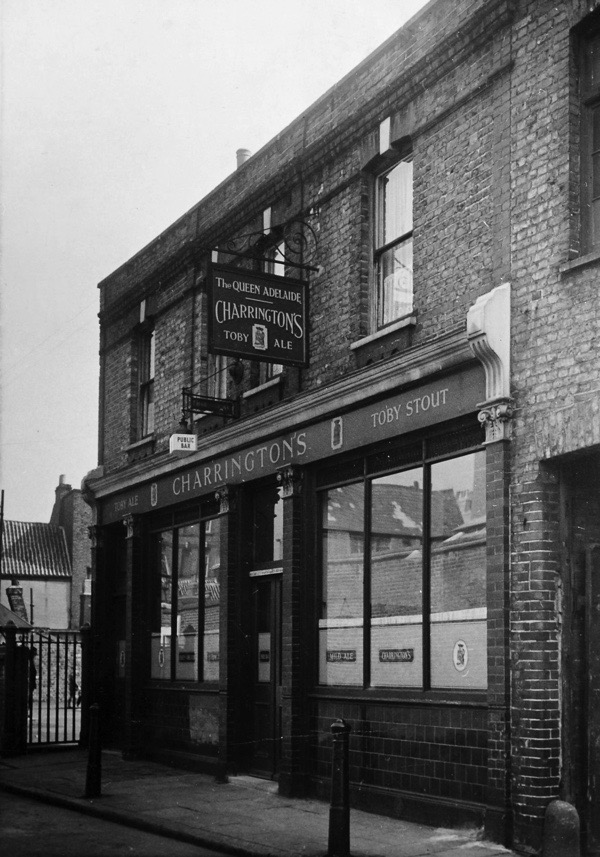
The Queen Adelaide, 483 Hackney Rd, Bethnal Green, E2 (Opened before 1834, renamed ‘The Hop Picker’ in 1983, renamed ‘Tantrums’ in 1992, renamed ‘Images’ in 1993, then renamed ‘Max’s Bistro’ and this year re-opened as ‘The Queen Adelaide’)

The Queen Adelaide, 54 Ivy St, Hoxton, N1 (Opened before 1891, closed in the sixties and now ‘Ivy St Family Centre’)

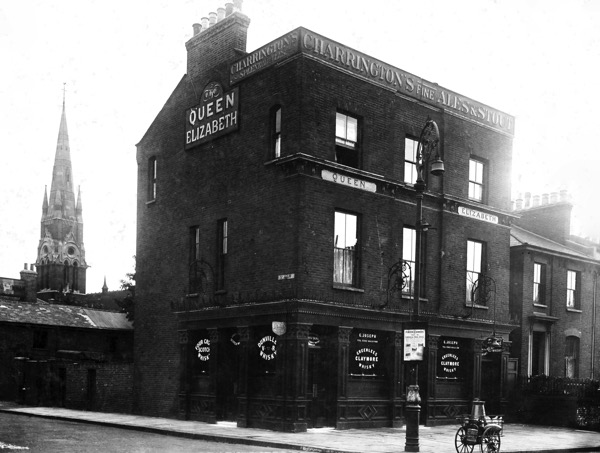
The Queen Elizabeth, 9 Graham Rd, Dalston, E8 (Opened before 1864, closed in 2005, converted to a church in 2007 and now residential)

The Queen Victoria, 179 St Leonards Street, Bow, E3 (Opened before 1851, closed in 2001 and now residential)

The Queen Victoria, 78 How’s St, Hoxton, E2 (Opened before 1871 and now demolished)

The Queen’s Arms, 250 Roman Rd, Bethnal Green, E2 (Opened before 1861 but now demolished)

The Queen’s Head, 5 Westham Lane, Stratford, E15 (Opened before 1872 and open today)

The Railway Tavern, 576 Commercial Rd, Limehouse, E1 (Opened before 1877 and open today)

The Railway Tavern, 131 Angel Lane, Stratford, E15 (Opened before 1848 and open today)

The Railway Tavern, 272 Victoria Dock Rd, Canning Town, E16 (Opened before 1891, closed due to bomb damage in World War II and demolished in the sixties)

The Railway Tavern, 2 St Judes St, Dalston, N16 (Opened before 1881 and open today)

The Railway Tavern, 131 Globe Rd, Bethnal Green, E2 (Opened before 1869, closed in 2014 and now being converted to flats)

The Railway Tavern, 30 Grove Rd, Bow, E3 (Opened before 1864, closed in 2000 and now flats)

The Railway Tavern, 339 Mare St, Hackney, E8 (Originally established as ‘Eight Bells’ in 1665, renamed and rebuilt in 1880, rebuilt again in 1955, closed in 2009 and converted to a betting shop, now a phone shop)

The Railway Tavern, 59 Kingsland High St, Hackney E8 (Opened before 1856, rebuilt 1939/40, closed in 2015 and now a restaurant)

The Railway Tavern, 393 Old Ford Rd, Bow, E3 (Opened before 1871, closed in 2001 and now flats)

The Railway Tavern, 186 Plaistow Rd, Plaistow, E15 (Opened before 1878, closed in 2009 and now a supermarket)

The Railway Tavern, 116 West India Dock Rd, Poplar (Opened before 1841, known as ‘Charlie Brown’s’ from 1897 and demolished in 1989 for Limehouse Link Rd)

The Red Lion, 17 Bevis Marks, City of London, EC3 (Opened before 1826, rebuilt in 1965 and renamed ‘The White Horse in 2008)

The Rising Sun, Burdett Rd, Mile End, E1 (Opened before 1869 and now demolished)

The Rose & Crown, 83 Bunhill Row, St Lukes, EC1 (Opened as ‘Excelsior Music Hall ‘in 1869, destroyed by enemy action in 1942)

The Royal Sovereign, 64 Northwold Rd, Clapton, E5 (Opened before 1825 and open today)

The Royal Duchess, 551 Commercial Rd, E1 (Opened before 1882, rebuilt and reopened in 1963, closed in 2015)

The Royal Oak, 57 St Stephens Road, Bow, E3 (Opened before 1848 and recently demolished for a bus turning circle)

The Royal Standard, 126 High Rd, Loughton (Opened 1862 and converted to nightclub in 1999)

The Royal Standard, Well St, Wellclose Sq, E1 (Opened before 1781, closed in 1922 and now demolished)

The Rydon Arms, 225 New North Rd, Hoxton, N1 (Opened before 1851, closed in 1998 and now residential)
Photographs courtesy Heritage Assets/The National Brewery Heritage Trust

You may also like to take a look at
George Cruikshank’s London In Winter
As the temperatures plunge this week, there will be no denying that winter has its grip upon London – which offers the ideal premise to look back at winters long ago in the capital, as witnessed by George Cruikshank in the LONDON ALMANAC published between 1835 & 1838 (Click on any of these images to enlarge)

Everybody freezes

Penny for the guy!

St Cecilia’s Day

Lord Mayor’s Show

Ice skating on the Serpentine

Christmas Eve

Christmas Ball

Christmas Dinner

Frost Fair on the Thames

January – New Year’s bills arrive
You may also like to take a look at
A Conversation With Milly Rich
Recently, I enjoyed a light lunch at the Victory Services Club in Marble Arch with Milly Rich and you can read our chat below. I hope Milly will not consider me indiscreet if I reveal that she is in her ninety-ninth year, yet is blessed with the vital nature and lucidity of thought of one many decades her junior.

“You know, being nearly a hundred is a lot of years to account for…”
Portrait of Milly Rich by Patricia Niven
The Gentle Author – Are you from the East End?
Milly Rich – I am from the last place I have lived! But I was born at 19 Commercial Rd on October 23rd 1917, which of course was during the First World War and my mother, Leah, told me that the air raid warnings were sounding at the time. People were terrified of air raids but my she had a basement under her shop in Commercial Rd where she took shelter.
My mother made corsets and she taught me to make them too. Corsets were a vital part of a lady’s outfit in those days because – of course – smart clothes needed a good foundation and a good foundation was a nice heavily-boned corset with a strong steel bust in the front. Everybody had remarkably good posture, not slumped – like you see today – over a hand-held computer.
The Gentle Author – Your mother was proprietor of the shop?
Milly Rich – I have a picture of her standing outside the shop with her two assistants when she was not yet twenty. She was very creative, very artistic – and she got her first job in an embroidery factory in Hanbury St. Then she opened a shop at 87 Brick Lane and – many years later – it transpired that the young man I married was the son of the owner of the embroidery factory where my mother had once been a designer. So the world is full of concentric circles!
The Gentle Author – Tell me about your father.
Milly Rich – My father, Morris Levrant, was an ‘émigré of the Empire of Russia’ and I know that because he went to America first and patented an airtight valve for bicycle tyres when he was thirty. He was very clever. My mother said he spoke nine languages and he was an inventor. He was born in Siedlce in Poland where my daughter has traced our family back to 1733.
He left a wife and three children in New York when he came to London and my mother’s father was not very happy about that. Apparently, my grandfather put him through hoops to prove that he was properly divorced. I do not know how he got the divorce but he obviously did because otherwise they would not have allowed the marriage. My parents were married in Princelet St Synagogue and I was born in 1917, so I suppose they were married in 1916.
The Gentle Author – Do you have brothers and sisters?
Milly Rich – I had one brother, Mossy. He is dead now, he died at seventy-five years old. I suppose it speaks volumes for the kind of life we led that he had rickets, which is caused by malnutrition. He was very good with his hands and became a jeweller and worked in Black Lion Yard and Hatton Garden.
When the Jews were promised a homeland in the Balfour Declaration, my father decided he would settle in what was then Palestine. Of course, he was an inventor, and he was agog to go and be an inventor there – he was a clever chap. So in 1921 we set sail.
The Gentle Author – You shut the shop in Commercial Rd?
Milly Rich – Yes, we got rid of it and went off to Palestine but a war broke out there and, in the first month, my father was killed and he was buried there. He was only forty when he died and left three children in New York. We found them not very long ago. The two sisters were still alive, they were ten and eleven years older than me. We went and stayed with them, and they were lovely. They turned out to be artists and designers too
When my father died, my mother was expecting my brother, so she could not come back from Palestine at once but she did not speak the language and, of course, my father had all the money – she was stuck in Jaffa. Fortunately my uncle – my mother’s sister’s husband – came to the rescue and got us back to England. By that time, I was three, I remember. And we were stuck in Boulogne because I had a watery eye – they thought it was catching – an eye disease, maybe trachoma but it was just a trapped eyelash.
On our return, we stayed with my uncle in Whitechapel. He had a jewellery shop opposite the Whitechapel Gallery, it was museum as well in those days. I remember they had a septic mouse in a case on the stairs and an illuminated panorama of Medieval London on the landing. It was lovely, I used to stand and stare at it for hours.
We stayed there until my uncle found the shop at 192 Bethnal Green Rd. It was flanked on one side by the Liberal Party headquarters, Sir Percy Harris was the MP, and on the other side by a newsagent. They were not Jewish, but everybody was on excellent terms and there was no anti-Semitism where we were.
We lived above the shop and we had tenants as well, who had to come through the shop. Originally, it been a house and garden but it had been transformed into one great long space. My mother had a curtain put up to screen people walking through because they had to cross our parlour, which my mother also used as a fitting room for the corsets.
Women used to come in and treat her as an agony aunt. Like a hairdresser or a dressmaker, she was a recipient of confidences. All the locals would tell my mother their troubles which invariably were to do with their husbands. They used to speak Yiddish so that I should not hear but, knowing they were speaking so I could not understand, I soon picked up Yiddish. I never let on that I could and, of course, I would tell the stories to my friends at school which was a source of much merriment.
There was a window in the parlour so my mother could see if anyone came into the shop. My brother used to climb up to look through it at the women trying on the corsets and, of course, a good time was had by all!
The Gentle Author – What took you out of Bethnal Green?
Milly Rich – I won a scholarship to Central Foundation School in Spital Sq. It was a fee-paying school at the time and there used to be quite a division between the scholarship girls and the fee-paying pupils. I was a great reader and I have always loved words and I had a good vocabulary. The other children did not like it. “Oh you’ve swallowed a dictionary,” that was a great insult. I did not care, did I? From there, I won another scholarship but I could not make up my mind whether to go to the London School of Economics, because I wanted to be a journalist, or St Martin’s School of Art.
In the event, I decided I would not train to be a journalist because I was not going to learn shorthand – I was not going to take down anybody else’s words. So I took the place at St Martin’s instead and hated it. We used to sign in and go off to the local Lyons teashop and sit there for hours, making patterns on the tablecloth with the salt cellar. Eventually, my mother could not afford for me to stay there any longer because I only got ten shillings a week and I did not like it anyway – I do not like any form of regimentation.
I got a job inscribing certificates because I was quite good at lettering and I did that for a couple of months. It was trees in Israel. They kept planting forests and I used to write ‘five trees planted in the name of so-and-so on the occasion of his this-and-that.’
I did not do it for long, I got a job in a drawing office instead. I told them I could do it, even though I had never held a drawing pen in my life. They said, “Well, here’s one – take it home and bring it back tomorrow, completed.” I went into an art shop and asked, “How do you do this?” They showed me a drawing pen and how you filled it and how you used it, so I went home and I did the drawing and I took it back the next day and I got the job. The drawing office was quite fun actually, I enjoyed it there. It was right at the top of Crown House, which is still there on the corner of Drury Lane and Aldwych. We used to feed the pigeons and there was a Sainsbury’s around the corner which delivered lunch in a box. You got a sandwich and some orange juice and a piece of cake for sixpence.
You know – being nearly a hundred is a lot of years to account for.
The Gentle Author – Tell me about Moss, your husband.
Milly Rich – We met at a play-reading group. He was a writer, and I always liked plays and acting and so on. We met there and he would walk me home.
The Gentle Author – Where did he come from?
Milly Rich – His father had the embroidery factory in Hanbury St, where my mother had once worked doing the patterns although we did not realise that at the time. It was only when our parents were introduced that they realised that they all knew each other already. Small world. People were so ready to help each other, I do not know if people are still like that in the East End, but they were once. I remember the blackshirts marching down Bethnal Green Rd and shouting “The Jews, the Jews, we’ve got to get rid of the Jews!” Whenever they passed our shop, my brother used to be outside yelling.
The Gentle Author – Did you feel threatened?
Milly Rich – I do not think I was aware of it, but I became aware because Moss used to take me to the political meetings and the Unity Theatre. When there was the Battle of Cable St, we went there. I remember leaning on the lamppost outside Gardiner’s Corner and we were all yelling, “They shall not pass, they shall not pass.”
The Gentle Author – That was eighty years ago.
Milly Rich – Then war was declared and we all thought the first air raid would obliterate London. Everybody was terrified and I had known Moss four years, so he said “We’d better get married right away, while we can,” and he got a special licence. I did not want any fuss and I told my mother, “I’m not having any ‘do’” because getting married, especially in Jewish families, was a great occasion you know. I said, “I’m not having any family there.” It was the custom then – I do not know what people do now– for the woman to take the man’s name but I did not like that, so I said, “If I have got to take your name, you have got to take my name.” His name was Rich and my name was Levrant so we became Levrant Rich, which sounds quite good.
The Gentle Author– Was that unusual in those days?
Milly Rich – Goodness knows! Moss was very easy about it, he said he did not care. My mother said she would kill herself if we did not get married in the synagogue, but I said “I’m not having anyone there , I don’t want a fuss,” so she agreed she would not tell anyone. But when Moss and I arrived at the synagogue, standing outside wreathed in smiles was my fat Aunty Milly and her husband. I said, “I’m not going to do it!” and we turned tail and ran away, so we did not get married that day.
We came back the next day and got married when nobody was there. We got no photographs, nothing. It was just the two of us, and Moss had to go back to work because he was in the timber importing business, doing the advertising, and everybody thought the work was absolutely vital. So he went back to work and I went shopping in Petticoat Lane for a couple of cups and saucers and a saucepan.
Moss had found us an attic room at 4 Mecklenburgh Sq and we went back there. It was one pound a week which was a lot of money for rent. There was an oven on the landing which four other tenants used and we each took a turn to put a shilling in the meter. Sometimes, I would come back early and find the landlady on her knees fiddling the meter!
When the air raid siren went, we dashed down to the shelter which was just opposite. One night we got a direct hit. The thing shuddered but it did not go off and we were marshalled out by wardens. I remember walking up Gray’s Inn Rd with fires blazing on either side right up to Euston Station. There were aeroplanes droning overhead and the church opposite the station was on fire. We were ushered into the station and we spent the rest of the night there, before returning to Mecklenburgh Sq.
Although our rent was one pound a week, Moss earned four pounds and I earned two pounds and a bit, so we only had just over six pounds as our total income. After our pound rent was paid and Moss had ten cigarettes delivered each day, I used to be able to send stuff to the laundry. They would come and collect and deliver it, all freshly ironed, and a sheet was tuppence to launder. Can you imagine? Shirts and everything. I never did any washing myself. As well as Mrs Pointy the landlady, there was a caretaker who kept our two rooms clean for two shillings a week, which was very nice. Mrs Pointy used to feed her cat cods’ heads and the smell – I can still smell it – was absolutely indescribable.
The Gentle Author – Nowadays in London, many people spend half their wages on rent.
Milly Rich – I was just thinking about the nature of progress. When I was young, it was usual for a woman to stay at home and the man would bring home the money – his wage could support the wife and the family. Now two wages are not enough, do you call that progress?
Transcript by Rachel Blaylock

Milly, aged one and a half in 1919

Milly, aged five in 1922
 Milly, aged eighteen in 1935

Milly, aged twenty in 1939

Moss in 1939

Milly & Moss’ Marriage Certificate, 1939

Milly’s London Transport card, 1939

Milly & Moss in the forties

Milly & Moss in the eighties – Milly & Moss were married for seventy-two years
You may also like to read about
Maurice Sills, St Paul’s Cathedral Treasure
Jack Corbett, London Oldest Fireman
Aaron Biber, London’s Oldest Barber
Charlie Burns, Waste Paper Dealer
James Hadfield’s Pistol
Julian Woodford outlines the tale of James Hadfield, mysterious would-be assassin of George III, revealing how his pistol found its way into the hands of Joseph Merceron, East End gangster & corrupt magistrate, known as The Boss of Bethnal Green – and where it is today.
Next Wednesday 30th November at 7pm at The Society Club in Cheshire St, Julian will be telling the story of Joseph Merceron’s reign of crime, controlling Bethnal Green & Spitalfields for half a century from his base in Brick Lane. CLICK HERE TO BOOK A TICKET

Click to enlarge this print, reproduced courtesy of V&A Museum
When I talk about how Joseph Merceron ruled the East End for half a century, I am often asked ‘How did he get away with it?’ It is a question I could not answer until I discovered that he owned a gun which almost changed English history.
In 1795, Merceron used his position of influence in Bethnal Green to become a magistrate. Just weeks afterwards, King George III’s carriage windows were shattered by an angry mob as he travelled to open Parliament and Prime Minister William Pitt the Younger launched a ‘reign of terror’ with laws forbidding public assembly or publication of ‘seditious writings.’ Secretly, the Home Office also set up an extensive spy network in the East End administered by the local magistrates and their clerks.
During the early seventeen-nineties, in the wake of the French Revolution, radical societies sprang up across London – especially in the East End. Their members agitated for universal suffrage or, in more extreme, cases a revolution of their own. Over the next few years, Pitt’s ‘Gagging Acts’ were applied with increasing severity and the Home Office spies busied themselves in infiltrating radical societies. Democratic activists and mutineering sailors were rounded up and incarcerated without trial at Coldbath Fields Prison in Clerkenwell.
The ritual abuse they suffered at the hands of the Prison Governor, Thomas Aris, was ignored or even encouraged by Merceron and his fellow magistrates. But when the prisoners’ plight was raised in Parliament by the radical MP Sir Francis Burdett, it became the subject of a national scandal that rocked the Pitt government and damaged the credibility of the Middlesex magistrates.
Then, in the spring of 1800, came an act of terror that appeared to justify Pitt’s harsh conservatism. James Hadfield was a British soldier who had suffered horrendous head wounds in the Napoleonic Wars, and been captured and tortured by the French. Released in a prisoner exchange but traumatised to the point of insanity and unfit for further service, Hadfield was simply turned onto the London streets. Here he encountered an itinerant preacher named Bannister Truelock, who persuaded Hadfield he could trigger the Second Coming of Christ – he just needed to shoot the King and die in the attempt.
On 15th May 1800, Hadfield bought an old flintlock pistol from a pawnbroker and made his way to Drury Lane Theatre, where George III was due to attend a Royal Command Performance. As the King took a bow from the Royal Box, Hadfield pulled out his pistol and fired, narrowly missing his Majesty. Despite a lengthy investigation and an apparemt attempt by the government to rig the jury, Hadfield was acquitted of murder on the grounds of insanity, setting an important legal precedent. Instead of being executed, he was committed to the Bethlehem hospital in Moorfields where he spent the next forty-one years writing poems to his pet squirrels.
You might wonder what the connection is to The Boss of Bethnal Green? In 2006, when I started researching my book, I traced Joseph Merceron’s descendants and met his great-great-great grandson Daniel, who showed me an ancient tin box full of Merceron’s papers. This was enough to make my journey worthwhile, but I was dumbstruck when Daniel walked back into the room brandishing an old flintlock pistol and casually announced that – according to family lore – it had once belonged to The Boss and was used in an assassination attempt on George III at Drury Lane in 1800.
That was all Daniel knew and, although I remembered James Hadfield’s story, I could not think how Joseph Merceron could possibly have been involved. Just an hour’s research on the internet uncovered the answer. The transcript of Hadfield’s trial revealed the key prosecution witness was Major Wright, a solicitor of Wellclose Sq and clerk to the Tower Hamlets magistrates. He was a significant figure in Merceron’s circle and closely linked to the Home Office spy network. At Drury Lane, the Major had been sitting within arm’s reach of Hadfield and collared him with his weapon after the event. Among the trial papers are letters from Home Office spies claiming that Hadfield and Truelock were members of the London Corresponding Society which had infiltrated army regiments, including Hadfield’s 15th Light Dragoons.
Remarkably, Major Wright was allowed to keep the pistol as a souvenir. Yet his will lists a print of the assassination attempt among his effects not the gun, which had given to his master – Joseph Merceron. Based on the evidence, I believe Major Wright was secretly tailing James Hadfield on behalf of the Home Office, but it did not suit the government to blow his cover at Hadfield’s trial.
This anecdote offers the explanation for the astonishing longevity of Joseph Merceron’s career as the Godfather of Regency London. Despite being responsible for appalling corruption on a vast scale, he was the devil-the-government-knew, manning the front line in the East End for William Pitt’s ‘war on sedition.’ Merceron owned and licensed many of the pubs where the radical societies met. Merceron’s clerks were actively involved in running spies and, despite repeated attempts to prosecute him during his first three decades in power, the government repeatedly refused to do so and it was only in 1818 – well after the end of the Napoleonic Wars – that he was finally brought to trial and jailed briefly.

James Hadfield’s pistol – the gun that nearly changed history
[youtube iznWirIaqB0 nolink]

Follow @JosephMerceron on twitter
You may also like to read about