
At Victoria Park Model Boat Club
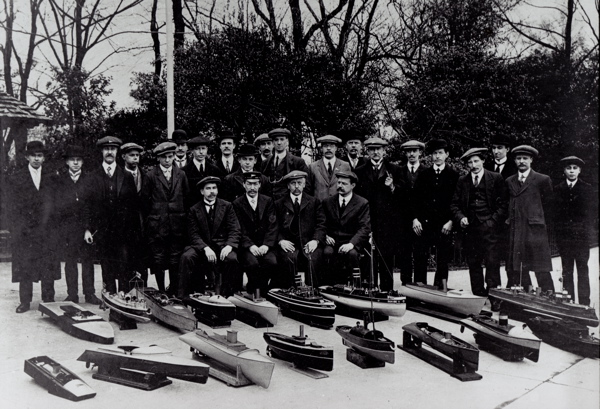
January 3rd 1937

Keith Reynolds, a sympathetic man with an appealingly straggly moustache who is Secretary of the Victoria Model Steam Boat Club, agreed to let me take a look at his photographic collection. So, as the members got steam up on the lakeside, I sat inside the club house and sifted through the archive, listening to all the variously enigmatic whistling and chugging sounds coming from the shore.
Keith told me that the model boat club existed even before the founding of the Model Steam Boat Club in 1904, preceded by a Model Sailing Boat Club that he believes was founded in 1875. The old club house in Victoria Park dates from this period and Keith showed me where the lockers once were, custom-built to store huge model sail boats, before the age of steam took over.
There are just a handful of early black and white pictures, donated years ago by member Olive Cotman. Although the photograph at the top is from January 3rd 1937, the other one is undated. As well as the impressive display of boats in both photographs, the members display a fine selection of hats, and in the top picture, if you look closely, you can see the pennant-shaped club badge pinned onto many of the caps.
The dignity of these men, seemingly so serious in their moustaches and caps, yet so proud to be photographed with their fleet of model steam boats, is undeniably touching. These boats were miniature versions of the vessels that you might see a mile away on the Thames at that time.
By contrast, the 1937 picture shows the crowd who braved the chill wind of Victoria Park in January to admire the model boats and the anonymous schoolboy in his cap on the far right is more interested in the camera than the boats, as he gazes towards us and into eternity.
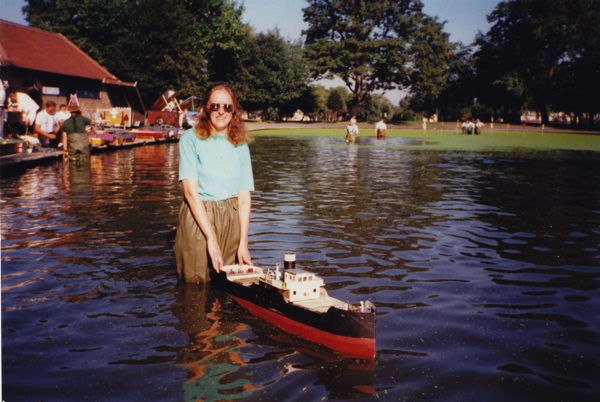
As I looked through the thousands of colour photographs taken by Janet Reynolds, Keith’s wife, over the forty summers since their marriage, I became fascinated by these idyllic pictures which evoke so many long happy Sunday afternoons. I was looking at images of the younger selves of those members of the club who I had been introduced to that morning. Keith has been sailing steam boats for fifty years, since he was ten, although he had to wait until he was fourteen to become a full-fledged member in his own right in 1964.
One day Keith’s father stopped by the lake to speak with the father of the current chairman Norman Lara, and that was how it began for the Reynolds family, which has now been involved for four generations. ‘She married into the Boating Club,’ admitted Keith affectionately, referring to the induction of his wife Jan, ‘She took photographs because she didn’t want to boat, but then she decided it was more fun to get involved, and now my daughter and my grandson of fourteen are also members.’ These lyrical images were taken by a photographer who became seduced by this diminutive nautical sport, embracing it as a family endeavour to entertain successive generations.
Out on the shore, Keith introduced me to the engineer Phil Abbott who showed me the oldest vessel still in use, a steam-powered straight-racing boat with the name of ‘All alone’ from 1920, beside it sat ‘Yvonne’ a high-speed steam-powered straight-racing boat from 1947. These boats speak of the different eras of their manufacture. ‘All alone,’ with its brass funnels and tones of brown with an eau-de-nil interior, possesses a quiet twenties elegance in direct contrast to the snazzy red and beige forties colour scheme of the speed boat which raises its prow arrogantly in the water as it roars along.
‘All alone’ was made by Arthur Perkins, who offered it to the club, as many members do, before his demise and ‘Yvonne’ has a similar provenance. When Keith revealed that he had acquired half of the thirty-seven boats he possessed, making the others himself, I realised that the club was the boats rather than the members, who are – in effect – mere custodians, providing maintenance for these vessels, enabling them to sail on, across Victoria Park Boating Lake, over decades and through generations.
Keith pinned a blue and white pennant-shaped enamel club badge on my shirt, just like those in the photo, and confessed that the club is eager for new members. It does not matter if you do not have a boat, anyone is welcome to join the conversation at the lakeside, and guidance is offered if you want to buy or make your own vessel, he explained courteously. All you need to do is go along to see Keith one Sunday in Victoria Park.
It would be the perfect excuse to spend every Sunday boating for the rest of your life and you would be joining the honoured ranks of men and women who have pursued this noble passtime since 1904 on the lake in Victoria Park. These treasured photographs speak for themselves.




You may also like to read about
Norman Phelps, Boat Club President
Lucinda Douglas Menzies at Victoria Park Steam Model Boat Club
At Doggett’s Coat & Badge Race

Sculling under London Bridge
It might have been the hottest day of the year but that was not going to stop six young apprentice watermen rowing from Southwark to Chelsea in the Doggett’s Coat & Badge Race of 2016. Held annually since 1715, this is the world’s oldest continuously-held sporting event and a fiercely-contested prize among families of watermen who have been working on the Thames for centuries.
Photographer Tom Bunning & I climbed down onto Fishmongers’ Wharf next to London Bridge to watch the apprentices carrying their skiffs over their shoulders down Fishmongers’ Steps and launching them on the river as high tide approached. On the wharf, a large board listed the contestants names and outlined their form, revealing cousins, uncles and grandfathers who had attempted this race before them.
At 10:45am HMS Belfast fired its guns, sending the seagulls into a whirl and signalling that the river was closed to traffic for the duration of the race. The six contestants lined up in their skiffs, with the Umpire’s boat close behind carrying Bobby Prentice – who holds the unbroken record for Doggett’s Coat & Badge of twenty-three minutes and twenty-two seconds in 1973 – resplendent his magnificent gold-braided outfit. Then they were off, skimming across the surface of the water like beetles, and before we knew it they had disappeared under Cannon St Bridge and away into three hundred years of history.
The origin of the race lies with Thomas Doggett, a flamboyant Irishman who became an actor-manager at the Haymarket & Drury Lane Theatres at the beginning of the eighteenth century. Acclaimed as, ‘the leading low comedian of the London stage,’ Doggett began his career performing in a booth at the notorious Bartholomew Fair in Smithfield before graduating to the West End.
The story goes that the race began as a wager in gratitude to a young waterman who rescued Doggett when he fell overboard while crossing the Thames. Doggett offered a traditional waterman’s red coat and a silver badge inscribed with a horse as a symbol of the house of Hanover and the word ‘liberty,’ to be presented to whoever could row fastest between the Swan in Southwark and the Swan in Chelsea.
Originally, the race was held each year on August 1st as a celebration of the anniversary of George I’s accession to the throne and rowed against the tide by watermen in skerries taking as long as two hours to complete the course. Doggett financed it until his death in 1721 when responsibility passed to the Fishmongers Company who have organised the event ever since. In more recent times, the race has been run with the tide and the contestants now row in single sculls. A commentator of 1864 declared, ‘This deplorable decision to go with the flow obviously marks the start of the subsequent sustained decline in the British national character.”
When we saw the contestants of 2016 disappear from view, Benjamin Folkard had already established a significant lead and it was no surprise to see him return in a motorboat an hour later as the victor. Yet this was his third attempt and he received a generous emotional greeting at Fishmongers’ Wharf from Louis Pettifer who won last year, now wearing his fine red waterman’s coat and badge. Up on the terrace of Fishmongers Hall, Sir Steve Redgrave congratulated the winner formally as dignitaries stood round and an enthusiastic cheer went up from a flotilla of corporate hospitality boats on the Thames.
Tom & I observed all this from a vantage point on London Bridge where a small crowd had formed, and a small white-haired woman confided to me that she had come to London especially to see this race which had been won by her ancestor in 1825. The river sparkled, shimmering with sunlight, and it was curious to witness such an elusive event, simultaneously so fleeting but yet so old.

Alfie Anderson


Perry Flynn


Jacob Berry

The finish of Doggett’s Coat & Badge Race at Chelsea by Thomas Rowlandson

HMS Belfast fires a gun to signal closure of the river for the race

Umpire Bobby Prentice sits in the prow


Doggett’s Coat & Badge Race, 1838


Lining up at London Bridge in 1906


T Cole, winner in 1849

Benjamin Folkard embraced by last year’s winner Louis Pettipher at Fishmongers’ Wharf

A trumpeter plays a fanfare to announce Benjamin Folkard as winner of Doggett’s Race

Doggett’s Coat & Badge Winners, 1901

Louis Pettipher presents Benjamin Folkard with champagne on the terrace of Fishmongers’ Hall

Doggett’s Coat & Badge Winners, 1960

Louis Pettipher, Benjamin Folkard, Sir Steve Redgrave

Twenty winners of Doggett’s Coat & Badge, 1905 (click to enlarge this image)

Portraits believed to be of Thomas Doggett by Thomas Murray (left) and Johann Zoffany (right)

Plaque in Eltham churchyard – Doggett married the granddaughter of the Vicar of Eltham
Colour photographs copyright © Tom Bunning
You may also like to read about
Bobby Prentice, Waterman & Lighterman
Old Bob Prentice, Waterman & Lighterman
George Parrin, Ice Cream Seller

‘I’ve been on a bike since I was two’
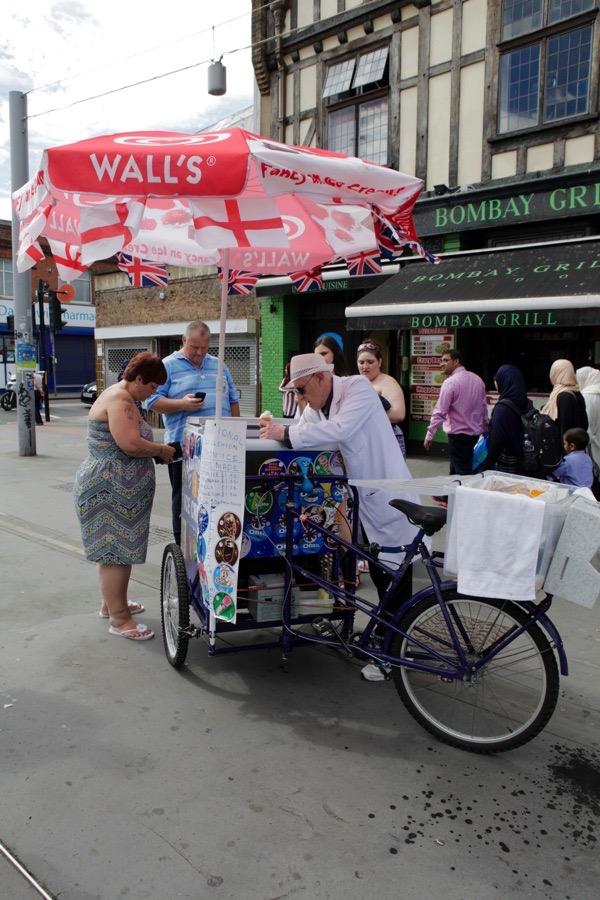
Contributing Photographer Colin O’Brien & I encountered Ice Cream Seller, George Parrin, coming through Whitechapel Market on his bicycle last weekend. Even before we met him, his cry of ‘Lovely ice cream, home made ice cream – stop me and buy one!’ announced his imminent arrival and then we saw his red and white umbrella bobbing through the crowd towards us. George told me that Whitechapel is the best place to sell ice cream in the East End and, observing the looks of delight spreading through the crowd, we witnessed the immediate evidence of this.
Such was the demand on that hot Saturday afternoon that George had to cycle off to get more supplies, so it was not possible for me to do an interview. Instead, we agreed to meet outside the Beigel Bakery on Brick Lane on Friday afternoon where trade was a little quieter. On arrival, George popped into the bakery and asked if they would like some ice cream and, once he had delivered a cup of vanilla ice, he emerged triumphant with a cup of tea and a salt beef beigel. ‘Fair exchange is no robbery!’ he declared with a hungry grin as he took a bite into his lunch.
“I first came down here with my dad when I was eight years old. He was a strongman and a fighter, known as ‘Kid Parry.’ Twice, he fought Bombardier Billy Wells, the man who struck the gong for Rank Films. Once he beat him and once he was beaten, but then he beat two others who beat Billy, so indirectly my father beat him.
In those days you needed to be an actor or entertainer if you were in the markets. My dad would tip a sack of sand in the floor and pour liquid carbolic soap all over it. Then he got a piece of rotten meat with flies all over it and dragged it through the sand. The flies would fly away and then he sold the sand by the bag as a fly repellent.
I was born in Hampstead, one of thirteen children. My mum worked all her life to keep us going. She was a market trader, selling all kinds of stuff, and she collected scrap metal, rags, woollens and women’s clothes in an old pram and sold it wholesale. My dad was to and fro with my mum, but he used to come and pick me up sometimes, and I worked with him. When I was nine, just before my dad died, we moved down to Queens Rd, Peckham.
I’ve been on a bike since I was two, and at three years old I had my own three-wheeler. I’ve always been on a bike. On my fifteenth birthday, I left school and started work. At first, I had a job for a couple of months delivering meat around Wandsworth by bicycle for Brushweilers the Butcher, but then I worked for Charles, Greengrocers of Belgravia delivering around Chelsea, and I delivered fruit and vegetables to the Beatles and Mick Jagger.
At sixteen years old, I started selling hot chestnuts outside Earls Court with Tony Calefano, known as ‘Tony Chestnuts.’ I lived in Wandsworth then, so I used to cycle over the river each day. I worked for him for four years and then I made my own chestnut can. In the summer, Tony used to sell ice cream and he was the one that got me into it.
I do enjoy it but it’s hard work. A ten litre tub of ice cream weighs 40lbs and I might carry eight tubs in hot weather plus the weight of the freezer and two batteries. I had thirteen ice cream barrows up the West End but it got so difficult with the police. They were having a purge, so they upset all my barrows and spoilt the ice cream. After that, Margaret Thatcher changed the law and street traders are now the responsibility of the council. The police here in Brick Lane are as sweet as a nut to me.
I bought a pair of crocodiles in the Club Row animal market once. They’re docile as long as you keep them in the water but when they’re out of it they feel vulnerable and they’re dangerous. I can’t remember what I did with mine when they got large. I sell watches sometimes. If anybody wants a watch, I can go and get it for them. In winter, I make jewellery with shells from the beach in Spain, matching earrings with ‘Hello’ and ‘Hola’ carved into them. I’m thinking of opening a pie and mash shop in Spain.
I am happy to give out ice creams to people who haven’t got any money and I only charge pensioners a pound. Whitechapel is best for me. I find the Asian people are very generous when it comes to spending money on their children, so I make a good living off them. They love me and I love them.”




Photographs copyright © Colin O’Brien
You might also like to read about
Matyas Selmeczi, Silhouette Artist
Adam Dant’s London Riot Map
When temperatures rise in the city, volatile emotions frequently reach combustion – Londoners take to the streets and lawlessness prevails, as it did last week in Hyde Park. Contributing Artist Adam Dant has mapped this venerable London tradition of summer riots in his elegant cartography of public disturbances in the capital from AD60 until the present day, LONDON ENRAGED. A limited edition of fifty hand-tinted prints is available from TAG Fine Arts.

(Click on this image to enlarge it and study the history of urban turbulence)
A LIST OF THE RIOTS
AD 60 Battle Bridge – alleged current site of King’s Cross station where Boudica’s Revolt resulted in her death
1189 Tower of London – Jews honouring Richard I at the king’s coronation were massacred
1196 St Mary le Bow, Cheapside – William Fitz Osbert AKA ‘William of the Long Beard’s’ sermon against ‘The Rich’ resulted in rioting and his being drawn apart by horses and hanged on a gibbet
1221 Westminster – Riots followed an annual London v Westminster wrestling match
1268 City of London – ‘ A dispute arose between certain members of the craft of the Goldsmiths and certain of the craft of the Tailors ‘
1391 Salisbury Place, Westminster – The Bakers’ Loaf Riots
1517 St Paul’s Cross – Evil Mayday Riots, A Xenophobic speech by Dr Bell prompted subjects of Henry Vlll to riot against foreigners
1668 Moorfields/Shoreditch – ‘The Bawdy House Riots/Messenger Riots ‘Dissenters prevented from private lay worship lay siege to illegal brothels in the East End in protest at the King’s tacit approval of such trade’
1710 Lincoln’s Inn – The Sacheverell Riots : The trial of preacher Henry Sacheverell resulted in riots, the destruction of Daniel Burgesse’s Presbyterian meeting house and the passing of the 1714 Riot Act
1719 Spitalfields Weavers’ Riots – weavers riot and attacked women for wearing Indian clothing
1743 Gin Riots – Rioting against the gin act is fuelled by the consumption of gin
1768 St George’s Field’s, Lambeth – Crowds gathered and rioted in protest against the imprisonment of John Wilkes for criticising the king
1769 The Spitalfields Riots – Weavers Riot over rates of piece-work pay
1780 The Gordon Riots – Lord George Gordon called for the repeal of the Catholic Relief Act of 1778 and a return to the repression of Catholics
1809 The Old Price Riots, New Theatre Covent Garden – Riots caused by rising theatre ticket prices
1816 Spa Fields Riots – Revolutionary Spenceans rioted after a mass meeting in Islington
1830 Hyde Park – Riots for electoral reform resulted in the Duke of Wellington’s carriage being attacked and his installation of iron shutters at Apsley House
1866 Hyde Park – Members of the Reform League riot after it’s suppression
1886 The West End Riots – Rioting followed a protest by the Social Democratic Foundation, Britain’s first socialist political party who agitated against free trade
1887 Trafalgar Sq, Bloody Sunday – Violence erupted between police and demonstrators protesting against unemployment and coercion in Ireland
1907 Battersea Park, The Brown Dog Riots – Rioting started after medical students attempted to destroy an anti-vivisection statue of a dog
1909 The Tottenham Outrage – Deaths and injuries resulted from the fall out of an attempted armed robbery by two Bolsheviks
1911 The Siege (or Battle) of Sidney Street – A violent stand-off occurred between police and the army and two Latvian revolutionaries
1919 The Battle of Bow St – Police clashed with Australian, American and Canadian servicemen after attempting to stop them playing dice outside the YMCA
1932 Hyde Park , National Hunger March Riot – Police confiscates a petition of a million names from The National Unemployed Workers Movement resulting in riots
1936 The Battle of Cable St – East enders rioted against the police who attempted to protect a march by the British Union of Fascists
1958 Notting Hill – Race riots between White British residents and West Indian Immigrants
1968 Grosvenor Sq – Demonstrations against the US war in Vietnam outside the American Embassy turned violent
1974 Red Lion Sq – Disorder followed demonstrations against the National Front by Anti-Fascists
1976 Notting Hill Carnival Riots – Riots occurred after heavy handed policing of pickpockets in the carnival crowd
1977 The Battle of Lewisham – A National Front march from New Cross to Lewisham resulted in riots after violent clashes with Anti-Fascist demonstrators
1979 Southall Riots – A demonstration against a National Front election meeting resulted in violence and the death of Anti-NF activist Blair Peach
1981 Brixton Riots – Riots on ‘Bloody Saturday‘ resulted from antagonism between the police and residents of an area with a high level of socio-economic problems
1985 Brixton Riots – Rioting and fires followed the wrongful shooting by police of Dorothy ‘cherry ‘ Grose
1985 Broadwater Farm Riots – Tensions between local black youth and largely white Metropolitan Police following the shooting of Dorothy Grose turned to rioting after the death of Cynthia Jarrett of a heart attack during a police search
1990 Poll Tax Riots – Rampaging and looting followed a protest against Margaret Thatcher’s Community Charge or ‘Poll Tax’
1995 Brixton Riots – Rioting occurred after a peaceful protest outside Brixton Police station became violent
1996 England v Germany UEFA cup riot, Trafalgar Sq
1999 Carnival Against Capitalism – A battle ensued between mounted police and protestors who had bricked up the LIFFE entrance and set off a nearby fire hydrant to release the lost Walbrook river
2000 Anti-Capitalism Mayday Riot
2001 Anti-Capitalism Mayday Riot
2002 Millwall FC New Den Stadium – Riot between fans of Millwall and fans of Birmingham FC
2009 G20 Summit Protest Riot – Police ‘kettled’ protestors outside the Bank of England which resulted in a riot and the death of innocent newspaper vendor Ian Tomlinson
2009 West Ham FC Upton Park – rioting between fans of Millwall FC and West Ham FC
2010 Millbank – Riots followed student protests against increase in tuition fees
2011 Oxford Circus – Protestors demonstrating against government public spending cuts were ‘kettled’ by the police
2011 Tottenham Riots – Riots followed the shooting by police of Mark Duggan and spread from Tottenham across the country
2010 Brick Lane – American Apparel Disturbances, riots followed after customers were prevented from shopping for cut-price clothes
2016 Brick Lane – The ‘Fuck Parade’ rioting followed a ‘Class War’ demonstration against ‘Cereal Killer’ Cafe

Map copyright © Adam Dant
You may also like to take a look at
Argotolis, The Map Of London Slang
Adam Dant’s Map Of The Coffee Houses
The Meeting of the New & Old East End in Redchurch St
Map of the History of Shoreditch
Map of Shoreditch in the Year 3000
Map of Shoreditch as the Globe
Map of the History of Clerkenwell
Map of the Journey to the Heart of the East End
Robson Cezar At St Katharine’s Precinct

Spitalfields resident, artist Robson Cezar known as ‘King of the Bottletops’ is currently cycling down to St Katharine’s Precinct at the end of Cable St in Limehouse each day where he is undertaking a mural commission for the Royal Foundation of St Katharine, and Contributing Photographer Sarah Ainslie followed him down there to take a peek.
All readers are invited to visit the precinct and follow his progress over coming weeks, and you are welcome to bring your bottletops to contribute to the mural or to assist in sorting all the colours. The open air studio is open weekdays and Sundays from 11am – 3pm until August 7th.


Photographs copyright © Sarah Ainslie
St Katharine’s Precinct, Butcher Row, Limehouse, E14 8DS
You may also like to read about
Robson Cezar, King of the Bottletops
Haymaking On Walthamstow Marshes

Raf Szafruga, heroic scyther
Last summer, in celebration of Lammastide which marks the beginning of the grain harvest, Contributing Photographer Colin O’Brien & I went along to join the mowers wielding scythes on Walthamstow Marshes. This year you can join them yourself on Saturday 30th & Sunday 31st July from 10:30am each day. Devised by Kathrin Böhm & Louis Buckley, this is the fourth year of Community Hay Harvest upon the Lammas Lands, which were originally drained for agriculture in ancient times and exist now as one of the last areas of natural marshland in London, protected as a Site of Special Scientific Interest.
In the nineteenth century, this became the location of conflict when the East London Waterworks illegally fenced off some of the marshes and, on 1st August 1892, several thousand local people turned out to take down the fences and reclaim the Common Land. William Morris, who was born and brought up in Walthamstow and knew these marshes as child, was instrumental in setting up the Commons Preservation Society in 1865 to protect land such as this, which has been in common ownership for centuries.
“We’ve hit one hundred!” declared scything expert Clive Leeke, who had been giving lessons, “more than one hundred local people have come to learn scything.”Although scything exists in the public imagination as a resolutely macho activity, we discovered a range of participants of both sexes and all ages eager to take up scythes and set forth onto the grasslands.
As the climax of the afternoon, the joyful scythers set off together in a line cutting rhythmically through the long grass under the wide sky and Clive explained that, in spite of the heat, he was not expecting see any perspiration. Scything is about having good technique and a sharp blade rather than physical strength, I learnt.
Nevertheless, it was obvious that Raf Szafruga from Poland made headway across the marshes far in advance of all the other mowers. Clive explained that, over the weekend, East Europeans who were blackberrying around the marsh came to join the scything and had no need of lessons. “They’ve never lost touch with the land, like we have,” he admitted to me with a grin and a shrug.
Yet as we turned our heads, we could see the line of mowers their working away across the marsh as they would have done before the railway came and it was remarkable how swiftly they had picked up these age-old skills. At the end of proceedings, Clive presented a Lammas loaf to the mower with best overall performance and style, and we all went away sunburnt and satisfied by a memorable summer afternoon on Walthamstow Marshes.


Scything Guru, Clive Leeke, teaches ‘Scything without tears’


Richard Williams – “I was born in the country but I have lived in London for thirty years”


Sharpening the blades with whetstones


Natalie Wood won the prize for the best windrow

Julian Weston – “Yesterday, I did my first scything and today I won a competition.”

Louis Buckley

Kathrin Böhm & her son Lawrence

Kathrin – “My heart is gladdened that so many people have come out to give it a try”

Kent & William Sturgis

Lammas loaf baked by Jojo Tulloh with flour ground in Hackney

Click on this group photo to enlarge
Photographs copyright © Colin O’Brien
You may also like to read about
Sheepshearing at Spitalfields City Farm
Wonderful London’s East End
It is my pleasure to publish these evocative pictures of the East End (with some occasionally facetious original captions) selected from the popular magazine Wonderful London edited by St John Adcock and produced by The Fleetway House in the nineteen-twenties. Most photographers were not credited – though many were distinguished talents of the day, including East End photographer William Whiffin (1879-1957).

Boys are often seen without boots or stockings, and football barefoot under such conditions has grave risks from glass or old tin cans, but there are many urchins who would rather run about barefoot.

When this narrow little dwelling in St John’s Hill, Shadwell, was first built in 1753, its inhabitants could walk in a few minutes to the meadows round Stepney or, venture further afield, to hear the cuckoo in the orchards of Poplar.

Middlesex St is still known by its old name of Petticoat Lane. Some of the goods on offer at amazingly low prices on a Sunday morning are not above suspicion of being stolen, and you may buy a watch at one end of the street and see it for sale again by the time you reach reach the other.

A vanished theatre on the borders of Hoxton, just before demolition, photographed by William Whiffin. In 1838, a tea garden by the name of ‘the Eagle Tavern’ was put up in Shepherdess Walk in the City Rd near the ‘Shepherd & Shepherdess,’ a similar establishment founded at the beginning of the same century. Melodramas such as ‘The Lights ‘O London’ and entertainments like ‘The Secrets of the Harem,’ were also given. In 1882, General Booth turned the place into a Meeting Hall for his Salvation Army. There is little suggestion of the pastoral about Shepherdess Walk now.

In the East End and all over the poorer parts of London, a strange kind of establishment, half booth, half shop, is common and particularly popular with greengrocers. Old packing cases are the foundation of a slope of fruit which begins unpleasantly near the level of the pavement and ends in the recess behind the dingy awning. At night, the buttresses of vegetables are withdrawn into shelter.

Old shop front in Bow photographed by William Whiffin. Pawnbroking, once as decorous as banking, has fallen from the high estate in the vicinity of Lombard St. Now, combined instead with the sale of secondhand jewellery, furniture and hundred other commodities, it is apt to seek the corners of the meaner streets.

A water tank covered by a plank in a backyard among the slums is an unlikely place for a stage, but an undaunted admirer of that great Cockney humorist, Charlie Chaplin, is holding his audience with an imitation of the well-known gestures with which the famous comic actor indicates the care-free-though-down-and-out view of life which he has immortalised.

Old shop front in Poplar photographed by William Whiffin

An old charity school for girl and boy down at Wapping founded in 1704. The present building dates from 1760 and the school is supported by voluntary subscriptions. The school provided for the ‘putting out of apprentices’ and for clothing the pupils.

The hunt for bargains in Shoreditch. A glamour surrounds the rickety coster’s barrow which supports a few dozens of books. But, to tell the truth, the organisation of the big shops is now so efficient that the chances of finding anything good at these open air book markets may have long odds laid against it.

The landsman’s conception of a sailing vessel, with all its complex of standing and running rigging that serves mast and sail with ordered efficiency, is apt for a shock when he sees a Thames barge by a dockside. The endless coils and loops of rope of different thickness, the length of chain and the litter of brooms, buckets, fenders and pieces of canvas, seem to be in the most insuperable confusion.

Gloom and grime in Chinatown. Pennyfields runs from West India Dock Rd to Poplar High St. A Chinese restaurant on the corner and a few Chinese and European clothes are all that is to be seen in the daytime.

The gem of Cornhill, Birches, where it stood for two hundred years. Towards the end of the eighteenth century, the brothers Adam erected its beautiful shop front. Within were old bills of fare printed on satin, a silver tureen fashioned to the likeness of a turtle and many other curious odd-flavoured things. Birches have catered for the inspired feasting of the City Companies and Guilds for two centuries but now this shop has moved to Old Broad St and, instead of Adam, we are to have Art Nouveau ferro-concrete.

It is doubtful if the Borough Council of Poplar had any notion, when they supplied the district with water carts, that the supplementary use pictured in this photograph by William Whiffin would be made of them. Given a complacent driver, there is no reason why these children should not go on for miles.

Grime and gloom in St George’s St photographed by William Whiffin. St George’s St used to be the famous Ratcliff Highway and runs from East Smithfield to Shadwell High St. It is a maritime street and contains various establishments, religious and otherwise, which cater for the sailor.

River Lea at Bow Bridge photographed by William Whiffin. On the right are Bow flour mills, while to the left, beyond the bridge, a large brewery is seen.

A view of Curtain Rd photographed by William Whiffin, famed for its cabinet makers. It runs from Worship St – a turning to the left when walking along Norton Folgate towards Shoreditch High St – to Old St. Curtain Rd got its name from a curtain wall, once part of the outworks of the city’s fortifications.

Fish porters of Billingsgate gathered around consignments lately arrived from the coast. At one time, smacks brought all the fish sold in the market and were unloaded at Billingsgate Wharf, said to be the oldest in London.

Crosby Hall as it stood in Bishopsgate. Alderman Sir John Crosby, a wealthy grocer, got the lease of some ground off Bishopsgate in 1466 from Alice Ashfield, Prioress of St Helen’s, at a rent of eleven pounds, six shillings and eightpence per annum, and built Crosby Hall there. It came into the possession of Sir Thomas More around 1518 and by 1638 it was in the hands of the East India Company, but in 1910 it was taken down and re-erected in Cheyne Walk.

Whatever their relations with the Constable may come to be in later life, the children of the East End, in their early days, are quite willing to use his protection at wide street crossings.

There is no more important work in the great cities than the amelioration of the slum child’s lot. Many East End children have never been beyond their own disease-ridden courts and dingy streets that form their playground.
Photographs courtesy Bishopsgate Institute
You may also like to take a look at


