
Tony Bock’s East End

At The Royal Oak, Bethnal Green
These pictures are a selection from those taken in the five years between 1973 and 1978, when Tony Bock lived in the East End working as a photographer for the East London Advertiser. “Britain in the nineteen seventies never seemed comfortable with itself,” Tony admitted to me, “caught between the post-war years that hung on too long and the late twentieth century that seemed late in arriving.”
Although he was brought up in Canada where his parents emigrated in 1952, Tony was born in Paddington and, after being thrown out of photography school in Toronto in 1972, he decided to return to his country of birth and the East End where his mother’s family came from. “My grandfather was a docker his entire working life, working at Hay’s Wharf near London Bridge in the nineteen twenties then moving on to ‘The Royals’ (as the Royal Docks were known) until he retired.” he explained.
Yet Tony’s return was destined to be short-lived and there is an ambivalence which runs through these eloquent photographs. While he had a personal connection to the world that he portrayed, equally Tony was a stranger to it. In many of these pictures a dramatic tension exists between the empathy of the photographer and an underlying sense of dislocation – though it was not simply the dislocation of an outsider, but that of a world undergoing transition and fragmentation. In these photographs, Tony explored his relationship to the culture of his own origin, yet he discovered it was a troubled society in which he could never feel at home.
“I lived in Wapping for several years and met Lyn, my wife-to-be, who was also a journalist at the East London Advertiser.” Tony recalled, “But in 1978, I was offered work at The Toronto Star, the largest paper in Canada. The racism and pollution in the East End were getting me down and when Maggie Thatcher was elected – well – that was enough to send me back home.”
Tony’s spell at photography school granted him an awareness of the work of the great international photographers of the twentieth century and this knowledge informed the confident aesthetic of his East End pictures, with their strong compositions and deftly-balanced multiple points of focus within a single frame. For Tony Bock, his sojourn in the East End delivered the opportunity he needed to take a clear-eyed look at his roots before returning to pursue a career as a photojournalist in Toronto. Today, these pictures from the mid-seventies offer us an invaluable personal vision of a not-so-distant world that is rapidly fading from memory.
“I worked at The Star for over thirty years, it was a great place to be a photojournalist. It was a paper that cared about photography, had the budget to undertake long term projects, sent staff around the world, and dealt with social issues.” he told me, “Oddly, my life in East London followed the route my mother’s family had taken years earlier.”

Saturday night out, Dagenham

Children playing in Poplar

Clown at Stratford Broadway

At J.Kelly, Pie & Mash, Bethnal Green

At The White Swan, Poplar

At the E1 Festival, Stepney

Train departing Liverpool St Station

In Watney Market

Corner Shop, Sidney St

Boy with a gun and his sister, Pearl St, Wapping

Wapping Stairs

Demolition at Tiller Rd, Isle of Dogs

Commercial Docks, Rotherhithe

No remuneration to Place-keepers.
Photographs copyright © Tony Bock
Trussing The Cooper At Truman’s Brewery

Cooperage in Spital St
More than a quarter century has passed since the Truman brewery closed in Brick Lane in 1989 and it is hard now to imagine the teeming life of the place that sustained itself over three centuries of brewing on this site. But thanks to the British Pathe archive of news footage, I was permitted a startling glimpse of the lively community that was once here. Trussing the Cooper records a traditional apprentice’s initiation ritual of humiliation in 1954. The apprentice, Gordon Wright of Bromley in Kent, is put in a barrel, covered with all kinds of filth and rolled around until he emerges coated in grime to be presented with a pint of ale, now a fully fledged cooper. It is a powerful cinematic cameo with a gleeful Dionysiac energy that cuts across the intervening half century, thrusting us into the joyful heart of their world. Whatever else was going on, these people certainly knew how to make their own fun – but I am glad I was not the one in the barrel. To his eternal credit, Gordon takes it all in great spirit. Maybe he had a couple of pints already to give him some Dutch courage?
[youtube kWHC4qLPisI nolink]


The former Truman’s Cooperage
You also like to read about
Nippers At The Museum of Childhood
I am talking about Horace Warner’s SPITALFIELDS NIPPERS at 6:30pm on Thursday 16th March at the V&A’s Museum of Childhood in Bethnal Green. Click here for tickets

Wakefield Sisters
In his Spitalfields albums, Horace Warner collected together the portraits that he made of the people who lived in Quaker St around 1900 and, because he captioned some of them with their names, we have been able to trace the biographies of his subjects in the public records.
When you see this tender portrait of Jessica Wakefield in her clean apron and her younger sister Rosalie in her check dress, it is impossible not to wonder what happened to these two and thus it imbues the photograph with an even greater resonance to discover that they lived to the ages of ninety-four and eighty-four respectively. I can no longer look at this picture without seeing it as an image of Jessica & Rosalie poised upon the threshold of life itself.
Observe how Jessica places her arm protectively around her little sister who was four years and half years younger than she. Jessica had been born in Camden on January 16th 1891 and Rosalie at 47 Hamilton Buildings, Great Eastern St, Shoreditch on July 4th 1895. They were the second and last of four children born to William, a printer’s assistant, and Alice, a housewife.It seems likely they were living in Great Eastern St at the time Horace Warner photographed them, when Jessica was ten or eleven and Rosalie was five or six.
Jessica married Stanley Taylor in 1915 and they lived in Wandsworth, where she died in 1985, aged ninety-four. On July 31st 1918 at the age of twenty-three, Rosalie married Ewart Osborne, a typewriter dealer, who was also twenty-three years old, at St Mary, Balham. After five years of marriage, they had a son named Robert, in 1923, but Ewart left her and she was reported as being deaf. Eventually the couple divorced in 1927 and both married again. Rosalie died aged eighty-four in 1979, six years before her elder sister Jessica, in Waltham Forest.
Once we know what life had in store for the Wakefield Sisters, these bare facts deliver a poignant dramatic irony to their photograph. We hope they remained close and were able to support each other through the travails and joys of existence. Once Jessica & Rosalie come alive to us as individuals, we are left to contemplate the moment of stillness that was captured for eternity by Horace Warner in 1900.
[youtube WOJlJ0qfFrs nolink]

Click here to order a copy of SPITALFIELDS NIPPERS by Horace Warner

You may also like to read about
An Astonishing Photographic Discovery
Tony Hall’s East End

There is little traffic on the road, children are at play, housewives linger in doorways, old men doze outside the library and, in the distance, a rag and bone man’s cart clatters down the street. This is the East End in the afternoon, as photographed by newspaper artist Tony Hall in the nineteen sixties while wandering with his camera in the quiet hours between shifts on The Evening News in Fleet St.
“Tony cared very much about the sense of community here.” Libby Hall, Tony’s wife, recalled, “He loved the warmth of the East End. And when he photographed buildings it was always for the human element, not just the aesthetic.”
Contemplating Tony’s clear-eyed photos – half a century after they were taken – raises questions about the changes enacted upon the East End in the intervening years. Most obviously, the loss of the pubs and corner shops which Tony portrayed with such affection in pictures that remind us of the importance of these meeting places, drawing people into a close relationship with their immediate environment.
“He photographed the pubs and little shops that he knew were on the edge of disappearing,” Libby Hall confirmed for me, ‘He loved the history of the East End, the Victorian overlap, and the sense that it was the last of Dickens’ London.”
In 1972, Tony Hall left The Evening News and with his new job came a new shift pattern which did not grant him afternoons off – thus drawing his East End photographic odyssey to a close. Yet for one who did not consider himself a photographer, Tony Hall’s opus comprises a tender vision of breathtaking clarity, constructed with purpose and insight as a social record. Speaking of her late husband, Libby Hall emphasises the prescience that lay behind Tony’s wanderings with his camera in the afternoon. “He knew what he was photographing and he recognised the significance of it.” she admitted.
These beautiful streetscapes complete my selection of pictures from the legacy of approximately one thousand photographs by Tony Hall held in the archive at the Bishopsgate Institute.


Three Colts Lane

Gunthorpe St


Ridley Rd Market


Stepney Green


Photographs copyright © Libby Hall
Images Courtesy of the Tony Hall Archive at the Bishopsgate Institute
You may also like to read
Tony Hall’s East End Panoramas
At London Fields Railway Arches

Bill Waldon, Westgate Motor Centre
‘I used to have five arches but I was priced out and ended up in this dark hole!’
Contributing Photographer Sarah Ainslie & I spent a day last week visiting the occupants of the railway arches in London Fields where an atmosphere of crisis prevails currently. Thirty years ago, these crumbling old arches were empty and derelict but, over time, a diverse economy of small businesses has grown up here – chiefly car repairs, cabinet-making and secondhand furniture dealing, supplemented more recently by brewers, bakers and coffee roasters.
Yet now the owner Network Rail is demanding 200% and 300+% rent increases which threaten to destabilise this small community and drive out those have been longest established in this location offering invaluable services to local residents.
‘We feel we are the guardians of the arches,’ explained Nivinh Chu whose father started Chu’s Garage twenty-eight years ago, ’Yet we are being driven out by these increases, when small businesses are the heart and soul of Hackney.’ In common with some of their neighbours, Chu’s Garage faces a back-dated rent hike from £18,000 to £40,000 per annum while for others the increases are even higher.
‘Bricks were falling out of the roof for the first twenty years but Network Rail did nothing, so we had to built this temporary roof so nobody gets injured,’ Nivinh admitted to me with a grin at the absurdity of the situation.
In response to these adverse circumstances, the occupants of the railway arches are banding together to form the London Fields Traders Action Group to challenge Network Rail’s excessive rent increases and we wish them all the best in their fight to stay in business. Follow their endeavours at www.facebook/londonfieldsguardiansofthearches

John Lucien and John ‘boy’ Griffin of Westgate Motor Centre, established twenty-four years under the arches – ‘We do general repairs and we try to look after everybody’

Ben Mackinnon, Founder of E5 Bakehouse

Ben Mackinnon and fellow bakers at E5 Bakehouse

Stephen Maxwell of Maxwell Pinborough, bespoke furniture

Stephen Maxwell and colleagues at Maxwell Pinborough

Vict Anhu Vu of USA Nails Beauty Supply – ‘For fifteen years, we have had three warehouses under the arches and a shop in Mare St’

Noemi Dulischewski, founder of Brunch, a pop-up restaurant in the the London Fields Brewery Tap Room which has been running for two years

Charlie Fox, Proprietor of Poetstyle bespoke furniture and upholstery – ‘We moved in on Christmas eve thirty years ago and now we are facing 250% rent increase’

Ali Sharif of Sharif Auto Services has been operating under the London Fields arches for seven years. Currently he pays £30,000 but Network Rail want £100,000

Charles Woodward and ‘Popsy’ of London Doggies, pet grooming business established six years

Ian Rutter, Company Manager of London Fields Brewery

Simon Clark, Coffee Roaster at Climpson’s Coffee

Ahmet Ozer has been dealing in secondhand catering equipment for seventeen years from his arch

Quang Chu, Nivinh Chu and Jimmy Chu of Chu’s Garage

Quang Chu and Jimmy Chu of Chu’s Garage, opened by their father twenty-eight years ago
Photographs copyright © Sarah Ainslie
You may also like to read about
Alan Dein’s East End Shops

P.Lipman, Kosher Poultry Dealers, Hessel St
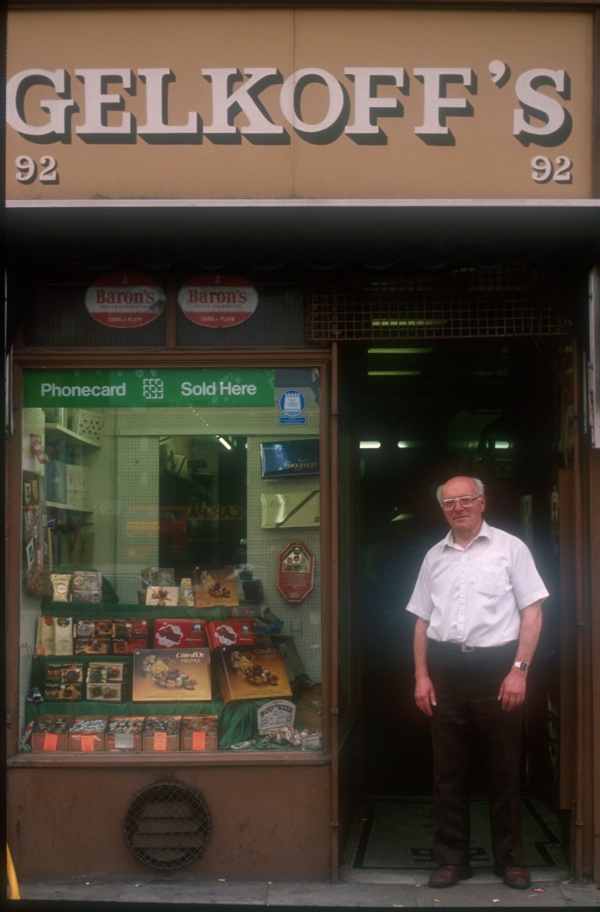
“In my twenties, I’d been doing a number of oral history recordings, working for the Museum of the Jewish East End which was very active recording stories of the life of Jewish people who had settled here.”explained Alan Dein, broadcaster and oral historian, outlining the background to his unique collection of more than a hundred photographs of East End shopfronts.
“My photographs of the derelict shopfronts record the last moments of the Jewish community in the area. The bustling world of the inter-war years had been moved into the suburbs, and the community that stayed behind was less identifiable. In the nineteen eighties they were just hanging on, some premises had been empty for more than five years. They were like a mouthful of broken teeth, a boxer’s mouth that had been thumped, with holes where teeth once were.”
Feeding his twin passions for photography and collecting, Alan took these pictures in 1988 while walking around the streets of the East End at a time when dereliction prevailed. Although his family came from the Jewish East End and his Uncle Lou was a waiter at Blooms, Alan was born elsewhere and first came to study. “As a student at the City of London Polytechnic in Old Castle St, I spent a lot of time hanging out here – though the heart of the area for me at that time was the student common room and bar.” he told me.
“Afterwards, in 1988, I moved back to live in a co-operative housing scheme in Whitehorse Rd in Stepney and then I had more time to walk around in this landscape that evoked the fragmentary tales I knew of my grandparents’ lives in the East End. The story I heard from their generation of the ‘monkey parade’, when once people walked up and down the Mile End Road to admire the gleaming shopfronts and goods on display. My family thought I was mad to move back because when they left the East End they put it behind them, and it didn’t reflect their aspirations for me.
The eighties were a terrible time for removing everything, comparable to what the Victorians had done a century earlier. But I have always loved peeling paint, paint that has been weathered and worn seafront textures, and this was just at the last moment before these buildings were going to be redeveloped, so I photographed the shopfronts because this landscape was not going to last.”
In many of these pictures, there is an uneasy contradiction between the proud facades and the tale of disappointment which time and humanity has written upon them. This is the source of the emotionalism in these photographs, seeing faded optimism still manifest in the confident choice of colours and the sprightly signwriting, becoming a palimpsest overwritten by the elements, human neglect and graffiti. In spite of the flatness of these impermeable surfaces, in each case we know a story has been enclosed that is now shut off from us for ever. Beyond their obvious importance as an architectural and a social record, Alan’s library of shopfronts are also a map of his exploration of his own cultural history – their cumulative heartbreak exposing an unlocated grief that is easily overlooked in the wider social narrative of the movement of people from the East End to better housing in the suburbs.
Yet Alan sees hope in these tantalising pictures too, in particular the photo at the top, of Lipman’s Kosher Poultry Dealers, in which the unknown painter ran out of paint while erasing the name of the business, leaving the word “Lip” visible. “A little bit of lip!” as Alan Dein terms it brightly, emblematic of an undying resilience in the face of turbulent social change.
SIGN THE PETITION TO SAVE OUR SHOPKEEPERS FROM THE NEW BUSINESS RATES

Goulston St

In Whitechapel

Commercial Rd

Redchurch St

Stepney Green

Cheshire St

Alie St

Hessel St

Hackney Rd

Quaker St

Mile End Rd

Toynbee St

Alie St

In E2

Brick Lane

Great Eastern St

Commercial St

Hessel St

Mile End Rd

Relocated to Edgeware

Bow Common Lane

Brick Lane

Ben Jonson Rd

Wilkes St

Bow Rd

Ridley Rd

New Goulston St.
Whitechapel High St

Alderney Rd, Stepney
Photographs copyright © Alan Dein
You may also like to take a look at
Philip Marriage, Photographer

Quaker St, 1967
The passage of time in Spitalfields became visible to Philip Marriage as he made successive visits over three decades to take these photographs. Working for HMSO publications in Holborn and commuting regularly through Liverpool St Station, he revisited Spitalfields sporadically over the years, drawn by a growing fascination with those streets where his ancestors had lived centuries earlier.
The poignant irony of these pictures is that while Philip came to Spitalfields in search of the past, he discovered many of the streets which interested him were retreating in time before his lens, disintegrating like phantoms into the ether, even as he was photographing them.
In 1967, when Philip Marriage first visited with his camera, he found a landscape scattered with bomb sites from World War II and he witnessed the slum clearance programme, as settled communities were displaced from their nineteenth century cottages and tenements into new housing complexes. Twenty years later, he encountered the opposing forces of redevelopment and conservation that were reshaping the streets to create the environment we recognise today.
But other, less obvious, elements affect our perception of time in these photographs too. Those pictures from 1967 exist in a lyrical haze which is both the result of air pollution caused by coal fires and the unstable nature of colour film at that time. By the eighties, the smog has been consigned to the past and better colour film delivered crisper images, permitting photographs which appear more contemporary to us.
Yet it was relatively recent events in Spitalfields, that came after he took his pictures, which render Philip Marriage’s photographs so compelling now – as windows into a lost time before the closure of the Truman Brewery and the Fruit & Vegetable Market.

Quaker St, 1987

Quaker St, looking west, 1967

Quaker St, looking west, 1987

Artillery Lane, 1967

Artillery Lane, 1985

Samuel Stores, Gun St, 1985

Samuel Stores, Gun St, 1986

Former Samuel Stores, Gun St, 1987

Verdes, Brushfield St, 1988

Verdes, Brushfield St, 1990

Poyser St, Bethnal Green, 1967

Poyser St, Bethnal Green, 1967

Cheshire St with Rag & Bone Man, 1967

Middleton St, Bethnal Green, 1967
Photographs copyright © Philip Marriage
You may also like to take a look at
Philip Marriage’s Spitalfields
Alan Dein’s East End Shopfronts of 1988
Mark Jackson & Huw Davies, Photographers


