
The Pleasures & Miseries Of London
Written anonymously and published in 1820, The Tour of Dr Syntax Through the Pleasures & Miseries of London was one of a popular series of comedies featuring the idiosyncratic Dr Syntax, a character originated by William Coombe and drawn by Thomas Rowlandson. These plates are believed to be the work of Robert Cruikshank, father of George Cruikshank.

Dr Syntax & his Spouse plan their trip to London

Setting out for London

Arriving in London

Robbed in St Giles High St

A Promenade in Hyde Park

A Flutter at a Gaming House

At an Exhibition at the Royal Academy

At a Masquerade

In St Paul’s Churchyard on a Wet & Windy Day

Inspecting the Bank of England

Presented to the King at Court

A Night at Vauxhall Pleasure Gardens

A Visit to the House of Commons

A Trip behind the Scenes at the Opera

A Lecture at the London Institution

Going to Richmond on a Steam Boat

Reading his Play in the Green Room

Overshoots London Bridge & pops overboard into the Thames

Images courtesy of Bishopsgate Institute
You may also like to take a look at
More of Tom & Jerry’s Life in London
James Boswell, Artist & Illustrator
Today I feature James Boswell, illustrator of A HOXTON CHILDHOOD, whose drawings we have reproduced from the original artwork for the new edition (including A.S. Jasper’s sequel THE YEARS AFTER illustrated by Joe McLaren) which I am publishing this spring.
The launch party for A HOXTON CHILDHOOD & THE YEARS AFTER is on Tuesday 25th April 7pm at the Labour and Wait Workroom, 29-32 The Oval, Off Hackney Rd, Bethnal Green, E2 9DT. There will be live music, readings and refreshments. Click here for tickets

Drawing of Hoxton Market by James Boswell
A few years ago, I had the privilege of travelling up to a leafy North London suburb to meet Ruth Boswell – an elegant woman with an appealing sense of levity – and we sat in her beautiful garden surrounded by raspberries and lilies, while she told me about her visits to the East End with her late husband James Boswell who died in 1971. And when I left with two books of drawings by James Boswell under my arm as a gift, I realised it had been an unforgettable introduction to an artist who deserves to be better remembered.
Ruth is no longer with us. But this year I returned to that same North London suburb with designer David Pearson to meet James Boswell’s daughter Sal Shuel and enquire after his drawings for A.S Jasper’s A HOXTON CHILDHOOD. Thanks to Sal, we were able to photograph the original artwork of his illustrations and cover design, and reproduce them freshly in the new edition, A HOXTON CHILDHOOD & THE YEARS AFTER.
To introduce you to James Boswell’s work, I have selected these lively drawings of the East End done over a thirty year period between the nineteen-thirties and the fifties. There is a relaxed intimate quality to these – delighting in human detail – which invites your empathy with the inhabitants of the street, who seem so completely at home it is as if the people and cityscape are merged into one. Yet, “He didn’t draw them on the spot,” Ruth revealed, as I pored over the line drawings trying to identify the locations, “he worked on them when he got back to his studio. He had a photographic memory, although he always carried a little black notebook and he’d just make few scribbles in there for reference.”
“He was in the Communist Party, that’s what took him to the East End originally,” she continued, “And he liked the liveliness, the life and the look of the streets, and and it inspired him.” In fact, James Boswell joined the Communist Party in 1932 after graduating from the Royal College of Art and his lifelong involvement with socialism informed his art, from drawing anti-German cartoons in style of George Grosz during the nineteen thirties to designing the posters for the successful Labour Party campaign of 1964.
During World War II, James Boswell served as a radiographer yet he continued to make innumerable humane and compassionate drawings throughout postings to Scotland and Iraq – and his work was acquired by the War Artists’ Committee even though his Communism prevented him from becoming an official war artist. After the war, as an ex-Communist, Boswell became art editor of Lilliput influencing younger artists such as Ronald Searle and Paul Hogarth – and he was described by critic William Feaver in 1978 as “one of the finest English graphic artists of this century.”
Ruth met James in the nineteen-sixties and he introduced her to the East End. “We spent quite a bit of time going to Blooms in Whitechapel in the sixties. We went regularly to visit the Whitechapel when Robert Rauschenberg and the new Americans were being shown, and then we went for a walk afterwards.” she recalled fondly, “James had been going for years, and I was trying to make my way as a journalist and was looking at the housing, so we just wandered around together. It was a treat to go the East End for a day.”

Pennyfields
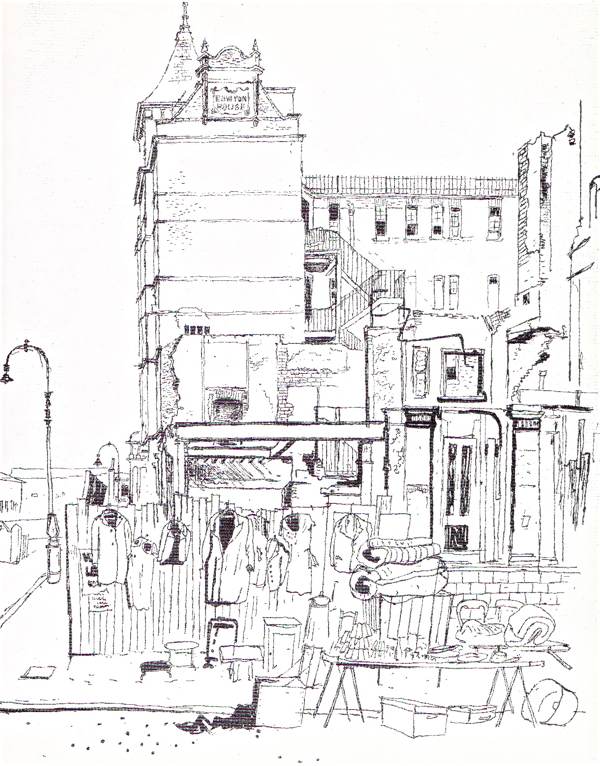
Rowton House

Old Montague St, Whitechapel

Gravel Lane, Wapping

Brushfield St, Spitalfields


Wentworth St, Spitalfields


Brick Lane


Fashion St, illustration by James Boswell from “A Kid for Two Farthings” by Wolf Mankowitz, 1953.

Russian Vapour Baths in Brick Lane from “A Kid for Two Farthings.”

James Boswell (1905-1971)


Leather Lane Market, 1937
Images copyright © Estate of James Boswell
You can see more work by James Boswell at www.jboswell.org.uk
You might also like to take a look at
In the Footsteps of Geoffrey Fletcher
The Most Famous Bells In The World
In the third of my series of the stories of Whitechapel Bells, I visit the Bow Bells in Cheapside

These are the bells of St Mary-le-Bow in the City of London which have good claim to be the most famous set of bells in the world, known as the Bow Bells. These are the bells that Dick Whittington heard in the fable, which seemed to call ‘Turn again Whittington, Thrice Lord Mayor!’ as he ascended Highgate Hill to depart the capital in 1392, inspiring his return to London to seek his fortune with the assistance of his celebrated cat. These are the bells that are so beloved of Cockneys that you must be born within the sound of Bow Bells to call yourself one of their crew. Naturally, these bells were cast at the Whitechapel Bell Foundry, the most famous bell foundry in the world.
Simon Meyer, Steeplekeeper at St Mary-le-Bow had to ascend Christopher Wren’s magnificent tower to change the clock to British Summer Time recently, which afforded me the opportunity to accompany him and view the bells for myself. When we arrived in the belfry, Simon leapt happily around upon the frame as if it were second nature to him yet I found it necessary to place my feet a little more deliberately as we negotiated the famous bells. ‘They’re about to ring,’ he announced at one moment, which filled my head with alarming thoughts of bells rotating in their frames but in fact turned out to be a clock chime which did not entail any movement of bells. Occasioning a reverberation within the belfry as powerful as the sound itself, this is not something I shall forget in a hurry.
The earliest record of the Bow Bells is from 1469 when the Common Council ordered a curfew rung each night at 9pm, marking the end of the apprentices’ working day. In 1588, Robert Greene compared Christopher Marlowe’s poetry to the sound of Bow Bells when he wrote, “for that I could make my verses jet upon the stage in tragical buskins, every word filling the mouth like the faburden of Bow-Bell, daring God out of Heaven with that Atheist ‘Tamerlaine.'”
After the Great Fire, Christopher Wren rebuilt St Mary-le-Bow and the association with Whitechapel began in 1738 when Master Founder Thomas Lester recast the tenor bell. In 1762, he recast the other seven bells and added two more to make a set of ten that were first rung to celebrate George III’s twenty-fifth’s birthday.
In the twentieth century, the bells were restored by H. Gordon Selfridge, the department store entrepreneur, yet these were destroyed within eight years when the church was bombed during an air raid on May 10th 1941. Climbing the tower today, you are immediately aware that it is a reconstruction since the internal structure is of concrete, creating the strange impression of utilitarian bunker clad in seventeenth century stonework.
The current set of twelve bells were cast in Whitechapel in 1956 by Arthur Hughes, and Alan Hughes, the current Whitechapel Bell Founder, recalls being taken out of school for the day by his father to witness the casting. Every bell has an inscription from the psalms and the first letter of each spells out D WHITTINGTON.
It was the use of a 1927 recording of Bow Bells by the BBC during World War II that took them to the widest audience, broadcasting their sound to occupied countries across Europe as a symbol of hope. Even today, the sound of Bow Bells is broadcast globally as the interval signal by the BBC World Service, making these the most familiar bells on the planet. Bow Bells are the definitive London bells and the signature of the capital in sound.


FOUNDED BY ALBERT ARTHUR HUGHES OF THE WHITECHAPEL BELL FOUNDRY 1956


THE WHITECHAPEL BELL FOUNDRY LONDON

“‘I do not know,’ says the great bell of Bow’

The ringers’ chamber

St Paul’s viewed from the tower of St Mary-le-Bow

Erected in 1821, the Whittington Stone commemorates the spot on Highgate Hill where Dick Whittington heard the Bow Bells in 1392 and decided to return to London and seek his fortune

This sculpture of the cat was added in 1964

Sculpture of Dick Whittington and his cat at the Guildhall by Lawrence Tindall, 1999

St Mary-le-Bow, Cheapside, c.1900 (Courtesy Bishopsgate Institute)
You may also like to read about
A Visit To Great Tom At St Paul’s
A Petition to Save the Bell Foundry
Save the Whitechapel Bell Foundry
So Long, Whitechapel Bell Foundry

CLICK HERE TO SIGN THE PETITION
Henrietta Keeper, Singer
I am delighted to announce that my good friend Henrietta Keeper will be singing at the launch party for A HOXTON CHILDHOOD & THE YEARS AFTER on Tuesday 25th April 7pm at the Labour and Wait Workroom, 29-32 The Oval, Off Hackney Rd, Bethnal Green, E2 9DT. Click here for tickets

Friday is an especially good day to have lunch at E. Pellicci in the Bethnal Green Rd, because not only is Maria Pellicci’s delicious fried cod & chips with mushy peas likely to be on the menu, but also – if you are favoured – you may also get to hear Henrietta Keeper sing one of her soulful ballads. Celebrated for her extraordinary vitality, the venerable Henrietta (known widely as “Joan”) is naturally reticent about her age, a discretion which you will appreciate when I reveal that she is able to pass as one thirty years her junior.
Henrietta tucked into her customary fried egg & chips last Friday as the essential warm-up to her weekly performance while I sat across the table from her enjoying the cod & chips with mushy peas, and helping her out with her chips. “My husband died fourteen years ago, of emphysema from smoking and he ate a lot of hydrolized fat.” she admitted to me, her dark eyes shining with emotion,“When he died, I threw away the biscuits and I bought a book on nutrition and studied it, and now I’ve got strong. I only eat wholemeal bread, white bread’s a killer. I am keeping well, to stay alive for the sake of my children because I love them. I don’t want to go the same way my husband did.”
“Anna Pellicci makes me laugh, ‘She says, ‘Are you still here?”” continued Henrietta with affectionate irony, leaning closer and casting her eyes around the magnificent panelled cafe that is her second home,“I first came to Pelliccis in 1947 when I got married. No-one had washing machines then, so I used to take my washing to the laundrette and come here with my three babies, Lesley hanging onto the pram, Linda sitting on the front and Lorraine the baby inside.” Yet in spite of being around longer than anyone else, Henrietta possesses a youthful, almost childlike, energy and wears a jaunty bow in her hair. “I’m so tiny,” she declared to me batting her eyelids flirtatiously, “I’m just a little girl.”
As a prelude the afternoon’s performance, I asked Henrietta the origin of her singing and she grew playful, speaking with evident delight and invoking emotions from long ago. “It all started with my dad when I was a little girl, he had a beautiful voice.” she recalled fondly, “He was a road sweeper, but years ago there wasn’t much work – so, when he couldn’t get a job, he used to stand outside the pub singing. And people put money in his hat, and he took it home and gave to my mum. That was the only entertainment we had in those days. Everybody was poor, so the best thing was to go to the pub and make your own music. When I was sixteen years old, I used to sing duets with my dad in pubs. The first song I sang was “Sweet Sixteen – When I first saw the love light in your eyes, when you were sweet sixteen…”
Henrietta got lost in the sentiment, singing the opening line of Sweet Sixteen across the table in a whisper, before the choosing the moment to assure me,“I’m a ballad singer, I don’t like to sing ‘Hey, Big Spender!’ even though I think Shirley Bassey’s marvellous – that suits her voice, not mine.” I nodded sagely in acknowledgement of the distinction, before she continued with a fresh thought, “But I like Country & Western. Have you heard of Patsy Cline and Lena Martell? I like that one, ‘I go to pieces each time I see you again…'”
Born in the old Bethnal Green Hospital in the Cambridge Heath Rd, Henrietta and all her family – even her great-grandparents – lived in Shetland St opposite. Evacuated at the age of ten to Little Saxham, near Bury St Edmunds in Suffolk, Henrietta found herself with a devout Welsh family who worked on the land and went to church on Sundays. Here Henrietta excelled in the choir and “that’s how I learnt singing. I got to sing, ‘My Lord is Sweet,’ on my own and I loved it.” she confided to me with a tender smile.
Returning to the East End at the time of the doodlebugs, Henrietta was out playing with her friend Doris when they heard the sound of the Luftwaffe overhead followed by explosions. In the horror of the moment, Doris suggested they take refuge in Bethnal Green Tube Station, but Henrietta had the presence of mind to refuse and went instead to join her family sleeping under the railway arches. That night, one hundred and seventy three people were killed on the staircase as they crowded into the entrance of the tube, including Henrietta’s friend Doris. “It’s not for your eyes,” Henrietta’s father told her when they laid out the bodies on stretchers upon the pavements in lines, but she recalls it in vivid detail to this day.
We ate in silence for a while before Henrietta resumed her story.“When my children started school, I joined the Diamond “T” Concert Party,” she told me,”I had a friend who worked at Tate & Lyle in Silvertown and one of the things they did for the community was organise entertainments. We used to go to old people’s homes, churches and hospitals, and I became one of their singers for thirty years. We had quite a laugh. The only reason I left was that everyone else died.”
I understood something of Henrietta’s circumstance, her story, the origin of her singing and how she made use of her talent over all these years. I realised it was imperative that Henrietta continues singing, if she is to seek the longevity she desires, and for one born and bred in Bethnal Green, Pelliccis is the natural venue. Yet there was one mystery left – why does everyone know Henrietta as ‘Joan’ ?
“My mum was called Henrietta, and because I was the eldest I was called Henrietta, but I hated it so I when I went for my first job interview, as a machinist in Mare St making army denims, I told them I was called, “Joan.” she confessed, “They was more cockney there than I am, they said, ‘What’s your name, love?’ and I didn’t like calling out ‘Henrietta’ because it sounded so posh, I just said the first name that came into my head – ‘Joan.’ All my neighbours and my mother-in-law know me as Joan, but my family know me as Henrietta. And that’s how I told a little white lie, in case you might be wondering.”
As our conversation passed, we had completed our meals. Joan ordered a piece of bread pudding to take home to eat later and I polished off a syrup pudding with custard. And then, the moment arrived – Henrietta took her microphone from her bag and composed herself to sumon the spirit of the place, a hush fell upon the cafe and she sang…

“I’m a ballad singer, I don’t like to sing ‘Hey, Big Spender!”


Henrietta Keeper – “I’m so tiny, I’m just a little girl.”
You may like to read my other Pelliccis stories
A Visit To Great Tom At St Paul’s
In the second of my series of the stories of Whitechapel Bells, I visit one of London’s biggest bells

Click to hear the sound of Great Tom
Like bats, bells lead secluded lives hibernating in dark towers high above cathedrals and churches. Thus it was that I set out to climb to the top of the south west tower of St Paul’s Cathedral last week to visit Great Tom, cast by Richard Phelps at the Whitechapel Bell Foundry in 1716.
At 11,474lbs, Great Tom is significantly smaller than Great Paul, its neighbour in the tower at 37,483lbs, yet Great Paul has been silent for many years making Great Tom the largest working bell at St Paul’s and, if Big Ben (30,339lbs) falls silent during renovations this year, then Great Tom will become London’s largest working bell.
To reach Great Tom, I had first to climb the stone staircase beneath the dome of St Paul’s and then walk along inside the roof of the nave. Here, vast brick hemispheres protrude as the reverse of the shallow domes below, creating a strange effect – like a floor of a multi-storey car park for flying saucers. At the west end, a narrow door leads onto the parapet above the front of the cathedral and you descend from the roof of the nave to arrive at the entrance to the south west tower, where a conveniently placed shed serves as a store for spare clock hands.
Inside the stone tower is a hefty wooden structure that supports the clock and the bells above. Here I climbed a metal staircase to take a peek at Great Paul, a sleek grey beast deep in slumber since the mechanism broke years ago. From here, another stone staircase ascends to the open rotunda where expansive views across the city induce stomach-churning awe. I stepped onto a metal bridge within the tower, spying Great Paul below, and raised my eyes to discern the dark outline of Great Tom above me. It was a curious perspective peering up into the darkness of the interior of the ancient bell, since it was also a gaze into time.
When an old bell is recast, any inscriptions are copied onto the new one and an ancient bell like Great Tom may carry a collection of texts which reveal an elaborate history extending back through many centuries. The story of Great Tom begins in Westminster where, from the thirteenth century in the time of Henry III, the large bell in the clocktower of Westminster Palace was known as ‘Great Tom’ or ‘Westminster Tom.’
Great Tom bears an inscription that reads, ‘Tercius aptavit me rex Edwardque vocavit Sancti decore Edwardi signantur ut horae,’ which translates as ‘King Edward III made and named me so that by the grace of St Edward the hours may be marked.’ This inscription is confirmed by John Stowe writing in 1598, ‘He (Edward III) also built to the use of this chapel (though out of the palace court), some distance west, in the little Sanctuary, a strong clochard of stone and timber, covered with lead, and placed therein three great bells, since usually rung at coronations, triumphs, funerals of princes and their obits.’
With the arrival of mechanical clocks, the bell tower in Westminster became redundant and, when it was pulled down in 1698, Great Tom was sold to St Paul’s Cathedral for £385 17s. 6d. Unfortunately, while it was being transported the bell fell off the cart at Temple Bar and cracked. So it was cast by Philip Wightman, adding the inscription ‘MADE BY PHILIP WIGHTMAN 1708. BROUGHT FROM THE RVINES OF WESTMINSTER.’
Yet this recasting was unsatisfactory and the next year Great Tom was cast again by Richard Phelps at the Whitechapel Bell Foundry. This was also unsuccessful and, seven years later, it was was cast yet again by Richard Phelps at Whitechapel, adding the inscription ‘RICHARD PHELPS MADE ME 1716’ and arriving at the fine tone we hear today.
As well as chiming the hours at St Paul’s, Great Tom is also sounded upon the death of royalty and prominent members of the clergy, tolling last for the death of the Queen Mother in 2002. For the sake of my eardrums, I timed my visit to Great Tom between the hours. Once I had climbed down again safely to the ground, I walked around the west front of the cathedral just in time to hear Great Tom strike noontide. Its deep sonorous reverberation contains echoes of all the bells that Great Tom once was, striking the hours and marking out time in London through eight centuries.


Above the nave


Looking west with St Brides in the distance

Spare clock hands

Looking east along the roof of the cathedral

Up to the clock room

The bell frame for Great Paul in the clock room

Great Paul

Looking up to Great Paul

Looking across to the north west tower from the clock room


Looking along Cannon St from the rotunda


Looking south to the river

Looking across to the north west tower

Looking down on Great Paul

Looking up into the bell frame

Looking up to catch a glimpse of Great Tom, St Paul’s largest working bell

Great Tom cast by Richard Phelps in Whitechapel in 1716, engraved in 1776 (Courtesy of The Ancient Society of College Youths)

Great Tom strikes noon at St Paul’s Cathedral
You may also like to read about
A Petition to Save the Bell Foundry
Save the Whitechapel Bell Foundry
So Long, Whitechapel Bell Foundry

CLICK HERE TO SIGN THE PETITION
So Long, Des & Lorraine’s Junk Shop
Yesterday, Des & Lorraine closed the door on their legendary junk shop in Bacon St after more than thirty-five years of trading. Rent increases forced the move and in future you can find them at Unit 14, Cromwell Industrial Estate, Staffa Rd, Leyton, E10 7QZ. Call Des on 07553 345852 for opening times to discover the cheapest and most interesting collection of junk in London.

Portrait of Des by Simon Mooney
Des & Lorraine’s junk shop in Bacon St was sandwiched between a secondhand catering equipment dealer and a tattoo parlour, so you might not even have noticed the discreet entrance if you did not know it. You could easily be unaware of the wonders that were contained behind this unassuming frontage.
Des led me through the low-ceilinged narrow passage lined with old wardrobes into the shop itself. At first, as you entered this shadowy antechamber, you realised the ceiling was higher and hung with things which gave the feeling of being in a deep forest with heavy branches overhead. Then you found yourself in an old stable with a cobbled floor, a corrugated iron roof and spaces opening up on all sides, each crowded with furniture accumulated in the gloom, giving way to indeterminate darkness.
This is where Des & Lorraine dealt in junk for over thirty-five years. Without windows, the chill was tangible, and I understood why Lorraine was commonly seen wrapped in a hat and scarf, and whenever possible sat in the car outside during the winter months. They are busy people by nature and custom, fugutive figures constantly coming and going, collecting and delivering. Consequently, it took me several days to get an opportunity to speak to Des yet even then he was hovering, as customers came and went throughout our conversation.
I was impressed that Des describes himself as dealing in ‘junk’ because, while antique dealers may consider themselves superior within the hierarchy of professionals, for the inquisitive customer ‘junk’ possesses the greater interest. With antiques there is an implication of higher monetary value but with junk it is all about the intrinsic poetry of the items. So to my mind, it is to his credit that Des is unapologetically a junk dealer.
Wherever I looked in Des & Lorraine’s magnificent junk shop in Bacon St, the detail was overwhelming – with a panoply of old stuff hung above, creating the impression of an eccentric galaxy of objects in a frozen moment. Des certainly likes to collect, especially old toys and other curios that looked good hanging overhead. The airplanes and vehicles created the sense of motion in Des’ cosmos while the other items, like the signs and musical instruments, the gas mask and the giant potato peeler imparted a surreal quality to his strange universe. Gazing up into this thicket was like looking into a dream, yet Des appeared to be a down-to-earth fellow.
“Certain things I like to keep. Most of this stuff here is from childhood. A lot of people ask to buy these things but they are not for sale. It’s all stuff that’s become collectible. It’s stuff I bought, except the horse which belonged to my kids and they left it out in the rain.” he explained to me, as he surveyed his marvellous collection with proprietorial satisfaction.
Seized by an idea, “Let me show you one of the strangest things I ever found,” Des said and, visibly excited, began burrowing through a stack of old boxes. Pulling out an old holdall, he produced a slim booklet and held it open to show me a photograph of a mermaid. I scrutinised his mild features for any hint of irony that might reveal he was pulling my leg, but his brown-eyed gaze was without concealment. I was baffled. “You’re kidding me?” I said, but he shook his head. “Where did you get it?” I asked. “I found it in the course of my work,” he explained dispassionately, “This was while ago, but it cost me quite a lot of money at the time.” I was disarmed. Des continued, “It has a spine running the length of its body and some scientists from Cambridge University verified it by carbon dating as over two hundred years old.”
As the conversation spun into the unknown territory, towards a weird place familiar only to Des, I asked, “Where is it?” Pre-occupied with sorting rusty old spanners, he indicated a dusty corner casually,“I used to have it set up there but now it’s at home,” he said, “I’ll send you picture from my phone this evening.”
Willingly consenting to the notion of a mermaid photographed by a mobile phone, I gave Des my number and said goodbye. The picture you see below arrived that evening, Des’ mummified mermaid in a glass tank sitting upon his dining table. I shall leave you to draw your own conclusion upon its authenticity as a mermaid, but from this picture I do believe it is an authentic specimen from a nineteenth century display, a cabinet of curiosities or a freak show, and that itself is good enough for me.
Des & Lorraine were always happy to allow customers to rummage in their shop, as long as they asked first. It was the last outpost of the mysterious kingdom of junk.


Des’ mermaid

Lorraine with Viscountess Boudica (photograph by Colin O’Brien)
Des & Lorraine, Unit 14, Cromwell Industrial Estate, Staffa Rd, Leyton, E10 7QZ Telephone 07553 345852
You may like to read these other Bacon St stories
Charlie Burns, King of Bacon St
Alan Shipp, Hyacinth Grower
Expect widespread outbreaks of hyacinth mania across Cambridgeshire today as Alan Shipp stages the annual public opening of his incomparable hyacinth nursery at Waterbeach from 11am until 5pm

‘I could not imagine what my life would have been like without hyacinths’
On a blustery day last week, I took the train up to Waterbeach outside Cambridge to visit Alan Shipp, Hyacinth Grower who cultivates two hundred and forty-three different varieties of this favourite flower, which are all in full bloom now. I stood in the rain, inhaling the fragrance of the gentle breeze wafting over Alan’s field of hyacinths, flourishing in the rich soil of the silted water-meadows of the River Cam.
Alan Shipp is Britain’s only Hyacinth Grower and is also the Custodian of the National Collection of Hyacinths. He has the world’s largest collection of varieties and knows more about this intriguing plant than anyone else alive. Each year at the end of March, Alan opens his hyacinth nursery to the public at peak flowering time, drawing international press attention to the tiny village of Waterbeach for this celebrated event in the horticultural calendar, which sometimes attracts over a thousand enthusiasts – travelling from far and wide to gawp at this incomparable hyacinth spectacle.
The lines of multicoloured hyacinths stretch to horizon. They seem to sing against the black soil. The rain makes them shine and then the sun makes them glow, luminous with light beneath a dark East Anglian sky. Alan Shipp & I stood alone together in the field contemplating the hyacinths in silent pleasure – until the storm broke, when we took shelter in Alan’s greenhouse where he told me the astonishing story of his life in hyacinths, as the rain hammered on the glass and the wind rattled the panes around us.
“In the eighteen-eighties my grandfather, Thomas Shipp, won a pony and whip in a raffle. To put it to some use, he managed to borrow a harness and cart, and went round door to door selling vegetables. Then he bought a piece of ground and started growing his own, and that is this piece of ground. That was how it all started, growing fruit and vegetables.
Eventually when my father, Kenneth Shipp, got involved, he started wholesaling the produce we grew ourselves. In the fifties, we started selling imported fruit too which we used to bring up from Spitalfields Market on Monday and Wednesday each week.
At the entrance to the Floral Market on Lamb St in Spitalfields was the Floral Cafe and I can still remember the bacon sarnies. It was a whole slice of fried gammon between two pieces of bread. We used to try and get there at four-thirty or five – it was a wonderful atmosphere. The owner was a chap called Leonard Swindley. I said to him once, ‘I’ve seen the porters just walk behind the counter, make themselves a jug of tea and disappear. You can’t carry on like that, you’re being robbed!’ He replied, ‘Can you think of a happier way of losing money?’ I left the argument defeated.
We stopped selling produce after one of our salesmen left and set up on his own in opposition. We had been growing acres and acres ourselves but the method of vegetable production changed out of all recognition. We would have a little plot of a couple of hundred square metres of leeks that we would plant by hand but today, two miles away, there is a field of one hundred and forty-five acres of leeks. To get a reasonable living, we needed a larger farm but I know of no land that has come up for rent in Waterbeach in the last thirty years.
So in 1985, I decided I could best increase the output per acre by becoming a hyacinth grower. It was just sheer chance. There was a clearance sale at a bulb nursery at the the other side of Cambridge, including hyacinth bulbs. So I bought one hundred, twenty each of five different varieties, and planted them because I had always been a very keen gardener. After the leaves died down, I dug them up and moved them elsewhere but there was one that I missed. It had rolled under a shrub. When I found it next summer, it had put its roots down but the rest of the bulb had been eaten away where it was exposed and, upon this surface, small bulbs had formed. The slugs had actually illustrated for me the method of propagating hyacinths.
I thought, ‘I wouldn’t mind doing this,’ so I got a planting stock from Taylors Bulbs of Holbeach. Their general manager gave me advice, he said, ‘Alan, don’t grow many varieties.’ I didn’t really heed his advice because I now have two hundred and forty-three. And that’s how I got started!
I discovered there was a National Collection of Hyacinths at Barnard Castle and I got in touch to say that, as I was the only hyacinth grower in the country, I was willing to propagate for them free of charge. They brought me two bulbs each of fifty varieties that I propagated and which became the nucleus of my collection. I seemed to come up against a wall, regarding getting more varieties, after one hundred and eight varieties. Then I got a letter from a lady in Lithuania who had a collection of hyacinths that she had assembled from all over the former Soviet Union – things I’ve never heard of, things that we thought were extinct! She’d got the names but knew nothing but about them so I sent her my research and we exchanged bulbs.
I thought I had missed double-flowered yellow hyacinths by one hundred years but lo-and-behold she had got two – one with a name and one unidentified. The one with the name was in catalogues from 1897 and the other I grew as ‘unidentified double-yellow hyacinth.’ Then in 2013, by sheer chance, a friend of mine came across an illustration of it by Mary Delany in the British Library. That was the world’s first double-yellow hyacinth, introduced in 1770! When it was introduced, it was £800 a bulb yet Mary Delany had painted it, so I wondered how she got access. But it was reported she had contact with Court and it was George III’s bulb that she illustrated at the time he was at Kew Palace in Kew Gardens. So that was a breakthrough.
I am on the Royal Horticultural Society’s Bulb Committee. It was the ‘Daffodil & Tulip Committee’ but, in 2012, the remit embraced all bulbs and we had an intake of other specialists. One of them was Alan Street from Avon Bulbs who regularly wins a gold medal at the Chelsea Flower Show. ‘Alan,’ he said, ‘I’ve got an unusual hyacinth, it’s red and white. I can tell you’ve heard of it by the look on your face.’ It was Gloria Mundi.
Hyacinth Mania was a hundred years after Tulip Mania. It was started by the Scottish Horticulturalist Peter Voorhelm who found a white double hyacinth with a rosy coloured centre in 1708. Previously, all double hyacinths had been discarded as inferior because they are deformed by extra petals in the middle, but he so liked this one that he propagated it and called it Konig Van Groot-Brettanje in honour of William of Orange – and that started Hyacinth Mania for white doubles with coloured centres.
Gloria Mundi was a lost variety of white double with a coloured centre in the catalogues in 1767. Alan Street had a friend in Switzerland called Ingrid Dingwell and Ingrid had a gardening friend who was a lorry driver called Theo, who took a load of humanitarian aid to Romania during the Ceaucescu era to remote village with a population of three hundred and seventy-odd souls. Theo’s friend fell in love with a local girl and married her, and Theo was given hospitality by the bride’s father at the wedding. To show his gratitude, Theo gave the bride’s father a pocket watch and the old man asked Theo to help himself to any plant growing in the garden, including bulbs of a hyacinth called Gloria Mundi. Theo gave them to Ingrid who sent them to Alan Street who grew them for fifteen years, oblivious of what he had. The year after I identified them, Alan took a pot to the RHS and they were given an award, two hundred and fifty years after the variety had been lost.
I cannot say that what I do is much of a business, it is more a hobby that gives a little bit of income and the selling of the bulbs has financed the conservation scheme. Without my work, the National Collection of Hyacinths would have just disappeared. I have saved well over a hundred varieties of hyacinths from extinction. At seventy-eight years old, the next problem I have is who is going to carry it on after me? I am looking for someone.
I love hyacinths. There is their fragrance, there is their beauty. There is no other flower that can give you this range of colours at the end of March. If someone gave me a paint chart, I could match every colour on it with hyacinths. I would have a job to get black but I could get pretty close to it.
They are so fascinating. They are all evolved from just the one wild species growing from eight hundred to a thousand metres in the hills at the border of Iran, Iraq, Syria and Turkey. It is believed that the Romans may have brought them to Europe because there is a sub-species which grows on the Mediterranean coast of France. How did hyacinths get from the Levant to there, unless they were taken as bulbs by the Romans and gone feral?
The first recorded introduction of hyacinths to Europe was by the Flemish Botanist Carolus Clusius who was appointed Prefect of the imperial gardens in Vienna in 1573 by Ferdinand II. Ferdinand’s ambassador to Turkey was Ogier Ghiselin de Busbecq and he brought back tulips, crocuses, cyclamen and hyacinths to the palace gardens – all the bulbs from the Levant. Unfortunately, Ferdinand died that year but Clusius got a job at the botanic garden in Leyden and took the bulbs with him. That was the start of the Dutch bulb industry.
Clusius may have introduced hyacinths to Britain when he visited in 1590 and John Gerard records growing them in his garden in London in 1597. Hyacinths would undoubtably have been included among the ‘florists’ flowers,’ along with tulips, carnations, auriculas and roses, grown competitively in the East End during the eighteenth and nineteenth centuries. In the Victorian era, florists’ competitions were rampant up and down the country, and hyacinths always featured.
Hyacinths have formed my life. They have got me onto the RHS Bulb Committee, brought me lots of friends and won me worldwide recognition – probably got me into the Rotary Club too. To be honest, I could not imagine what my life would have been like without hyacinths. How did I ever live without them?”


Alan Shipp, National Hyacinth Collection, Waterbeach, Cambridge, CB25 9NB. Telephone 01223 571064
You may also like to read about
In the Cherry Orchards of Kent


