
Abdul Chowdry In Camden Square
Photographer Abdul Chowdry‘s lively pictures of Camden Sq Adventure Playground are currently on display at Holborn Library. The playground operated from the early seventies until the mid-eighties and Abdul Chowdry was Playleader throughout this period, taking the pictures you see below in 1978 and 1979. Initially created in response to a petition by over 900 local people in 1971, the playground was temporarily relocated to Maiden Lane in the mid-eighties never to return, and now these photographs recall a lost era.

‘I had a camera and I was interested in photography, so it was nice to keep a snapshot of what people were doing and look back on it. It was more to show the kids what they looked like – I did not think I was taking pictures for history or anything – I simply happened to be in an environment that was conducive to taking lovely photographs. It is only looking back that you realise it is a snapshot of the time.
The kids used to take pictures as well. Nowadays, everybody has a camera on their phone but not everyone had one then. A couple of youngsters wanted to be photographers and we were blessed because we had brilliant people doing all sorts of things: candle-making, silk-screen printing, enamelling – and photography was one of all those things.
When you look at something through a lens, you look at it with an entirely new perspective, and you can see from the pictures how the kids were interacting with their environment. Photography was a way for them to converse about what was going on, to develop and to build confidence. I used photography because I was interested in it and, when we were developing the pictures, the kids could be part of that and they could learn the skill of it for themselves. ‘– Abdul Chowdry


Photographs copyright © Abdul Chowdry
With grateful thanks to Maisie Rowe
You may also like to take a look at
Travellers Children in London Fields
Peta Bridle’s River Etchings
It has been a year since we heard from Peta Bridle, but this week she sent me her latest drypoint etchings, all inspired by the presence of the River Thames – to add to her growing portfolio of London, its culture, people and places

The Old Rose, The Highway, E1 – ‘The Old Rose sits alone on a corner of Chigwell Hill, facing the thunder of the traffic along The Highway. A small plaque reads ‘This is the corner of Chigwell Streate 1678’ and at the foot of the hill is Tobacco Dock. The Old Rose closed in 2011 and remains boarded up, but it is a lovely building so I hope it survives.’

Mission House Steps, Gravesend – ‘These worn steps draped in weed belong to the Mission House. Once ‘The Spread Eagle’ a pub, the Mission was set up by a local reverend to cater for the spiritual needs of Gravesend’s waterside and emigrant population in the days families waited here on boats for weeks, preparing to sail to Canada or Australia for a better life.’

Alderman Stairs, E1 – ‘Hidden between two former warehouses lies Alderman Stairs. A narrow passageway leads down to the Thames and out onto a stone pavement. Once a place to hail a boat, the shore is now a quiet place – quite different to the London on land.’

Gallions’ Reach Wreck, North Woolwich – ‘When the docks closed down in the sixties many Thames sailing barges were abandoned along the river. This wreck lies bare to the sky near the mouth of the Royal Albert Dock. Once used to carry building materials, it now holds only quivering grass.’

Gallions’ Reach Wreck, North Woolwich – ‘Close up with twisted nails and timbers shaped by the Thames’

The Devil & Two Women, St Katharine’s Chapel, Limehouse – ‘St Katherine’s Chapel once stood on the riverbank near the Tower of London, but it is now located in Limehouse. Inside the chapel are medieval choir stalls with misericords and this one is of the Devil eavesdropping on two women chatting – the sculptor has captured beautiful detail in their clothing and faces.’ Drawn with kind permission from St Katherines Chapel

Queen Philippa, St Katherine’s Chapel, Limehouse – ‘This carving is of Queen Philippa, who was married to King Edward III. The sculptor has given her a beautiful smile and vivid face. I wonder if the woodcarver found a model or is it a portrait of Queen Philippa?’ Drawn with kind permission from St Katherines Chapel

Finds from the Tower of London beach – ‘Me and my children found these objects on the beach when it was open to the public. Top row, left to right – Medieval camel or sheep on part of a large medieval dish, medieval red pottery with zig-zag design, medieval red London stoneware from a large dish with a rose design. I can fit my thumb exactly into the thumbprint of the potter who made it centuries ago and their fingertips were tiny! Maybe it was a child? Centre row, left to right – Gold, green and blue glaze is still bright on a fragment of pottery, carved bone mount in a tulip design from a box, bearded face from a bartman jug. Bottom row, left to right – Corner of a seventeenth century Dutch tile in gold, white and blue, clay pipe with milled detail around the bowl, London redware storage jar rim from the late sixteenth or early seventeenth century, part of an earthenware vessel used in brewing.’

Fly Fishing Flies – ‘A selection of fishing flies tied by my Dad and brother’
Prints copyright © Peta Bridle
You may also like to take a look at
At Stephen Walters & Sons, Silkweavers
The Huguenots of Spitalfields have organised a visit to Stephen Walters & Sons, Silkweavers, in Sudbury on 18th July. For details email bookings@huguenotsofspitalfields.org
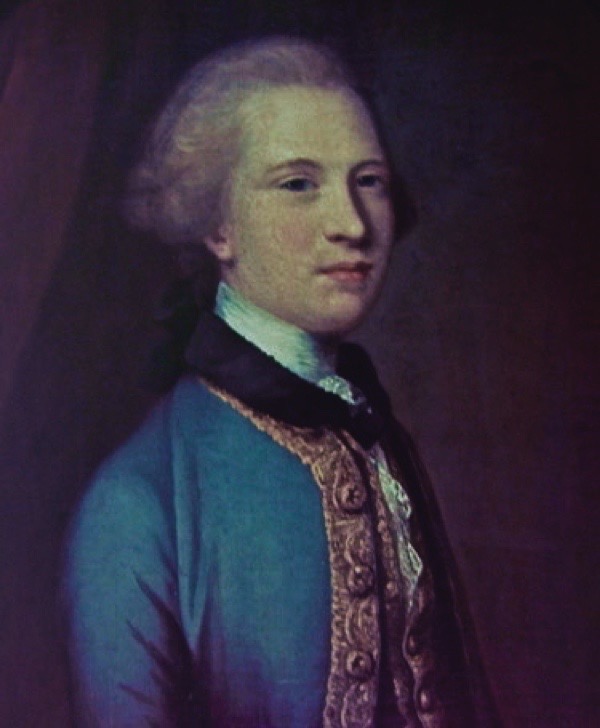
Joseph Walters of Spitalfields by Thomas Gainsborough
When Julius Walters of Stephen Walters & Sons says, “I am just a weaver,” it is a masterpiece of understatement, because he is a ninth generation weaver and the custodian of the venerable family business founded by his ancestor Joseph Walters in Spitalfields in 1720, which was moved to Suffolk by his great-great-great-great-grandfather Stephen Walters in the nineteenth century – where today they continue to weave exemplary silk for the most discerning clients internationally, building upon the expertise and knowledge that has been accumulated over all this time. This is the company that wove the silk for the Queen’s coronation robes and for Princess Diana’s wedding dress.
Thomas Gainsborough’s portrait of Joseph Walters was there to greet us when I arrived at the long finely-proportioned brick silk mill overlooking the green water meadows at the edge of Sudbury, where his ninth generation descendant Julius came down the stairs to shake my hand. Blushing to deny any awareness of the family resemblance, that his proud secretary was at pains to emphasise, he chose instead to point out to me the willows nearby that had been felled recently – as a couple are each year – for the manufacture of cricket bats.
We convened around a long wooden counter in a first floor room where the luxuriously coloured strike offs – as the samples are called – were laid out, glowing in the soft East Anglian light. There is such exquisite intricacy in these cloths that have tiny delicate patterns woven into their very construction, drawing the daylight and delighting the eye with their sensuous tones. Yet lifting my gaze, I could not resist my attention straying to the pigeon holes that lined the room, each one stacked with patterned silks of every hue and design. A curious silence resided here, yet somewhere close by there was a centre of loud industry.
“Everything we do comes from somewhere…” interposed Julius Walters enigmatically, as he swung open a door and that unmistakeably-appealing smell of old leather bindings met my nostrils. There were hundreds of volumes of silk samples from the last two centuries stacked up in there, comprising thousands upon thousands of unique jewel-like swatches still fresh and bright as the day they were made. Some of these books, often painstakingly annotated with technical details in italic script, comprised the life’s work of a weaver and all now bear panoramic witness to the true colours of our predecessors’ clothing. A vast memory bank woven in cloth, all available to be reworked for the present day and brought back to new life.
Spellbound by this perspective in time, I awoke to the clamour of the mill as we descended a staircase, passing through two glass doors and collecting ear plugs, before entering the huge workshop filled with looms clattering where new silk cloths were flying into existence. Here I stood watching the lush flourishes of acanthus brocades and tiny complex patterns for ties appear in magical perfection as if they had always existed, yet created by the simple principle of selecting how the weft crosses each thread of the warp, whether above or below. Although looms are mechanised now, each still retains its Jacquard above, the card that designates the path of every thread – named after Joseph Marie Jacquard who invented this device in 1804, which became so ubiquitous that his name has now also become both the term for the loom and for any silk cloth that has a pattern integrated into the weave.
With the bravura of a showman and the relish of an enthusiast, Julius led us on through more and more chambers and passages, into a silk store with countless coloured spools immaculately sorted and named – crocus and rose and mud. Then into a vaporous dye plant where bobbins of white thread came out strawberry after immersion in bubbling vats of colour. Then into a steaming plant where rollers soften the cloth to any consistency. Then into the checking office where every inch is checked by eye, and finally into the despatch office where the precious silken goods are wrapped in brown paper and weighed upon a fine red scales.
There are so many variables in silk weaving, so many different skills and so much that could go wrong, yet all have become managed into a harmonious process by Stephen Walters & Sons over nine generations. In his time, Julius has introduced computers to track every specification of ten of thousands of orders a year – one every five minutes – created by so may short runs. New technology has provided a purifier which uses diamonds to cleanse dye from the water that eventually returns to the water meadows, renewing the water course that brought his ancestors from Spitalfields to Suffolk one hundred and fifty years ago.
“All my school holidays and spare time were spent at the mill – but then I went away, and came back again.” confided Julius quietly as we made our farewells, “With eight generations behind you, it changes the way you approach your life. It’s not about this year, it’s about managing the company from one generation to the next, so you deal with your employees and your customers differently.”
Now you know what it means when Julius Walters says, “I am just a weaver.”


Dobby Weaving, 1900.

Aaron Offord, Machine Operator

Warping in the early twentieth century

Vikki Meuser, Warping in the early twenty-first century

Employees in 1966

Weaving umbrella silk in the nineteen fifties

Preparing skeins of silk for weaving the coronation robes, 1952

Weaving the silk for the coronation robes, 1952

Staff photograph 1949, Bernard Walters (grandfather of Julius Walters) sits second from right in front row, with his sister Winnie on his left and Mill Manager, Bill Parsons on his right
You may also enjoy these other stories of silk
At Anna Maria Garthwaite’s House
Anna Maria Garthwaite, Silk Designer
Charles Dickens in Spitalfields
Charles Dickens’ visit to a silk warehouse
Phil Maxwell At Watney Market

The markets of the East End tend to divide between those for recreational shopping at weekends and those which are weekday and utilitarian, where people seek the essentials of life at the keenest prices. Both are interesting in different ways, yet the recreational markets tend to get photographed much more than the utilitarian ones, which makes Contributing Photographer Phil Maxwell‘s pictures of Watney Market over the last thirty years especially fascinating.
Once one of the East End’s largest, Watney Market boasted an early branch of Sainsburys in 1881 – selling cheese and salt bacon to dockers – and by 1900 it was claimed there were a hundred stalls and a hundred shops. By 1928, the number of businesses had more than doubled, drawing protests from nearby churches for trading on Sundays. Yet by the sixties it was in decline and Tony Bock photographed the last days of the old market before it was redeveloped into its current form in the eighties.
Watney Market is a pedestrianised precinct now, creating an uninterrupted theatre of human life with a lively immersive atmosphere where locals feel free to linger, enjoying the socialising and banter for which East End markets are justly famous.


Photographs copyright © Phil Maxwell
You may also like to take a look at
Phil Maxwell in Bethnal Green Rd
The Artists Of Headway East
Operating for the last ten years under the auspices of Headway East, SUBMIT TO LOVE STUDIOS is a collective of self-taught artists who have all survived brain injuries. This week they are opening a shop at 93 Kingsland Rd, E2 8AG, for five days from Monday until Friday with an exhibition of works for sale and a range of activities daily.

Errol Drysdale – ‘In my mind, Art is a Godsend. It’s a peaceful thing to do.’

Jon Barry

Sandra St Hilaire – ‘I enjoy creating my Art work as I didn’t know I could draw before.’

Sam Jevon – ‘I only discovered Art after my accident, I find I have a lot of concentration and patience.’

Sean – ‘I just enjoy doing it, I’d never done it before. I don’t think about it too much. For some reason I enjoy doing oil pastels’

Brian Searle – ‘Art is about learning through opportunities when accidents come along – learning how to take that opportunity and make Art out of it. In my artist’s statement, I call it a ‘happy-accident style.’ That’s when the best Art comes along – through happy accidents.’

Nicholas Mayers – ‘Art work is a funny thing. However, you make it up as you go along.’

Cecil Waldron

Naila Ai

Chris Miller

Freddie Irshad – ‘Each short or long project I do gives me ideas for my next project and helps me explore the hidden talent within myself. Art is something I used to run away from, but thanks to a friend I was brought back into the Art room’

Chippy Aiton

Shinobu Soya – ‘I come in here, I don’t think about anything I just do it.’

Sandra Lott – ‘At 57 age I finally had to sketch and succeed at last – Garden Landscaping, Tree Native Plants, Florals, Herbs.’

Tirzah Mileham – ‘I love Art. It helps me do things of how I’m feeling, and drawing or making things I like, and also for my family.’

Peter Lawrence

Tony Allen – ‘I do love Art, you can do absolutely anything you want as long as you don’t go overboard. You get a chance to put down things you think of and share it with everyone.’

Stephen Staunton

Mark Taylor – ‘I lose myself in painting, it makes me more relaxed, it makes me concentrate. The confidence it gives me when I see the end product is unbelievable.’

Joseph Hector

Richard Symes – ‘It’s a great place to come to, in my case it really tests my concentration, it’s a place where I can practise getting things done.’

Mark Bishop

Theresa Malcolm – ‘Even though I find it frustrating sometimes, I really enjoy seeing the finished piece.’

Richard Moss
SUBMIT TO LOVE STUDIOS at 92 Kingsland Rd, E2 8AG – 8th-15th May, 11am – 7pm
You may also like to read about
Miriam Lantsbury, Headway East
In the Kitchen At Headway East
Chris Miles’ East End

Chris Miles contacted me from Vancouver Island, where he describes himself as a Londoner in exile. ‘In the early seventies, I lived as a recently-graduated student in the East End, firstly on Grove Rd and then on Lauriston Rd above a supermarket,’ he explained and sent me his splendid photographs. Published for the first time today, mostly were taken around Bethnal Green, Roman Rd and Mile End, and Chris & I welcome identification of precise locations from eagle-eyed readers.

George Davis is Innocent, Mile End Rd

Linda ‘n Laura

Getting a loaf, Stepney Green

S Kornbloom, Newsagent & Confectioner, Jubilee St

Corner Shop Groceries & Provisions, Stepney Way

Ronchetti’s Cafe, Piano’s & Kitchen Chairs Wanted

Snacks & Grills

The Bell Dining Rooms, Lot 63 Buildings at back

Leslies Restaurant, Fresh Up with your Meal

Harry’s Cafe, Teas & Snacks, Breakfasts & Dinners

Valente’s Cafe, Hackney Rd

Cafe Restaurant

Dinkie

Station Cafe

Fish Bar

J Kelly, No Prams or Trollie’s, Please

G Kelly

Charlie & Mick’s Cafe

Menu at Charlie & Mick’s Cafe

John Pelican

Joe’s Saloon – ‘We cater for long and short hair styles’

M Evans & Sons, Garn Dairy

Marion’s, Blouses, Trouser Suits, Smock Dresses, Ect.

Sunset Stores

N Berg, Watch & Clock Repairs


S Grant, High Class Tailor, Seamens Outfitter

Littlewood Brothers Ltd, Domestic Stores, Grocery & Hardware

J Galley & Sons, Established 1901

Henry Freund & Son, Established 1837

Rito for Better Roof Repairs

Common Market NO

Alan Enterprises Ltd, L & R Ostroff Ltd, Brick Lane

Photographs copyright © Chris Miles
You may also like to take a look at
A Walk In Long Forgotten London
If you got lost in the six volumes of Walter Thornbury’s London Old & New you might never find your way out again. Published in the eighteen-seventies, they recall a London which had already vanished, in atmospheric engravings enticing the viewer to visit the dirty, shabby, narrow labyrinthine streets leading to Thieving Lane, by way of Butcher’s Row and Bleeding Heart Yard.

Butcher’s Row, Fleet St, 1800

The Old Fish Shop by Temple Bar, 1846

Exeter Change Menagerie in the Strand, 1826

Hungerford Bridge with Hungerford Market, 1850

At the Panopticon in Leicester Sq, 1854

Holbein Gateway in Whitehall, 1739

Thieving Lane in Westminster, 1808

Old London Bridge, 1796

Black Bull Inn, Gray’s Inn Lane

Cold Harbour, Upper Thames St, City of London
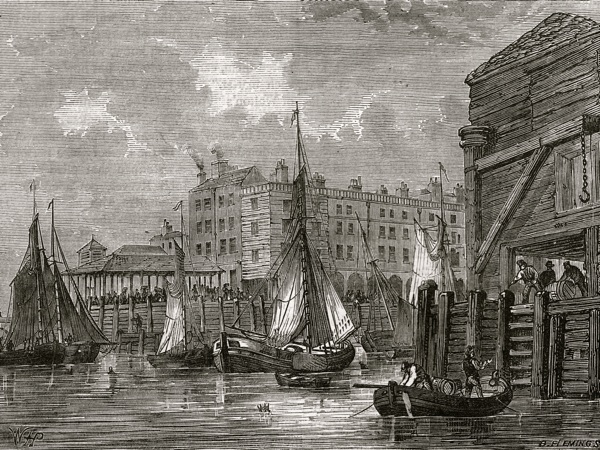
Billingsgate, 1820

Bedford Head Tavern, Covent Garden

Coal Exchange, City of London, 1876

The Cock & Magpie, Drury Lane

Roman remains discovered at Bilingsgate

Hick’s Hall in Clerkenwell, 1730

Former church of St James Clerkenwell

Door of Newgate Prison

Fleet Market

Bleeding Heart Yard in Hatton Garden

Prince Henry’s House in the Barbican

Fortune Theatre, Whitecross St, 1811

Coldbath House in Clerkenwell, 1811

Milford Lane, off the Strand, 1820

St Martin’s-Le-Grand, 1760

Old Bethlehem Hospital (Bedlam), Moorfields, in 1750
Images courtesy Bishopsgate Institute
You may also like to take a look at


