
Introducing EAST END VERNACULAR
Thanks to the support from you, the readers of Spitalfields Life, I have been able to produce EAST END VERNACULAR, Artists who painted London’s East End streets in the 20th century and today is publication day. Below you can read an extract from my introduction to the book.
Join me for the launch at the Nunnery Gallery in Bow, E3 2SJ, on Tuesday 10th October from 6pm. Courtesy of Bow Arts, there will be a special opening of their new exhibition THE WORKING ARTIST, The East London Group for Spitalfields Life readers.
At 6:30pm, I will be introducing my new book and then signing copies in the gallery where some of the paintings by Albert Turpin, Elwin Hawthorne, Harold Steggles, Walter Steggles and other East London Group artists featured in EAST END VERNACULAR will be on display. There will be drinks and live music.

William Jones, Limeburner, Wapping High St by James McNeill Whistler
Is the East End a place or a culture? The endless and unresolved debate over its precise location reveals that this is more than a question of mere topography. There is a consensus that the East End begins at Aldgate Pump, while its southern border is defined by the River Thames and its eastern boundary by the River Lea, yet the northerly edge of its territory remains ambiguous and ill-defined in Hackney. This confusion is compounded by those who say that Hornchurch or Leyton is the East End now, acknowledging its elusive and fugitive nature while simultaneously admitting the existence of a collective understanding among those who know they are in the East End, even if they cannot agree upon its geography.
In the spirit of Humpty Dumpty, who told Alice that when he used a word it meant whatever he chose it to mean, I have coined East End Vernacular to describe those artists who set out to portray the East End in ways that appreciate both the human and the utilitarian nature of its environment. Many originated in the East End and were self-taught, which gave them an innate personal understanding of this cultural world. Yet their work is complemented by those that came from outside who were drawn by the distinctive quality of the place.
Unsurprisingly, the human catastrophe of deprivation, disease and poor housing in the nineteenth-century East End did not attract painters as pictorial subject matter. Yet we have the engravings of Gustave Doré published in London, A Pilgrimage in 1890, dramatising the darkness and want so persuasively that his images persist in the popular consciousness to this day. Too often, the history of the East End is still restricted to a history of poverty, whereas I choose to explore a parallel history of resourcefulness, highlighting the persistent and dignified creativity of people who have forged their own ways of living in spite of widespread economic disadvantage.
By contrast to Doré’s grim gothic visions, perhaps James McNeill Whistler was the first artist to appreciate the utilitarian environment of the East End on its own terms, seeing the beauty in it and recognising the intimate relationship of the working people to the urban landscape they had constructed. Crowded housing in the East End encouraged people to lead their lives in public, either on the street or in ‘public’ houses, creating a unique society premised upon an integral relationship with the built environment, which functioned as an exterior theatre for the congress of life. Many artists fascinated by Whistler’s vision came in his footsteps, some embracing his medium of etching, like Joseph Pennell, while others like Frank Brangwyn and Christopher Richard Wynne Nevinson were attracted by the spectacle of the docks and the life of the river.
In contradiction to the widespread belief that artists only arrived in the East End towards the close of the twentieth century, I can report that when Charles Dickens came to Spitalfields in 1851, he visited a young artist in his studio.
“As yet machinery has not been invented to turn artist, or to guide the shuttle through the intricate niceties of the Jacquard loom, so as to execute designs. Figured and brocaded silks must still be done by hands, and those hands must be skilful. We knock at the door of a cheerful little house, extremely clean. We are introduced into a little parlour, where a young artist sits at work with crayons and watercolours. He is a student of the School of Design. He is at work on a new pattern for a table-cover. He has learnt to paint in oil … He shows us one that was in last year’s Exhibition at the Royal Academy, he shows us another that he means to finish in good time to send to the next Exhibition. He does these things over and above his regular work.”
Dickens foresaw the end of manufacturing in the East End, while recognising the possibility for artists and designers to win esteem, and perhaps even a living, by creating and selling their work.
In compiling East End Vernacular, I make no claim to present an exhaustive or definitive survey, merely to choosing those artists whose work appeals to me as revealing the most sympathy with and understanding of the subject matter. Neither can I assert the existence of an East End School of painting spanning the twentieth century, although I discovered that most of the artists featured knew of the work of several others and, in arranging the sequence, I was struck by the common qualities shared by many of these paintings. For these are personal pictures and, beyond that, many reveal an overt affection for the East End streets that inspired them.
Ultimately, this is an heroic story of the triumph of artists with the talent and moral courage to pursue truthful images of the environment and society they knew intimately, defying adverse circumstances, including poverty and prejudice, through sheer force of creativity. The best of these paintings are by those who were at one with the world they represented, manifesting a vision that is both visceral and poetic.
Throughout the nineteenth and for much of the twentieth century, the East End was considered to be the least cultured part of London by comparison with the more affluent areas, yet I have been able to assemble this magnificent selection of pictures representing the East End, many painted by artists from the East End, and I challenge anyone to uncover a comparable selection of twentieth century works as vital as these, entitled South, West or North London Vernacular.

In Wentworth St, Spitalfields, by Gustave Doré

Click here to order a copy of EAST END END VERNACULAR for £25

Take a look at some of the artists featured in East End Vernacular
At Dr Johnson’s House
I walked over to Fleet St yesterday to pay a visit upon Dr Samuel Johnson who could not resist demonstrating his superlative erudition by recounting pertinent examples of lexicography that came to mind as he showed me around every corner of his rambling old house in Gough Sq where he wrote the famous Dictionary of the English Language

House. n.s. [hus, Saxon, huys, Dutch, huse, Scottish.] 1. A place wherein a man lives, a place of human abode. 2. Any place of abode. 3. Place in which religious or studious persons live in common, monastery, college. 4. The manner of living, the table. 5. Family of ancestors, descendants, and kindred, race. 6. A body of parliament, the lords or commons collectively considered.

Acce’ss. n.s. [In some of its senses, it seems derived from accessus, in others, from accessio, Lat. acces, Fr.] 1. The way by which any thing may be approached. 2. The means, or liberty, of approaching either to things or men. 3. Encrease, enlargement, addition. 4. It is sometimes used, after the French, to signify the returns of fits of a distemper, but this sense seems yet scarcely received into our language.

To Rent. v.a. [renter, Fr.] 1. To hold by paying rent. 2. To set to a tenant.

Ba’ckdoor. n.s. [from back and door.] The door behind the house, privy passage.

Door. n.s. [dor, dure, Saxon, dorris, Erse.] The gate of a house, that which opens to yield entrance. Door is used of houses and gates of cities, or publick buildings, except in the licence of poetry.

Hábitable. adj. [habitable, Fr. habitabilis, Lat.] Capable of being dwelt in, capable of sustaining human creatures.

Time. n.s. [ꞇıma, Saxon, tym, Erse.] 1. The measure of duration. 2. Space of time. 3. Interval. 4. Season, proper time.

Stair. n.s. [ꞅꞇæᵹꞃ, Saxon, steghe, Dutch.] Steps by which we rise an ascent from the lower part of a building to the upper. Stair was anciently used for the whole order of steps, but stair now, if it be used at all, signifies, as in Milton, only one flight of steps.

Chair. n.s. [chair, Fr.] 1. A moveable seat. 2. A seat of Justice or authority. 3. A vehicle borne by men, a sedan.

Díctionary. n.s. [dictionarium, Latin.] A book containing the words of any language in alphabetical order, with explanations of their meaning, a lexicon, a vocabulary, a word-book.

A’ftergame. n.s. [from after and game.] The scheme which may be laid, or the expedients which are practised after the original design has miscarried, methods taken after the first turn of affairs.

Mystago’gue. n.s. [μυσταγωγὸς, mystagogus, Latin.] One who interprets divine mysteries, also one who keeps church relicks, and shews them to strangers.

Box. n.s. [box, Sax. buste, Germ.] 1. A case made of wood, or other matter, to hold any thing. It is distinguished from chest, as the less from the greater. It is supposed to have its name from the box wood. 2. The case of the mariners compass. 3. The chest into which money given is put. 4. The seats in the playhouse, where the ladies are placed. (David Garrick’s box illustrated)

Fascina’tion. n.s. [from fascinate.] The power or act of bewitching, enchantment, unseen inexplicable influence.

A’fternoon. n.s. [from after and noon.] The time from the meridian to the evening.

Intelléctual. n.s. Intellect, understanding, mental powers or faculties. This is little in use.

Prívacy. n.s. [from private.] 1. State of being secret, secrecy. 2. Retirement, retreat. 3. [Privauté, Fr.] Privity; joint knowledge; great familiarity. Privacy in this sense is improper. 4. Taciturnity.

Lexicógrapher. n.s. [λεξικὸν and γράφω, lexicographe, French.] A writer of dictionaries, a harmless drudge, that busies himself in tracing the original, and detailing the signification of words.

Ca’binet. n.s. [cabinet, Fr.] 1. A set of boxes or drawers for curiosities, a private box. 2. Any place in which things of value are hidden. 3. A private room in which consultations are held.

A’bsence. n.s. [See Absent.] 1. The state of being absent, opposed to presence. 2. Want of appearance, in the legal sense. 3. Inattention, heedlessness, neglect of the present object.

Work. n.s. [weorc, Saxon, werk, Dutch.] 1. Toil, labour, employment. 2. A state of labour. 3. Bungling attempt. 4. Flowers or embroidery of the needle. 5. Any fabrick or compages of art. 6. Action, feat, deed. 7. Any thing made. 8. Management, treatment. 9. To set on Work To employ, to engage.


Way. n.s. [wœʒ, Saxon, weigh, Dutch.] The road in which one travels.

Court. n.s. [cour, Fr. koert, Dut. curtis, low Latin.] 1. The place where the prince resides, the palace. 2. The hall or chamber where justice is administered. 3. Open space before a house. 4. A small opening inclosed with houses and paved with broad stones.

Cat. n.s. [katz, Teuton. chat, Fr.] A domestick animal that catches mice, commonly reckoned by naturalists the lowest order of the leonine species.

To Mew. v.a. [From the noun miauler Fr.] To cry as a cat.
Visit Dr Johnson’s House, 17 Gough Square, EC4A 3DE
East End Women At Work
Contributing Photographer Sarah Ainslie took these portraits of women in Hackney between 1990 and 1991 as a commission for Hackney Museum. “I was aware there were a lot of women in the workplace but mostly in behind the scenes roles,” Sarah explained to me, “I wanted to give them visibly and also show the variety of work that women were doing.”

Terrie Alderton, Bus Driver

Loretta Leitch, Electrician

Rosemary More, Architect

Fontanelle Alleyne, Environmental Health Officer

Hackney Regristar of Births, Marriages & Deaths

Jenny Amos, Heating & Ventilation Engineer

Carol Straker, Dancer

Annie Johns, Sculptor

Sue Hopkins, Doctor at Lawson Practice Baby Clinic

Lilly Claridge, Age Concern Charity Shop Manager

Karen Francis & Carolyn Donovan, Dustwomen

Helen Graham, Street Sweeper

Denise Martin, Truck Driver

Judy Benoit, Studio Manager

Luz Hollingsworth, Fire Fighter

Diane Abbott, Member of Parliament

Dionne Allacker, Joanne Gillard, Winnifred John, Clothing Warehouse Supervisors

Lanette Edwards, Machinist

Nora Fenn, Buttonholist

Jane Harris, Carpenter

Eileen Lake, Chaplain at Homerton Hospital

Dr Costeloe, Homerton Hospital

Ivy Harris & E Vidal, Cleaners at Homerton Hospital

Sister Ferris Aagee, Homerton Hospital

Joan Lewis, Homerton Hospital

Sister Sally Bowcock

Valerie Cruz, Catering Assistant

K Lewis, Traffic Warden

Gerrie Harris, Acupuncturist

WPC Helen Taylor

Mary, Counter Assistant at Ridley’s Beigel Bakery

Mandy McLoughlin & Angela Kent, Faulkners Fish & Chip Restaurant

Terrie Tan, Driver at Lady Cabs

Maureen McLoughlin, Supervisor at Riversdale Laundrette

Anna Sousa, Hairdresser at Shampers

Jane Reeves, Councillor

Carolin Ambler, Zoo Keeper

Mrs Sherman, Dentist

Eileen Fisher, Police Domestic Violence Unit

Yvonne McKenzie, Jacqui Olliffe & Dirinai Harley, Supervisors at Oranges & Lemons Day Nursery

Jessica James, Active Birth Teacher

Di England, Supervisor at Free Form Arts

Sally Theakston, Chaplain, St John’s Hackney
Photographs copyright © Sarah Ainslie
Photographs courtesy Hackney Museum
At Mick Taylor’s Flat
The third of my stories about my pal Mick Taylor who died on Friday at St Joseph’s Hospice
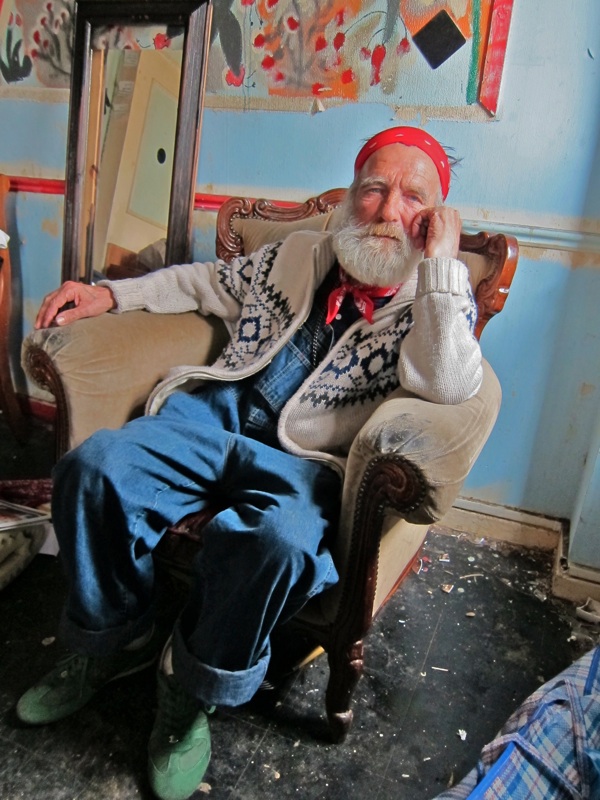
One day, Mick Taylor invited me over to his flat in Whitechapel. After hanging around outside the Beigel Bakery for the last half century and becoming renowned for his personal sense of style, Mick had become a living landmark upon Brick Lane – so I was honoured to accept the invitation to discover his actual place of habitation.
As soon as I entered the large square between the modernist housing blocks, filled with huge trees in blossom, I lifted up my eyes to the top balcony where Mick was waiting, immediately recognising his white beard and red neckerchief, as he sat perched upon a stool outside his front door on that bright morning. We exchanged salutes and I ascended the concrete stairs quickly, hurrying along the top balcony which gave a panoramic view of the estate, eager to shake his hand and step inside. A skinny cat ran between my legs as I crossed the threshold and walked through into the room at the back, where Mick and I settled ourselves down upon two armchairs to savour the quiet in this hidden corner amidst the clamour of Whitechapel.
The room was almost empty save for the chairs and a wardrobe with a few clothes hung carefully on hangers. Sleeping on a camp bed at one end, was a homeless young woman living on the street to whom Mick had offered shelter and protection. So we spoke in whispers to avoid waking her. Nevertheless, Mick was keen to talk, relating how he came to the flat and thinking out loud for my benefit, contemplating the nature of his lifelong relationship with Brick Lane.
“I was living in rented accommodation in one room on the ground floor in Fieldgate St for a year before I came here. It was opposite Rowton House – that was a rough place – and sometimes at night young people used to come and take drugs right outside my door. I didn’t know much about that side of life then.
When I went to the housing office, they gave me this flat and, since I came here twelve years ago, I never looked back. They said, “If you want this flat, you must view it tomorrow.” It was in a state but I took it at once. I had all the walls done and new fittings, and I had curtains that I got down Wentworth St. I held them out and said, “They’ll do me.” I had a wall of mirrors too, it looked good. Everyone that came liked it. But I’ve cleared the flat out and I’m going to start again. I want to strip the walls and paint the ceiling with a roller. That old lamp’s been there so long, I can’t remember where I got it. Maybe it was Brick Lane?
Originally I went down the “Lane” to find things, you can’t find things there anymore. The days are gone when people used to leave things out to take. I didn’t do anything bad really, I think I’m pretty straight. I’ve grown a beard and it makes me look like a hundred years’ old man but it gives me freedom. I’m seventy-three. I’ve changed a helluva lot. Maybe it’s going down the Lane has ruined me? I know all the people there in the shops. If I go anywhere else, I’m lost. A girl who works in the coffee shop, she asked me, “Why do you wear that red suit?” I said, “It’s the way I am.” You can only be what you are.
Every day I walk along the Bethnal Green Rd, across Weavers’ Fields, over Vallance Rd and up Cheshire St to Brick Lane. So many places to go looking for things, back alleys and streets where once you could pick up things. It was a funny way of life I had but I enjoyed it. All I know is to go down the Lane. I trust all the people down there, there’s no bad ones. A photographer from New York took more than twenty pictures of me and gave me one pound fifty. I said, “Are you short of money?” and give it back to him. I’ve had a few arguments with people, but things get better. You’ve got to see the good in people. Life’s never what you want it to be, but you learn a little humility along the way.
It’s nice to come back home and sit down in the peace and warm. It’s a good feeling to sit here and know the rent’s paid, and be enjoying a bit of grub. Whereas if you sit in a coffee shop, you wonder what you’re going to do with your life? “
All this time the girl slept, unaware of our conversation. Mick explained that, to give her privacy, he had spent the previous night in the flat below belonging to his friend Johnny. And so, recognising that perhaps this was the reason Mick had sat outside awaiting me and that maybe he intended to visit his neighbour upon my departure, I took my leave. “I’ll go down to Johnny’s flat in a bit,” Mick admitted in a low voice, as we shook hands, “He takes care of me and I take care of him. He’s a good friend, we’ve always got along well. We hit it off when we met on the day I moved in. He takes care of his grandfather who’s ninety-odd.” Walking back down the stairs, I was struck by the modesty of Mick’s frugal dwelling and touched that, when he had so little, he would sacrifice his only room to someone more vulnerable than he.

“It’s a good feeling to sit here and know the rent’s paid, and be enjoying a bit of grub.”

She asked me,“Why do you wear that red suit?” I said, “It’s the way I am.”

“I’ve grown a beard and it makes me look like a hundred years’ old man but it gives me freedom.”
You may also like to read about
A Walk With Mick Taylor
Today I remember a walk with my pal Mick Taylor who died on Friday at St Joseph’s Hospice

Almost every day, I exchanged greetings with Mick Taylor who had been sitting outside the Beigel Bakery – off and on – for nearly fifty years. Over all that time, Mick became famous for his personal style, emerging as a star player in the street life that he loved so much, celebrated as the Sartorialist of Brick Lane.
During a recent spell of fine weather – that Mick termed “a cockney summer” – we had been discussing taking a stroll together, and over two days, Mick and I enjoyed a ramble round those streets which held most meaning for him. Coming directly to the top of Brick Lane by bus each day, it was something of an adventure for Mick to walk south down the Lane to the familiar places of long ago. As he confessed to me, “When you have known an area so long, you begin to forget where you are.”
One afternoon, leaving the environs of the Beigel Bakery which was Mick’s customary habitat and spiritual home, we turned left just before the railway bridge into Grimsby St where the East London Line bridge of steel girders replaced the nineteenth century railway arches a few years ago. “You could find old things in the street and bring them down here and sell them, and people would always buy them and that way you were never without anything.” Mick assured me, casting his eyes affectionately over this former source of livelihood and screwing up his eyes in bewilderment as if somehow he could conjure it back into existence by focussing his attention. “They used to call me Mick the Finder.” he said, as we walked on.
Round the corner in Cheshire St, we paused outside the squat brick building that is Blackman’s, where the redoubtable Lee Knight sold shoes for years at rock bottom prices in a business continued now by his son Phil. This was a location of pleasure for Mick. He told me his beloved Gran bought him the pair of Italian pointed black shoes with cuban heels here, that he wanted for his seventh birthday, at a cost of two pounds, two shillings and sixpence. “My mother had twelve sons and two daughters, she didn’t have time to take care of us, she was too busy trying to find a husband,” he revealed, raising his eyebrows humorously, as partial explanation of why he came to be brought up by his grandparents.
Next day, we set out in the morning to venture further, walking down to the Truman Brewery where Mick worked as Drayman in 1963. “At half past seven in the morning it was busy here,” he recalled, rolling his eyes to evoke the chaotic drama as we passed the old iron gates. We turned the corner into Dray Walk where Mick arrived for work each day at quarter to seven. “You saw all the lorries backed up here,” he said gesturing to the invisible line of vehicles that once occupied the space where the shops are now,“We loaded them with barrels, hogsheads, firkins and crates.”
Yet before he started work Mick had to clock in and enjoy the two or three pints of maturing brown ale with his workmates, as was the custom in the brewery. “All the time I worked here I never saw any of the workers drunk,” Mick insisted,“You couldn’t afford to be drunk. You had to take it easy, because it was dangerous manhandling the kegs.” The foremen sent out the lorries making deliveries around London and by eleven o’ clock in the morning the draymen were finished. “We all met in the car park of the Ace Cafe on the North Circular. I’d be sat on the back of the lorry drinking pints from the keg.” Mick admitted to me with a delighted grin, “You lay the keg on its side and eased in the pointed handle of a file, and the beer poured out.”
“You had poor people here then, in those days most people wanted to get out of here,” he whispered to me as we moved on, pushing our way through the fashionable crowd,“Funny old world we live in isn’t it?” Glancing around conspiratorially as we passed the Spitalfields Market, “The villains used to come down here, and it wasn’t to buy fruit & vegetables,” he confided,“They used to do their business over a cup of tea and a sandwich, sit in a cafe and have a bit of a firm. They wore traditional gear, coat and scarf and a cheese cutter, and no-one paid any attention.”
Passing Burger King in Whitechapel High St, site of the legendary Blooms Restaurant, we arrived at the climax of our journey, Albert’s men’s clothing shop, still with its fascia of marble and red neon gothic lettering. A cut-price joint today, yet still charismatic for Mick as the place where he first cultivated his sartorial elegance. “I used to come down here when I had a bit of money, on Thursdays at three or four after I got paid. It was like going to the West End, I felt like I was famous.” he eulogised, “They sold cashmere suits and silk shirts. In those days, you had a lot of villains and benders came here, smart people. They all showed respect for each other.”
Walking back up the Lane towards the Beigel Bakery, Mick ruminated over the journey, thinking out loud, “It’s good that the young people are coming in and bringing money,” he suggested to me, “but I don’t think they care very much about the people who are here, they’re a bit selfish in that way.” And then he qualified the thought quickly, lest I think him ungenerous “People always treat me with respect and say nice things, they’re polite to me,” he confirmed with a weary smile. Both our energies were flagging now after this emotional odyssey through space and time, and we made for the nearest cafe to seek a perspective. “I haven’t had a walk like that in a long while, I think it’s done me good,” Mick concluded thoughtfully as we sat down together.

In his usual spot outside Brick Lane Beigel Bakery.

In Grimsby St – “You could find old things in the street and bring them down here and sell them, and people would always buy them and that way you were never without anything.”

At Blackman’s, Cheshire St – where Mick’s Gran bought him the pair of Italian pointed black shoes with Cuban heels that he wanted for his seventh birthday, at a cost of two pounds, two shillings and sixpence.

At Dray Walk, Truman Brewery – the doorway where Mick clocked in each morning and enjoyed two or three pints of maturing brown ale with his workmates at eight in the morning before commencing work.

At Albert’s, 88 Whitechapel High St – “I used to come down here when I had a bit of money, on Thursdays at three or four after I got paid. It was like going to the West End, I felt like I was famous.”

Mick Taylor – “You had poor people here then, in those days most people wanted to get out of here.”
You may also like to read about
So Long, Mick Taylor
Over the past ten days, I visited Mick Taylor three times at St Joseph’s Hospice and I was off to visit him again this weekend, until I received the news that he died last night. An orphan of the Second World War, he was one of the great East End characters and Spitalfields will be the less for his passing.

Mick Taylor (1945-2017)
It was at the end of 2009 that I first interviewed Mick Taylor, known as the Sartorialist of Brick Lane, who spent half a century standing outside the Beigel Bakery and became renowned for his astonishing outfits. One Easter Sunday we sat and drank tea together on Brick Lane, enjoying the warmth of the afternoon and watching the passing show, while Mick spoke about his life’s journey that brought him there.
“If you come down here to Brick Lane somebody always helps you out with a sandwich or something. Sometimes I come here without a penny in my pocket but I get a cup of tea. All it takes is to ask nicely and people will help you out. People want to sell things and I tell them where they can sell it. Knowing how to make a shilling, that’s what it’s all about and I’ve sold anything you care to mention over the years here.
I was a war child, I had no father but I had a mother. On 9th November 1945, I was born in my grandmother’s bed in Maclaren St, Hackney. My mother couldn’t afford to keep me so my grandmother and grandfather, Florence and George Taylor brought me up. I never had anything new, only secondhand things, but they brought me up well. My grandfather was a lovely man, he never hit me. He only had one eye, he was blinded in World War I, and he worked on the barges on the River Lea. My grandmother used to pawn his suit every Monday, buy veg on Tuesday, and get it back again on Thursday when he got paid, so he could wear it at the weekend. She taught me how to cook, and I still cook dinner every Sunday.
One day, when I worked for Truman’s, I got up at seven thirty in the morning and my grandmother had a heart attack and died in front of me. I went to work but I couldn’t work because my mind was falling to bits. So I told the foreman, and then I went wandering all over the place for four days until the police picked me up and took me to Hackney Hospital and, while I was under observation, I cut my wrists. I wanted to die because my grandmother was dead.
The woman in the next bed there was Frances Shea, Reggie Kray’s wife, she had mental problems. It sent her a little crazy being married to one of the Krays, but she was a lovely girl. I dressed up smart for her. Sixteen weeks we were together, she needed a bit of company and I took care of her. Then, when they sent her home, she died at once of an overdose but I don’t believe it. I loved her, and she cured me of the loss of my grandmother.
After that, I worked for the council and I did various jobs, I started my life all over again. I’ve been married a couple of times. I’ve lived my life, I’ve enjoyed it, I’ve had some good times. I’ve two sons but I don’t know where they are. Me and their mother divorced and I’ve never seen them again.
I never had much money but I’ve always made myself smart with a few quid and a suit and shirt – buying the right clothes, the right colour, the right cut. I used to go to Albert’s in Whitechapel and pay seventy five pounds for a pair of shoes, a suit, and a shirt. For my birthday, when I was seven years old, I came down with my grandmother to buy Italian shoes in Cheshire St for two pounds, two shillings and sixpence – pointed black shoes with Cuban heels. I already knew what I wanted at seven years old – you’re born with it, your style.”
Sporting his cap at a calculated angle, dressed in his petrol blue slacks, with a singlet, silk scarf and chain, Mick was in his element that day, and even as we spoke, passers-by interrupted to request photographs with him. Like many others, Mick found a sympathetic community on Brick Lane, where he could present himself as he pleased and be celebrated for it. Neither cynical nor sentimental about his past, Mick was able to inhabit his present with equanimity. Once we had finished our cups of tea, the shadows were lengthening, the stalls were packing up and the market crowds were thinning out, so I asked Mick what his plans were for the rest of that day, and he rubbed his hands in hungry anticipation with a gleam of joy in his intense blue eyes.
“I’m going to buy a bit of lamb at the corner shop and boil it up with some potatoes and carrots and a few seasonal things. That’s cockney food – a bit of boiled veg and a bit of a joint and if you’ve got money left, something sweet like a Spotted Dick. I learnt to make it when I worked in a pie shop when I was a child. Whatever pies was left, I always took them home with me.“Give it to the family,” they used to say. That’s the cockney way of life.”


You may also like to read about
William Fishman, Historian
Anne Kershen remembers William Fishman (1921-2014), distinguished historian of the East End

William Fishman in Whitechapel
The grandson of Jewish Eastern European immigrants, Bill walked the streets of the East End with his father as a young boy in the twenties and witnessed poverty little different to that of a hundred years before. As Bill described the experience in East End Jewish Radicals 1875-1914, he ‘ate, laughed, wept and dreamed dreams with the immigrant poor.’ Seeing his tailor father giving coins to the needy in the street and his rabbi grandfather bringing home hungry strangers, whether Jew or Gentile, to the Friday night dinner table imbued Bill with two life-long guiding principles: compassion and charity – or in the Hebrew, rachamones and tzedakah.
As a teenager in the thirties, Bill was drawn to Labour and then to Communism, which at the time was seen as the only way to oppose men such as Oswald Mosley and Fascism in general. Bill was at Gardner’s Corner in Whitechapel on October 4th 1936, when Mosley attempted to march through the East End and ‘make it his own.’ Later, Bill admitted that, as a teenager, he was not quite sure why he was there, he ‘only knew I had to be.’ Those events of the thirties were to feature powerfully in his teaching, when he became a Professor at Queen Mary College, now Queen Mary University of London.
But the outbreak of the Second World War put Bill’s plans of becoming a teacher on hold. He served with the Essex Regiment in India and it was there he picked up the languages and dialects that he would use to greet South East Asian immigrants in Brick Lane forty years later. For a short while, Bill was seconded to Scotland and a Scottish regiment – the sight of William J. Fishman in a kilt was something to behold.
After demobilisation in 1946, Bill trained as a teacher and at the age of thirty-four became Principal of Bethnal Green Junior Commercial College. The College’s main activity was the provision of evening classes, enabling Bill – the ever hungry historian – to make up the study he had sacrificed at the outbreak of war. He enrolled as a student at the London School of Economics and combined a full-time job with being a full-time student.
A fluent French speaker, Bill was drawn to exploring theories of French anarchism. These studies resulted in his first book, which in subject matter was both geographically and temporally distant from the streets of Spitalfields and Whitechapel that were familiar to him. In The Insurrectionists (1970), he explored the lives and ideologies of French revolutionaries, including Marat and Robespierre, in order to identify their influence on Karl Marx, Lenin and the Russian Revolution. The writing demonstrated the originality, intellectual depth and lyricism that were to mark him out as a prize-winning historian.
Bill’s love of history and equal dislike of bureaucracy led to a Schoolmaster Fellowship at Balliol College, Oxford, where he met a number of distinguished historians who stimulated his desire to research the area in which he had grown up, and bring its political and social history to a wider audience.
In 1972, awarded the Barnet Shine Fellowship, Bill was able to leave his college job with its demanding administrative work load and join the newly-formed Politics Department at Queen Mary College. There Bill completed East End Jewish Radicals, with whose gentle anarchist hero, Rudolf Rocker, he felt such empathy. After this, he embarked on other books which would take the study of the East End beyond the realms of academia and into the reach of a general readership, especially The Streets of East London (1979) and East End & Docklands (1980) which combined photography of the past and the present. At this time, Bill become celebrated for his walking tours of Whitechapel and Spitalfields, and The Streets of East London included maps so readers could follow in his footsteps.
In his tour de force, East End 1888 (1988) Bill explored in minute detail the events of the decisive year in Victorian England. Poverty, criminality, immigration and overcrowded housing were all part of the East End landscape, but they resonated far beyond and the resolution of the consequent social problems became part of the national political agenda. East End 1888 was intended as a warning that these same issues were not to be ignored a hundred years later. In the words of George Santayana, which Bill quoted in the front of the book, ‘Those who do not remember the past are condemned to repeat it.’ If we look around us today, it appears neither 1888 nor 1988 have been remembered, which makes East End 1888 a book for our time.
Colin Holmes and I have edited a book which celebrates Bill’s work, entitled An East End Legacy, Essays in Memory of William J. Fishman. It comprises a selection of writings which reflect not only the respect and love with which Bill Fishman was held, but also the extent to which his work has spoken to others.
William J. Fishman (Bill to all of us who knew and loved him) was a true child of the East End. Born and raised here, he spent his entire teaching and academic career in the area he captured so brilliantly in his writing. Whilst the sight of him striding down the streets of the East End is no more, his memory and impact live on.


William Fishman (1921- 2014)
Photographs courtesy © Bishopsgate Institute


