
Eva Frankfurther, Artist

There is an unmistakeable melancholic beauty which characterises Eva Frankfurther‘s East End drawings made during her brief working career in the nineteen-fifties. Born into a cultured Jewish family in Berlin in 1930, she escaped to London with her parents in 1939 and studied at St Martin’s School of Art between 1946 and 1952, where she was a contemporary of Leon Kossoff and Frank Auerbach.
Yet Eva turned her back on the art school scene and moved to Whitechapel, taking menial jobs at Lyons Corner House and then at a sugar refinery, immersing herself in the community she found there. Taking inspiration from Rembrandt, Käthe Kollwitz and Picasso, Eva set out to portray the lives of working people with compassion and dignity.
In 1959, afflicted with depression, Eva took her own life aged just twenty-eight, but despite the brevity of her career she revealed a significant talent and a perceptive eye for the soulful quality of her fellow East Enders.


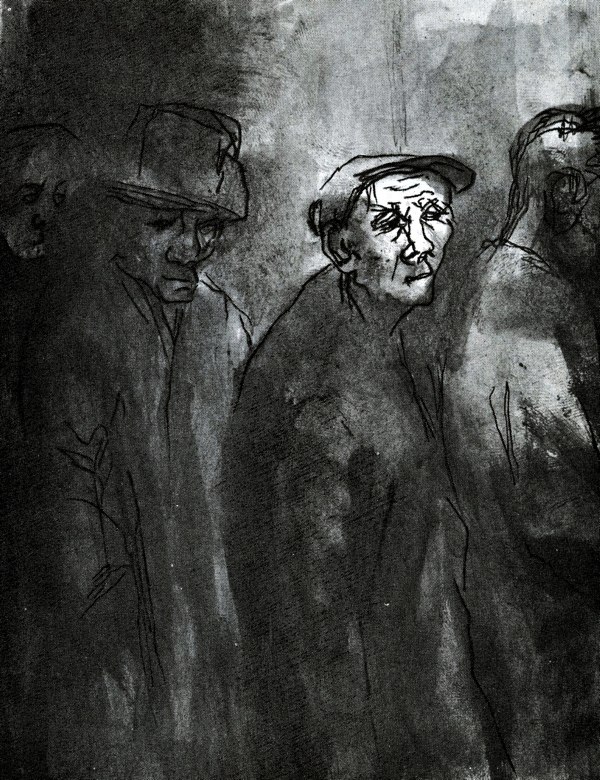


“West Indian, Irish, Cypriot and Pakistani immigrants, English whom the Welfare State had passed by, these were the people amongst whom I lived and made some of my best friends. My colleagues and teachers were painters concerned with form and colour, while to me these were only means to an end, the understanding of and commenting on people.” – Eva Frankfurther
Images copyrigh t© Estate of Eva Frankfurter
You may also wish to take a look at
A Reply From Crest Nicholson
Ten days ago, I wrote to Crest Nicholson regarding their use without permission of my photograph of the Bethnal Green Mulberry in their leaflets and exhibition for their proposed London Chest Hospital Development. I was encouraged by their initial response, admitting ‘we made a mistake’ and apologising ‘I am sorry you have had to contact us in this respect.’ But then this disappointing letter arrived from the Company Secretary which attempts to gag my criticism of their development and their plan to dig up the ancient Mulberry tree. Click here to read my initial letter.

(Click on this letter to enlarge)
My reply emailed to Crest Nicholson today:
29th January 2018
Dear Kevin Maguire,
Thankyou for your letter of 25th January in response to my letter of 17th January, relating to your use without permission of my photograph of the Bethnal Green Mulberry, which you reproduced in your leaflets and exhibition for your proposed London Chest Hospital development.
I understand that you have ceased circulation of the leaflet, removed my photograph from your exhibition and are now offering to pay for this usage.
However, I am unable to agree with your proposed letter of agreement in its current form.
I see no need for confidentiality in this matter and intend to continue to publish our correspondence as I have done to date. The confidentiality provision should be removed.
The statement referring to no admission of liability is a nonsense – you have acknowledged that it is my photograph which you have used without my permission. There is a clear breach of my copyright for which there is liability.
Your language concerning what I may or may not publish in the future is totally irrelevant to the issue of your breach of my copyright and has no place in the letter.
“by accepting this payment you agree that you shall not publish or cause to be published any false, misleading, derogatory, or disparaging comments about Crest Nicholson.”
You well know that I am critical of your proposed London Chest Hospital development and your attempts to secure permission to dig up the ancient Bethnal Green Mulberry, so I am unwilling to sign a document which would grant you recourse to take action against me if I were to write anything that you might choose to interpret as “false, misleading, derogatory, or disparaging.”
You underestimate me if you think that I will permit you to gag me by making it a condition of payment.
May I remind you it was your indefensible behaviour in using my photograph without permission in your leaflet discrediting the history of the Bethnal Green Mulberry which was the catalyst for this dialogue?
I am under no obligation whatsoever to accept any conditions of payment from you, but you are under legal obligation to pay me for the use of my photograph which was in clear breach of the law of copyright.
Please pay me without further delay.
Yours sincerely
The Gentle Author

The Gentle Author’s photograph of the Bethnal Green Mulberry which Crest Nicholson want to dig up

The Gentle Author’s photograph as reproduced without permission by Crest Nicholson in their leaflet and exhibition for their proposed London Chest Hospital development
You may also like to read about
Here We Go Round The Bethnal Green Mulberry
A Plea For The Bethnal Green Mulberry
Beattie Orwell, Centenarian

Portrait of Beattie Orwell by Phil Maxwell
On an especially cold day recently, it was my delight to accompany Contributing Photographer Phil Maxwell to visit centenarian Beattie Orwell and sit beside her in her cosy flat while she talked to me of her century of existence in this particular corner of the East End.
A magnanimous woman who delights in the modest joys of life, Beattie is nevertheless a political animal who is proud to be one of the last living veterans of the Battle of Cable St – a formative experience that inspired her with a fiercely egalitarian sense of justice and led to her becoming a councillor in later life, acutely conscious of the rights of the most vulnerable in society.
In spite of her physical frailty at one hundred years old, Beattie’s moral courage grants her an astonishing monumental presence as a human being. To speak with Beattie is to encounter another, kinder world.
“I am Jewish and both my parents were East Enders, born here. My father’s parents came over from Russia. On my mother’s side, her parents were born here but her grandfather was born in Holland. So I am a bit of a mixture!
My father Israel worked as a porter at the Spitalfields Market and my mother Julia was a cigar maker at Godfrey & Phillips in Commercial St. I grew up in Brunswick Buildings in Goulston St, until I got bombed out. It was horrible, we had a little scullery, too small to swing a cat. My mother had one bedroom and, the three children, we slept in a put-you-up. I had two sisters Rebecca & Esther. Rebecca was the eldest, she very clever at dressmaking. When she was fifteen, she could make a dress. We needed her because my father died when he was forty-four, he had three strokes and died in Vallance Rd Hospital. I was only thirteen. He used to take me everywhere, he was marvellous. He took to me to the West End to visit my aunt, she was an old lady with a parrot and lived on Bewick St. We used to have a laugh with the parrot.
We moved to City Corporation flats in Stoney Lane and I went to Gravel Lane School. It was lovely school, they taught us housewifery. We had a little flat in the school and we used to clean it out, then go shopping in Petticoat Lane to buy ingredients to make a dinner, imagining we were married. The boys used to do woodwork and learnt to make stools and things like that. I loved that school. When I was twelve it closed and I went to the Jewish Free School in Bell Lane. It was very strict and religious. When the teacher wanted us to be quiet, she’d say, ‘I’m waiting!’ It was good, I enjoyed my school life.
I left when I was fourteen and I went to work right away, dressmaking in Alie St. I used to lay out material. I do not know why but I must have heavy fingers, I could not manage the silk. It used to fall out of my hands. I only lasted a week before I left, I could not stand it. Then I went to work with my sister at Lottereys in Whitechapel opposite the Rivoli Picture Palace, they used to make uniforms for solders. I went into tailoring, men’s trousers, putting the buttons on with a machine. We worked long hours and it was hard work. By the time I got married I was earning two pounds and ten shillings a week. I never earned big money. I worked all the way through the war. I gave all the money to my mother and she gave me a shilling back. I used to walk up to the West End. It was threepence on the trolley bus.
I was nineteen in 1936. I was there with all the crowds at the Battle of Cable St. I am Jewish and I knew we must fight the fascists. They were anti-semitic, so I felt I had to do it. I was not frightened because there were so many people there. If I was on my own I might have been frightened, but I never saw so many people. You could not imagine. Dockers, Scottish and Irish people were there. It was a marvellous atmosphere. I was standing on the corner of Leman St outside a shop called ‘Critts’ and everyone was shouting ‘ They shall not pass!’ I was with my friend and we stood there a long time, hours. So from there we walked down to Cable St where we saw the lorry turned over. I never saw the big fighting that happened in Aldgate because I was not down there, but I saw them fighting in Cable St near this turned over lorry. From there, we walked down to Royal Mint St, where the blackshirts were. They were standing in a line waiting for Oswald Mosley to come. So I said to my friend, ‘We’d better get away from here.’
We went back through Cable St to the place where we started. From there, the news came through ‘They’re not passing.’ We all marched past the place where Fascists had their headquarters – they threw flour over us, shouting – to Victoria Park where we had a big meeting with thousands of people. I had never seen anything like it in my life and I used to go to all the meetings. I never went dancing. My mother used to say, ‘I don’t know where I got you from!’ because I was only interested in politics. I am the only one like this in the whole family. I still know everything that is going on.
I used to go to Communist Party socials in Swedenborg Sq, off Cable St, and – being young – I used to enjoy it. Then I joined the Labour Party, the Labour League of Youth it was called. We used to go on rambles. It was lovely. We went to Southend once. I always used to march to Hyde Park on May Day and carry one of the ropes of our banner. I met my husband John in Victoria Park when I was with the Young Communists League, although I was not a member. They had a Sports Day and my husband was running for St Mary Atte Bowe because he was a Catholic. I met him and we went to a Labour Party dance. We got married in 1939.
We managed to get a flat in the same building as my mother, at the top of the stairs. They were private flats and I remember standing outside with a banner saying, ‘Don’t pay no rent!’ because the owners would not do the flats up. They did not look after us, it was horrible thing for us to have to do but it worked. I laugh now when I think about it. I was always brave. I am brave now.
We got bombed out of those flats while my husband was in the army. I had a baby so they sent me to Oxford where my husband was based with the York & Lancasters. We had a six-roomed house for a pound a week. My mother and sister came with me and they looked after my baby while I went to work in munitions. I was a postwoman too and I used to get up at four in the morning and walk over Magdalen Bridge.
I came back to the East End to try to get a flat here and I got caught in one of the air raids, but I knew this was where I had to live. My mother used to get under the stairs in Wentworth St when there was a raid and put a baby’s pot on her head. The war was terrible.
They sent my husband to Ikley Moor and it was too cold for him, so we came back for good. I managed to get two horrible little side rooms in Stoney Lane, sharing a kitchen between four and a toilet between two. I had no fridge, just a wooden box with chicken wire on the front. I used to go the Lane and buy two-pennorth of ice and put the butter in there. I had to buy food fresh everyday. There was a black market trade in fruit. These flats had been built for the police but the police would not have them, so they let them out to other people. All the flats were named after royalty, we were in Queens Buildings. I watched them building new flats in Cambridge Heath Rd but, before I could get one of them, I was offered a lot of horrible flats. Yet when I got there we were overcrowded, until we got a three bedroom flat at last, because I had two girls and a boy. I lived sixty-seven years there.
My husband never earned much money so I had to carry on working. He had twenty-two shillings a week pension from the army. He did all kinds of things and then got a job in the Orient Tea Warehouse. In 1966, when he was going to be Mayor of Bethnal Green and they would not give him time off, he went up to the Hackney Town Hall and got a job in the Town Clerk’s Office. He was always good at writing, he had lovely hand writing.
I became a councillor and I loved it. Our council was the best council, they were best to the old people. We used to go and visit all the old people’s homes. I never told them I was coming because I used to try and catch them out. We checked the quality of food and how clean it was. I organised dinners in York Hall for all the old people and trips to Eastbourne, but it has all been done away with – they do nothing now.
I was a councillor for ten years from 1972 until 1982. I had to fight to get the seat but I always loved old people, my husband was the same. He was known as the ‘Singing Mayor’ because he used to sing in all the old people’s homes. From when I was forty-two, I used to go round old people’s homes on Friday nights and I still do it. We have dinners together, turkey, roast potatoes and sausages, with trifle for afters.”


Beattie Orwell is featured in Phil Maxwell & Hazuan Hashim’s forthcoming film PENSIONERS UNITED. Watch the trailer and you can support this inspirational endeavour by clicking here
Photographs copyright © Phil Maxwell
See more of Phil Maxwell’s work here
Phil Maxwell’s Kids on the Street
Phil Maxwell & Sandra Esqulant, Photographer & Muse
More of Phil Maxwell’s Old Ladies
Phil Maxwell’s Old Ladies in Colour
Lucinda Rogers At Ridley Rd Market III

Outside Kash fabric shop
In the third of this series, Contributing Artist Lucinda Rogers & I visit Ridley Rd Market in Dalston to meet more of the traders featured in her current exhibition On Gentrification – Drawings of Ridley Rd Market at House of Illustration in Kings Cross.
Lucinda is discussing her work at the gallery on Thursday 1st February at 7pm. Click here for tickets.

Hamid for fabrics
Hamid Sedigh – “I came to this country in 1974 to see the Beatles in Liverpool. I couldn’t understand English then, but I loved the music and I used to buy their 45 records. I became a student of fashion at Redbridge College, where I studied for two years. I brought a carpet with me from Iran and I thought, ‘If I need some money, I can sell it.’ I offered it to a rich man for £1000 but he said, ‘I will give you £800.’ It was an expensive silk carpet that I had been given as a present, so I would not part with it. In Stamford Hill, there was a carpet shop I knew run by those gentlemen with black hats and ringlets, so I offered it to them. They offered to swap it for twenty rolls of fabric that they had and I said, ‘Yes.’ I brought it to this market in 1978 to sell from a stall and I have been here selling fabric ever since.”

Donna & Maria at Jimbos
Donna Merny – “My sister was working here and she asked me to come on Saturday, but I ended up working on weekdays too from nine until four. Almost everyone that works here is a friend of a friend and we all know each other’s children. It’s quite a nice atmosphere and I like meeting the different people, we get all sorts here. There are only a few people, you think, ‘Oh no! Not her again.’ I serve customers and do general tidying up. To be honest, I worked in an office and I didn’t like it at all. Brenda who owns this shop, her family used to have a lot of stalls in this market more than forty years ago.”

Fruit Mountain, entrance to Ridley Rd
Matt Fawcett (just visible behind his fruit mountain) – “I get up at four in the morning and I am at New Spitalfields Market at five-fifteen, five days a week. It pays the bills. The guy who started this stall, he was a prize fighter, so I think that was how he got the best pitch in the market.”
Drawings copyright © Lucinda Rogers
Lucinda Rogers: On Gentrification – Drawings from Ridley Rd Market is open at House of Illustration, Tuesday – Sunday from 10am-6pm until 25th March
You may also like to take a look at
Lucinda Rogers at Ridley Rd Market
Lucinda Rogers at Ridley Rd Market II
Caroline Gilfillan & Andrew Scott’s East End
It is my pleasure to present these poems by Caroline Gilfillan with photographs by Andrew Scott – dating from the early seventies when Caroline & Andrew were squatters in the East End

Spitalfields Street Sweepers
Council issue donkey jackets slung over saggy suits,
the street sweepers get to work,
broom heads shooshing over concrete and tar,
herding paper and peel and fag ends into heaps,
strong fingers grasping the broom handles,
knuckles big and smooth as weathered stones
moving easy in their bags of skin, watchful eyes
on you, your finger-clicks, your lens.


Aldgate Gent
Shoes shined, trilby brushed, ears scrubbed
clean as a baby’s back, he chugs through the
sun drops and diesel clag of Aldgate.
No crumbs in his turn-ups, no fluff in his pockets:
the wife, at home in one of the new flats
over by Mile End, keeps him spruce.
He’s on his way to meet Solly at Bloom’s
for gefilte fish and a chinwag. We flew
past him in a dented van, croaky from
last night’s pints, hair in need of a good cut
and ears a good wash behind. And No,
we didn’t notice him, but he was a good
father to his sons, if inclined to sound off.
His wife went first but his sister cooked for him
after, and the nurses at the London
did him proud when the time came.
Us? We played our gigs and tumbled on,
leaving scraps of quavers and clefs
scattered across the pavement, the kerb,
the bang, rattle and clank of Aldgate East.


Stoneyard Lane Prefabs
Two ticks and the fixer of the Squatters Union
has done the break-in, courtesy of a jemmy.
The door creaks in the fish-mud breeze blowing up
from Shadwell docks. Here you are girls.
Faces poke, glint through curtain cracks.
A man comes back for his hobnailed boots. Stands lit up
by orange street lights, his meek face
breathing beer. We got behind with the rent, he says,
muddy laces spilling over knuckles.
Thought we’d leave before the council chucked us out.
The next morning two hoods from the council break the lock,
bawl through the drunken door, Clear out or we’ll
board you in. Bump-clang of an Audi brings bailiffs.
The fixer flies in, fists up to his chin.
Has words. We hunch on the kerb with our carrier bags.


Mile End Automatic Laundry
Natter chat, neat fold, wheel carts of nets, sheets, blankets, undies, pillow-slips,
feed the steel drum, twirl and swoosh, dose of froth, soaping out the Stepney dirt.
Say hello to the scruffs from the squats off Commercial Road, more of them now,
breaking the GLC doors off their hinges, and I don’t stick my nose
where it’s not wanted, though you can tell a lot by a person’s laundry,
can’t you? That girl with the hacked-off hair, no bras in her bag, and no
fancy knickers, though the boy brings in shirts, must go to work
somewhere smarter than the street where they live and that
pond-life pub on the corner. Speaking of which,
walking home the other night I heard music,
a group, with drums, guitars, the lot,
so I peeped in and there was
the girl, earnest as a nun, singing
You can get it if you really want
and I thought
just you wait
and see.


Poems copyright © Caroline Gilfillan
Photographs copyright © Andrew Scott
You may also like to read about
The Pointe Shoe Makers Of Hackney
Contributing Photographer Patricia Niven and Novelist Sarah Winman visited the Freed of London factory in Well St to create these portraits of the Pointe Shoe Makers, an elite band of highly-skilled craftsmen who make the satin slippers worn by the world’s greatest ballerinas.

It takes two to three years to become a fully trained Pointe Shoe Maker. Hardly surprising, as each shoe is hand-made and two thirds of these shoes (including the toe ‘blocks’ themselves) are made to a Dancer’s individual specifications. Such specifications are printed onto dockets which the Makers work by. One docket was quite illegible to me – a shorthand code with the only clear words: Hessian, strong, slight taper.
There is something inaccessible and mysterious about this world – from the Makers’ symbols, to the language of the shoe, to the exclusive world of the finished product. And yet, I found the Makers to be a pragmatic group of men, into football not dance, who have become blasé about praise and who all refer to the making of these shoes as a job, irrespective of the beauty, the artistry of the finished product. They live in a world of chiaroscuro, where prima ballerinas, surrounded by bodyguards, turn up in limousines to applaud them whilst they stand at their benches six days a week producing nearly forty shoes a day, a quarter of a million shoes a year.
I asked each man if he had ever tried on a ballet shoe to get a sense of the feel – Never! – Even more remarkable then, to think that each shoe is made by touch, look, and imagination alone.
I asked each man whether he had ever been to the ballet.
I asked each man whether he calls himself a Pointe Shoe Maker or a Shoe Maker.
I asked the Maker Taksim (Anchor) what he would like people to know about his work.
He said, “I wish people could try this job. This is the hardest job I’ve ever done. My hands go numb, and I can’t feel them. Over time you get used to the pain.”
I said, “That’s what ballet dancers say about their feet.”
He said,”Really? So, their feet are our hands.”
– Sarah Winman

Taksim known as ‘Anchor’
“I’ve been here for fifteen years. I love my job and no-one tells me what to do. It came easy to me because I used to work in the leather trade and put that experience to good use. I know how the material works and moves.
I haven’t been to the ballet but I have seen my dancers on television – Leanne Benjamin, Jane Taylor to name two. I make Jane Taylor one hundred pairs of shoes a year, all 5 ½ X heel pins. I am proud to make shoes for her. I have met all my prima ballerinas and had photos taken with them. They appreciate us I think.
I have no time to go to the ballet because I work six days a week. I need to rest and put my feet up. I’m a big football fan, enjoying the tennis too, at the moment. We don’t tell people we make ballet shoes, we are just shoe makers. I make thirty-eight pairs a day and am booked up until mid December.
I was born in Cyprus. I never imagined I would have done this. When I came here thirty years ago, I expected to work in a fish and chip shop.”

Taksim’s ‘anchor.’

Taksim’s ‘anchor’ in place upon a pair of his shoes – ballerinas have been known to scratch off their Maker’s symbol to keep him exclusively for her!


Taksim’s work bench.

Fred known as ‘F’
“I was in-between jobs and went to Freed in Mercer St in Covent Garden and learned to be a Maker. I had no idea what I was getting into. My friends all worked in warehouses or were builders so I didn’t tell ‘em what I did until I’d been making shoes for a year.
Have I been to the ballet? No, you’re havin’ a larf, aren’t you?!
When I made my first shoe, I was elated, tell you the truth, that I’d done something. I started off unloading lorries, and it took three months before I got on the bench. Then did soft toes, then hard toes.
I make forty pairs a day and I have a waiting list. I call myself a shoe maker. When you hear a prima ballerina say you’re great, it’s wonderful. Then you hear it so many times…and well…
There’s really nothing glamorous about standing at a bench for ten hours. Do I enjoy making shoes? Look at me. I’m sixty-two and sweating!”

Fred’s ‘F’ on the sole a pair of his shoes.

Fred’s work bench.

Ray known as ‘Crown’
“We are given symbols when we start making shoes, so that if anything is wrong with the shoe they know who to blame! I have been here for twenty-six years. My father-in-law got me a job interview here. I get satisfaction from making the whole shoe myself. Other shoes are made by lots of people.
I love that dancers are wearing my shoes.
You are trained and learn the basics. People teach you their ways and sometimes those ways are conflicting. Then I had to find my own way. There’s a lot of trial and error. I found a style that I like and the dancers like, and I’ve kept to it.
Every dancer likes a different shoe. Each Maker is different – one might use more paste than the other. But dancers come back and stay with you for life. They will tell you what they need.
I’ve never been to the ballet, but if I watch it on the television I look at their feet. I know how to craft the shoe by touch, feel, look. I instinctively know how much paste to use, how much hessian. If the dancer wants a light block she’ll get one. If she wants a shoe with more give I do that. The dancers are fascinated to meet the makers. I make forty pairs a day. I don’t have much time off. People wait weeks to get a shoe from me. I make a lot of shoes for the New York City Ballet.
I love my job. I could never have dreamt of this, or of having my photo taken with dancers or even of someone writing down what I’m saying.
I was born around here – grew up bit with my dad and a bit with my mum. It was all a bit of an adventure. My two daughters take up my time. I made a pair of soft toes for my six year old girl. They don’t do ballet now. They have found their own interests.”

Ray’s work bench.


Ray’s ‘Crown’ on the sole of a pair of his shoes.


Daniel known as ‘Butterfly’
“My wife has been a Pointe Shoe Fitter in the Freed shop since she was sixteen. She was a dancer, went away and travelled the world. We met when she was in the Philippines, and she brought me back with her and we had babies. She went back to the shop and four months ago I started to make shoes here. I have a good teacher in Tksim, he’s a Master.
I do enjoy it. I always found it fascinating when my wife talked about dancing and shows and make-up. I always had the curiosity. Always thought, I want to be part of all that.
I haven’t been to the ballet yet, but I’ve watched it on Youtube.
Since I’ve been making shoes, I look at the dancer’s feet. I used to be a tight-rope walker and a trapeze artist. When I was a trapeze artist, I had to wear a leather glove. We made the leather gloves ourselves and the leather was so important. I understand how the leather is important for the shoe, I’d never realised it before.
I will call myself a Pointe Shoe Maker.I make twenty-four shoes a day. It has come naturally to me, but it’s very hard work. My hands and my shoulders ache. This here is the first ever shoe I made here. It gives me great satisfaction because it is a very important shoe – because this is a shoe that is not to be worn everyday in the street.
It’s craftsmanship.”

Daniel’s first shoe with his ‘Butterfly’ mark on the sole.

Daniel’s mark.

At Daniel’s work bench.

Alan known as ‘Triangle’
“I started next door in Despatch and then I was given the opportunity to come here and make shoes. I made my first pair of shoes nine years ago. Dancers come here and they thank us and applaud us.
I have been to the ballet once. I can’t remember what it was – it wasn’t really my cup of tea. I’m a DJ and prefer a different dance. My kids do ballet and I’ve made one of them a pair of shoes
I call myself a shoe maker.
If I wasn’t here, I would be painting or decorating or a barman.
We don’t see what other people see. You see something beautiful. I see a finished product, a skilled job well done.”

One of Alan’s shoes with his ‘triangle’ on the sole.

An order with the customer’s specifications.


When the block and platform have been created – this is the moment when it rests ghostly on Pointe, unaided, perfectly balanced, dancing its own breathtaking dance.

Alan’s work bench

Darren Plume, Quality Controller & Manager of the London Makers
“My grandfather worked as a storeman here thirty years ago. I left school and joined here when I was fifteen and a half years old. I started off unloading lorries, making tea, that sort of thing. I’ve been here twenty-six years now and have done mostly everything. I took over jobs as people left or retired. I never thought about leaving because I’m happy with what I do.
It’s the people who made me want to stay. I had a lot of father figures. I’ve known Ray (Crown) twenty-six years and we see each other more than we see our own families. My mates used to think I was nuts working here because they were all on building sites, but then they saw the dancers who came in and they changed their minds.
The Makers know more about the shoes than I do. The shoes go into the ovens overnight to bake and harden the block and, first thing in the morning, I check every one of them – that’s my responsibility. I also liaise with the dancers, because if they have a problem they’ll ask to visit us.
Once I used to be in awe of them, now I think they might be a little in awe of us. No shoes, no dance. The dancers rely on us a lot. Their Maker would only have to get an injury and psychologically it could affect them quite a bit.
I’ve been to the ballet twice. I saw Swan Lake at the ENO in the round five years ago. We took a Maker’s bench down there and made shoes in the foyer for the audience to see what we did. Three, four hundred people wanted to shake our hands.
When I was watching the ballet I was only looking at the shoes.
This job’s a bit like a fairytale. You can get caught up in the moment. Some days it flows, some days it’s a pig’s ear and some days you’re as happy as Larry. The most important thing as a manager is to listen to people. Then buy ‘em a coffee and make ‘em happy.”
Photographs copyright © Patricia Niven
You may also like to read about
The Battle Of Tolmers Square
On Monday 5th February at 7:30pm, veteran housing activist Nick Wates will be giving a talk at Leila’s Cafe introduced by Will Palin and hosted by the EAST END PRESERVATION SOCIETY, about his seminal experiences in Camden in the seventies, occupying Tolmers Sq after the council attempted to evict local residents and sell the land off to property developers. Nick will reflect upon the lessons of Tolmers Sq and their relevance for campaigns today.
Click here to book your free ticket

“The Tolmers Sq campaign dominated my life for six years. I was obsessed by it, I lived and breathed it. I spent hours in smoke-filled meetings. I paced the streets and talked to people. I wrote thousands of words and did frequent all-nighters preparing artwork for printers. Then I repeated the process in Limehouse before escaping Inner London to bring up my two children on the South Coast and experiment with community planning.
Yet neighbourhoods all over the country are still facing the destructive power of property speculators and mismanagement by local and central government. The housing crisis is worse than it was then. And community activists are still burning themselves out trying to make the world a better place and create sustainable urban neighbourhoods.
I am looking forward to sharing my memories of our campaign to save Tolmers Sq and revealing some of the tools of our trade as activists at the time, as evidence that it was not all merely a dream.” – Nick Wates


Tolmers Square campaign timeline
1957
Tolmers Sq Tenant Association (TSTA) formed.
1959
Developers submit planning application for a twenty-two-storey office tower on the south side of Tolmers Sq and TSTA launch anti-office campaign.
1960
London County Council (LCC) rejects planning application for office development and starts preparing plans for a comprehensive housing development.
1962
Stock Conversion, a property company headed by Joe Levy, starts buying land in the Tolmers area. TSTA campaign for tenants displaced by the nearby Euston Centre development.
1963
LCC starts trying to demolish ‘unfit’ houses in the area.
1965
Reorganisation of London government. LCC replaced by the Greater London Council (GLC), and the Borough of St Pancras amalgamated into Camden. Central Government refuses to give Camden permission to buy land or to build offices.
1966
Camden Council starts negotiations with Stock Conversion to purchase land in the area and provide support for office development.
1967
Camden Council continues to demolish ‘unfit’ housing.
1968
Camden Council submits Compulsory Purchase Order (CPO) for a small area of housing.
1970
Central Government rejects CPO. Camden Council starts negotiations with Stock Conversion for the whole Tolmers area.
1971
The beginning of opposition from some Labour councillors to a deal involving office development.
1973
The issue starts receiving considerable publicity. Squatters start moving into empty property. Camden Council approves the ‘Levy Deal’. Students from University College London survey the area. Claudius Offer (masterminded by Christopher Booker & Bennie Gray) presented to Camden Council. It still involves building offices but the profits would go to the Council. Tolmers Village Association (TVA) formed. Stop the Levy Deal campaign launched.
Camden Council reject the Levy Deal. House collapses in Hampstead Rd.
1974
General Election. TVA holds exhibition to involve local people in the area’s future. Camden makes CPO on a few buildings. TVA publishes Tolmers Destroyed pamphlet, occupies derelict land and holds first summer carnival. Stock Conversion discloses new plans to develop without the Council. Camden submit a CPO for all of Stock Conversion’s property. General Election.
1975
Squatters summonsed by Stock Conversion. Squatters’ anti-eviction campaign. Locally made film Tolmers: Beginning or end? shown on BBC2. Camden Council buys all of Stock Conversion’s property in the area. Camden Council applies for an Office Development Permit for 300,000 square feet.
1976
Camden Council approves new scheme, a mix of rehabilitation and new build, housing and offices. Publication of The Battle for Tolmers Square by Routledge.
1977
Temporary landscaping of Tolmers Sq
1978
Last Tolmers carnival
1979
Squatters evicted by Camden.
1982
Camden organise ceremony to mark the ‘completion’ of the Tolmers Sq development.
2010
Tolmers photos and posters included in the Goodbye London exhibition in Berlin.
2011
Tolmers in Colour published.
2018
Plans for HS2 show Euston Station expanding into the Tolmers area.
[youtube 7LjAmpFGVCI nolink]


Photographs copyright © Nick Wates
You may also like to read about


