
A Walk From Dover To Folkestone
At this season, The Gentle Author always enjoys an annual late summer holiday beyond Spitalfields in the form of a day trip to the sea and this year’s excursion was a walk from Dover to Folkestone

Dover Castle
In Dover’s Market Sq, a plaque informs the visitor that ‘while searching for his aunt Betsey Trotwood, David Copperfield rested on this doorstep and ate a loaf of bread he had just bought.’ He set out to walk east from here, as I did last September when I walked over the white cliffs to Deal, but this year I turned right on Dover Beach and walked west to Folkestone.
It was no simple matter to find the way and I found myself negotiating works for the rebuilding of the west harbour before I could ascend a thundering motorway to commence the coastal path. The urge to escape the hubbub is a powerful motivation to walk, striding upwards along the cliff until the drama of the sea and the sky fills your consciousness. I am always delighted how – even in our small country – it is remarkably easy to discover solitude in the landscape. The intense physical experience of walking along the cliff top combined with the spectacle of a vast sparkling expanse of ocean quickly induces a vertiginous euphoric reverie.
Before long, you encounter sobering reminders that this was formerly a site of conflict. The turf undulates where earthworks were once constructed to defend against any potential invasion and the cliff edge is punctuated by concrete defence posts. Most surreal was to come upon a tall concave disc of concrete pointed towards the sea at Abbott’s Cliff, as ethereal and mysterious as a sculpture by Ben Nicholson or Barbara Hepworth. This was a sound mirror from the First World War which permitted an operator to sit with an ear trumpet and hear the sound of enemy aircraft before they became visible. Within twenty-five years it became obsolete once aircraft speeds increased and radar was invented.
Yet on a warm afternoon in late summer the history of conflict feels mercifully remote as you walk determinedly onward along the narrow path bordered by wild thyme and scabious. Lone birds of prey hover overhead, escorting you on your way. Only a few miles after Dover Harbour has retreated into the distance, Folkestone comes into view – a town spilling out from the coast into a golden sea in the late afternoon sun. Your feet have grown weary by then and you discover your destination is further away than it looks and a brief refreshment at the Lighthouse Inn at Capel-Le-Ferne is necessary before you commence your descent into Folkestone.
Much of this last section of the path is overarched by sea-blown hedges where shafts of bright sunlight descend into the cool shadow, until finally you emerge into the open with Folkestone spread out beneath you. A vista of cliffs to the east testifies to your eight mile walk, as you tread the soft municipal grass of the golf course and then follow a line of suburban villas to arrive at the harbour where a well-earned supper of fish and chips awaits you.

A serenade at Dover

Dover Harbour Board 1606

The ascent from Dover


Looking back towards Dover


A sound mirror from World War One at Abbott’s Cliff

Statue of an airman commemorating the Battle of Britain

Spitfire at the Battle of Britain memorial

Birdwatchers at the Clifftop Cafe

Looking down towards Folkestone


Travellers’ joy


Folkestone seen from the cliff path

Bowls at Folkestone in the shadow of the Martello Tower

Bell installed on the beach by Norwegian artist A.K Dolven

Children fishing for crabs at Folkestone Harbour

You may like to read about my previous trips beyond Spitalfields at this time of year
A Walk Along the White Cliffs, 2017
A Walk from Shoeburyness to Chalkwell, 2013
In William Blake’s Lambeth
Celebrating the ninth birthday of Spitalfields Life with a week of favourite posts from the past year

Glad Day in Lambeth
If you wish to visit William Blake’s Lambeth, just turn left outside Waterloo Station, walk through the market in Lower Marsh, cross Westminster Bridge Rd and follow Carlisle Lane under the railway arches. Here beneath the main line into London was once the house and garden, where William & Catherine Blake were pleased to sit naked in their apple tree.
Yet in recent years, William Blake has returned to Lambeth. Within the railway arches leading off Carlisle Lane, a large gallery of mosaics based upon his designs has been installed, evoking his fiery visions in the place where he conjured them. Ten years work by hundreds of local people have resulted in dozens of finely-wrought mosaics bringing Blake’s images into the public realm, among the warehouses and factories where they may be discovered by the passerby, just as he might have wished. Trains rumble overhead with a thunderous clamour that shakes the ancient brickwork and cars roar through these dripping arches, creating a dramatic and atmospheric environment in which to contemplate his extraordinary imagination.
On the south side of the arches is Hercules Rd, site of the William Blake Estate today, where he lived between 1790 and 1800 at 13 Hercules Buildings, a three-storey terrace house demolished in 1917. Blake passed ten productive and formative years on the south bank, that he recalled as ‘Lambeth’s vale where Jerusalem’s foundations began.’ By contrast with Westminster where he grew up, Lambeth was almost rural two hundred years ago and he enjoyed a garden with a fig tree that overlooked the grounds of the bishop’s palace. This natural element persists in the attractively secluded Archbishop’s Park on the north side of the arches, where I found celandines and fritillaria in flower this week in the former palace grounds.
To enter these sonorous old arches that span the urban and pastoral is to discover the resonant echo chamber of one of the greatest English poetic imaginations. When I visited I found myself alone at the heart of Lambeth yet in the presence of William Blake, and it is an experience I recommend to my readers.


‘There is a grain of sand in Lambeth that Satan cannot find”


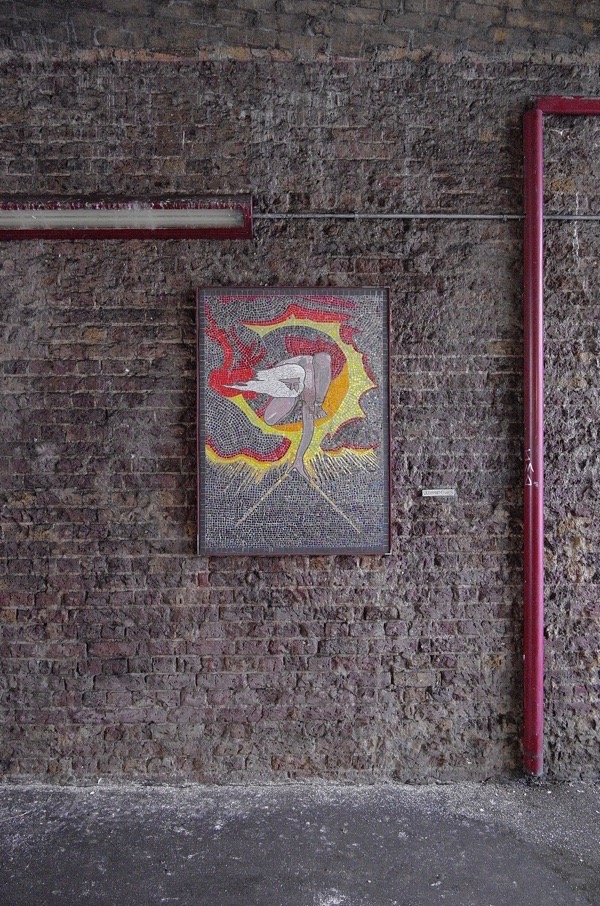


These mosaics were created by South Bank Mosaics which is now The London School of Mosaic
You may also like to take a look
Bow Food Bank Portraits
Celebrating the ninth birthday of Spitalfields Life with a week of favourite posts from the past year

Alison Neville, Volunteer
“I have been working here about six months. I was born in Stepney and now I live in Bow. I started coming for myself when I couldn’t work for a while. They helped me and then I became a volunteer. Even when I do the washing up, I enjoy it. Many people are struggling in this city and the price of living now is unbelievable”

Cody Hopper, Studying Modern History at Queen Mary University
“I enjoy volunteering in the community. It’s not like a job where you get paid, your reward is knowing you are helping other people. I have made friends over the last six months and it is a little community of its own here. The food bank is not just about distributing food, it’s about getting people out of their houses and offering social contact to people who might be lonely. Once I graduate and get a job, I will look for other volunteering opportunities because I enjoy it so much.”

Irena Urbonas, Volunteer
“I retired after thirty-eight years teaching in Bethnal Green about three years ago and I was working in a charity shop but I became ill and couldn’t continue. Because I have been seriously ill, I can advise and support others with serious illness. We see all kinds of problems, homelessness, drug and alcohol addiction, job loss. If I can help I will, but I do not impose on them. It is not just a food bank, you can get help for problems and some people come back for the social life. If this was here every day, I would come. I love it. I was born in Bethnal Green but my parents are from Lithuania and I come from a very poor background. Yet I never realised I was poor because my dad was a driver so he could borrow cars and drive us around. My mother was very strict and she realised the value of education, so we all went to grammar school. It all comes back because I have been there, and now I can help in a certain way. You see people at the lowest of the low. I do my best to welcome them and give them what they need. It does humble you. I ask people not to thank me because I don’t need their thanks.”

Trevor Blackman, Founding Director of Ape Media
“I’ve been doing this since 2014. Supposedly, I am in charge of the shop but I am here because I enjoy meeting people. The first Christmas we were open, we had one hundred and sixty people come in. There is a real need. A lot of people saw their benefits cut with the introduction of Universal Credit. It hit people hard. We had people on benefits who are struggling to feed their children and that’s horrible – we give them twenty items. Parents go without food to feed their children.”

Ruth, Volunteer
“I just love it, it gets me out of the house and talking to people. People can come here for ten visits and collect ten items and some of these people are in desperate need. Many of them are working on zero hours contracts and not getting much employment, they can’t earn enough to pay the bills. Some of these people are gutted when they get to the end of their visits and they ask me, ‘Where shall we go now?’ They have nowhere else to turn to.”

Pat O’Sullivan, Supervisor of distribution of extras at the Food Bank
“After they have been in the shop, people come to see me and I give them extras, fruit and veg, soap and women’s sanitary products. I came here myself three years ago and then I became a volunteer because I wanted to help others by giving something back. Some people who come are homeless and I have helped a couple to get jobs and find housing. I count everyone here as my friends. All my life, I have been caring for other people.”

Robert Ricks, Volunteer
“I think this place serves a good purpose, people need our services. I am particularly proud that we run it with as little bureaucracy as possible and all the money is spent on food for distribution. We don’t rely on referrals, we allow anyone to come here and get help. I am a retired lawyer and it allows me to make contact with people and be aware of those those less fortunate, whom I might never meet in any other circumstances.”

Dan Clark, Musician
“I have quite a lot of spare time in the day because I work at night. I need to get up early in the morning to come here which is hard sometimes, but I feel compelled to do it. It’s a damning condemnation of our society that people are short of food in such a rich country.”

Lynn Stone, Food Bank Manager
“We are here to address a need as far as we are able. There could be a food bank every morning of the week and still not meet everyone’s needs. If we can do a little to help some people then that makes it worthwhile, but I am sad we cannot do more. It is embarrassing for us that people are so grateful, that’s not a comfortable feeling. We see that the benefits system is not helping vulnerable people, but pushing them into a spiral of decline and need. It’s so unfair.”

Lorraine Villada, Volunteer
“I do all the administration and step in whenever there’s a gap. I do it because I feel fortunate to help people in need. There are a lot of people struggling to buy food and, with the changes in the benefits system, we are seeing a lot more people coming to sign up. I have lived in Tower Hamlets all my life. I like to give something back to the community where I was born and raised. I worked for Tower Hamlets Council but found myself out of work due to illness, but now I have a new job and I hope I shall be able to carry on here because it means a lot to me.”

Debbie Cummins, Registrar
“I am passionate to help people and I have been in the situations they have been in, so I quite understand and I love doing it. I am an East Ender born in Bethnal Green. The benefits officers haven’t got a clue and people get pushed around and nobody cares. But my job is just registering people, I cannot solve their problems. Sometimes people come who have gone six weeks without money, we have homeless people coming in here too and we try to feed them. These are human beings, some of these people had good jobs and now they are homeless. We can see the problem. We see a lot of people suffering. This is the East End and we are all human and we have to help each other. We have people who have used up their visits but they keep coming for the company and a cup of tea because they do not see anyone else and they are lonely. I love this food bank.”

Bushra Bakar, Legal Adviser
“Many clients are on benefits or homeless, so I can advise them and help with other issues like employment and debt management. I did my undergraduate degree in Law at London Metropolitan University. Public law and employment law are my specialities and now I am training to qualify. I’ve come across a number of clients who are rough sleepers without access to benefits, often because they are asylum seekers without legal rights. I assist a lot of people in need and it makes me realise just how many people out there need help.”

Father Javier, Parish Priest of St Catherine’s Roman Catholic Church
“This brings together the whole community under the umbrella of something that unites us all.”

Reverend Debbie Frazer, Rector of St. Mary & Holy Trinity Bow
“I am one of the founders of the Bow Food Bank. We did not want to restrict access to referrals from Department of Work & Pensions and General Practitioners, we wanted it to be unconditional so that people can come to us and say they need help. In the benefits system, people are treated with mistrust as if they were potential criminals, but I think they get more from being treated with dignity and respect. If people come here because they are in need of food, we let them know that they are welcome.”

Merlin, Most-beloved church dog
Photographs copyright © Sarah Ainslie
Contributing Photographer Sarah Ainslie & I visited Bow Food Bank to do portraits of some of the volunteers who run this vital service and learn about their motives and experiences.
Taking place at Bow Church each Monday morning, this is an independent food bank which means vouchers from the Department of Work & Pensions are not required, anyone who is in need of food can come and ask for help. Assistance to those in crisis is offered in the form of ten items of grocery every other week for up to fifteen visits.
If you would like to donate or volunteer, visit Bow Food Bank
You may also like to read about
At The Great Yiddish Parade
Celebrating the ninth birthday of Spitalfields Life with a week of favourite posts from the past year

Did you spot a ragtag procession of musicians, people in costume, children and dogs marching from Aldgate through Whitechapel to Mile End Waste? Behind this light-hearted frolic was a serious intent, for this was the Great Yiddish Parade, commemorating the procession of Jewish unemployed and garment workers which took place here in 1889. Contributing Photographer Sarah Ainslie & I joined the parade to lend our support and bring you this feature.
Whitechapel was once the centre of London’s Jewish community but, during the last century, they left to seek better housing in the suburbs. Yet it remains a significant location for many whose ancestors arrived here a hundred years ago or more, escaping persecution in Eastern Europe and building new lives in this country. Indeed, many of those inspired to participate in Sunday’s parade had past family connections to Whitechapel.
The original parade processed from Berners St in Stepney to the Great Synagogue in Aldgate, demanding that the Chief Rabbi condemn exploitative working practices in East End tailoring trades. After he refused to do so, they continued their march up Whitechapel Rd to Mile End Waste, where last Sunday’s parade culminated in a series of speeches from the eighteen-eighties. A klezmer band led the procession enlivened by rousing Yiddish songs of protest.
Above all, it was a heartfelt celebration to honour the moral courage of those who, in their disadvantage, discovered the power of collective action, advancing social progress for all through their fight for better working conditions. Growing public awareness of modern-day slavery and recent challenges to the dubious practices of the so-called ‘gig economy’ suggest uneasy parallels with our own time, revealing that this struggle is far from over.

(Courtesy of Modern Records Centre, University of Warwick)

Orlando & Lucian Valman

The parade gathers in Aldgate

Vivi Lachs, Historian & Yiddisher, who established The Great Yiddish Parade

Vivi rallies her comrades

Nadia Valman, organiser of the parade, dressed as seamstress of 1889


Michael Ellman in his grandfather’s tailcoat

Walking through Aldgate

Esther Neslen, Singer

Poet Stephen Watts reads a banner carried by Artist Dan Jones

Rabbi Janet Burden of Ealing Liberal Synagogue and her dog Raz


Julie Begum as Olive Christian Malvery, an Anglo-Indian freelance journalist who reported on the conditions of female and child workers in the East End in the eighteen-eighties.
“So I would like to ask you, brothers and sisters, have any of you here been to a bar lately? I am sure that many of you are familiar with the establishments of the Whitechapel Rd. Well, I want to talk to you about the lives of the barmaids who work there. Many of the young girls who earn their living in this arduous calling are subjected to numerous temptations. And yet they remain good, upright, and respectable women. Often they are obliged to stand behind a counter serving semi-drunken, coarse, and foul-mouthed persons of both sexes. They are obliged to listen to the vile talk of that class of man who makes it a pastime to insult young women engaged in this business. As a girl once said to me,’The life is hard enough without having to be insulted by cads.'”

Walking through Whitechapel


Jo Green, Clarinetist

Walking through Mile End

Phil Whaite, Saxophonist

Speeches at Mile End Waste beside the statue of General Booth

“I have come to you in the East End of London from the United States of America. My friends, I am an Anarchist, and I will tell you why. Anarchism is the great liberator of man from the phantoms that have held him captive. What are these phantoms? Religion, the dominion of the human mind, Property, the dominion of human needs, and Government, the dominion of human conduct, represent the stronghold of man’s enslavement and all the horrors it entails. Break your mental fetters, says Anarchism to man, for not until you think and judge for yourself will you get rid of the dominion of darkness, the greatest obstacle to all progress.”- Emma Goldman, Anarchist & Writer, spoke in Whitechapel in the eighteen-eighties

“‘A good man will be contented fast enough if he be fed and clothed sufficiently, but if a man be not well fed and clad, he is a base wretch to be contented.’ So says William Cobbett, and certainly the strikers might have one more banner with this inscription written on it. We have learned a good deal since William Cobbett’s time, and some of us have become very ‘refined’ indeed, but still on this foundation of victuals and shelter without anxiety must you build ‘refinement’ and all.'” – William Morris, who spoke at Mile End Waste in 1889

“I’d like to know if there are sadder sights anywhere than those we now see around us? I mean the homes of honest working men who have nothing to do, skilled workmen whose trades are itching at their fingers’ ends, who spend their days tramping about looking for work, and come home at night with empty pockets to hungry wives and children? I need draw no picture of these things. You not only see them, but feel them. You know what it is to have wives fainting for want of food, and children crying for crusts you cannot give them. ” – Words of a young man speaking on Mile End Waste from Margaret Harkness’ novel of 1888, Out of Work.
Photographs copyright © Sarah Ainslie
You may also like to read about these other parades
So Long, Nathans Pie & Eels

Contributing Photographer Andrew Baker visited Nathan’s Pies & Eels in Barking Rd to record the drama of West Ham’s last home game of the season, when – as they did every Saturday for more than forty years – fans piled in for a hearty meal before the match. Yet this was a poignant occasion because Nathan’s is now closed for good, shut down by excessive rent increases that have rendered this thriving business untenable.
Nathan’s was an East End cultural landmark, a community centre and a culinary destination, cherished for its delicious pies cooked freshly each day to the same recipe by generations of the Nathan family. At the moment of the passing of an era, I sat down with Richard Nathan in his beautiful sparkling pie shop to record his family’s story and celebrate their incredible achievement and service to their beloved customers in Newham through the decades.
“We opened this shop in November 1974, my great-aunt Dorrie and her husband Roy. Although he was a Minchin, they put her maiden name ‘Nathan’ on the shop. My grandparents had been in the business of pies before that, it had always been in the family. My parents Christine & David took over in 1983 and they still help out in their late seventies. Finally, I am the fourth generation.
It has always been an Eel & Pie house and we have never changed the recipes. Even though we have been through thick and thin, we have retained a high level of quality. You get a full pie full of meat without any gristle. At other places, you might cut into pie and find it full of gravy but not here!
I am the owner-proprietor which means I do everything from unblocking the toilets to making the pies. I had a good teacher, my father. From the age of five, I would be in the bakehouse standing on a chair with an apron trailing down to my feet, cutting bits of dough off the pies. So I have always helped. I worked as a Saturday boy for a number of years and when I left school at sixteen I decided to come into the business. That was thirty years ago next month. Quite some time even though I am still young.
I work ten to twelve hours a day, five days a week. It has not made me rich but it has provided a comfortable living, through sheer hard work. Everybody that works here has made Nathan’s Pie & Mash shop what it is today.
We are closing now after more than eighty years of our family in the business. There are lots of factors that have led to shutting the shop – the closure of Upton Park football ground, the imposition of strict new parking regulations so our customers cannot park, the new business rates and a threatened 100% rent increase. Rent is a hard fought battle these days. It used to be like a gentlemen’s agreement that every five years it would increase by perhaps a thousand, but all of a sudden a new regime came in. The council is the landlord but they appointed a property management company. It took me four years of court battles to bring their proposed rent of £22,000 per annum down to reasonable £14, 500, from an original rent of £11,000. Meanwhile the business rates have increased and increased. The rent and rates here are over £25,000 a year but I cannot put the prices of my pies to match these increases.
When I look back, it has been fun running this shop. On a football day, it was part of a big social routine – buying your programme, coming in here and having pie and mash, enjoying a pint at the Boleyn Tavern or the Working Men’s Club and then going round the back to the stadium. Unfortunately, all that has now gone and the eight hundred and sixty-six dwellings in the new development that replace the stadium will not be affordable for local people.”


Richard & David Nathan, piemakers


Pamela Balder, Brenda Rice and Shirley Frankland
Brenda Rice – “I started in 1976. I had just lost my daughter so I need to do something and I came to work here. I walked by one day and saw the advert. I said to my husband, ‘There’s a job going down the Boleyn,’ and he said ‘Would you like me to drive you down there in the car?’ and I have been here ever since. Some of our customers have been coming in for years and we all know each other, we are like family. Even if you wake up in the morning and don’t feel like coming in, by the time you come here and get talking to everyone you feel better.”
Shirley Frankland – “I came to work here in 1993. It is walking distance from my home and I enjoy the social life. We go out together and meet up at different places. We have already got three evenings booked ahead including the Brick Lane Music Hall. We cannot tell you what we get up to!”
Pamela Balder – “Like Shirley, I started in 1993. I had been married a little while and we bought a house when prices were sky-high so I needed to look for a job. At the time, my mum Pam worked here and she said, ‘There’s a vacancy.’ Before that, I was a Saturday girl from the age of fourteen.”
Photographs copyright © Andrew Baker
You may also like to read about
Boiling the Eels at Barney’s Seafood
Some Favourite Pie & Mash Shops
More Favourite Pie & Mash Shops
Dorothy Rendell, Artist
Celebrating the ninth birthday of Spitalfields Life with a week of favourite posts from the past year

Self portrait by Dorothy Rendell
I feel touched and privileged to have been given the eleventh hour opportunity last year to interview Artist Dorothy Rendell who died in January. It is a matter of regret that she did not receive the recognition she deserved for her painting earlier in her life, yet I take consolation that she died with a copy of my interview at her bedside and she took great delight in the many appreciative comments she received for her work, regarding this late public acknowledgement as vindication of a kind.
I enjoyed visiting Dorothy Rendell to hear her stories, admire her paintings and share her company. At ninety-four years old, Dorothy was taking her ease, relaxing in the warm with a glass of red wine and a cigarette while contemplating the winter sunlight in the garden of her tiny cottage at Mile End Place. Blessed with magnificent cheek bones and a profile worthy of Edith Sitwell, Dorothy was a natural raconteuse who possessed the hauteur of another age, tempered by an endearing, caustic sense of humour.
Studying at St Martin’s School of Art during World War Two, Dorothy began her career as an artist with a studio in Kensington where she encountered the likes of Henry Lamb, Carel Weight and Orovida Pissarro. Yet it was in Stepney working for more than forty years at Harry Gosling School that she discovered the joyful expression of her abilities and here she undertook a series of portraits of pupils that spanned her career.
Just a handful of unexhibited oil paintings bear witness to a significant talent which might have made Dorothy famous if she had received the recognition she deserved. Instead it led her to the East End – by way of Italy – and ultimately to a modest life of fulfilment as an inspirational and passionate art teacher.
“Very few people really say what they think and say it bluntly and openly regardless, they couch it round with tact, but I am not like that. At ninety-four, I do not belong to any age. When I think ‘fifty years ago today,’ it does not seem all that time ago to me.
I had to give up my art work because I had no money and I could not find anywhere to paint. I had a huge studio at the back of a house in Warwick Gardens, Kensington, which was freezing cold and falling down, the rain would drip in. It had once belonged to Jacob Epstein. It was the most romantic studio. People used to love coming round and I had constant visitors. I used to paint there but I wasted an awful lot of time working to make money when I should have been painting. I exhibited at the Leicester Gallery and at the Royal Academy, but I never had a solo show. I just put things up here and there. I muddled through life really, but I have had an interesting life.
I came to the East End because I could not get a job anywhere else, people were terribly against women artists. They still are in this country. I used to go for teaching jobs and I had very good credentials, including references from Henry Lamb, Vivian Pitchforth and Mr Dickie who was an Inspector of Schools, but I never got the job because some man would come along and swipe it. This used to infuriate me because I knew that I was better and I was better at teaching too. I never thought I would own a house and when I came to live in Mile End Place, people said, ‘You’re crazy, you’ve bought a load of rubble, but I think it’s marvellous!’ All of my life has been flukes like that.
I started drawing very early on, at ten years old. Dorothy Rushforth, my mother, came from the north of England and went to art school, she was quite advanced for her time. My father came from a long line of gentleman farmers in Devonshire and he was a bit of a villain. His family lost all their money through one of them being a gambler. So he travelled the world on luxury liners doing doubtful business deals and brought people back and my mother had to entertain them and cook for them. They just frittered away their lives.
My mother encouraged me to draw and when I was eighteen I got a prize for the best artist in the school but nobody mentioned it and nobody took me to prize giving. It is most extraordinary when I think about it now! Of course, the war was on and one was whisked from here to there.
I came up to London in wartime and I was by myself, I did not know a soul. I got one room in an attic in Pembroke Sq, Notting Hill Gate. There were lots of interesting people and a very good cinema there, with marvellous French films, I had never seen anything like them. It was exciting. Then I got into St Martin’s School of Art through doing evening classes because I had to work in the day to earn money. At art school, I met Vivian Pitchforth who was a well known draftsman and if you were taught how to draw by him, it was a great honour. Somehow, he noticed me. I do not know how because I never said a word to anyone.
The art school was in Charing Cross Rd then, it was lovely. I inhabited all those dumps in Old Compton St where you got cheap meals for tuppence ha’penny. We all used to go to them, I am quite sure we were eating horseflesh! There were lots of little cafes, it was wonderful. Robert Beulah who was a Royal Academician, his mother ran a cafe there and she quite liked me, she thought I was quiet and well behaved – so we had a little clientele there. It was very good. I loved my years in Soho, living in that awful attic in Notting Hill Gate which is probably worth a fortune now! How life changes.
I met Henry Lamb, the artist, and I thought he was marvellous, he was very quiet and very scholarly. He became my friend and he followed my work when I left art school, and he used to write to me over the years. I never earned any money as an artist, I had not got the gift of making money, I would always belittle my work. I do a picture and think, ‘That’s quite good’ but then I would think ‘That bit there needs changing.’ I remember doing a painting of lemons, I was quite pleased with it. I did it in my father’s bank which was open on Sunday, so I put all these lemons on the counter with a cauliflower and I painted them. I did not think much of it yet years after I put it in an exhibition and people said, ‘You’re brilliant!’ It means a lot when you are eighteen but there you are, what does it matter now? I enjoyed doing it.
I tried getting my work exhibited by galleries but it was an awful fag, I made a living by doing odd jobs. I travelled a lot and I read a terrific amount because I was too shy to talk to people – and that was a good thing because I got a wide vocabulary. I travelled all over Italy, you did not hitch then but I got lifts somehow and I used to draw in cafes. I found that this was terribly popular and I could draw because of my marvellous tuition. It was wonderful.
When I first went to Florence, somebody sent me there and said, ‘Try and make a go of it!’ I did not have any money, if I had a few quid I was surprised. I shared a house with extraordinary people. One or two very wealthy, one or two officers in the army, a Spanish girl, various other people, and me. I used to go out and draw in the evening because I love watching Italian life outdoors. Those drawings are scattered all over Italy. It was fun, I loved drawing ordinary people sitting around chatting. They did not mind where I came from. I loved it. I would love to be Italian.
Eventually, I came to the East End and I had to go round awful schools. I was not used to these East End types of all nationalities but I stuck it out – I think I must had a bit of character – and I eventually got a job at Harry Gosling School where they had a remarkable headmistress. She was astonishing, she became my best friend instantly. She was called Sybil Mary Parry. She got me going on life really. She got some brilliant results. She was a state scholar, which means she was the best eighteen year old taking exams in the county. She was very intelligent and she had a big clientele of boyfriends, who all played rugby for Wales. I can still hear here shrieking across the room when the television was on and Wales were playing.
The school was in a very poor part of the East End and I could see that for the children it was life or death to get a good education, and she saw to it that they did. She was very eccentric, she would talk to people all the time and even go round to the betting shop herself to put her ten bob on the Derby. Sibyl used to keep a bottle of sherry in her filing cabinet. She was a marvellous character. She is not forgotten.
She used to publicise my children’s art and I became quite well known with the inspector. He really loved this school and he used to come every week or so just to see it. What a school! It turned out some marvellous people and I still hear from them. Old people get in touch and say, ‘You used to teach me.’
You are dropped in, and you either survive or you die – but I survived.”

Orovida Pissarro, Camille Pissarro’s granddaughter. “I met her through Carel Weight whom I encountered in Warwick Gardens, he had a studio down the road. One day, I was looking outside a junk shop in the Earl’s Court Rd and he asked me, ‘What are you wanting?’ I said, ‘I’m going out to buy a chair because I have a quartet coming to practice in my studio and I have not got four chairs.’ He said, ‘Come with me, I can give you a chair.’ So he took me to his house and we became friends.
I used to cook for Orovida at her home in Redcliffe Gardens, she was a great gourmet. She was Jewish but she loved roast pork. After the meal, she would go to sleep and I would be painting away. She had no children, she was hermaphrodite. I realised that very quickly. She had lovely things and she would get out bundles of letters from Zola. I loved going to see her but she was eccentric and very demanding, she liked daft things on the television like Doctor Finlay’s Casebook. She used to have a birthday party every year with a lot of interesting people and I went along with Carel Weight, and we would have a feast of roast pork. She was a very good painter and her paintings were quite interesting. Orovida liked being painted and it was a marvellous interior with lovely things round her. I knew her for years until she died.”

Wapping – “I got a window from a pub beside Wapping Pier Head and it took me weeks. I did drawings and squared it up. I am not one of those who does quick ones.”

Wapping, View from an upper window at Wapping Pier Head in spring

View across Mount Pleasant from Doughty St -“I had a friend who had a flat there, next door to Dickens’ House. I had many a meal there and stayed the night. She was a teacher and a writer, but she was always having affairs in Paris. With her job and boyfriends, the crises she put me through. A good friend.”

One of Dorothy’s pupils at Harry Gosling School

“This little boy was one of the pupils I taught. A little horror! He’d been badly behaved – so the head teacher told me, ‘Take him and make him sit for you!’ So he had to sit still for about two or three days. I think I did a painting of him too”

“This is a nice little girl who had a terrible life. She was pretty and I liked her, so I drew her. I think I probably went to her house. It was squared up for a painting but I don’t know what happened to the painting. Children are very good to draw as long as they are not commissioned, when they are commissioned they are hellish. One mother came to me and wanted a portrait of her daughter. She looked a nice kid and I didn’t charge very much. She wore jeans, but when she turned up she was all dressed up – it was awful!”

“I used to give them their drawings. They used to beg me for them and were so persuasive that I used to hand them over, until one day a boy took my drawing and folded it up in half and put it in his pocket. I nearly screamed! They never did that in Italy, they treasure their drawings there.”

“This is Harry. Miss Parry, the head teacher, she adored this drawing. Harry was really thick and he used to look at you with that blank expression, but he was marvellously funny and he made a tremendous effort. Somebody who used to work with me said, ‘I’m going to bring Harry to Miss Parry’s funeral,’ and I said, ‘But he’ll be middle aged now.’ She found him and he came to the funeral. I couldn’t believe it. He was a lorry driver for Charringtons.”


“This was a little Afghan girl, I thought she was beautiful. She was a vain little girl who would sit for hours in the art room. Miss Parry thought it was better for pupils to sit with me than to sit and do nothing, so she would send the badly behaved ones to the art room and I would draw them. They liked being drawn, they were flattered by it.”

“I never had any absentees from my art classes, they were always very keen. As my head teacher used to say, ‘They’ll always go to art with you!’ They enjoyed doing it. There were always a certain number who could not draw, who found it very difficult. I would get them started making patterns but they would think they could not do that. So I would say, ‘Yes you can.’ I would get something like an electric light bulb and say, ‘Make some patterns from what you can see with that.’ – repeating and so forth. And they would come up with some marvellous things. Then they got keen. You have to think up strange things to get children really interested.”


“This little girl, I got to know her mother and father, and she went on to grammar school. The children of immigrants always did much better than the English ones because their parents wanted them to work.”


“This was in the doctor’s waiting room. Quite a well known doctor round here invited me to draw there.”

“When I started teaching I thought I would teach in the West End but they would not take women, so I had to move to the East End – but I don’t regret that at all because I got so wrapped up in it and there were all these places where I could go and draw.” Dorothy Rendell (1924-2018)
Paintings copyright © Estate of Dorothy Rendell
Portrait of Dorothy Rendell at ninety-four © Lucinda Douglas Menzies
At Margolis Silver
Celebrating the ninth birthday of Spitalfields Life with a week of favourite posts from the past year

Kudret Yirtici, Polisher
There are still traditional manufacturing industries thriving in the East End – as Contributing Photographer Sarah Ainslie & I discovered when we visited Margolis Silver, market-leaders in silverware, at their factory in London Fields. Here we found a band of highly-skilled silversmiths with proud dirty faces, designing and manufacturing silverware for the swankiest West End hotels, restaurants and clubs, employing techniques that have not changed in centuries.
Upstairs in his solitary garret, we met the most senior member of staff, Albert Alot, a virtuoso metal spinner of a lifetime’s experience who can take a disc of copper and expertly spin it into a cup on a lathe with all the flamboyant magic of Rumplestiltskin. Down below, led by Richard Courcha whose father started the company half a century ago, we found the polishers at work, cleaning the copper vessels prior to plating. With their grimy visages and overalls topped off by a characterful array of hats, they were a charismatic band who generously welcomed us into their lair and tolerated our nosy questions with patience and good humour. Next door, Chloe Robertson supervised the electroplating, first with nickel and then silver, cheerfully presiding over two enormous boiling vats of steaming hydrochloric acid and livid green arsenic bubbling away.
There is a compelling alchemy to this fascinating process which, thanks to immense skills of the silversmiths, transforms the raw material of copper sheets into sophisticated gleaming silverware, sufficient to grace the grandest tables with its luxurious allure. It is exceptional to visit a workshop such as this, where everyone takes such obvious delight in their collective achievement.
Away from the workshop, Valerie Lucas runs an office stacked to the roof with myriad examples of silverware, teapots, coffeepots, condiments, basins, bowls and plates of every imaginable design. Here we met director Lawrence Perovetz, who is of Huguenot descent and cherishes the living tradition of Huguenot silversmiths in London through his work.
Yet all these people, machines and processes are crammed into a tiny factory that few in London Fields even know exists. As Polisher Pascal Fernandes quipped, summing it up succinctly for me, “It’s a little house of treasures this is!”

Arthur Alot – “I’m from Plaistow and I was born in the war. I’ve been doing this all my life, since I did an apprenticeship down at Shaw’s Metal Spinners in Stratford years and years ago. They’ve gone now. Years ago in the twenties, the old spinners used to walk in dressed in spats and whatever. I moved to a factory in the Holloway Rd where I met this spinner, a proper one, who had come out of Hungary at the time of the revolution. He had been taught by the sixth best spinner in Hungary and he taught me and my brothers. I have taught a few who are starting on their own.”

Arthur spins a cup out of a disc of copper


Arthur Alot, Metal Spinner

Richard Courcha – “I am the factory manager and I do polishing. It was my father, Thomas Courcha’s business, he started it in 1968. He was a metal polisher and he went into partnership with Johnny Mansfield in a little factory in North London and then, when this place came up for grabs in 1968, they moved in. The company was called TC Plating Ltd – Tommy Courcha Plating in full.
I came here all the time as child, every other Saturday in the back of my dad’s old red Escort van. It was a bustling place. I used to help out with the makers, there were ten makers working here during the late seventies. In those days we manufactured for the retail market, producing gallery trays, punchbowls and wine coolers that were sold in the West End. Designers would bring in their drawings, and my dad and his team would make the moulds and conjure them up.
The retail side dropped off in the eighties because of cheap products coming in from India. So then we moved into restoring antique silverware. About ten years ago, it all changed again. This was around the time I met Lawrence who had this idea of supplying hotels and now we are joined at the hip.
I came here to work in 1982. I did not have any plans to do anything else. It was a bustling business and my brother was here as well until he retired. I suppose I like the job. It is what I do. It is in my blood. It is what I grew up with. After thirty-six years, I know how to do making.”


Collin Foru-berkoh, Polisher


Bradley Hitchman – “I am a silversmith and maker of thirty-four years. When I was thirteen, I moved to Morden and the next door neighbour owned this company. A few years after I left school, I was doing a training scheme to be an engineer but I thought ‘Silversmith’ sounded more glamorous than ‘Engineer.’ So I came here. It was a struggle at first. It was very repetitive, hundreds of this, thousands of that. The same thing over and over again. But when it comes to doing it now it is second nature. Once I got the hang of things and things came easier, it was no longer boring – you just got on with it. I have always liked working with my hands. I like the creative side of this work, you can take a piece of metal and turn it into something – like this dessert trolley! Pretty much everything here is bespoke. ”


Pascal Fernandes – “I am a polisher and a finisher. Way back in 1976, I got an apprenticeship as a polisher and I was taught by three very good people. It is very dangerous work because the machines show you no mercy, they can take your hand off. At first, I found it boring but over the years you learn from other people who might do something differently. You do not necessarily copy them because each has an art of their own. My way is the way I was taught originally by a man who was taught by the best. It is creative and I took it as my living, so I must like it. You learn your lessons as you go along. You have got to take the good with the bad.”


Chloe Robertson – “I am a maker and I do electroplating as well. I did a degree in Design in Liverpool and picked working with metal and wood. I won ten thousand pounds start-up business funding and I funded myself to go to Bishopsland which is a post-graduate college for silversmiths and jewellers, and then I won an award as ‘Woodturner of the Year’ which meant I got a free workshop for a year. Then this job popped up and I have been here two years. I am the newbie, but I love this work and I intend to stay at least ten years. It is fascinating working alongside these guys who have been here for all these years, I learn something new every day. Some of these techniques they know are mind-boggling.”

Chloe plates the copper with nickel in a vat of boiling arsenic

Chloe dries the plated objects in a box of grain

Lawrence Perovetz, Director & Valerie Lucas, Secretary, Margolis Silver
Photographs copyright © Sarah Ainslie
You may also like to look at these nearby manufacturers


