Watermen’s Stairs

Wapping Old Stairs
I need to keep reminding myself of the river. Rarely a week goes by without some purpose to go down there but, if no such reason occurs, I often take a walk simply to pay my respects to the Thames. Even as you descend from the Highway into Wapping, you sense a change of atmosphere when you enter the former marshlands that remain susceptible to fog and mist on winter mornings. Yet the river does not declare itself at first, on account of the long wall of old warehouses that line the shore, blocking the view of the water from Wapping High St.
The feeling here is like being offstage in a great theatre and walking in the shadowy wing space while the bright lights and main events take place nearby. Fortunately, there are alleys leading between the tall warehouses which deliver you to the waterfront staircases where you may gaze upon the vast spectacle of the Thames, like an interloper in the backstage peeping round the scenery at the action. There is a compelling magnetism drawing you down these dark passages, without ever knowing precisely what you will find, since the water level rises and falls by seven metres every day – you may equally discover waves lapping at the foot of the stairs or you may descend onto an expansive beach.
These were once Watermen’s Stairs, where passengers might get picked up or dropped off, seeking transport across or along the Thames. Just as taxi drivers of contemporary London learn the Knowledge, Watermen once knew the all the names and order of the hundreds of stairs that lined the banks of the Thames, of which only a handful survive today.
Arriving in Wapping by crossing the bridge in Old Gravel Lane, I come first to the Prospect of Whitby where a narrow passage to the right leads to Pelican Stairs. Centuries ago, the Prospect was known as the Pelican, giving its name to the stairs which have retained their name irrespective of the changing identity of the pub. These worn stone steps connect to a slippery wooden stair leading to wide beach at low tide where you may enjoy impressive views towards the Isle of Dogs.
West of here is New Crane Stairs and then, at the side of Wapping Station, another passage leads you to Wapping Dock Stairs. Further down the High St, opposite the entrance to Brewhouse Lane, is a passageway leading to a fiercely-guarded pier, known as King Henry’s Stairs – though John Roque’s map of 1746 labels this as the notorious Execution Dock Stairs. Continue west and round the side of the river police station, you discover Wapping Police Stairs in a strategic state of disrepair and beyond, in the park, is Wapping New Stairs.
It is a curious pilgrimage, but when you visit each of these stairs you are visiting another time – when these were the main entry and exit points into Wapping. The highlight is undoubtedly Wapping Old Stairs with its magnificently weathered stone staircase abutting the Town of Ramsgate and offering magnificent views to Tower Bridge from the beach. If you are walking further towards the Tower, Aldermans’ Stairs is worth venturing at low tide when a fragment of ancient stone causeway is revealed, permitting passengers to embark and disembark from vessels without wading through Thames mud.

Pelican Stairs

Pelican Stairs at night

View into the Prospect of Whitby from Pelican Stairs

New Crane Stairs

Wapping Dock Stairs

Execution Dock Stairs, now known as King Henry’s Stairs

Entrance to Wapping Police Stairs

Wapping Police Stairs

Metropolitan Police Service Warning: These stairs are unsafe!

Wapping New Stairs with Rotherithe Church in the distance

Light in Wapping High St

Wapping Pier Head

Entrance to Wapping Old Stairs

Wapping Old Stairs

Passageway to Wapping Old Stairs at night

Aldermans’ Stairs, St Katharine’s Way
You may also like to read about
Madge Darby, Historian of Wapping
Whistler in Wapping & Limehouse
So Long, The Water Poet
The Water Poet in Folgate St will close forever on 29th March as part of British Land’s redevelopment of Norton Folgate into a hideous corporate plaza, granted planning permission by former Mayor of London, Boris Johnson, in 2016.
Contributing Writer Gillian Tindall first encountered John Taylor the Waterman-Poet (1578 – 1653) when she was researching her book The House by the Thames a dozen years ago. She gives an account of the man behind the legend and the Spitalfields pub that bears his name.

The Water Poet at the edge of Spitalfields and Norton Folgate is a recent berth for John Taylor, although there has been a tavern on the corner where Folgate St meets Blossom St for over two centuries and possibly an ale-house before that. The old name for the muddy pathway that became Folgate St was White Horse Lane, after the brewery situated there since Taylor’s own times. Even longer ago, what became White Horse Lane was formerly the north entrance to the religious house of St Mary Spital.
In the eighteenth century, the street was laid out in stages by a Sir Isaac Tillard, a man of Huguenot descent, who had acquired some of the old Mary Spital land. The earliest evidence of a purpose-built public house appears then and by 1805 it was registered as The Pewter Plate. Those in charge locally have always kept an eye on pubs and publicans, so it is easy to trace the Plate throughout the nineteenth century, the heyday of urban pubs, and into the twentieth. In 1904, when pubs all over the London were being enlarged and made grander, the Plate was rebuilt with the fancy brickwork and the tall, elaborate chimney that you see today.
At some point, probably between the wars, when Spitalfields was becoming ever sootier and more neglected, as its more prosperous citizens took themselves off to greener suburbs, the building was a pub no longer. By the seventies, the erstwhile pub along with two other adjacent properties, became commercial premises owned by`R.Bardigger.’
By and by, the pub was restored to its proper use and the name The Water Poet dates from the current owner’s acquisition in 2003. He undertook the wonderful transformation of the old back yard into a green-leafed garden with fairy lights. It is this area, along with several large rooms created out of a former warehouse, that is to be destroyed as part of British Land’s scheme to redevelop Norton Folgate in the teeth of local opposition. Unfortunately, their hideous corporate plaza with bogus facades received planning permission airily bestowed by the previous and unregretted Mayor of London. John Taylor the water-poet, I believe, would be with us in this struggle.
Those who have enjoyed a drink at The Water Poet in Folgate St may have wondered about this unlikely-sounding figure so far from the water. Yet John Taylor, the seventeenth century Thames ferry-boat man, was a convivial fellow – unless he was waging a vendetta – who was very much at home in pubs. When not on one of his great walks round Britain, he lived most of his life in Bankside, which had many hostelries alongside the theatres and bear-pits. He also had relations who kept inns in Leicester, Abingdon and Norwich whom he sought out in his travels.
Taylor lived through times far more unnerving than ours. Born in Gloucester in the prosperous later days of Queen Elizabeth’s reign, he came up to London to seek his fortune and was apprenticed to an oar-maker, before a spell in the Navy upon dangerous expeditions against Spain in Flores and Cadiz.
Once back in London, he lived through the increasingly turbulent times of the Stuart era, the Civil War and the social oppression of the Cromwellian period. A royalist yet with a liking for Puritan values, he worked as a waterman in the service of the king and was distressed when Charles I lost his head. Taylor was getting on in years by then, complaining bitterly that the Commonwealth had driven the theatres off the south bank and damaged the watermen’s trade, much of which had traditionally consisted of crossings between the City and Southwark. He died in his seventies before Charles II was restored to the throne.
Part subversive journalist, pamphleteer and satirical ballad-maker, part would-be poet and playwright, Taylor longed to join a literary society into which he had not been born. A ferryman by nature, he lived between two worlds socially. As hands-on oarsmen, watermen were tough, rough fellows of their time, competing vociferously for trade, but they met a remarkable range of customers many of whom valued and cultivated them. This was also an era when the Waterman’s Company was being established (with Taylor’s active involvement), fares were being set, intelligent men like him were becoming fully literate and the era of New Learning would soon dawn.
Taylor was a natural self-publicist, a collector of useful friends, but also a genuinely passionate believer in freedom of expression and the rights of the individual in every class. He became an advocate for the destitute watermen who had lost their trade during the ferocious winter of 1620-21 when the Thames froze over for six weeks. He soon discovered that, in spite of all his efforts, there was not much money to be made from a literary life – a truth that still holds today – and developed ingenious means of raising cash. When in difficulty, he would take off on long journeys round Britain on foot for which, anticipating the modern way, he would get sponsorship from rich acquaintances. As a stunt, he once rowed down the Thames in a boat made of paper and later made a much publicised trip – in a rather more solid craft – down the Rhine and the Elbe.
A good talker, Taylor cultivated the society of Bankside actors, advocating their cause against the rising tide of Puritanism. I imagine him as the archetypal cab-driver – “Had Will Shakespeare in the back of my boat the other day… As my good friend Mr Henslowe said to me…” He fought back with some success against the Uber of his time – namely, the wheeled conveyances for hire that were beginning to appear on London’s cobbled streets and alleys as an alternative to the traditional way of travelling by river.
John Aubrey, diarist and man-about-town who was familiar with some of the cleverest men of his era, described John Taylor as `very facetious and diverting company’ and possessing `a good, quick look’. Thomas Decker, the Jacobean playwright, called him `the ferryman of heaven’, but there may have been a touch of irony in that.
Taylor’s poetry has not survived in the public mind, since perhaps it did not really deserve to, but his cheerful and inventive spirit has lived on to this day. He died in an inn in Covent Garden kept by his second wife, and lies buried somewhere behind St Martins in the Fields, where the graveyard of the old church lay, and where present-day travellers and aspirants to fame gather with their backpacks and their own travellers’ tales.

John Taylor the Water Poet
From An Arrant Thief, 1622

John Taylor’s A Swarm of Sectaries & Schismatiques published 1641

Engraving of John Taylor by Thomas Cockson, 1630

The Water Poet in Folgate St (Photograph by Richard Lansdowne)
You may like to read
Dorothy Rendell’s London
As a prelude to my lecture about The Life & Works of Dorothy Rendell (1923-2018) this Thursday 14th at Nunnery Gallery, Bow Arts and the opening of Dorothy’s Rendell’s posthumous solo show this Saturday 16th March at Abbott & Holder, I am publishing this selection of her drawings, seen publicly for the first time today. Click here for tickets for my lecture.
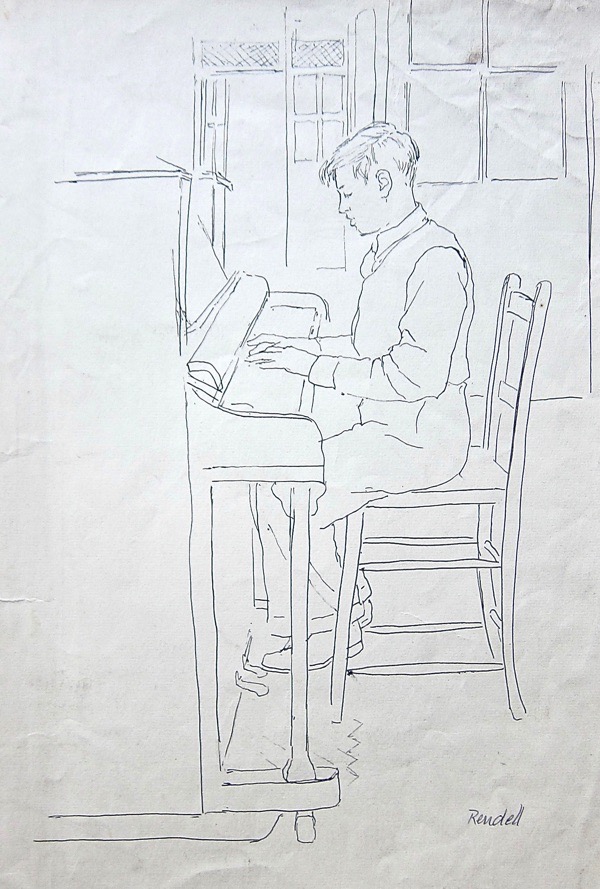
After I picked these drawings, I realised they told the story of Dorothy’s life in London from her art school days in Soho, via her studio in South Kensington, to her job at Harry Gosling School and her home in Mile End Place.

When Dorothy was a student at St Martin’s School of Art in the postwar years, she was fascinated by this view of Frith St, Soho, where men gathered to read prostitutes cards in the newsagents window and she drew the same scene several times from her vantage point of a first floor window across the road.

Frith St

Frith St

Frith St

Old Compton St with Bar Italia in the background

Shepherd Market

Shepherd Market

Shepherd Market

Shepherd Market

‘The Reading Room’

Art School Dance

Art School Model


Dorothy invited the Carl Lewis Quartet to practice in her studio in South Kensington that had formerly belonged to Jacob Epstein


Teaching at Harry Gosling School


In the art room

Mile End Place

Self-portrait by Dorothy Rendell
Drawings copyright © The Estate of Dorothy Rendell
You may also like to read about
Down The Old Roman Rd

The recent sunshine encouraged me to enjoy a Sunday stroll down the Roman Rd and experience the manifold wonders of this celebrated thoroughfare, tracing a path eastward from Bethnal Green across two millennia.
Have you ever noticed that the Roman Rd is not aligned with the Bethnal Green Rd that precedes it to the west? This clue reveals that the Roman Rd was there long before the Bethnal Green Rd was laid out. Old Ford Rd to the north was the former route eastward to Norwich from London, continuing the path of Old St and Old Bethnal Green Rd towards the ford over the River Lea. Yet Old Ford Rd became frequently waterlogged in winter which caused the Romans to lay out a new road – a little to the south – which they called ‘Pye Rd’. This was the road we know as the ‘Roman Rd’ and the Bethnal Green Rd was cut through relatively recently to connect it with Bishopsgate.
The prevailing character of the Roman Rd declares itself in the higgledy-piggledy terrace that you encounter upon the north side beyond Museum Gardens and the fire station. In the nineteenth century and for much of the last century, these terraces of small shops lined the entirety of the Roman Rd with the small trades and family businesses that were lifeblood of the East End for generations and define its architectural landscape even to this day.
Beyond Globe Town, you encounter postwar redevelopment in the form of the three checkered towers of Cranbrook Estate designed by Francis Skinner, Douglas Bailey & Berthold Lubetkin in 1963, with the sculpture of the Blind Beggar of Bethnal Green and his dog by Elisabeth Frink in the foreground.
Crossing Regent’s Canal, you enter Mile End Park, carved out from the bombsites of former streets in an ambitious yet not entirely realised plan to connect Victoria Park with the Thames by a green corridor. Grove Rd bounds its eastern extremity, lined with some fine Victorian villas.
William Wigginton’s curious St Barnabas of Bethnal Green, with its spire knocked off in the blitz and its shrine outside adorned by biblical texts, stands sentinel at the beginning of the longest remaining stretch of small shops in Roman Rd. As I passed that Sunday, the congregation of the devout were saying their prayers.
On each side of Roman Rd, long elegant nineteenth terraces of houses extend to north and south. Many of the most attractive of these have already been renovated, and skips and scaffolding attest to those currently in progress. Yet equally, you do not have to look far to discover evidence of a crude imperative to maximise redevelopment at the expense of the neighbourhood, manifest in cheap new buildings that show little respect for their gracious predecessors.
To my mind, the heartland of the Roman Rd is the stretch between W F Arber’s Printworks at 459 and George’s Plaice at 484. Yet since Gary Arber and Tom Disson have both slung their hooks in recent years, and George’s Plaice is now demolished, perhaps I will have to rethink? Reassuringly, there are still some long established shops that remain in this section – Sew Amazing, Thompsons Ironmongers and Denningtons Florists to name only a couple of favourites. Yet the thought of the fabled Roman Rd on the penumbra of living memory, when it was lined with an infinite variety of small shops, remains intoxicating.
Once you pass under the arch with its fanciful inscription in Latin and enter the pedestrianised Roman Rd Market, you enter a more domestic territory where street life takes precedence over traffic and residents walk slowly, exchanging greetings. There is a tangible sense of community here and the Passmore Edwards Library is an inspiring example of the philanthropy of the past. I often wonder if the proprietors of G Kelly, my favourite eel & pie shop (currently closed for rebuilding), have ever considered their position on the highway once known as Pye Rd? This final section of the Roman Rd is distinguished by some fine greengrocers before it all peters out at Parnell Rd, where the route once descended to the ford over the River Lea.
Gary Arber used to regale me with tales of the phenomenal number of pubs that lined the Roman Rd in his youth and the possibilities of multiple refreshment continuously on offer between here and Bethnal Green. I dreamed of undertaking a pub crawl to visit all these establishments. Yet such is the depletion of pubs in the Roman Rd that I fear if I were to do so today, I should return home sober.

St John on Bethnal Green by Sir John Soane marks the beginning of the Roman Rd

This nineteenth century brick fire station has been replaced by a brutalist concrete fire station to the east and is now a Buddhist centre


Cranbrook Estate designed by Francis Skinner, Douglas Bailey & Berthold Lubetkin in 1963, with the sculpture of the Blind Beggar of Bethnal Green and his dog by Elizabeth Frink


Regent’s Canal

Mile End Park, carved out from the bombsites of former streets in a ambitious yet not entirely realised plan to connect Victoria Park with the Thames by a green corridor

Grove Rd, lined with some fine Victorian villas

A shrine with biblical texts at St Barnabas Bethnal Green


Elegant nineteenth terraces of houses extend to north and south


The meeting of the old and new in Roman Rd

The meeting of the old and new in Roman Rd


Passmore Edwards Library is an inspiring example of the philanthropy of the past


You may also like to read about
Pearl Binder At The Whitechapel Bell Foundry
Artist & Writer Pearl Binder (1904-1990) came from Salford in the twenties to live in a hayloft in Whitechapel while studying at Central School of Art. Subsequently, she published ODD JOBS in 1935, a series of illustrated pen portraits including this account of a visit to the Whitechapel Bell Foundry, which was introduced to me by her son Dan Jones.
This week the Association of Heritage Crafts designated bell founding as craft in critical danger of being lost forever in this country, which makes Pearl Binder’s account especially poignant and emphasises how essential it is that we save the Whitechapel Bell Foundry to preserve these skills for future generations.

‘Casting bells is a similar process to making puddings and just as tricky’
In more primitive times, owing to the difficulty of transport, bells had to be cast right outside the church for which they were intended. The bell-founders, like gipsy tinkers, travelling with their tools from one place of worship to the next. As roads and vehicles improved, however, it was found more practical to cast the bells in a static foundry.
The present Whitechapel Bell Foundry dates from 1570 and was built on the site of the old Artichoke Inn. During the last three centuries, carillons of every size have been cast here for churches and cathedrals all over the world – also orchestral bells, fire bells, ship’s bells, cattle bells, hand bells, and even muffin bells. The famous Bow Bells came from here and in 1858 Big Ben was cast in the middle foundry.
During the Great War the foundry ceased to cast church bells and made gun cradles instead.
Today, like any other commodity, bells have to be turned out at cut price to keep pace with modern competitive methods. Nevertheless, the standard of work Mears & Stainbank is still very high.
The head moulder, who has been with the firm over forty years, came to the Whitechapel Bell Foundry as a boy of fourteen to be apprenticed to the head moulder of those days, who himself in the eighteen-seventies had started work in a colliery at the age of eight, beginning every morning at six, with a score of other children, under the supervision of a foreman armed with a whip.
Within living memory one outstanding craftsman has emerged from the crowd of workers employed at the Whitechapel Bell Foundry. A moulder developed extraordinary skill in designing metal founts for the lettering and ornamental devices for the bells, cutting and casting the letters himself in the foundry. These founts are still in use today, long after his death.
A common labourer, Tom Kimber, taught himself in his spare time to draw armorial bearings with exquisite precision. By rights such a man should have been attached to the College of Heraldry. However, he died as he lived, humbly hauling dirt by day for his weekly thirty shillings and copying inscriptions from the bells in the evenings.
For many years, after his ordinary day’s work, he copied the blazon on every bell sent to the foundry for repair, puzzling out for himself the Latin inscriptions. In this way he compiled in several big albums an invaluable record of centuries of ecclesiastical heraldry. Here are a few inscriptions.
This is from a tenor bell twice recast:
JOHN OF COLSALE MANOR MADE MEE IN THE YEAR OF OUR LORD 1409
This is from from an Essex village church:
PRAY WITH GODLY MIND FOR US, O VIRGIN MARY
This is from Berkshire in 1869:
I MOURN THE DEAD, CALL THE PEOPLE AND GRACE FESTIVALS
This is from from Peasenhall Suffolk in 1722:
IN THIS ROOM NOW GABRIEL STRIKE SWEETLY
And this from a Norfolk village:
GODAMENDWHATISAMESANDSENDLOVEWHERENONIS 166
It is good to recall that John Bunyan was a bell ringer.

You enter the Whitechapel Bell Foundry through a sunny courtyard. On a window sill a green plant is thriving in an old bell mould.
The first room is the tuning department. Etiquette ordains a bell shall be cast well on the large side to allow the scraping involved in the process of tuning to be carried out without stinting metal, otherwise the tone would be sharp. The diameter and thickness of the bell determine the tone, a twenty-ton bell having as much as one ton removed in the course of tuning.
A workman guides the knife edge which scrapes the sides of the dish bell (the trade name for orchestra bells) on a revolving platform. With a loud grinding noise, metal chips fly off, glittering like tinsel.
With a hammer encased in felt and several hundred tuning forks, the senior tuner painstakingly tests the pitch of the completed bell before it is passed as perfect.
Once a bell is perfectly tuned, it cannot get out of tune. What does happen is the sides of the bell get flattened by the constant impact of the clapper, and the clapper must be changed around so it hits another spot.
The next room is dimly lit. Here old bells affected by climate are sent to have their corrosion chipped off. Woodwork is painted with lead paint, ironwork with red oxide, and holes are drilled in certain defective clappers and filled with rubber to bring out the note. Here also the strickles (wooden shapes) and the disused moulds of all the old bells are stored.
On the waist of each mould an inscription and the destination of the bell are engraved. When the bell is cast the letters will appear in relief. That monster strickle attached to the high ceiling belongs to Big Ben.
This notice is pinned to the board:

Leading out of this room is the dusty, whitewashed foundry where the biggest castings are made. Those heavy oak beams supporting the ceiling came from Queen Victoria’s Great Exhibition in Hyde park, now mouldering peacefully in Crystal Palace.
In the opposite corner to the big furnace is the drying kiln, carefully watched so that no damp may remain in the moulds.
Purposeful litter crowds this foundry: heaps of coal for the big furnace, heaps of coke for the pot-holes as the small furnaces are called, sanguine bricks, clay burned yellow by repeated firings, empty baskets, piled trestles, sieves of all sizes, spades, casings, and the inevitable earthenware teapot.
Big Ben, which took shape in this room, was actually cast in a clay mould, but for over sixty years now metal casts – perforated to allow the gases to escape – have been in use here. Yet the ancient process of ‘beating’ – softening the clay by continually hand beating with a metal rod – still survives.
Casting bells is a similar process to making puddings and just as tricky. You may use exactly the same ingredients in exactly the same manner as last time, yet the result is by no means calculable. The metal used in casting bells is composed of one part of tin to four parts of copper, a greater proportion of copper rendering the bell softer, a greater proportion of tin making it more brittle.
A carillon of eight bells can ring 5040 different changes. One ringer to one bell is the rule, although there is on record one phenomenal bellringer who could actually ring two different bells at the same time.
At the end of the last workshops glows a row of crucibles used for all except the largest castings.
A secret flight of worn stone steps leads down below to a chain of mouldering windowless cellars where the pot-holes are stored. From the construction and disposition of these cellars, their site on the notorious highway to Colchester in what used to be a notorious neighbourhood of crimping dens, and from the fact that Dick Turpin frequented the old Red Lion Inn, less than a stone’s throw away, it seems reasonably certain that they were once used as a coiner’s den.
The casting is most beautiful to watch. First the molten bell metal is lifted in its vessel from the crucible by ten men pulling steadily together. The orange-hot vessel is tilted, pouring the liquid metal in a dazzling pool into a large beaker and showering bright sparks like fireworks in all directions.
The workmen, in caps, leather aprons, and heavy gloves, stand ready, their serious faces lit by the radiance. Not a word is spoken. They move without instruction, grouping and regrouping with natural unison.
The large beaker is wheeled into the foundry, hoisted into position by pulleys, and tilted to the required angle by manipulating the control wheel. One of the workmen swiftly removes surface cinders from the liquid, as one removes tea leaves from a cup of hot tea, and the glowing metal pours slowly into the bell mould until the bubbling at the riser (hole) indicates that the mould is full.
The laden bell mould is set aside to cool. In a couple of days the emerging bell will be scraped, polished and tuned. And half a century hence perhaps it will wend its way back to the foundry again.

Pearl Binder (1904-1990)

You can help save the Whitechapel Bell Foundry as a living foundry by submitting an objection to the boutique hotel proposal to Tower Hamlets council. Already we have lodged over six hundred letters of objection but we aim to deliver over a thousand. If you have not already done so, please take a moment this weekend to write your letter of objection. The more objections we can lodge the better, so please spread the word to your family and friends.
HOW TO OBJECT EFFECTIVELY
Use your own words and add your own personal reasons for opposing the development. Any letters which simply duplicate the same wording will count only as one objection.
1. Quote the application reference: PA/19/00008/A1
2. Give your full name and postal address. You do not need to be a resident of Tower Hamlets or of the United Kingdom to register a comment but unless you give your postal address your objection will be discounted.
3. Be sure to state clearly that you are OBJECTING to Raycliff Capital’s application.
4. Point out the ‘OPTIMUM VIABLE USE’ for the Whitechapel Bell Foundry is as a foundry not a boutique hotel.
5. Emphasise that you want it to continue as a foundry and there is a viable proposal to deliver this.
6. Request the council refuse Raycliff Capital’s application for change of use from foundry to hotel.
WHERE TO SEND YOUR OBJECTION
You can write an email to
planningandbuilding@towerhamlets.gov.uk
or
you can post your objection direct on the website by following this link to Planning and entering the application reference PA/19/00008/A1
or
you can send a letter to
Town Planning, Town Hall, Mulberry Place, 5 Clove Crescent, London, E14 2BG

You may also like to read about
Nigel Taylor, Tower Bell Manager
Hope for The Whitechapel Bell Foundry
A Petition to Save the Bell Foundry
Save the Whitechapel Bell Foundry
So Long, Whitechapel Bell Foundry
Fourteen Short Poems About The Whitechapel Bell Foundry
Darton’s Nursery Songs
I had the pleasure of making the acquaintance of Nick Darton whose ancestor William Darton Junior (1781 – 1854) was a publisher in the City of London two hundred years ago and published these charming Nursery Songs on June 15th 1818.
The Juvenile Review described it as ‘A very foolish book, ….. what, for instance, can be more ridiculous than the idea of “a dish running after a spoon,” or the moon being in a fit?’ yet it was published in many editions over the next fifty years and numerous other publishers followed in a similar tradition.
William Darton Junior attended the Friends School in Clerkenwell but was removed at the age of eight to help in his father’s publishing business in Gracechurch St. After two years, he was sent to Ackworth School in Yorkshire before returning to London when he began his apprenticeship with his father at the age of fourteen. He showed early promise as an engraver and was adding his signature his own work even before his full seven years of apprenticeship were up. In 1804, he left his father’s business in his early twenties to set up by himself at Holborn Hill, concentrating on the publication of children’s books, games, educational aids, pastimes and juvenile ephemera.
Over coming weeks, I shall be publishing more from Nick’s collection of his ancestor’s wonderful chapbooks.

Let us go the wood, says this pig
What to do there? says this pig & c.

When the bough breaks,
The cradle will fall,
And sown will come cradle
And baby and all.

To bed, to bed, says sleepy head.
Let’s stay awhile says slow,
Put on the pot, says greedy gut.
We’ll sup before we go.

See Saw Margery Daw

Pat it and prick it and mark it with C
And then it will serve for Charley or me.

The Clock struck one,
The mouse came down,
Hickory Diccary Dock.

Who comes here? A Grenadier
What do you want? A pot of beer
Where’s your money? I’ve forgot
Get you gone, you drunken sot.

Cushy Cow bonny, let down thy milk.

Jack & Jill

Baa baaa, black sheep, have you any wool?

Little Jack Horner

The Lion & The Unicorn

Little Robin Redbreast sat upon a tree

Little boy blue, blow your horn

The cat’s run away with the pudding bag string

There was an old woman, she lived in a shoe

Ding Dong Bell, Pussy Cat’s in the Well

The Man in the Moon

The little husband

There was a little man & he had a little gun

Little Johnny Pringle

Taffy was a Welchman, Taffy was a Thief

Four & Twenty Blackbirds baked in a pye

He’ll sit in a barn
And keep himself warm
And hide his head under
his wing, Poor Thing!

Images courtesy of Nick Darton
You may also like to take a look at
The Legacy Of Dorothy Rendell
Just a handful of unexhibited oil paintings and three boxes of sketchbooks bear witness to the significant talent of Dorothy Rendell (1923-2018), which might have made her famous if she had received the recognition she deserved. Instead it led her to a job in Harry Gosling School and ultimately to a modest life of fulfilment as an inspirational and passionate art teacher in the East End.
Poet & Novelist Stephen Watts who knew Dorothy writes an appreciation of her work today on the occasion of the creation an archive of her drawings at Bishopsgate Institute. Dorothy’s drawings accompanying this feature are seen publicly for the first time.
Dorothy Rendell first solo show opens at 2pm on Saturday 16th March and closes at 6pm on Saturday 23rd March at Abbott & Holder, Museum St, WC1A 1LH
In advance of the exhibition, I shall be giving an illustrated lecture on The Life and Works of Dorothy Rendell at 6pm next Thursday 14th March at Nunnery Gallery, Bow Arts. Click here for tickets.

Self portrait by Dorothy Rendell, c.1960
The Bishopsgate Institute holds three green boxes containing drawings by the artist Dorothy Rendell who died in 2018 at the age of ninety-five. For much of her life she lived at 12 Mile End Place, a short street of old terraces hidden through an archway off the Mile End Rd, a quiet enclave. Mile End Place – fittingly it seems to me – abuts the Jewish Cemetery on Alderney Rd that W. G. Sebald evoked in his novel Austerlitz.
Dorothy studied at St Martin’s School of Art during the Second World War and might have made a name from her art in her lifetime if she had not fallen foul of the institutionalised prejudice and discrimination against women that pervaded the British art world in the post-war years.
Later, when her superb evocations of the daily and quotidian lives of ordinary people might have brought her recognition, she suffered from not being remotely a part of the New-Brit Conceptualist movements that came to dominate art in the East End and beyond. She was – quite simply – painted out of the history of East End (and other) art, as a number of artists and writers always are painted out of their rightful places.
If The Gentle Author had not chanced upon Dorothy and her work very late in her long life and not had the intuition to recognise the glimmer of it, and had Bishopsgate Institute not existed in the form and spirit it does, we might have lost all possibility of any awareness of Dorothy Rendell’s great art forever.
Perhaps it is better not to talk of her life’s art as a ‘career,’ for she was no career artist and it was this which gives her work quality. She was an outsider, though not at all an ‘outsider artist.’ She saw people’s ordinary lives and observed them at close quarters. What she did was to place herself outside the bounds of the art world and draw and paint for the whole of her life. The sadness is that almost certainly much of her art is, at least for the moment and quite possibly for longer, lost or misplaced, or unplaced.
In the interview conducted in her last months, she describes her years in Italy where her drawings were ‘scattered everywhere.’ And she tells us that she would often give portrait sketches to the children at Harry Gosling School, where she taught art for many years. Where are those sketches or the children, now?
Her art undoubtedly suffered – not in quality or the courage she showed throughout her life – but from not being given an audience. Yet how much did she suffer? Dorothy Rendell developed an astonishing degree of inurement to the lack of recognition and she made of that a strength. Perhaps it was a canny and life-affirming form of self-preservation learnt early on of necessity and practiced with calm enjoyment right through to the end? In amidst the drawings, for instance, are recipes for meals that she loved.
Let us be glad of the three boxes at Bishopsgate Institute and other holdings as yet unexamined. In the first smaller box are seven artist’s notebooks. Sometimes in the same notebook are drawings in pencil, ink and water colour wash of roughly A4 size and mostly undated.
Many of the drawings in these notebooks are sketches, often of people, often done quickly yet with great accuracy, evoking individuals with a deep objective sympathy. It is an art of silent participation, even when single figures are portrayed – they are isolated but they are part of a community. These sketches have a quickened deft simplicity such that lives are held still and ‘taken’ or ‘kept’ while the people themselves then move on.
I knew Dorothy from around 1974 and saw her all too sporadically thereafter until I lost touch with her maybe fifteen year ago. I would sometimes see her, stopped by Altab Ali Park or outside Whitechapel Bell Foundry or on the Mile End Road, on her way somewhere. She stopped and was feeling what was around her. One of her favourite words was ‘marvellous,’ but she said it with real verve, and to her it meant the unexpected miracle of survival, the way things win through when every logic and oppression seeks to erase them.
The second green box is larger but also contains notebooks: early ones from Italy and France, from the fifties and the sixties. Some are dated and a few are named: Mantova, for instance, and a number of French villages. They have a carefree quality, of a young woman’s perception of where she was. Then there is a file marked ‘Doctor’s Clinic, Bow Road’ dated 2003 or 2004: here the names seem to matter more: Fakia & Huba, Jameel & Mum, Aisha, Raheda Begum, Jyotsna, Tahida. Delicate but strong portraits and all of women, either alone or with their children, waiting but not with a doctor or nurse. These women are mostly British Bangladeshi or Somali: strong and lovely portraits of held calm. Some of the women and their children, grown now, will still be living with their families locally. Will any of them be able to see their lives in these drawings ? Will they see these drawings ever, as would be so right and fitting.
The third box contains larger files of single, sleeved drawings, of carefully worked portraits, sometimes developed from earlier sketches. Rarely signed or dated, many are of children at school and we can fairly guess that these are from Harry Gosling School, just off the Commercial Rd at Aldgate. Dorothy Rendell taught art there for many years until her retirement around 1980.
Most of the children are ten or eleven years old and, assuming they were born around 1960, would be approaching retirement themselves right now. Harry Gosling’s head teacher was Sybil Parry, who became a close friend of Dorothy’s. It was through this school that I came to know Dorothy, because my partner taught children newly arrived after the Bangladesh 1971 War of Independence at the ESL Unit that was based at Harry Gosling School.
I know pupils remember their strong teachers, the East End had many such examples and their lives need telling. How many of those now old children would be moved to see Dorothy Rendell’s art! What happened to Maureen Castle, to Trevor and Mohamed and Denise?
There is a third file with sixty drawings from Rowton House and various drop-in centres, or of other friends and acquaintances. But what happened to Dorothy Rendell’s other notebooks, to all her finished paintings, her life’s work? How fitting that she lived so many years adjacent to the cemetery evoked by W. G. Sebald – the writer of the disappearing world.


Drawings from The Dorothy Rendell Archive at Bishopsgate Institute
You may also like to read about