Marion Elliot’s New Papercuts
Favourite illustrator Marion Elliot has spread her wings and taken flight with this superlative series of large papercut collages for the Shop Floor Project
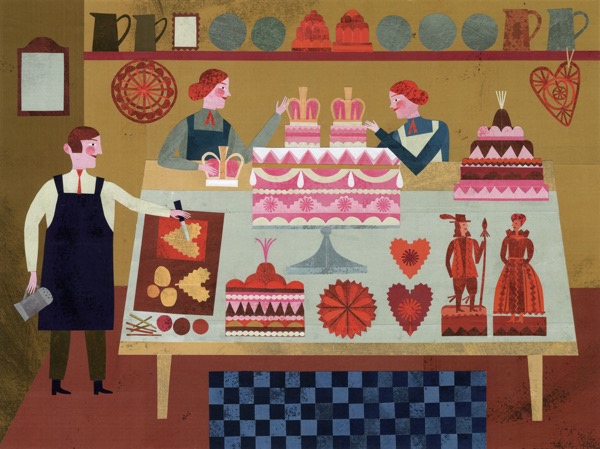
The Gingerbread & Cake Makers
‘Christmas preparations are underway as two bakers prepare a magnificent Twelfth Cake complete with elaborate paste decorations. At the end of the table, a gentleman makes a batch of gingerbread biscuits by pressing the dough into wooden moulds. Gingerbread was a commonly sold in the street and at fairs, and gingerbread figures of kings, queens, religious figures and symbols became very popular during the sixteenth century. The elaborately carved wooden moulds are themselves things of beauty and offer wonderful insights into the fashions and preoccupations of our social history.’
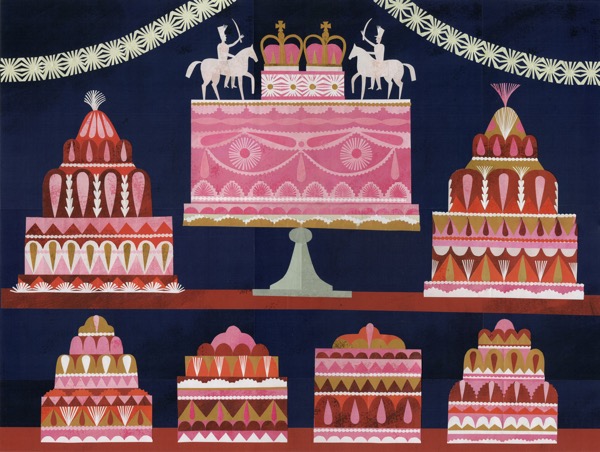
Twelfth Night Cakes
‘I have long been an admirer of the work of the food historian, chef and confectioner Ivan Patrick Day. He recreates historic food and table settings, making visual and edible feasts that delight and astonish. I was particularly taken with his Twelfth Cake made to celebrate the feast of Epiphany on the 6th January and embellished with moulded paste kings and queens, crowns, decorative swags and fleur de lys, all on a tinted cochineal icing base. For this collage, I imagined a Georgian confectioner’s Christmas window display with a centrepiece of a Twelfth Cake surrounded by quivering jellies cast from ceramic moulds.’
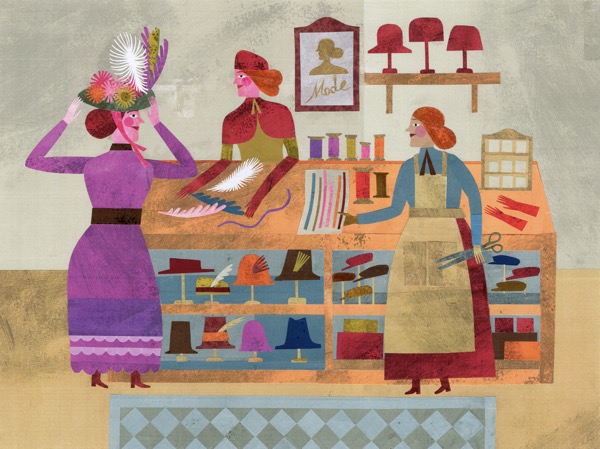
At the Milliner’s
‘I love haberdashers’ shops and enjoy browsing through the incredible stock of places like VV Rouleaux just off Marylebone High St. Inspired by this, I created a milliner’s shop of my own, the sort that might once have been found in any market town, with a stock of ribbons and trims to embellish hats. Here, a Victorian lady exclaims in delight as she carefully balances an ornate, feather-trimmed hat upon her head. The milliner stands ready with extra feathers to complete the arrangement, whilst a wistful shop girl waits to cut lengths of velvet ribbon for their excitable customer with her huge dressmaker’s shears.’
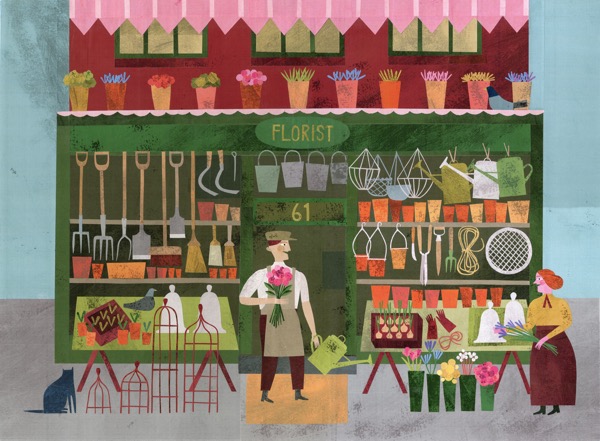
At the Florist’s
‘This collage was inspired by my love of ironmongers’ and the vast array of things that they sell, including gardening tools. I was also very taken with a lovely photograph from around 1900 showing an East Ender standing proudly beside his potted hyacinths and tulips to be entered into a floral competition. I wanted to show the variety of tools and equipment available to gardeners at the turn of the nineteenth century, including spades, forks, hoes, shears, flower stands, hanging baskets, and sieves. These were almost invariably things of beauty, elegant and solid and built to last.’
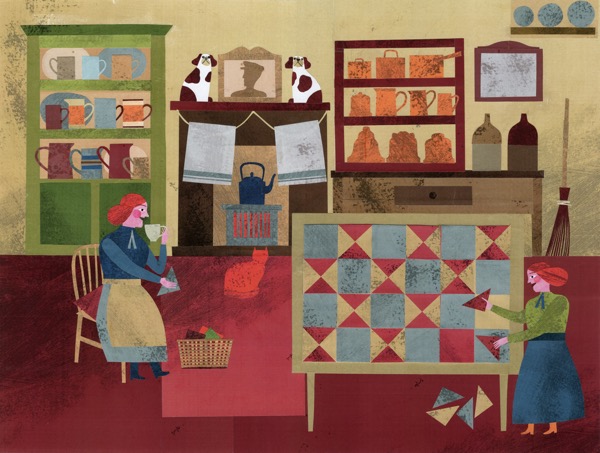
The Quilt Makers
‘I wanted to convey the peace and quiet of a winter’s evening in a Welsh farmhouse kitchen where a woman pieces a quilt whilst her mother drinks tea and sorts through coloured fabric scraps. The scene was inspired by a visit a few years ago to the St Fagan’s Museum near Cardiff which opened in 1948. It was created to reflect the lives, culture and architecture of the Welsh people and is an open-air site, where historic Welsh buildings were transported and re-erected. I particularly liked the row of terraced houses, each one decorated to reflect a different era and full of wonderful furniture, pottery and framed pictures.’
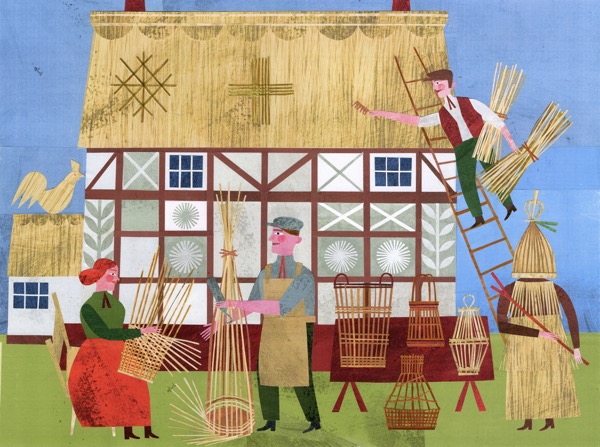
The Basket Weavers
‘I admire the craftsmanship and skill that goes into willow and straw weaving and the traditional way that willow was harvested in wetlands like the Norfolk Broads. Straw weaving has many connections to folklore, country traditions and customs such as corn-dolly making. One of the best-known twentieth century century straw weavers was Fred Mizen, who lived around the village of Great Bardfield in Essex. His skill led to a commission to create a giant straw Lion & Unicorn for the Festival of Britain in 1951, each figure over six feet tall, which were displayed in the Lion & Unicorn Pavilion and Selfridges shop window, before they were devoured by mice.’
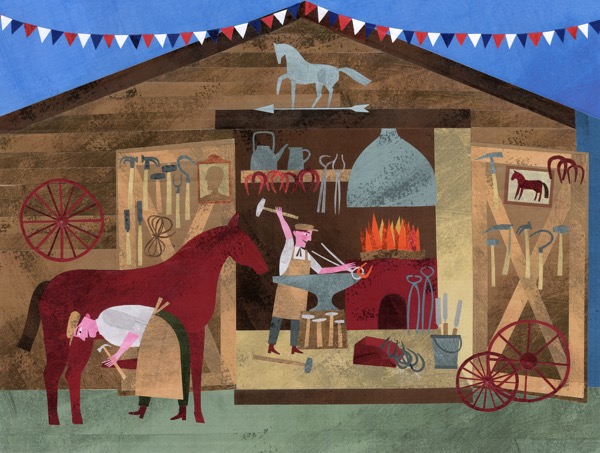
The Farrier
‘At one time, blacksmiths made horseshoes and shoed horses at the forge, but eventually farriering became a separate trade. I was interested in showing all the different tools that would have been used for the tasks a blacksmith carried out, including making horseshoes, producing household tools, repairing farm machinery and even pulling teeth! The Industrial Revolution became a double-edged sword for blacksmiths because, while they produced tools and machine parts to support its rapid development, the rise of mechanisation ultimately reduced demand for their skills.’
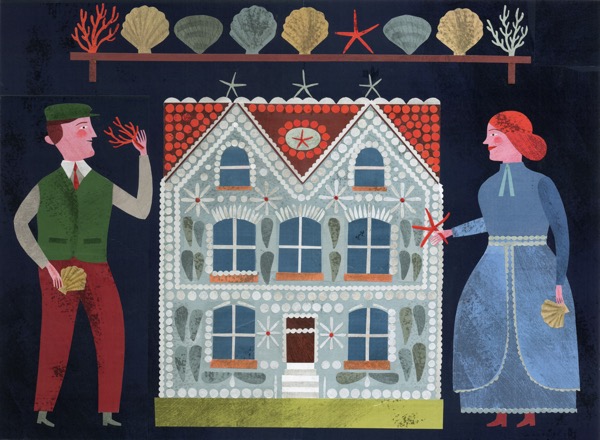
Making a Shell House
‘Shell grottoes originated in Ancient Greece, evolving into temples and garden features, before being popularised by Renaissance architects and becoming hugely popular throughout Europe in the 1600s. The trend was enthusiastically adopted by the designers of grand houses and outdoor, often subterranean rooms, lined with shells, became hugely desirable. Shells were also used in many aspects of folk art, from shell-encrusted frames and sailors’ valentines to shell-lady figurines and elaborate maritime dioramas featuring ships and mermaids. My collage is a mix of all these things, a grotto in the form of a house, that is also a love token or valentine, and a diorama.’
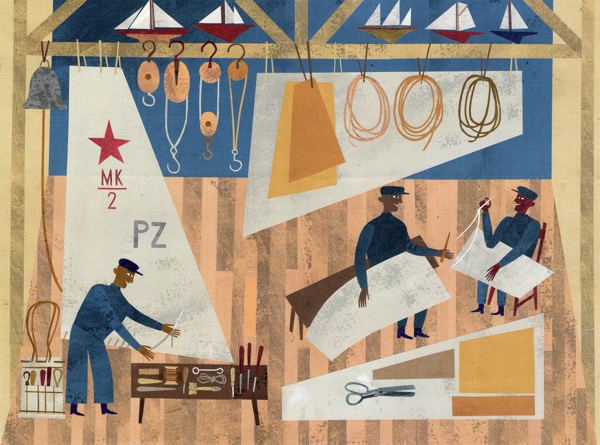
In the Sail Loft
‘My parents lived in St Ives for many years and I was a frequent visitor. The beaches are backed by old sail lofts and you could still visit these vast spaces and imagine the huge expanses of canvas hanging from the ceiling as they were made into sails. I researched the tools that sailmakers used to fashion the sails, which were traditionally hand stitched, and included them in this picture, laid out on a bench. Sailmaking is now a critically endangered heritage craft, so I enjoyed making this collage as a celebration of the immense skill needed to make sails and rope by hand. The main sail being hand finished in the foreground bears the initials PZ, the identification code for Penzance.’
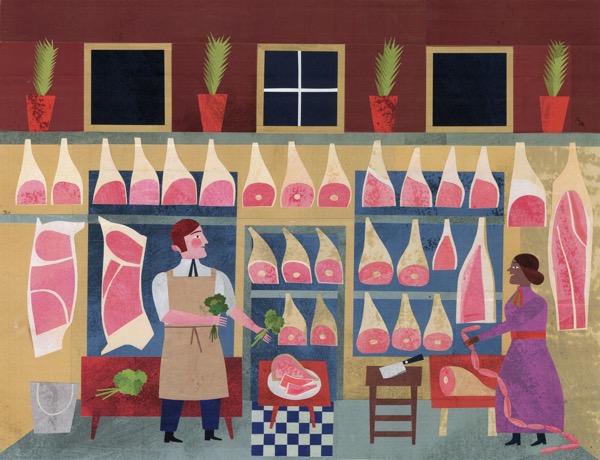
The Butcher’s
‘This collage is inspired by Victorian butcher shop dioramas. These were miniature shop fronts encased in a wooden frame and featuring tiny replica cuts of meat, strings of sausages and animal carcasses, all neatly arranged in the windows. They often contained a plump butcher and his assistant in aprons, in front of striped cutting blocks. It is thought that these were not toys, but displays placed in butchers’ shop windows to show what was on offer. In my version, a butcher watches his wife twisting a string of sausages as he garnishes a plate of chops.’
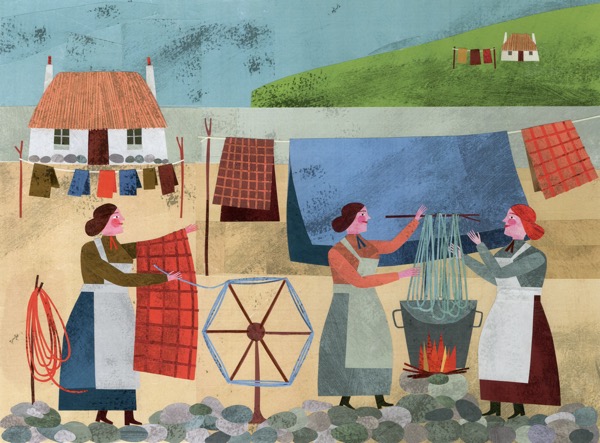
The Wool Dyers
‘In Hebridean tweed making, raw wool was dyed before spinning, a practice known as dyeing in the wool. This gave a deeper colour than dyeing the spun yarn. Islanders, mostly women, gathered natural materials such as lichen and plants to produce dyes. To dye the wool, a large metal pot was placed on the beach with a fire beneath and the wool was layered into the pot with natural plant matter, and boiled for hours until it reached the desired hue. Then the wool was carded and spun into yarn, ready for weaving. Once woven, the tweed was taken off the loom and pounded by hand to shrink and thicken it. This was known as waulking the tweed and was done by groups of women to the accompaniment of traditional waulking songs.’
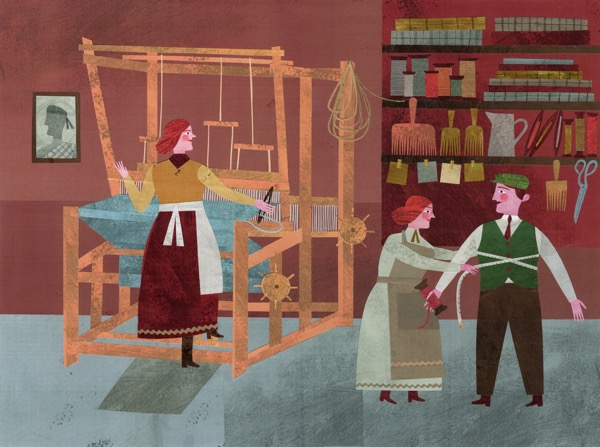
The Tweed Weavers
‘I once visited the Outer Hebrides and was lucky enough to buy some lengths of Harris Tweed straight off the loom, from a weaver who worked from his home. The colours echoed the landscape and it was incredibly soft to the touch. Here I have imagined a weaver weaving tweed on an enormous floor loom, worked by foot pedals or treadles to lift the heddles up and down as the shuttle glides through. Her assistant measures up a customer for a jacket in front of bales of cloth in a variety of patterns and colours. Harris Tweed is incredibly hard-wearing, both thorn proof and water-resistant and will last a lifetime if cared for properly, so this may be the customer’s only visit!’
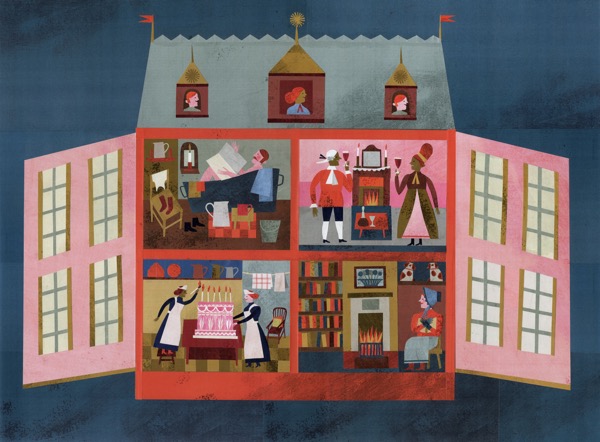
The Dolls’ House
‘I have a great affection for dolls’ houses. I like the feeling of getting a glimpse into a miniature world that has its own life, even when you are not there – a totally self-contained environment full of excitement and drama. One of my favourite childhood books, The Dolls’ House by Rumer Godden, concerns a wooden doll named Tottie and her family who are badly treated by the beautiful but cruel doll, Marchpane, when they move from a shoe box into a beautiful dolls house…a very heart-rending tale! I read this story many times as a child and it reinforced my belief in the reality of toy houses and their inhabitants’
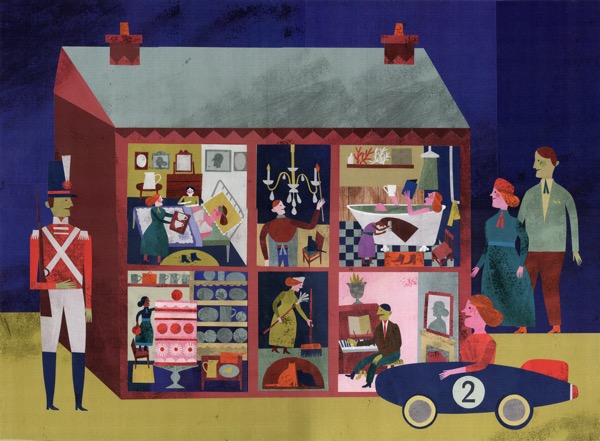
The Visitors
‘I wanted this collage to show a great house preparing for a celebration as the dolls await their visitors, who arrive on foot and by (wooden) racing car. The rooms bustle with activity as a maid serves a reviving cup of tea to the hostess, who has just had forty winks in her boudoir. One sister soaks in the bath whilst another combs out her wet hair. In the stairwell, the chandelier is being polished and, downstairs, the maid does a last minute sweep up in the hallway. In the kitchen, the cook balances precariously on a chair as she ices an enormous cake and Father tries out a few parlour songs on the piano. The action unfolds under the watchful gaze of a wooden soldier, who has caught the eye of the driver.’
Images copyright © Marion Elliot
Original papercuts and prints available from the Shop Floor Project
You may also like to take a look at
Dee Tocqueville, Lollipop Lady
Cordelia Tocqueville
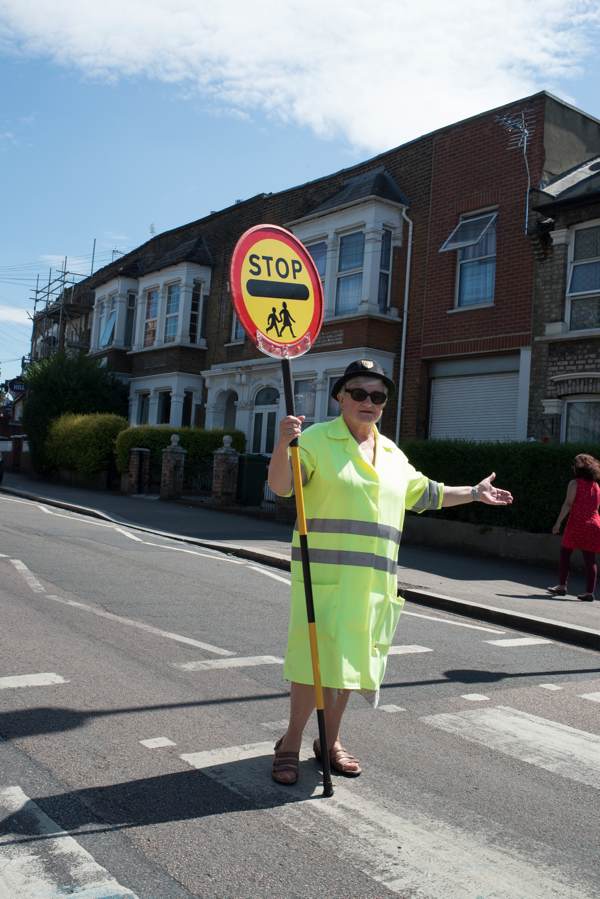
Contributing Photographer Sarah Ainslie & I made the trip over to Leytonstone to pay homage to Cordelia – known as ‘Dee’ – Tocqueville, the undisputed queen of East End Lollipop Ladies, who has been out on the street pursuing her selfless task every day, come rain or shine, for as long as anyone can remember. “I took the job at first when my daughter was small, because she was at the school and I could be at home with her in the holidays,” Dee admitted to me, as she scanned the road conscientiously for approaching cars,“Though after the first winter in the rain and cold, I thought, ‘I’m not sticking this!’ but here I am more than forty years later.”
Even at five hundred yards’ distance, we spotted Dee Tocqueville glowing fluorescent at the tricky bend in Francis Rd where it meets Newport Rd outside the school. A lethal configuration that could prove a recipe for carnage and disaster, you might think – if it were not for the benign presence of Dee, wielding her lollipop with imperial authority and ensuring that road safety always prevails. “After all these years, I’m part and parcel of the street furniture,” she confessed to me coyly, before stepping forward purposefully onto the crossing, fixing her eyes upon the windscreen of an approaching car and extending her left hand in a significant gesture honed over decades. Sure enough, at the sight of her imperial sceptre and dazzling fluorescent robes the driver acquiesced to Dee’s command.
We had arrived at three, just before school came out and, over the next half hour, we witnessed a surge of traffic that coincided with the raggle-taggle procession of pupils and their mothers straggling over the crossing, all guaranteed safe passage by Dee. In the midst of this, greetings were exchanged between everyone that crossed and Dee. And once each posse had made it safely to the opposite kerb, Dee retreated with a regal wave to the drivers who had been waiting. Just occasionally, Dee altered the tone of her voice, instructing over-excited children at the opposite kerb to “Wait there please!” while she made sure the way was clear. Once, a car pulled away over the crossing when the children had passed but before they had reached the other side of the road, incurring Dee’s ire. “They’re impatient, aren’t they?” she commented to me, gently shaking her head in sage disappointment at human failing.
Complementing her innate moral authority, Dee is the most self-effacing person you could hope to meet.“It gives you a reason to get up in the morning, and you meet lots of people and make lots of friends,” she informed me simply, when I asked her what she got out of being a Lollipop Lady. Dee was born and grew up fifty yards away in Francis Rd and attended Newport Rd School as a pupil herself, crossing the road every day, until she crossed it for good when she married a man who lived a hundred yards down Newport Rd. Thus it has been a life passed in the vicinity and, when Dee stands upon the crossing, she presides at the centre of her personal universe.“After all these years I’ve been seeing children across the road, I have seen generations pass before me – children and their children and grandchildren. The grandparents remember me and they come back and say, ‘You still here?'” she confided to me fondly.
At three-thirty precisely, the tumult ceased and the road emptied of cars and pedestrians once everyone had gone home for tea. Completing her day’s work Dee stowed the lollipop in its secret home overnight and we accompanied her down Newport Rd to an immaculately-appointed villa where hollyhocks bloomed in the front garden. “I have rheumatism in my right hand where the rain runs down the pole and it’s unfortunate where I have to stand because the sun is in my eyes,” she revealed with stoic indifference, taking off her dark glasses once we had reached the comfort of her private den and she had put her feet up, before adding, “A lot of Boroughs are doing away with Lollipop Ladies, it’s a bad thing.” In the peace of her own home, Dee sighed to herself.
The shelves were lined with books, evidence of Dee’s passion for reading and a table was covered with paraphernalia for making greetings cards, Dee’s hobby. “People don’t recognise me without my uniform,” she declared with a twinkle in her eye, introducing a disclosure,“every Thursday, I go up to Leyton to a cafe with armchairs, and I sit there and read my book for an hour with a cup of coffee – that’s my treat.” Such is the modest secret life of the Lollipop Lady.
“When my husband died, I thought of giving it up,” Dee informed me candidly, “but instead I decided to give up my evening cleaning job for the Council, when I reached seventy, and keep this going. I enjoy doing it because I love to see the children. One year, there was an advert on the television in which a child gave a Lollipop Lady a box of Cadbury’s Roses and I got fifteen boxes that Christmas!”
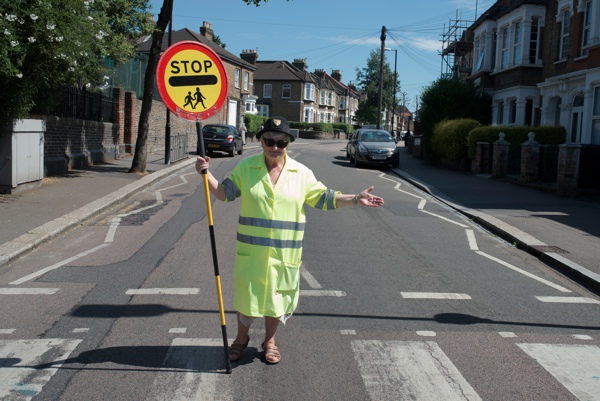
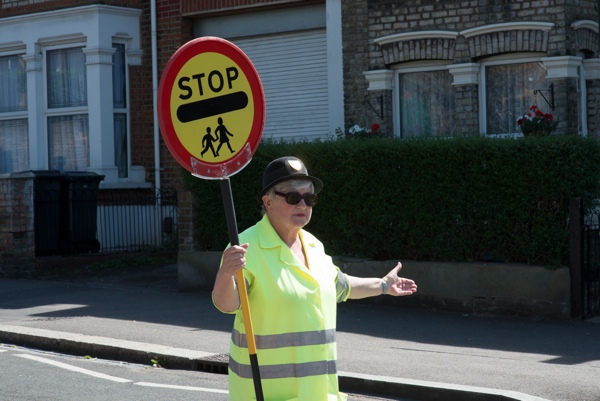
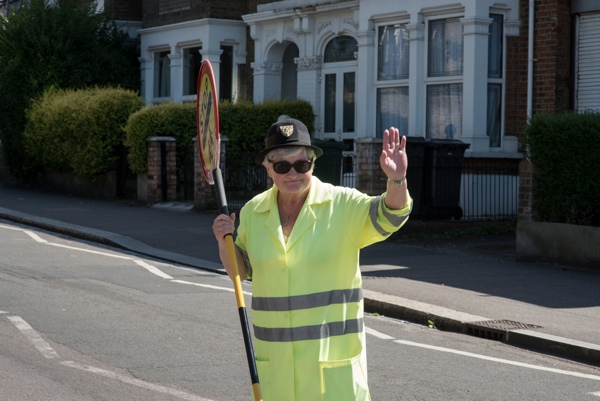
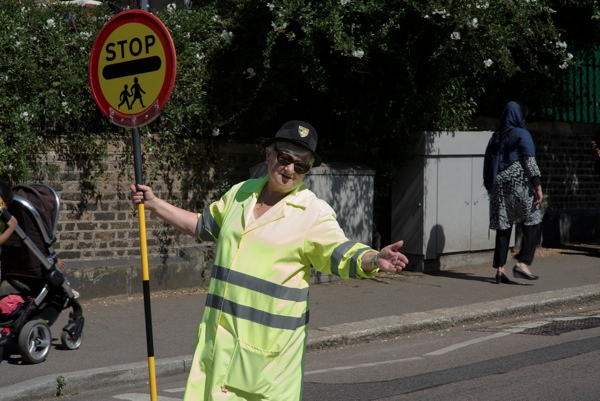
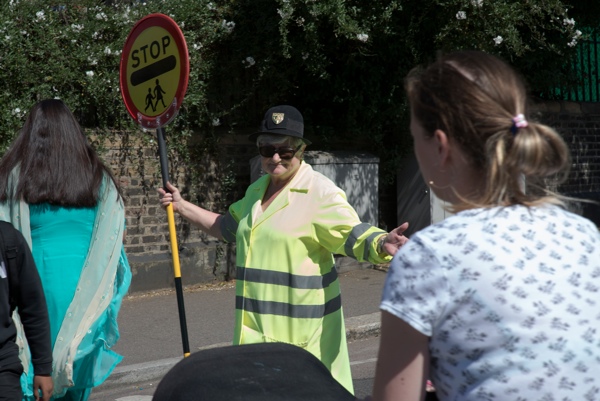
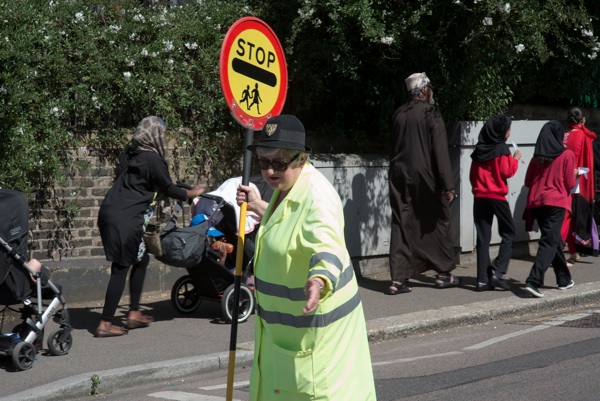
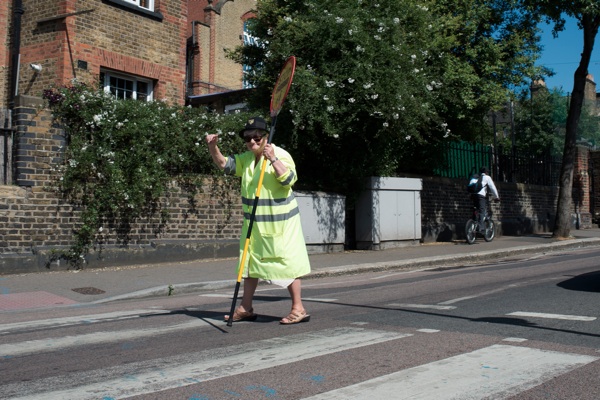
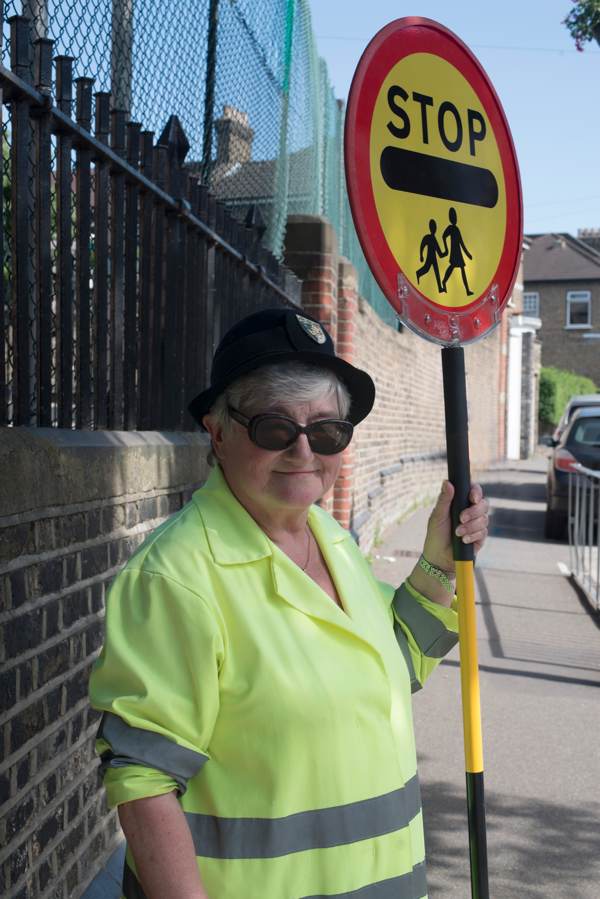
“After all these years, I’m part and parcel of the street furniture”
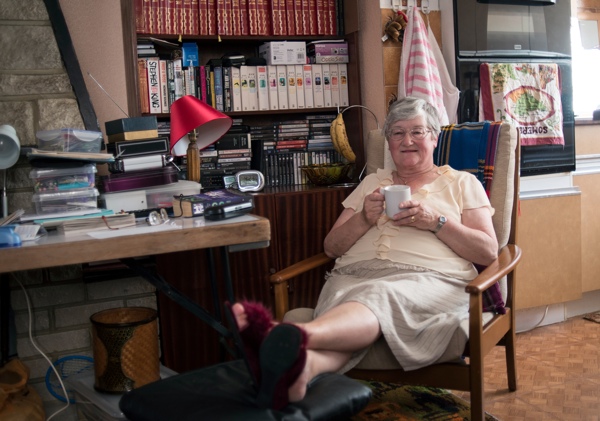
Dee puts her feet up in the den at home in Newport Rd
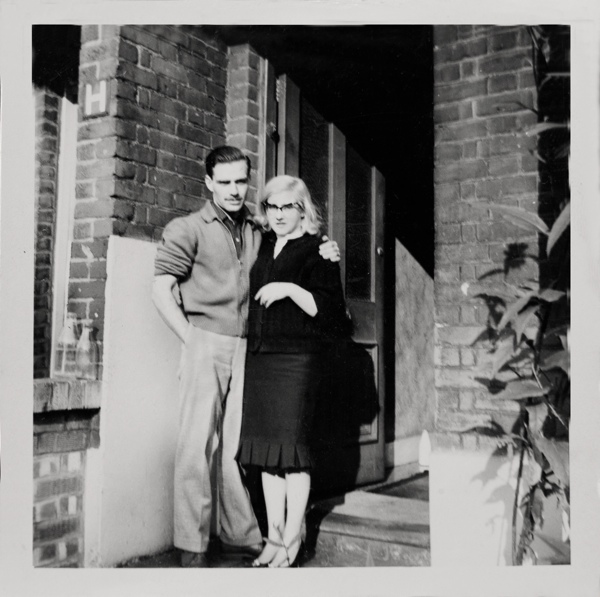
Dee with her brother David in 1959 outside the house in Francis Rd where they grew up
Photographs copyright © Sarah Ainslie
You may also like to take a look at
A Walk Through Walter Thornbury’s London
At this moment of the year, when the temperature drops and the dusk closes in, I get a longing to go walking through Walter Thornbury’s London

Golden Buildings off the Strand
There is the London we know and the London we remember, and then there is the London that is lost to us but recalled by old photographs. Yet beyond all this lies another London which is long forgotten, composed of buildings and streets destroyed before the era of photography. Walter Thornbury’s ‘Old & New London – how it was and how it is‘ of 1873 offers a glimpse into this shadowy realm with engravings of the city which lies almost beyond recognition. It is a London that was forgotten generations ago and these images are like memories conjuring from a dream, strange apparitions that can barely be squared with the reality of the current metropolis we inhabit today.
“Writing the history of a vast city like London is like writing a history of the ocean – the area is so vast, its inhabitants are so multifarious, the treasures that lie in its depths so countless. … The houses of old London are encrusted as thick with anecdotes, legends and traditions as an old ship is with barnacles. Strange stories of strange men grow like moss in every crevice of the bricks … Old London is passing away even as we dip our pen in the ink…” – Walter Thornbury

The Four Swans Inn, Bishopsgate – shortly before demolition

Garraway’s Coffee House – shortly before demolition after 216 years in business

Roman wall at Tower Hill

Dyer’s Hall, College St, rebuilt 1857

Old house in Leadenhall St with Synagogue entrance

Yard of the Bull & Mouth, Aldergsgate 1820

The Old Fountain, Minories

Demolition of King’s Cross in 1845

Clerkenwell in 1820 before the railway came through

Middlesex House of Detention, Clerkenwell

In the Jerusalem Tavern above St John’s Gate, Clerkenwell

Cock Lane, Smithfield

Hand & Shears, Clothfair

Smithfield before the construction of the covered market

Last remnant of the the Fleet Prison demolished in 1846

The Fleet Ditch seen from the Red Lion

Back of the Red Lion seen from the Fleet Ditch

Field Lane 1840

Leather Lane

Exotic pet shop on the Ratcliffe Highway with creatures imported through the London Docks

Sir Paul Pindar’s Lodge, Spitalfields

Room in Sir Paul Pindar’s House, Bishopsgate – demolished for the building of Liverpool St Station

Kirkby Castle, Bethnal Green

Tudor gatehouse in Stepney

Boar’s Head Yard, Borough High St

Jacob’s Island, Southwark

Floating Dock, Deptford

Painted Hall, Greenwich

Waterloo Bridge Rd

Balloon Ascent at Vauxhall Gardens, 1840

House in Westminster, believed to have been inhabited by Oliver Cromwell

Old shops in Holborn

Mammalia at the British Museum

Rookery, St Giles 1850

Manor House of Toten Hall, Tottenham Court Rd 1813

Marylebone Gardens, 1780

Turkish Baths, Jermyn St

Old house in Wych St

Butcher’s Row, Strand 1810

The Fox Under The Hill, Strand

Ivy Bridge Lane, Strand

Turner’s House, Maiden Lane

Covent Garden

Whistling Oyster, Covent Garden

Tothill St, Westminster

Old house on Tothill St

The Manor House at Dalston

Old Rectory, Stoke Newington 1856

Sights of Stoke Newington – 1. Rogers House 1877 2. Fleetwood House, 1750 3. St Mary’s Rectory 4. St Mary’s New Church 5, New River at Stoke Newington 6. Queen Elizabeth’s Walk, 1800 7. Old gateway
Images courtesy Bishopsgate Institute
You may also like to take a look at
Tony Bock’s East Enders

Click here to see the full selection

Clock Winder at Christ Church, Spitalfields
Here are the East Enders of the nineteen seventies as pictured by photographer Tony Bock in the days when he worked for the East London Advertiser – the poncey dignitaries, the comb-over tories, the kids on the street, the market porters, the fascists, the anti-fascists, the shopkeepers, the sheet metal workers, the unions, the management, the lone dancers, the Saturday shoppers, the Saturday drinkers, the loving family, the West Ham supporters, the late bride, the wedding photographer, the kneeling politician and the clock winder.
Welcome to the teeming masses. Welcome to the infinite variety of life. Welcome to the exuberant clear-eyed vision of Tony Bock. Welcome to the East End of forty years ago.
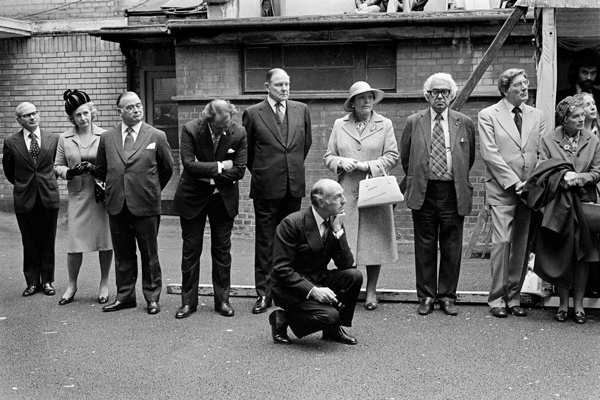
Dignitaries await the arrival of the Queen Mother at Toynbee Hall. John Profumo kneels

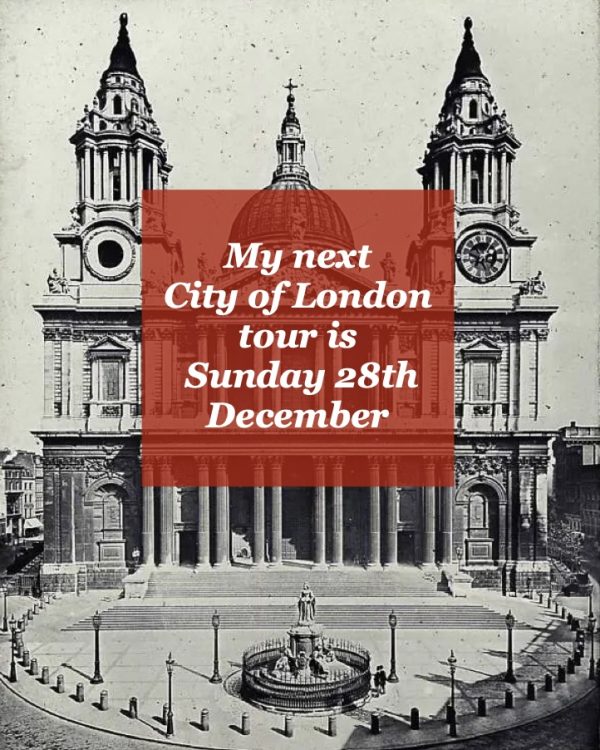
On the steps of St Paul’s Cathedral
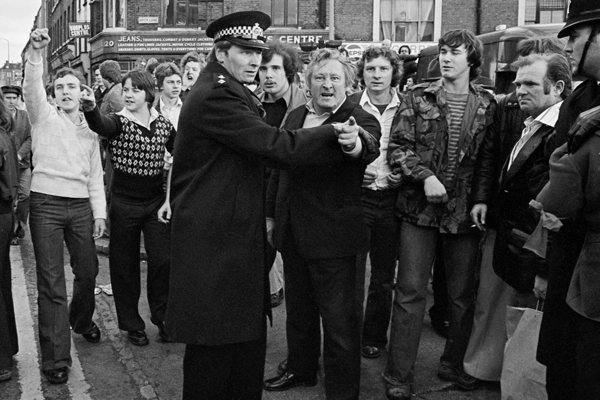
National Front supporters gather at Brick Lane

Watching a National Front march in Hackney
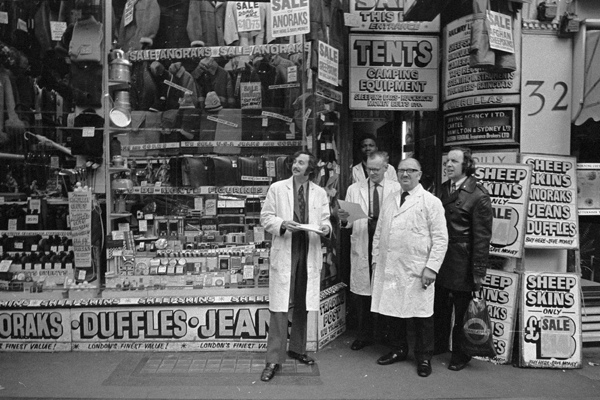
Shopkeepers come out to watch an anti-racism march in Hackney
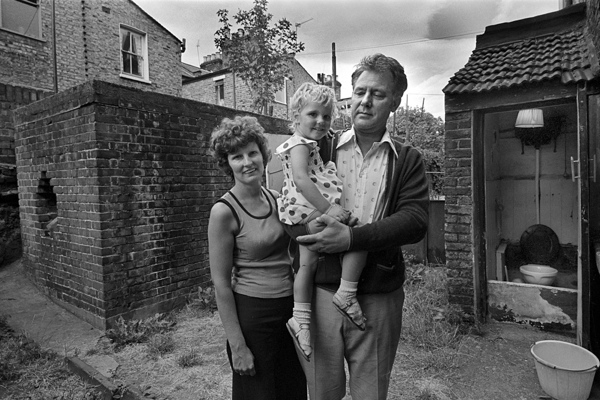
A family in Stratford pose in their back yard
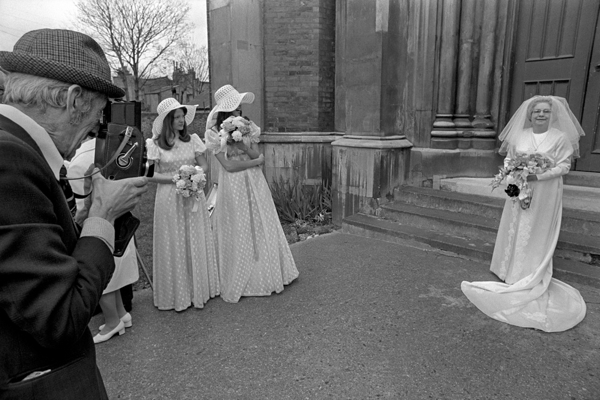
Wedding photographer in Hackney – the couple had been engaged many years

West Ham fans at Upton Park, not a woman to be seen

Sports club awards night in Hackney

Dancers in Victoria Park
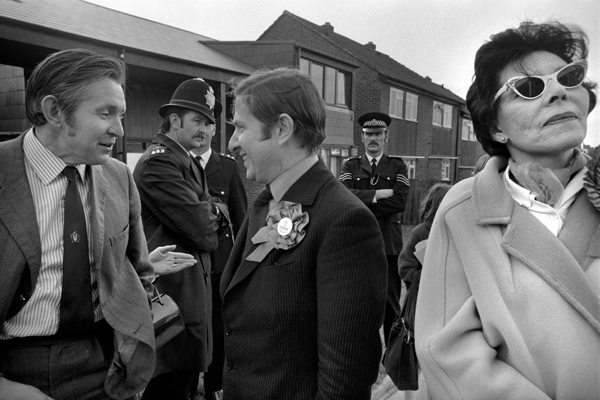
Conservative party workers in the 1974 electoral campaign, Ilford

Ted Heath campaigns in Ilford for the General Election of 1974
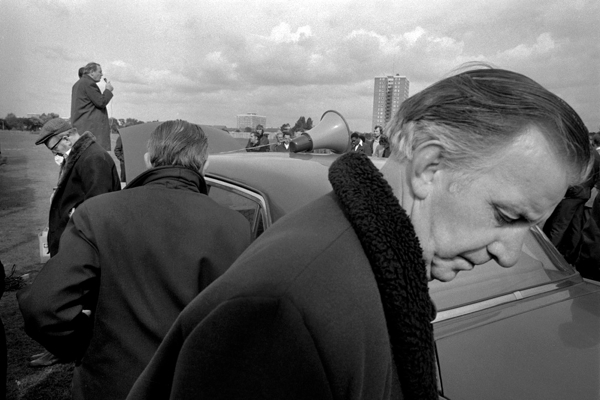
Ford workers union meeting, Dagenham
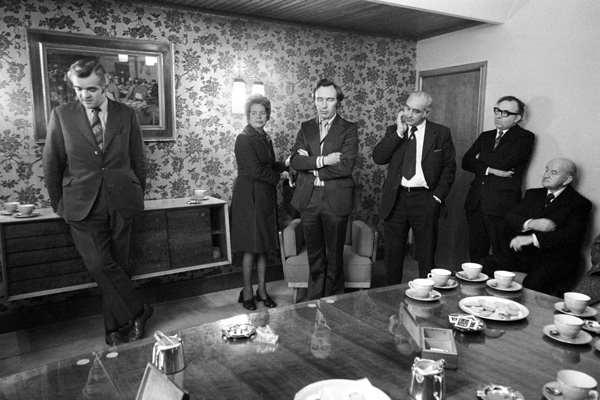
Ford managers, Dagenham
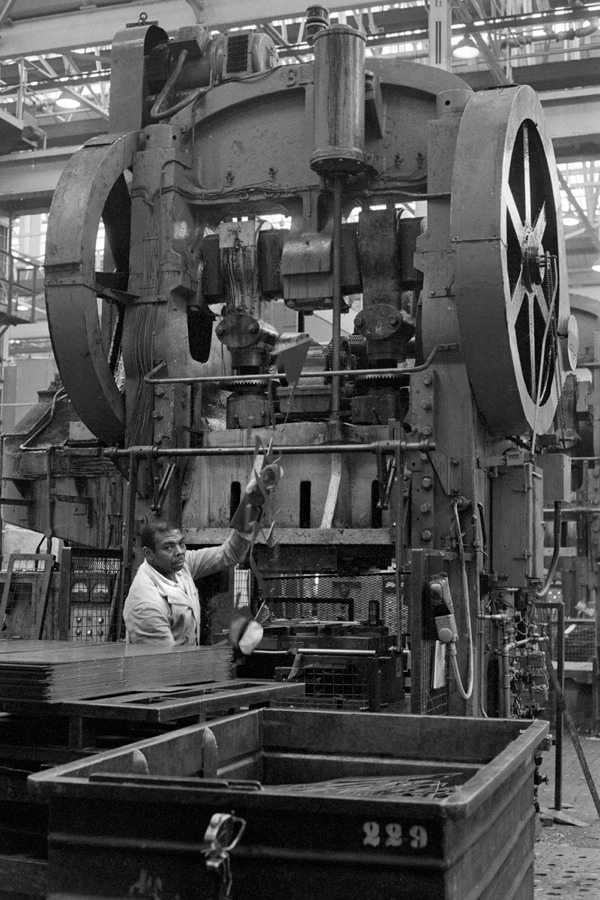
Press operator at Ford plant, Dagenham
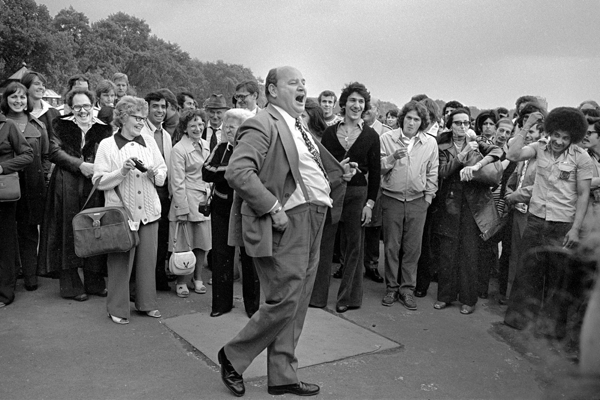
At Speakers’ Corner, Hyde Park
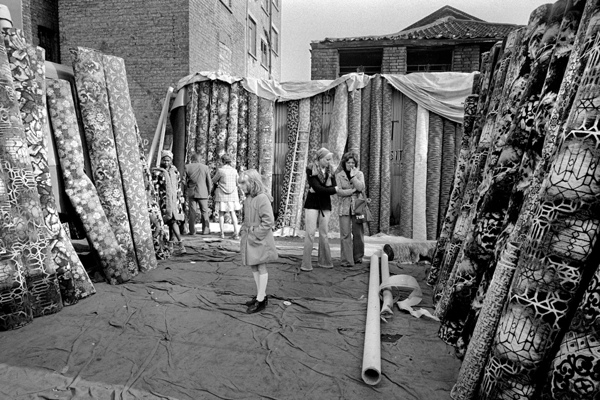
Brick Lane Sunday Market
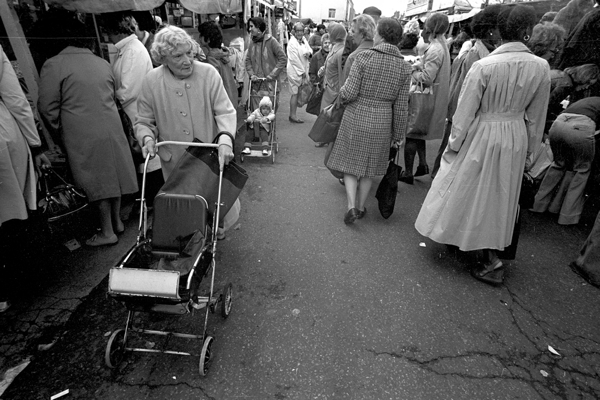
Saturday morning at Roman Rd Market
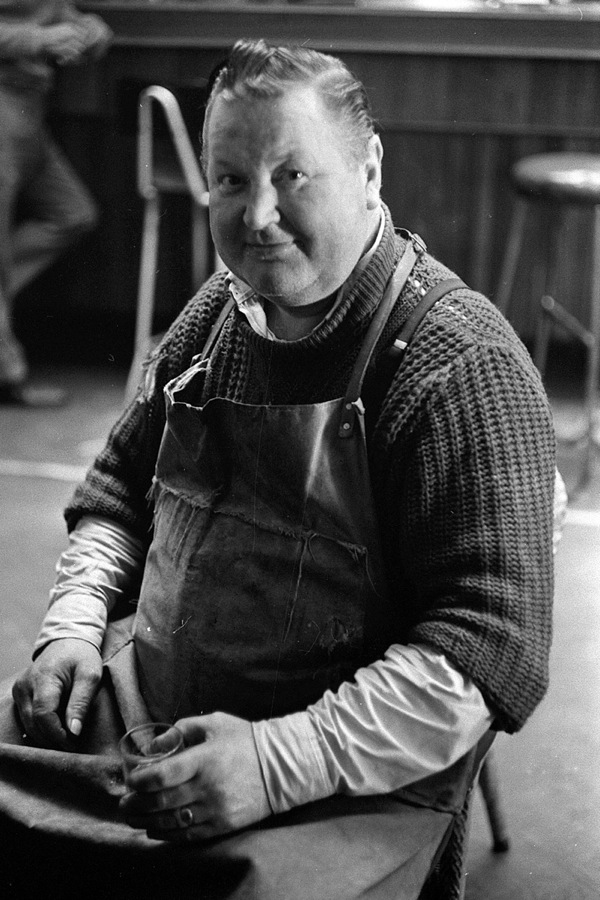
Spitalfields Market porter in the workers’ club
Photographs copyright © Tony Bock
You may like to see these other photographs by Tony Bock
The Lost Squares Of Stepney
William Palin evokes the lost glories of two of the East End’s forgotten architectural wonders, Wellclose Sq and Swedenborg Sq.
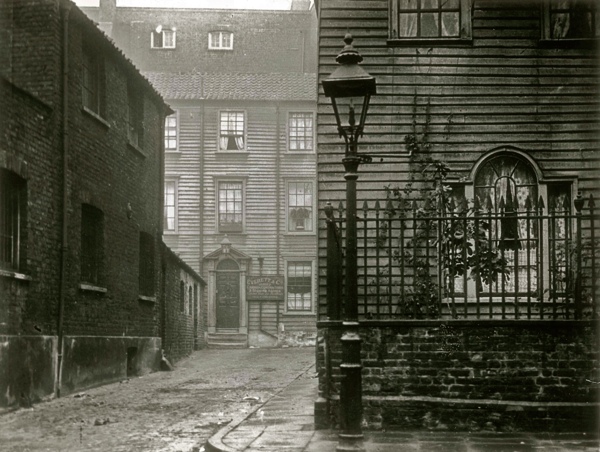
In Wellclose Sq – “This unfortunate and ignored locality”
“The devastation of the square was pitiful to see. I only saw one man all the time I paced the square, and he had one foot in the grave. The April evening was chill and the sky overcast, but a blackbird warbled in the plane trees, introducing impromptu variations and evidently trying to keep his courage up. The half dozen Georgian terraced houses left on the north side looked indescribably weary and exhausted, their bricks crumbling and their stucco returning to sand. Grass was coming up on the pavement.”
When Geoffrey Fletcher ventured off Cable St into Wellclose Sq in the spring of 1968, he stumbled upon an eerie scene. Earmarked for redevelopment and languishing under a Compulsory Purchase Order, the entire square – the oldest and most historically important in East London – was about to disappear. Its destruction, together with Swedenborg (originally Princes) Sq, a smaller neighbour to the east, erased two and a half centuries of history and ripped the heart out of this remarkable enclave of forgotten London.
The growth of the eastern suburb of London during the seventeenth century was a phenomenon. Even before the development boom which followed the Great Fire, busy hamlets had grown up outside the City’s eastern boundary and along the northern banks of the Thames where thriving communities serviced, and profited from, growing river trade.
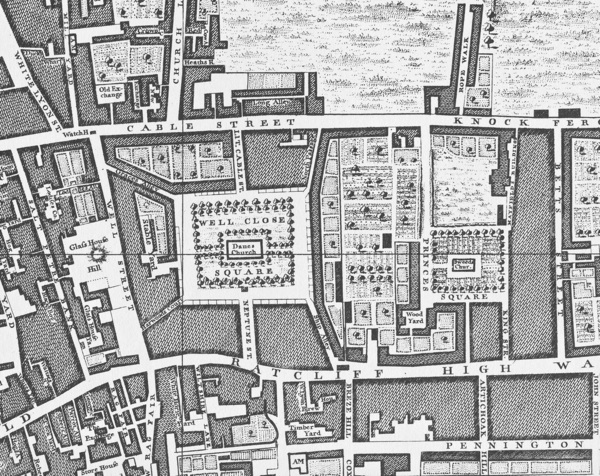
Detail of John Rocque’s Map of London (1746) showing Wellclose Sq and Princes Sq.
One speculator who recognised the potential for profit east of the City was the notorious Nicholas Barbon who is said to have laid out a staggering £200,000 in building in London after the Great Fire. In 1682, Barbon leased the Liberty of Wellclose (or Well Close) – a parcel of land north of Wapping – from the Crown. Barbon intended his new development on the Wellclose to appeal to the well-to-do members of the East End’s maritime community. Following the Great Fire, the riverside neighbourhoods had been swelled by the influx of new immigrants profiting from the rebuilding of the city.
The huge demand for timber created a lucrative trade for the Scandinavians, and the Norwegians (Danish subjects until 1814) were said to have “warmed them selves comfortably by the Fire of London.” Anglo-Danish connections had been strengthened by the marriage in 1683 of Princess Anne (later Queen Anne) to Prince Georg of Denmark and it was Georg’s father, King Christian V, who supplied the most of the funds for the construction of the new Danish Church at Wellclose Sq.
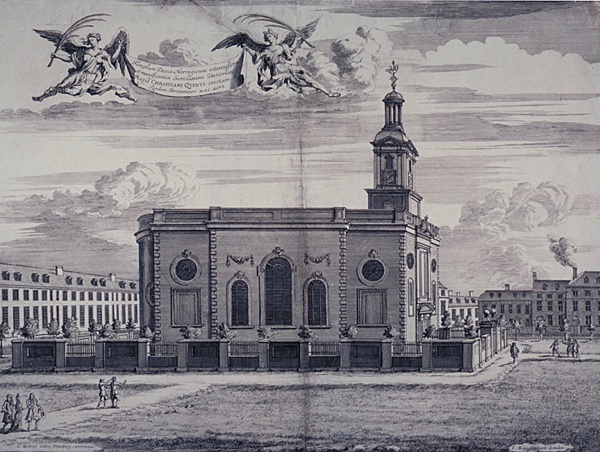
Danish-Norwegian Church in Wellclose Sq engraved by Johannes Kip in 1796.
The architect was the Danish sculptor Caius Gabriel Cibber. Cibber (the son of the King of Denmark’s cabinet-maker) had trained in Italy and had worked for Wren at St Paul’s. He is perhaps best known for his figures of ‘Raving’ and ‘Melancholy Madness’ made for the entrance to Bethlehem Hospital. Cibber’s new Danish Church at Wellclose Sq was completed in 1696. It was baroque in style, in the manner of Wren’s City churches and, its interior was distinguished by a vaulted ceiling with a distinctive circular central boss fringed with ornament.
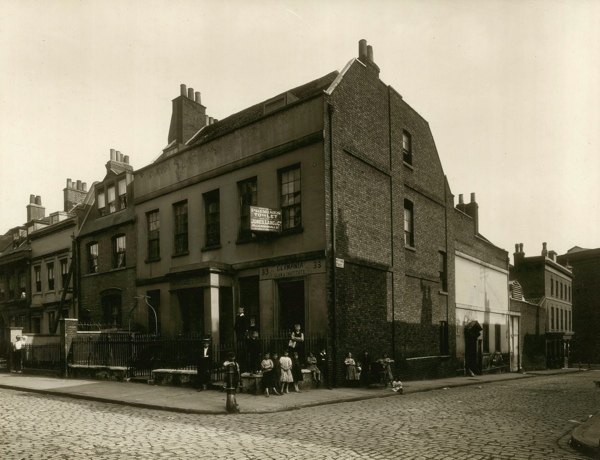
The Old Court House, Wellclose Sq (City of London, London Metropolitan Archives)
A number of the original seventeenth-century houses on the south side of the square survived until the nineteen sixties and photographs show them to be of good quality, with well-proportioned panelled rooms, and staircases with twisted balusters. Yet, other than the church, the most important and beautiful building in the square was the Old Court House, on the corner of Neptune St, built after 1687 as the seat of Justice for the four Tower Liberties. Its fine staircase and rooms of bolection panelling, identify it as part of Barbon’s first development. One of the prison cells from the building was later re-assembled and is now on display at the Museum of London.
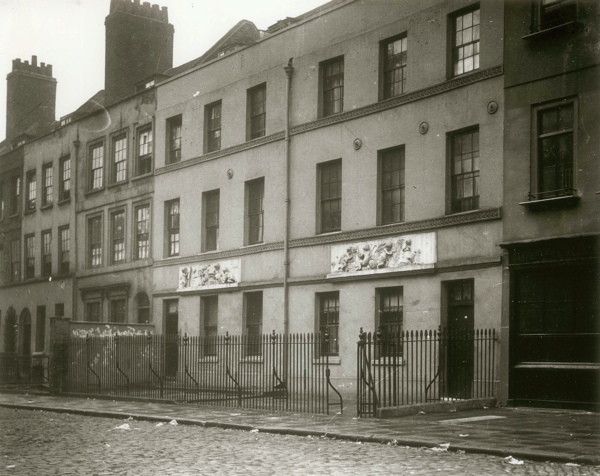
The former Danish Embassy, c.1930. (City of London, London Metropolitan Archives)
Other buildings of note in the square included Nos 20 & 21 on the west side which once housed the Danish Embassy. The two charming sculpted reliefs featuring putti practising the arts and sciences were removed to the Norwegian Embassy in Belgravia in the nineteen sixties. Also on the west side, stood two extraordinary relics of eighteenth-century maritime London. At the corner of Stable Yard was No.26, a timber framed weather-boarded house, complete with Venetian window, and, in the yard behind, there was a five-bay boarded house which in appearance recalled a North American East Coast colonial mansion.

At the corner of Stable Yard, Wellclose Sq. (London & Middlesex Archaeological Society, Bishopsgate Institute)
By the early nineteenth-century, the square was losing its respectability as a consequence of its proximity to the docks and the gradual industrialisation of the East End. The enclosure of the docks meant that seamen could leave ship during the unloading and loading of cargo. “Houses of ill-fame are swarming,” complained a contemporary Wesleyan missionary, “the neighbourhood teems with lazy, idle, drunken lustful men, and degraded, brutalised hell-branded women, some alas! girls in their early teens.”
As the numbers of lodging houses, pawn shops, pubs, and music halls multiplied, so did the sugar refineries. These refineries (or ‘bakeries’) had first appeared in the area in the seventeen-sixties. Manned mainly by poor German immigrants and belching sickly fumes into air, they did not help to improve the desirability of the neighbourhood. By the eighteen-fifties, there were at least five refineries operating around the square.
In 1816, the church was handed to trustees for charitable uses in aid of Danish and Norwegian seamen in London and, in 1856, the church became a mission under the control of St George-in-the-East only to be demolished and replaced by the new St Paul’s School in 1870.
The early success of Wellclose Sq inspired another Scandinavian community to undertake a similar development. Princes Sq (renamed Swedenborg Sq in 1938 after Emmanuel Swedenborg, who was interred there in 1772) was laid out in the seventeen-twenties by the Swedish community. It featured a plainer version of the Danish church, also positioned at the centre of the square inside a railed burial enclosure with high gates.
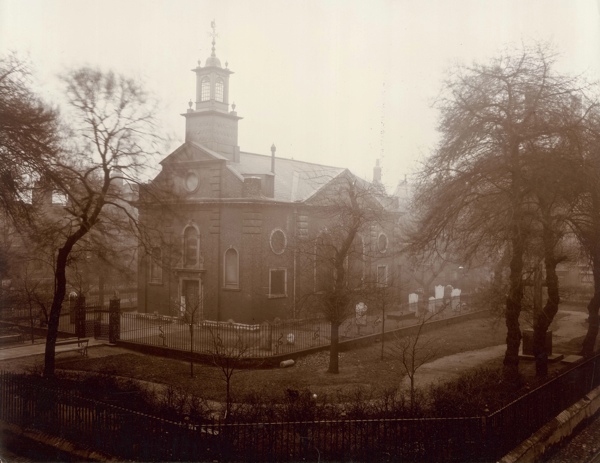
The Swedish Lutheran Church in Swedenborg Sq in December 1908. (City of London, London Metropolitan Archives)
The Swedish congregation abandoned the building in 1911, moving west to Harcourt St in Marylebone, and the church, stripped and empty, deteriorated quickly. Photographs from 1919 show the windows broken and the railings torn down. Finally, in 1923, the site was purchased by the council, cleared, and replaced by a children’s playground. The east, west and south sides of the square had gone up in the seventeen-twenties and the north side a century later. Like Wellclose Sq, the south side contained some larger houses and most of these survived until the nineteen sixties.
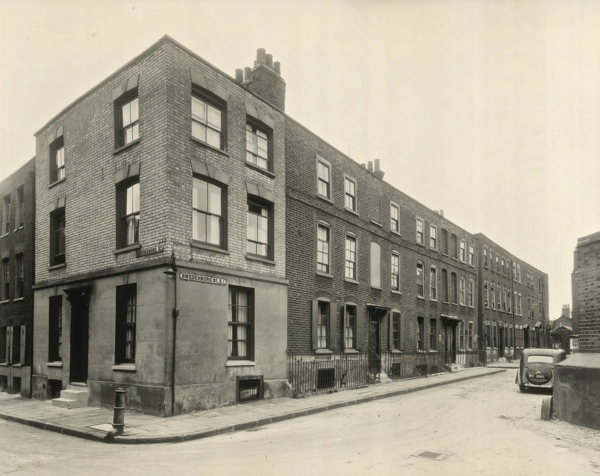
South side of Swedenborg Sq, 1945. (City of London, London Metropolitan Archives)
The seventeen-twenties terrace on the west side of the square was particularly fine, with handsome Doric doorcases and high basements. After World War II, the square was surveyed by the borough architect who concluded that the houses were in good order “excepting for want of attention due to the war” and “worthy of preservation on architectural grounds.” Subsequent repair work was carried out and a comparison of the photographs taken in 1945 with those of the late fifties and early sixties show that many of the buildings have been carefully rehabilitated.
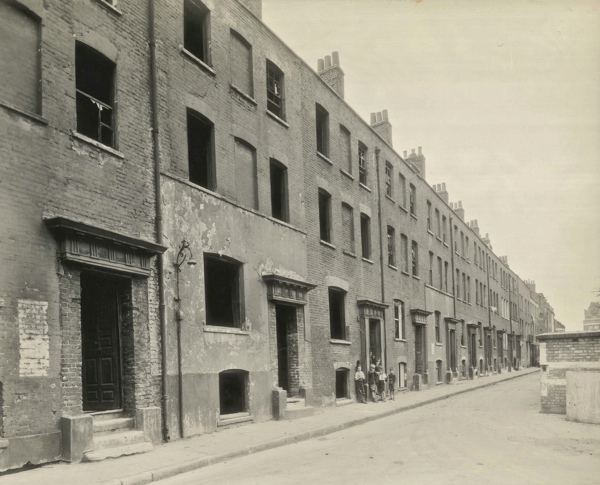
Houses on the west side of Swedenborg Sq in 1945. (City of London, London Metropolitan Archives)
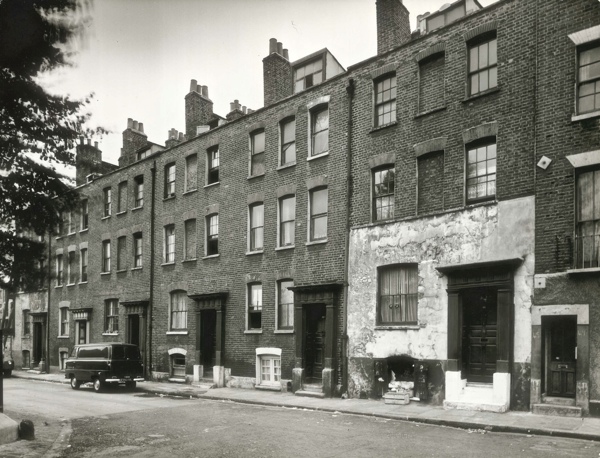
Houses in Swenborg Sq after Post-War repair in 1961. (City of London, London Metropolitan Archives)
This revival was short-lived however. In March 1959, a chilling memo from the LCC Valuer recorded that seventeen Grade II and twelve Grade III buildings in the square have been declared a “SLUM.” This change in the way the buildings were perceived must be seen against a background of political change and pressure for removal of the older London neighbourhoods in favour of modern, planned estates. A Compulsory Purchase Order (CPO) is set in motion and, at an inquiry in 1961, the Inspector concluded that the buildings were not capable of preservation.
Within a decade Swedenborg Sq had disappeared completely beneath the Swedenborg Gardens and St Georges Housing Estate – the area was simply erased from history. At Wellclose Sq, the houses came down too but the street pattern was retained, creating a strange non-place. Forty years on, the south side of the square remains empty and, on the site of the Old Court House, a sad wasteland stretches down to the busy Highway beyond.
Visiting in 1966, with the squares on their last legs, the historian and journalist Ian Nairn, who wrote so perceptively about the “soft-spoken this-is-good-for-you castration of the East End,” summed up the terrible plight of these two architectural jewels.
“Embedded in it (Cable St) are the hopeless fragments of two once splendid squares, Wellclose and Swedenborg, built for the shipmasters of Wapping when London began to move east. Those who could care about the buildings don’t care about the people, those who care about the people regard the decrepit buildings rather as John Knox regarded women: unforgivable blindness. Nobody cares enough, and the whole place will soon be a memory.”
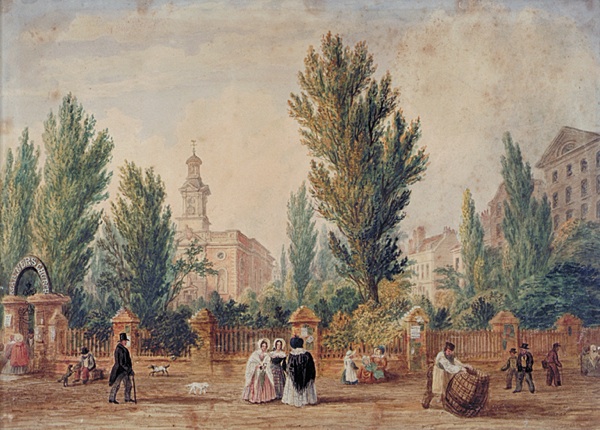
Danish and Norwegian Church in Wellclose Sq, c.1845, by unknown artist.
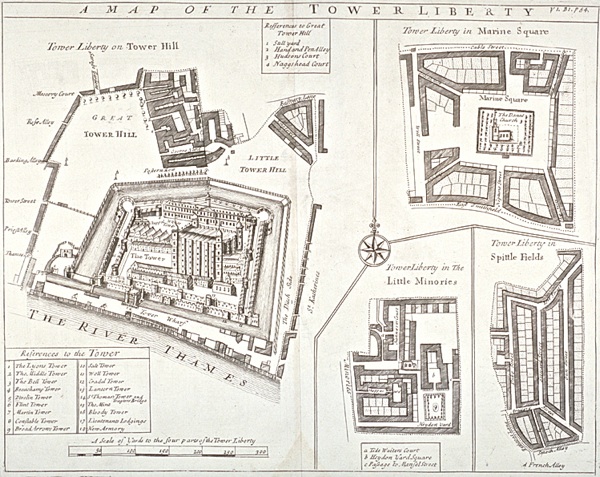
Liberties of the Tower 1720, including Marine Sq, Spittle Fields and Little Minories.
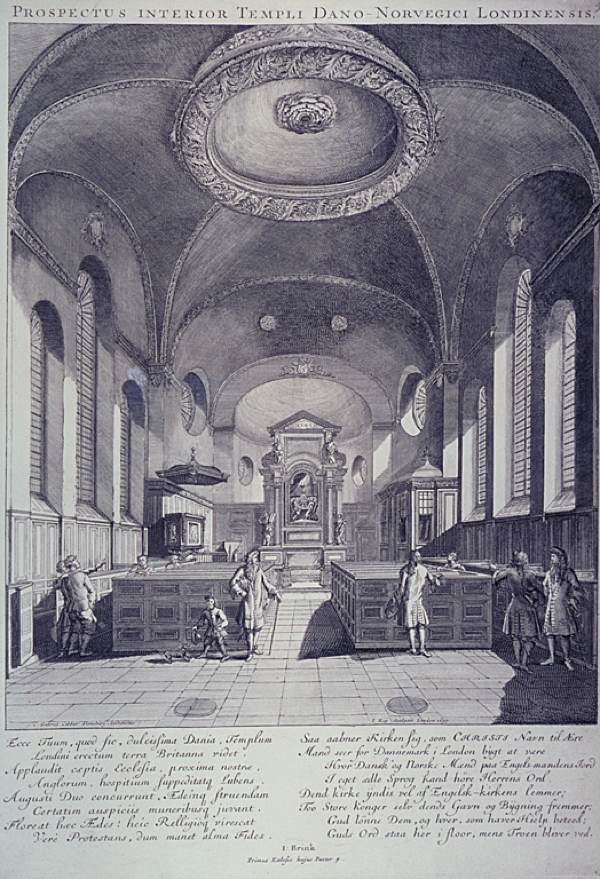
Interior of the Danish-Norwegian church engraved by Kip in 1796.
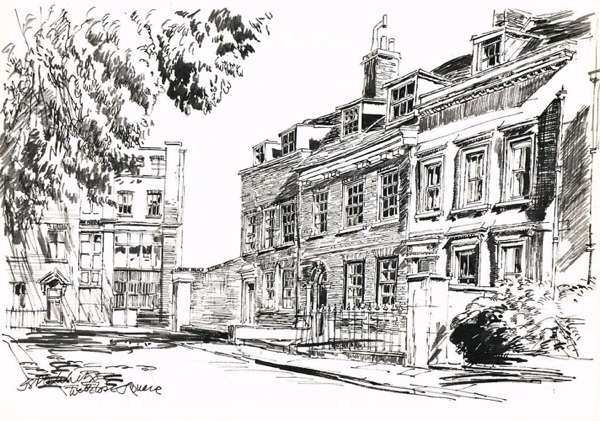
Geoffrey Fletcher’s drawing of Wellclose Sq, 1968.
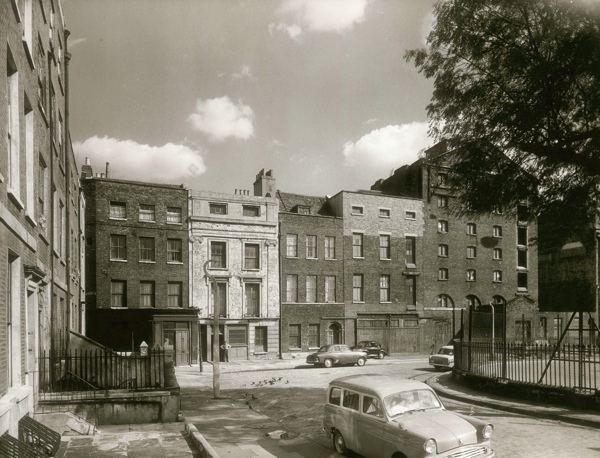
Wellclose Sq looking east from the steps of No.5 (City of London, London Metropolitan Archives)
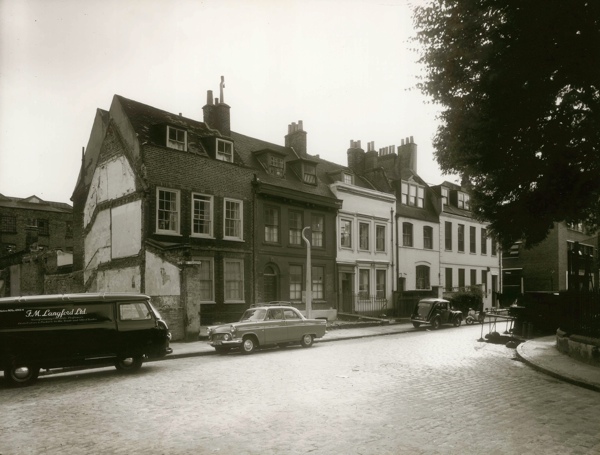
Wellclose Sq, south side, 1961. (City of London, London Metropolitan Archives)
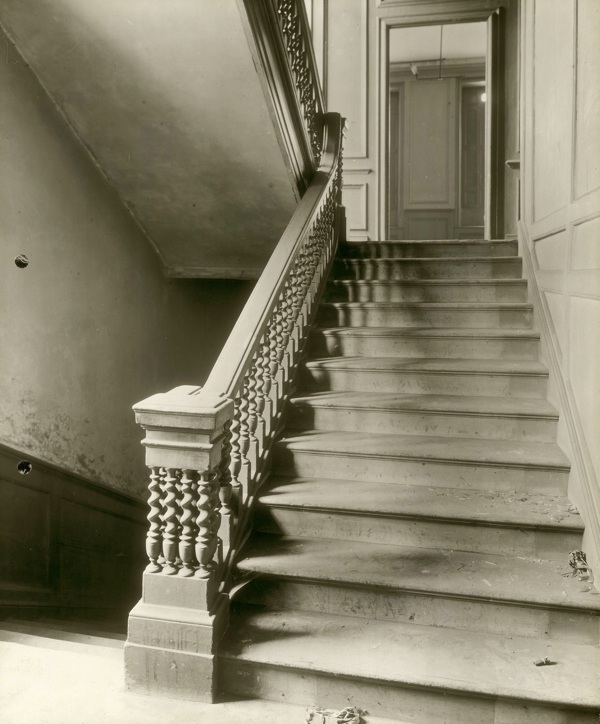
Old Court House, view to first floor landing showing the fine Barbon staircase, 1911 (City of London, London Metropolitan Archives)
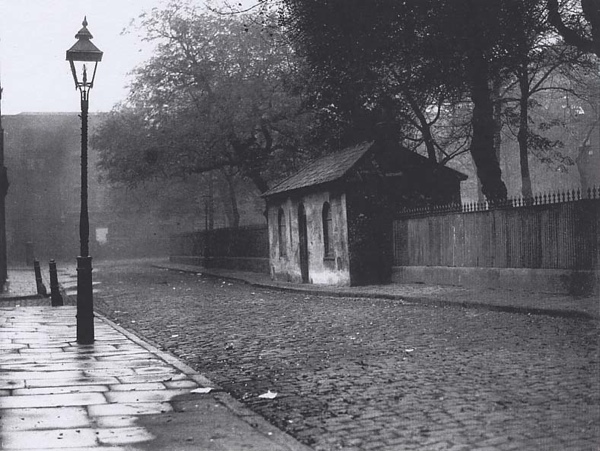
Watch House, Wellclose Sq, 1935. (City of London, London Metropolitan Archives)
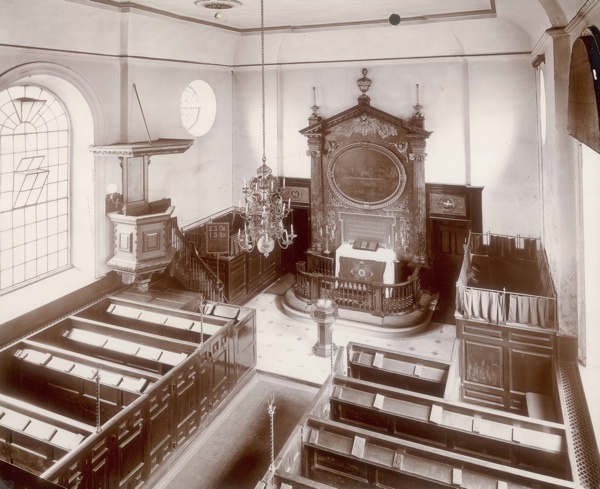
Interior of Swedish church, 1908. (City of London, London Metropolitan Archives)
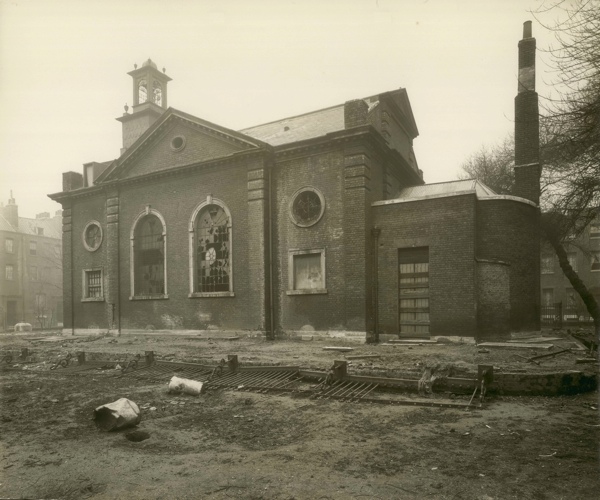
Swedish church, 1919. (City of London, London Metropolitan Archives)
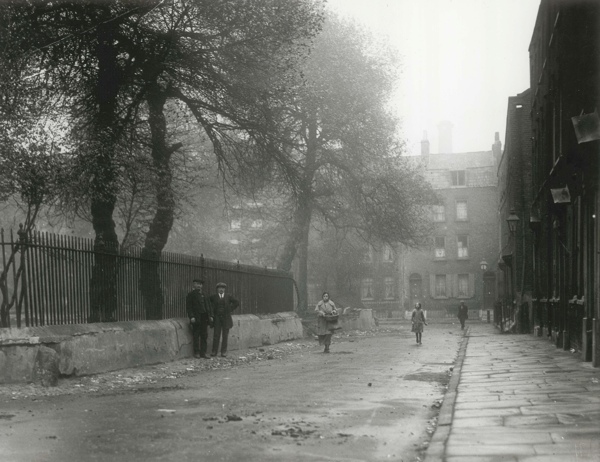
Swedenborg Sq, south side looking east, 1921 (City of London, London Metropolitan Archives)
You may slso like to read about
In the Debtors’ Cell, Wellclose Sq
David Mason, Wilton’s Music Hall
My Coin Collection
Around twenty years ago, I bought this coin from a street trader at the time of the excavation of the Roman cemetery in Spitalfields. In 1576, John Stow wrote about the Roman coins that were dug up here in Spitalfields and I suspect mine came from the same source. A visit to the British Museum confirmed that the coin had been minted in London and the piercing was done in the Roman era when it was the custom to wear coins as amulets. So somebody wore this coin in London all those centuries ago and today I wear it on a string around my neck to give me a sense of perspective.
As you can see, my collection has grown as I have discovered that coin collectors are eager to dispose of pierced coins at low prices and I have taken on the responsibility of wearing them on behalf of their previous owners. It was only when the string broke in Princelet St one dark night in the rain and I found myself scrabbling in the gutter to retrieve them all that I realised how much they meant to me.
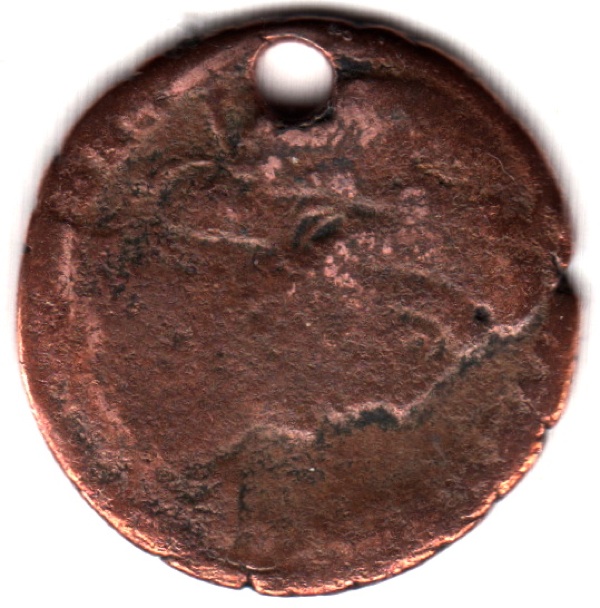
Coin of the Emperor Arcadius minted in London
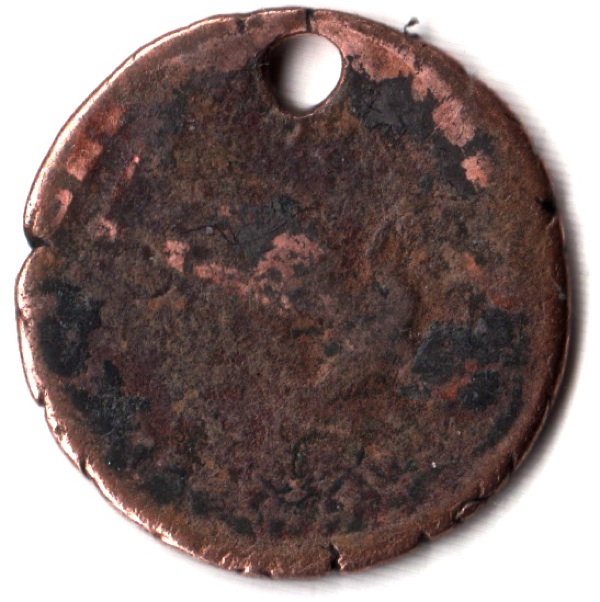
Figure of Minerva upon the reverse
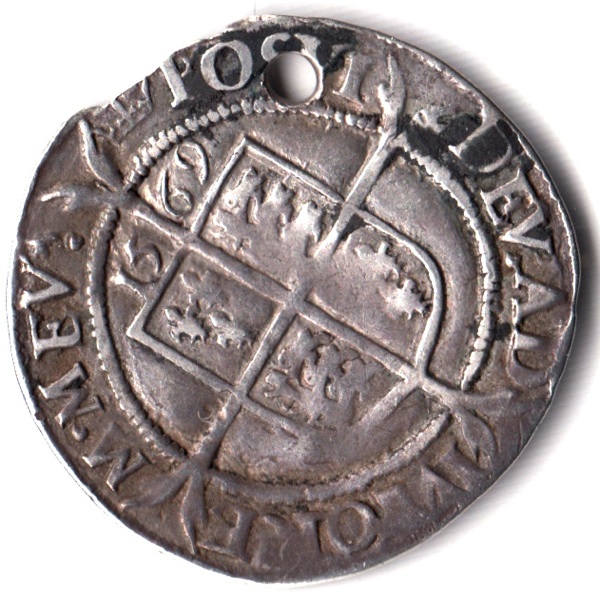
Silver sixpence minted at the Tower of London, 1569
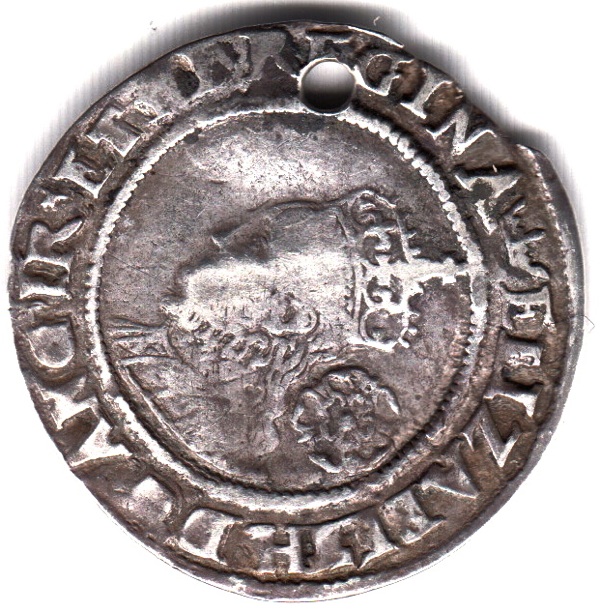
Head of Queen Elizabeth and Tudor rose
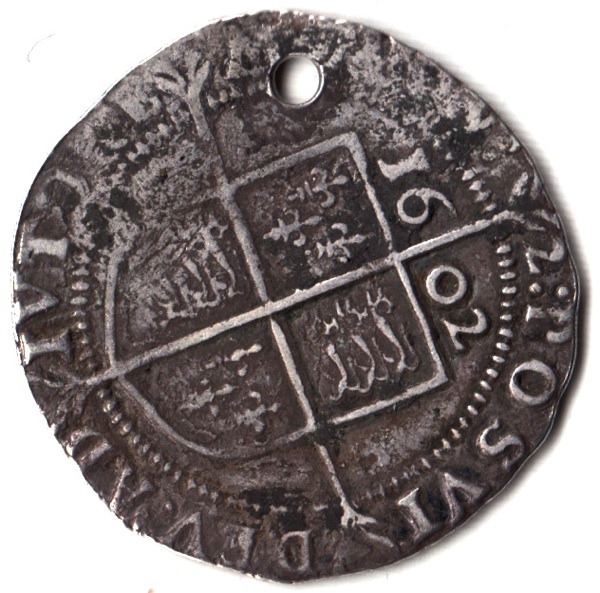
Silver sixpence minted at the Tower of London, 1602

Head of Elizabeth
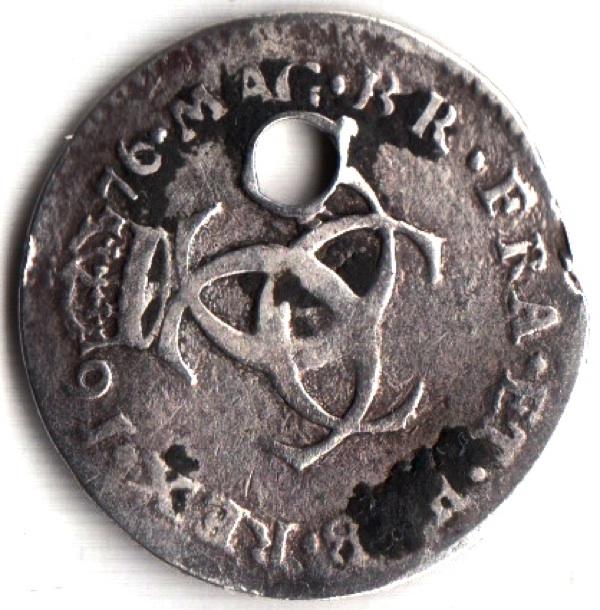
Silver sixpence, 1676
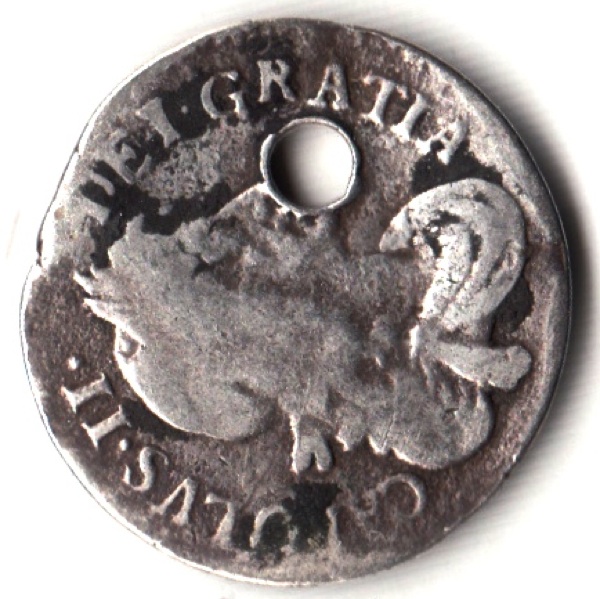
Head of Charles II
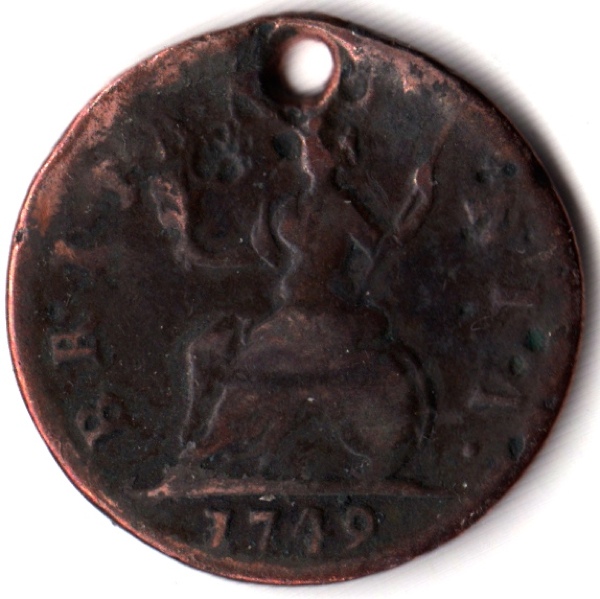
Farthing, 1749

Head of George II
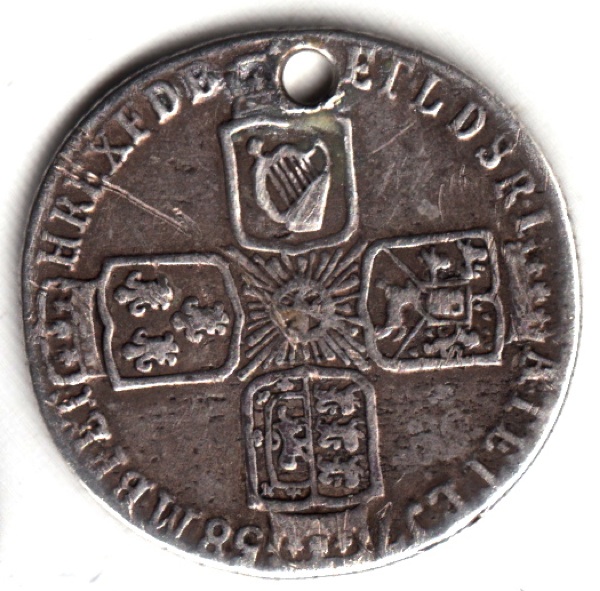
Silver sixpence, 1758
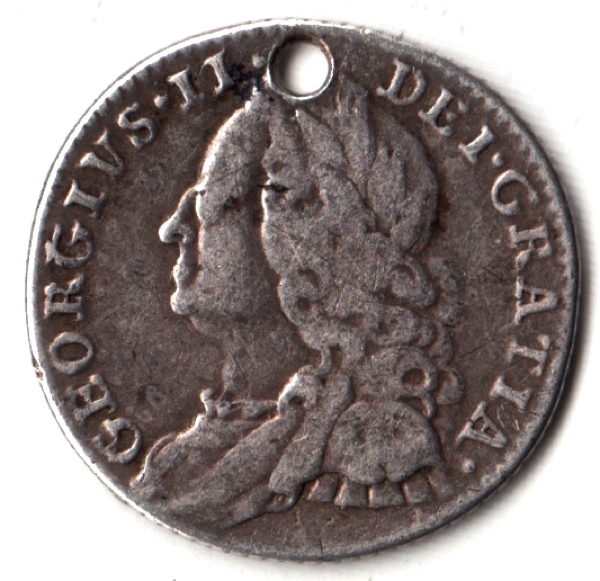
Head of George II
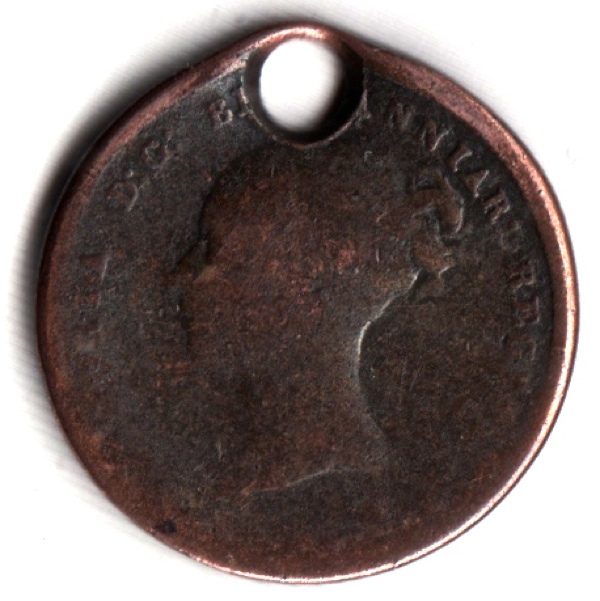
Young Queen Victoria
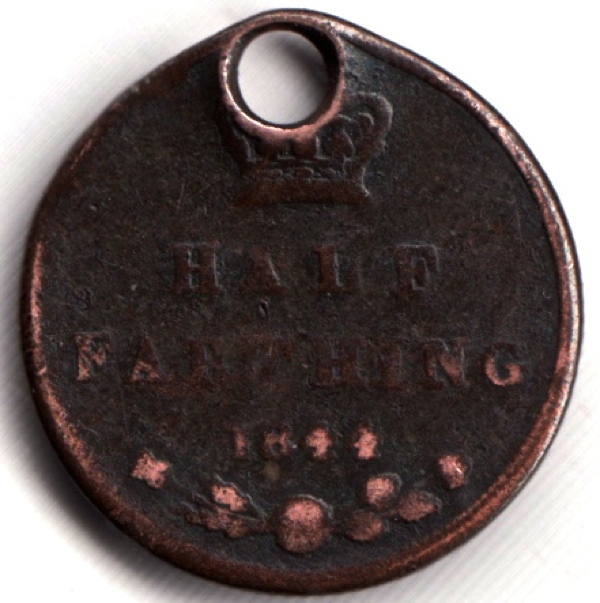
Half Farthing, 1844

Head of Queen Victoria
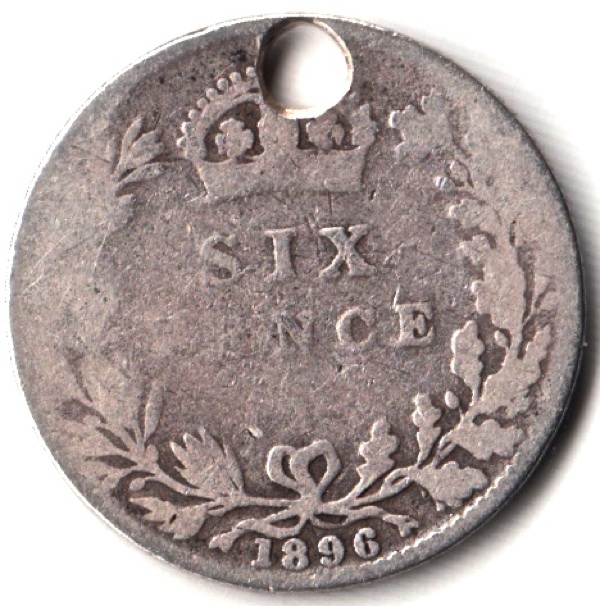
Silver sixpence, 1896
You may also like to read about
Colin Thubron Remembers Gillian Tindall
This is the eulogy for writer and historian Gillian Tindall by travel writer Colin Thubron which he read at her memorial gathering held at Cecil Sharp House in Regent’s Park on Friday last. Gillian died aged eighty-seven on 1st October and we are proud to have published her final work Journal of a Man Unknown. She was a Contributing Writer to Spitalfields Life for many years.

Gillian Tindall used to say with some amusement that her literary life was split into different regions. Whereas in England she was known for her urban studies such as The Fields Beneath or The House by the Thames, in France she was recognised as the author of Celestine, and in India as the writer of Bombay: City of Gold. In fact her Indian obituary recorded that ‘she had a huge impact on Indian readers and writers, and strongly influenced Mumbai’s urban heritage movement.’ Whereas a recent article in the journal of the Royal Institute of British Architects writes that her work on London ‘helped forge a way of seeing cities and places that is integral to most architects’ education’.
While hallmark interests run through all Gillian’s work, its range across genres is extraordinary. Beside those books of so-called micro-history for which she is celebrated, she wrote nine distinguished novels – Fly Away Home won the Somerset Maugham Award – three collections of short stories, biographies of George Gissing and of Wenceslaus Holler, (whose etchings are a crucial guide to seventeenth century London), an appreciation of Rosamund Lehmann, radio plays, a study of London’s future Elizabeth Line, and a poignant reflection, partly autobiographical, on the memories evoked by leftover objects: The Pulse Glass, and the Beat of Other Hearts.
She also wrote an affecting survey called Countries of the Mind: the Meaning of Place to Writers. And place – the observation of a street, a house, even of chance artefacts – was the wellspring of her non-fiction. ‘Houses and barns,’ she wrote, ‘gate posts, hedgerows, field slopes and the lie of paths, persist and persist, even when people that created them are earth themselves’. In effect cities and buildings become, in her work, a palimpsest, in which the past lingers beneath the surface of things, and continues to shape them.
We think not only of The Fields Beneath but of The House by the Thames, which breathes life into forgotten individuals, from traders in coal and iron to a motley middle class, over more than four centuries. Of Three Houses, Many Lives, with their changing medley of uses: a girls’ boarding school, a vicarage, a lorry drivers’ drinking club; and of her Footsteps in Paris which illuminates the Latin Quarter through six past, transient inhabitants, including, obliquely, herself.
Memory, in Gillian’s work, seems almost to be embodied in the buildings and objects that elicit it. In her novels, too, the past presses up beneath the present, but here as a corrective to the illusions or evasions of the living. In her novel Spirit Weddings the past reasserts itself with shocking revelations. The protagonists of two other novels, Give Them all my Love and To the City become overwhelmed by memories that fracture their lives. And Gillian’s sixth novel Looking Forword might be read as a reflection on memory itself, and on loss.
France, in whose heartland in the Indre she and her husband bought a village house, was an abiding love. ‘In my teens,’ she wrote, ‘my personal England seemed a dark, ramshackle, threatening place… Lacking any internalised Paradise derived from my actual childhood, I have apparently worked in a back-to-front manner from my youthful attachment to French urban life and culture, accreting round myself the compost of an older France….In central France, I have found the mythic house of childhood simplicity.’
It was here, in an abandoned home near her own, that she came by chance on a sheaf of letters addressed in the mid-nineteenth century by five different suitors to the local innkeeper’s daughter, and from which, with Gillian’s intimate knowledge of French rural history, she was able to resurrect a world on the brink of change in her celebrated Celestine. ‘A narrative of enigmatic beauty,’ wrote the poet W.S.Merwin in the New York Times, ‘a glimpse of time and mortality.’
It was typical of Gillian that the lives she resurrected were not those of the so-called great but of the overlooked and unremembered, who seem, in her work, to stand in for the great mass of those forgotten, who have nevertheless shaped our own world. For instance, her The Journey of Martin Nadaud, based on unpublished papers, traces the career of a nineteenth-century French stone mason. Her last novel, published earlier this month, is the vividly imagined life-story of a Sussex-born ironmonger, Journal of a Man Unknown. In The Pulse Glass she remarks that in the recreating of family trees those who don’t procreate are sidelined, and she affectionately resurrects, from a wide and convoluted family history, a distant relative, a benign Aunt Bess, who died almost two centuries ago.
Gillian’s research was meticulous, excited and focused, and crucially productive of the telling detail and anecdote. Besides the regular volumes of history and sociology, the archives of her choice were multiple: town and parish records, local newspapers, chance letters, the memories of the old. ‘To sit all day in a newspaper library’ she wrote, ‘with a succession of leather-bound broadsheet volumes before you, turning pages through the weeks, months and years, is to feel both the copious existence of daily life and its transience…. You could write a complete social history of the twentieth century simply out of the pages of the Hornsey Journal’.
When she and her husband had finally to leave their beloved house in France, she compiled, in French, a history of its previous owners – poor farmers, for the most part – which she was able to give to people in parting. ‘Both I and those who received my account’, she wrote, ‘were pleased that another handful of such people had been brought back from the quiet darkness of forgetting.’
Gillian’s was a richly distinctive mind and voice, and in her conviction that the death of the past impoverishes the present, she created books that will surely stand the test of time.
But typically she was conscious of the vulnerability of all communication. ‘No one has yet invented a better storage and retrieval system than the book,’ she wrote. ‘Our current digital methods of record are, by comparison, laughably ephemeral, vulnerable to time, error and the obsolescence of technology…. even now wiping out vast potential areas of paper record that have been the staple of research for centuries. Time will show,’ she continued, ‘whether this change is just another version of the casually brutal but necessary wastage and winnowing that have always occurred….’ But ‘I don’t somehow think that in thirteen centuries’ time some future archivist will be lovingly cradling a preserved hard disc in his hand and produce the means to decode its secrets.’
But we may be confident that, in whatever form it takes, Gillian’s own work, with its rare combination of scholarly rigour and imaginative sympathy, will endure into the uncertain future.

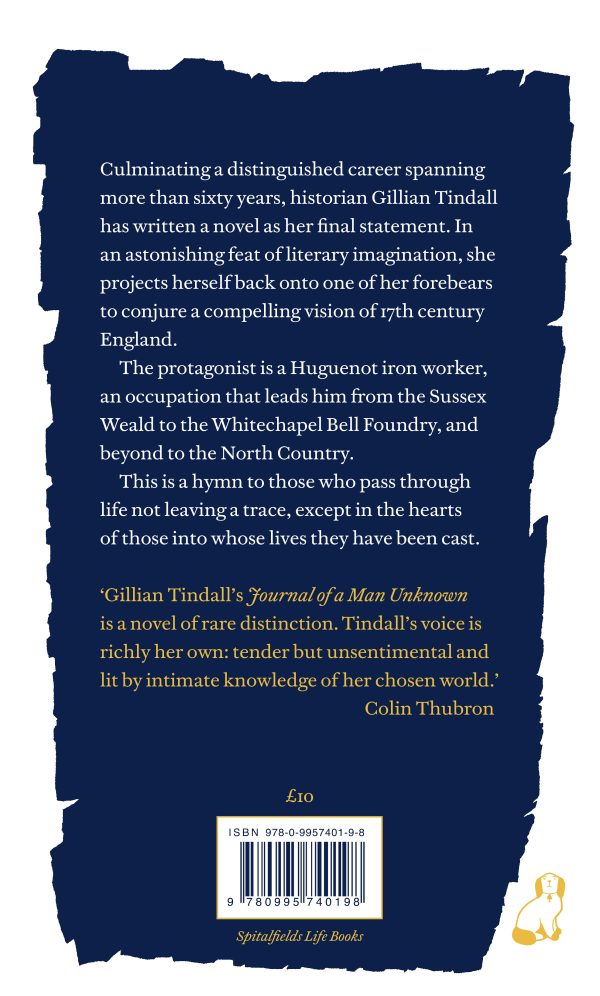
Click here to order a copy of Journal of a Man Unknown