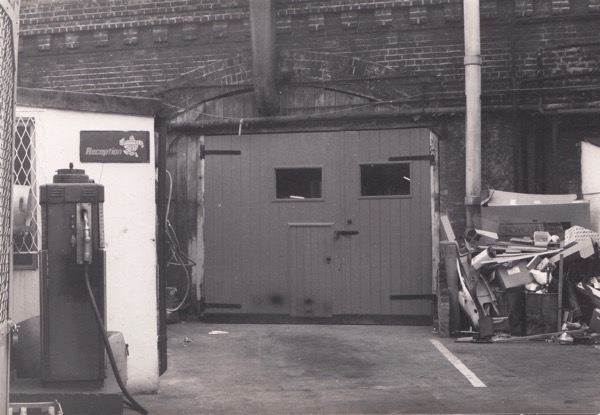
The Journeyman Weavers’ Houses
I am delighted to announce that after my report on the threat of demolition to 3 Club Row – a journeyman weavers’ house dating from 1764/6 – Historic England visited the property last week, and the Secretary of State is currently assessing whether to grant listed status to this building and 5 Club Row which is its mirror image.
Last Friday, Tower Hamlets Council issued a Building Preservation Notice on 3 Club Row which gives it legal protection during the listing process and makes it a criminal act for anyone to damage it.
If you would like to learn more about the journeyman weavers and discover why their surviving houses are significant, you can join a guided walk on Saturday 15th June hosted by Julian Woodford, author of The Boss of Bethnal Green. Click here for tickets.
The battle to save 3 Club Row is not yet over. If you have not yet submitted an objection to the demolition, please do so. We need to register as many objections as possible. You will find instructions at the foot of this article.

3 & 5 Club Row, two survivors of a terrace of six four-room houses built 1764-6
The terraces of silk merchants’ houses in Spitalfields declare their history readily, yet these more modest buildings of the same era survive as the last vestiges of the workshops and dwellings where the journeyman weavers pursued their trade. You might easily walk past without even noticing these undemonstrative structures, standing disregarded like silent old men in the crowd. I am indebted to Peter Guillery and his book The Small House in Eighteenth Century London for highlighting these buildings where the silk weavers worked, which are equally as significant historically as the larger homes of the merchants who profited from their labour.

190 & 192 Brick Lane, weavers’ houses of 1778-9 built by James Laverdure (alias Green), Carpenter

113 & 115 Bethnal Green Rd, two five room houses of c.1735 probably built by William Farmer, Carpenter

70-74 Sclater St, three houses built for weavers c.1719

70-74 Sclater St, No 70 was refronted in 1777

97 & 99 Sclater St, built c 1720

46 Cheshire St, built in the sixteen-seventies

4a – 6a Padbury Court, probably built c. 1760

125 Brick Lane, shop and workshop tenement probably built in 1778 for Daniel Dellacort, a distiller

Note the developer’s Porsche in this rendering of their proposed replacement for 3 Club Row
HOW TO OBJECT EFFECTIVELY
Use your own words and add your own personal reasons for opposing the development. Any letters which simply duplicate the same wording will count only as one objection.
1. Quote the application reference: PA/19/00932/A1
2. Give your full name and postal address. You do not need to be a resident of Tower Hamlets or of the United Kingdom to register a comment but unless you give your postal address your objection will be discounted.
3. Be sure to state clearly that you are OBJECTING to the demolition of 3 Club Row.
4. The building is exceptionally rare and significant and should be listed.
5. It is an historic building in a Conservation Area and part of the historic and architectural interest of the area.
6. The replacement scheme is not worthy a replacement.
WHERE TO SEND YOUR OBJECTION
You can register and object by clicking here if you have a UK postcode
or
you can write an email to
planningandbuilding@towerhamlets.gov.uk
or
you can send a letter to
Town Planning, Town Hall, Mulberry Place, 5 Clove Crescent, London, E14 2BG
Ronnie Grant, Racing Driver

‘I was racing with people a third of my age…’
Last year, at ninety-three years old, garage owner Ronnie Grant shot to fame as one of the tenants of the railway arches faced with exorbitant rent increases by Network Rail. Ronnie showed admirable moral courage as one of the founders of Guardians of the Arches – linking more than fifteen hundred businesses – and became a spokesman in Parliament and the press, championing the cause of his fellows across the nation as the arches were sold off.
Contributing Photographer Sarah Ainslie & I visited Ronnie under the railway arches in Clapham to hear the life story of this inspirational nonagenarian who has taken the brave initiative to stand up for others in his advanced years. We were astonished to find him unloading sacks of cement from a truck and, once we sat down to talk, we discovered that Ronnie was already a hero in another arena, as a racing driver.
“I used to be down here working hard at five o’clock in the morning and still here at ten o’clock at night. I had a cold once and I took too many codeine tablets, and I spewed up blood. I was carted into St James’ Hospital, Balham. I was given six pints of blood and one of those was infected with Hepatitis, so then I was put in isolation. I lay there and all I had to do was drink water. I thought, ‘When I get out, I am going to do everything I ever wanted to do.’ This was in the sixties and Volkswagen had just brought out this Formula V racing car. It had the front axle and engine of a beetle but you could make up a frame of your own. This is what I did and I did it here in my garage. I built a racing car in this arch, it was quite easy really. So I started racing and I started winning. I thought, ‘This has got to be good!’
As a racing driver, you have to be fit. At six o’clock in the morning, I would be up at Crystal Palace running round the track for half an hour, then I would play squash and do thirty lengths in the olympic pool afterwards. This was before I started work at half past seven or eight o’clock. I did that for donkey’s years. When I finished work at half past seven or eight, I would go swimming until ten o’clock. That keeps you fit.
I raced all round Europe in Formula V, and I used to get start money, prize money and travel expenses. We loaded the car onto a pick-up truck and my little son George sat in the racing car and I sat in the front of the pick-up. I raced in Holland, Belgium and German. I always used to be in the first eight or ten and I often won, so I used get francs in Belgium, guilders in Holland and marks in Germany – that was how I started racing.
Then I went into Super V and, through the grapevine, I heard that Lola Cars up in Huntingdon had a chassis but no gearbox. I met John Barnard and Patrick Head, they used to come here and help me working on the racing car. We went from there, Patrick designed a Formula 2000 car which I raced. I was still racing when I was sixty-five, so I did quite well at that. It gave me a lot of joy because I was racing with people a third of my age.
I am a Londoner, born in 177 Railton Rd, Brixton. My father, Harry Grant, came from India to study in London, but he enlisted in World War I and lost a leg. I do not know too much about his family, although they came to visit us once when I was a child. I remember they stayed at the Savoy and bought me a Crombie coat, which I got teased for a school because it was expensive.
During the thirties, nobody wanted to employ a man with one leg. My father did odd jobs and we got by. I had a gorgeous upbringing. We had a lovely family. We never went hungry. We had two bedrooms – me, my brother and my sisters slept in one room and my parents in the other. When I think about it now, how my mother cooked and did all the washing in a tiny scullery I do not know. She used to get up at five to light the boiler to heat the water. My brother was older than me and I had younger two sisters. We all had jobs. I used deliver papers in the morning and help the baker after school.
I wanted to be a sailor so they put me in the Greenwich Naval College. My dad bought me a bike and I used to cycle from Brixton Hill down to Greenwich to go to school. I was doing that for months until a car hit me – bang – in Camberwell and I finished up in St Giles’ Hospital with a broken leg.
When World War II came, my brother Dennis went into the RAF and flew Lancaster bombers, he did thirty tours and won the DFC. He won a scholarship and became a Lloyds underwriter but I was the dunce. If there were thirty in class, I was number thirty. I was seventeen years old but I put eighteen years old on the form and I volunteered for the navy. Unfortunately, I told them I was a van driver, so they told me, ‘Men of your level of qualification are required in the army.’ They put me in the infantry in France, Belgium, Holland and Germany. Then they told me they needed men in Burma and, if you volunteered, you got seven days leave. So I volunteered. I took the Empress of Scotland out of Southampton but, when I got to Port Said, they dropped the Atom Bomb. So they did not need us in Burma, instead they sent us to Palestine and Egypt, then Cyprus and Greece.
I met a girl there, Mary, and we came back together and we were married for many years. We adopted my son George who was her step-sister’s child. When he was eighteen months old, my wife left, she said ‘I’m going to see my cousin in Birmingham, look after him,’ and I did not see her again for years. I do not know what happened. George stayed in a nursery at Egham in the week, while I was working, and I picked him up at the weekend. I bought a house in Clapham and was doing it up and he came to stay with me there. I married Sheila who I had known since was eighteen. She was married to someone else and I was married to someone else. When she got divorced I rang her up and that was it, we have been together fifty-two years.
I became a cabdriver, driving a saloon with three doors and luggage rack on the side. With my partner Jack Laming, we started off with one cab. He had been chauffeur to Sir Duncan Hall-Lewis, they lived in the South of France. Jack came over to London and lived in the same block of flats as I did in Stockwell Rd. We bought this cab and we ran it together for the first year, alternating night and day. We changed over every month, but we both preferred night work because you can move about much quicker and you get couples and fours rather than solo passengers. That was all extra money.
Then we bought another cab. We started down in Melbourne Sq off Brixton Rd but, when we reached six cabs, Mr Good the owner said, ‘I’m going to have to ask you to move.’ We moved up to a place in Stockwell and then we heard these arches were going so we came up here and we got this, luckily enough.
I have been a tenant of Network Rail since 1960. When I came here, these arches were nothing like they are now. There was one forty watt light bulb in each arch and a brick wall between them. It belonged to British Rail then, so I phoned them up and said, ‘I want to make a few improvements.’ They sent down a surveyor and he said, ‘What do you want to do?’ I said, ‘I want to put a ramp in there and take up the cobblestones.’ He said, ‘You can do anything you like as long as you pay the rent.’ It was two pound fifty per arch per month then. Very reasonable.
When we first came here, it was like countryside. There was a little village green up the road with two-up-two-down cottages all the way round. It was a lovely village green, and I was friendly with the manage of the pub opposite and I used to park the cabs on the forecourt.
At one stage in the game, we had nearly forty-five cabs. Every year, we had to get our cabs overhauled as if they were new, clean the chassis and everything. Then people started asking us to do their cars, so I said,’Right, we’ll do cars!’ I was a motorcyclist because the only way to get around if you could not afford a car was on a motorbike, so we did cars, motorbikes and three-wheelers.’ That was how the garage started.
We were good at what we did and we never stitched people up, so everyone came back to us. Over the years, we have had the grandfathers, the fathers and the sons. People keep coming back.
Network Rail wanted to increase my rent by 350%. We do MOTs but we have not had a rise in our fees since 2010. In this respect, we are working for the government. We cannot increase our fees, but Network Rail can come along and say they want 350% increase. We paid £34,000 a year for three arches and they wanted £143,000 a year. It is not possible. We could just about manage £50,000 but that would be quite a high increase. It is a long way from two pounds fifty a month!
We battled with them and we got people together. United we stand. This is why we formed the Guardians of the Arches. We joined up with the Chu family from their garage in London Fields to fight this together. We are getting people together from all around the country.
When I spoke in the Houses of Parliament, we had people from Manchester, Newcastle, and Gateshead – all over the country – as well as London. We had a committee room and I got up and said my piece and other traders spoke as well. We are asking for a reasonable rent, not a 350% increase that will drive us out of business. Unless they increase the MOT fees, we cannot survive. BMW charge £150 an hour labour costs but we charge £70 an hour. If we put it up too much we will lose all our customers. Not everyone can afford it. There are hundreds of small businesses that are going to go out of out business, destroying livelihoods.
There are three neighbouring arches here. One has been empty eight years, one has been empty five years and Dentons catering equipment quit when they heard of the increase.
I am in favour of progress – I bought a washing machine last week using my apple watch – but I do not approve of them putting up the rent when they have not done a stroke of work in any of the arches for sixty years. All they have done is sit back and collect the money. Think of the money I have paid them since 1960, and there are thousands and thousands of us. It is diabolical, but I remain optimistic – I do not want to be anything else.”
Click to support GUARDIANS OF THE ARCHES crowdfunding campaign

The first photo of Ronnie with his mother and elder brother Dennis in the twenties.

Ronnie at seven or eight years old with his brother Dennis and aunties and friends in Bromley

Young Ronnie

In the thirties, Ronnie at sixteen years old, collecting milk crates for South Suburban Co-op at 16 Brixton Hill. He remembers the horse was called Trooper and the boy who wanted a lift was Percy Chamberlain.

Ronnie in his twenties, during World War II

Ronnie’s taxicab company

Ronnie as a cab driver

The Clapham railway arch as it was in 1960

Ronnie in a Ford 2000, designed by Patrick Head in the seventies

Ronnie at Silverstone, 1981

“At Silverstone on 31st March 1984, I spun, got on the grass and a Belgian smashed a car onto me. I lost my elbow and leg, I lay down in the mud and blacked out and thought this is the end! I was in hospital for nine months and visited by Jimmy Saville”

At Brands Hatch in the eighties

Memorabilia from Ronnie’s racing days

Ronnie and his son George who runs the garage with him today

Memorabilia from Ronnie’s racing days

Roger Price, AKA Roger the Lodger, twenty years at the garage

Memorabilia from Ronnie’s racing days

George Dunbarton, sixteen years at the garage

Memorabilia from Ronnie’s racing days

Ashley Gaynor, Manager, six years at the garage


Sarah Todd, Book Keeper at the garage


Ronnie and his beloved garage in Clapham
New photographs copyright © Sarah Ainslie
Clapham North MOT, 629 Cottage Grove, Clapham North, SW9 9NJ
You may also like to read about
The Highdays & Holidays Of Old London
On Bank Holiday Monday, let us to consider the highdays & holidays of old London

Boys lining up at The Oval, c.1930
School is out. Work is out. All of London is on the lam. Everyone is on the streets. Everyone is in the parks. What is going on? Is it a jamboree? Is it a wingding? Is it a shindig? Is it a bevy? Is it a bash?
These are the high days and holidays of old London, as recorded on glass slides by the London & Middlesex Archaeological Society and once used for magic lantern shows at the Bishopsgate Institute.
No doubt these lectures had an educational purpose, elucidating the remote origins of London’s quaint old ceremonies. No doubt they had a patriotic purpose to encourage wonder and sentiment at the marvel of royal pageantry. Yet the simple truth is that Londoners – in common with the rest of humanity – are always eager for novelty, entertainment and spectacle, always seeking any excuse to have fun. And London is a city ripe with all kinds of opportunities for amusement, as illustrated by these magnificent photographs of its citizens at play.
Are you ready? Are you togged up? Did you brush your hair? Did you polish your shoes? There is no time to lose. We need the make the most of our high days and holidays. And we need to get there before the parade passes by.

At Hampstead Heath, c.1910.

Walls Ice Cream vendor, c.1920.

At Hampstead Heath, c.1910.

At Hampstead Heath, c.1910.

Balloon ascent at Crystal Palace, Sydenham, c.1930.

At the Round Pond in Kensington Gardens, 1896.

Christ’s Hospital Procession across bridge on St Matthews Day, 1936.

A cycle excursion to The Spotted Dog in West Ham, 1930.

Pancake Greaze at Westminster School on Shrove Tuesday, c.1910.

Variety at the Shepherds Bush Empire, c.1920.

Dignitaries visit the Chelsea Royal Hospital, c.1920.

Games at the Foundling Hospital, Bloomsbury, c.1920.

Riders in Rotten Row, Hyde Park, c.1910.

Physiotherapy at a Sanatorium, 1916.

Vintners’ Company, Master’s Installation procession, City of London, c.1920.

Boating on the lake in Battersea Park, c.1920.

The King’s Coach, c.1911.

Queen Victoria’s Diamond Jubilee procession, 1897.

Lord Mayor’s Procession passing St Paul’s, 1933.

Policemen gives directions to ladies at the coronation of Edward VII, 1902.

After the procession for the coronation of George V, c.1911.

Observance of the feast of Charles I at Church of St. Andrew-by-the-Wardrobe, 1932.

Chief Yeoman Warder oversees the Beating of the Bounds at the Tower of London, 1920.

Schoolchildren Beating the Bounds at the Tower of London, 1920.

A cycle excursion to Chingford Old Church, c.1910.

Litterbugs at Hampstead Heath, c.1930.

The Foundling Hospital Anti-Litter Band, c.1930.

Distribution of sixpences to widows at St Bartholomew the Great on Good Friday, c.1920.

Visiting the Cast Court to see Trajan’s Column at the Victoria & Albert Museum, c.1920.
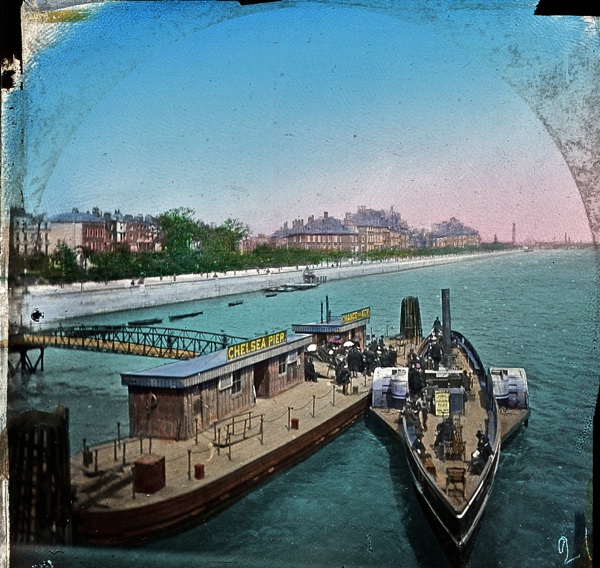
A trip from Chelsea Pier, c.1910.

Doggett’s Coat & Badge Race, c.1920.

Feeding pigeons outside St Paul’s, c.1910.

Building the Great Wheel, Earls Court, c.1910.
Glass slides copyright © Bishopsgate Institute
You may also like to take a look at
In Search Of The Civil War In London

At the site of the Civil War fort in Shoreditch
Very little survives today of the fortifications constructed to defend London in the English Civil War. Yet there is evidence to be found if you know where to look. So Contributing Cartographer Adam Dant & I set out to walk the route of the wall built by the Parliamentarians from Wapping to Westminster in 1642/3 to see what we could discover, as part of Adam’s research for a map he is planning of London in the Civil War.
In the autumn of 1642, Londoners blocked streets with barricades, posts and chains to defend their city. Over the next year, this evolved into eighteen kilometres of ramparts and ditches surrounding the capital, linking twenty forts containing around two hundred cannon. As many as 100,000 worked on digging the ditches and building up the ramparts with entire trades suspending their usual work for the duration.
A bank and ditch extended from Wapping up to Whitechapel where the excess earth was piled up in a mound that sat there until the eighteenth century when it was used to fill the ditch in again, which became Cannon St Rd and New Rd. Mount Terrace next to the Royal London Hospital takes its name from this and, off Commercial St, you will still find Rampart St and Flintlock Close recalling this era.
It was a bright summer’s morning as Adam Dant and I set off from Wapping New Stairs with George Vertue’s plan of the defences in hand. It is the best record we have but – as it was drawn almost a century later in 1738 – it may not be entirely accurate. As a guide, we carried the writing of William Lithgow, a Lanarkshire tailor who wrote an account of the defences in May 1643. “I have never seen a larger inveloped compasse within the whole universe,” he wondered.
As Adam & I ambled from Whitechapel through Spitalfields, I thought of Nicholas Culpeper the herbalist who lived in Red Lion House where Puma Court is today. In 1642, he was summoned by Oliver Cromwell to serve on the front line at Edgehill as Surgeon General.
In Shoreditch, the defences stood just north of St Leonard’s Church with a gateway at the foot of the Kingsland Rd. Today ‘The Conquerer,’ a former pub in Boundary St, is adorned with a painting of a Roundhead soldier which cannot be a co-incidence.
We set off westward following the line of the defences which ran in parallel but fifty yards north of Old St. The only evidence we found is in the name of Mount Mills off Goswell Rd, where the remains of seventeenth century windmills were recently excavated. From here, we followed the line of the wall and ditch until we reached Exmouth Market, teeming with office workers lining up for takeaway lunches. Here we took a brief detour, walking up Amwell St, uphill to Claremont Sq where a reservoir makes a convenient stand-in for Fort Royal, from which Wenceslas Hollar drew the view towards the city in 1644.
Retracing our steps to Exmouth Market and crossing Mount Pleasant, we traced the line of defences across Bloomsbury without finding any sign of their existence until we reached Bedford Sq. Southampton Fort stood here more than four centuries ago and the dramatic geometry of the square today evokes a military fortification without a huge leap of imagination.
In Fitzrovia, only the presence of Eastcastle St reassured us that we were still on the right track but, as we turned south west through Mayfair we came into Mount St, referring to a Civil War bulwark that stood here, known as ‘Oliver’s Mount.’ It was mid-afternoon when we arrived in Hyde Park where the remains of Civil War earthworks are still visible parallel to Park Lane. For as along as I have known the Park, I assumed these long mounds were recent landscaping to shield traffic noise, yet these inauspicious lumps in the grass actually date from when Park Lane was Tiburn Lane and the Tiburn river flowed through here, and this was the front line of the defence of London.
There is a certain irony that the west wall of Buckingham Palace garden follows the line of the Parliamentarian defences, protecting our monarch where once this line was protection against the Royalist forces. From Victoria, the ditch and wall ran down the river at Vauxhall and traversed the south bank to Southwark. But we wandered through the back streets around Vincent Sq towards Westminster, taking a short cut through Dean’s Yard to emerge in front of the Abbey.
Weary, foot-sore and thirsty, Adam & I arrived in Whitehall where Oliver Cromwell still presides over Parliament and – at respectable distance – a bust of Charles I at the Banqueting House commemorates the location of his execution. Across the road at Horseguards, the number ten on the clockface is painted black to indicate the hour when the axe fell and our nation’s history changed forever.
It was a long walk that Adam & I undertook on a warm day in the footsteps of John Lithgow through the dusty crowded streets and, in Westminster, we were confronted with the turbulence of our contemporary politics. Yet we were grateful that the journey we had taken through London in the Civil War granted a certain perspective which restored a necessary sense of proportion in the current crisis.
If readers are aware of other evidence of the Civil War visible today in London please let us know so Adam Dant can include it on his map.

George Vertue’s Plan of the Defences, published in 1738 (click to enlarge)

Wapping New Stairs, where the defences met the Thames

The line of the defences ran northward from Wapping to Whitechapel

Rampart St runs parallel to New Rd in Whitechapel

Off Commercial Rd

The Whitechapel Mound in the eighteenth century

Mount Terrace in Whitechapel, where they piled up the earth from digging the ramparts
“Advancing thence along the trench dyke which runneth through Wappine fields to the further end of White-chappell, a great way without Aldgate, and on the road to Essex, I saw a nine-angled fort, only pallosaded and single ditched, and planted with seven pieces of brazen ordinance.” William Lithgow 1643

Herbalist Nicholas Culpeper was summoned from Red Lion House in Spitalfields by Oliver Cromwell to be Surgeon General on the front line during the Civil War

The gate at Shoreditch looking south towards St Leonards Church

The same view today

St Clements Church and King’s Sq gardens, north of Old St, on the line of the defences

Mount Mills off Goswell Rd records the site of Mount Mills Fort
“Standing on the highway near to the Red Bull, this is a large and singular fortification, having a fort above, and within a fort. The lowest consisting of five angles, two whereof towards the fields are each of them thrice parted, having as many great cannon, with a flanking piece from a hid corner, the upper fort standing circular is furnished with eleven pieces of cannon” William Lithgow 1643

Mount Mills Fort from a broadside of 1643

Northampton Sq on the line of the defences

This reservoir in Claremont Sq occupies the site of Fort Royal
” Continuing to Islington-hill, where there is erected a most rare and most admirable fortification called Strawes Fort, but now Fort Royall. It hath eight angles and a spacious interlading distance between each of the cornered bulwarkes. This fort is marvellous persicuous and prospective both for city and country, commanding all the other inferior fortifications near and about that part of the enclining ground.” William Lithgow 1643

Wenceslas Hollar’s drawing of the view south towards the City from Fort Royal c.1644

Great Ormond St on the line of the defences

Southampton Fort stood north of Bedford Sq
“Consisting of two divided bulwarks, and each of them garnished with four demi-culverines of brasse with the intervening distance fortified. The two former bodies are pallosaded, double-ditched, and the middle division whereof barricaded with stakes a yard high and each of them hooked up with three counter thwarting pike of iron.” William Lithgow 1643

Eastcastle St north of Oxford St

Mount St in Mayfair on the line of defences

These mounds running parallel to Park Lane are vestigial remains of Civil War earthworks

John Roque’s map of 1746 records the earthworks in Hyde Park

The western wall of Buckingham Palace garden follows the line of Civil War defences

Adam Dant consults his notes in Grosvenor Gardens

Vincent Sq on the line of the defences

Oliver Cromwell presides outside the Houses of Parliament in Westminster

Charles I commemorated at the Banqueting House in Whitehall

Print of the execution, 1649 (reproduced courtesy of British Museum)

At Horseguards, the number ten on the clock is permanently marked in black in remembrance of the hour of the time of the execution of Charles I
We are indebted to the scholarship of David Flintham in preparing this feature
You may also like to read about
In City Of London Churchyards

In the churchyard of St Dunstan’s in the East, Idol Lane
If ever I should require a peaceful walk when the crowds are thronging in Brick Lane and Columbia Rd, then I simply wander over to the City of London where the streets are empty at weekends and the many secret green enclaves of the churches are likely to be at my sole disposal. For centuries the City was densely populated, yet the numberless dead in the ancient churchyards are almost the only residents these days.
Christopher Wren rebuilt most of the City churches after the Great Fire upon the irregularly shaped medieval churchyards and it proved the ideal challenge to develop his eloquent vocabulary of classical architecture. Remarkably, there are a couple of churches still standing which predate the Fire while a lot of Wren’s churches were destroyed in the Blitz, but for all those that are intact, there are many of which only the tower or an elegant ruin survives to grace the churchyard. And there are also yards where nothing remains of the church, save a few lone tombstones attesting to the centuries of human activity in that place. Many of these sites offer charismatic spaces for horticulture, rendered all the more appealing in contrast to the sterile architectural landscape of the modern City that surrounds them.
I often visit St Olave’s in Mincing Lane, a rare survivor of the Fire, and when you step down from the street, it as if you have entered a country church. Samuel Pepys lived across the road in Seething Lane and was a member of the congregation here, referring to it as “our own church.” He is buried in a vault beneath the communion table and there is a spectacular gate from 1658, topped off with skulls, which he walked through to enter the secluded yard. Charles Dickens also loved this place, describing it as “my best beloved churchyard.”
“It is a small small churchyard, with a ferocious, strong, spiked iron gate, like a jail. This gate is ornamented with skulls and cross-bones, larger than the life, wrought in stone … the skulls grin aloft horribly, thrust through and through with iron spears. Hence, there is attraction of repulsion for me … and, having often contemplated it in the daylight and the dark, I once felt drawn towards it in a thunderstorm at midnight.” he wrote in “The Uncommercial Traveller.”
A particular favourite of mine is the churchyard of St Dunstan’s in the East in Idol Lane. The ruins of a Wren church have been overgrown with wisteria and creepers to create a garden of magnificent romance, where almost no-one goes. You can sit here within the nave surrounded by high walls on all sides, punctuated with soaring Gothic lancet windows hung with leafy vines which filter the sunlight in place of the stained glass that once was there.
Undertaking a circuit of the City, I always include the churchyard of St Mary Aldermanbury in Love Lane with its intricate knot garden and bust of William Shakespeare, commemorating John Hemminge and Henry Condell who published the First Folio and are buried there. The yard of the bombed Christchurch Greyfriars in Newgate St is another essential port of call for me, to admire the dense border planting that occupies the space where once the congregation sat within the shell of Wren’s finely proportioned architecture. In each case, the introduction of plants to fill the space and countermand the absence in the ruins of these former churches – where the parishioners have gone long ago – has created lush gardens of rich poetry.
There are so many churchyards in the City of London that there are always new discoveries to be made by the casual visitor, however many times you return. And anyone can enjoy the privilege of solitude in these special places, you only have to have the curiosity and desire to seek them out for yourself.

In the yard of St Michael, Cornhill.

In the yard of St Dunstan’s in the East, Idol Lane.

At St Dunstan’s in the East, leafy vines filter the sunlight in place of stained glass.


In the yard of St Olave’s, Mincing Lane.

This is the gate that Samuel Pepys walked through to enter St Olave’s and of which Charles Dickens wrote in The Uncommercial Traveller – “having often contemplated it in the daylight and the dark, I once felt drawn towards it in a thunderstorm at midnight.”

Dickens described this as ““my best beloved churchyard.”


In the yard of St Michael Paternoster Royal, College St.


In the yard of St Lawrence Jewry-next-Guildhall, Gresham St.

In the yard of St Mary Aldermanbury, Love Lane, this bust of William Shakespeare commemorates John Hemminge and Henry Condell who published the First Folio and are buried here.


In the yard of London City Presbyterian Church, Aldersgate St.


In the yard of Christchurch Greyfriars, Newgate St, the dense border planting occupies the space where once the congregation sat within the shell of Wren’s finely proportioned architecture.

In the yard of the Guildhall Church of St Benet, White Lion Hill.


In St Paul’s Churchyard.
You may also like to read about
Real Life For Children, 1819
Before the internet and before photography, the first means of cheap mass-distribution of images was by woodcuts. These appealing examples, enlarged from originals no larger than a thumbnail, are selected from a set of chapbooks, Pictures Of Real Life For Children, Printed & Sold by R.Harrild, Great Eastcheap, London. Believed to date from around 1819, the series included some Cries Of London and, in spite of the occasionally pious text, these are sympathetic and characterful portrayals of working people.
While some are intended as illustrations of professional types, such as Mr Prescription the physician, others are clearly portraits, such as the Rhubarb Seller who was also included in William Marshall Craig’s Itinerant Traders of 1804. Although we shall never know who they all were, the expressive nature of each of these lively cuts – achieved with such economy of means – leads me to suspect that many were based upon specific individuals who were recognisable to readers in London at that time.

Man with his Dancing Bear. This curious sight is frequently seen about the streets of this great city, and is far from being the most contemptible.

Mary Fairlop was always industrious, she rises with the lark to pursue her labour.

Mr Prescription, the physician, is taking the round among his patients. He is pleased to see Master Goodchild so well. By taking his physic as he ought, he is just recovered from a dangerous illness.

This is Mr Ridewell, the smart little groom, who is noted for keeping himself, his stable, and his master’s horse clean.

The Farmer.

The Milkmaid.

Hair Brooms.

Clothes Props. “Buy a Prop, a prop for your clothes.”

“Pickled Salmon, Newcastle Salmon.” Here comes Johnny Rollins, known for selling Newcastle salmon.

“Fine Yorkshire Cakes, Muffins and Crumpets.” In addition to his vocal abilities, this man has lately introduced a bell, by which means the streets are saluted every morning and afternoon with vocal and instrumental music.

“Rhubarb! Rhubarb!” This is a well-known character in our metropolis. He is a Turk as his habit bespeaks him. With his box before him, he offers his rhubarb to every passerby.

“Live Cod, dainty fresh Cod.” Much praise is due to the Fishman for his honest endeavours to obtain a livelihood. At break of day, he is seen at Billingsgate buying fish, and before noon he has been heard in most parts of the metropolis.

“Old Clothes, any shoes, hats or old Clothes.”

This is John Honeysuckle, the industrious gardener, with a myrtle in his hand, the produce of his garden. He is justly celebrated for his beautiful bowpots and nosegays all round the country.

The Nut Woman.

“Beer!” This is the publican with the nice white apron. I like this man’s beer, he keeps the Coach & Horses and his pots always look so clean.

This porter, for his industry and obliging disposition, is respected.

The Cooper is just now with adze in hand. hooping a large wine cask, which is part of a large order he has received from a merchant who trades to the East and West Indies.

The Pedlar.

The Organ Grinder.

The Watchman.
You may also like to take a look at these other sets of the Cries of London
Geoffrey Fletcher’s Pavement Pounders
William Craig Marshall’s Itinerant Traders
H.W.Petherick’s London Characters
John Thomson’s Street Life in London
Aunt Busy Bee’s New London Cries
Marcellus Laroon’s Cries of London
More John Player’s Cries of London
William Nicholson’s London Types
Francis Wheatley’s Cries of London
John Thomas Smith’s Vagabondiana of 1817
John Thomas Smith’s Vagabondiana II
John Thomas Smith’s Vagabondiana III
Thomas Rowlandson’s Lower Orders
More of Thomas Rowlandson’s Lower Orders
Malcolm Tremain’s Spitalfields, Then & Now
I took a walk with my camera in the footsteps of Malcolm Tremain to visit the locations of his photographs from the early eighties and discover what time has wrought …


Passage from Allen Gardens to Brick Lane


Spital Sq, entrance to former Central Foundation School now Galvin Restaurant


In Spital Sq


In Brune St


In Toynbee St


Corner of Grey Eagle St & Quaker St


In Quaker St


Steps of Brick Lane Mosque


In Puma Court


Corner of Wilkes St & Princelet St


In Wilkes St


Jewish Soup Kitchen in Brune St


Outside the former night shelter in Crispin St, now student housing for LSE


In Crispin St


In Bell Lane


In Parliament Court


In Artillery Passage


In Artillery Passage


In Middlesex St


In Bishopsgate


In Wentworth St


In Fort St


In Allen Gardens


At Pedley St Bridge
Black & white photographs copyright © Malcolm Tremain
You may also like to take a look at
Andrew Scott’s East End, Then & Now
Val Perrin’s Brick Lane, Then & Now