In Search Of Culpeper’s Spitalfields

Ragwort in Hanbury St
(The concoction of the herb is good to wash the mouth, and also against the quinsy and the king’s evil)
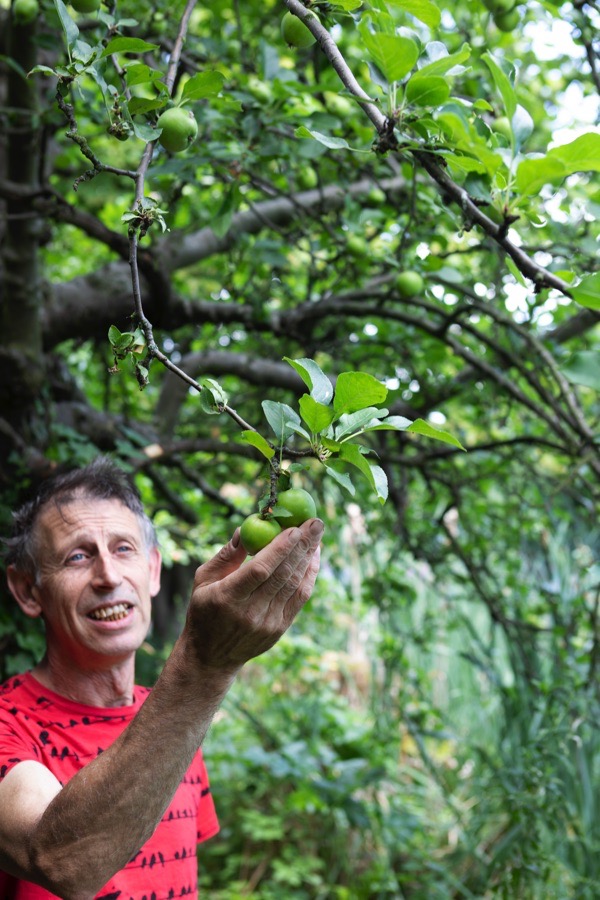
Taking the opportunity to view the plaque upon the hairdresser at the corner of Puma Court and Commercial St, commemorating where Nicholas Culpeper lived and wrote The English Herbal, the celebrated seventeenth century Herbalist returned to his old neighbourhood for a visit and I was designated to be his guide.
Naturally, he was a little disoriented by the changes that time has wrought to Red Lion Fields where he once cultivated herbs and gathered wild plants for his remedies. Disinterested in new developments, instead he implored me to show him what wild plants were left and thus we set out together upon a strange quest, seeking weeds that have survived the urbanisation. You might say we were searching for the fields in Spitalfields since these were plants that were here before everything else.
Let me admit, I did feel a responsibility not to disappoint the old man, as we searched the barren streets around his former garden. But I discovered he was more astonished that anything at all had survived and thus I photographed the hardy specimens we found as a record, published below with Culpeper’s own annotations.

Honeysuckle in Buxton St (I know of no better cure for asthma than this, besides it takes away the evil of the spleen, provokes urine, procures speedy delivery of women in travail, helps cramps, convulsions and palsies and whatsoever griefs come of cold or stopping.)

Dandelion in Fournier St (Vulgarly called Piss-a-beds, very effective for obstructions of the liver, gall and spleen, powerful cleans imposthumes. Effectual to drink in pestilential fevers and to wash the sores. The juice is good to be applied to freckles, pimples and spots.)

Campion in Bishop’s Sq (Purges the body of choleric humours and helps those that are stung by Scorpions and other venomous beasts and may be as effectual for the plague.)

Pellitory of the Wall in Hanbury St (For an old or dry cough, the shortness of breath, and wheezing in the throat. Wonderfully helps stoppings of the urine.)

Herb Robert in Folgate St (Commended not only against the stone, but to stay blood, where or howsoever flowing, and it speedily heals all green wounds and is effectual in old ulcers in the privy parts.)

Sow Thistle in Princelet St (Stops fluxes, bleeding, takes away cold swellings and eases the pains of the teeth)

Groundsel off Brick Lane (Represses the heat caused by motions of the internal parts in purges and vomits, expels gravel in the veins or kidneys, helps also against the sciatica, griping of the belly, the colic, defects of the liver and provokes women’s courses.)

Ferns and Campanula and in Elder St (Ferns eaten purge the body of choleric and waterish humours that trouble the stomach. The smoke thereof drives away serpents, gnats and other noisome creatures which in fenny countries do trouble and molest people lying their beds.)

Sow Thistle and Herb Robert in Elder St

Yellow Wood Sorrel and Sow Thistle in Puma Court (The roots of Sorrel are held to be profitable against the jaundice.)

Comfrey in Code St (Helps those that spit blood or make a bloody urine, being outwardly applied is specially good for ruptures and broken bones, and to be applied to women’s breasts that grow sore by the abundance of milk coming into them.)

Sow Thistle in Fournier St

Field Poppy in Allen Gardens (A syrup is given with very good effect to those that have the pleurisy and is effectual in hot agues, frenzies and other inflammations either inward or outward.)

Fleabane at Victoria Cottages (Very good to heal the nipples and sore breasts of women.)

Sage and Wild Strawberries in Commercial St (The juice of Sage drank hath been of good use at time of plagues and it is commended against the stitch and pains coming of wind. Strawberries are excellent to cool the liver, the blood and the spleen, or an hot choleric stomach, to refresh and comfort the fainting spirits and quench thirst.)

Hairy Bittercress in Fournier St (Powerful against the scurvy and to cleanse the blood and humours, very good for those that are dull or drowsy.)

Oxe Eye Daisies in Allen Gardens (The leaves bruised and applied reduce swellings, and a decoction thereof, with wall-wort and agrimony, and places fomented or bathed therewith warm, giveth great ease in palsy, sciatica or gout. An ointment made thereof heals all wounds that have inflammation about them.)

Herb Robert in Fournier St

Camomile in Commercial St (Profitable for all sorts of agues, melancholy and inflammation of the bowels, takes away weariness, eases pains, comforts the sinews, and mollifies all swellings.)

Unidentified herb in Commercial St

Buddleia in Toynbee St (Aids in the treatment of gonorrhea, hepatitis and hernia by reducing the fragility of skin and small intestine’s blood vessel.)

Hedge Mustard in Fleur de Lys St (Good for all diseases of the chest and lungs, hoarseness of voice, and for all other coughs, wheezing and shortness of breath.)

Buttercup at Spitalfields City Farm (A tincture with spirit of wine will cure shingles very expeditiously, both the outbreak of small watery pimples clustered together at the side, and the accompanying sharp pains between the ribs. Also this tincture will promptly relieve neuralgic side ache, and pleurisy which is of a passive sort.)
You may like to read about
Wonderful London’s East End
It is my pleasure to publish these evocative pictures of the East End (with some occasionally facetious original captions) selected from the popular magazine Wonderful London edited by St John Adcock and produced by The Fleetway House in the nineteen-twenties. Most photographers were not credited – though many were distinguished talents of the day, including East End photographer William Whiffin (1879-1957).

Boys are often seen without boots or stockings, and football barefoot under such conditions has grave risks from glass or old tin cans, but there are many urchins who would rather run about barefoot.

When this narrow little dwelling in St John’s Hill, Shadwell, was first built in 1753, its inhabitants could walk in a few minutes to the meadows round Stepney or, venture further afield, to hear the cuckoo in the orchards of Poplar.

Middlesex St is still known by its old name of Petticoat Lane. Some of the goods on offer at amazingly low prices on a Sunday morning are not above suspicion of being stolen, and you may buy a watch at one end of the street and see it for sale again by the time you reach reach the other.

A vanished theatre on the borders of Hoxton, just before demolition, photographed by William Whiffin. In 1838, a tea garden by the name of ‘the Eagle Tavern’ was put up in Shepherdess Walk in the City Rd near the ‘Shepherd & Shepherdess,’ a similar establishment founded at the beginning of the same century. Melodramas such as ‘The Lights ‘O London’ and entertainments like ‘The Secrets of the Harem,’ were also given. In 1882, General Booth turned the place into a Meeting Hall for his Salvation Army. There is little suggestion of the pastoral about Shepherdess Walk now.

In the East End and all over the poorer parts of London, a strange kind of establishment, half booth, half shop, is common and particularly popular with greengrocers. Old packing cases are the foundation of a slope of fruit which begins unpleasantly near the level of the pavement and ends in the recess behind the dingy awning. At night, the buttresses of vegetables are withdrawn into shelter.

Old shop front in Bow photographed by William Whiffin. Pawnbroking, once as decorous as banking, has fallen from the high estate in the vicinity of Lombard St. Now, combined instead with the sale of secondhand jewellery, furniture and hundred other commodities, it is apt to seek the corners of the meaner streets.

A water tank covered by a plank in a backyard among the slums is an unlikely place for a stage, but an undaunted admirer of that great Cockney humorist, Charlie Chaplin, is holding his audience with an imitation of the well-known gestures with which the famous comic actor indicates the care-free-though-down-and-out view of life which he has immortalised.

Old shop front in Poplar photographed by William Whiffin

An old charity school for girl and boy down at Wapping founded in 1704. The present building dates from 1760 and the school is supported by voluntary subscriptions. The school provided for the ‘putting out of apprentices’ and for clothing the pupils.

The hunt for bargains in Shoreditch. A glamour surrounds the rickety coster’s barrow which supports a few dozens of books. But, to tell the truth, the organisation of the big shops is now so efficient that the chances of finding anything good at these open air book markets may have long odds laid against it.

The landsman’s conception of a sailing vessel, with all its complex of standing and running rigging that serves mast and sail with ordered efficiency, is apt for a shock when he sees a Thames barge by a dockside. The endless coils and loops of rope of different thickness, the length of chain and the litter of brooms, buckets, fenders and pieces of canvas, seem to be in the most insuperable confusion.

Gloom and grime in Chinatown. Pennyfields runs from West India Dock Rd to Poplar High St. A Chinese restaurant on the corner and a few Chinese and European clothes are all that is to be seen in the daytime.

The gem of Cornhill, Birches, where it stood for two hundred years. Towards the end of the eighteenth century, the brothers Adam erected its beautiful shop front. Within were old bills of fare printed on satin, a silver tureen fashioned to the likeness of a turtle and many other curious odd-flavoured things. Birches have catered for the inspired feasting of the City Companies and Guilds for two centuries but now this shop has moved to Old Broad St and, instead of Adam, we are to have Art Nouveau ferro-concrete.

It is doubtful if the Borough Council of Poplar had any notion, when they supplied the district with water carts, that the supplementary use pictured in this photograph by William Whiffin would be made of them. Given a complacent driver, there is no reason why these children should not go on for miles.

Grime and gloom in St George’s St photographed by William Whiffin. St George’s St used to be the famous Ratcliff Highway and runs from East Smithfield to Shadwell High St. It is a maritime street and contains various establishments, religious and otherwise, which cater for the sailor.

River Lea at Bow Bridge photographed by William Whiffin. On the right are Bow flour mills, while to the left, beyond the bridge, a large brewery is seen.

A view of Curtain Rd photographed by William Whiffin, famed for its cabinet makers. It runs from Worship St – a turning to the left when walking along Norton Folgate towards Shoreditch High St – to Old St. Curtain Rd got its name from a curtain wall, once part of the outworks of the city’s fortifications.

Fish porters of Billingsgate gathered around consignments lately arrived from the coast. At one time, smacks brought all the fish sold in the market and were unloaded at Billingsgate Wharf, said to be the oldest in London.

Crosby Hall as it stood in Bishopsgate. Alderman Sir John Crosby, a wealthy grocer, got the lease of some ground off Bishopsgate in 1466 from Alice Ashfield, Prioress of St Helen’s, at a rent of eleven pounds, six shillings and eightpence per annum, and built Crosby Hall there. It came into the possession of Sir Thomas More around 1518 and by 1638 it was in the hands of the East India Company, but in 1910 it was taken down and re-erected in Cheyne Walk.

Whatever their relations with the Constable may come to be in later life, the children of the East End, in their early days, are quite willing to use his protection at wide street crossings.

There is no more important work in the great cities than the amelioration of the slum child’s lot. Many East End children have never been beyond their own disease-ridden courts and dingy streets that form their playground.
Photographs courtesy Bishopsgate Institute
You may also like to take a look at
Hilary Haydon, Brother At The Charterhouse

Unlike the hermit monks of the medieval priory that once stood upon this site, the current Brothers at the Charterhouse are a sociable bunch and thus I was able to pay a visit upon Hilary Haydon, the third-most senior Brother, who took me on a tour of the accommodation.
Seniority – in this instance – is based upon how long a Brother has been resident at the Charterhouse, not age. Yet Hilary has a rather more vivid way of expressing it. Gesturing to the pigeon holes for mail, he explained that as residents die the labels of those remaining get moved up. “You start here and then you move along, until you drop off the end,” he informed me with startling alacrity.
It made me realise that residence in the Charterhouse affects the Brothers’ sense of time – inhabiting these ancient stone walls induces a certain philosophical perspective upon mortality, setting the span of an individual’s life against the centuries of history that have passed here. It is both a consolation and an encouragement to recognise the beauty of the fleeting moment, as manifest in the immaculately-tended gardens alive with bluebells and tulips, and as illustrated upon the tomb of Thomas Sutton – the benefactor – by bubbles, symbolising the transitory nature of fame.
I crossed the wide lawn that sets the Charterhouse apart from the clamour of Smithfield, aware that my diagonal path, bisecting the velvet greensward, passed over the largest plague pit in the City of London in which sixty-thousand victims of the Black Death were interred. Arriving at the entrance, I cast my eyes up to the fifteenth century gatehouse of the former Carthusian Priory. Henry VIII met with greater resistance from the monks here than any other religious order and thus he had John Houghton, the prior, cut in four and his right arm nailed to the door.
Yet this grim history seemed an insubstantial dream, as I entered to discover Hilary Haydon waiting in the gatehouse to greet me. He led me along stone passages and into hidden courtyards, through the cloisters and the Great Hall and the chapel, with its flamboyant monument of fairground showiness for Thomas Sutton.
My wonder at the quality, age and proportion of the architecture was compounded by my delight at the finely-conceived planting schemes of the gardens and it was not difficult to envisage this elaborate complex as a Renaissance palace, which it became for the Howard family through three generations until they sold it to Sutton in 1611. The wealthiest commoner in England, he endowed his fortune upon a school and almshouses here, entitled ‘King James’ Hospital in Charterhouse.’ Daniel Defoe described it as “the noblest gift that ever was given for charity, bu any one man, public or private, in this nation.”
Four centuries later, the school has moved out to Goldalming, leaving Smithfield in 1872, yet the almshouses still flourish – offering sheltered accommodation to forty Brothers. Formerly a barrister in the City, Hilary came here twenty years ago when he became a widower. “I have never regretted it,” he assured me with an emphatic grin, “Meals appear, your room is cleaned and the community is supportive.” Hilary revealed to me that among the Brothers, there are solicitors, barristers and priests, as well as an actor currently understudying for ‘The Woman in Black,’ the stage manager of the original production of ‘Oliver!’ and – as we entered the refectory – he introduced a distinguished-looking gentleman as the ballet critic of The Sunday Times.
Each morning, the Brothers are woken by the chapel bell at ten to eight. “I use it as an alarm clock,” confessed Hilary in a whisper, “I attend chapel only for funerals and when I read the lesson.” Breakfast follows in the Great Hall at eight-twenty, succeeded by morning coffee at eleven, lunch at one and afternoon tea at three – and thus time is measured out in the benign conditions of the Charterhouse. “A very silent brother who sat next to me came into lunch one day and died beside me,” Hilary admitted, “As it happens, there was a doctor who was only at the other side of the table and he was across the table like lightning – it was a beautiful way to go.”

The fifteenth century gate to the monastery is encompassed by an eighteenth century structure


Doorway and cubby hole for passing food through at the entrance to the former priory, dissolved in the fifteen-forties and bricked up ever since.

Graffiti from the days this was the refectory for Charterhouse School

Chimney piece of the three graces and a chest that may have belonged to Thomas Sutton

The Great Hall

Bluebells and an ancient fig tree at the entrance to the Charterhouse

Looking through to the chapel, with the relic of a door damaged an incendiary bomb

Thomas Sutton, the founder, has lain here for four centuries

Bubbles symbolise the futility of wordly fame

Vestments await the priest in the chapel

Graffiti carved by the bored schoolboys of the eighteen-fifties in the chapel

Note the spelling of “Clarkenwell” upon the memorial stone set into the floor

In the chapel

Eighteenth century dwelling built over the ancient gatehouse

Hilary Haydon in the cloister at the Charterhouse – “It’s always cool in here”
Visit The Charterhouse, Charterhouse Square, EC1M 6AN
You may also like to read about
At The Canal Club
Novelist Sarah Winman visited the Canal Club in Bethnal Green recently with Photographer Rachel Ferriman to report on the threat to the community spaces at the Wellington Estate

Toslima Rahman with her daughter Saima & son Ayaan at the Canal Club
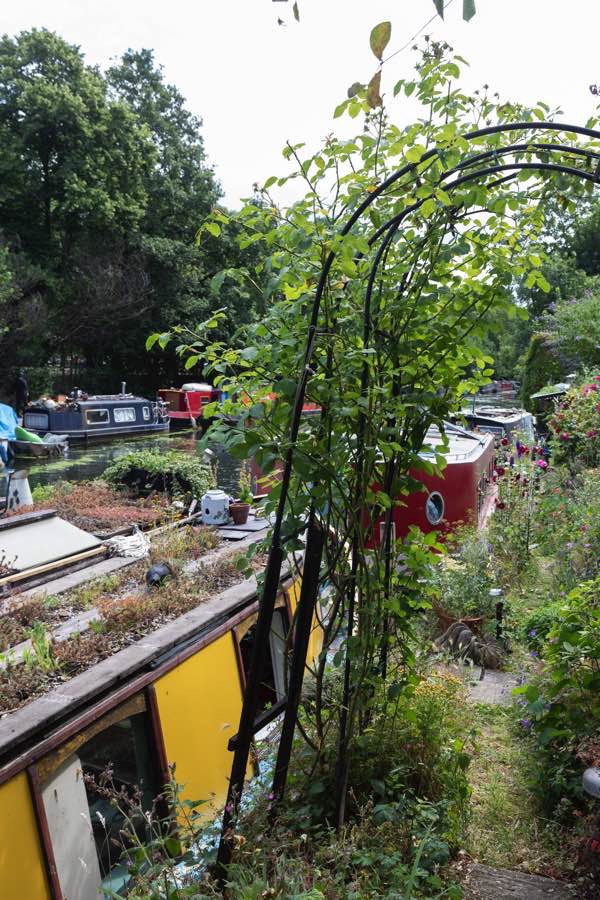
The Canal Club sits at the corner of Waterloo Gardens and Sewardstone Rd in Bethnal Green. It consists of a playground, a ball park, a community centre and community garden between the vast Wellington Estate to the east, of which it is part, and the Grand Union Housing Coop to the west. At the southern border is Belmont Wharf, a small boating community established by Sally and Dominique who were granted permission by the council nine years ago to have moorings along this stretch of Regent’s Canal and to create a sustainable garden for boat dwellers and land dwellers alike.
The garden is incredibly beautiful, a biodiverse haven. The sound of children playing carries across the water from Victoria Park and faded bunting flutters in the breeze. Flowers of every colour bloom and bees are plenty and go about with purpose. Butterflies delight around the nettles and even bats have found a home here. This garden has been created with care and thought and, more importantly, time. The air is sweet and clean, far removed from the fug of Cambridge Heath Rd and Hackney Rd that pollute nearby.
I met residents Sally, Dominique, Alex, Ricardo, Helga, Erdoo, Mr & Mrs Ali, and Toslima to learn that this beloved site has been selected by Tower Hamlets Council for a housing infill scheme. These schemes are becoming common practise by councils, who target sites – usually recreational – on existing estates and build further.
The proposal for the Wellington Estate is to demolish the Canal Club and remove the open space and community asset it provides. This is to construct a further twenty-two flats on an already densely populated estate which was built in the thirties as an answer to slum clearance – basically, it is taking space from those who have little to start with.
It is a complex situation that is the outcome of thirty years of right-to-buy, money held by central government and the chronic need for housing. However, what is inexcusable to the residents of the estate and the boating community and supportive locals, is the opaque nature of the dealings – the council’s lack of transparency and openness to discussion. Two years ago, they thought they were simply looking at the refurbishment of their community centre, until they later found out that the decision to demolish the Canal Club site was already under way.
Alex explains that the Canal Club land was given by the GLC to the people of the Wellington Estate in the late seventies and early eighties to offset the overcrowding and the lack of balconies and gardens. It was their land and she believes the present council had a responsibility to share their ideas with the residents. The irony is not lost on her too, that Tower Hamlets say they are an Climate Emergency Council and yet are taking away the only green public space on the estate.
Everyone talks about the eighties and nineties when the community centre was thriving. It was hired out for weddings and birthdays then. There was a youth club, opportunities to learn a second language and for recent immigrants to learn English, space for pensioners to get together, and for the residents association to meet and share ideas. Dwight tells us he was a member of the youth club and it was the only chance for kids to have day trips out of London. He remembers camping in Tunbridge Wells. The chance to ride horses and canoe – see a different life, be a different person.
There is nothing for kids now, someone says. So much has already gone. And if you take away the ball park, then what? Looting across the generations, another says. Building slums of the future, says another. Erdoo, who has lived on the state all her life, tells me that her dad Joseph looked after the Community Centre for years before the council took away his key and barred the local residents from using it anymore. Then the Community Centre was offered up to private use for private rents. The popular Scallywags nursery is the present tenant, but ill-feeling from that time remains.
This engaging group of people care so much about their environment and improving the lives of others. Yet what is apparent is how the agency of council tenants is being eroded in the widening chasm of inequality.
The right to space and light and clean air can never only be for the rich.
I stand on the old wharf where the custodians, Sally and Dominique, repaired it with two-hundred-year-old bricks. Wildflowers grow here now and nature has reclaimed an area once used for the dumping of waste. Kick the soil and a filament of plastic is revealed, hidden by knapweed or evening primrose, or large swathes of hemp-agrimony. Over the years, composting has built up the fertility of the soil, attracting a diversity of insects and bird population. Dominique explains that the principle of permaculture is to work in sympathy with nature and harness its natural energy. A wild colony of bees appear every year for a few weeks when the cherry tree blossoms and then disappear again to their unknown world. Dominique keeps a daily diary of the changes and visitations. The secret life that we do not see, either because we move too fast or because the insects are too small.
The license for this garden expires next year, and Dominique and Sally fear the council will not renew it if the demolition goes ahead. I find it unbelievable that such a necessary and beautiful urban green space could be sacrificed especially in a time of declining mental health. The benefits that access to nature provides are irrefutable. This community garden is more than a garden, it is a destination for the carers and patients who come down from the Mission Practise or readers looking for solitude. It is a resource for artists seeking inspiration and children who want to know how the natural world works – or simply those who need to be reminded that they are more than their circumstance.
As I leave this corner of East London, I am reminded of a speech delivered by Robert Kennedy back in the sixties about how the value of a country is measured – “It does not allow for the health of our children, the quality of their education or the joy of their play. It does not include the beauty of our poetry… It measures neither our wit nor our courage, neither our wisdom nor our learning, neither our compassion… it measures everything in short, except that which makes life worthwhile.”
Please help save the Canal Club: CLICK HERE TO SIGN THE RESIDENTS’ PETITION

The Wellington Estate

Save Our Community Spaces – Refurbish Not Demolish

In the Community Garden

Dominique Cornault at the Canal Club

Sally Hone at the Canal Club

Mr & Mrs Ali outside the Canal Club

Helga Lang at the Canal Club


Dwight James at Belmont Wharf


Erdoo Yongo outside her mum’s house on Wellington Estate


Barbara, resident of the Estate, and Bonny her dog

Photographs copyright © Rachel Ferriman
You may also like to take a look at
Forty Years At The Golden Heart
Sandra Esqulant is celebrating 40 years as publican at The Golden Heart in Commercial St

Sandra Esqulant
“One day, about fifteen years ago, Sandra took a Hula Hoop and started Hula Hooping on the traffic island in the middle of Commercial St, and, without even thinking about it, I took a picture of her,” recalled Phil Maxwell in amusement, outlining the spontaneous origin of his photographic relationship with Sandra Esqulant, landlady of the Golden Heart since 1979. No-one has taken more photographs in Spitalfields than Phil and so it was inevitable that he would turn his camera upon Sandra, whose buoyant, playful nature is a gift to photography.
Once the pub for the Truman Brewery which closed more than thirty years ago, the Golden Heart was kept by Sandra and her husband Dennis together, until he died in 2009 leaving her to continue alone. Sandra has risen to the challenge heroically and, today in Spitalfields, she is among the few who connect us to that earlier time, when the life of the Brewery and the Fruit & Vegetable Market dominated, and the Golden Heart opened at dawn to serve the market porters. As a consequence, she is one who commands such affection among residents of the surrounding streets, that the question “How’s Sandra?” is exchanged as a kind of greeting, and the answer is taken as indicative of the state of things in general in this particular corner of London.
“At first, I knew her only to go in and have a pint, which I didn’t do that often. It was only in later years that I started drinking in the Golden Heart. I’d be completely broke and she’d always lend me twenty quid.” admitted Phil with an uncharacteristic blush,“After the Hula Hoop, she let me take pictures of her anytime. I was photographing her once when she was dancing in the bar and one of the customers told me to stop, and Sandra said, ‘Phil can take pictures of me whenever he pleases, he’s my photographer.'”
We were sitting in Phil’s studio in Greatorex St, in anticipation of the arrival of the great lady for a photo session, and just as Phil began glancing discreetly at his watch, Sandra made her entrance – worthy of a heroine in a musical comedy – bearing cakes and coffees and an abundance of goodwill, and exclaiming “Oh Phil, I love you!”
As we consumed our Danish pastries, Phil took the opportunity to focus his lens upon Sandra, while reminding her of the Hula Hoop incident, a cue for further hilarity. “As you know, I like making people happy and seeing everybody happy and laughing, even though I’ve been a bit down myself recently,” she confided to me, placing a hand upon my wrist. “I used to wind people up by saying I could do it for two days non-stop. My biggest thrill was doing it at two or three in the morning,” she continued, filling with glee at the mere thought of nocturnal Hula Hooping on a traffic island, “the police would come round and they’d say, ‘Don’t worry, that’s just Sandra.'”
“So when shall we do your portrait?” queried Phil, interposing the question as if it were something far off, but catching Sandra’s attention and causing her to sit up quickly, in the manner of a school girl when a teacher enters. Phil sat behind his camera on the tripod and Sandra sat facing him, expectant and eager. “I’ve put my lipstick on, do I look alright?” she asked, seeking approval. “You look good.” granted Phil gently, a little preoccupied now, peering through his lens at her.
I sat to one side, observing both photographer and subject, fascinated by Sandra’s impassive mode of readiness, with chin lifted just as she raises her countenance at the bar to greet a customer. Over all this time it has become the gaze that she raises to meet life.
Phil shifted his attention between the view through the lens and looking over the camera to meet Sandra’s eyes. In the silence of the intimate moment, emotions coursed through Sandra’s features like currents in water and as she looked towards the lens, it was if she were looking through it, deeper and deeper.
“She’s not a person who tries to hide anything when the camera is in front of her.” commented Phil afterwards, once Sandra had departed leaving a space in the room, a vacuum where her presence had been.“There’s never a moment when she isn’t the centre of attention, but she doesn’t demand your attention, you just can’t help looking at her.” he said.



Photographs copyright © Phil Maxwell
You can watch Sandra a film portrait of Sandra Esqulant by Hazuan Hashim & Phil Maxwell by clicking here.
More pictures by Phil Maxwell
The Broderers Of St Paul’s

Anita Ferrero
Like princesses from a fairy tale, the Broderers of St Paul’s sit high up in a tower at the great cathedral stitching magnificent creations in their secret garret and, recently, Contributing Photographer Sarah Ainslie & I climbed up one hundred and forty-one steps to pay a visit upon these nimble-fingered needleworkers.
‘There are fourteen of us, we chat, we tell stories and we eat chocolate,’ explained Anita Ferrero by way of modest introduction, as I stood dazzled by the glittering robes and fine embroidery. ‘It’s very intense work because the threads are very bright,’ she added tentatively, lest I should think the chocolate comment revealed undue levity.
I was simply astonished by the windowless chamber filled with gleaming things. ‘There are thirteen tons of bells suspended above us,’ Anita continued with a smile, causing me to cast my eyes to the ceiling in wonder, ‘but it’s a lovely sound that doesn’t trouble us at all.’
Observing my gaze upon the magnificent textiles, Anita drew out a richly-embellished cope from Queen Victoria’s Jubilee. ‘This is cloth of gold’ she indicated, changing her voice to whisper, ‘it ceased production years ago.’
‘There are still wonderful haberdashers in Kuala Lumpur and Aleppo,’ she informed me as if it were a closely-guarded secret, ‘I found this place there that still sold gold thread. If someone’s going to Marrakesh, we give them a shopping list in case they stumble upon a traditional haberdashery.’ Next, Anita produced a sombre cope from Winston Churchill’s funeral, fashioned from an inky black brocade embroidered with silver trim, permitting my eye to accommodate to the subtler tones that can be outshone by tinsel.
In this lofty chamber high above the chaos of the city, an atmosphere of repose prevails in which these needlewomen pursue their exemplary work in a manner unchanged over millennia. I was in awe at their skill and their devotion to their art but Anita said, ‘As embroiderers, we are thankful to have a purpose for our embroidery because there’s only so many cushions you can do.’
I walked over to a quiet corner where Rachel Rice was stitching an intricate border in gold thread. ‘I learnt my skills from my mother and grandmother, and I always enjoyed sewing and dressmaking but that’s not fine embroidery like this,’ she admitted, revealing the satisfaction of one who has spent a life devoted to needlework. Yet she qualified her pride in her craft by admitting her humanity with a weary shrug, ‘Some of the work is extremely tedious and it’s never seen.’
‘We are all very expert but our eyesight is fading and a few of us are quite elderly,’ confided Anita, thinking out loud for the two of them as she picked up the story and exchanged a philosophical grin with Rachel. Nowhere in London have I visited a sanctum quite like the Broderers chamber or encountered such self-effacing creative talents.
‘We not so isolated up here,’ emphasised Anita, lifting the mood with renewed enthusiasm, ‘Most people who work in the Cathedral know we’re here. We often do favours for members of staff, taking up trouser hems etc – consequently, if we have a problem, we can call maintenance and don’t have to wait long.’
I was curious to learn of the Broderers’ current project, the restoration of a banner of St Barnabas. ‘He’s the one saint I’d like to meet because he’s called ‘The Son of Encouragement’ – he looks like a nice guy,’ confessed Anita fondly, laying an affectionate hand upon the satin, ‘We’re restoring the beard of St Barnabas at present and we’re getting Simon the good-looking Virger up here to photograph his beard.’

Rachel Rice – ‘I learnt my skills from my mother and grandmother’


Sophia Sladden


Margaret Gibberd

‘As embroiderers, we are thankful to have a purpose for our embroidery because there’s only so many cushions you can do.’


Judy Hardy

‘We chat, we tell stories and we eat chocolate..’


Virger Simon Brears is the model for the beard of St Barnabas


View from the Triforium
Photographs copyright © Sarah Ainslie
You may catch a glimpse of the Broderers for yourself by taking a Triforium Tour at St Paul’s Cathedral.
The Coal Holes Of Old London
These hundred and fifty drawings of cast iron plate covers for coal chutes were sketched by a young medical student, Dr Shephard Taylor, while studying at King’s College Hospital in the Strand in 1863. “I determined to try to reproduce them on paper, and, although I had no particular artistic skill or genius, I found no great difficulty in making a fair sketch of the more simple devices,” he admitted proudly. Whether Dr Taylor was a purist who omitted those with their maker’s names because he preferred abstract design or whether he simply could not do lettering, we shall never know.
Dr Taylor was ninety years old before his cherished designs were published in 1929 and he christened them Opercula, which means a cover or a lid. I will give a prize to anyone that can send me a photograph of any of these opercula drawn by Dr Taylor still in its location today.


You may also like to take a look at