
My Ghastly Facadism Lecture

Cover design by David Pearson
To celebrate the forthcoming publication of my new book THE CREEPING PLAGUE OF GHASTLY FACADISM, I am giving an illustrated lecture showing some of London’s worst cases of facadism and explaining why it is happening and what it means.
I am especially delighted that this lecture will be held behind one of the facades in my book, the former Whitechapel Public Baths of 1846, Britain’s oldest purpose built public baths which were facaded in 2002 and are now part of London Metropolitan University.
The lecture is at 7pm on Monday 4th November at The Wash Houses, The Cass, London Metropolitan University, 25 Old Castle St, E1 7NT.
Click here to book your ticket
This event is presented with the gracious support of The Cass, London Metropolitan University

Whitechapel Public Baths, 25 Old Castle St, E1
Following Edwin Chadwick’s sanitary report of 1842, a Committee for Baths for the Labouring Classes was formed in October 1844, spurred on by concern to prevent further outbreaks of cholera. The Committee agreed to make their first intervention in Whitechapel and subscriptions were sought.
Inspired by the 1846 Baths & Washhouses Act, this pioneering facility where people could wash themselves and their laundry was designed by Price Pritchard Baly and completed in 1851. Its construction was utilitarian, combining brown brick walls with an iron roof. The Builder lauded its ‘useful’ design but described the scheme as entirely devoid of the ‘beautiful,’ noting that its appearance was ‘not simply plain and unpretending, but downright ugly.’
Lack of funding forced the Committee to abandon its ambition to build four bathhouses of several storeys each and the single storey Whitechapel Baths was their only success.
The bathhouse closed in the nineteen-nineties and was rebuilt as The Women’s Library in 2002. Since 2013, it has become an events space for London Metropolitan University.

CLICK HERE TO ORDER A COPY FOR £15
“As if I were being poked repeatedly in the eye with a blunt stick, I cannot avoid becoming increasingly aware of a painfully cynical trend in London architecture which threatens to turn the city into the backlot of an abandoned movie studio.”
The Gentle Author presents a humorous analysis of facadism – the unfortunate practice of destroying an old building apart from the front wall and constructing a new building behind it – revealing why it is happening and what it means.
As this bizarre architectural fad has spread across the capital, The Gentle Author has photographed the most notorious examples, collecting an astonishing gallery of images guaranteed to inspire both laughter and horror in equal measure.
You may also like to take a look at
A Walk In Walter Thornbury’s London

Golden Buildings off the Strand
There is the London we know and the London we remember, and then there is the London that is lost to us but recalled by old photographs. Yet beyond all this lies another London which is long forgotten, composed of buildings and streets destroyed before the era of photography. Walter Thornbury’s ‘Old & New London – how it was and how it is‘ of 1873 offers a glimpse into this shadowy realm with engravings of the city which lies almost beyond recognition. It is a London that was forgotten generations ago and these images are like memories conjuring from a dream, strange apparitions that can barely be squared with the reality of the current metropolis we inhabit today.
“Writing the history of a vast city like London is like writing a history of the ocean – the area is so vast, its inhabitants are so multifarious, the treasures that lie in its depths so countless. … The houses of old London are encrusted as thick with anecdotes, legends and traditions as an old ship is with barnacles. Strange stories of strange men grow like moss in every crevice of the bricks … Old London is passing away even as we dip our pen in the ink…” – Walter Thornbury

The Four Swans Inn, Bishopsgate – shortly before demolition

Garraway’s Coffee House – shortly before demolition after 216 years in business

Roman wall at Tower Hill

Dyer’s Hall, College St, rebuilt 1857

Old house in Leadenhall St with Synagogue entrance

Yard of the Bull & Mouth, Aldergsgate 1820

The Old Fountain, Minories

Demolition of King’s Cross in 1845

Clerkenwell in 1820 before the railway came through

Middlesex House of Detention, Clerkenwell

In the Jerusalem Tavern above St John’s Gate, Clerkenwell

Cock Lane, Smithfield

Hand & Shears, Clothfair

Smithfield before the construction of the covered market

Last remnant of the the Fleet Prison demolished in 1846

The Fleet Ditch seen from the Red Lion

Back of the Red Lion seen from the Fleet Ditch

Field Lane 1840

Leather Lane

Exotic pet shop on the Ratcliffe Highway with creatures imported through the London Docks

Sir Paul Pindar’s Lodge, Spitalfields

Room in Sir Paul Pindar’s House, Bishopsgate – demolished for the building of Liverpool St Station

Kirkby Castle, Bethnal Green

Tudor gatehouse in Stepney

Boar’s Head Yard, Borough High St

Jacob’s Island, Southwark

Floating Dock, Deptford

Painted Hall, Greenwich

Waterloo Bridge Rd

Balloon Ascent at Vauxhall Gardens, 1840

House in Westminster, believed to have been inhabited by Oliver Cromwell

Old shops in Holborn

Mammalia at the British Museum

Rookery, St Giles 1850

Manor House of Toten Hall, Tottenham Court Rd 1813

Marylebone Gardens, 1780

Turkish Baths, Jermyn St

Old house in Wych St

Butcher’s Row, Strand 1810

The Fox Under The Hill, Strand

Ivy Bridge Lane, Strand

Turner’s House, Maiden Lane

Covent Garden

Whistling Oyster, Covent Garden

Tothill St, Westminster

Old house on Tothill St

The Manor House at Dalston

Old Rectory, Stoke Newington 1856

Sights of Stoke Newington – 1. Rogers House 1877 2. Fleetwood House, 1750 3. St Mary’s Rectory 4. St Mary’s New Church 5, New River at Stoke Newington 6. Queen Elizabeth’s Walk, 1800 7. Old gateway
Images courtesy Bishopsgate Institute
You may also like to take a look at
The East End In The Afternoon

There is little traffic on the road, children are at play, housewives linger in doorways, old men doze outside the library and, in the distance, a rag and bone man’s cart clatters down the street. This is the East End in the afternoon, as photographed by newspaper artist Tony Hall in the nineteen sixties while wandering with his camera in the quiet hours between shifts on The Evening News in Fleet St.
“Tony cared very much about the sense of community here.” Libby Hall, Tony’s wife, recalled, “He loved the warmth of the East End. And when he photographed buildings it was always for the human element, not just the aesthetic.”
Contemplating Tony’s clear-eyed photos – half a century after they were taken – raises questions about the changes enacted upon the East End in the intervening years. Most obviously, the loss of the pubs and corner shops which Tony portrayed with such affection in pictures that remind us of the importance of these meeting places, drawing people into a close relationship with their immediate environment.
“He photographed the pubs and little shops that he knew were on the edge of disappearing,” Libby Hall confirmed for me, ‘He loved the history of the East End, the Victorian overlap, and the sense that it was the last of Dickens’ London.”
In 1972, Tony Hall left The Evening News and with his new job came a new shift pattern which did not grant him afternoons off – thus drawing his East End photographic odyssey to a close. Yet for one who did not consider himself a photographer, Tony Hall’s opus comprises a tender vision of breathtaking clarity, constructed with purpose and insight as a social record. Speaking of her late husband, Libby Hall emphasises the prescience that lay behind Tony’s wanderings with his camera in the afternoon. “He knew what he was photographing and he recognised the significance of it.” she admitted.
These beautiful streetscapes are from the legacy of approximately one thousand photographs by Tony Hall held in the archive at the Bishopsgate Institute.


Three Colts Lane

Gunthorpe St


Ridley Rd Market


Stepney Green


Photographs copyright © Libby Hall
Images Courtesy of the Tony Hall Archive at the Bishopsgate Institute
Libby Hall & I would be delighted if any readers can assist in identifying the locations and subjects of Tony Hall’s photographs.
You may also like to read
Tony Hall’s East End Panoramas
A Childhood In Charterhouse Square
It is my pleasure to present these extracts from the childhood memoirs of Grace Jackson, sent to me by her great niece Anna O’Donoghue who typed them out and published them in a pamphlet this year.
Grace lived at 5 Charterhouse Sq between 1880 and 1892, when it was the vicarage for St Sepulchre’s Church, with her parents, eight brothers and sisters, and her grandfather, who was the vicar for forty years.
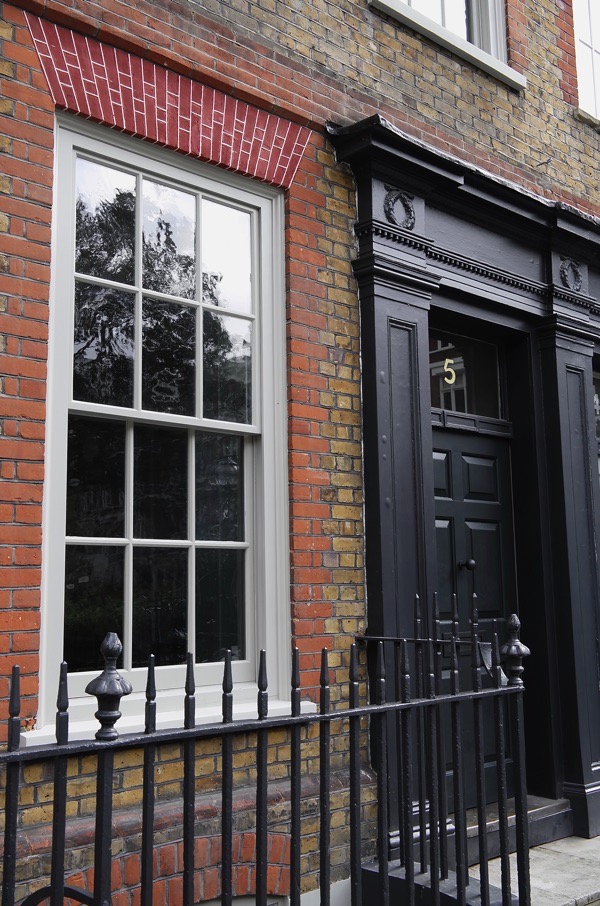
I was born at 5 Charterhouse Sq on January 26th 1880, one of a family of six boys and three girls. I was the seventh child of a seventh child but was never aware of any psychic powers. The only time when I was doubtful was when the craze for table turning was popular and my name was spelt out as being the medium – at which I went straight off to bed and left the party to find another person to receive the spirit messages!
5 Charterhouse Sq was a house of four storeys with a basement kitchen and a flat roof, a favourite playing place with two attics opening on to it. The inner attic was used for keeping silkworms which made lovely golden cocoons. My chief concern about them was getting mulberry leaves from the two trees which grew in the central court of the Charterhouse. These had to be picked with caution as it meant going onto the grass, a practice not encouraged by the gardeners. I do not think we were ever looked upon very favourably by the latter as we were also fond of popping the fuchsia buds that grew along the cloisters which ran down two sides of the court.
We always enjoyed playing in the Charterhouse, although we were never sure of a welcome from the warden who kept guard at the gate, and we usually tried to step through when he was having time off in his little room. We liked it as it was a place of cloisters and little courtyards which made good places for playing in.
It was there that my brother Francis and I saw our first and only ghost. We had been told by a friend that if we stood at the far end of one of the little alleys at dusk and whistled three times, a ghost would appear at the opposite opening. And it did! We fled for our lives, screaming and rushing through the walled gardens, pursued by the ghost who, by now, was as frightened as we were disturbing the old pensioners. When we were eventually caught by the friend who had put us up to this escapade, we were all in a state of collapse.
Although we lived practically in the City, being only just without the sound of Bow Bells, we were lucky in having ample space to play in, having the square and the Charterhouse. After school hours we were also allowed to go into the playground where we all enjoyed roller skating. My brothers used to ride on penny farthing bicycles until the fast low one which I remember was called the ‘bantam cycle’ was introduced.
We were always interested in kneeling on the window seats and watching everything that was going on through the open window. There were large gates below us, which could be shut at night to keep the square private, and just inside these was a favourite place for men to settle their differences in a fight. We did not like watching these, but there were more interesting events like a dancing bear, a German band or a barrel organ and May Day processions. One year, I remember a Jack-in-the-Green on November 5th, and funerals with the hearse and the horses’ heads carrying large black plumes.
Balloons would pass over, and one morning the square was covered with small leaflets advertising some sort of drink. On some of these there was a coupon entitling the finder to a free bottle. Although we diligently searched for this coupon we had no success and were quite convinced that the gardener had come out very early. He was a very imposing figure with a very fine brown beard. He treated us very well and even allowed a few of us to have a small piece of earth as a border for our own plants.
The Lord Mayor’s Show was always a great occasion and we were usually given seats in the Civil Service Stores. Street vendors sold panoramic pictures of the show before it took place, which always amused us as they were naturally quite fictitious. I think they were sold as ‘1d plain’ or ‘2d coloured’. One year the Show came along our square, an unusual event, but it was a wet cold day and we were saddened afterwards on hearing that one of the children taking part had died from the effects.
When I was seven, the City was preparing to celebrate Queen Victoria’s Golden Jubilee and we were taken to see the illuminations. These largely took the form of metal shapes with fairy lamps hanging on them. I remember the row which was fastened along the entrance to the Charterhouse. On this and on other royal occasions, we would go along Ludgate Hill or St Pauls to watch the procession and see the Queen. My recollections of her were of a small black figure, rather unsmiling and not looking very regal.
Our nurse used to take some sort of paper with alarming pictures of the events that were likely to happen if Prince Edward ever became King. His accession, according to these papers, would usher in a time of violence. This made me feel very alarmed as I was a very nervous child and was not helped by these pictures, and by being taken by my nurse – who must have belonged to some Second Advent Society – to meetings about the end of the world. I remember my fear at seeing any red in the sky – not an uncommon sight as there were frequent fires in the City – believing this meant the end of the world and we should all be burnt up. My brothers had no fears of this sort and would often go on to the flat roof of our house at night from which there was a good view over the City, to see if there was a fire raging.
Our roof was a favourite playground, it had a tallish parapet and my brothers would occasionally walk along this to the horror of people below who would rush to ring our bell and warn mother what was happening. Personally, I found it made me feel quite dizzy enough even to look over, so there was never any fear of my taking part in this dangerous game.
My mother always seemed busy with her sewing machine so seldom came out with us, and my father, who was head of a room at the War Office was only seen at weekends. He was not really a family man and after office hours would go to his club – The Thatched House – until we younger children were well out of the way. We were all very fond of our parents.
Mother had a gift for telling stories in a very graphic way, although some of those told at bedtime were hardly suitable for a nervous child. Her re-telling of the Old Testament stories was always my favourite, and I am reported to have said after many hearings of the fiery furnace and the three children, ‘Make them really burnt this time’. So I suppose I liked horrors in spite of being easily frightened!
On Sunday afternoons, my father would often take us out. We were always asked if it was a ‘walking’ or a ‘riding‘ Sunday and always decided on the latter which meant a penny ride along the Thames Embankment. My older brothers were encouraged to walk, being given a penny if they went as far as Cleopatra’s Needle. We also enjoyed an occasional outing on a steamboat and one afternoon we went with our nurse for a picnic in Battersea Park. We evidently had return tickets for the steamboat which my nurse lost, and as we did not have enough money to pay for the return journey, we had to walk until we were near enough to home to pay the bus fare.
The Muffin Man with his bell and white cloth-covered tray on his head was always a welcome sound. The Cats’ Meat Man was also frequently heard and his wares were sold skewered to a stick. The Lavender Sellers were more popular with us with their song. Fire engines, with their steam funnels and the men in helmets sitting back to back were always an exciting sight, with the large brass bell clanging to clear the road. And the Lamplighter with his long rod, although so often seen, was usually watched with interest.
We lived near Smithfield Market and would often see sheep being driven along. The fish market was also close and as a luxury we used to buy a pint of winkles. I remember on one occasion, while gloating over my little bag, I walked into a lamp post which I suppose would make an impression on me, although it is a queer thing that some memories remain so vivid.
In the summer when the gardener in the square cut the grass, he would let us gather it and make a sort of nest. Then we would have a feast, keeping some buns and pink and white long-shaped sugar cakes we called meringues. Of course, an occasion like this meant saving up before we could buy them.
To augment our pocket money, we used to make paper spills and on May Day and November 3rd , my grandfather gave us each a tip, probably sixpence. He was instructed to do this by the manservant who looked after him and who, on these special days, insisted that my grandfather should have his purse handy in spite of his protests that he would not need it, not realising that we were going to invade his study during the morning with either a May Day greeting or a request to ‘Remember the Guy’.
My education cannot be called anything outstanding. We had one governess, Miss Burks, who taught us everything: Latin for my brothers, French, the piano and all other subjects for girls. She must have been fairly efficient as I could read the newspaper when I was six, a feat I was called upon to demonstrate to visitors. The facts of life were an entire mystery however, so when I read that the Queen was expecting to be put to bed I was thoroughly mystified and my embarrassed governess hastily made me continue reading.
My mother had never expected to have a large family having been told after the birth of her first child that she could not have any more. However, the babies arrived in quick succession and when the twins increased the number to four, my father was so overwhelmed that he omitted to register their births. So, in later years when certificates were needed, all that could be produced were those for my sister Dolly and brother Wilfred.
Every Christmas, my Godmother, Amy Tyrrell, took me to the pantomime at Drury Lane – the only time I ever went to a theatre. This was a great occasion and the stars were Dan Leno, Little Dick and, I think, Herbert Campbell. The performance always ended with what was called ‘a transformation scene’ which was followed by the Harlequinade with Columbine, the clown with the ‘red hot poker’ and, of course, Harlequin.

Grace Jackson as a young woman

St Sepulchre, Old Bailey

Gardens of the Charterhouse with one of the Mulberry trees
You may also like to read about
The Alleys, Byways & Courts Of Old London
In the archive at the Bishopsgate Institute, I had the good fortune to come across a copy of Alan Stapleton’s London’s Alleys, Byways & Courts, 1923. A title guaranteed to send anyone as susceptible as myself meandering through the capital’s forgotten thoroughfares, yet the great discovery is how many of these have survived in recognisable form today. Clearly a kindred spirit, Stapleton prefaces his work with the following quote from Dr Johnson (who lived in a square at the end of an alley) – ‘If you wish to have a notion of the magnitude of this great city, you must not be satisfied with seeing its great streets and squares, but survey its innumerable little lanes and courts.’

St John’s Passage, EC1

Passing Alley, EC1

St John’s Gate from Jerusalem Passage, EC1

Stewart’s Place, Clerkenwell Green, EC1

Clerkenwell Close, EC1

Savoy Steps, Strand, WC2

Red Lion Passage, Red Lion Sq, WC1

Corner of Kingley St & Foubert’s Place, W1

Market St, Shepherd Market, W1

Crown Court, Pall Mall, SW1

Rupert Court, W1

Meard’s St, W1

Conduit Court, Long Acre, WC2

Devereaux Court, Strand, WC2

Greystoke Place, Chancery Lane, EC4

Huggin Lane, Cannon St, EC4

Mitre Court, EC1

Faulkner’s Alley, Cow Cross St, EC1

Last of Snatcher’s Island, Drury Lane, WC2

Brick Lane looking north

Brick Lane looking south
‘Hatton in 1708 called Brick Lane the longest lane in London, being nearly three quarters of a mile long. But Park Lane by Hyde Park was then six furlongs thirteen poles in length, so it had the advantage of Brick Lane, the length of which was five furlongs four poles. Today, Brick Lane by taking in its length its old continuations, Tyssen St and Turk’s St now beats it by thirteen poles. Tyssen St measuring one furlong fourteen poles and Turk’s St eight poles, thus bringing the length of the current Brick Lane to six furlongs twenty-six poles. Yet White HorseLane was undoubtedly the longest in London when it existed’ – Alan Stapelton 1923
Images courtesy Bishopsgate Institute
You may also like to take a look at
Tim Hunkin’s Fulfilment Center Machine

Tim Hunkin contemplates a zero hours contract
It is always an event when creative mastermind Tim Hunkin unveils a new satirical slot machine and ‘The Fulfilment Center’ – which can be played at Novelty Automation in Holborn from today – is no disappointment.
Inspired by online warehouses, Tim’s machine features a picker with a trolley who must collect the required items in the allotted time or face the consequences. The challenge for the player is to direct the picker with a control knob and hurry them along the aisles by ‘walking’ upon the plates at the foot of the machine. At the end of the game, depending on their performance, the player is hired or fired. Needless to say, I was fired.
I popped over to visit Tim at his amusement arcade in Princeton St on Sunday and, once he had successfully installed his new machine, he explained it to me.
‘I read that the picking ‘guns’ Amazon workers carry tell them how many seconds they have to get from one product to the next. Suddenly I realised that a ‘fulfilment center’ could become one of my games – this is the name that Amazon give their warehouses, which always makes me laugh. The bad conditions that workers endure is well known and some have already written to me saying nice things about my machine. I don’t think their lives have got any better.
The way it works is that the player has to rush round the warehouse picking products. If you complete your day’s work in the time allotted – lucky person that you are – you get a zero hours contract. If you are not good enough, you get a P45. So you can’t win really.’


Novelty Automation, 1 Princeton St, Holborn, WC1R 4AX. Open Tuesday- Sunday 11am-5pm, with late opening until 8pm on Thursdays.
You may like to read my other stories about Tim Hunkin
At The Boar’s Head Playhouse

Excavations at Aldgate
Down in Aldgate, on the corner where Petticoat Lane meets Whitechapel High St, once stood the Boar’s Head Playhouse. Just outside the City gate, it originated as a tavern and lodging for travellers at the beginning of the sixteenth century but by 1557 it was operating as a playhouse and continued to do so through the Shakespearean era.
We only know this because of a record of the Privy Council banning a lewd play entitled ‘ A Sack Full of News’ from being performed there in that year. In fact, most of what is known about this playhouse comes from lawsuits and it seems the Boar’s Head quickly acquired a reputation for satires and low city comedies of London life.
Last week, I went down to visit the Museum of London Archaeology‘s excavations and stand in the muddy spot where the players stood five hundred years ago, as the traffic of modern London roared around my ears. The archaeological site is in the shadow of a new Travelodge which suggests that, when it comes to the need for cheap accommodation, not too much has changed in this corner of Aldgate.
In 1594, Oliver Woodliffe took out a lease on the Boar’s Head and contructed a theatre in the yard complete with tiring house and a stage. In 1598, this was subleased to Richard Samwell who expanded the audience capacity by adding galleries. As a measure of the success of the playhouse, the following year he added more galleries and built a roof on the stage.
The Lord Derby’s Men became the first resident players and Robert Browne, leader of the company, quickly acquired the theatre, bringing in the Lord Worcester’s Men as the next resident company of actors. This was the heyday of the Boar’s Head Playhouse when the Privy Council wrote to the Lord Mayor in 1601 praising Worcester’s Men, ‘the place called the Boar’s Head is the place they have especially used and do like best, we do pray and require that the said house, namely the Boar’s Head, may be assigned to them.’
Yet the glory days of theatre were short-lived, curtailed by an outbreak of plague the following year. In 1603, Joan Alleyn wrote to her husband Edward, the celebrated actor, ‘Browne of the Boar’s Head is dead and died very poore.’
Chief Archaeologist Heather Knight confirmed that the Boar’s Head was a rectangular theatre in common with others north of the river, The Curtain, The Fortune and The Red Bull, while those on the south bank were round, The Globe, The Rose, The Swan and The Hope. Rectangular theatres offered a broad stage which suited plays with lots of action involving fencing, whereas the more intimate round playhouses suited romances. It is a mystery why these different styles of playhouse evolved on the opposing banks of the Thames, though it may reflect the differing audiences in each part of London.
How I wish I could have walked down from Spitalfields to the Boar’s Head Playhouse to join the audience and enjoy scurrilous comedies by Thomas Heywood, Thomas Dekker, John Webster, William Rowley, Thomas Middleton and see Ben Jonson’s lost play ‘The Isle of Dogs.’

A wall of the Boar’s Head Playhouse is uncovered (photograph courtesy MOLA)

The Boar’s Head Playhouse 1598 by C Walter Hodges

The Boar’s Head Playhouse 1599 by C Walter Hodges

Finds from the recent excavations at the Boar’s Head – the beer mug is likely to be from the tavern
You may also like to read about


