Gardening On The Roundabout

I went back to lend Caroline Bousfield a hand on the roundabout in Victoria Park Village where she has been gardening for the past fifteen years with spectacular results.
Wearing the regulation high-visibility vests that are an essential safety requirement for gardening on a roundabout, we crossed the road carrying secateurs and baskets. The roundabout presented an impressive display of flowers, including valerian, marigolds, evening primrose, cosmos, achillea and euphorbia – all set against the dramatically contrasted foliage of Caroline’s planting which creates such a luxuriant vision for those passing on the bus or shopping on the other side of the street.
“It was before the days of guerrilla gardening,” Caroline informed me, revealing that when she first began gardening on the roundabout, it was borne out of a gardener’s frustration in witnessing the neglect of such an attractive location for planting. “There was just a mass of green vegetation with straggly weeds around the edge. Every time I walked past it my fingers would itch to pull some of it out and plant something better in its place. And I think I did, once or twice, before I realised I should ask permission.” she admitted, as if she had no choice in her actions. Over the intervening years, Caroline has entered into an agreement with the council to lease the roundabout so that she can continue tending it on their behalf. “I think things have changed and Hackney Council is more open to this kind of thing nowadays,” she confirmed sagely, as we started work, cutting lavender in handfuls while the buses and trucks sped past just feet away.
Yet the pungent scent and the absorption of the work induced a state of concentration in which the presence of the traffic did not register. We were consumed by our task, gathering lavender but leaving enough for the bees that swarmed upon the plants, equally preoccupied in their work. Then it was time for tidying up. I undertook the unravelling of bindweed which was choking the smaller shrubs, while Caroline pruned the buddleias. As the branches were cut away, she called me over to see the scattered paper and foil food packets revealed beneath – the debris of foxes’ takeway dinners scavenged from the bins and enjoyed here in peace, as a moonlight picnic within the depths of the shrubbery at the heart of the roundabout.
Carrying the armfuls of pruned branches off the roundabout proved to be an activity which required a certain knack to find the gap in the traffic and haul it across to the pavement in time. In this task, Caroline demonstrated expertise borne of experience and an innate sense of timing, while I undertook the less challenging work of carrying the lavender. Then we stashed the sweet-smelling basket in Caroline’s pottery workshop nearby where she has been making and selling her own pots since 1975. Here she stores the lavender in the loft of this former carriage house, and when Caroline fires the kiln it fills the entire workshop with a powerful and intoxicating scent. By making her lavender up into bags and selling it through the local shops, Caroline makes enough money to pay for any new plants that are added to the roundabout each year. Although she also confided to me that she was off on holiday to Cornwall, where she hoped to get some seeds of a deeper-coloured valerian which grows wild on the cliffs there.
People driving past and travelling on buses may wonder about the mystery of the familiar “lady on the roundabout,” but there is no secret. Over fifteen years, Caroline has created a widely-admired garden and a known landmark, distinguished by a more lyrical style of planting than the standardised design of the corporate-sponsored roundabouts which exist elsewhere. During this time, Caroline’s roundabout has become a centrepiece for the life that surrounds it and a symbol of the thriving community in Victoria Park Village. Today, Caroline’s roundabout pays for itself and sustains itself without watering. Caroline’s roundabout owes its existence to her knowledge, insight and imagination, and her passionate and committed gardening.
“People do notice,” she confided to me in modest satisfaction, as she sat in the cool of the workshop to take a break, drink a glass of water and catch her breath.


“a certain knack to find the gap in the traffic and haul it across to the pavement in time”

Enough lavender left to satisfy the bees

Caroline Bousfield – “People do notice.”
You may also like to read about
Caroline Bousfield, Craftsman

Caroline Bousfield has been making pots in this former coach house in Victoria Park Village for nearly forty-five years. When local food shops began to close due to competition from supermarkets, she formed a traders’ association and they brought back a butcher, a fishmonger, a baker and a greengrocer. Then Caroline planted the roundabout outside her studio and created a garden that is now the appealing centrepiece of this lively corner of the East End. Today, her pottery workshop is the oldest-established business in Victoria Park Village and she has worked there longer than anyone else.
Caroline Bousfield’s story is an inspiring example of how the creative influence of a one community-spirited individual can have a huge impact upon a place, improving it for the better. Yet she presents herself modestly, wiping the clay off her hands with a cloth and welcoming everyone into her tiny workshop personally. To the left as you enter, you discover Caroline working at her wheel, surrounded by hundreds of white biscuit-fired dishes and pots awaiting glaze, while to the right is her showroom, lined wall-to-wall in shelves laden with examples of the elegant traditional studio pottery that is her forte. Drying her hands on her faded blue apron, Caroline pushes her thick brown hair away from her face to give you her full attention and you cannot but feel privileged to be there in her charismatic den.
“People always ask, how long does it takes to make a pot?” she confided to me with a complicit smile, “And there are two answers to that, two minutes or twenty years – depending on which way you look at it.”
Caroline trained originally as a potter and as a furniture maker, and has taught both continuously over the years. With characteristic lack of pretence, she calls herself a “Craftsman,” adding “My gardening is self-taught.”
“I came to London in 1972 when I got married, after doing a Teachers’ Certificate at Goldalming. My husband took a job with the Ford Motor Company in Dagenham and, as he couldn’t face commuting through the Blackwall Tunnel, we came to live here. It was thought to be a strange thing to do, to move to the East End, in those days.
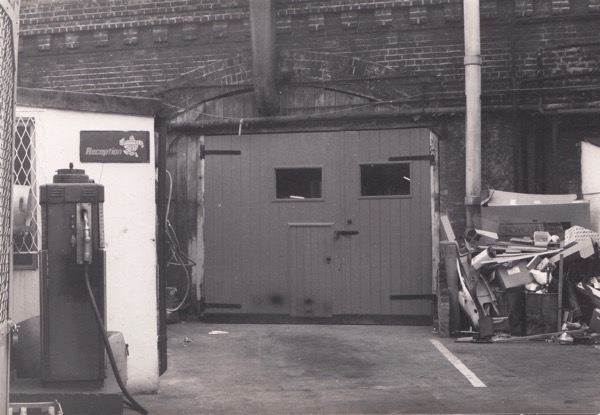
I taught pottery at Kingsway College until my two daughters came along. But I found that if you had children or a dog, people spoke to you in the street and a fellow dogwalker in Victoria Park told me that this place was for sale. It was built as a coach house and stable in 1885, and over the stone lintel you can still read the words “North Metropolitan Volunteer Fire Escape Brigade.” Mr Koopman had run it as an electrical repair shop from 1929 until he retired in 1975, and I bought it for £2,500, which was a bargain even then. My plan was to be able to make and sell my own pots in one place, and I like being here very much – if you run a shop you become a centre for local information. I remember Mr Davis, the hardware and grocer next door, every can was dusted and wiped as he took it from the shelf. And if you asked for rubber rings for jam jars, he’d opened up a trapdoor in the floor with a counterweight and return with some. ‘It says,’One shilling and sixpence’ on the label, that sounds like a lot!’ he’d say. This was already in the days of decimal currency.
When my daughters were babies, I just brought them here and got on with my work. Then I used to swap with a friend who had children, so we each got childcare for one day and my husband took care of them on Saturdays. When my children grew up, I decided I wanted to go back to making furniture and I imagined I would do that at home in the cellar, on the days I wasn’t here, but instead I started a traders’ association for local businesses. There were four butchers when I came and they all went, then the greengrocer and baker closed, so those of us who were left we discussed how to bring them back. We approached a butcher and a fishmonger and invited them to come here, and the existing shops even shuffled around to offer them the best locations.
And I started to lobby the roads’ department to let me grow plants on the roundabout, but the first answer was ‘no,’ so then I simply went over and started pulling up the weeds. In the end, I had to write a method statement and agree to wear a high-visibility vest, and pay £5 for the privilege too. They said this was because, if I got it free, I could claim squatters’ rights and build structures. Then I thought I should create an association to do it, so it was not just me – but it is just me. I’ve raised the money myself. People donate me books that I sell in the shop, and I pick the lavender and make lavender bags, and that pays for anything new I want to plant. I’ve come second and third in Hackney in Bloom but there is not really an appropriate category for roundabouts. Now people see me gardening from buses and cars, and they call me ‘The Lady On The Roundabout” locally.
There are secrets on my roundabout for anyone that works there – a patch of violets which nobody sees but me and which give a wonderful scent when in flower, a blackbird who is a regular visitor, the remains of foxes’ suppers stolen from bins and sometimes the debris of a party. If I ignore the traffic, the sound of bees on the lavender can be heard.
People who have spent a few hours working on the roundabout say that they feel differently about the place, they feel that they belong more. The climate for guerrilla gardening is quite different now from when I started on the roundabout ten years ago and I highly recommend it to anyone who lives near any unkempt public space.”


Biscuit fired pots awaiting glaze.


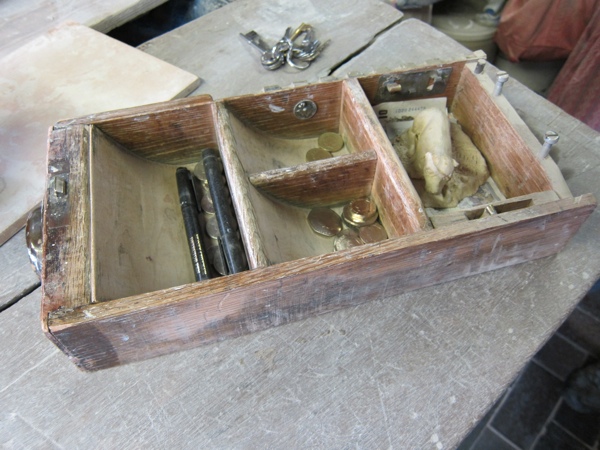
The money drawer from Mr Koopman’s Radio Shop with a sixpence that he nailed inside for luck and a dog made by a local pensioner who asked for clay to model his pet.

Caroline and her husband Gordon Gregory when they bought the coachhouse in 1975.

Gordon Gregory and his mother in 1975, after rebuilding the facade using the original bricks.

Caroline’s pottery studio today.

John Claridge’s photograph of the carriage house as electrical shop in 1964

Caroline on the Victoria Park Village roundabout that she planted and where she continues to garden, becoming famous in East London as “The Lady On The Roundabout.”
1964 Archive photograph © John Claridge
Caroline Bousfield’s Pottery Workshop & Shop, 77a Lauriston Rd, Hackn
So Long, Pyke’s Cinematograph Theatre

I undertook a melancholy pilgrimage along the Central Line to pay my last respects to the Pyke’s Cinematograph Theatre in Shepherds Bush this week, after a tip-off from one of the readers. As you can see, all that is left standing is a fragment of the facade of this early temple of moving pictures.
Impresario Montague Pyke opened the Shepherd’s Bush Cinematograph Theatre on 3rd March 1910 and it showed films until 1981, when it closed with The Fog. In 1923, after Pyke went bankrupt, it was reconfigured by John Stanley Beard as the New Palladium, becoming subsequently the Palladium, the Essoldo, the Classic, and finally Odeon 2. Despite surviving a flying bomb, a period of dereliction and a decade as the Walkabout Australasian bar, it has not escaped the voracious developers of our day.
Sitting next to the Shepherds Bush Pavilion and the Shepherds Bush Empire, in the Shepherds Bush Conservation Area, you might think this line of fine palaces of culture and entertainment overlooking the green were integral to the identity of the place. Yet last year Hammersmith & Fulham Council granted permission for full demolition except part of the front wall, which will be stuck onto the hotel tower in spread sheet architecture that will occupy this site in future.
Bearing a formal resemblance to a triumphal arch from ancient times, this fragment stands now as a poignant relic of another world, a vanished universe of the romance of early cinema – black and white films, live musical accompaniment and the advent of talkies. Innumerable dreams that were conjured here have vanished, leaving just this wrack of an arch – the portal to an era of cinematic glamour and fantasy forever lost to us.
You will recall I have lamented the growing resemblance of London to the backlot of an abandoned movie studio, full of frontages, so the irony of a cinema now joining the parade of facades has not escaped me.

As the Shepherds Bush Palladium

Original interior

External plaster signage

External plaster signage

The Walkabout Australian Pub, the Cinematograph’s last incarnation

This is the future of the facade of Pyke’s Cinematograph Theatre
You may also like to read about
Visit The Secret Gardens Of Spitalfields
Nine gardens in Spitalfields are open for visitors on Saturday 8th June from 11am – 4pm. Tickets cost £15 to visit them all and you can find details at the website of the National Gardens Scheme.


You may also like to read about
The Return Of Norah Pam

Norah Pam first came to Spitalfields in the summer of 1931 and made a return visit recently, just to see how things were ticking over in her old neighbourhood more than eighty years later. Here you can see her standing outside 11 Victoria Cottages, where her great-grandparents Lewis Carr, a silk dyer, and his wife Louisa came to live with their three children, shortly after the terrace was built in the 1860s. Norah was delighted to see that the gardens are well kept – just as she remembers them in her childhood in the 1930s.
By 1881, the family had moved to the flats at the rear of the cottages, known as Albert Family Dwellings and it was there that Norah grew up. She still has vivid memories of these formative years in Spitalfields, even though she only came to live in the Dwellings at the age of six and left in 1940 at the age of fifteen when the bombing of London made it too risky to stay.
It was my pleasure to introduce Norah to Spitalfields resident Mavis Bullwinkle who also grew up in Albert Family Dwellings in the 1930s, which was the cause of considerable mutual excitement since – although Mavis does not remember Norah – Norah, being seven years older, remembers eighty-six year old Mavis being born. “You were such a little baby,” she recalled sweetly, causing Mavis to blush, “I remember when your sister was born, she had golden curls and blue eyes and everyone doted on her, and my mother said to me, ‘Pay some attention to the little girl standing at the side of the pram,’ and that was you.”
This was a cause of great amusement to Mavis, who shrieked with girlish delight to confirm this unexpected recollection. “Yes, that’s right” she exclaimed in surprise, “My hair was was straight as die!” Yet all these years later, this conversation was evidence that Norah had taken notice of her mother’s instruction. “I can see you now coming down the stairs beside the pram,” she added, thinking back across time, on the occasion of meeting someone she had not seen in more than seventy years.
We all sat in a garden at Victoria Cottages and enjoyed a sunny morning chatting together, while Norah brought out her family photographs, which span dizzying amounts of time, and beguiled us with her account of her Spitalfields childhood.
“We moved into a flat in Albert Family Dwellings to be close to my grandmother – the family had been in Spitalfields since the 1840s.
I went to All Saints School in Buxton St. Some of the children were quite poor. I had a friend whose father was a ganger – a roadworker – and if it rained he got no work and he had no money. Several children had parents who were builders, they couldn’t work in bad weather either. Some were railway people, and if they had big families they couldn’t manage. My friend’s family worked in the parcels office, they were comfortable, they even had a holiday because they got free travel. There was a lot of poverty because in 1931 all public service workers had a pound cut from their pay – a wage of three pounds and five shillings a week went down to two pounds and five shillings a week. It was a significant amount of money and people had to cut back.
I wasn’t allowed to play outside. I was an only child and very protected, but I caught Scarlet Fever. I was taken to Homerton in the fever ambulance which was grey. My parents weren’t allowed to visit. They would bring a parcel each week and stand outside. The flat was sealed and the bedding taken away for fumigation, and my father had to have three days off work because it was so contagious. Then after six weeks, they said I had Nasal Diptheria and I had to stay another six weeks, so it was very harrowing for all of us. My mother cried when people asked how I was.
When the war came, everyone was evacuated but, because I had been seriously ill, I pleaded with my parents to let me stay at home, and there was no school, so I had a heyday. I remember the bombing of the docks. On that day, I went on my own to Dalston on the bus to buy a skirt at Marks & Spencer. The air raid siren went at two o’clock and we were told to get off the bus and go to a shelter. Then, at four, I bought my skirt and walked back to Spitalfields.
I wanted a pair of silk stockings to go with my skirt and in Hanbury St there was a little shop that sold everything. The owner was Noah Cohen, so I went to his shop and there was this little old lady and her daughter who was in her thirties. Noah let them go into the back to change and he told me their story. The girl had been in the bath when the air raid siren went and her mother called her to go to the Anderson shelter. The house was in Jamaica St and it got a direct hit, but they were saved by the shelter and all she had left was the dress she put on when she got out of the bath. Her mother had come to buy her a set of underwear to go to a night shelter in a school, and he let her change into her new clothes. I often wondered what happened to that woman because a lot of the schools were hit.
I went home and, by the time I got to the Cottages, I was running because I could smell the fires burning at the docks. And, as my mother opened the door, the people upstairs were coming down for safety. We sat in the doorway and my mother made tea while the bombs fell. The German planes made a particular noise. They got nearer and nearer and nearer, and you heard the bombs dropping, and you thought, “This is us,” and then they went over.
The people in the building across the road all left, and they set their cats and dogs loose. We found a dog in the street and my mother called it “Victory “because she said, “We’re going to have victory! They can continue bombing but we won’t give in. They can do what they like.” We kept him for seven years and he died on 31st May 1946, on my twenty-first birthday, in his sleep.
Then, in 1940, a landmine fell on the Crown & Leek in Deal St and they evacuated a mile around, and that’s when we all decided to leave. But even after we moved out, I was always coming back to see my friends. I missed by friends. And my father said, “But I thought you wanted a house with a garden?!”
Today, the Albert Family Dwellings have long gone, demolished in 1975. Mavis Bullwinkle who lived in the Dwellings until the end and now lives a quarter a mile away, told me she had not been over to this area of Spitalfields for thirty years, “Because I miss them so much.” The pair of terraces named Victoria and Albert Cottages, and St Anne’s Church, are all that remain now of the world that Norah and Mavis knew in their childhood. Yet for a couple of hours it came alive again, as they sat in the garden and shared recollections of the two old ladies who ran the sweetshop across the road – gone more than half a century ago – the mission hall that moved to Bethnal Green in 1935, and of the teachers at Sir John Cass School where they were both pupils before the war.
In contrast to the general assumption of poverty in the East End, Norah and Mavis’ history reveals a more complex social picture of people of different incomes living in close proximity. Norah and Mavis were also keen to emphasise the self-respecting ethic they grew up with. “They think we were all prostitutes and drunks, and we were dirty, but our working class morality was strong,” declared Mavis, turning passionate, “We didn’t think we were poor, we had enough to eat and we never wasted anything.” A statement which prompted the exchange of a glance of unity between the two women.
Then it was time to say goodbye – once Norah Pam and Mavis Bullwinkle had swapped numbers, because a new friendship had been kindled that morning. Norah took one last glance at the gardens of Victoria Cottages, where her great-grandparents lived one hundred and fifty years ago, and looked up to the space in the sky where Albert Family Dwellings once stood. “I had a happy childhood here,” she said.

Norah’s great grandparents, Lewis and Louisa Carr, and their children, Lewis, Louisa Ann and George – the residents of 11 Victoria Cottages, Spitalfields. On the reverse of this photograph Norah has written, “When my great-grandfather became a widower, he went to lunch each Sunday with my gran, always arriving wearing wearing a tall silk hat.”

Norah’s great uncle, Lewis Carr. He became a vaccination officer for Smallpox and lived on Cheshire St.

Norah’s grandmother, Louisa Ann Carr as a young woman. She worked at home sewing waistcoat buttons for Savile Row.

Norah’s grandmother, Louisa Ann, as an older woman at Albert Family Dwellings.

Norah’s parents’ on their wedding day.

Norah’s father Edward Samuel Simmonds in 1939.

Norah’s mother, Violet Louisa Simmonds, with their dog Victory.

Norah’s class at All Saints’ School, Buxton St in 1934. Nine year old Norah is in the check dress with spectacles, third from the right in the first row seated on chairs. Norah’s glasses were from Mr Stutter, the optician in Bishopsgate.

Norah in 1940, aged fifteen.

Norah and Mavis both grew up in the Albert Family Dwellings in Deal St that were demolished in 1975.

The last May Queen at Sir John Cass School in 1939, Mavis is third from the right in the front row of girls standing.

Mavis’ Aunt Ada and her mother Gwen in Deal St outside the Albert Family Dwellings in the 1920s.

Norah Pam & Mavis Bullwinkle at Victoria Cottages.
You may like to read my profile of Mavis Bullwinkle, Secretary
The Journeyman Weavers’ Houses
I am delighted to announce that after my report on the threat of demolition to 3 Club Row – a journeyman weavers’ house dating from 1764/6 – Historic England visited the property last week, and the Secretary of State is currently assessing whether to grant listed status to this building and 5 Club Row which is its mirror image.
Last Friday, Tower Hamlets Council issued a Building Preservation Notice on 3 Club Row which gives it legal protection during the listing process and makes it a criminal act for anyone to damage it.
If you would like to learn more about the journeyman weavers and discover why their surviving houses are significant, you can join a guided walk on Saturday 15th June hosted by Julian Woodford, author of The Boss of Bethnal Green. Click here for tickets.
The battle to save 3 Club Row is not yet over. If you have not yet submitted an objection to the demolition, please do so. We need to register as many objections as possible. You will find instructions at the foot of this article.

3 & 5 Club Row, two survivors of a terrace of six four-room houses built 1764-6
The terraces of silk merchants’ houses in Spitalfields declare their history readily, yet these more modest buildings of the same era survive as the last vestiges of the workshops and dwellings where the journeyman weavers pursued their trade. You might easily walk past without even noticing these undemonstrative structures, standing disregarded like silent old men in the crowd. I am indebted to Peter Guillery and his book The Small House in Eighteenth Century London for highlighting these buildings where the silk weavers worked, which are equally as significant historically as the larger homes of the merchants who profited from their labour.

190 & 192 Brick Lane, weavers’ houses of 1778-9 built by James Laverdure (alias Green), Carpenter

113 & 115 Bethnal Green Rd, two five room houses of c.1735 probably built by William Farmer, Carpenter

70-74 Sclater St, three houses built for weavers c.1719

70-74 Sclater St, No 70 was refronted in 1777

97 & 99 Sclater St, built c 1720

46 Cheshire St, built in the sixteen-seventies

4a – 6a Padbury Court, probably built c. 1760

125 Brick Lane, shop and workshop tenement probably built in 1778 for Daniel Dellacort, a distiller

Note the developer’s Porsche in this rendering of their proposed replacement for 3 Club Row
HOW TO OBJECT EFFECTIVELY
Use your own words and add your own personal reasons for opposing the development. Any letters which simply duplicate the same wording will count only as one objection.
1. Quote the application reference: PA/19/00932/A1
2. Give your full name and postal address. You do not need to be a resident of Tower Hamlets or of the United Kingdom to register a comment but unless you give your postal address your objection will be discounted.
3. Be sure to state clearly that you are OBJECTING to the demolition of 3 Club Row.
4. The building is exceptionally rare and significant and should be listed.
5. It is an historic building in a Conservation Area and part of the historic and architectural interest of the area.
6. The replacement scheme is not worthy a replacement.
WHERE TO SEND YOUR OBJECTION
You can register and object by clicking here if you have a UK postcode
or
you can write an email to
planningandbuilding@towerhamlets.gov.uk
or
you can send a letter to
Town Planning, Town Hall, Mulberry Place, 5 Clove Crescent, London, E14 2BG
Ronnie Grant, Racing Driver

‘I was racing with people a third of my age…’
Last year, at ninety-three years old, garage owner Ronnie Grant shot to fame as one of the tenants of the railway arches faced with exorbitant rent increases by Network Rail. Ronnie showed admirable moral courage as one of the founders of Guardians of the Arches – linking more than fifteen hundred businesses – and became a spokesman in Parliament and the press, championing the cause of his fellows across the nation as the arches were sold off.
Contributing Photographer Sarah Ainslie & I visited Ronnie under the railway arches in Clapham to hear the life story of this inspirational nonagenarian who has taken the brave initiative to stand up for others in his advanced years. We were astonished to find him unloading sacks of cement from a truck and, once we sat down to talk, we discovered that Ronnie was already a hero in another arena, as a racing driver.
“I used to be down here working hard at five o’clock in the morning and still here at ten o’clock at night. I had a cold once and I took too many codeine tablets, and I spewed up blood. I was carted into St James’ Hospital, Balham. I was given six pints of blood and one of those was infected with Hepatitis, so then I was put in isolation. I lay there and all I had to do was drink water. I thought, ‘When I get out, I am going to do everything I ever wanted to do.’ This was in the sixties and Volkswagen had just brought out this Formula V racing car. It had the front axle and engine of a beetle but you could make up a frame of your own. This is what I did and I did it here in my garage. I built a racing car in this arch, it was quite easy really. So I started racing and I started winning. I thought, ‘This has got to be good!’
As a racing driver, you have to be fit. At six o’clock in the morning, I would be up at Crystal Palace running round the track for half an hour, then I would play squash and do thirty lengths in the olympic pool afterwards. This was before I started work at half past seven or eight o’clock. I did that for donkey’s years. When I finished work at half past seven or eight, I would go swimming until ten o’clock. That keeps you fit.
I raced all round Europe in Formula V, and I used to get start money, prize money and travel expenses. We loaded the car onto a pick-up truck and my little son George sat in the racing car and I sat in the front of the pick-up. I raced in Holland, Belgium and German. I always used to be in the first eight or ten and I often won, so I used get francs in Belgium, guilders in Holland and marks in Germany – that was how I started racing.
Then I went into Super V and, through the grapevine, I heard that Lola Cars up in Huntingdon had a chassis but no gearbox. I met John Barnard and Patrick Head, they used to come here and help me working on the racing car. We went from there, Patrick designed a Formula 2000 car which I raced. I was still racing when I was sixty-five, so I did quite well at that. It gave me a lot of joy because I was racing with people a third of my age.
I am a Londoner, born in 177 Railton Rd, Brixton. My father, Harry Grant, came from India to study in London, but he enlisted in World War I and lost a leg. I do not know too much about his family, although they came to visit us once when I was a child. I remember they stayed at the Savoy and bought me a Crombie coat, which I got teased for a school because it was expensive.
During the thirties, nobody wanted to employ a man with one leg. My father did odd jobs and we got by. I had a gorgeous upbringing. We had a lovely family. We never went hungry. We had two bedrooms – me, my brother and my sisters slept in one room and my parents in the other. When I think about it now, how my mother cooked and did all the washing in a tiny scullery I do not know. She used to get up at five to light the boiler to heat the water. My brother was older than me and I had younger two sisters. We all had jobs. I used deliver papers in the morning and help the baker after school.
I wanted to be a sailor so they put me in the Greenwich Naval College. My dad bought me a bike and I used to cycle from Brixton Hill down to Greenwich to go to school. I was doing that for months until a car hit me – bang – in Camberwell and I finished up in St Giles’ Hospital with a broken leg.
When World War II came, my brother Dennis went into the RAF and flew Lancaster bombers, he did thirty tours and won the DFC. He won a scholarship and became a Lloyds underwriter but I was the dunce. If there were thirty in class, I was number thirty. I was seventeen years old but I put eighteen years old on the form and I volunteered for the navy. Unfortunately, I told them I was a van driver, so they told me, ‘Men of your level of qualification are required in the army.’ They put me in the infantry in France, Belgium, Holland and Germany. Then they told me they needed men in Burma and, if you volunteered, you got seven days leave. So I volunteered. I took the Empress of Scotland out of Southampton but, when I got to Port Said, they dropped the Atom Bomb. So they did not need us in Burma, instead they sent us to Palestine and Egypt, then Cyprus and Greece.
I met a girl there, Mary, and we came back together and we were married for many years. We adopted my son George who was her step-sister’s child. When he was eighteen months old, my wife left, she said ‘I’m going to see my cousin in Birmingham, look after him,’ and I did not see her again for years. I do not know what happened. George stayed in a nursery at Egham in the week, while I was working, and I picked him up at the weekend. I bought a house in Clapham and was doing it up and he came to stay with me there. I married Sheila who I had known since was eighteen. She was married to someone else and I was married to someone else. When she got divorced I rang her up and that was it, we have been together fifty-two years.
I became a cabdriver, driving a saloon with three doors and luggage rack on the side. With my partner Jack Laming, we started off with one cab. He had been chauffeur to Sir Duncan Hall-Lewis, they lived in the South of France. Jack came over to London and lived in the same block of flats as I did in Stockwell Rd. We bought this cab and we ran it together for the first year, alternating night and day. We changed over every month, but we both preferred night work because you can move about much quicker and you get couples and fours rather than solo passengers. That was all extra money.
Then we bought another cab. We started down in Melbourne Sq off Brixton Rd but, when we reached six cabs, Mr Good the owner said, ‘I’m going to have to ask you to move.’ We moved up to a place in Stockwell and then we heard these arches were going so we came up here and we got this, luckily enough.
I have been a tenant of Network Rail since 1960. When I came here, these arches were nothing like they are now. There was one forty watt light bulb in each arch and a brick wall between them. It belonged to British Rail then, so I phoned them up and said, ‘I want to make a few improvements.’ They sent down a surveyor and he said, ‘What do you want to do?’ I said, ‘I want to put a ramp in there and take up the cobblestones.’ He said, ‘You can do anything you like as long as you pay the rent.’ It was two pound fifty per arch per month then. Very reasonable.
When we first came here, it was like countryside. There was a little village green up the road with two-up-two-down cottages all the way round. It was a lovely village green, and I was friendly with the manage of the pub opposite and I used to park the cabs on the forecourt.
At one stage in the game, we had nearly forty-five cabs. Every year, we had to get our cabs overhauled as if they were new, clean the chassis and everything. Then people started asking us to do their cars, so I said,’Right, we’ll do cars!’ I was a motorcyclist because the only way to get around if you could not afford a car was on a motorbike, so we did cars, motorbikes and three-wheelers.’ That was how the garage started.
We were good at what we did and we never stitched people up, so everyone came back to us. Over the years, we have had the grandfathers, the fathers and the sons. People keep coming back.
Network Rail wanted to increase my rent by 350%. We do MOTs but we have not had a rise in our fees since 2010. In this respect, we are working for the government. We cannot increase our fees, but Network Rail can come along and say they want 350% increase. We paid £34,000 a year for three arches and they wanted £143,000 a year. It is not possible. We could just about manage £50,000 but that would be quite a high increase. It is a long way from two pounds fifty a month!
We battled with them and we got people together. United we stand. This is why we formed the Guardians of the Arches. We joined up with the Chu family from their garage in London Fields to fight this together. We are getting people together from all around the country.
When I spoke in the Houses of Parliament, we had people from Manchester, Newcastle, and Gateshead – all over the country – as well as London. We had a committee room and I got up and said my piece and other traders spoke as well. We are asking for a reasonable rent, not a 350% increase that will drive us out of business. Unless they increase the MOT fees, we cannot survive. BMW charge £150 an hour labour costs but we charge £70 an hour. If we put it up too much we will lose all our customers. Not everyone can afford it. There are hundreds of small businesses that are going to go out of out business, destroying livelihoods.
There are three neighbouring arches here. One has been empty eight years, one has been empty five years and Dentons catering equipment quit when they heard of the increase.
I am in favour of progress – I bought a washing machine last week using my apple watch – but I do not approve of them putting up the rent when they have not done a stroke of work in any of the arches for sixty years. All they have done is sit back and collect the money. Think of the money I have paid them since 1960, and there are thousands and thousands of us. It is diabolical, but I remain optimistic – I do not want to be anything else.”
Click to support GUARDIANS OF THE ARCHES crowdfunding campaign

The first photo of Ronnie with his mother and elder brother Dennis in the twenties.

Ronnie at seven or eight years old with his brother Dennis and aunties and friends in Bromley

Young Ronnie

In the thirties, Ronnie at sixteen years old, collecting milk crates for South Suburban Co-op at 16 Brixton Hill. He remembers the horse was called Trooper and the boy who wanted a lift was Percy Chamberlain.

Ronnie in his twenties, during World War II

Ronnie’s taxicab company

Ronnie as a cab driver

The Clapham railway arch as it was in 1960

Ronnie in a Ford 2000, designed by Patrick Head in the seventies

Ronnie at Silverstone, 1981

“At Silverstone on 31st March 1984, I spun, got on the grass and a Belgian smashed a car onto me. I lost my elbow and leg, I lay down in the mud and blacked out and thought this is the end! I was in hospital for nine months and visited by Jimmy Saville”

At Brands Hatch in the eighties

Memorabilia from Ronnie’s racing days

Ronnie and his son George who runs the garage with him today

Memorabilia from Ronnie’s racing days

Roger Price, AKA Roger the Lodger, twenty years at the garage

Memorabilia from Ronnie’s racing days

George Dunbarton, sixteen years at the garage

Memorabilia from Ronnie’s racing days

Ashley Gaynor, Manager, six years at the garage


Sarah Todd, Book Keeper at the garage


Ronnie and his beloved garage in Clapham
New photographs copyright © Sarah Ainslie
Clapham North MOT, 629 Cottage Grove, Clapham North, SW9 9NJ
You may also like to read about