
Christmas At Dennis Severs’ House
I often wonder if those who visit the Christmas installation at Dennis Severs’ House in Folgate St in spellbound silence today have any idea of what it was like when the creator of this time capsule interior was alive. The late Rodney Archer was a close friend of Dennis and, in this extract from his diary This Strange Re-collection of People (1980-88), Rodney spills the beans.

Christmas was for me the best time of the year to visit Dennis Severs in his house, which he shared with Mr & Mrs Jervis and their children in the Liberty of Norton Folgate. The hall was festooned with garlands of holly and ivy and mistletoe. No tinsel marred the scene! The smell of Christmas spices assaulted your nostrils as you entered the front door. Oranges stuck with cloves abounded and the warm hospitality of the Jervises’ was almost palpable. Young boys in velvet waistcoats and knee britches and enchanting young girls in Kate Greenaway muslin dresses would greet you as you entered, offering rum punch circa 1730. Steven, who was eventually to run a restaurant from the ground floor of his house in Church St, had found the recipe in an old eighteenth century cookbook and Dennis was delighted. These children bearing punch were the sons and daughters of neighbours, friends and guests. If you were among the favoured, invited to one of Dennis’ private parties, you had to be prepared to join in and not rock the boat. Everything and everyone was highly organised.
As midnight struck, we were all hurried out of the drawing room and upstairs in the dark to the attic. This was the room in which the sitting tenant, who died within minutes of Dennis signing the contract to secure the house, lived and so promptly perished. It was also the room in which Dorian, the most beautiful of Dennis’ footmen, had his lodging. Towards the end of his brief life, when he was dying of AIDS, Dorian was forced to step into the cupboard when the tours came round to see the room inhabited – in the fiction of it – by Tiny Tim and his father, Bob Cratchet. I am not sure how the Jervises were connected to the Cratchets but what with the arrival of the Spinning Jenny in the early nineteenth century, hard times overtook the silk weavers of Spitalfields and perhaps Mrs Jervis had to take in a lodger? Eventually, Dorian was to move to Church St, two doors away from where I lived with my mother.
“Shhh, don’t talk any of you, shhh… Steven, Arlecchino, Quiet!” Dennis ordered like the matron in charge of a hospital ward. Think Hattie Jacques in ‘Carry on Nurse.’ “Where are Beyond & Ken? Not behind again?!” he asked, wondering if the two performance artists who attended the Hornsey School of Art had lost their way.
Beyond & Ken had lingered too long in the front room on the first floor, called somewhat grandly the ‘piano nobile.’ They were duly fetched and fixed in Dennis’ disapproving eye. All ready and inspected, we followed faithfully and quietly behind as he pushed open the door to his bedroom where we saw the four poster bed covered in red velvet. The bed and canopy had been made from pallets and refuse rescued from the nearby fruit and vegetable market – Dennis was an early recycler.
“Nothing here is real,” he cautioned as Judy (Edgar-in-Elder-St’s first wife) dared to touch a papier mache wig stand. In real life, the bed was Dennis’ own but for the purpose of the pantomime had become… “The bed of Ebenezeer Scrooge, just imagine it,” he said in an almost conspiratorial whisper. Dennis took himself very seriously in these moments and woe betide anyone who did not share his enthusiasm. I wondered why I often felt the need to come out of the illusion he had spent so long in creating. Perhaps, even though I was not a ‘Guardian’ reader, there was something in me that felt too manipulated in these moments? A kind of scepticism mixed with jealousy perhaps? After these many years, now Dennis has departed to join the great Ebenezeer in the sky, I ask his pardon if I did not always share his vision. It was complete but unrelenting and did not allow for one’s own response.
“Imagine,” he continued, “the Ghost of Christmas Past, Present and Future flying overhead.”
Being dyslexic, Dennis had probably never read ‘A Christmas Carol,’ although he would have seen and loved that most famous version with the peerless Alistair Sim as the old miser and, of course, he would have remembered his mother, in the years before she fell ill, reading it to him in the far-removed and warm and sunny clime of California, in the town of Escondido where he had been born.
“You must imagine the snow falling on the rooftops and the frost on the windowpanes of Scrooge’s London house,” she might embroider, delighting her enchanted son, who would one day bring back to the land of its origin the very tale that had been exported so far across the world.
The tape of ‘A Christmas Carol’ would be playing in the background as we all stood, unable to hear it clearly, while Dennis in headmistress mode kept us quiet and I suspect, if we were honest, slightly resentful. Or did the others just feel, “Dear Dennis, he’s so eccentric, how wonderful!” ?
Finally, we were ushered into the drawing room on the ‘piano nobile’ floor where wine glasses and Christmas punch awaited. Dennis proposed a toast to Christmas,
“To Christmas, Ebeneezer Scrooge, the Queen and Spitalfields,”
to which we all added,
“And Dennis,”
“And Dennis,”
“And Dennis.”
Lionheart marred the occasion to my mind – I may have stood outside of it a bit but I never deliberately sabotaged the tale – Lionheart laughed and stabbed out with, “The Queen!” stressing Her Majesty in such a way that it was quite clear what queen he had in mind. There was little love lost between Lionheart and Dennis. There always existed between them that false bonhomie that just manages to control the very real dislike underneath.
Later on, I made moves to go. Phyllis, my mother, had already said goodnight amongst much gooing and gahing, cooing and cahing and was waiting for me downstairs. She was always a bit ambivalent about Dennis and the house he shared with the Jervis family. But she responded to his flattering ways and purred appropriately when stroked. Outside, on the way, home her tarter, or perhaps even her Tartar side, would emerge.
“Well, I’m glad that’s over for another year. I can’t bear those garlands made out of nuts. And, as for the Queen,” she added tetchily.
The garlands in question were draped across the panels in Mrs Jervis’ drawing-room and, from a distance, looked remarkably like the Grinling Gibbons’ carvings found in many a stately mansion and English country house. Up close, however, the illusion vanished and you saw that they were an ingenious hodgepodge of walnuts, almonds and brazil nuts sewn together of an evening by Dennis and his friends. Dennis would often have his most trusted fans around for a night in the smoking room. There, clad cap-a-pie in leather, they would celebrate the joys of friendship in a modern version of the eighteenth century Hellfire Club, sharing a pipe of marijuana and a working class lad or two.
“All is illusion and magic, that is the whole point,” he warned, his voice veering into a higher key as his eagle eyebeam struck the further side of the room, where Ian Gladly had been sighted examining a painting of Gainsborough’s ‘Blue Boy’ too closely. It looked real but how could it be?! Had Dennis raided the Tate Gallery? He was known for his daring.
“Do not all charms fly/ At the mere touch of cold philosophy?” – our host amazed nearly everyone by quoting John Keats. I was not amazed, though I was amused, because I had given Dennis the Keats quotation only a week before when he was complaining about the people who had not “got it” because their reading of ‘The Guardian’ and their critical eye got in the way. Duly chastised, Ian scurried away to refill his empty glass with the Christmas punch circa 1730.
“Dennis, I must go now too. Thank you for a wonderful evening,” I ventured, not realising that I was skating on very thin ice. Dennis replied with suave charm,“Thank you, Rodney, thank you for sticking it out for so long.”
For a moment, I did not feel the pain. I genuinely thought he was thanking me and then I realised that his was as much an attack as Lionheart’s had been. Maybe I had sounded rather grand, rather condescending? – I have that effect occasionally but, on this occasion, I chose my words carefully and was genuinely grateful. Perhaps, and this is more likely, he had picked up on my attitude at a much deeper level? Dennis was not an intellectual in any way. He was very much a creature of instinct, emotion and intuition. And he would sniff out any insincerity on your part and snuff you out immediately like a candle in an eighteenth century wall sconce. When riled he was a veritable tiger. He himself was, however, notoriously insincere. He liked to think of himself as very American and straightforward, but he could smile and be a villain with the best of us. In short, he was a ‘character.’
A group of us had gathered in the hall on the ground floor, fumbling for our coats in the Victorian room which opened off the room in which the Christmas goose sat proudly on its big eighteenth century platter, awaiting consumption.
“The wonderful thing about Denny,” Edgar-in-Elder-St drawled, “is he is a confidence man, a trickster. He sold to the English what was already theirs. It’s better than bottled water – and what a swizz that is – And we fell for it completely. We bought it!”
“Very American, that,” Lionheart added, as he struggled to find Arlecchino’s opera cape which had somehow gone missing.
“Lionheart, where ees my cape, I can’t pass thee market porters dressed as a ‘macaroni’, a kind of Yankee Doodle Dandy! I will be a laughing stocking.”
At this point Arlecchino’s eyes met those of Whitechapel, Dennis’ black and white cat, sitting at the bottom of the stairs and enjoying the festivities. Finally, we found the cape and Arlecchino’s costume was hidden from the amused and even scornful eyes of the market porters, through whom he imagined himself moving so perplexingly.
I had confided to Lionheart earlier that I found the house too much of a museum and a bit too Hollywood for my taste. I can say this without doing Dennis any harm at all because, in all these years, I have only met two other people who felt the same as I did. Dennis prided himself on being the real thing. The ‘real thing’ in terms of taste and decoration was distinguished by him as the ‘Joan Collins School of Decoration’ versus the ‘Queen Mother’s School of Decoration.’ There was even a television programme on the area in which Dennis and William Candy, the architectural-historian-who-wore-a-kilt-and-sported-a-pigtail, were seen wandering around Spitalfields and Brick Lane, past the Jewish Soup Kitchen for the Poor, along the Moorish Arcade in Fashion St, examining different facades and door fronts, lintels and fanlights, approving or disapproving as the Queen Mother dictated.
Our door front had been a thing of beauty and a joy forever, until we had to have it taken away and repaired and, in that process, hundreds of years of paint was stripped off – O, God, forgive me – to reveal the original contours sleeping unsuspected beneath and then the door became a bad thing. In vain did I argue that mother and I had very little choice in the matter – the architect insisted – but Dennis would have none of it, and so Phyllis and I had the indignity of hearing Dennis and William Candy, the architectural-historian-who-wore-a-kilt-and-sported-a-pigtail, stop in front of our door and exclaim to the nation in a televised documentary, “This is very much an example of the Joan Collins School of Decoration! We prefer the Queen Mother’s School.” They both shook hands on it and that was that. Our fate was sealed.
My mother and I had been consigned to that uncomfortable circle of Dante’s Inferno shared by homosexuals and failed house restorers. Though he would have been mortally offended to hear it, Dennis’ house had a bit too much of the ‘Metro Goldwyn Mayer School of Decoration’ itself but God protect you if you ever hinted so much. He was not only very sensitive in these matters but also – and the two go together like a horse and eighteenth century carriage – deeply insecure.
I had previously joked with Lionheart about Dennis’ ordering us all about as if we were servants, “Now those of you who are sitting in them, bring the eighteenth century chairs up to the drawing room.”
“Dennis, which ones are they?” I asked.
“O, Rodney, really! The eighteenth century chairs have no arms, thereby enabling Mrs Jervis and her daughter, Sophia, to sit with their farthingales and hoopskirts unimpeded,” he emphasised, somewhat pedantically in his short quick trans-Atlantic accent.
Well, lah-di-bloody-dah, my dears, and God bless you all – Dennis, Ebeneezer Scrooge, the Queen and Spitalfields!


Text copyright © Estate of Rodney Archer
Photographs copyright © Dennis Severs House
Dennis Severs House, 18 Folgate St, Norton Folgate, E1 6BX
Rodney Archer’s diary is preserved in the archive at Bishopsgate Institute
You might also like to read
My Panto Years
Traditionally, Boxing Day is the occasion for a visit to the pantomime and so I choose this day to publish my theatrical memoir

Longer ago than I care to admit, fortune led me to an old theatre in the Highlands of Scotland. Only now am I able to reveal some of my experiences there and you will appreciate that discretion prevents me publishing any names lest those who are still alive may read my account.
It was a magnificent nineteenth century theatre, adorned with gilt and decorative plasterwork. Since this luxurious auditorium with boxes, red drapes and velvet seating was quite at odds with the austere stone buildings of the town, it held a cherished place in the affections of local theatregoers who crowded the foyers nightly, seeking drama and delight.
Although it is inexplicable to me now, at that time in my life I was stage struck and entirely in thrall to the romance of theatre. Perhaps it was because of my grandfather the conjurer who died before I was born? Or my love of puppets and toy theatres as a child? When I left college at the beginning of my twenties, I refused to return home again and I did not know how to make my way in London. So I was overjoyed when I landed a job at a theatre in the north of Scotland. I packed my possessions in cardboard boxes, took the overnight train and arrived in the frosty dawn to commence my adult life.
As soon as it was discovered I had a literary education, I was assigned the task of organising the script and writing the ‘poetry’ for the annual pantomime, which that year was Dick Whittington. In the theatre safe I found a stash of tattered typescripts dating back over a century, rewritten each time they were performed. These documents were fascinating yet barely intelligible, and filled with gaps where comedians would supply their own patter. I discovered that the immortals, in this case Fairy Bow Bells and Old King Rat, spoke in rhyming couplets. Yet to my heightened critical faculties, weaned on Shakespeare and Chaucer, these examples were lame. So I resolved to write better ones and set to work at once.
Fairy Bow Bells:
In the deepest, bleakest Wintertime,
I welcome you to Pantomime.
Here is Colour! Here is Magic!
Here is Love and naught that’s Tragic.
‘You are here to learn the art of compromise, and how to pour a decent gin and tonic, darling,’ the director informed me at commencement with a significant nod of amusement when I submitted my work. I tried to raise an amenable smile as I served the drinks, but it was a line delivered primarily for the benefit of the principals gathered in the tiny office for a production meeting. These were veterans of musical comedy and summer variety who played pantomime every year, forceful personalities who each brought demands and expectations in proportion to their place in the professional hierarchy, with the ageing comedian playing Dame Fitzwarren as the star. Next came the cabaret singer and dancer playing Dick Whittington and then the television personality playing Tommy the Cat.
It was my responsibility to manage auditions for the chorus of boy and girl dancers, sifting through thousands of curriculum vitae and head-shots to select the most promising candidates. Those granted the opportunity were given ten minutes to impress the musical director and the choreographer with a show tune and a short dance sequence. Shepherding them in and out of the room and handling their raw emotions proved a challenge when they lost their voices, broke into tears or forgot their routines – or all of these.
The cast convened for a read-through in the low-ceilinged rehearsal room in a portacabin in the theatre car park. Once everyone had shaken hands and a cloud of tobacco filled the room, the director wished everyone good luck and, turning to me before leaving the room, declared loudly ‘Don’t worry, darling, they know what to do!’, employing the same significant nod I had seen in the production meeting and catching the eye of each of the principals again.
We all sat down, I handed round the scripts and the cast turned to the first page. The principals gasped in horror, exchanging glances of disbelief and reaching for their cigarettes in alarm. Dame Fitzwarren blushed, tore out a handful of pages and spread them out on the table, muttering, ‘No, no, no,’ to himself in condemnation. I sat in humiliated silence as, in the ensuing half hour, my sequence of pages was entirely rearranged with some volatile horse trading and angry words. Was this the art of compromise the director had referred to? I had organised the scenes in order of the story – no-one had explained to me that in pantomime the sequence of opening scenes are a device to introduce the principals in order of status from the newcomers to the seasoned stars. Yet even if I had understood this, it would have made little difference since the cast were all unknown to me.
On the second day, the floor of the portacabin was marked with coloured tapes which indicated the placing of the scenery and it was my job to take the cast through their moves. Dame Fitzwarren was keen to teach his comedy kitchen sequence to the two young actors playing the broker’s men. Once he had walked them through, I suggested we should give it a go. ‘No,’ he said, ‘That was it, we did it.’ I understood that, in pantomime, comedians only rehearse their sequences once as a matter of honour.
The little theatre owed its existence to the wealth of the whisky distilleries which comprised the main industry in the town and many of the directors of these distilleries were members of the theatre board. In particular, I remember a diminutive fellow who made up for his lack of height with an abrasive nature. He confronted me on the opening night, asking ‘Is this going to be good, laddie?’ My timid reply was, ‘It’s not for me say, is it?’ ‘It had better be good because your career depends upon it,’ was his harsh response, poking me in the gut with his finger.
In fact, Dick Whittington – in common with all the pantomimes at that theatre – was a tremendous success, playing to packed houses from mid-December until the end of January. The frantic energy of the cast was winning and the production suited the mechanics of the building beautifully, with brightly coloured flying scenery, drop-cloths and gauzes. The audience gasped in wonder when Fairy Bow Bells waved her wand to conjure the transformation scene and booed in delight when Old King Rat popped up through a trap door in a puff of smoke. They loved the familiar faces of the comedians and laughed at their routines, even if they were not actually funny.
Given the punishing routine of three shows a day, the collective boredom of the run and the fact that they were away from home, the pantomime cast occupied themselves with a rollercoaster of affairs and liaisons which only drew to an end at the final curtain. Once Dick Whittington unexpectedly stuck her tongue down my throat in the backstage corridor on New Year’s Eve and Dame Fitzwarren locked the door of the star dressing room from the inside, subjecting me to his wandering hands when I came to discuss potential cuts in the light of the stage manager’s timings. I found myself entering and leaving the building through the warren of staircases and exit doors in order to avoid unwanted attention of this nature. The gender reversals and skimpy costumes contributed to an uncomfortably sexualised environment which found its expression on stage in the relentless innuendo and lewd references, all within an entertainment supposedly directed at children. ‘Thirty miles to London and no sign of Dick yet!’
I shall never forget the musical director rehearsing the little girls in tutus from a local stage school who supplied us with choruses of sylphs on a rota to accompany Fairy Bow Bells. ‘Come along, girls,’ he instructed the children, thrusting his chest forward and baring his dentures in a frozen smile of enthusiasm,’ Tits and teeth, tits and teeth,’ using the same exhortation he gave to the adult dancers.
Our version of Dick Whittington contained an underwater sequence, when Dick’s ship was wrecked, permitting the characters to ‘swim’ through a deep sea world which was given greater reality by the use of ultra-violet light and projecting an aquarium film onto a gauze. This was also the moment in the show when we undertook a chase through the audience, weaving along the rows. Drawing on the familiar tradition of pantomime cows and horses – and perhaps inspired by the predatory nature of the environment – I devised the notion of a pantomime shark in a foam rubber costume that could chase the characters through the front stalls and around the circle to the accompaniment of the theme from Jaws. I had no idea of the pandemonium that this would unleash but, each night, I made a point of popping in to stand at the back to enjoy the mass-hysteria engendered by my shark.
The actor playing Old King Rat had previously been cast as Adolphus Cousins in Major Barbara, so I decided to exploit his classical technique by writing a death speech for him. It was something that had never been done before and this is the speech I wrote.
Old King Rat:
This is the death of Old King Rat,
Foiled at last by Tommy the Cat.
No more nibbles, no more creeping,
No more fun now all is sleeping.
This is the instant at which I die,
Off to that rathole in the sky…
Naturally this was accompanied by extended death-throes, with King Rat expiring and getting up again several times. Later, I learnt my speech had been pirated by other productions of Dick Whittington, which is the greatest accolade in pantomime. Maybe it is even now being performed somewhere this season?
In subsequent years, I was involved in productions of Cinderella and Aladdin, but strangely I recall little of these. I did not realise I was participating in the final years of a continuous theatrical tradition which had survived over a century in that theatrical backwater. I did not keep copies of the scripts and the fragments above are all I can remember now. I do not know if I learnt the art of compromise but I certainly learnt how to pour a stiff gin and tonic. And I learnt that in any theatre there is always more drama offstage than onstage.

You may also like to read about
Schrodinger At Christmas

Schrodinger and St Nicholas
More than eighteen months have passed since Schrodinger swapped his life as Shoreditch Church Cat for a more domestic existence with me in Spitalfields. I sometimes wonder if he misses his former residence, yet I have observed that he has learnt to appreciate the home comforts of fires, carpets and soft upholstery even if my dwelling is modest in size compared to a church.
In his public life, Schrodinger learnt to be wary of people and it has taken all this time for him to realise that, in his new home, he has no longer any need to be circumspect. He has learnt to relax.
At first, Schrodinger slept on the sofa outside my bedroom door but then he started leaping onto my bed to say goodnight before retreating again to the sofa when I put out the light. Then he began jumping onto my bed when I woke in the morning as well. Now I am aware that Schrodinger makes nocturnal visits and sometimes I wake to discover him curled up against my feet, like those dogs on marble tombs.
Yet he is no pushover. Schrodinger has proven a valiant defender of the territory and, one night last week, I woke to a screaming match. What sounded like two hysterical children was in fact Schrodinger and another cat fighting through the cat flap.
Startled when I appeared to interrupt the conflict, Schrodinger threw out a strong right hook at his unseen adversary and broke the flap from its hinges to send it flying six feet down the garden path. I opened the door in time see a fugitive ginger cat disappearing through the gate.
If Schrodinger has become domesticated, he has certainly not been tamed. It is rather a question of accommodation. Schrodinger is working out how to place himself within the household, while resisting subservience and guarding his independence of spirit.
My old house was built without a bathroom and I have been having a proper one installed this year, which has been a source of disturbance for Schrodinger. When the plumbers come clumping in to do their work in their great big boots, he makes himself scarce for a couple of hours until peace resumes.
A few days ago, I saw Schrodinger come running into the stairwell on his way out of the house to escape the clamour in the bathroom, as he has done each time the plumbers have been here. Yet on this day he became aware that my gaze was upon him and, looking up the stairs to where I was writing at my desk, Schrodinger made an instant decision. Instead of seeking refuge outside, as is his custom, he came running upstairs to me.
Leaping onto my lap, Schrodinger and I came eye-to-eye as his troubled gaze sought mine. So I put my arms round him in reassurance. At that moment, I realised that Schrodinger is truly here with me now. Schrodinger has given me his trust and I have to prove myself worthy of it. Yesterday I fitted a new cat flap for him.


Schrodinger likes to play football with holly berries
You may also like to read about
The Consolation of Schrodinger
Schrodinger’s First Year in Spitalfields
All The Spitalfields Parties Of Yesteryear

The van drivers of the Spitalfields Market certainly knew how to throw a party, as illustrated by this magnificent collection of photographs in the possession of George Bardwell who worked in the market from 1946 until the late seventies. George explained to me how the drivers saved up all year in a Christmas Club and hired Poplar Town Hall to stage shindigs for their families at this season. Everyone got togged up and tables overflowed with sponge cakes and jam tarts, there were presents for all and entertainments galore. Then, once the tables were cleared and the children safely despatched to their beds, it was time for some adult entertainment in the form of drinks and dancing until the early hours.


You may also like to take a look at
At Whitechapel Mission On Christmas Eve
Today I recall a visit to the Whitechapel Mission with my friend the late photographer Colin O’Brien

Before dawn one Christmas Eve, Photographer Colin O’Brien & I ventured out in a rainstorm to visit our friends down at the Whitechapel Mission – established in 1876, which opens every day of the year to offer breakfasts, showers, clothes and access to mail and telephones, for those who are homeless or in need.
Many of those who go there are too scared to sleep rough but walk or ride public transport all night, arriving in Whitechapel at six in the morning when the Mission opens. We found the atmosphere subdued on Christmas Eve on account of the rain and the season. People were weary and shaken up by the traumatic experience of the night, and overcome with relief to be safe in the warm and dry. Feeling the soothing effect of a hot shower and breakfast, they sat immobile and withdrawn. For those shut out from family and social events which are the focus of festivities for the rest of us, and facing the onset of winter temperatures, this is the toughest time of the year.
Unlike most other hostels and day centres, Whitechapel Mission does not shut during Christmas. Tony Miller, who has run the Mission and lived and brought up his family in this building over the last thirty-five years, had summoned his three grown-up children out of bed at five that morning to cover in the kitchen when the day’s volunteers failed to show. Although his staff take a break over Christmas which means he and his wife Sue and their family have to pick up the slack, it is a moment in the year that Tony relishes. “40% of our successful reconnections happen at Christmas,” he explained enthusiastically, passionate to seize the opportunity to get people off the street, “If I can persuade someone to make the Christmas phone call home …”
Tony estimates there are around three thousand people living rough in London, whom he accounts as follows – approximately 15% Eastern Europeans, 15% Africans and 5% from the rest of the world, another 15% are ex-army while 30%, the largest proportion, are people who grew up in care and have never been able to establish a secure life for themselves.
Among those I spoke with on Christmas Eve were those who had homes but were dispossessed in other ways. There were several vulnerable people who lived alone and had no family, and were grateful for a place where they could come for breakfast and speak with others. Here in the Mission, I recognised a collective sense of refuge from the challenges of existence and the rigours of the weather outside, and it engendered a tacit human solidarity. “This is going to be the best Christmas of my life,” Andrew, an energetic skinny guy who I met for the first time that morning, assured me, “because it’s my first one free of drugs.” We shook hands and agreed this was something to celebrate.
Tony took Colin & me upstairs to show us the pile of non-perishable food donations that the Mission had received and explained that on Christmas Day each visitor would be given a gift of a pair of socks, a woollen hat, a scarf and pair of gloves, with a bar of chocolate wrapped inside. Tony told me that on Christmas Day he and his family always have a meal together, but his wife Sue also invites a dozen waifs and strays – so I asked him how he felt about the lack of privacy. “My kids were born here,” he replied with a shrug and a smile and an astonishing generosity of spirit, “after thirty years, I don’t have a problem with it.”


Food donations
Photographs copyright © Estate of Colin O’Brien
Click here to donate to the work of the Whitechapel Mission
You may also like to read about
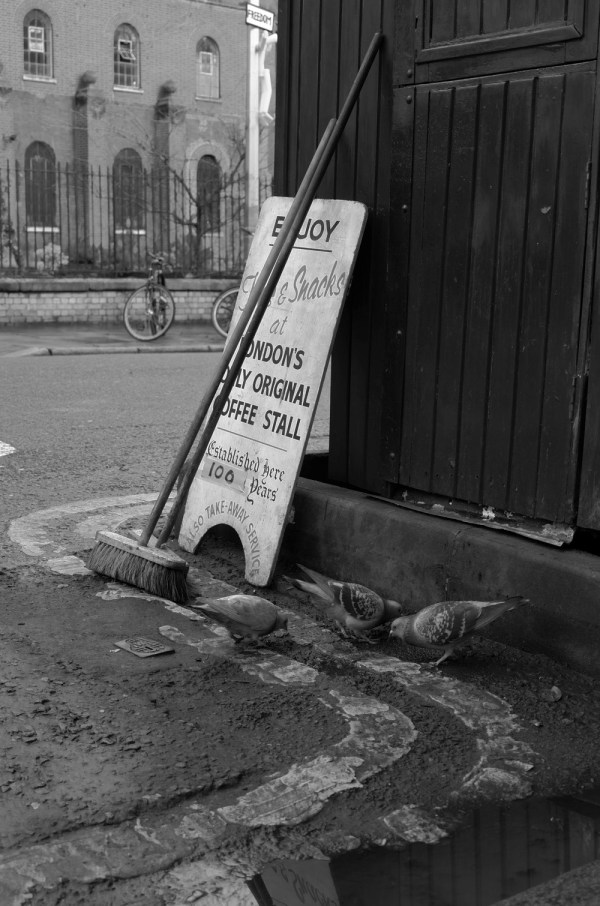
Last Brew At Syd’s Coffee Stall
Complementing my History of Syd’s Coffee Stall, here is my report on the centenary celebrations

On Friday, I joined the excited throng at Syd’s Coffee Stall on the corner of Calvert Avenue to celebrate the Tothill family’s monumental achievement over three generations, serving tea in Shoreditch for an entire century. Free cups of tea, mince pies and pigs-in-blankets were distributed to all, even cups of Camp Coffee were on offer to the adventurous.
We were grateful for the warm drinks and sustenance as we huddled together under the awning in the pouring rain, reflecting in vertiginous awe upon the notion of a hundred years measured out in tea cups. Sydney Tothill’s grandchildren, Jane & Stephen, presided over the poignant gathering of loyal customers, which included the grandchildren of William Richards, Carriage Builders & Wheelwrights of 280 Hackney Rd, who built the stall for Syd when he started out in 1919.
I chatted to a gentleman who was paying a sentimental visit after sixty-five years. During the fifties, while apprenticed as a furniture maker in Rivington St, he frequented Syd’s stall daily and could not resist returning on this last day to pay his respects and enjoy a final cuppa.
Cheryl Diamond who has worked at the stall since 1995 kept filling the teapot, while Jane Tothill sold raffle tickets and we all contemplated the display of old photographs illustrating the glorious history of Syd’s.
After he was gassed in the trenches of World War I, Syd senior used his compensation money to open the stall. In spite of being a Coffee Stall, Syd only sold tea and beef extract – adopting the description ‘Coffee Stall’ to impart aspiration to his endeavour. When World War II came along, the stall operated twenty-four hours during the London Blitz, serving refreshments to the firemen and auxiliary workers. At the time of the Coronation, Syd junior launched ‘Hillary Caterers’ in honour of Sir Edmund Hillary’s conquest of Everest. As the first and only caterer ever licensed to serve food on the steps of St Paul’s Cathedral, Syd became a Freeman of the City of London.
Yet all good things must come to an end and, when the teapot was drained to the last dregs on Friday, Syd’s Coffee Stall passed into legend as the crowd dispersed into the rain. In January, the old stall will be towed away by the Museum of London where it will remain in perpetuity as a modest wonder, emblematic of the indomitable spirit of Londoners and as enduring testimony to the sustaining properties of an honest cup of tea.

Passionate tea drinkers huddle in the rain

Cheryl Diamond


Stephen, Jane & Geraldine Tothill


Contemplating historic photographs of Syd’s Coffee Stall


You may also like to read about
So Long, Syd’s Coffee Stall
Yesterday, Syd’s Coffee Stall served the last cuppa and closed forever after a century of serving refreshments at the corner of Calvert Avenue and Shoreditch High St. The stall will now be wheeled away to the Museum of London in January where it will reappear as an exhibit when the museum opens at its new home in Smithfield in a few years time.

This is Sydney Edward Tothill pictured in 1920, proprietor of the Coffee Stall that operated for a century, open for business five days a week at the corner of Calvert Avenue and Shoreditch High St, where this photo survived, screwed to the counter of the East End landmark that carried his name. “Ev’rybody knows Syd’s. Git a bus dahn Shoreditch Church and you can’t miss it. Sticks aht like a sixpence in a sweep’s ear,” reported the Evening Telegraph in 1959.
This is a story that began in the trenches of World War I when Syd was gassed. On his return to civilian life in 1919, Syd used his invalidity pension to pay £117 for the construction of a top quality mahogany tea stall with fine etched glass and gleaming brass fittings. And the rest is history, because it was of such sturdy manufacture that it remains in service ninety-nine years later.
Jane Tothill, Syd’s granddaughter who upholds the proud family tradition, told me that Syd’s Coffee Stall was the first to have mains electricity, when in 1922 it was hooked up to the adjoining lamppost. Even though the lamppost in question was supplanted by a modern replacement, it stood beside the stall to provide the power supply. Similarly, as the century progressed, mains water replaced the old churn that once stood at the rear of the stall and mains gas replaced the brazier of coals. In the nineteen sixties, when Calvert Avenue was resurfaced, Syd’s stall could not be moved on account of his mains connections and so kerbstones were placed around it instead. As a consequence, if you looked underneath the stall, the cobbles were still there.
Throughout the nineteenth century, there was a widespread culture of Coffee Stalls in London, but, in spite of the name – which was considered a classy description for a barrow serving refreshments – they mostly sold tea and cocoa, and in Syd’s case “Bovex”, the “poor man’s Bovril.” The most popular snack was Saveloy, a sausage supplied by Wilsons’ the German butchers in Hoxton, as promoted by the widespread exhortation to “A Sav and a Slice at Syd’s.” Even Prince Edward stopped by for a cup of tea from Syd’s while on his frequent nocturnal escapades in the East End.
With his wife May, Syd ran an empire of seven coffee stalls and two cafes in Rivington St and Worship St. The apogee of this early period of the history of Syd’s Coffee Stall arrived when it featured in a silent film Ebb Tide, shot in 1931, starring the glamorous Chili Bouchier and praised for its realistic portrayal of life in East London. The stall was transported to Elstree for the filming, the only time it ever moved from its site. While Chili acted up a storm in the foreground, as a fallen woman in tormented emotion upon the floor, you can just see Syd discharging his cameo as the proprietor of an East End Coffee Stall with impressive authenticity, in the background of the still photograph below.
In spite of Syd’s success, Jane revealed that her grandfather was “a bit of a drinker and gambler” who gambled away both his cafes and all his stalls, except the one at the corner of Calvert Avenue. When Syd junior, Jane’s father was born, finances were rocky, and he recalled moving from a big house in Palmer’s Green to a room over a laundry, the very next week. May carried Syd junior while she was serving at the stall and it was pre-ordained that he would continue the family business, which he joined in 1935.
In World War II, Syd’s Coffee Stall served the ambulance and fire services during the London blitz. Syd and May never closed, they simply ran to take shelter in the vaults of Barclays Bank next door whenever the air raid sounded. When a flying bomb detonated in Calvert Avenue, Syd’s stall might have been destroyed, if a couple of buses had not been parked beside it, fortuitously sheltering the stall from the explosion. In the blast, poor May was injured by shrapnel and Syd suffered a mental breakdown, leaving their young daughter Peggy struggling to keep the stall open.
The resultant crisis at Syd’s Coffee Stall was of such magnitude that the Mayor of Shoreditch and other leading dignitaries appealed to the War Office to have Syd junior brought home from a secret mission he was undertaking for the RAF in the Middle East, in order to run the stall for the ARP wardens. It was a remarkable moment that revealed the essential nature of the service provided by Syd’s Coffee Stall to the war effort on the home front in East London, and I can only admire the Mayor’s clear-sighted sense of priority in using his authority to demand the return of Syd from a secret mission because he was required to serve tea in Shoreditch. As he wrote to May in January 1945, “I do sincerely hope that you are recovering from your injuries and that your son will remain with you for a long time.”
Syd junior was determined to show he was more responsible than his father and, after the war, he bravely expanded the business into catering weddings and events along with this wife Iris, adopting the name “Hillary Caterers” as a patriotic tribute to Sir Edmund Hillary who scaled Everest at the time of the coronation of Elizabeth II. No doubt you will agree that as a caterer for a weddings, “Hillary Caterers” sounds preferable to “Syd’s Coffee Stall.” In fact, Syd junior’s ambition led him to become the youngest ever president of the Hotel & Caterer’s Federation and the only caterer ever to cater on the steps of St Paul’s Cathedral, topping it off by becoming a Freeman of the City of London.
Jane Tothill began working at the stall in 1987 with her brothers Stephen and Edward, and the redoubtable Clarrie who came for a week “to see if she liked it” and stayed thirty -two years. In recent years, Jane managed the stall with the loyal assistance of Francis, who serving behind the counter for the last thirty years. The challenges were parking restrictions that made it problematic for customers to stop, hit and run drivers who frequently caused damage which requiring costly repair to the mahogany structure and graffiti artists whose tags had to be constantly erased from the venerable stall. Yet after a hundred years and three generations of Tothills, during which Syd’s Coffee Stall survived against the odds to serve the working people of Shoreditch without interruption, it became a symbol of the enduring human spirit of the populace here.
Syd’s Coffee Stall is a piece of our social history that does not draw attention to itself, yet deserves to be celebrated. Syd senior might not have survived the trenches in 1919, or he might have gambled away this stall as he did the others, or the bomb might have fallen differently in 1944. Any number of permutations of fate could have prevented the extraordinary survival of Syd’s Coffee Stall for an entire century. Yet by a miracle of fortune, and thanks to the hard work of the Tothill family we enjoyed London’s oldest Coffee Stall here in our neighbourhood for a hundred years. We cherish it now because the story of Syd’s Coffee Stall teaches us that there is a point at which serving a humble cup of tea transcends catering and approaches heroism.

May Tothill, Syd’s wife, behind the counter in the nineteen thirties

Jane Tothill, Syd and May’s granddaughter, behind the counter (photograph by Sarah Ainslie)

Syd junior and his mother May, behind the counter in the nineteen fifties

A still from the silent film “Ebb Tide” starring Chili Bouchier with Syd in a cameo as himself

In 1937 with electricity hooked up to the lamppost

You may also like to read about


