
Eleanor Crow’s Map Of East End Trades
Tomorrow is Small Business Saturday and Eleanor Crow has illustrated this map for the East End Trades Guild which will be distributed free in shops – so don’t forget to pick up your copy.
In these testing times, we must cherish and support the independent shops and small businesses which contribute so much to the East End by creating employment for local people and building communities.
Eleanor Crow will be talking about her book SHOPFRONTS OF LONDON at 2pm this Sunday at our BLOOMSBURY JAMBOREE at the Art Workers Guild. Click here for tickets


Click on the map to enlarge it


CLICK HERE TO ORDER A SIGNED COPY FOR £14.99
At a time of momentous change in the high street, Eleanor’s witty and fascinating personal survey champions the enduring culture of Britain’s small neighbourhood shops.
As our high streets decline into generic monotony, we cherish the independent shops and family businesses that enrich our city with their characterful frontages and distinctive typography.
Eleanor’s collection includes more than hundred of her watercolours of the capital’s bakers, cafés, butchers, fishmongers, greengrocers, chemists, launderettes, hardware stores, eel & pie shops, bookshops and stationers. Her pictures are accompanied by the stories of the shops, their history and their shopkeepers – stretching from Chelsea in the west to Bethnal Green and Walthamstow in the east.
Winter Light In Spitalfields

The inexorable descent into the winter darkness is upon us, even if just a couple of weeks from now we shall reach the equinox and days will start to lengthen. At this season, I am more aware of light than at any other – especially when the city languishes under an unremitting blanket of low cloud, filtering the daylight into a grey haze that casts no shadow.
Yet on some recent mornings I have woken to sunlight and it always lifts my spirits to walk out through the streets under a clear sky. On such days, the low-angled sunshine and its attendant deep shadow conjures an exhilarating drama.
In these particular conditions of light, walking from Brick Lane down Fournier St is like advancing through a cave towards the light, refracting around the vast sombre block of Christ Church that guards the entrance. The street runs from east to west and, as the sun declines, its rays enter through the churchyard gates next to Rectory illuminating the houses opposite and simultaneously passing between the pillars at the front of the church to deliver light at the western end where it meets Commercial St.
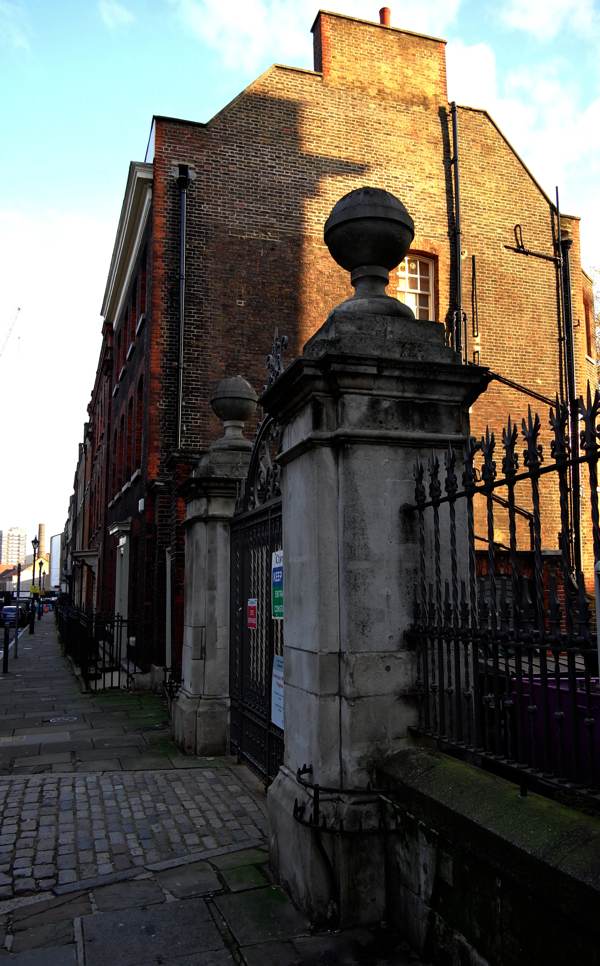
For a spell, the shadows of the stone balls upon the pillars at the churchyard gate fall upon the houses on the other side of the street and then the rectangle of light, admitted between the church and the Rectory, narrows from the width of a house to single line before it fades out. At the junction with Commercial St, the low-angled sun directed through the pillars in the portico of Christ Church casts tall parallel bars of light and shade that travel down Fournier St from the Ten Bells as far as number seven, reflecting off the window panes to to create a fleeting pattern like stars within the gloom of the old church wall.
As you can see from these photographs, I captured these transient effects of light with my camera to share with you as a keepsake of winter sunshine, for consolation when those clouds descend again.


The last ray
The shadow of the cornice of Christ Church upon the Rectory


The shadow of the pillars of Christ Church upon Fournier St


Windows in Fournier St reflecting upon the church wall


In Princelet St
You may also like to read about
The Secretary Of State Steps In

Thanks to all the letters written by you – the readers of Spitalfields Life – Robert Jenrick, the Secretary of State, has stepped in and issued a Holding Direction to Tower Hamlet Council which prevents them proceeding with approving the Whitechapel Bell Foundry planning application for change of use to a boutique hotel while he considers what to do.
If you have not yet written to the Secretary of State, you should do so at once to PCU@communities.gsi.gov.uk
Emphasise the national and international significance of the bell foundry and point out that the planning application causes ‘substantial harm’ to an important heritage asset. Explain there is a viable scheme to continue the Whitechapel Bell Foundry as a proper working foundry and ask him to hold a Public Inquiry.

You may also like to read about
A Letter to the Secretary of State
The Fate of the Whitechapel Bell Foundry
Nigel Taylor, Tower Bell Manager
Four Hundred Years at the Whitechapel Bell Foundry
Pearl Binder at Whitechapel Bell Foundry
Dorothy Rendell at Whitechapel Bell Foundry
Hope for The Whitechapel Bell Foundry
A Petition to Save the Bell Foundry
Save the Whitechapel Bell Foundry
So Long, Whitechapel Bell Foundry
Fourteen Short Poems About The Whitechapel Bell Foundry
The Hackney Yearbook
Behold the wonders of commerce and retail over a century ago, courtesy of the Hackney Year Book 1906 from the archive at the Bishopsgate Institute!


Images courtesy Bishopsgate Institute
You may also like to take a look at
Adverts from Shoreditch Borough Guide
An Important Correction

The email address we published yesterday for you to write to the Secretary of State asking him to call in the Whitechapel Bell Foundry was incorrect.
You email you need to use is PCU@communities.gsi.gov.uk
If you wrote to the wrong address, please resend it to the email above.
We apologise for any confusion, and thank you for your patience and support.
Note that the incorrect email which we published yesterday in good faith was accurately quoted from ‘House of Commons Briefing Paper Number 00930, 31st January 2019, Calling-in planning applications (England).’
Read the full instructions here
Peri Parkes’ Conder St Paintings
Fiona Atkins who curated the current exhibition at Townhouse Spitalfields considers the first pictures Peri Parkes painted while living in Conder St, Stepney. In these works, he evolved subtly from the academic style of the Slade towards a recognition of the presence of people in the East End.
These paintings and more are on display until Sunday 8th December in ‘Peri Parkes, The Last View.’

Conder St 1, 1979
The years after Peri Parkes left the Slade were turbulent ones for him. He had married while he was there and they had the first of his two daughters shortly after, but by 1979 he and his wife had divorced and he moved in with his artist friend Martin Ives, who was living in a prefab run by Acme Housing Association on Conder St, off Salmon Lane in Stepney.
In the seventies, artists were at college for four or five years but were given no practical advice on how to survive or make a living in the world. Afterwards, they were faced with the prospect of finding a studio, buying materials and equipment and then, unable to make a living as artists, finding a job to pay for it. Inevitably, artists cut costs to reduce the amount of time spent working and devote as much time as possible to their art.
Acme Housing Association was started in 1972 to provide studio and living space for artists, by working with the Greater London Council and taking derelict properties for low rents. The GLC had thousands of such properties on its hands, bought by compulsory purchase as part of plans for post-war redevelopment before the money ran out in the economic downturn of the seventies.
Thus Peri Parkes lived at 9 Conder St in the late seventies and early eighties while working as an art teacher locally. His paintings show the influence of William Coldstream who had been Head of the Slade. During Peri’s time there, Coldstream had started to paint a series of views of Westminster from the seventeenth floor of the Department of the Environment. Although probably not originally conceived as a series, his biographer Bruce Laughton says he kept seeing new configurations each time he finished one. This may also be true of Peri’s paintings of the backs of houses in Conder St. They reveal the same desire to show new configurations, which can be used to put most of this series of paintings in order.
The painting above appears to be the first of the Conder St series of paintings of backs of houses and was probably painted shortly after Peri arrived in the East End in 1979. It has a tight, linear structure, the bricks in the walls at the front are all carefully delineated and Coldstream-style ‘dots and dashes’ for measurements are visible. The paint is applied in broad washes of colour, particularly on the backs of the houses themselves, which gives a luminous glow to the colour.
By the second Conder St painting below, Peri’s style is looser. The tree reflected in the window is painted more freely, the bricks are indicated rather than painted individually and the colour is no longer applied in expanses of colour. The angle of the painting is different too and Peri’s gaze is more focused on the foreground and the collection of a picket fence, a compost bin and a washing line.
The third painting of Conder St was titled ‘House in the East’ at the Tolly Cobbold Eastern Arts exhibition. The focus in this picture is on the same view as the previous painting but with the addition of foliage.
Peri Parkes wrote a statement in the catalogue: ‘This was painted in the space of a year. I hope something of the building’s organic structure (moisture, decomposition) has registered in the painting. At the very beginning, a rich snakeskin pattern of moss down a wall was the painting’s main focal point. One day it was scraped away. Nonetheless, I have determined that its absence remains the main focus of the painting.’
It is curious that, although for Peri the absence of the moss was the focus, it is not depicted in the finished painting. He had written in an essay for his teacher’s training: ‘By imagination I do not mean the ability to invent, but to inhabit, to find oneself in everything.’
This painting illustrates Peri’s desire to ‘inhabit’ his paintings and paint as though ‘touching the surface,’ in order that his brushstrokes reflected what he knew had once been there, so his sensation of it would inhabit the painting. This notion came from Peri’s teacher at the Slade, Patrick George, who had been at Camberwell College of Art after the war with William Coldstream. His paintings are a search for the essence of his subject rather than a literal representation. Patrick George was one of the curators of the Tolly Cobbold exhibition for which this painting was selected in 1981, Peri’s first recorded exhibited work.
The similarity in Peri’s style, palette and treatment of the foliage suggests that the fourth Conder St painting was done at the same time as ‘House in the East.’ Ten years later, Peri successfully submitted it for exhibition in the RA Summer Show of 1995, suggesting that this was a painting which continued to satisfy him.
The fifth Conder St picture represents a complete change of approach: an exploration of the visual logic of the relationship between the lines and the structure holding it all together, which renders the painting almost abstract in places. Interestingly though, there is the suggestion of two figures, the first in Peri’s work. They are faceless and probably hanging out washing – representing a virtual constant of life rather than any individual – but something so frequently observed it became a fundamental part of his world in the East End.

Conder St 2, c.1980

Conder St 3, House in the East, c. 1980-1

Conder St 4, c.1982

Conder St 5, c.1982 – in this painting, figures appear for the first time

Conder St 6, c. 1981-2

Conder St 7, c. 1981-2
Paintings copyright © Estate of Peri Parkes
You may also like to read about
A Letter To The Secretary Of State

Casting a bell at Whitechapel Bell Foundry in July 1933
We were appalled by the disgraceful decision of Tower Hamlets Council in November to grant permission for change of use from bell foundry to boutique hotel. This destroys any future for the Whitechapel Bell Foundry as a working foundry, reducing centuries of our history to a side-show for tourists in a quirky bell-themed hotel.
It is imperative now that the Secretary of State call in this planning application, taking it out of the hands of Tower Hamlets Council and holding a Public Inquiry. Last month’s farcical planning meeting revealed that the national and international significance of the Whitechapel Bell Foundry render it too important for its fate to be decided by the local authority.
With the forthcoming General Election imminent, we have to move very fast. We need as many people as possible to write to Secretary of State immediately. Use your own words and give your personal opinions but be sure to include the key points listed here. Read the guidance below and write today, then forward this to your friends and family, encouraging them to do the same.
HOW TO WRITE EFFECTIVELY TO THE SECRETARY OF STATE
- Address your letter to Robert Jenrick, Secretary of State for Housing, Communities & Local Government.
- Ask the Secretary of State to issue a ‘holding direction’ which means that planning permission cannot proceed.
- Ask the Secretary of State to call in the planning application for the Whitechapel Bell Foundry and hold a Public Inquiry.
- Point out that the hotel planning application causes ‘substantial harm’ to a very important heritage asset.
- Emphasise the significance of the Whitechapel Bell Foundry and the very controversial nature of this proposal, locally, nationally and internationally.
Anyone can write, wherever you are in the world, but be sure to include your postal address and send your letter by email to
PCU@communities.gsi.gov.uk
or by post to
National Planning Casework Unit
5 St Philips Place
Colmore Row
Birmingham BP3 2PW

The Bell of Hope in Manhattan was cast at the Whitechapel Bell Foundry and presented by the Lord Mayor of London to the people of New York on the first anniversary of the 9/11 attacks
You may also like to read about
The Fate of the Whitechapel Bell Foundry
Nigel Taylor, Tower Bell Manager
Four Hundred Years at the Whitechapel Bell Foundry
Pearl Binder at Whitechapel Bell Foundry
Dorothy Rendell at Whitechapel Bell Foundry
Hope for The Whitechapel Bell Foundry
A Petition to Save the Bell Foundry
Save the Whitechapel Bell Foundry
So Long, Whitechapel Bell Foundry
Fourteen Short Poems About The Whitechapel Bell Foundry


