
List Of Shops Open For Business

Syd’s Coffee Stall by Eleanor Crow
Every Wednesday, I publish the up to date list of stalwarts that are open in Spitalfields. Readers are especially encouraged to support small independent businesses who offer an invaluable service to the community. This list confirms that it is possible to source all essential supplies locally without recourse to supermarkets.
Be advised many shops are operating limited opening hours at present, so I recommend you call in advance to avoid risking a wasted journey.
This week’s illustrations are by Eleanor Crow from her book SHOPFRONTS OF LONDON.

Leila’s Shop, Calvert Ave, by Eleanor Crow
GROCERS & FOOD SHOPS
The Albion, 2/4 Boundary St
Ali’s Mini Superstore, 50d Greatorex St
AM2PM, 210 Brick Lane
As Nature Intended, 132 Commercial St
Banglatown Cash & Carry, 67 Hanbury St
Breid Bakery, Arch 72, Dunbridge St
Brick Lane Minimarket, 100 Brick Lane
The Butchery Ltd, 6a Lamb St (Open Thursdays only)
City Supermarket, 10 Quaker St
Costprice Minimarket, 41 Brick Lane
Faizah Minimarket, 2 Old Montague St
JB Foodstore, 97 Brick Lane
Haajang’s Corner, 78 Wentworth St
Hackney Essentials, 146 Columbia Road
Leila’s Shop, 17 Calvert Avenue (Call 0207 729 9789 between 10am-noon on Tuesday-Saturdays to place your order and collect on the same day from 2pm-4pm)
The Melusine Fish Shop, St Katharine Docks
Nisa Local, 92 Whitechapel High St
Pavilion Bakery, 130 Columbia Rd
Rinkoff’s Bakery, 224 Jubilee Street & 79 Vallance Road
Spitalfields City Farm, Buxton St (Order through website)
Sylhet Sweet Shop, 109 Hanbury St
Taj Stores, 112 Brick Lane
Zaman Brothers, Fish & Meat Bazaar, 19 Brick Lane

Beigel Shop, Brick Lane, by Eleanor Crow
TAKE AWAY FOOD SHOPS
Before you order from a delivery app, why not call the take away or restaurant direct?
Absurd Bird Fried Chicken, 54 Commercial St
Al Badam Fried Chicken, 37 Brick Lane
Allpress Coffee, 58 Redchurch St
Band of Burgers, 22 Osborn St
Beef & Birds, Brick Lane
Beigel Bake, 159 Brick Lane
Beigel Shop, 155 Brick Lane
Bellboi Coffee, 104 Sclater St
Bengal Village, 75 Brick Lane
Big Moe’s Diner, 95 Whitechapel High St
Burro E Salvia Pastificio, 52 Redchurch St
The Carpenters Arms, 73 Cheshire St (Open for take away beers)
China Feng, 43 Commercial St
Circle & Slice Pizza, 11 Whitechapel Rd
Crosstown Doughnuts, 157 Brick Lane
Dark Sugars, 45a Hanbury St (Take away ice cream and deliveries of chocolate)
Donburi & Co, Korean & Japanese, 13 Artillery Passage
Duke of Wellington, 12 Toynbee St (Open for take away beers)
Eastern Eye Balti House, 63a Brick Lane
Enso Thai & Japanese, 94 Brick Lane
Exmouth Coffee Shop, 83 Whitechapel High St
Grounded Coffee Shop, 9 Whitechapel Rd
Holy Shot Coffee, 155 Bethnal Green Rd
Hotbox Smoked Meats, 46-48 Commercial St
Jack The Chipper, 74 Whitechapel High St
Jonestown Coffee, 215 Bethnal Green Rd
Laboratorio Pizza, 79 Brick Lane
La Cucina, 96 Brick Lane
Leon, 3 Crispin Place, Spitalfields Market
Madhubon Sweets, 42 Brick Lane
Mooshies Vegan Burgers, 104 Brick Lane
Nude Expresso, The Roastery, 25 Hanbury St
E. Pellicci, 332 Bethnal Green Rd
Pepe’s Peri Peri, 82 Brick Lane
Peter’s Cafe, 73 Aldgate High St
Picky Wops Vegan Pizza, 53 Brick Lane
Polo Bar, 176 Bishopsgate
Poppies, 6-8 Hanbury St
Quaker St Cafe, 10 Quaker St
Rajmahal Sweets, 57 Brick Lane
Rosa’s Thai Cafe, 12 Hanbury St
Shawarma Lebanese, 84 Brick Lane
Shoreditch Fish & Chips, 117 Redchurch St
Sichuan Folk, 32 Hanbury St
String Ray Globe Cafe, 109 Columbia Road
Sushi Show, 136 Bethnal Green Rd
Ten Bells, 84 Commercial St (Takeway beer on Thursday, Friday & Saturday)
Vegan Yes, Italian & Thai Fusion, 64 Brick Lane
White Horse Kebab, 336 Bethnal Green Rd
Yuriko Sushi & Bento, 48 Brick Lane

WC & K King, Amwell St, by Eleanor Crow
OTHER SHOPS & SERVICES
Analogue Films Photo Lab, 58 Hanbury St
Boots the Chemist, 200 Bishopsgate
Brick Lane Bookshop, 166 Brick Lane (Books ordered by phone or email are delivered free locally)
Brick Lane Bikes, 118 Bethnal Green Rd
Brick Lane Off Licence, 114/116 Brick Lane
Day Lewis Pharmacy, 14 Old Montague St
E1 Cycles, 4 Commercial St
Eden Floral Designs, 10 Wentworth St (Order fresh flowers online for free delivery)
Flashback Records, 131 Bethnal Green Rd (Order records online for delivery)
Harry Brand, 122 Columbia Road (Order gifts online for delivery)
Hussain Tailoring, 64 Hanbury St
iRepair, Phones & Computer, 94 Whitechapel High St
GH Cityprint, 58-60 Middlesex St
Leyland Hardware, 2-4 Great Eastern St
Mobile Clinic & Laptop Repairs, 7 Osborne St
Post Office, 160a Brick Lane
Quality Dry Clean, 151 Bethnal Green Rd
Rose Locksmith & DIY, 149 Bethnal Green Rd
Sid’s DIY, 2 Commercial St
Spitalfields Dry Cleaners, 12 Whites Row

Emjay Decor, Bethnal Green Rd, by Eleanor Crow
ELSEWHERE
E5 Bakehouse, Arch 395, Mentmore Terrace (Customers are encouraged to order online and collect in person)
Gold Star Dry Cleaning & Laundry, 330 Burdett Rd
Hackney Essentials, 235 Victoria Park Rd
Quality Dry Cleaners, 16a White Church Lane
Newham Books, 747 Barking Rd (Books ordered by phone or email are posted out)
Region Choice Chemist, 68 Cambridge Heath Rd
Symposium Italian Restaurant, 363 Roman Road (Take away service available)
Thompsons DIY, 442-444 Roman Rd

Daren Bread, Stepney Green, by Eleanor Crow
Paintings copyright © Eleanor Crow
You may like to see Eleanor Crow’s other shopfront paintings

Doreen Fletcher’s Early Drawings
Doreen Fletcher is an astonishingly brilliant draughtswoman. Even though her drawings are often undertaken as preparation for paintings, they stand as art works in their own right.
Readers are already familiar with Doreen Fletcher‘s paintings of the East End that were published in a monograph by Spitalfields Life Books and exhibited with such success at the Nunnery Gallery last year. Today it is my pleasure to introduce you to a selection of her early pencil drawings which originate from the Potteries where Doreen grew up. These pictures were done by Doreen in her teens and early twenties, and have never been see together before publicly.

Grandad at Prospect Terrace, 1975
“My grandad was a hard man when young, it was said he could break a brick with his bare fist. A survivor of Ypres, he gravitated to Knutton Forge in Warrington after the war where he met my grandmother, the daughter of a local shop-keeper who was forever making and losing money. As my granddad was twelve years older, it was assumed that he would die first but he was left a widower at the age of eighty-four and lived on for another eight years, despite a life of heavy smoking and beer consumption. To the end, he remained unable even to make a sandwich for himself, although he was a dab hand at making wreaths, a cottage industry in which the whole family took part every Christmas.”

View from our living room window, 17 Bailey St, 1975
“This was the view I saw from our living room window every morning, from when I was a tiny child until I left home at the age of twenty. It was identical to thousands of other views from other houses. At the end of the yard there was a row of three shacks – a coal house, an outside loo and a tool storage area. There was very little colour in those streets, save for the odd dandelion and escaped budgerigar, although sparrows abounded and there were pigeon fanciers with coops.
The house where I grew up was in a dip amongst row upon row of terraced houses, built in the eighteen-sixties to house mill workers. They were huddled together, forming a tight knit community of families, with corner shops surviving by selling produce on tick and a couple of pubs. Most of the inhabitants had been born within a few miles of Newcastle-under-Lyme, the only exceptions being an Italian couple from Milan who came to work in the mill, and a few Polish and Yugoslav refugees who spoke almost no English and who had a special delicatessen on the other side of town. All were accepted.”

Mum & Dad on the Front Step, 1976
“Alice, my mother, worked in a munitions factory during the war and became a servant afterwards. It gave her ideas about not having the newspaper on the table and no tomato ketchup, and healthy eating. Colin, my dad, was a farm worker who wanted to be a vet but did not like school and suffering a year long illness when he was seven deprived him of the education he needed.
After I was born, they moved into the town from Stableford because he could earn more money there. When they started installing pylons in the late fifties, he worked on that. Later he worked putting in pipes for North Sea Gas too but, when he was fifty-seven, he had a brain haemorrhage at work, probably caused by a pneumatic drill, and never worked again.”

Houses Under Snow, 1980

Mother in the kitchen, Bailey St, 1975
“The scullery was a tiny multi-purpose extension. The cooker was by the entrance on the left, in front of my mother, and, on the other side, was a washing machine with a mangle. My mum is pouring water from a kettle kept on a shelf of the kitchen cabinet. I can still remember the midnight blue and gold hues of the teapot. I bought it as a present, thinking it was very posh and sophisticated unlike the common brown tea-pots in daily use.”
Directly behind her you can see a bath, which was considered upwardly-mobile when it was installed in 1957. There were no taps, the hot water came from the geyser on her right, so by the time there was enough to bathe, the hot water was lukewarm.”

St Giles, 1989

Corner Shop, Bailey St, 1975
“Almost every street had one or sometimes two corner shops, where provisions were bought on ‘tic’ with the bill paid, hopefully, on Friday. This was the morning after most workers got their wages. Mr & Mrs Jones ran the shop favoured by my mother and their daughter was an art student, so they were happy to pose for me.”

House in Whitfield Ave, 1977

House in Fenton, 1987
“Visits to Newcastle took on a new poignancy once my former home was demolished and I began to document the facades of the terraces that remained, wandering the streets often with my dad in tow, carrying a scrappy sketchbook and a camera I bought second hand.”

The Cottage Inn, Tunstall, 1998
“My grandparents ran ‘The Cottage Inn’ during the war and my dad my worked at nearby Shelton Bar Ironworks while courting my mum. After the war, the family moved to Prospect Terrace, Newcastle. Their dog, Paddy, moved with them but he used to take the bus every day at 11 am back to the pub in Tunstall. Everyone knew him, including all the bus conductors.”

House in New Ashfields, 1998
“I sold the painting I did from this drawing. I was attracted by the neat geometry of the brickwork. This house was in the New Ashfields, built a few decades later than the Old Ashfields where I grew up. The houses were generally more spacious and upmarket than my streets.”

Chapel in Silverdale, 1983

Fairground, 1977
“Every Summer, a fair came to Newcastle during the ‘Wakes’, two weeks in July when the potteries closed down and those who could afford it went away to stay in a boarding house or caravan in Rhyl, Blackpool or – for the more adventurous – Great Yarmouth. For those of us, who stayed behind there was the fun of the fair, with hotdogs and candyfloss.The summer I made this drawing, I visited Abergele in North Wales, where my boyfriend’s grandparents had retired. They lived in a bungalow in a suburban avenue close to the sea and, while I was there, we visited an amusement park in Rhyl. It was here I was persuaded, against my better judgement, onto a ride and I recall praying for the horizon to re-establish itself. It was the first and last time I ever took a fairground ride.”

Margaret Ann Hair Salon, 1995
Paintings copyright © Doreen Fletcher
You may also like to take a look at
Doreen Fletcher’s Early Paintings
Readers are familiar with Doreen Fletcher‘s paintings of the East End that were published in a monograph by Spitalfields Life Books and exhibited with such success at the Nunnery Gallery last year. Today it is my pleasure to introduce you to a selection of her early paintings which originate from the Potteries where Doreen grew up. These pictures comprise a significant body of work, painted by Doreen in her teens and early twenties, which have never been see together before publicly.

Salvation Army Building, 1970 (Courtesy of Brampton Museum)

Brook St, 1975
“This was the very first urban oil painting I ever did. I was inspired by the fact that each time I returned to visit my parents, a little more of their environment had disappeared and I felt an urgent need to record what remained. I little realised at the time I had found both a subject and a content that would last a lifetime.”

Bungalow in Summertime, 1976
“When I painted this, I had already lived in London for two years with my boyfriend, an art student at Wimbledon. During the summers we decamped to our hometown of Newcastle-under-Lyme on his motorbike which I loved riding pillion. On summer evenings, we drove around the countryside, stopping for a drink at a country inn and savouring the contrast between our new, busy lifestyles in London and the peaceful country lanes we travelled.
One evening, I was taken aback to see a suburban bungalow in the middle of a field. It looked completely out of place and reminded me of the house where my great uncle lived in which the heavy oak furniture seemed out of scale in the small rooms. Due to this I had developed a prejudice against what I saw as ‘bungalow culture.’”

House in Whitfield Ave, 1977
“The house where I grew up was declared not fit for human habitation in 1974. My parents were happy to move into a council property they were offered across the road from this one. There was a huge garden with two greenhouses where my dad grew vegetables in regimented rows, with tomatoes and chrysanthemums. He was delighted, but my mother was lonely and missed the intimacy of the cramped streets with a shop on every corner near the town centre.”

The Albert, Liverpool Rd, 1977

Takeaway Chip Shop, 1979
“This is typical of chip shops dotted all over Newcastle and the Potteries where long queues would form at tea-time and again after the pubs had closed.”

Black & Yellow Door, 1980
“Notice the foot scraper that all terraced houses had in those days, for knocking off the clay from clogs and later Wellingtons. The bright colours of the paintwork were trendy in the early-mid seventies, as opposed to the dull browns, navy blues and maroons favoured in the fifties and sixties.”

Beats Grocers, 1980 (Courtesy Potteries Museum & Art Gallery)

Finesse Hair Salon, 1980
“Hairdressers such as this abounded in the sixties and many remain today. My mum went every Friday to have her hair ‘set’ and, twice a year, she subjected herself to the torture of strong-smelling perm lotion, with her hair screwed in rollers, then baked under a hairdryer for a couple of hours. As a result, she did not have much left of her once luxurious hair by the time she was fifty. I grew up fearful of these hairdressers and, to this day, I delay a haircut as long as possible.”

House with Pylon, 1980

Gardeners’ Hut, Westlands, 1980

11 Whitfield Avenue

Red House in Talke, 1980
“When I went on the bus with my mum to visit my gran at Talke during the school holidays, we passed this house somewhere around Talke Pitts and, even amongst the red brick of the Midlands, it struck me as very red indeed. I must have been eight or nine but the memory of it remained and, when I went in search of it fifteen years later, I was delighted to find it was still standing.”

Sheldon’s Hair Salon, Knutton, 1982
“It is my mother who is looking in the window of Sheldon’s hairdressers and dress shop. She went once a week to have her hair ‘set.’ At that time, she was ten years younger than I am now but considered herself old at fifty-five and dressed accordingly. When I was a child, we used to take a walk each Sunday afternoon to places such as Knutton, a former mining village on the outskirts of Newcastle-under-Lyme. Even in such a small place, a shop like Sheldon’s could support its proprietors.”

Chatwins Bakers, 1982
“I painted this ten years after I left Newcastle and five years after I first envisaged it. Chatwins Bakery was a family business, alive and thriving today, having expanded from fresh bread baked daily by John Chatwin and sold by horse and cart to twenty shops throughout Staffordshire, Cheshire and North Wales.”

Wrights Grocers, 1982
“I painted this in the early eighties while I was living in Paddington but it recalls a corner shop in my hometown. In the background, a row of condemned houses awaits demolition and it is apparent the grocery store is not long for this world either. The goods it contains are typical of what was on offer in any small shop across the country.”

Church in Brampton, 1982
“Although I was sent to a strict Church of England Primary School, I have been a non-believer since the age of five and a committed atheist since I was twelve. In spite of this, the Methodist, puritanical blood runs deep in my veins and I have never been attracted to Baroque architecture preferring the severe Victorian architectural styles of Newcastle and Stoke.”

View from Clayton Fields, Newcastle-under-Lyme, 1985 (Courtesy of Brampton Museum)
“This was a commission from Newcastle Borough Council. I was asked to removed the green and white stripes on the side of one of the buildings in the distance because the Chief Executive considered them an eyesore.”

Tiffany Dance Hall, 1979

Tiffany’s at Night, 1988
“Tiffany’s in the early seventies was the centre of the universe. I went there on Saturday afternoons with my friend Janet and later we graduated to Wednesday evenings from 7pm-10pm. It was the only time in my life that I visited a Dance Hall, they have never interested me since”

Winter in the Park, 1989
“This is the sister painting to the ‘Gardeners’ Hut’ but done many years later.”

Northern Stores, 1998
“Even in the sixties, the Northern Stores was an anachronism. It was a hardware shop I enjoyed visiting with my dad on Saturday mornings when he would buy something for his allotment, perhaps chicken feed or paraffin or a bag of nails for mending a fence. My pleasure at being out with him was heightened by the awareness that our next stop would be the art materials shop or the bookshop where he always spent more on me than he did on his own needs.”
Paintings copyright © Doreen Fletcher
You may also like to take a look at
Doreen Fletcher in her own words

CLICK TO BUY ONE OF THE LAST COPIES OF DOREEN FLETCHER’S BOOK FOR £20
Dan Cruickshank’s Survey Of Spitalfields
During the lockdown, Dan Cruickshank has been using his daily exercise to make a detailed Survey of Spitalfields in collaboration with Alec Forshaw. Today Dan introduces his survey, aiming to draw attention to all the buildings and architectural features that define the nature of the place, yet which are often overlooked when it comes to listing, making them vulnerable to destruction by developers.
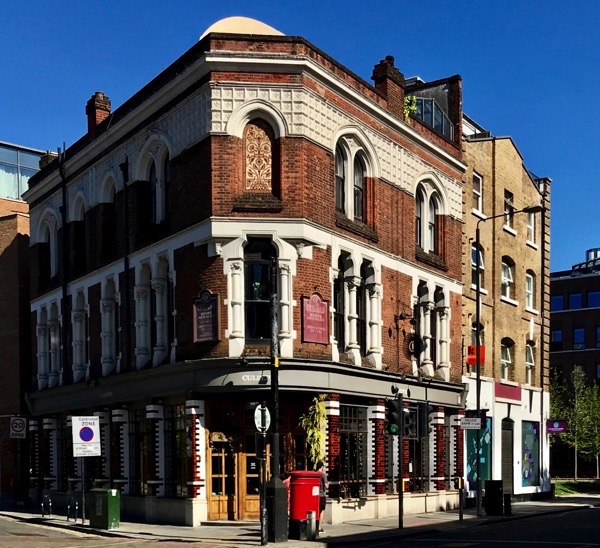
The Princess Alice, Commercial St
A battle is being waged to protect Spitalfields’ characterful, but mostly statutorily unprotected, late-nineteenth and early-twentieth century architecture. It is a strange experience walking the streets during the emptiness of the lockdown and in a light that is almost uncanny in its purity. Even the simplest buildings acquire a luminosity and a strangely monumental quality. The clarity of light has revealed these structures as heroic and often poetic architecture that contributes to the distinctive nature of the place.
Spitalfields Neighbourhood Planning Forum, which was made possible by the Localism Act of 2011, supports a community and conservation-led vision for the area. It has a vision that builds on, rather than obliterates, the qualities that make Spitafields unique, including its mixture of small-scale uses, its diversity and its residential character, as well as its historic architecture. So I am drawing up a list of what – in planners’ language – are called non-designated heritage assets. This means all unlisted but significant buildings, along with street furniture such as the array of nineteenth century bollards, signs, sewer vents, cobbles and granite kerbs – indeed everything that contributes to the character and appearance of Spitalfields.
My photograph of the superb Princess Alice public house – now renamed The Culpeper – which was built in 1883 in fine Gothic Revival style, illustrates the importance of this survey. Despite its panache, the pub is only locally listed – which means it has no statutory protection – whereas the adjoining eighteen-fifties commercial block is – quite rightly – nationally listed by Historic England, revealing that there is no consistency in the protection of Spitafields’ built heritage.

The Princess Alice public house was built by architect, Bruce J. Capell, an experienced pub designer who worked extensively for Truman’s Brewery. His design is erudite, delightful and on a key corner site does much to enliven this portion of Commercial St, confirming its status as one of London’s architecturally most significant Victorian thoroughfares.

While The Princess Alice is not protected, the adjoining eighteen-fifties commercial block is listed by Historic England.

There is a Spitalfields that is almost invisible, the late-Victorian commercial and industrial architecture is taken for granted and unappreciated by most. Few of these buildings are protected and all are at risk. Yet they form the fundamental historic fabric of the place and many are magnificent, heroic expressions of the utilitarian and functional tradition that distinguishes much of Britain’s nineteenth century industrial architecture. Others comprise fascinating essays in nineteenth century fashions for historic styles – Italianate, Flemish Renaissance Revival or Gothic. Commercial Street, cut through Spitalfields by the Metropolitan Board of Works from 1843 to 1857, is a treasure trove of such architecture. Little of it is listed and some of it is threatened with obliteration, as is the case of this splendid late eighteen-forties Italianate terrace, 2-4 Commercial St, at the south end.

This is a characterful group of late-nineteenth century buildings on Wentworth St, between Middlesex St and Bell Lane, opposite Goulston St. Their diverse architecture and eclectic mix of uses make this a fine example of the the type of unlisted buildings that are threatened by the advancing towers of the City of London.

These pale buildings in Wentworth St, with their almost ethereal upper storeys perched over a shuttered underworld of abandonment and imminent decay, appear as emblems of transience and death. They are a reminder of the sudden contrast and strange juxtaposition that distinguishes Spitalfields and defines its character. Perhaps nowhere is this sense of contrast more stark than in Wentworth St. By tradition, a lively market and commercial street, it was once the heartland of the late-nineteenth century Jewish community.
In 1892, Israel Zangwill, observed in Children of the Ghetto, that ‘..Wentworth St and Goulston St were … in festival times … a pandemonium of caged poultry, clucking and quacking and screaming.’ In 1896, Henry Walker wrote his first impression of Wentworth St thus, ‘an almost impossible scene is before us. We seem to be in a world of dissolving views. We suddenly find ourselves in a foreign land … we might be in Warsaw or Cracow … Wentworth St is the market of the poorer immigrant Jews. It is the East London counterpart of the Continental Ghetto.’
These buildings are part of the architectural theatre of the area’s long-dispersed community of Jewish refugees escaping Tsarist persecution. Now they stand, unprotected and evidently vulnerable. Intensely melancholic, they are a memorial to a lost world.

The Ten Bells, at 84 Commercial St on the corner with Fournier St, is one of the area’s most-popular and best-known pubs. It dates from 1755 but was revamped and stuccoed in the mid-nineteenth century, and the bar was decorated with stylish tiles in the eighteen-nineties. While the pub is listed, the splendid mid-nineteenth century group to the left are not. Number 88, in the centre, is particularly fine with tall pilaster strips that evolve into giant arcading. This stripped-down classicism is typical of the often sublime mid-to-late-nineteenth century commercial and industrial buildings of Spitalfields and Shoreditch.

The centre of Commercial St was laid out between 1849 and 1857 on the site of ancient Red Lion St. This simple and civilised row of shops with living accommodation above was probably constructed in the late-eighteen fifties. They are generally well preserved, although some have lost their cornices, and are good examples of their date and type, but none are listed. In the foreground on the left is the remarkable Stapleton’s stable at 106 Commercial St which includes an interior court with a wide and shallow ramp serving several storeys of stabling. The ornate terracotta plaque states the that the stables were established in 1842, but the façade dates from the eighteen-nineties.
A recent proposal to convert the building into a series of bars and restaurants has been rejected by Tower Hamlets Council following strong local opposition. To many, there seem to be quite enough bars in Spitalfields already and this building stands at the edge of a residential area. Yet the scheme, which includes significant alterations to the interior, has been re–submitted. Meanwhile the Spitalfields Trust and others are pushing for Stapleton’s to be recommended for listing by Historic England. Will HE do the right thing?

Number 148-150 Commercial St, probably dating from the eighteen-sixties, is an even more visually striking example of stripped-back commercial classicism. Its stucco cladding – which makes the composition even more abstract – is perhaps later. The strange austerity of the design is emphasised by its neighbours which are contemporary but more typically ornate and florid examples. To the right is a mid-eighteen sixties group that includes the splendid Commercial Tavern which is already listed. To the left is the former rectory of St. Stephen’s church, built in 1861 in fine Gothic style to the design of Ewan Christian. The church itself, which formerly stood next door is just one of Spitalfields many lost Victorian churches. It was replaced in the mid-thirties by a cinema, now converted into a hulking block of flats.
The contrast between the buildings in this group could not be more dramatic or telling. They offer a compressed history of the architecture and life of ninetieth and early-twentieth century Spitalfields – work, prayer, and entertainment all combined. These buildings are tremendously important, yet since only the Commercial Tavern is listed the rest have uncertain futures.

Many of the buildings in Commercial Street possess a sublime, almost abstract, power. Number 66-68, dating from the eighteen-fifties, is bold and functional in conception. The building is designed like a machine, with large windows illuminating work areas and a loading bay and crane. The only aesthetic concessions are a rugged cornice and serrations on the undersides of the window arches. This was just enough perhaps to raise the building to the poetic realm of architecture. This block demonstrates that austere and gaunt structures can possess an almost romantic beauty. It is a wonderful example of a visually-haunting architecture that so brilliantly captures the spirit of its age, even if the story of this architecture in Spitalfields has yet to be written and certainly yet to be fully appreciated or protected.

Detail from The Bell, a late-Victorian public house in Middlesex Street. The image of the bell doubles as a friendly, smiling, mustachioed and crowned head. Can this be a portrait or a punning rebus? Was the landlord of the pub named Bellamy or King? Such small details delight me and, although this pub is not statutorily protected, it will surely be on my list of non-designated heritage assets.
Photographs copyright © Dan Cruickshank
Click here to follow and contribute to Dan Cruickshank’s Survey of Spitalfields
You may like to take a look at these other stories by Dan Cruickshank
Around Old Billingsgate
These intriguing photographs are selected from a cache of transparencies of unknown origin at the Bishopsgate Institute. We believe they date from the nineteen-sixties but the photographer is unidentified.

Fish Porters at Number One Snack Bar next to St Magnus the Martyr

Looking west along Lower Thames St and Monument St

Sign outside St Mary-At-Hill

Pushing barrows of ice up Lovat Lane

Passage next to St Mary-At-Hill

Carved mice on a building in Eastcheap

Old shop in Eastcheap

Billingsgate Market cat

Inside the fish market designed by Horace Jones

Old staircase near Billingsgate

The Coal Exchange, built 1847 demolished 1962

Part of London Bridge crossing Lower Thames St, now removed

The Old Wine Shades, Martin Lane

Sign of a Waterman, now in Museum of London

In All Hallows Lane

Derelict site next to Cannon St Station

Looking towards Bankside Power Station by Sir Giles Gilbert Scott, now Tate Modern

Old Blackfriars Station

The Blackfriar pub

Sculptures upon the Blackfriar

Sunrise over Tower Bridge
Images courtesy Bishopsgate Institute
You may also like to take a look at
Cats In The Time Of Coronavirus

Our feline friends have been having a high old time of late, with doting owners at home all day tending to their domestic needs and the streets cleared of traffic to facilitate their urban wanderings. Photographer Chris Kelly found that she encountered far more than usual while taking her daily exercise and took these pictures to record these strange days when the cats took over.
“Like most photographers I decided to record the experience of lockdown and, of course, it had to be local. Daily exercise has taught me to notice more about my neighbourhood, I saw very few people but when the sun came out so did the cats.
Over exactly two months I met an astonishing number of cats, some of them self-distancing but many of them eager for attention. After a tiger in the Bronx Zoo caught the coronavirus there was some early advice about keeping cats indoors. Yet it transpired that there’s no record of humans catching the virus from cats and the advice changed. Cats should be kept indoors if the owners are infected – but only if the cats don’t mind.
Photographing cats is a frivolous pursuit, although friends and former colleagues appreciated them when I shared a few online and the strikingly beautiful spotted Bengal cat is now someone’s screensaver. The last time I saw this cat it was two thirds of the way up a pine tree in pursuit of a magpie chattering derisively.
Now the rules are relaxing I might just meet some owners and hear their lockdown stories.”
Chris Kelly


Photographs copyright © Chris Kelly
Chris Kelly’s THE NECESSARY CAT – A PHOTOGRAPHER’S MEMOIR is available from many independent bookshops including Brick Lane Books, Broadway Books & Newham Bookshop.
You may like to see these other photographs by Chris Kelly
Dogs Of London Fields
Photographer Rachel Ferriman and Writer Lucy Yates made these splendid canine portraits
“One hot Sunday afternoon we set out for London Fields to discover how dogs and their owners have been faring under lockdown. So many people sat on the grass in the sun that the heavy shade of the trees provided the only spots for dog walkers to exercise their pets. Gradually the buzz of conversation and the dim thud of music gave way to trills of birdsong and the rattle of an occasional train. As the evening cooled and shadows lengthened, the dogs came out.
When we returned the following morning, the park had shrugged off its dusty exhaustion. The tennis courts were newly open and a sprinkler ticked across the cricket pitch. The air was cool and fresh, spiked with moisture. A few yoga devotees had spread mats out on the grass, a scattering of people were breakfasting cross-legged on the grass and two small children chased after a kite. This second visit brought more relaxed opportunities to meet local residents and their pets as they criss-crossed the park, greeting each other.” – Lucy Yates

Max (German Shepherd) with Natasha
“Max belongs to a fellow named Alan. He’s been waiting for a knee operation for well over a year so I’ve been walking Max since I lost my own dog in February last year. Max and Bailey were best friends, Bailey was a Staff-Pitt mix who looked like a thug but was a big teddy bear.
I’ve lived here on the Blackstone Estate for thirty years now. The sun rises over there in the east and, if you stand on this path, you get a cathedral of trees. It’s beautiful. Max is coming up to eleven years old, he has heat pads and cooling pads to keep him comfortable. Max’s owner takes such good care of him. There’s a really good community amongst the dog walkers.”

Max

Peaches (Pomsky Puppy) with Holly & Larry
Larry – “Peaches is twelve weeks old now. We got her from a breeder in Wales. We were unsure about buying a dog during lockdown, partly because we were worried about scammers.”
Holly – “Lockdown is depressing, so in the end we said, “Let’s just go for it.” We’re real lockdown parents, we’ve just been at home feeding her with chicken breast.”

Peaches

Loki with Evan
“I adopted Loki a year and a half ago from friends who had kids – two boys plus a dog was too much for them. Everyone’s at home at the moment, so it’s easy to walk him but the park has been busy. We have to exhaust him otherwise he’s barking out of the window all day. He gets really hot and is a real puddle seeker, he goes for the most disgusting puddles. There’s a splash and you just see the steam rising off him.”

Loki and his beloved ball

Tommy (retired racing Greyhound) with Katie & Arturas
Arturas – “Tommy’s a retired racer from Ireland, he’s got a tattoo on his right ear. You can use this to look up his sporting achievements on a database. When I saw him in the Battersea Dogs Home I felt an instant connection, he just came up to me. I’d only gone along for a quick look but I filled out the papers and paid £130 for him. I walked all the way to Denmark Hill station to get on the Overground to take him home but he stopped at the stairs. He’d never been up stairs before. He had to learn right then and there – we did it little by little.”
Katie – “When we first got him, he didn’t ever seem happy but now he likes to be petted. The first time we let him off his leash in London Fields he just bolted. We were running around and screaming, “Catch the dog!” The other week he met another greyhound in the park and they just started running together so fast. The whole park was watching.”

Tommy

Tommy’s racing tattoo

Storm (Siberian Husky) with Luca
“Storm’s a neighbour’s dog, he’s elderly and can’t get out now because of the coronavirus. I used to walk Storm on weekends but now I’m walking her five or six times a week. She hasn’t seen as many of her friends in the park as she usually would.
She’s eight and a half years old, and is a rescue dog from Manchester. It’s been hot today so, if she needs to cool down, she’ll go for a dip in the canal just in up to her belly. I always carry a bottle of water for her too. Walking her is one of the best parts of my day and having her at my side makes me feel better.”

Storm

Ludo (Labrador) with Charlie & Milo
Charlie – “Milo’s just got a new ball and is totally focused on that. I walk him every day in London Fields or Haggerston Park. During lockdown, he’s been having two walks a day and everyone’s around so he’s been really happy. He’s got a garden too so he’s a lucky dog.”

Ludo

Iggy (Hungarian Viszlaw) with Davina
“Iggy is eight months and his favourite snack is apples and coconut strips. We always go for a two hour walk in the morning. I used to be a fashion consultant on the wholesale side. I’ve always supported people in business and I realised I wanted to do it in a more satisfying, nurturing way. I trained as a reiki practitioner and during lockdown I’ve been doing virtual distanced healing. Lockdown has made me slow down in a good way.”

Iggy

Molly (Jack Russell Terrier) with Sharon
“I bought Molly as a Jack Russell but both her parents are quite long, so she might be a bit Spaniel. She’s ten months old. I’ve lived here thirty years, near Broadway Market.”

Molly

Rilo, Laika, Birdie & Jess with Kenny & Riley, aged eight
Riley – “At home we have another dog, Coco, a tortoise and three birds.”
Kenny – “All the dogs were street dogs originally. Rilo and Laika were from Greece, Birdie from Romania and Jess from the Isle of Dogs. We have a business – Adam Reed Salon – in Spitalfields, next to the Ten Bells on Fournier Street. We’d been only open for four weeks and then had to close due to Covid, which was a bit of a disaster, to be honest.”

Rilo, Laika, Birdie & Jess with Kenny & Riley

Rocco & Missy (Jack Russell Terriers) with John
“Everyone calls me John but my real name’s Giovanni. I’ve made films with Robert de Niro – No, I’m joking you! I’m known for having a silly sense of humour. Fella came round with the puppies, I said I only wanted one. He knew what he was doing when he walked in, my wife fell in love with the other one so I bought the two. I had another Jack Russell called Bluey, he used to jump up and down. I told a woman he was an Australian Jack Russell, because all Australian animals jump, don’t they?
I’ve lived around here all my life, my mum died when I was seven and my grandfather’s three sisters and their mum brought me up. My grandad always used to say, “It’s nice to be nice, have a shine on your shoes and a smile on your face” – he had so many sayings. I went to St. Peter’s Italian school in Clerkenwell and one of my granddaughters married an Italian, turns out I went to school with his grandparents.”

Rocco & Missy

Lillie-May with Ann
“I’ve been feeling ill for the last few weeks. I’ve got asthma and chronic obstructive pulmonary disease. I usually meet John in the park walking Rocco & Missy too. He’s always waiting for me.”

Lillie-May

Crystal (Pitbull-Staffordshire Bull Terrier cross) with Abdul
“I live on the other side of the park. She’s eleven now but I’ve had her since she was about a year old. She wasn’t trained or anything when I got her.”

Crystal

Jelly with Fran & Grace
“I got her at ten weeks old in February. She’s five months old now. Best money I’ve ever spent. We usually walk in Hackney Downs, but every now and again we come down here.”

Jelly

Percy & Moomin (Chihuahuas) with Liz
“I’ve had Percy for four years and I got Moomin as a puppy. I work for the NHS, so I’ve been busy but I’ve been walking them early every day. I want to try jogging with them as Percy’s put on a few lockdown pounds recently.”

Pablo (Chihuahua) with Jess
Jess – “This is his first walk. We wanted a puppy for a really long time but now we’re both working from home we had time. Our decision to get him was really spontaneous. We’d been for a walk in Victoria Park and, when we got home and checked the website, a new litter of Chihuahua puppies had just been posted two hours before in Brighton. We chose him because he was super-playful and just wanted to know who you were.”
Sacha – “We talked about good names for dogs really early on in our relationship and we both liked Pablo. He’s Mexican breed so we went with a Latin American name.”

Pablo on his very first walk with Sacha & Jess
Photographs copyright © Rachel Ferriman
You may also like to take a look at
The Dogs of Spitalfields in Spring
The Dogs of Spitalfields in Autumn


