
A Sense Of Proportion

In ‘Mrs Dalloway’ when an unhappy young woman takes her shell-shocked husband to a clinic, the psychiatrist declares that he is not mad, he just lacks a sense of proportion. Virginia Woolf is often considered a grim heavyweight novelist but personally I have always found her work irresistibly comic and full of exhilarating caustic irony, of which this incident I quote here is a prime example.
I bought this copper Roman coin in the Spitalfields Market in 1997 to remind me to keep a sense of proportion. It only cost £2.30 and, with the millennium approaching, I wanted a thousand-year-old item to give me a sense of chronological perspective. When I took it to the British Museum, they told me it was in fact fourth century, made here at the time of the Emperor Arcadius and of very little value. You can see Arcadius’ head on the coin in the picture above, he was among the earliest emperors to rule from Constantinople, a minor emperor. I was delighted to learn that on the reverse is Minerva, the goddess of wisdom – this suited my aspiration well.
Most interesting, was to discover that the piercing of the coin at the back of the head was original. The custom was for lovers to wear them as tokens of affection, keepsakes. Since then, I have worn it round my neck every day on a leather thong and never ceased to wonder who wore it here in Britain all those years ago and what was the story. This coin and I have now have innumerable stories that I would like to tell the original owner. I was wearing it in New York on 11th September 2001 and again in Holborn on 7th July 2005. There was the time I stepped from the ocean on a remote beach at the western end of Cuba in 1998 to discover the wallet containing my money, cards, passport and tickets was stolen. The only coin I had left was this one.
At the time I bought the coin in the market, they were excavating the Roman cemetery in Spitalfields that now lies beneath the new development. The antiquarian John Stow described how in 1576, in a brick-field near the Spital-churchyard, there were discovered Roman funeral urns, containing copper coins of Claudius, Vespasian, Antoninus Pius and Trajan. It is possible that my coin was from that cemetery.
In 2006, I added the two gold wedding rings that my mother had worn up until her death. One was her own wedding ring and the other was her mother’s. I have never worked out which is which but since my grandfather was a bank manager whereas my father was an engineer working on the shop floor, I assume that the thicker one was my grandmother’s and the other was my mother’s.
These rings are a powerful reminder of how I came to be, my personal relationship to the passage of time as I understand it, through the succession of generations in my family. Wearing the rings beside the Roman coin affords a broader perspective, setting family history against the span of history itself. The function of these keepsakes is to help me hold these thoughts in mind, to sustain me in the constant human struggle to maintain a sense of proportion.

The Loneliness Of Old London

Lost in Old London – Rose Alley, Southwark, c. 1910
When I first came to live in London, I had few friends, no job and little money, but I somehow managed to rent a basement room in Portobello. For a year, I wandered the city on foot, exploring London without any bus fare. I think I never felt so alone as when I drifted aimlessly in the freezing fog in Hyde Park in 1983.
As I walked, I used to puzzle how I could ever find my life in London. Then I went back and sat in my tiny room for countless hours and struggled to write, without success.
Today, I am sometimes haunted by the spectre of my pitiful former self as I travel around London and, when examining the thousands of glass slides created by the London & Middlesex Archaeological Society for educational lectures at the Bishopsgate Institute a century ago, I am struck by the lone figures isolated in the cityscape.
The photographers may have included these solitary people to give a sense of human scale – but my response to these pictures is emotional, I cannot resist seeing them as a catalogue of the loneliness of old London.

Alone outside Shepherd’s Bush Empire, c. 1920

Alone at the Chelsea Hospital, c. 1910

Alone at the Natural History Museum, c. 1890

Alone at the Tower of London, c. 1910

Alone at Leg of Mutton Pond, Hampstead, c. 1910

Alone in the Great Hall at Chelsea Hospital, c. 1920

Alone outside St Lawrence Jewry, 1908

Alone in Bunhill Fields, c. 1910

Alone in Hyde Park, c. 1910

Alone at the Guildhall, c. 1910

Alone at Brooke House, Hackney, 1920

Alone on Hampstead Heath, c. 1910

Alone in Thames St, 1920

Alone at the Orangery, Kensington Palace, c. 1910

Alone in the Deans Yard at Westminster Abbey, c. 1910

Alone at Hampton Court, c. 1910

Alone at the Houses of Parliament with the statue of Richard I, c. 1910

Alone in the tiltyard at Eltham Palace, c. 1910

Alone in Cloth Fair, c. 1910

Alone at Marble Arch, c. 19o0

Alone at Southwark Cathedral, c. 1910

Alone outside Carpenters’ Hall, c. 1920

Alone outside Jackson Provisions’ shop, Clothfair, c. 1910

Alone outside Blewcoat School, Caxton St, c. 1910

Alone on the Victoria Embankment, c. 1910

Alone outside All Saints Chelsea, c. 1910

Alone at the Albert Hall, c. 1910
Glass slides courtesy Bishopsgate Institute
Take a look at
The Lantern Slides of Old London
The High Days & Holidays of Old London
The Fogs & Smogs of Old London
The Forgotten Corners of Old London
The Statues & Effigies of Old London
Meandering Along The River Lea
Taking advantage of yesterday’s spring sunshine to escape the city and seek some fresh air, I wandered along the river bank from Bow as far as Tottenham Hale

At Cody Dock

Sir Corbet Woodall, Gas Engineer and Governor of the Gas Light and Coke Company, with two of his historic gasometers at Bow

At Bow Lock

Looking towards the tidal mill at Three Mills Island

At Three Mills Island

Who can identify this water fowl?

Old Ford Lock

Beneath the Eastway

Sculling on the Hackney Cut

At Lea Bridge

Barge cat

The Anchor & Hope

Looking towards Clapton


The Lea Rowing Club


At Tottenham Lock

Two Thames Barges at Tottenham Hale

Coal & diesel delivery barge


At Stonebridge Lock
You may also like to read about
James Leman’s Album Of Silk Designs

The oldest surviving set of silk designs in the world, James Leman’s album contains ninety ravishingly beautiful patterns created in Steward St, Spitalfields between 1705 and 1710 when he was a young man. It was my delight to visit the Victoria & Albert Museum and study the pages of this unique artefact, which is the subject of an interdisciplinary research project under the auspices of the V&A Research Institute, funded by the Andrew W. Mellon Foundation. The Leman Album offers a rare glimpse into an affluent and fashionable sphere of eighteenth century high society, as well as demonstrated the astonishing skill of the journeyman weavers in East London three hundred years ago.
James Leman (pronounced ‘lemon’ like Leman St in Aldgate) was born in London around 1688 as the second generation of a Huguenot family and apprenticed at fourteen to his father, Peter, a silk weaver. His earliest designs in the album, executed at eighteen years old, are signed ‘made by me, James Leman, for my father.’ In those days, when silk merchants customarily commissioned journeyman weavers, James was unusual in that he was both a maker and designer. In later life, he became celebrated for his bravura talent, rising to second in command of the Weavers’ Company in the City of London. A portrait of the seventeen-twenties in the V&A collection, which is believed to be of James Leman, displays a handsome man of assurance and bearing, arrayed in restrained yet sophisticated garments of subtly-toned chocolate brown silk and brocade.
His designs are annotated with the date and technical details of each pattern, while many of their colours are coded to indicate the use of metallic cloth and different types of weave. Yet beyond these aspects, it is the aesthetic brilliance of the designs which is most striking, mixing floral and architectural forms with breathtaking flair in a way that appears startling modern. The Essex Pink and Rosa Mundi are recognisable alongside whimsical architectural forms which playfully combine classical and oriental motifs within a single design. The breadth of James Leman’s knowledge of botany and architecture as revealed by his designs reflects a wide cultural interest that, in turn, reflected flatteringly upon the tastes of his wealthy customers.
Until recently, the only securely identified woven example of a James Leman pattern was a small piece of silk in the collection of the Art Gallery of South Australia. Miraculously, just as the V&A’s research project on the Leman Album was launched, a length of eighteenth-century silk woven to one of his designs was offered to the museum by a dealer in historical textiles, who recognised it from her knowledge of the album. The Museum purchased the silk and is now investigating the questions that arise now design and textile may be placed side by side for the first time. With colours as vibrant as the day they were woven three hundred years ago, the sensuous allure of this glorious piece of deep pink silk adorned with elements of lustrous green, blue, red and gold shimmers across the expanse of time and is irresistibly attractive to the eye. Such was the extravagant genius of James Leman, Silk Designer.


On the left is James Leman’s design and on the right is a piece of silk woven from it, revealing that colours of the design are not always indicative of the woven textile

The reverse of each design gives the date and details of the fabric and weave

Portrait of a Master Silk Weaver by Michael Dahl, 1720-5 – believed to be James Leman
All images copyright © Victoria and Albert Museum, London
Click here to read about recent research into James Leman’s Album
With grateful thanks to: Dr Olivia Horsfall Turner, Senior Curator of Designs – Dr Victoria Button, Senior Paper Conservator – Clare Browne, Senior Curator of Textiles – Dr Lucia Burgio, Senior Scientist and Eileen Budd, V&A Research Institute Project Manager
You may also like to read about
The Principal Operations of Weaving
At Anna Maria Garthwaite’s House
Anna Maria Garthwaite, Silk Designer
David Truzzi-Franconi’s East End
Photographer David Truzzi-Franconi sent me these pictures that he took in the seventies, published for the first time today.
“While I was working in the City of London as an heraldic artist & calligrapher, I discovered on my lunchtime walks that a few paces from the bustle of Bishopsgate led me to another world. I combine a love of the drawing and writing of Geoffrey Fletcher with the photography of Henri Cartier-Bresson. Eventually I bought a Rolleiflex camera and spent my days off exploring the East End with a few rolls of film in my pocket. ” – David Truzzi-Franconi

Derelict House in Bethnal Green


Gunthorpe St, Whitechapel


Shop, E1

Chicksand St, E1

Derelict House, Spitalfields

Knife Grinder, Wilkes St, E1

Street performers at Tower Hill


Three legged dog

Meths drinkers on a bomb site near Brick Lane


Meths Drinkers at the Peabody Buildings


Blending ‘Red Biddy’ – wine and methylated spirits

Blacksmith’s Arms, Isle of Dogs

Thames Foreshore at Low Tide

Three Mills Island, Bow

St Paul’s, Covent Garden
Photographs copyright © David Truzzi-Franconi
Cat Women
This fine collection of portraits of females and their felines was assembled by Alice Maddicott author of CAT WOMEN : An Exploration of Feline Friendships and Lingering Superstitions.
“I became a cat woman the moment I was hit with a thud of love that I’d never realised a creature could produce,” Alice admitted to me. “I never thought I’d become a cat lady but, as I think of it now, the strangest thing is that it is something you can become.”

“It is easy to miss the second cat, he disappears into the white of her floral dress, next to the tabby stripes of his friend.”

“Girl and cat are all the life of this photograph – her happiness so bright.”
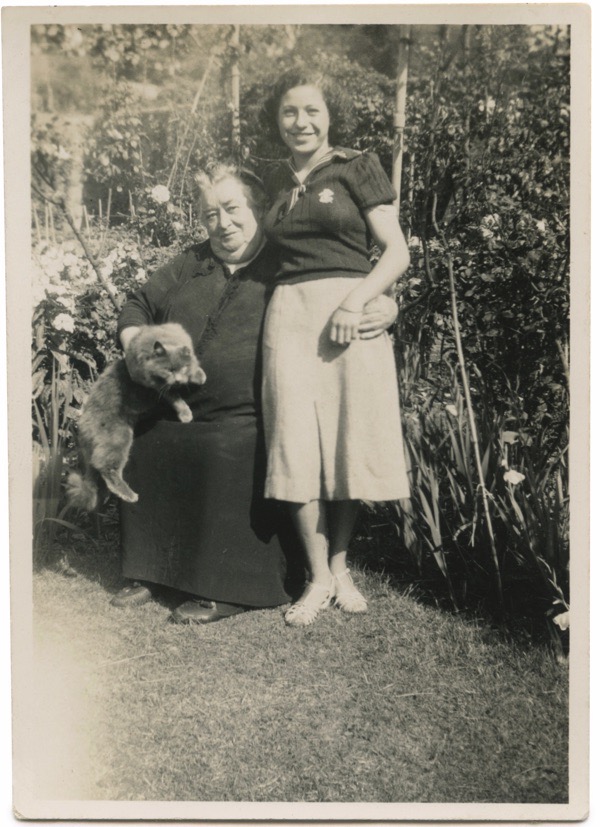
“A mother sits, her daughter stands, made one by the curve of her arms. The cat has been grabbed to make a triptych – their little family – a tumble of curves.”

“Look at me and Mary, he says, we are one and you can never tear us apart.”

“Rosalind lifts Marmalade out of the pram – her precious patient.”

“There are some pains only cats can make better.”

“The invisible ribbons that bind her and Sadie are stronger than any threat. She will not leave her.”

“He’s wrapped in arms, she frames him, a tender representation of perfect teenage dreaminess, when the world was vast and full and for the taking.”

“The kitten she holds is Gretel, her brother Hansel is elsewhere, a black blur battling the wire fence.”

“This is not their first Christmas together and each year they pose together by the sparkling tree.”

“On her dress near her shoulder, that could be a tear from naughty claws and teeth.”

“She is smiling but it is the love for her cat that stands out. She cuddles him properly.”

“He’s going doolally, blissed out as she holds him so protectively.”

“Cradling the loose end of a washing line, she rests. A well-earned sit on the steps and a bowl of food for the cat.”

“Her neatly parted hair, clips in place, hides her true wildness, how much she and Moppet share and the joy of freedom waiting for them.”

“She doesn’t look mean, more frustrated and worn out, the feeling any parent of toddlers would understand.”

“This cat is somewhat grander and gazes more at ease than her owner, who is strangely still, arms obscured, buckled feet neatly turned out.”

“Her garden is beautiful and full of sun. Her cat is white and all candyfloss despite the strange grip she has on her.”

“She could have forgotten the strength of the bond she had with her cat then suddenly be flooded with the memory, months or years later.
Photographs and text copyright © Alice Maddicott
You may also like to read about
Old Letterheads & Receipts From Whitechapel
It is my delight to publish these old Whitechapel letterheads and receipts from Philip Mernick‘s astonishing ephemera collection. Many are remarkable for the beauty of their typographic design as well as revealing the wide range of industry and commerce.

Speigelhalters were in Whitechapel from 1928 until 1988

Gardiner’s Corner was a familiar landmark in East End for generations


This was the family business of the artist Nathaniel Kornbluth


All letterheads and receipts courtesy of Philip Mernick
You may also like to take a look at


