
Christmas Baubles
Each year on Christmas Eve, I bring in the tree at dusk, fetch the box of old glass decorations from the roof to hang upon its boughs, and set to work, decorating the tree as darkness falls

I do not know when my grandmother bought this glass decoration and I cannot ask her because she died more than twenty years ago. All I can do is hang it on my tree and admire it gleaming amongst the deep green boughs, along with all the others that were once hers, or were bought by my parents, or that I have acquired myself, which together form the collection I bring out each year – accepting that not knowing or no longer remembering their origin is part of their charm.
Although I have many that are more elaborate, I especially admire this golden one for its simplicity of form and I like to think its ridged profile derives from the nineteen thirties when my mother was a child, because my grandmother took the art of Christmas decoration very seriously. She would be standing beech leaves in water laced with glycerine in October, pressing them under the carpet in November and then in December arranging the preserved leaves in copper jugs with teazles sprayed gold and branches of larch, as one of many contrivances that she pursued each year to celebrate the season in fastidious style.
Given the fragility of these glass ornaments, it is extraordinary that this particular decoration has survived, since every year there are a few casualties resulting in silvery shards among the needles under the tree. Recognising that a Christmas tree is a tremendous source of amusement for a cat – making great sport out of knocking the baubles to the ground and kicking them around like footballs – I hang the most cherished decorations upon the higher branches. Yet since it is in the natural course of things that some get broken every year and, as I should not wish to inhibit the curiosity of children wishing to handle them, I always buy a couple more each Christmas to preserve the equilibrium of my collection.
Everlasting baubles are available – they do not smash, they bounce – but this shatterproof technological advance entirely lacks the poetry of these fragile beauties that can survive for generations as vessels of emotional memory and then be lost in a moment. In widespread recognition of this essential frailty of existence, there has been a welcome revival of glass ornaments in recent years.
They owe their origins to the glassblowers of the Thuringian Forest on the border of Germany and the Czech Republic where, in Lauscha, glass beads, drinking glasses, flasks, bowls and even glass eyes were manufactured since the twelfth century. The town is favoured to lie in a wooded river valley, providing both the sand and timber required for making glass and in 1847 Hans Greiner – a descendant of his namesake Hans Greiner who set up the glassworks in 1597 with Christoph Muller – began producing ornaments by blowing glass into wooden moulds. The inside of these ornaments was at first coloured to appear silvery with mercury or lead and then later by using a compound of silver nitrate and sugar water. In 1863, when a gas supply became available to the town, glass could be blown thinner without bursting and by the eighteen seventies the factory at Lauscha was exporting tree ornaments throughout Europe and America, signing a deal with F.W.Woolworth in the eighteen eighties, after he discovered them on a trip to Germany.
Bauble is a byword for the inconsequential, so I do not quite know why these small glass decorations inspire so much passion in me, keeping their romance even as other illusions have dissolved. Maybe it is because I collect images that resonate personally? As well as Father Christmas and Snowmen, I have the Sun, Moon and Stars, Clocks and even a Demon to create a shining poem about time, mortality and joy upon my Christmas tree. I cannot resist the allure of these exquisite glass sculptures in old-fashioned designs glinting at dusk amongst the dark needles of fir, because they still retain the power to evoke the rich unassailable magic of Christmas for me.

This pierrot dates from the nineteen eighties

Three of my grandmother’s decorations. The basket on the left has a piece of florists’ wire that she placed there in the nineteen fifties

This snowman is one of the oldest of my grandmother’s collection

Bought in the nineteen eighties, but from a much older mould

Baubles enhanced with painted stripes and glitter

The moon, sun and stars were acquired from a shop in Greenwich Avenue on my first visit to New York in 1990, amazingly they survived the flight home intact


These two from my grandmother’s collection make a fine contrast of colour

Even Christmas has its dark side, this demon usually hangs at the back of the tree

It is always going to be nine o’clock on Christmas Eve

Three new decorations purchased at Columbia Rd

A stash of glittering beauties, stored like rare eggs in cardboard trays

My first bicycle, that I found under the tree one Christmas and still keep in my attic
Fritz Wegner’s Christmas Plates
A few years ago, I came across this set of small souvenir Christmas plates Fritz Wegner designed for Fleetwood of Wyoming between 1980 and 1983 in limited editions, which I acquired for almost nothing. They are crudely produced, not unlike those ceramics sold in copyshops with photographic transfers, yet this cheap mass-produced quality endears them to me and I set them out on the dresser every Christmas with fondness.
I discovered my delight in the work of illustrator Fritz Wegner (1924-2015) in primary school through his drawings for Fattypuffs & Thinifers by Andrew Maurois. Throughout my childhood, I cherished his book illustrations whenever I came across them and the love of his charismatically idiosyncratic sketchy line has stayed with me ever since.
Only recently have I learnt that Fritz Wegner was born into a Jewish family in Vienna and severely beaten by a Nazi-supporting teacher for a caricature he drew of Adolf Hitler at the age of thirteen. To escape, his family sent him alone to London in August 1938 where he was offered a scholarship at St Martin’s School of Art at fourteen years old, even though he could barely speak English.

Journey to Bethlehem, 1983

The Shepherds, 1982

The Holy Child, 1981

The Magi, 1980
You may also like to take a look at
List Of Local Shops Open For Business

A.L.Barry, Chandlers & Seed Merchants, Roman Rd
These are the essential shops that are open in Spitalfields and vicinity during the current lockdown. Readers are especially encouraged to support small independent businesses who offer an invaluable service to the community. This list confirms that it is possible to source all essential supplies locally without recourse to supermarkets.
This week’s illustrations are shopfront photographs from the beginning of the last century, reproduced courtesy of Philip Mernick.

J.Garwood, Greengrocer, Bow Rd
GROCERS & FOOD SHOPS
The Albion, 2/4 Boundary St
Ali’s Mini Superstore, 50d Greatorex St
AM2PM, 210 Brick Lane
Planet Organic, 132 Commercial St
Banglatown Cash & Carry, 67 Hanbury St
Breid Bakery, Arch 72, Dunbridge St
Brick Lane Minimarket, 100 Brick Lane
The Butchery Ltd, 6a Lamb St
City Supermarket, 10 Quaker St
Costprice Minimarket, 41 Brick Lane
Faizah Minimarket, 2 Old Montague St
JB Foodstore, 97 Brick Lane
Haajang’s Corner, 78 Wentworth St
Leila’s Shop, 17 Calvert Avenue
Nisa Local, 92 Whitechapel High St
Pavilion Bakery, 130 Columbia Rd
Rinkoff’s Bakery, 224 Jubilee Street & 79 Vallance Rd
Sylhet Sweet Shop, 109 Hanbury St
Taj Stores, 112 Brick Lane
Zaman Brothers, Fish & Meat Bazaar, 19 Brick Lane

Vanhear’s Coffee Rooms, Commercial Rd
TAKE AWAY FOOD SHOPS
Before you order from a delivery app, why not call the take away or restaurant direct?
Absurd Bird Fried Chicken, 54 Commercial St
Al Badam Fried Chicken, 37 Brick Lane
Allpress Coffee, 58 Redchurch St
Band of Burgers, 22 Osborn St
Beef & Birds, Brick Lane
Beigel Bake, 159 Brick Lane
Beigel Shop, 155 Brick Lane
Bellboi Coffee, 104 Sclater St
Bengal Village, 75 Brick Lane
Big Moe’s Diner, 95 Whitechapel High St
Burro E Salvia Pastificio, 52 Redchurch St
The Carpenters Arms, 73 Cheshire St (Open for take away beers)
China Feng, 43 Commercial St
Circle & Slice Pizza, 11 Whitechapel Rd
Crosstown Doughnuts, 157 Brick Lane
Dark Sugars, 45a Hanbury St (Take away ice cream and deliveries of chocolate)
Donburi & Co, Korean & Japanese, 13 Artillery Passage
Duke of Wellington, 12 Toynbee St (Open for take away beers)
Eastern Eye Balti House, 63a Brick Lane
Enso Thai & Japanese, 94 Brick Lane
Exmouth Coffee Shop, 83 Whitechapel High St
Grounded Coffee Shop, 9 Whitechapel Rd
Holy Shot Coffee, 155 Bethnal Green Rd
Hotbox Smoked Meats, 46-48 Commercial St
Jack The Chipper, 74 Whitechapel High St
Jonestown Coffee, 215 Bethnal Green Rd
Laboratorio Pizza, 79 Brick Lane
La Cucina, 96 Brick Lane
Leon, 3 Crispin Place, Spitalfields Market
Madhubon Sweets, 42 Brick Lane
Mooshies Vegan Burgers, 104 Brick Lane
Nude Expresso, The Roastery, 25 Hanbury St
E. Pellicci, 332 Bethnal Green Rd
Pepe’s Peri Peri, 82 Brick Lane
Peter’s Cafe, 73 Aldgate High St
Picky Wops Vegan Pizza, 53 Brick Lane
Polo Bar, 176 Bishopsgate
Poppies, 6-8 Hanbury St
Quaker St Cafe, 10 Quaker St
Rajmahal Sweets, 57 Brick Lane
Rosa’s Thai Cafe, 12 Hanbury St
Shawarma Lebanese, 84 Brick Lane
Shoreditch Fish & Chips, 117 Redchurch St
Sichuan Folk, 32 Hanbury St
String Ray Globe Cafe, 109 Columbia Road
Sushi Show, 136 Bethnal Green Rd
Ten Bells, 84 Commercial St (Takeway beer)
Vegan Yes, Italian & Thai Fusion, 64 Brick Lane
The Watch House, 139 Commercial St
White Horse Kebab, 336 Bethnal Green Rd
Yuriko Sushi & Bento, 48 Brick Lane

S.Jones, Dairy, Bethnal Green Rd
OTHER SHOPS & SERVICES
Brick Lane Bookshop, 166 Brick Lane (Books ordered by phone or email are delivered free locally)
Brick Lane Bikes, 118 Bethnal Green Rd
Day Lewis Pharmacy, 14 Old Montague St
E1 Cycles, 4 Commercial St
Eden Floral Designs, 10 Wentworth St (Order fresh flowers online for free delivery)
Flashback Records, 131 Bethnal Green Rd (Order records online for delivery)
Harry Brand, 122 Columbia Road (Order gifts online for delivery)
Leyland Hardware, 2-4 Great Eastern St
Post Office, 160a Brick Lane
Rose Locksmith & DIY, 149 Bethnal Green Rd
Sid’s DIY, 2 Commercial St

Huxtables Stores, Ironmonger, Broadway, Plaistow
ELSEWHERE
E1 Dry Cleaners, Cannon Street Rd, E1 2LY
E5 Bakehouse, Arch 395, Mentmore Terrace, London Fields (Customers are encouraged to order online and collect in person)
Gold Star Dry Cleaning & Laundry, 330 Burdett Rd
Hackney Essentials, 235 Victoria Park Rd
Quality Dry Cleaners, 16a White Church Lane
Newham Books, 747 Barking Rd (Books ordered by phone or email are posted out)
Rajboy, 564 Commercial Rd, E14 7JD (Take away service available)
Region Choice Chemist, 68 Cambridge Heath Rd
Symposium Italian Restaurant, 363 Roman Road (Take away service available)
Thompsons DIY, 442-444 Roman Rd

Joan Lauder, Cat Lady
In my imagination, Joan Lauder (1924-2011) was a mysterious feline spirit in human form who prowled the alleys and back streets, a self-appointed guardian of the stray cats and a lonely sentinel embodying the melancholy soul of the place.
Here are Rodney Archer’s memories with Phil Maxwell’s black and white photos from the eighties and Clive Murphy’s colour pictures from the nineties.

One day, when I went round to enjoy a cup of tea and shot of rum with Rodney in his cosy basement kitchen in Fournier St, he told me about Joan, the Cat Lady, who made it her business to befriend all the felines in Spitalfields during the nineteen eighties.
Rodney: Joan went all around the neighbourhood feeding the cats regularly and she had names for them. You’d see her crouching, looking through the corrugated iron surrounding Truman’s Brewery, waiting for the cats to come and then they suddenly all appeared. I think once I saw her there and I asked her what she was doing, and she said ‘I’m waiting for the cats to appear.’
‘My darlings,’ she really did call them, ‘My darlings,’ and it was wonderful in a way that she had this love of cats and spent her life encouraging them and feeding them and keeping them alive. I could never quite work it out, but she had a bag, like one of those trolleys you carry, full of cat food. Now, either she’d taken the tops off the tins or something, since I noticed – because she had a kind of witchlike aspect – that although she put her hands right into the tin to feed them and then just threw it down, I never saw any cat food on her hands. It was like something out of Grimm’s Fairy Tales.
Over the years, I would chat to her but she was someone that you had to have some time for, because once she began she went on and on. The Cat Lady was strange – she spent all her money on the cats – she was like a character out of Dickens. She was almost a street person, except she had a place to live. And she did get benefits and she wasn’t an alcoholic or anything, she was very doughty, she had a bit of a moustache.
She was the kind of woman that, a hundred years ago, people would have been fearful of in a way. There was something awesome about her, because she had her own aura and she was there to feed the cats, and the cats were much more important to her than people. I’d talk about my cat to her and I think once she stopped by my door, and I opened it, and my cat sat looking at her.
The Gentle Author: I’ve heard she had this mantra, “Cats are better than rats.” Were there a lot of rats at that time?
Rodney: I think there were. When the market was still going and you had all the fruit and vegetables, the rats would come out to feed. I never saw that myself, but you might see a rat running along the curb. A lot of people said they were looking forward to the market closing because the area would be cleaner and neater, but I regretted that the market left and there weren’t cabbages everywhere.
The Gentle Author: Can you remember when you first saw the Cat Lady?
Rodney: I think I first saw her on the corner of Fournier St and Brick Lane. She had a huge physical endurance, but I think she must have been exhausted by her journey every day, because she would often stop for quite a long time, and she’d just be there looking around. I suppose she might have been looking for the cats. That’s why you could catch up with her and ask her how she was doing.
One day I just spoke to her, maybe I’d seen her around, and I said, ‘Are you feeding the cats?’ And she told me, and I said had a cat and so we talked about cats and the wisdom of cats and that kind of thing. And afterwards, I’d see her quite often. She didn’t talk much to me about her life – but she was the Great Mother of all the cats in Spitalfields.

Phil Maxwell photographed Joan, the Cat Lady, in the eighties


The cat lady on Brick Lane in the late nineteen eighties.
Phil: The woman in this photograph was always dressed in a head scarf and large coat. Usually she would pull a shopping bag on wheels behind her. She was the Cat Lady of Spitalfields. She knew where every cat and kitten lived in the wild and made it her task to feed them every day. Her bag was full of cat food which she would serve on newspaper at designated spots around Spitalfields.

Phil: The Cat Lady pauses for a second beside the Seven Stars pub on Brick Lane. She has just left some food in the ‘private road’ for some cats.

Phil: The Cat Lady floats past Christchurch School on Brick Lane – with her eyes closed, she contemplates the next cat awaiting a delivery.

Phil: The Cat Lady waits outside her favourite cafe in Cheshire St. Now a trendy boutique, in the nineteen-eighties you could buy a cup of tea and a sandwich for less than a pound at this establishment.

Phil: The Cat Lady ‘kept herself to herself’ and avoided the company of others

Phil: It must be about twenty years since I last saw the Cat Lady of Spitalfields. She devoted her life to feeding the stray cats of the area. I have no idea where she lived and I never saw her talking to another person. She seemed to live in her own separate cat world. Even though I was sitting opposite her when I took this photograph, I felt that she had created a barrier and would be reluctant to engage in conversation. It was impossible to make eye contact. I’m pleased I photographed her on the streets and in her Cheshire St cafe. She would not recognise Cheshire St and Brick Lane today.

Clive Murphy’s portrait of Joan Lauder

At Angel Alley, Whitechapel, 5th March 1992

Feeding the cat from The White Hart in Angel Alley, 5th March 1992

In Gunthorpe St, 5th March 1992

Buying cat food at Taj Stores, Brick Lane, 3rd August 1992

In Wentworth St, 3rd August 1992

Calling a cat, Bacon St, 3rd August 1992

The cat arrives, Bacon St, 3rd August 1992

Alley off Hanbury St, 2nd August 1992

Hanbury St, 26th November 1995

At Aldgate East, 3rd August 1992

At Lloyds, Leadenhall St, 3rd August 1992

Walking from Angel Alley into Whitechapel High St, 3rd August 1992

Beware Of The Pussy, 132 Brick Lane, 26th November 1995

Clive visits Joan in her Nursing Home, 1995
Clive: The women I have loved you could count upon the digits of one hand – my mother, her mother, our loyal companion Maureen McDonnell, the poet Patricia Doubell and the demented, incontinent Joan Lauder, the Cat Lady of Spitalfields who, in 1991, when I first spoke to her was already my heroine, a day-and-night-in-all-weathers Trojan, doggedly devoting herself to cats because human beings had for too long failed her.
She looked at me with suspicion when I suggested we tape record a book. Only my bribe that half of any proceeds of publication would fall to her or her favoured charities and enable the purchase of extra tins of cat food persuaded her at least to humour me. I could swear I saw those azure eyes, set in that pretty face, dilate.
I had entrapped her with the best of intentions as she, I was to learn, often entrapped, also with the best of intentions, the denizens of the feral world to have them spayed or neutered in the interests of control. But to the end, her end, I don’t think she ever trusted or respected me. I once found her surreptitiously laying down Whiskas in my hallway for my own newly-adopted cat which I named Joan in her honour. And she once spat the expletive ‘t***’ at me in a tone of total dismissal. To be called a foolish and obnoxious person was hardly comforting, given that I believe my own adage ‘in dementia veritas’ holds all too often true.
Black & white photographs copyright © Phil Maxwell
Colour photographs copyright © Clive Murphy
Midwinter In Spitalfields

The inexorable descent into winter darkness is upon us, even if we have reached the solstice and days will start to lengthen now. At this season, I am more aware of light than at any other – especially when the city languishes under an unremitting blanket of low cloud, filtering the daylight into a grey haze that casts no shadow.
Yet on some recent mornings I have woken to sunlight and it always lifts my spirits to walk out through the streets under a clear sky. On such days, the low-angled sunshine and its attendant deep shadow conjures an exhilarating drama.
In these particular conditions of light, walking from Brick Lane down Fournier St is like advancing through a cave towards the light, refracting around the vast sombre block of Christ Church that guards the entrance. The street runs from east to west and, as the sun declines, its rays enter through the churchyard gates next to Rectory illuminating the houses opposite and simultaneously passing between the pillars at the front of the church to deliver light at the western end where it meets Commercial St.
For a spell, the shadows of the stone balls upon the pillars at the churchyard gate fall upon the houses on the other side of the street and then the rectangle of light, admitted between the church and the Rectory, narrows from the width of a house to single line before it fades out. At the junction with Commercial St, the low-angled sun directed through the pillars in the portico of Christ Church casts tall parallel bars of light and shade that travel down Fournier St from the Ten Bells as far as number seven, reflecting off the window panes to to create a fleeting pattern like stars within the gloom of the old church wall.
As you can see from these photographs, I captured these transient effects of light with my camera to share with you as a keepsake of winter sunshine, for consolation when those clouds descend again.


The last ray
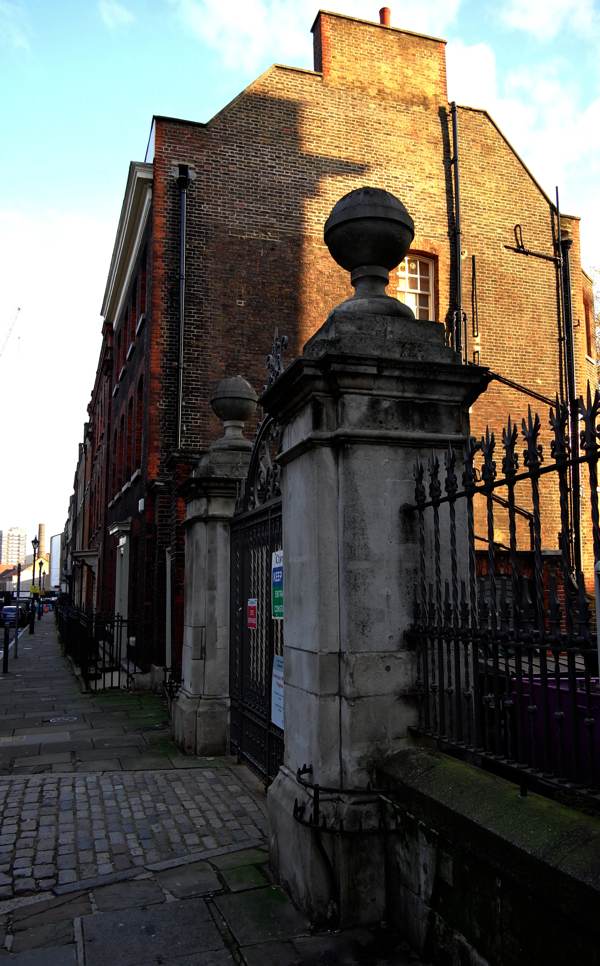
The shadow of the cornice of Christ Church upon the Rectory


The shadow of the pillars of Christ Church upon Fournier St


Windows in Fournier St reflecting upon the church wall


In Princelet St
You may also like to read about
So Long, Mama Irene
Mama Irene Sagar died on Thursday aged seventy-five. Many years ago, I passed an evening in her kitchen at this time of year and this is my account.
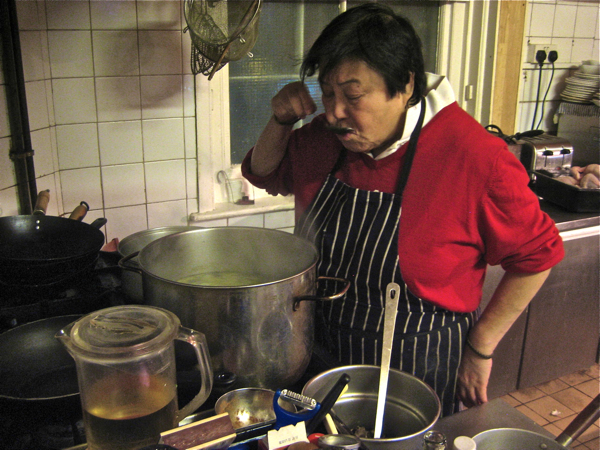
By the time you read this, Irene Sagar – proprietor of Lennies Snack Bar in Calvert Avenue in Shoreditch – will be in Thailand, gone to visit her family for Christmas. But each year, on the night before her departure, she closes early and cooks an elaborate feast for her friends. If you passed by that evening you would have seen a long table in the window with happy diners in party hats enjoying Mama’s Irene’s spicy cuisine, and it was my delight to be there amongst them to savour this special meal and record the preparations.
Lennies Snack Bar presents a modest face to the street, yet the view from inside across to George Dance’s magnificent church of St Leonards opposite, framed in Spring by the almond trees in blossom, creates a breathtaking prospect. But as the dusk fell on this particular afternoon in late December, the church receded into the gloom and the lights were out in the front of the cafe while Mama Irene worked peacefully in the kitchen at the back, where I kept her company as she told me her story.
“I only cook what I love, and I believe you can only do what you love. That’s why it’s not a job, it’s a passion.” she announced, stating her personal creed, as she placed a side of pork in the oven with a pat of affection and set about filleting six sea bream conscientiously. “I will never get tired of cooking,” she continued brightly, raising her head momentarily to share a grin with me.
Although you might assume that Mama Irene grew up cooking the Thai and Malaysian food for which she is famous, she only came to it later in life. Born in Malacca to a Malaysian father and a Thai mother she came to Yorkshire in 1958 as the wife of an airforce officer. “It was bloody cold,” she recalled. This was where Mama Irene attempted the Cornish pasty that became her notorious culinary debut, a gesture of reconciliation for her long-suffering husband after she was arrested several times for protesting against nuclear missiles. “I told him, ‘I believe in protest,'” she confided,“‘I married you, not the airforce,’ – but he was worried that they would take away his stripe.” Mama Irene delivered the pasty to her husband at work, with such overzealous contrition that she dropped it on the floor. And, partly as a consequence of this incident, today she is divorced with a fifty-year-old daughter and no hard feelings.
“I used to be an antique dealer specialising in nineteen twenties and Art Deco,” explained Irene, stirring her stockpot and introducing the next chapter in her life with cheerful alacrity “But I was so obsessed with that period that I wouldn’t sell any of it and I nearly lost my house. So I had to quit trading and I registered with a catering agency instead, as a general kitchen assistant. Working in different places, I saw what a chef can do and it made me want to be a chef. I worked during the day and went to school at night to get my qualifications. Then I became a commis chef and in the end I opened my own sandwich bar, Lennies Snack Bar in Old St.”
Mama Irene is justly proud of this period in her life, when things started to go right for her. Such was her success that she needed extra premises to prepare all the sandwiches and that was when she came to Calvert Avenue. “It was twenty years ago.” she realised, peeling garlic and filling with sentiment, “I saw this cafe, a typical greasy spoon, and I fell in love with it. So I asked the owner if she would sell it and I christened it Lennies after my place in Old St. But I thought it could become a Thai restaurant, and I opened up during the day selling homemade food.”
Halting from chopping celery and peering out towards the street to contemplate the changing neighbourhood, “I don’t know if it has changed for the better or the worse,” she said. “When I came here there was a strong community atmosphere, everyone looked out for each other. There was this button and buckle factory that stood empty for years, inhabited by Italian squatters, they had no money and no place to stay, and I used to go to wild parties there. They came to London to study circus and on Summer evenings there used to be juggling, fire-eating and rollerskating in the middle of Calvert Avenue. But also in those days, it was risky to walk down this road alone, quite often people would be attacked for their mobile phones, and they always came in here as a safe house where they could call and wait for the police to come.
This was the only cafe here, and I stayed open late so students studying art and photography at Hackney College could come and eat. They used to say, ‘Let’s go to Mama Irene’s and get a bowl of soup’ and they all gave me a couple of pounds each and I made them a bowl of soup, that’s how opening in the evenings first came about.” Since then, Mama Irene has been running her cafe by day and opening as a Thai restaurant at night, building up a loyal following and acquiring a lot of friends. There is nothing swanky about Lennies Snack Bar, simply a plain cafe with an open kitchen serving honest food and that is just how I like it.
“I love England so much,” she revealed, turning unexpectedly emotional as she added the spices and seasonings to her Thai Curry, “I am quite patriotic, I would rather live here in spite of the snow and the recession. It’s still a very fair place to live. You can make yourself heard here, but in Thailand or Malaysia you can’t even voice your opinion. I worked all my life here and I pay my dues, and I get upset when people run it to the ground.”
It was all coming together nicely. Once Mama Irene had her seabream marinating and her chicken, duck and pork cooking, and the curry was simmering, it was time to make her famous spicy sauce. “Cooking is an art, both in how you cook it and how you present it.” she informed me with authority, flourishing a ladle and arching her brows for emphasis.“First of all you eat it with your eyes. When it’s inviting and colourful, you want to eat it. My cooking is very spicy, I like strong flavours. I always do wholesome cooking, I don’t do artificial ingredients. In the Summer, I grow my own vegetables and bring them here from my allotment in Twickenham. I pick them in the early morning – you must pick them before midday because they taste so different, especially root vegetables. I grow my own herbs, beans, courgettes, tomatoes, lettuces and onions.”
By now, guests had begun to arrive, taking refuge from the cold night and sitting around in hungry anticipation, watching appreciatively as Mama Irene had three woks on the flame simultaneously, cooking the tofu, greens, and asparagus. With a placid nature and concentrated application, she had prepared an entire menu of dishes as we talked, and now they were all ready to be served at the same joyous moment. We had come to pay tribute to Mama Irene, and as we took our seats around the table, we were her children and we were blessed with her beneficence.


You may be interested in my other stories about Calvert Avenue:
How Raymond’s Shop became Leila’s Shop
Syd’s Coffee Stall, Shoreditch High St
So Long, Still & Star

Still & Star, 1 Little Somerset St, Aldgate
There is very little left of old Aldgate these days but the Still & Star, just opposite the tube station yet hidden down Little Somerset St, was a rare survivor. This tiny pub on the corner of two alleys is believed to be unique in the City of London as the sole example of what is sometimes described as a ‘slum pub’ – in other words, a licensed premises converted from a private house.
If it would interest you to take a look at this cosy characterful pub, which almost alone carries the history of the place, you had better do so soon because this week the City of London approved an application to demolish it to for a huge new office development.
Former landlord Michael Cox explained to me that the block once contained eight butcher’s shops which were all bought up by one owner, who opened the pub in 1820. Before it was renamed Little Somerset St, the passageway leading to the pub was ‘Harrow Alley’ but colloquially known as ‘Blood Alley.’ At that time, the City of London charged a tariff for driving cattle across the square mile and, consequently, a thriving butchery trade grew up in Aldgate and Whitechapel, slaughtering cattle before the carcasses were transported over to Smithfield.
There is no other ‘Still & Star’ anywhere else – the name is unique to this establishment – and Michael Cox told me the pub originally had its own still, which was housed in the hayloft above, while ‘star’ refers to the Star of David, witnessing the Jewish population of Aldgate in the nineteenth century.
All around us, pubs are being shut down permanently and demolished yet, as regular readers will know, I have a particular affection for these undervalued institutions which I consider an integral part of our culture and history – necessary oases of civility in the chaos of the urban environment.

Still & Star, 1951 (Courtesy Heritage Assets/The National Brewery Centre)

Still & Star, 1968 (Courtesy Heritage Assets/The National Brewery Centre)

Still & Star

The Still & Star portrayed in ‘Harrow Alley’ by Gustave Dore, 1880

Butcher’s shop at the corner of Harrow Alley (known as Blood Alley) leading through to the Still & Star

Map of 1890 shows the Still & Star with nearby butcher’s shops and slaughterhouses

Charringtons’ record of the landlords (Courtesy Heritage Assets/The National Brewery Centre)

The office block that will replace the Still & Star

A topsy-turvy cast of the old pub in green concrete will replace it nearby
You may also like to read about


