An Alternative Scheme For Liverpool St Station
Henrietta Billings, Director of SAVE Britain’s Heritage asks if the demolition and tower scheme is the only way to pay for station improvements at Liverpool St, as Network Rail claim. She introduces John McAslan’s alternative scheme, offering a sympathetic solution that delivers Network Rail’s ambitions without ruining the station or subjecting passengers to years of disruption.
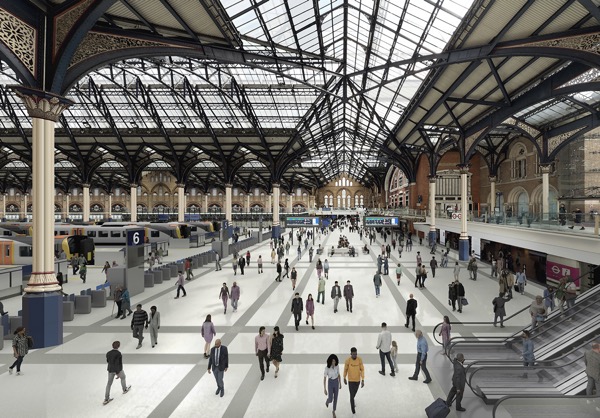
The improved concourse in John McAslan’s scheme (courtesy of JMP)
If you are one of the thousands who pass through Liverpool St Station regularly, you will be familiar with its magnificent features: the light-filled, triple-height concourse, the beautiful Victorian train sheds, and its illustrious adjacent neighbour, the grade II* former Great Eastern Hotel. With 270,000 people using the station every weekday, it is now the busiest terminus in the country. Everyone recognises it needs upgrades, like new escalators, lifts and more accessible toilets. The question is how can they be achieved without ripping out the guts of this well-loved landmark that is – at least theoretically – protected through its grade II listing and Conservation Area status?
Thanks to a number of highly controversial planning applications, Liverpool St Station is at the centre of a raging debate over how we fund essential upgrades to public buildings. Plans by Network Rail to build a nineteen-storey office block through the station are due to be considered by the Corporation of London on 10th February – with a recommendation for approval. Yet the plans have been met with significant opposition from commuters, residents and conservation groups since they were submitted in April last year (2,400 letters of objection, and counting).
The plans would see the beautiful concourse completely demolished. A new tower would loom over the remains of the original station and the historic hotel, and block out light from the rebuilt concourse. 50 Liverpool St, the Gothic revival masterpiece painstakingly built as part of the eighties conservation project, would be demolished, and the works would cause years of significant disruption to passengers. On heritage grounds alone, the City should refuse the plans because they contravene the City’s polices on heritage protection in relation to listed buildings and conservation areas. Additionally, the report we commissioned from sustainability expert Simon Sturgis shows the environmental credentials of the glass and steel tower fall short of the Corporation’s own sustainability ambitions.
Indeed, Network Rail’s £1.2bn proposal is “not technically viable” according to their own advisors and so far they have refused to release the actual costs of the station improvements. Given that the whole project was predicated on the need for the office block to fund the essential upgrades, releasing costs is essential both as a matter of transparency, and to assess the acceptability of what is on the table.
The proposal, designed by Acme Architects, follows an equally controversial application in 2023 by Herzog & de Meuron architects, which was shelved after also receiving thousands of objections including a strong rebuttal from Historic England. They objected “in the strongest terms” to what they argued were “fundamentally misguided” plans and called for a “comprehensive redesign” to avoid the harm caused by the scheme. Confusingly. this previous scheme has not been officially withdrawn, and remains in limbo as a “live” planning submission. In the words of Building Design senior writer Tom Lowe, it has been arguably the most chaotic development process of any major project over the past decade.
Against the backdrop of these competing contentious proposals, a new approach has emerged from a different team of architects and engineers. John McAslan + Partners, the architects behind the celebrated transformation of King’s Cross Station, have unveiled a fresh vision which shows that the station enhancements and accessibility upgrades could be achieved at half the cost, with a sympathetic, lighter-touch design.
When John McAslan + Partners approached SAVE six months ago with their scheme we immediately jumped at the opportunity to show there is an alternative way of providing the much-needed improvements to the station. We believe this proposal is an elegant design solution in the spirit of traditional railway architecture without the passenger disruption, demolition or over-scaled development currently on offer. It is an important contribution to a critical debate about how we develop our public buildings balancing heritage and commercial interests.
Working with architects on alternative schemes is a key campaign tactic that we use at SAVE - from Smithfield Market in Farringdon and the Little Houses on the Strand next to Somerset House, to Battersea Power Station and the mighty Wentworth Woodhouse in Rotherham, South Yorkshire. We know from fifty years of experience how powerful they can be in bringing fresh perspectives and impetus to contested development plans or important threatened landmarks.
John McAslan’s concept has been welcomed by Sir Tim Smit, founder of the pioneering Eden Project, and by heritage and sustainability experts alike as a helpful contribution to a debate that has so far been dominated by one idea: large-scale demolition and a nineteen-storey tower. We regard the McAslan approach as a compelling and viable alternative which is why we are calling on Network Rail and the City of London to pause the current scheme and give full consideration to this approach.
There is still time for Network Rail to get back on the right track. They should pause the Network Rail/Acme scheme for two reasons.
-
Costings of the required station upgrades have not been provided – so it is not possible to assess the full public benefit or justification for such massive and destructive over-station development in relation to the listed building and the conservation area.
-
The Corporation of London and Network Rail need more time to consider fully the heritage, financial and operational opportunities provided by the McAslan approach. The councillors on the planning committee can make this happen by voting to defer the planning application until they have had the chance to review this new information.
The committee date is approaching fast. Please add your voice by submitting your views on the Network Rail/Acme scheme and the alternative vision before 10th February.
CLICK HERE TO LEARN HOW TO OBJECT
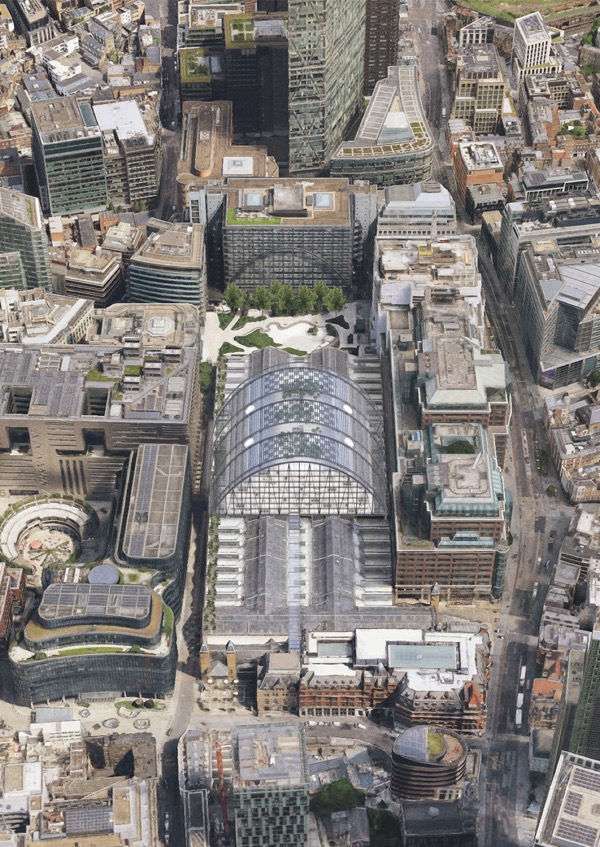
Instead of a nineteen-storey tower over the concourse, John McAslan + Partners propose a new steel office building cantilevered over the train sheds. The development could be delivered through access from the west without any interference to trains and is fully reversible. (courtesy of JMP)
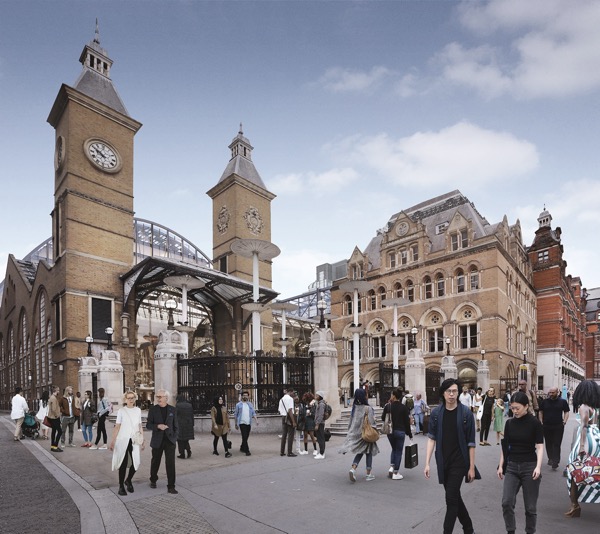
The Liverpool St entrance is unaltered in John McAslan’s scheme, with the new cantilevered offices just visible (courtesy of JMP)
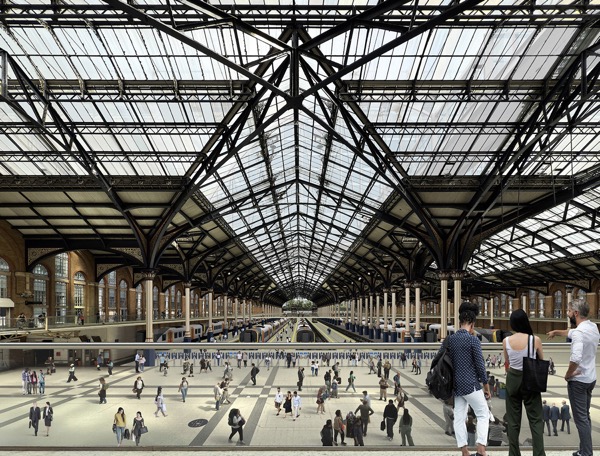
Looking from the concourse towards the historic train sheds (courtesy of JMP)
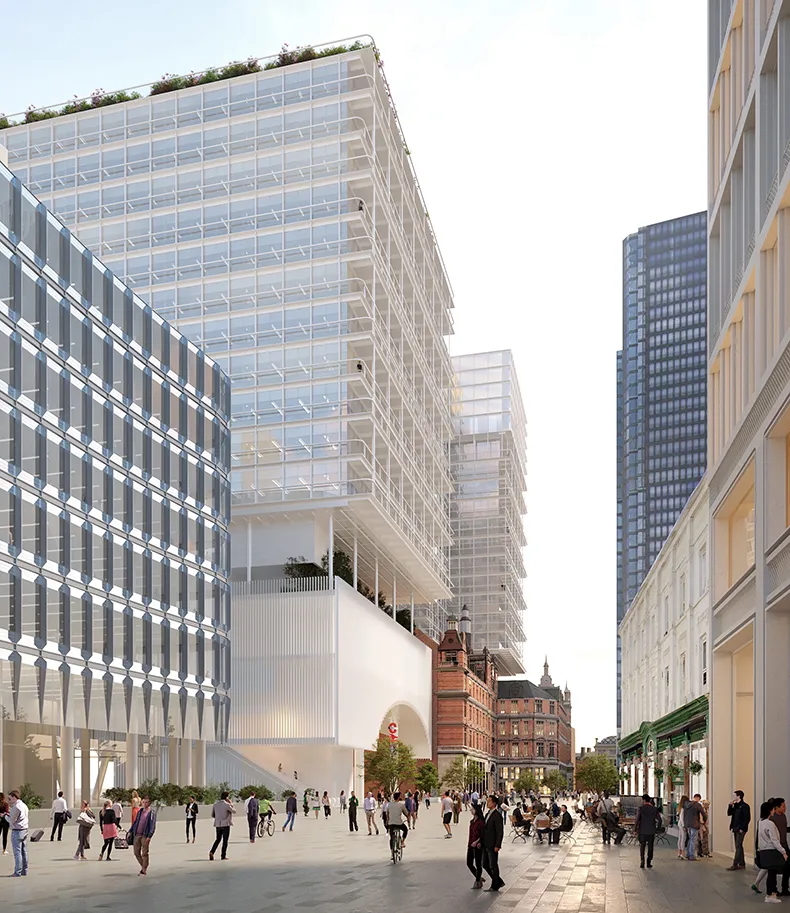
The Herzog & de Meuron scheme (courtesy of Herzog & de Meuron)
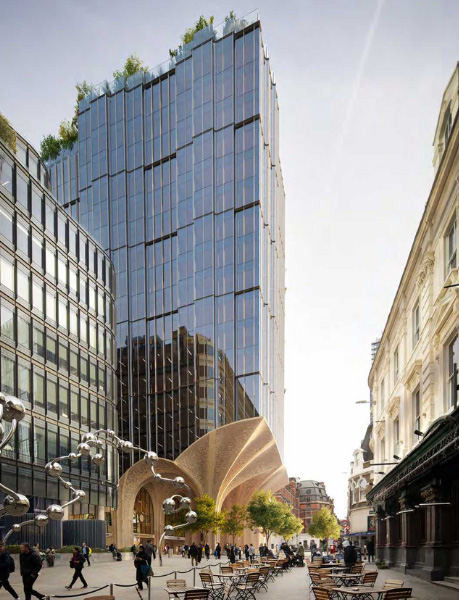
The Acme scheme (courtesy of Acme)
You may also like to read about
Towering Folly At Liverpool St Station
Colin O’Brien, Photographer
I am giving an illustrated lecture about Colin O’Brien, the Clerkenwell Photographer, on Tuesday 10th February at 6:30pm at Islington Museum, 245 St John St, EC1V 4NB. Entry is free and no booking is required, just come along.

Observe this tender photograph of Raymond Scallionne and Razi Tuffano in Hatton Garden in 1948, one of the first pictures taken by Colin O’Brien – snapped when he was eight years old, the same age as his subjects. Colin forgot this photograph for over half a century until he discovered the negative recently and made a print, yet when he saw the image again he immediately remembered the boys’ names and recalled arranging them in front of the car to construct the most pleasing composition for the lens of his box brownie.
Colin grew up fifty yards from Hatton Garden in Victoria Dwellings, a tenement at the junction of Faringdon Rd and Clerkenwell Rd – the centre of his childhood universe in Clerkenwell, that Colin portrayed in spellbinding photographs which evoke the poetry and pathos of those forgotten threadbare years in the aftermath of World War II. “We had little money or food, and shoes were a luxury. I remember being given my first banana and being told not to eat it in the street where someone might take it,” he told me, incredulous at the reality of his own past,“Victoria Dwellings were very run down and I remember in later years thinking, ‘How did people live in them?’”
Blessed with a vibrant talent for photography, Colin created images of his world with an assurance and flair that is astounding in one so young. And now these pictures exist as a compassionate testimony to a vanished way of life, created by a photographer with a personal relationship to all his subjects. “I just wanted to record the passage of time,” Colin told me with modest understatement, “There were no photographers in the family, but my Uncle Will interested me in photography. He was the black sheep, with a wife and children in Somerset and girlfriends in London, and he used to come for Sunday lunch in Victoria Dwellings sometimes. One day he brought me a contact printing set and he printed up some of my negatives, and even now I can remember the excitement of seeing my photographs appear on the paper.”
Colin O’Brien’s clear-eyed Clerkenwell pictures illustrate a world that was once familiar and has now receded far away, yet the emotionalism of these photographs speaks across time because the human detail is touching. Here is Colin’s mother spooning tea from the caddy into the teapot in the scullery and his father at breakfast in the living room before walking up the road to the Mount Pleasant Sorting Office, as he did every day of his working life. Here is Mrs Leinweber in the flat below, trying to eke out the Shepherd’s Pie for her large family coming round for dinner. Here is the Rio Cinema where Colin used to go to watch the continuous programme, taking sandwiches and a bottle of Tizer, and forced to consort with one of the dubious men in dirty raincoats in order to acquire the adult escort necessary to get into the cinema. Here is one of the innumerable car crashes at the junction of Clerkwenwell Rd and Faringdon Rd that punctuated life at Victoria Dwellings – caused by lights that were out of sync, instructing traffic to drive in both directions simultaneously – a cue for Colin to reach out the window of their top floor flat to capture the accident with his box brownie and for his mother to scream, “Colin, don’t lean out too far!”
At fifteen years old, Colin’s parents bought him Leica camera. “They couldn’t afford it and maybe it came off the back of a lorry, but it was a brilliant present – they realised this was what I wanted to do,” he admitted to me with an emotional smile. “My first job was at Fox Photo in the Faringdon Rd. I worked in the library, but I spent all my time hanging around in the dark room because that was where all the photographers were and I loved the smell of fixer and developer.” he recalled, “And if I stayed there I would have become a press photographer.” But instead Colin went to work in the office of a company of stockbrokers in Cornhill in the City and then for General Electric in Holborn – “I hated offices but I aways got jobs in them” – before becoming a photographic lab technician at St Martins School of Art and finally working for the Inner London Education authority in Media Resources, a role that enabled him to pursue his photography as he pleased throughout his career.
Over all this time, Colin O’Brien has pursued his talent and created a monumental body of photography that amounts to over half a million negatives, although his work is barely known because he never worked for publication or even for money, devoting himself single-mindedly to taking pictures for their own sake. Yet over the passage of time, as a consequence of the purism of his approach, the authority of Colin O’Brien’s superlative photography – distinguished by its human sympathy and aesthetic flair – stands comparison with any of the masters of twentieth century British photography.

Members of the Leinweber family playing darts at the Metropolitan Tavern, Clerkenwell Rd, 1954.
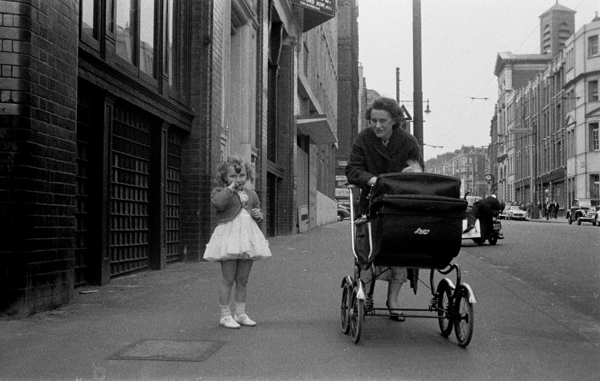
Girl in a party dress in the Clerkwenwell Rd, nineteen fifties.

Solmans Secondhand Shop, Skinner St, Clerkwenwell, 1963.
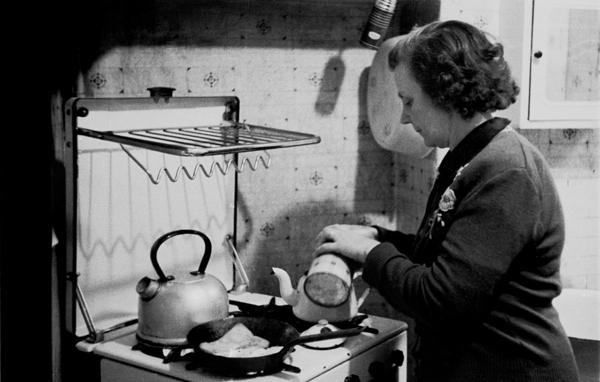
Colin’s mother puts tea in the teapot, in the scullery at Victoria Dwellings, nineteen fifties.

Linda Leinweber takes a nap, 117 Victoria Dwellings, nineteen fifties.
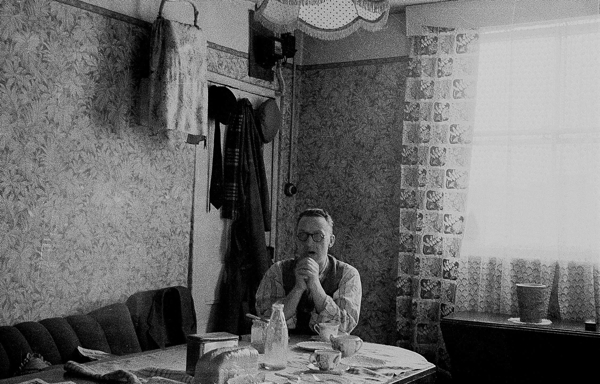
Colin’s father eats breakfast before a day’s work at the Mount Pleasant Sorting Office.
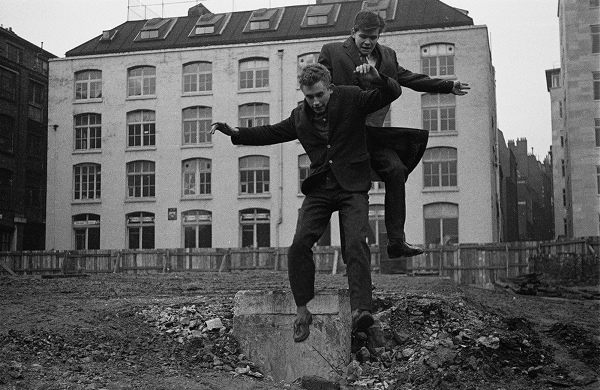
Jimmy Wragg and Bernard Roth jumping on a bomb site in Clerkenwell, late fifties.

Accident at the junction of Clerkwell Rd and Faringdon Rd, 1957.

Mrs Leinweber ekes out the the Shepherd’s Pie among her family, Victoria Dwellings, 1959.

Rio Cinema, Skinner St, Clerkenwell, 1954.
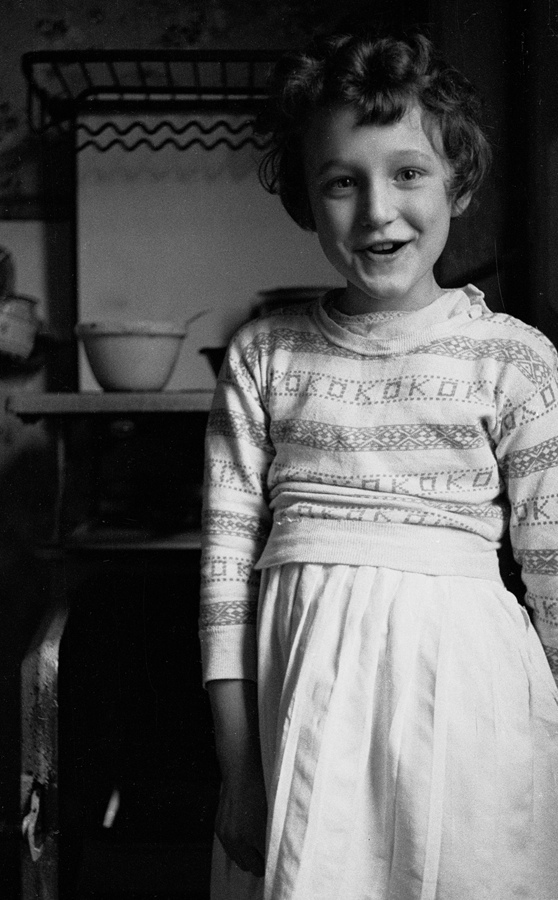
Hazel Leinweber, Victoria Dwellings, nineteen fifties.
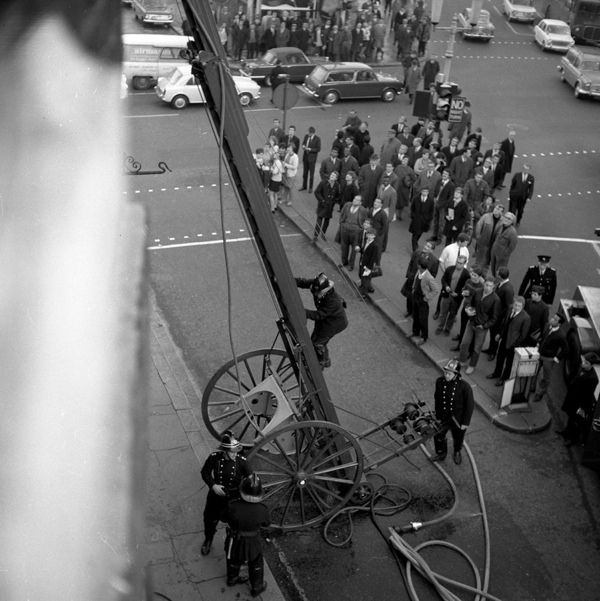
Fire at Victoria Dwellings, mid-fifties.

Colin’s mother outside her door, 99 Victoria Dwellings, nineteen fifties.

Boy at Woolworths, Exmouth Market, 1954.

Two women with a baby in Woolworths, Exmouth Market, 1954.

Cleaning the windows in the snow, Clerkenwell Rd, 1957.
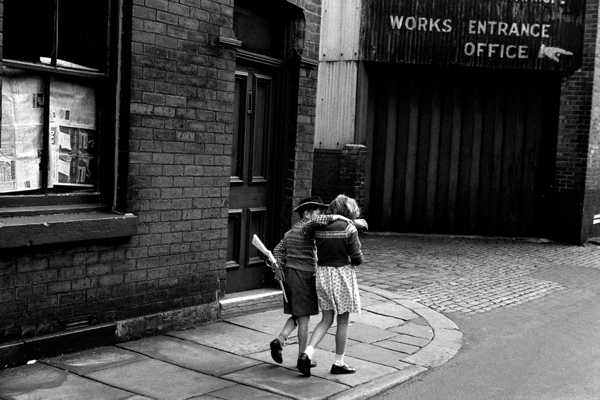
Cowboy and girlfriend, 1960.

Nun sweeping in the Clerkenwell Rd, nineteen sixties.

Colin’s window at Victoria Dwellings was on the far right on the top floor.

An old lady listens, awaiting meals on wheels in Northcliffe House, Clerkenwell, late seventies.

The demolition of Victoria Dwellings in the nineteen seventies.
Photographs copyright © Estate of Colin O’Brien
Barry Rogg Of Rogg’s Delicatessen
Alan Dein remembers Barry Rogg and his celebrated Whitechapel delicatessen
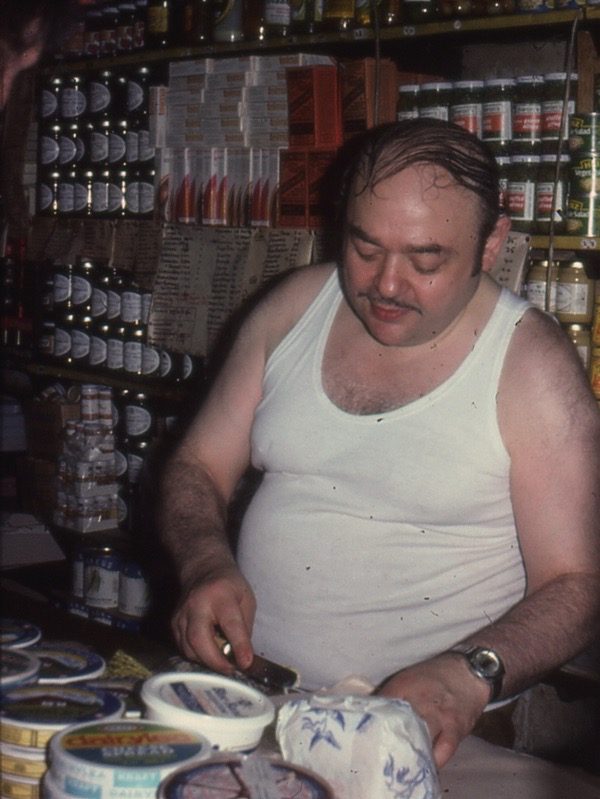
Barry Rogg by Shloimy Alman, 1977
As the years tick by and the places and the people I have loved pass on, I would like to take this opportunity to reflect on a remarkable character whose shop was an East End institution for over fifty years.
Just south of Commercial Rd, Rogg’s delicatessen stood at the junction of Cannon Street Rd and Burslem St with its white-tiled doorway directly on the corner. One step transported you into a world of ‘heimishe’ or homely Jewish food that still had one foot in the past, a land of old-time street market sellers and their Eastern European roots.
Rogg’s was crammed from floor to ceiling with barrels, tins and containers of what Barry Rogg always called “the good stuff”. He was the proud proprietor who held court from behind the counter, surrounded on all sides by his handpicked and homemade wares. The shelves behind him were lined with pickles and a variety of cylindrical chub-packed kosher sausages dangled overhead.
Barry’s appearance was timeless, a chunky build with a round face that sometimes made him look younger or older than he was. He would tell you the story of Rogg’s if you wanted to know, but he was neither sentimental about the heyday of the ‘Jewish East End’ nor did he run a nostalgia-driven emporium. Rogg’s customers were varied and changed with the times. There was always the Jewish trade but, up to their closure, Rogg’s was also a popular a haunt for dockers who would traipse up from the nearby Thames yards. After that his customers were made up from the local Asian community, until there came another wave when he was being discovered by the national press increasingly focusing eastwards.
Barry’s grandfather started in the business at another shop on the same street in 1911. By 1944, when Barry was fourteen and still at school, he had already begun to help the family out at their new corner shop at 137 Cannon Street Rd. In 1946 he moved in for good, though he had only anticipated it would be a two-year stint as the building was earmarked for compulsory purchase for a road widening scheme that fortunately never happened.
I got to know Barry Rogg in 1987 when I joined a team of part-time workers at the Museum of the Jewish East End – now the Jewish Museum – who were collecting reminiscences and artefacts relating to East End social history. Then Rogg’s was one of the very last of its kind in East London. By the nineties it was Barry alone who was flying the flag for the Yiddisher corner deli scene that had proliferated in Whitechapel from the late nineteenth century. Thankfully, due to his popularity and the uniqueness in the last decade of the twentieth century, we have some wonderful photographs and articles to remember Barry by.
There are tantalising images of the food but we no can longer taste it. An array of industrial-sized plastic buckets filled with new green cucumbers, chillies, bay leaves and garlic at various stages of pickling, the spread of homemade schmaltz herrings, fried fish, gefilte fish, salt beef, chopped liver, the cheesecake. I am sure everyone reading this who visited Rogg’s will remember how their senses went into overdrive. The smells of the pickles, the herrings, the fruit and the smoked salmon, the visual bombardment of all the packaging and the handwritten labels. “Keep looking” was a favourite Barry catchphrase and how could you possibly not?
Of course, you could spend all day listening to the banter with his customers. I also fondly recall conversations with his partner Angela, who helped out but generally kept a low profile in the back of the shop. Rogg’s was Barry’s stage. He had a deep love for the theatre and for art, and one wonders what else he might have done if – like so many of his generation – he had not ended up in the family business as a fifteen-year-old out of school.
Barry died in 2006 at the age of seventy-six. Years ago, I co-compiled an album for JWM Recordings, Music is the Most Beautiful Language in the World: Yiddisher Jazz in London’s East End from the twenties to the fifties. As a follow-up, my co-compiler and regular companion on trips to Rogg’s, Howard Williams suggested releasing another disc, this time with a food theme and dedicated to Barry Rogg.
This disc dishes up two sides recorded in New York in the late thirties and forties. Slim Gaillard – whose hip scatological word play would be celebrated in On the Road – performs a paean to the humble yet filling Matzoh Balls, dumplings made of eggs and matzoh meal. Yiddish singer Mildred Rosner serves Gefilte Fish a galloping love affair with this slightly sweet but savoury ancient recipe which consists of patties made of a poached mixture of ground deboned white fish, boiled or fried. These two classic dishes have graced the Jewish luncheon or dinner table for generations and the recipes are included.
On the label is Irv Kline’s portrait of Barry from 1983. Irv was an American who had retired to live in London. Barry’s photograph formed part of Irv’s study of surviving Jewish businesses in the East End, a travelling exhibition which I helped to hang during the eighties. I recall Irv being a real jazz buff so I hope that he too would appreciate the music accompanying his portrait of Barry Rogg.
Click here for information about the ‘Gefilte Fish/Matzoh Balls’ recording
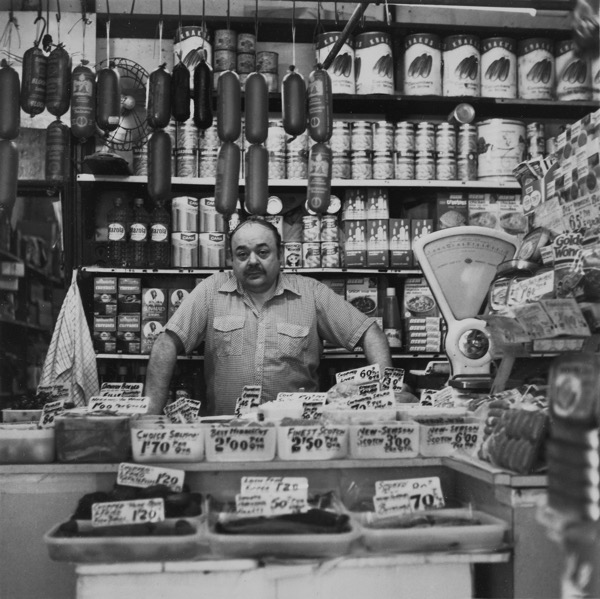
Irv Kline’s portrait of Barry Rogg, 1983
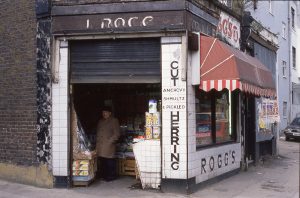
Alan Dein’s photograph of Rogg’s with one of Barry’s regular customers framed in the doorway, 1988
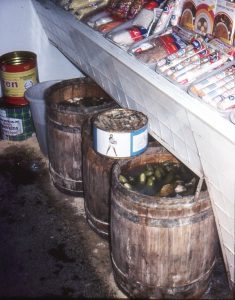
Shloimy Alman’s photograph of Rogg’s interior, 1977
You may also like to take a look at
James Boswell, Artist

A few years ago, I visited a leafy North London suburb to meet Ruth Boswell – an elegant woman with an appealing sense of levity – and we sat in her beautiful garden surrounded by raspberries and lilies, while she told me about her visits to the East End with her late husband James Boswell who died in 1971. She pulled pictures off the wall and books off the shelf to show me his drawings, and then we went round to visit his daughter Sal who lives in the next street and she pulled more works out of her wardrobe for me to see. And when I left with two books of drawings by James Boswell under my arm as a gift, I realised it had been an unforgettable introduction to an artist who deserves to be better remembered.
From the vast range of work that James Boswell undertook, I have selected these lively drawings of the East End done over a thirty year period between the nineteen thirties and the fifties.There is a relaxed intimate quality to these – delighting in the human detail – which invites your empathy with the inhabitants of the street, who seem so completely at home it is as if the people and cityscape are merged into one. Yet, “He didn’t draw them on the spot,” Ruth revealed as I pored over the line drawings trying to identify the locations, “he worked on them when he got back to his studio. He had a photographic memory, although he always carried a little black notebook and he’d just make few scribbles in there for reference.”
“He was in the Communist Party, that’s what took him to the East End originally,” she continued, “And he liked the liveliness, the life and the look of the streets, and and it inspired him.” In fact, James Boswell joined the Communist Party in 1932 after graduating from the Royal College of Art and his lifelong involvement with socialism informed his art, from drawing anti-German cartoons in style of George Grosz during the nineteen thirties to designing the posters for the successful Labour Party campaign of 1964.
During World War II, James Boswell served as a radiographer yet he continued to make innumerable humane and compassionate drawings throughout postings to Scotland and Iraq – and his work was acquired by the War Artists’ Committee even though his Communism prevented him from becoming an official war artist. After the war, as an ex-Communist, Boswell became art editor of Lilliput influencing younger artists such as Ronald Searle and Paul Hogarth – and he was described by critic William Feaver in 1978 as “one of the finest English graphic artists of this century.”
Ruth met James in the nineteen-sixties and he introduced her to the East End. “We spent quite a bit of time going to Blooms in Whitechapel in the sixties. We went regularly to visit the Whitechapel when Robert Rauschenberg and the new Americans were being shown, and then we went for a walk afterwards,” she recalled fondly, “James had been going for years, and I was trying to make my way as a journalist and was looking at the housing, so we just wandered around together. It was a treat to go the East End for a day.”

Rowton House

Old Montague St, Whitechapel
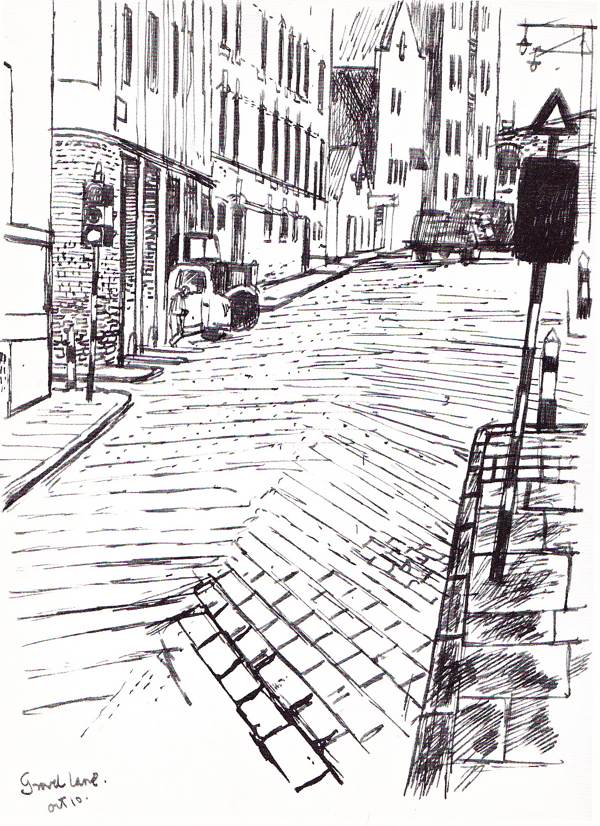
Gravel Lane, Wapping

Brushfield St, Spitalfields


Wentworth St, Spitalfields


Brick Lane


Fashion St, illustration by James Boswell from “A Kid for Two Farthings” by Wolf Mankowitz, 1953.

Russian Vapour Baths in Brick Lane from “A Kid for Two Farthings.”

James Boswell (1905-1971)


Leather Lane Market, 1937
Images copyright © Estate of James Boswell
You might also like to take a look at
In the footsteps of Geoffrey Fletcher
Tony Bock At Watney Market

Tony Bock took these pictures of Watney Market while working as a photographer on the East London Advertiser between 1973 and 1978. Within living memory, there had been a thriving street market in Watney St, yet by the late seventies it was blighted by redevelopment and Tony recorded the last stalwarts trading amidst the ruins.
In the nineteenth century, Watney Market had been one of London’s largest markets, rivalling Petticoat Lane. By the turn of the century, there were two hundred stalls and one hundred shops, including an early branch of J.Sainsbury. Tony’s poignant photographs offer a timely reminder of the life of the market that existed before the concrete precinct of today.
Born in Paddington yet brought up in Canada, Tony Bock came back to London after being thrown out of photography school and lived in the East End where his mother’s family originated, before returning to embark on a thirty-year career as a photojournalist at The Toronto Star. Recalling his sojourn in the East End and contemplating his candid portraits of the traders, Tony described the Watney Market he knew.
“I photographed the shopkeepers and market traders in Watney St in the final year, before the last of it was torn down. Joe the Grocer is shown sitting in his shop, which can be seen in a later photograph, being demolished.
In the late seventies, when Lyn – my wife to be – and I, were living in Wapping, Watney Market was our closest street market, just one stop away on the old East London Line. It was already clear that ‘the end was nigh,’ but there were still some stallholders hanging on. My memory is that there were maybe dozen old-timers, but I don’t think I ever counted.
The north end of Watney St had been demolished in the late sixties when a large redevelopment was promised. Yet, not only did it take longer to build than the Olympic Park in Stratford, but a massive tin fence had been erected around the site which cut off access to Commercial Rd. So foot and road traffic was down, as only those living nearby came to the market any more. The neighbourhood had always been closely tied to the river until 1969 when the shutting of the London Docks signalled the change that was coming.
The remaining buildings in Watney St were badly neglected and it was clear they had no future. Most of the flats above the shops were abandoned and there were derelict lots in the terrace which had been there since the blitz. The market stalls were mostly on the north side of what was then a half-abandoned railway viaduct. This was the old London & Blackwall Railway that would be reborn ten years later as the Docklands Light Railway and prompt the redevelopment we see today.
So the traders were trapped. The new shopping precinct had been under construction for years. But where could they go in the meantime? The new precinct would take several more years before it was ready and business on what was left of the street was fading.
Walking through Watney St last year, apart from a few stalls in the precinct, I could see little evidence there was once a great market there. In the seventies, there were a couple of pubs, The Old House At Home and The Lord Nelson, in the midst of the market. Today there are still a few old shops left on the Cable St end of Watney St, but the only remnant I could spot of the market I knew was the sign from The Old House At Home rendered onto the wall of an Asian grocer.
I remember one day Lyn came home, upset about a cat living on the market that had its whiskers cut off. I went straight back to Watney St and found the beautiful tortoiseshell cat hiding under a parked car. When I called her, she came to me without any hesitation and made herself right at home in our flat. Of course, she was pregnant, giving us five lovely kittens and we kept one of them, taking him to Toronto with us.”


Eileen Armstrong, trader in fruit and vegetables


Joe the Grocer

Gladys McGee, poet and member of the Basement Writers’ group, who wrote eloquently of her life in Wapping and Shadwell. Gladys was living around the corner from the market in Cable St at this time.


Joe the Grocer under demolition.

Frames from a contact sheet showing the new shopping precinct.
Photographs copyright © Tony Bock
You may like to see these other photographs by Tony Bock
At The Annual Grimaldi Service
I am publishing my account of a visit to the Annual Grimaldi Service as a reminder to any readers who might choose to join this year’s service which takes place next Sunday 1st February at 3pm at All Saints Church, Livermore Rd, Dalston.

The first Sunday in February is when all the clowns arrive in East London for the annual service to honour Joseph Grimaldi (1778-1837), the greatest British clown – held since 1946 at this time of year, when the clowns traditionally gathered in the capital prior to the start of the Circus touring season. Originally celebrated at St James’ Pentonville Rd, where Grimaldi is buried, the service transferred to Holy Trinity, Dalston in 1959 where the event has grown and grown, and where there is now a shrine to Grimaldi graced with a commemorative stained glass window.
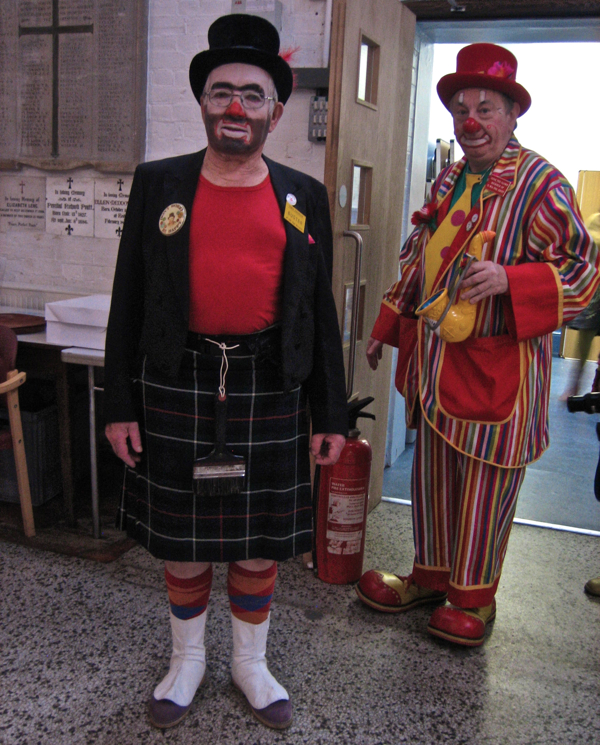
By mistake, I walked into the church hall which served as the changing room to discover myself surrounded by painted faces and multi-coloured suits. Seeing my disorientation, Mr Woo (in a red wig and clutching a balloon dog) kindly stepped over to greet me, explaining that he was veteran of forty years clowning including a stint at Bertram Mills Circus with the legendary Coco the clown – before revealing it was cut short when he fell over and fractured his leg, illustrating the anecdote by lifting his trouser to reveal a savagely-scarred shin bone. “He’s never going to win a knobbly knees contest now!” declared Uncle Colin with alarming levity, Mr Woo’s performing partner in the double act known as The Custard Clowns. “But what did you do?” I enquired in concern, still alarmed by Mr Woo’s injury. “I got a comedy car!” was Mr Woo’s shrill response, accompanied by an unnerving chuckle.
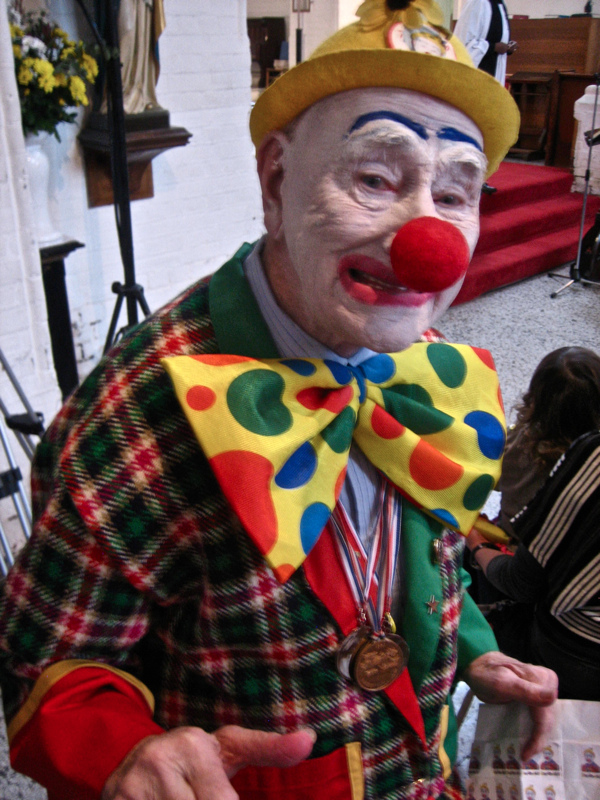
Reeling from the tragic ambiguity of this conversation, I walked around to the church where fans were gathering for the service and there, in the quiet corner church dedicated to Joseph Grimaldi, I had the good fortune to shake hands with Streaky the clown, a skinny veteran of sixty-three years clowning. There is a poignancy to old clowns such as Streaky with face paint applied to wrinkled skin – a quality only emphasised by the disparity between the harsh make-up and the infinite nuance of the lined features beneath.
At first, the presence of the clowns doing their sideshows to warm up the congregation changed the meaning of the sacred space, as if the vaulted arches became tent poles and we had come to a show rather than a church service – although both were strangely reconciled in the atmosphere of celebration that prevailed. Yet although the children delighted in the comedy and the audience laughed at the gags, I must admit that – as I always have – I found the clowns more funny peculiar than funny ha-ha.
But it is precisely this contradiction which draws me to them, because I believe that, through embracing grotesque self-humilation, they expose an essential quality of humanity – that of our innate foolishness, underscored by our tendency to take ourselves too seriously. We need to be startled or even alarmed by their extreme appearance, their gurning and their dopey japes, in order to recognise our true selves. This is the corrective that clowns deliver with a cheesey grin, confronting us with a necessary sense of the ridiculous in life.
“This is the best job I ever had – to make people smile and get them to laugh,” declared Conk the Clown, once he had demonstrated blowing bubbles from his saxophone. “How did you start?” I enquired. “I got divorced,” he replied – and everyone within earshot laughed, except me. “I had depression,” Conk continued with a helpless smirk, “so I joined the amateur dramatics, but I was no good at it, so I thought, ‘I’ll be a clown!'” Twelve years later, Conk has no apparent cause to regret his decision, as his mirthful demeanour confirmed. “It’s something inside, a feeling you know – everyone’s got laughter inside them,” he informed me with a wink, before disappearing up the aisle in a cloud of bubbles pursued by laughing children.
Turning around, I found myself greeted by Glory B, an elegant lady dressed in subtle tones of turquoise and blue, and sporting a huge butterfly upon her hat. Significantly, her face was not painted and she described herself as a ‘Children’s Entertainer’ rather than a ‘Clown.’ “Sometimes children are scared of clowns, ” she admitted, articulating my own thoughts with a smile, “so I work with Mr Woo as a go-between, to comfort them if they are distressed.”
Once the clown organist began to play, everyone took their seats and the parade of clowns commenced – old troupers and young goons, buffoons and funsters, jokers and jesters – enough to delight the most weary eyes and lift the spirits of the most down-hearted February day. An army of clowns filled the church with their pranking and japes, and their high wattage personalities. The intensity of an army of clowns is a presence that defies description, because even at rest there is such bristling potential for misrule.
In their primary-coloured parodic suits, I could recognise the styles of many periods, from both the twentieth and the nineteenth centuries, and when a clown stood up to carry the wreath to lay in honour of ‘Joey Grimaldi,’ I saw he was wearing an eighteenth century clown suit. At the climax of the service, the names of those clowns who had died in the year were read out and, for each one, a child carried a candle down the nave. After the announcements of ‘Sir Norman Wisdom,’ ‘Buddi,’ ‘Bilbo’ and ‘Frosty,’ I saw a feint light travel through the crowd to be lost at the rear of the church and it made tangible the brave purpose of clowning – that of laughing in the face of the darkness which surrounds us.

Mr Woo worked with Coco the clown at Bertram Mills Circus until he fractured his leg

Conk the clown once suffered from depression
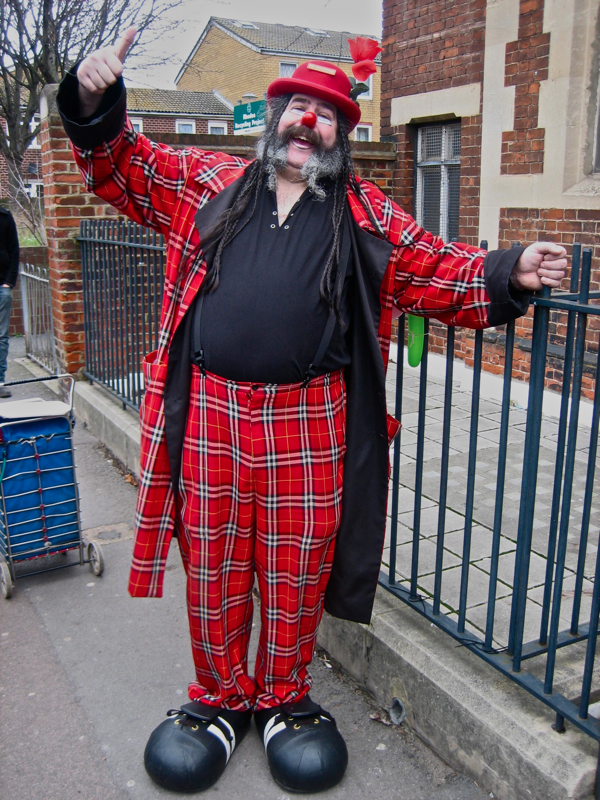
Arriving at Holy Trinity, Dalston

Streaky at Grimaldi’s shrine with the case of eggs recording the distinctive make-up of famous clowns

Streaky the clown, a veteran of sixty-three years clowning

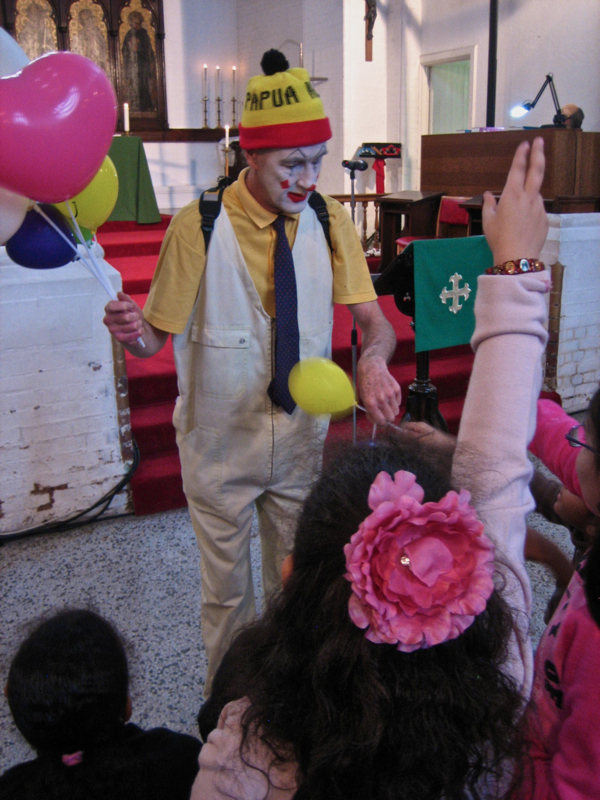

Glory B, Children’s Entertainer
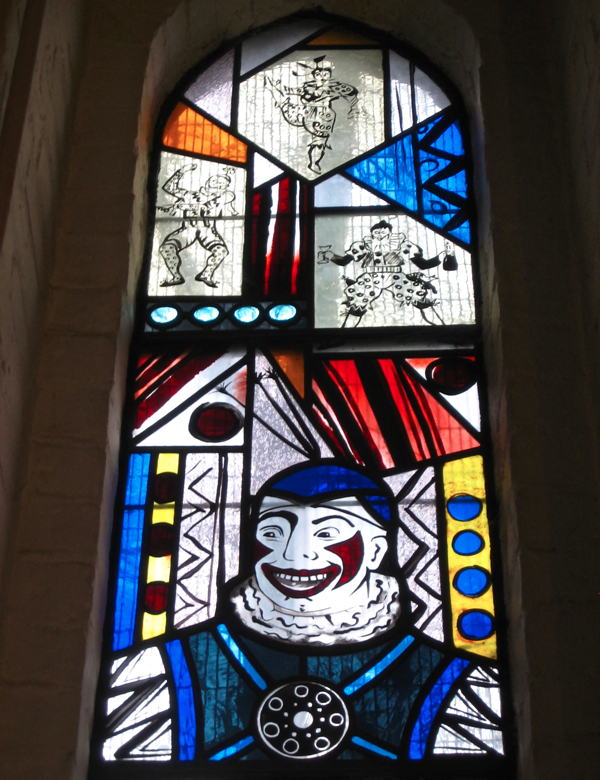
The commemorative window for Joseph Grimaldi



You may also like to take a look at
Mattie Faint, Clown & Giggle Doctor
John Claridge’s Clowns (Act One)
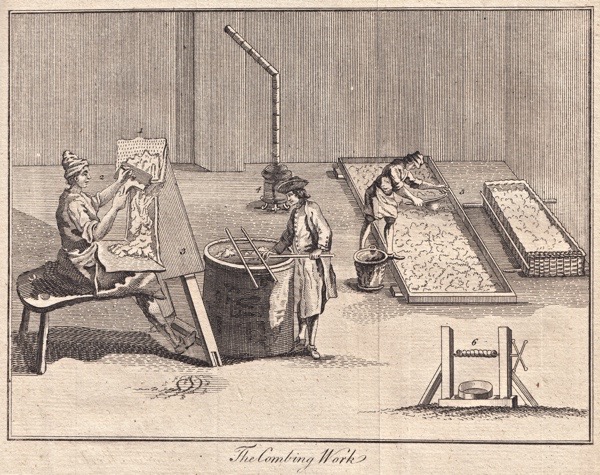
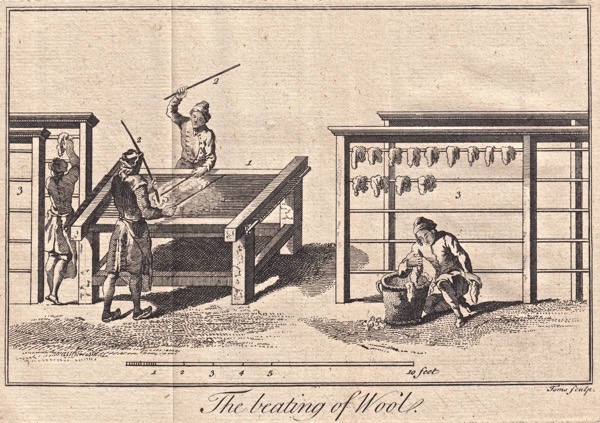
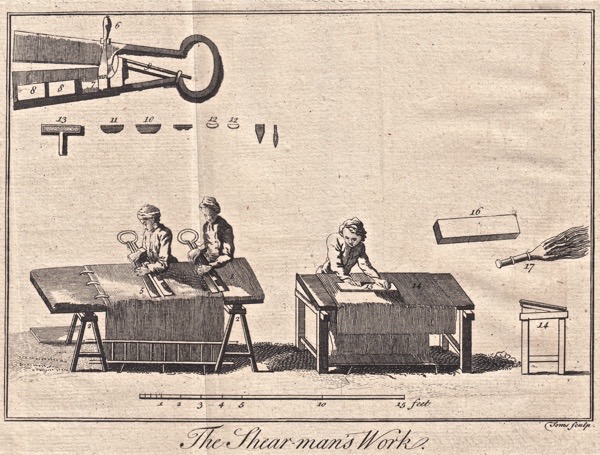
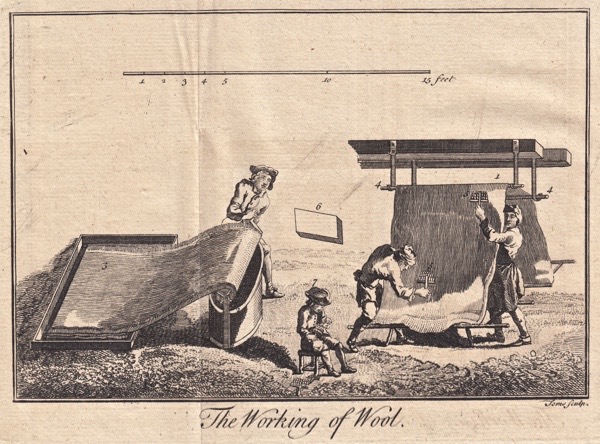
The Principal Operations Of Weaving
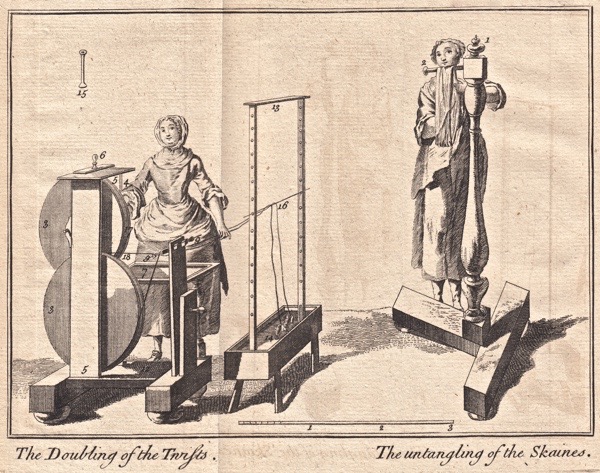
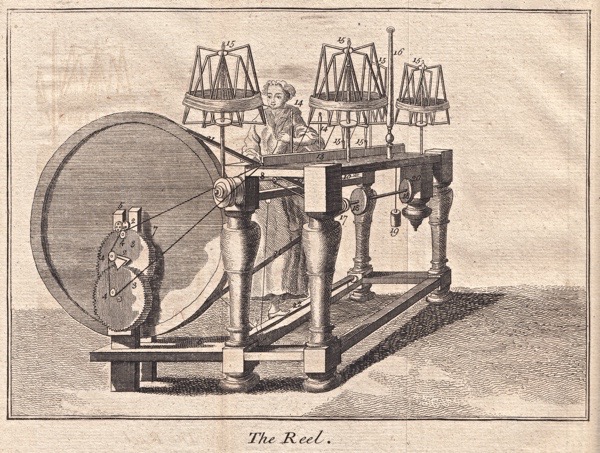
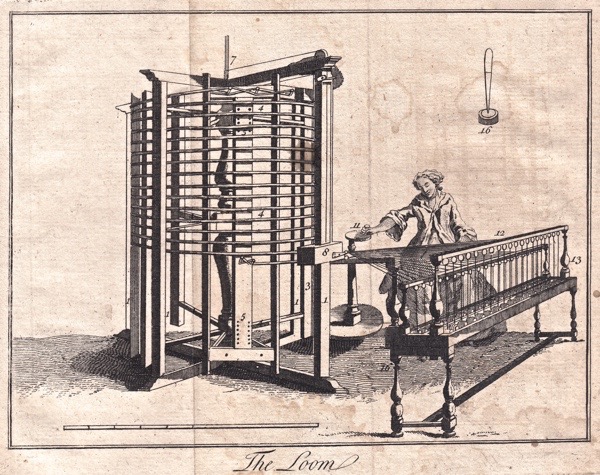
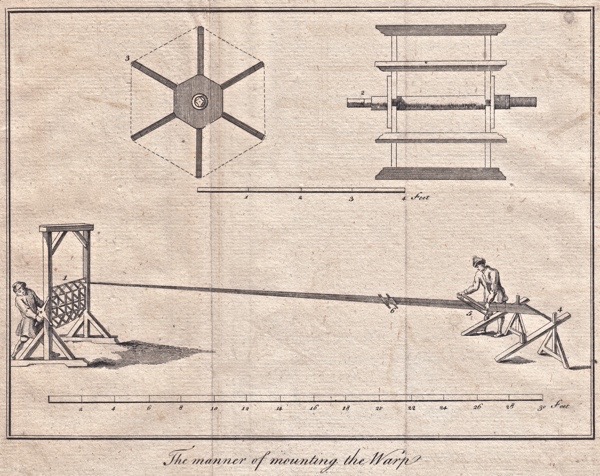
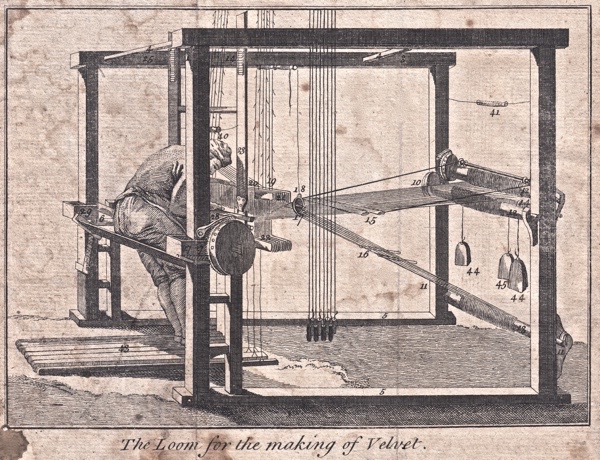
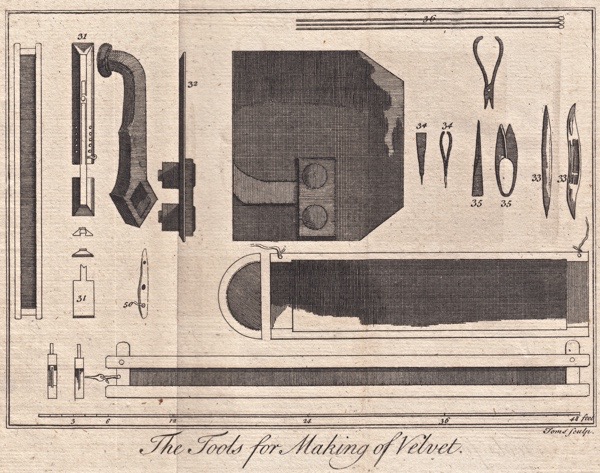
These copperplate engravings illustrate The Principal Operations of Weaving reproduced from a book of 1748 in the collection at Dennis Severs House. Many of these activities would have been a familiar sight in Spitalfields three centuries ago.



Ribbon Weaving




Dennis Severs House, 18 Folgate House, Spitalfields, E1
You make also like to read about