
The Battle For The Bell Foundry

Rupert Warren QC will be representing us
The Public Inquiry into the future of the Whitechapel Bell Foundry commences next week on Tuesday 6th October at 10am. It is to be an online event for all to see, streamed live for ten days, and we hope as many as possible will watch.
At a Public Inquiry everyone has a right to participate, either in writing or verbally. If you would like to contribute a statement, either on behalf of yourself or your group – whether your community group, your history society or band of bell ringers – you are encouraged to do so. For a link to watch and to request to speak, send an email in advance to Elizabeth.Humphrey@planninginspectorate.gov.uk
We are delighted to announce that the East End Preservation Society’s petition to SAVE THE WHITECHAPEL BELL FOUNDRY as a fully working foundry has reached over 25,270 signatures. Please click here to sign if you have not already done so.
Meanwhile, Raycliff, the sneaky developers who want to convert the bell foundry into a bell-themed boutique hotel, have now launched their own campaign with leaflets and sponsored posts on facebook, inviting people to ‘Preserve the Whitechapel Bell Foundry‘ by supporting their development. Please do not be deceived by this misinformation. Their intention is to reduce bell founding to a sideshow for tourists, making tiny bells in the coffee bar of their hotel, when we all know that cappuccinos and casting are not compatible.


Leaflet produced by the Save the Whitechapel Bell Foundry campaign
You may also like to read about
The Secretary of State steps in
A Letter to the Secretary of State
Rory Stewart Supports Our Campaign
The Fate of the Whitechapel Bell Foundry
Hope for The Whitechapel Bell Foundry
The Stars Are Bright
It is my delight to publish this dazzling gallery of images from THE STARS ARE BRIGHT, an exhibition of artists from Zimbabwe at The Theatre Courtyard Green Rooms, 36 Bateman’s Row, EC2A 3HH until 31st October

A revelatory collection of over six hundred paintings by young African artists of the nineteen-forties was discovered in St Michael & All Angels’ Church in Shoreditch in 1979 and seventy-five are now on display at a gallery nearby. The origin of these pictures was the Cyrene Mission School in Matabeleland, set up by Ned Paterson in 1938. He studied at the Central School of Art before joining the priesthood in Africa, where he encouraged his pupils to paint freely and create personal representations of their immediate world.
A visit from the Queen Mother in 1947 shone a light onto this work and in 1949 a show of paintings from the school opened at the Royal Society of Painters in Watercolour in London to great success. The acclaimed exhibition toured internationally with works acquired by the Royal Collection and the Smithsonian. Then the Cyrene Collection of paintings were put in store in Shoreditch and forgotten until they were acquired in 2018 by the Belvedere Trust who have organised the new exhibition.
Unseen since they were first exhibited, these paintings comprise a compelling and exuberant vision of the world. As remarkable for their abstract painterly qualities as for their documentary record, they bear vivid testament to the creative potential that can be unlocked by an inspirational teacher.

Story of My Life by Basil Mazibuko, 1947

The Careless Village by Basil Mazibuko, 1947

The Bent Tree by Mhletshwa Msidazi, 1946

Artist Christopher Msindazi, 1945

Artist Simon Hlabate

The Death Of Ananias & Sapphira by Samuel Songo, 1947

The Lonely Man by Ananias Mjuru, 1946

The Draught of the Fishes by Timothy Dhlodhlo

The First Day of Spring by Lever Matiwaza, 1946

Artist Tommy Augustine

The Good Shepherd by Livingstone Sango, 1945

The Raiders by Samuel Menaisi, 1947

Artist Moses Johuma

Tree Flowers by Barnabus Chiponza

Rocks & Flowers by W Nyatti, 1945

Village Horse & Trader by unknown artist
Paintings photographed by Debbie Sears
You may also like to take a look at
John Thomas Smith’s Rural Cottages

Near Battlebridge, Middlesex
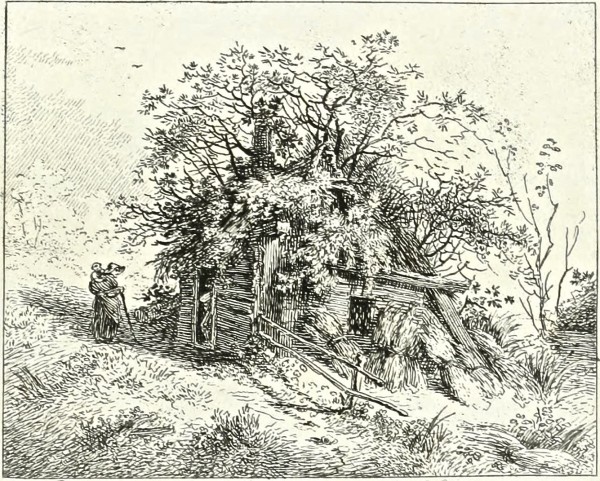
As September draws to an end and autumn closes in, I get the urge to go to ground, hiding myself away in some remote cabin and not straying from the fireside until spring shows again. With this in mind, John Thomas Smith’s twenty etchings of extravagantly rustic cottages published as Remarks On Rural Scenery Of Various Features & Specific Beauties In Cottage Scenery in 1797 suit my hibernatory fantasy ideally.
Born in the back of a Hackney carriage in 1766, Smith grew into an artist consumed by London, as his inspiration, his subject matter and his life. At first, he drew the old streets and buildings that were due for demolition at the turn of the eighteenth and nineteenth centuries in Ancient Topography of London and Antiquities of London, savouring every detail of their shambolic architecture with loving attention. Later, he turned his attention to London streetlife, the hawkers and the outcast poor, portrayed in Vagabondiana and Remarkable Beggars, creating lively and sympathetic portraits of those who scraped a living out of nothing but resourcefulness. By contrast, these rural cottages were a rare excursion into the bucolic world for Smith, although you only have to look at the locations to see that he did not travel too far from the capital to find them.
“Of all the pictoresque subjects, the English cottage seems to have obtained the least share of particular notice,” wrote Smith in his introduction to these plates, which included John Constable and William Blake among the subscribers, “Palaces, castles, churches, monastic ruins and ecclesiastical structures have been elaborately and very interestingly described with all their characteristic distinctions while the objects comprehended by the term ‘cottage scenery’ have by no means been honoured with equal attention.”
While emphasising that beauty was equally to be found in humble as well as in stately homes, Smith also understood the irony that a well-kept dwelling offered less picturesque subject matter than a derelict hovel. “I am, however, by no means cottage-mad,” he admitted, acknowledging the poverty of the living conditions, “But the unrepaired accidents of wind and rain offer far greater allurements to the painter’s eye, than more neat, regular or formal arrangements could possibly have done.”
Some of these pastoral dwellings were in places now absorbed into Central London and others in outlying villages that lie beneath suburbs today. Yet the paradox is that these etchings are the origin of the romantic image of the English country cottage which has occupied such a cherished position in the collective imagination ever since, and thus many of the suburban homes that have now obliterated these rural locations were designed to evoke this potent rural fantasy.

On Scotland Green, Ponder’s End

Near Deptford, Kent

At Clandon, Surrey – formerly the residence of Mr John Woolderidge, the Clandon Poet

In Bury St, Edmonton

Near Jack Straw’s Castle, Hampstead Heath

In Green St, Enfield Highway

Near Palmer’s Green, Edmonton
Near Ranelagh, Chelsea

In Green St, Enfield Highway

At Ponder’s End, Near Enfield

On Merrow Common, Surrey

At Cobham, Surrey – in the hop gardens

Near Bull’s Cross, Enfield

In Bury St, Edmonton

On Millbank, Westminster

Near Edmonton Church

Near Chelsea Bridge

In Green St, Enfield Highway

Lady Plomer’s Place on the summit of Hawke’s Bill Wood, Epping Forest

You may also like to take a look at these other works by John Thomas Smith
John Thomas Smith’s Ancient Topography of London
John Thomas Smith’s Antiquities of London
John Thomas Smith’s Vagabondiana
John Thomas Smith’s Vagabondiana II
Three Sneaky Developers
Why should I be surprised by developers being sneaky? Yet three recent local examples have caused me to gasp in wonder at the staggering audacity on display. Apparently the words ‘retain’ and ‘preserve’ now mean the opposite of what we thought they meant.
George Orwell would not be surprised by this doublespeak. In his book ‘Beyond Hypocrisy,’ Edward S. Herman outlines the principal characteristics thus, ‘What is really important in the world of doublespeak is the ability to lie, whether knowingly or unconsciously, and to get away with it, and the ability to use lies and choose and shape facts selectively, blocking out those that don’t fit an agenda or program.’

Three Regency canal-side cottages dated 1828-31 in Bethnal Green


Cottages demolished

Developers’ visualisation of the future scheme
These three bow-fronted Regency cottages, built between 1826 and 1831 and facing the canal in Corbridge Crescent, Bethnal Green, were an attractive local landmark and beloved of many.
In the planning application of November 2019 for their housing scheme the developer, Aitch Group, requested permission for ‘retention, restoration, external alteration and residential conversion of the existing Regency and Victorian Cottages.’
Yet now they have demolished the cottages – presumably to be replaced by replicas – and no-one can get to the bottom of whether this was lawful or not.

Rex Cinema opened in Bethnal Green Rd in 1938


Facade demolished

Developer’s visualisation of the future scheme
Originally Smart’s Picture House in 1913, this was remodelled in a magnificent Art Deco style by architect George Coles for Odeon impresario Oscar Deutsch as the Rex Cinema in 1938, becoming the Essoldo in 1949 and latterly Fankle Trimmings. Now it is to become a ninety-three room budget hotel developed by Accor in partnership with Keys Asset Management.
The developers’ ‘façade retention’ proposal of 2017 includes the sentence: ‘The façade restoration works will include a measured survey of the existing Bethnal Green Rd façade elevation to ensure the features of this element are maintained in the design.’
Even the councillors who approved the application did not understand that ‘façade restoration works’ meant demolition and construction of a new one.

Raycliff, the developers who plan to turn the Whitechapel Bell Foundry into a bell-themed boutique hotel, have flooded Whitechapel and Spitalfields with these leaflets encouraging local people to support their development as a means to ‘Preserve the Bell Foundry ®.’
In Raycliff’s original proposal, the old foundry buildings were to become an upmarket restaurant and private members’ club, but when UK Historic Building Preservation Trust challenged this by offering to buy the buildings at market value and re-open them as a fully working foundry, then Raycliff announced they would continue the tradition by casting bells in their hotel coffee bar.
We hope the Inspector at the Public Inquiry into the future of the Whitechapel Bell Foundry will recognise that bell founding and cappuccinos are not compatible.
The Public Inquiry into the future of the WHITECHAPEL BELL FOUNDRY is to be an online event, streamed live commencing Tuesday 6th Oct for 10 days. For a link to watch or to request to speak, send an email in advance to ELIZABETH.HUMPHREY@planninginspectorate.gov.uk
You may also like to read about
William Whiffin, Photographer
William Whiffin (1878-1957) is one of the great unsung London photographers, which makes it a rare pleasure to present this gallery of his pictures from the collection of his granddaughter Hellen Martin. Born into a family of photographers in the East End, Whiffin made his living with studio portraits and commercial commissions, yet he strove to be recognised for his more artistic photography.

Lion Brewery and the Shot Tower, South Bank

The photographer’s son Sid Whiffin at Cooper’s Stairs, Old Queen St

Off Fetter Lane

The Pantheon, Oxford St

In Princes Sq, Stepney

Figureheads of fighting ships in Grosvenor Rd

At Covent Garden Market

Jewry Street, off Aldgate High St

Milwall & the Island Horse Omnibus, c.1910

St Catherine Coleman next to Fenchurch St Station

In Fleet St

In Buckfast St, Bethnal Green


At Borough Market


In Lombard St

Rotherhithe Watch House


Wapping Old Stairs

Junction of Cambridge Heath Rd & Hackney Rd


Ratcliff Stairs, Limehouse

Ratcliff Causeway, Limehouse

St Jude’s, Commercial St

Farthing Bundles at the Fern St Settlement, Bow

Houndsditch Rag Fair

At the Royal Exchange, City of London


Weavers’ House, Bethnal Green Rd

Off Pennington St, Wapping

Borough of Poplar Electricity Dept


Pruning in the hop gardens of Faversham

Photographs copyright © Estate of William Whiffin
Hellen Martin & I should be very grateful if readers can identify any of the uncaptioned photographs
You may also like to read about
At Abbey Wood

Serving Hatch
Only recently did I learn that there is an abbey and a wood at Abbey Wood. Stunned by my own obtuseness, I set out to discover what I have been missing all these years. Visiting ruins was a memorable feature of childhood holidays, leaving a residual affection for architectural dereliction that has persisted throughout my life.
There is a familiar style of presentation in which the broken fragments of wall are neatly cemented in place while the former internal spaces are replaced by manicured lawns. This is the case at Lesnes Abbey in Abbey Wood, augmented with simple metal signs indicating ‘kitchen’ or ‘garderobe’ which set the imagination racing.
On leaving Abbey Wood station, my enthusiasm was such that I headed straight up the hill into the woods where I was overjoyed to discover myself entirely alone in an ancient forest of chestnut trees, filled with squirrels busily harvesting the chestnuts and burying them in anticipation of winter. Descending by a woodland path was perhaps the best way to discover the old abbey, situated upon a sheltered plateau beneath the hills yet raised up from the Thames and commanding a splendid view towards London.
Lesnes Abbey of St Mary & St Thomas the Martyr was founded in 1178 by Richard de Lucy, Chief Justice of England, as penance for the murder of Thomas A Becket. Richard retired here once the abbey was complete but died within three months. For centuries, the abbey struggled with the cost of maintaining the river banks and maintaining the marshlands productively. As a measure of how far it declined, it was closed by Cardinal Wolsey in 1525 as part of programme of shutting monasteries of less than seven residents, before the abbey was eventually destroyed in 1542 as one of the first to be subjected to the Dissolution of the Monasteries.
After demolition, the building materials were salvaged and the abbey was forgotten until Woolwich & District Antiquarian Society rediscovered it, excavated the ruins in 1909 and the site became a park in 1930.
One of the last sunny afternoons at the end of a long summer was the ideal occasion for my lone pilgrimage. I stood to gaze upon the ancient ruins and lifted my eyes in contemplation of the distant towers of contemporary London, wondering where the events of our time will lead. Then I walked back up into the forest and it crossed my mind that I if I followed the woodland paths long enough and far enough, maybe I could come back down the hill and enter the time when the abbey flourished and witness it as it was once, full of life.


Stairs to dormitory


The burial place of the heart of Roesia of Dover, great great granddaughter of the founder of this abbey, Richard de Lucy


West door of the church

Four hundred year old Mulberry tree, dating from the reign of James I


Chestnuts at Abbey Wood
You may also like to read about
Peta Bridle’s City Of London Sketchbook
Peta Bridle sent me this latest series of drawings from her City of London sketchbook.
‘Inspired by ‘Offbeat in the City of London’ by Geoffrey Fletcher, I visited some of the places he drew in the sixties and made my own sketches,’ Peta explained to me, ‘It was interesting to stand where he stood fifty years ago and often see many buildings unchanged, while others places were unrecognisable.’
‘I like drawing outside and, even when the lockdown was lifted, the City was empty and quiet so I rarely saw another person. Drawing was the thing that kept me going and brightened my week.’

Mermaid Court
‘I sat on the pavement to make this sketch which gives it a low viewpoint. I like the composition of the three bollards, leaning drunkenly against the paving stones. The shadows were constantly shifting due to the strong sunlight. A man from a cafe under the archway kindly bought me a cup of tea.’

Old Shop in Eastcheap
‘I sat on the steps of St Margaret Pattens to draw this. The doors are decorated with seashell motifs and framed by columns on either side. Seagulls kept squawking in the background which was common to all my drawings in the City, competing with the racket of construction works.’

Hodge & Dr Johnson’s House, Gough Sq
‘I sat behind the statue of the cat with oysters at his paws, looking towards Dr Johnson’s House. Hodge, ‘A very fine cat indeed,’ belonged to Samuel Johnson who sometimes bought his pet oysters to eat as a treat.’

Playhouse Yard, Blackfriars
‘I chose a Sunday morning to visit Playhouse Yard. The Blackfriars Theatre once stood here but all that remains of the Elizabethan playhouse is a piece of brick wall.’

Postmans Park
‘In the churchyard of St. Botolph’s, there are tablets describing act of bravery. The memorial was built by Victorian painter and philanthropist, GF Watts. On the front of the structure it reads ‘In commemoration of Heroic Self Sacrifice.’ It became rather cold in the park whilst I was drawing so please forgive the shaky lines!’

Shakespeare Memorial, Garden of St Mary Aldermanbury
‘I drew this sketch on a mild day in January. In the distance a marching band was making its way to the Guildhall and there were skateboarders practising in the garden. The bust of Shakespeare commemorates Henry Condell and John Heminges who published the First Folio. They lived in the parish and are buried in the churchyard. The church was damaged in the Blitz and rebuilt in Fulton, Missouri in 1966.’

Simpsons Chop House, Ball Court
‘Ball Court was empty during the lockdown. Behind me the occasional bus sailed up Cornhill and there was the gentle background hush of air conditioning units. Simpsons Tavern was founded in 1757 by Thomas Simpson. A jumble of books sit in the bow window and the alley to the side leads on to Castle Court.’

St Johns Garden, Clerkenwell
‘This is a lovely garden with a fountain and silvery olive tree set in the centre, referencing the Holy Land, since the Knights of St John are buried here.’

Doorway at St Magnus the Martyr
‘I have attended services with my children at St Magnus for the blessing of the river, held jointly with Southwark Cathedral in January. I made a study of one of its doorways, crowned with a cherub’s head. Outside is a piece of Roman piling from the Roman river wall. The church is on the original alignment of London Bridge where people crossing would enter the City.’

St Peter Upon Cornhill
It was very quiet in St Peter’s Alley next to the churchyard while I was drawing this. A couple said ‘hello’ as they walked past and a man hurried by clutching his sandwich bag.’

St Dunstan in the East
‘St Dunstan’s attracts many visitors to sit and enjoy the garden. I found a shady spot to draw as it was a very hot day. Palm trees flourish here and the walls are draped with greenery. The church was destroyed in the blitz and the yard turned into a public garden.’

Double page of St Dunstan in the East
Drawings copyright © Peta Bridle
You may also like to take a look at
Peta Bridle’s Gravesend Sketchbook


