
Ernest George’s Old London Etchings

Aldgate
Stefan Dickers, Archivist at Bishopsgate Institute, introduced me to these fine copper plate etchings by Ernest George (1839-1922). In the eighteen-eighties, George set out to immortalise those fragments of London which spoke of times gone by and Londoners long dead, recording buildings and views which have for the most part now disappeared.
I realise that my affection for these images sets me in line with the generations of chroniclers who have made it their business to document the transience of the city, starting with John Stow who wrote the very first Survey of London between 1560 and 1598 to describe the streets of his childhood that were vanishing before his eyes.
Ernest George’s etchings were published by the Fine Art Society in New Bond St in 1884, a magnificent temple of culture designed by Edward William Godwin which survived through the twentieth century only to close in August 2018.

Bishopsgate

Wych St, Strand

Fouberts Place, Soho

Crown Court, Pall Mall

St Bartholomew, Smithfield

Warwick Lane, City

Tower of London

London Bridge

Staple Inn, Holborn

Drury Lane

St John’s Gate, Clerkenwell

Limehouse

Shadwell
Images courtesy Bishopsgate Institute
You may also like to look at
Upon The Origins Of Bow Church
Bow Church is one of my favourite places in the East End, so it was an honour to be asked to write the history of this ancient place for their new website. Below you can read the first page and the rest is available at www.bow.church

The ancient Church of St Mary Stratford Atte Bow stands in the middle of the road at the entrance to the East End, where the lofty old tower welcomes travellers from Essex and bids farewell to those leaving London.
Our story begins with a miracle, when the waters of the River Lea parted in the manner of the Red Sea, allowing the wondrous passage of the body of St Erkenwald, carried across the dry riverbed on his journey from Barking Abbey to his final resting place in St Paul’s Cathedral in 693. Legend has it that when the saint’s body was laid down in Bow upon what became the site of the church, flowers blossomed where the bier sat upon the ground.
Our history continues with an accident, when Queen Matilda fell into the River Lea on her way to Barking in 1110 and became ‘well wetted with water,’ according to medieval historian John Leland. In the absence of miracles and to avoid future muddy mishaps, Matilda ordered the building of a bridge at this spot. Leland tells us it was ‘arched like unto a bowe,’ which gave the name to the village that grew up beside the crossing where a community of bridge keepers, boatmen, millers, fishermen, farmers, bakers, butchers, fullers, saddlers, dyers and cap makers flourished.
Each winter the inhabitants of Bow grew sick of trudging through the muddy paths to the parish church of St Dunstan’s in Stepney and launched a petition, believing that they were worthy of having their own place of worship, inspired perhaps by the building of the White Chapel in Aldgate. On 7th November 1311 Bishop Baldock of London complied, licensing the construction of a ‘chapel of ease’ at Bow and in 1327 King Edward III granted a piece of land ‘in the middle of the King’s Highway,’ where the chapel was founded as daughter church to St Dunstan’s.
A few years later in 1348 the Black Death pandemic arrived, blighting the land and killing as many as half the population which led to a labour shortage and the expectation of higher incomes. But the Statue of Labour of 1351 capped wages, escalating grievances and social unrest that contributed to the Peasants’ Revolt of 1381 in which over 1,500 people died.
Demanding an end to serfdom, protestors led by Wat Tyler marched from Essex through Bow in May to confront the fourteen year old King Richard II on Stepney Green. Although he acceded to their wishes, they entered London in June, sacking the Savoy Palace and occupying the Tower of London. Richard met with the rebels again in Smithfield where violence broke out and Wat Tyler was stabbed by William Walworth, Mayor of London, crushing the revolt.
The growth of the community at Bow over the next century was such that the chapel of ease acquired its first priest in 1456, recorded simply as ‘John.’ Significant legacies from local tradesmen permitted the improvement of the building, known as ‘The Great Work,’ enlarging it to the size it is today by 1490. John of York, a baker, left £13 4d to pay for candles and £3 towards the building of a steeple. John Laylond, a carpenter, bequeathed his stock of timber for ‘making doorways and floors of the new belfry.’ Richard Robyn, chapel warden, left forty shillings for the steeple and John Bruggis left £3 for glazing the west window.
At this time, a vaulted crypt of sixty feet long was constructed beneath the nave to store the bodies of parishioners until Judgement Day, which was sealed by government health order in 1891. The lower part of the tower of Kentish ragstone dates from this era, as does the battered octagonal font that was discarded in 1624 in favour of a more modern design. After three hundred years as a garden ornament, it was rescued and continues in use for baptisms.
As more houses, shops and taverns were built surrounding the churchyard, it created a public space for gatherings and markets, especially at public holidays and seasonal festivals. Thus arose the celebrated Bow Fair, recalled today in the street name of Fairfield Road. The market had its origins as a Green Goose Fair held at Whitsuntide for the sale of young geese from the surrounding countryside.
Every Whit Wednesday, the congregation of Bow visited their mother church of St Dunstan’s, walking in procession through the fields to pay their dues of twenty-four shillings, declaring their membership of Stepney parish and participating in a service of worship. Bow Fair culminated an annual week of festivity in summer. Over proceeding centuries, the fair attracted large crowds of visitors from London and Essex, acquiring a reputation for debauchery and drunkenness, as Shakespeare’s contemporary Gervase Markham wrote in 1600.
‘To Stratford Bow unto the Greengoose Fair
A world of people one day did repair
Both poor and rich, men likewise old and young.
Mixt with the males, the females came along.
The season of the year as usually was parching hot,
The weather scorching dry.
Hay makers, mowers, thither did repair.
Compelled by the sultry-hot-fire breathing air
The extreme heat did cause a thirst
So they drank until they almost burst.’

Shrine of St Erkenwald in Old St Paul’s by Wenceslas Hollar

Queen Matilda fell into the River Lea in 1110

King Edward III granted a piece of land ‘in the middle of the King’s Highway’ in 1327

Richard II meeting the Peasant’s Revolt in Stepney in 1381 by Jean Froissart

Octagonal font of 1410 at Bow Church

A village fair by Gillis Mostaert, 1590
You may also like to read about
Fran May’s Brick Lane
Our spring sale ends at midnight. Enter ‘SPRING’ at checkout to claim 50% discount.
Click here to visit the Spitalfields Life online bookshop

In 1976, Fran May arrived in London at the age of twenty-one to study photography at the Royal College of Art and some of the first pictures she took were of Brick Lane.
“At first, exploring London was daunting, too big and exhausting. Someone suggested I visited Brick Lane, but I would have to get there at dawn for the best of it. An early bird by nature, this was not too difficult. And what a reward. I wore my hair long and had a duffle coat—the perfect disguise. My dominant eye is my left eye, so the camera is always in front of my face. It is like the child of two who covers their eyes and thinks you cannot see them. I had become invisible too. I went time and time again. It was like stepping into a different world, a different universe, a film set. Characters, faces, businesses, from another time, caught in a time warp.
Head of Photography, John Hedgecoe, came to me one day and said I had been selected to be taught by Bill Brandt. The first time I went to his house near Kensington Church St, I took my landscape photographs. I confess I did not know all of Bill Brandt’s work, but I knew of the nudes on the beach. I rang his bell, acknowledged by a woman’s voice, the door clicked open. Once through the open front door, a voice called from beyond. “Come in. Come in.”
Bill sat before a fire in the grate, the light from the flames flickering on his face. “What have you brought me?” he asked in his gentle voice. I placed my portfolio on the floor and lifted the pictures to him one by one. He was silent until he looked at me and said, “I don’t think I can teach you anything, do you?” I did not know how to take this. I packed everything away, thanked him and left.
A couple of days later, I bumped into John Hedgecoe again in the corridor. “How did you get on with Bill Brandt?” he asked. I told him I didn’t think I should go again because Bill had said he couldn’t teach me anything. “No, you must go see him again. You must make the most of your opportunities”. So off I went, this time taking some of the images I had taken while at Sheffield and the more recent ones shot in Brick Lane.
This was a different experience. Bill studied each one for a long time. Seated on the footstool at his feet, Bill moved his reading light nearer and re-settled himself in his chair. I studied the firelight flickering on his face. Then he put the pile of photographs flat on his lap, breaking the silence and said, “Ah, Fran. Let me tell you something. Never loose these images, don’t think of them just as student work, for they will have social significance one day”. His eyes twinkled as he smiled at me.
I returned one more time to visit Bill Brandt. He told me he had not really known what he had achieved until later. The photographs he had taken were commissioned jobs. When they were put together in a particular order, they meant something new and that the passage of time mattered. Well, I did keep these images.”
Fran May’s Brick Lane photographs have recently been published in two books
BRICK LANE by Fran May, published by Cafe Royal Books
FRAN MAY, PHOTOGRAPHY 1974-78 published by Storm Books


Photographs © Fran May
You may also like to take a look at
Raju Vaidyanathan’s Brick Lane
Albert Turpin, Painter
Our spring sale ends on Easter Monday at midnight. Enter ‘SPRING’ at checkout to claim your discount.
Click here to visit the Spitalfields Life online bookshop
Albert Turpin’s paintings are featured in EAST END VERNACULAR, Artists who Painted London’s East End Streets in the 20th Century streets which is included in the sale.

Salmon & Ball, Bethnal Green, c.1948
When the Daily Herald asked Albert Turpin (1900–64) about his motives, he declared his wish “to show others the beauty in the East End and to record the old streets before they go.” Born in Columbia Rd into a family that struggled to feed themselves on his father’s salary, working as variously a tea-cooper, feather sorter and casual docker, Albert walked into Shoreditch Town Hall and enlisted at fifteen, giving his age as nineteen years old.
In the Royal Marines, he won success as a heavyweight boxing champion yet found time to explore his sensitive side too. “Out came my paint box and canvas and, making myself comfortable on the boat deck … I painted away to my heart’s content,” he told the Hackney Gazette in later years.
After the war, Albert married Sally Fellows in 1922, whom he met at the Hackney Empire. He took up window cleaning with the aim of finishing all his windows by lunchtime so he could spend the afternoon painting. He attended classes at Bethnal Green Working Men’s Institute and at the Bow & Bromley Commercial Institute, and showed his paintings at the Bethnal Green Museum.
During the General Strike of 1926, while on the way to such a class, Albert heard a speech by working class activist, Bill Gee. In his autobiography, Albert wrote that Bill Gee “did not teach me anything I did not already know, but what he did do was to make me forget all about my art class and join up with the organised workers right there.” Signing up for the Labour Party, Albert began his long political career by drawing cartoons for local newspapers.
He exhibited ten canvases in the East London Art Club exhibition at the Whitechapel Art Gallery in December 1928. One of these depicted a man eating food scavenged from a bin, entitled Man Must Eat until Albert changed the title to The Dust Bin to avoid offending public sensibilities. This show was so successful that Charles Aitken, Director of the Tate, transferred some pictures to his gallery, including several by Albert – from which the wealthy collector Joseph Duveen bought The Dust Bin. Subsequently, when the Lefevre Galleries in St James launched its annual exhibitions of the East London Group in November 1929, Albert showed three pictures and in following years he contributed regularly to their shows.
During the thirties, Albert became a member of the Bethnal Green Borough Council and an active anti-fascist protester, drawing the wrath of the blackshirts. They issued a poster in 1936 announcing, ‘Turpin responsible for East End disturbances.’ He also joined the Ex-Servicemen’s National Movement for Peace, Freedom & Democracy and supported the Republicans in the Spanish Civil War, writing “On many occasions, I was arrested for offences ranging from rioting and assaulting the police, to chalking anti-war slogans on walls at nights. To me, these incidents were like medals to a good soldier.”
When war came again, Albert joined the London Fire Brigade and became an official Fire Brigade War Artist. Awarded a certificate by the Society for the Protection of Life for saving a child from a blaze in Bethnal Green, Albert was unanimously elected Mayor in 1945. The Evening News reported that he “won’t be wearing the mayorial robes because he thinks it is waste of taxpayers’ money.” As a compromise he “wore a gold chain of office, which competed for glitter with his brightly polished firemen’s buttons.” Always possessing a strong moral sense, Albert disapproved of gambling and loathed drinking, refusing to wash pub windows when he resumed his window cleaning duties after the war.
For the rest of his life he continued to paint the East End and in 1960, he wrote to the East London Advertiser pleading for the importance of preserving people’s memories. ‘Don’t they mean anything to anybody?’ he asked.

Albert Turpin, Artist, Window Cleaner & Mayor of Bethnal Green

Columbia Market, 1952/3

The Arches, Cambridge Heath Rd

Cable St

Marian Sq, Hackney

Three Jolly Butchers, Cabbage Court, Brick Lane, c.1953

Bellevue Place, Cleveland Way

Rebuilding St Matthew’s Church, Bethnal Green, c.1956

Verger’s House, Shoreditch, 1954
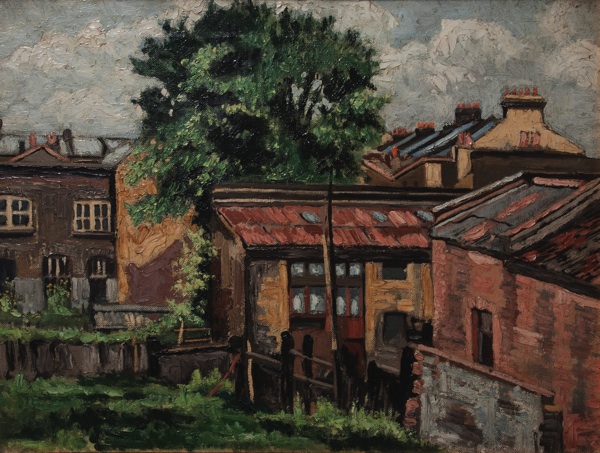
Shakey’s Yard in Winter, c.1952

Hackney Empire
Images copyright © Estate of Albert Turpin

Click here to buy a copy of EAST END VERNACULAR at half price
More Brick Lane Events
Our spring sale with all titles in the Spitalfields Life Bookshop at half price continues until Easter Monday. Enter ‘SPRING’ at checkout to claim your discount. Click here to visit the Spitalfields Life online bookshop
We are delighted to announce new webinars in the ongoing Spitalfields Trust series as part of the campaign to Save Brick Lane. Below you will find films of the first two events in case you missed them.
Visit www.battleforbricklane.com

HOUSE OF ANNETTA, SITE OF RESISTANCE
7pm Tuesday 13th April
Louis Schulz of ASSEMBLE introduces ANNETTA’S HOUSE, a new centre for campaigning and resistance against exploitative development.
25 Princelet St in Spitalfields was the home of the architect, cybernetician, conservationist, builder, beekeeper, and campaigner ANNETTA PEDRETTI until her death in 2018. An obsessive polymath, her work has been all but forgotten.
Her large home has been given to charity and is now to be used as a social centre for all, and a base for mounting a resistance against proprietarian society, and campaigning for land reform and housing justice for all.
In this talk Louis Shulz, from the Turner Prize winning architecture collective ASSEMBLE, who are leading the project, will discuss what we know of Annetta’s life and work, as well as plans to harness the site – forever removed from the flow of land speculation and inheritance – as a place that can catalyse a resistance against the relentless top-down redevelopment of the city.
Click here to register for free for HOUSE OF ANNETTA, A SITE OF RESISTANCE

A CATALOGUE OF PLANNING DISASTERS IN SPITALFIELDS
7pm Tuesday 6th April
Planning & Heritage Expert, ALEC FORSHAW examines the appalling history of bad planning decisions in Spitalfields.
In recent years, Spitalfields has faced a wave of soulless corporate development spreading from the City of London, inflicting ugly steel and glass blocks that are entirely at odds with the narrow streets of old brick buildings.
First it was the Spitalfields Market, then the Fruit & Wool Exchange and Norton Folgate, and now the wave has reached the historic Truman Brewery.
In this humorous illustrated lecture, Alec shows how the same mistakes have been repeated over and over in Spitalfields, exploring what can be done to prevent this onslaught in future and discussing how more responsible planning could benefit the area and the community.
Click here to register for free for A CATALOGUE OF PLANNING DISASTERS
Watch THE HISTORY OF THE TRUMAN BREWERY
Long-term local resident and co-founder of the Spitalfields Trust, DAN CRUICKSHANK, traces the histories of the families who managed the brewery through four centuries, the largest in the world before it closed in 1989.
Watch THE THREAT TO BRICK LANE, HEARTLAND OF BRITISH BANGLADESHI CULTURE
A discussion of Brick Lane’s cultural significance for the Bangladeshi community, its history and the challenges which threaten it.
Speakers include PROFESSOR CLAIRE ALEXANDER, author of the Runnymede Trust report Beyond Banglatown -Continuity, change and new urban economies in Brick Lane, DR FATIMA RAJINA and TASNIMA UDDIN, co-founders of Radical Socialist Bangladeshi Group , and COUNCILLOR ABDAL ULLAH, founder of the BBPI Foundation, whose first address was Brick Lane.
Swirl Of Words/Swirl Of Worlds
Our spring sale with all titles in the Spitalfields Life Bookshop at half price continues until Easter Monday. Enter ‘SPRING’ at checkout to claim your discount. Click here to visit the Spitalfields Life online bookshop

Stephen Watts by Lucinda Douglas Menzies
Poet & translator Stephen Watts has gathered an anthology of almost a hundred poems from almost a hundred languages, as a celebration of the astonishing richness of linguistic diversity in Hackney. Entitled Swirl of Words/Swirl of Worlds, it will be launched in June by Peer when copies will be distributed free to library members. As a preview, I have selected six favourites below, each followed by a translation in English. Click here to support this wonderful endeavour

(Latvian)


(Punjabi)


(Malayalam)


(Japanese)


(Bulgarian)


(Chinese)

So Long, Monty Meth
Our spring sale with all titles in the Spitalfields Life Bookshop at half price continues until Easter Monday. Enter ‘SPRING’ at checkout to claim your discount. Click here to visit the Spitalfields Life online bookshop

Monty Meth died on 14th March at the fine age of ninety-five
Can you spot Monty Meth in this photograph of the Cambridge & Bethnal Green Boys Club Summer camp at Greatstone in Kent in 1939? Wearing the jacket in the front row, Monty is distinguished by his ear-to-ear smile – a distinctive expression of a generous spirit that still graced his visage more than eighty years later.
Already, when this was taken, Monty was attending photography classes given by Harry Tichener, Member of the Royal Photographic Society and Manager of the Boys Club, who took this picture recording that glorious fleeting moment in the last summer before World War II. Monty credited his experience at the Club as the first step towards his career in Fleet St, firstly as a Photographer and then as a Journalist, winning him the News Reporter of the Year in 1970. Yet he was equally aware that it could all have turned out very differently.
“There is no doubt that without the Club, I should have become a bit of a ‘tea leaf,'” he confessed to me,“We used to knock things off from shops – I’m not proud of what we did, but you had no choice other than to be one of the boys. Not only did the Club give me some principles, it showed me how to think and act.”
When I visited Monty at his home in Oakwood, North London, I found – even at eighty-eight years old – he had already been up since five-thirty and out for his morning swim at six o’clock at the pool, long before I arrived. Monty met me at the Underground station and we walked together through the suburban streets with their carefully-tended gardens to reach the well-appointed home he shared with Betty his wife, where we settled down to chat.
“I was born in Bethnal Green at 10 Columbia Rd, above a barber’s shop where two families shared a few rooms. It was opposite the triangle where taxis waited and my memory is of horses and carts. My mother Millie came to London from Newcastle as a domestic servant to a Jewish family in Stepney and my father Max came from Austria. He was a bread roundsman and that’s how they met. They married in 1918 at New Rd Synagogue and had three sons, Arthur in 1919, Ron in 1921 and me in 1926. We moved from Columbia Rd to a new block of flats opposite the Children’s Hospital in the Hackney Rd in 1938 and I used to go after school to learn Talmud and Torah at the synagogue on the corner of Chance St. Afterwards, at seven o’clock, I used to bunk into the Cambridge & Bethnal Green Boys Club in the Blue Anchor on the next corner, and I got thrown out regularly until I was twelve.
In 1938, when I was old enough, I join the Club but I only stayed until 1944 when I went into the Royal Navy, yet I am absolutely certain that my career as a photographer which followed came as a result of my experiences there. I worked on the newsheet with David Roxan who preceded me in Fleet St and became a reporter at the News of the World, and I attended Harry Tichener’s Photography Class. As a result of my contacts with Bernard Collier and Bobby Gray, who were also in his class but had taken jobs at a picture agency in Fleet St called Photopress, I joined the agency when I left school at fourteen years old as a Messenger Boy, delivering photographs to newspapers for ten shillings a week. A year later, the Topical Press Agency offered me double the wages and I stayed with them until I went into the Navy.
When I returned to the Topical Press Agency after the war, I worked first in the dark room and then as a Photographer. I won an award for my work from Encyclopaedia Britannica but, in 1954, I didn’t see a future as a Photographer in Fleet St. I was writing and doing photo-stories for magazines on subjects like the Cornish china clay industry, the trug makers of Herstmonceux and traditional bookbinders, when I took a job as a feature journalist in Leeds. Betty came down from Scotland and we decided to set up home there, until 1965 when I became Industrial Correspondent for the Daily Mail – which was much less right wing in those days.
I was made Industrial Editor and, in 1970, I won Newspaper Reporter of the Year, before being recruited by Beecham as head of Communications where I stayed seventeen years, leaving in 1989 when they were bought by the Americans and became Smith Kline Beecham. Then in my sixties, I started a consultancy business that I ran with a colleague from the Daily Mail until 1999 when I was seventy-four.
I was a good Photographer and a pretty good Journalist. I had a good education and, at ten years old, we were writing essays – what the Club gave me was the confidence to stand up and speak, I learnt how to take minutes, be part of a committee and accept responsibility.”
Determined to apply his skills to benefit others, Monty took over the Enfield Over-Fifties Forum upon his retirement and built up the membership from seventy to six thousand, mobilising a significant campaigning group to advocate the interests of seniors in his neighbourhood. And, returning to where it all started, Monty became Chairman of the Cambridge & Bethnal Green Old Boys from 2000 until 2012, raising £37,000 for charities dedicated to maintaining the kind of youth club culture from which he once drew such benefit so long ago.

Monty Meth with his Macintosh Classic of 1990 from which he ran the Enfield Over-Fifties Forum

The ‘intruder’ at the Queen’s visit – photograph by Montagu Meth of Topical Press Agency, published in Daily Mirror 4th March 1951

Winston Churchill goes to vote – photograph by Montagu Meth of Topical Press Agency, published in Daily Telegraph 26th October 1951

10 Columbia Rd where Monty Meth was born above the barber’s shop in 1926

Monty Meth when he joined the Royal Navy in 1944 at eighteen

Monty (centre) with his brothers, Arthur and Ron

Monty as Industrial Editor of the Daily Mail

Monty was News Reporter of the Year in 1970

Monty and Betty
You may also like to read these other stories of members of Cambridge & Bethnal Green Boys Club
and watch


