
Terry Barns, Knot Tyer

‘There isn’t really a word for it in English,’ admitted Terry Barns, ‘in French, they call it ‘matelotage’ meaning ‘sailors’ knot-making.’
Terry did not become a serious knot tyer until his fifties, yet it was a tendency that revealed itself in childhood. Celebrating the Queen’s Coronation in 1953, when Terry was just nine years old, his mother made him a guardsman’s outfit from red and black crepe paper with a busby fashioned from the shoulders cut out of an old fur coat. Terry’s contribution was to make the chin strap. ‘We got some gold string and I tied reef knots over a core, making what I now know is known as a ‘Pilgrim’s Sennet’ or a ‘Soloman’s Bar,’ he explained to me in wonder at his former precocious self, ‘but I never thought anything about it at the time.’
This is how Terry tells the story of the intervening years –
‘My early life was in the Queensbridge Rd but I was born in Hertfordshire because Hitler was trying to blow up the East End in 1944. My mum was a dress machinist and my dad was a wood machinist, he used to drill the holes in bagatelles and I still have one he made at home. In 1950, when I was six, we got a Council House in Clapton with a bathroom and an inside toilet – it was wonderful.
Somehow, I passed the 11-plus and ended up at Grocers’ Company School in Hackney Downs. When I left school at fourteen, being a prudent person, I joined the General Post Office as a telephone engineer, running around Mare St and Dalston. Nobody told me I could have stayed on at school and I soon realised that if I didn’t leave the GPO, I’d never know anything else. So I became a ‘Ten Pound Pom’ and went off to Australia in 1966.
I met my wife Carol in Pedro St in Hackney at that time and she followed me to Australia shortly after. I was a very quick learner and I had a very good job in Sydney working for a Japanese telephone company, Hitachi, but we had no intention of staying and came back in 1968. Then we got married in 1969, had three children and bought a house, so that occupied me for the next twenty years! I went back to the GPO which became BT and, when I was fifty, they asked if I would like to take some money and not go back again. So I have been living on my BT pension for the past twenty years and that has been the story of my life.’
Yet, all this time that Terry had been working with telephone cables, his tendency with string and rope had been merely in abeyance. ‘In the seventies, my wife bought me a copy of The Ashley Book of Knots,’ he revealed, bringing out a pristine hardback copy of the knotter’s bible containing nearly four thousand configurations. At a stall outside the Maritime Museum in Greenwich, Terry came across the International Guild of Knot Tyers which led to a four day course with legendary knot tyer, Des Pawson in 1994. ‘He’s got a museum of rope work in his back garden,’ Terry confided in awe.
‘I’m an engineer, but Des – he’s artistic,’ Terry informed me, ‘he educated me how to see things, he showed me when things look right.’ For over ten years, Terry has been on the Council of the Guild of Tyers, accompanying Des as his bag man, demonstrating knot work at festivals of matelotage in France – ‘My kind of holiday,’ he describes it enthusiastically.
When a sculptor cast a rope in bronze to symbolise the identity of the East End, it was Terry who wound the strands – and you can see the result at the junction of Sclater St and Bethnal Green Rd today. The largest pieces of rope you ever saw are placed as features in Terry’s front garden in Woodford. Inside the house, walls are hung with nautical paintings and shelves are lined with volumes of maritime history. They tell the story of one man’s lifetime entanglement with cable, rope and string, and remind of us of how the East End was built upon the docks, of which the ancient and ingenious culture of rope work was a major thread, still kept alive by enthusiasts like Terry Barns.

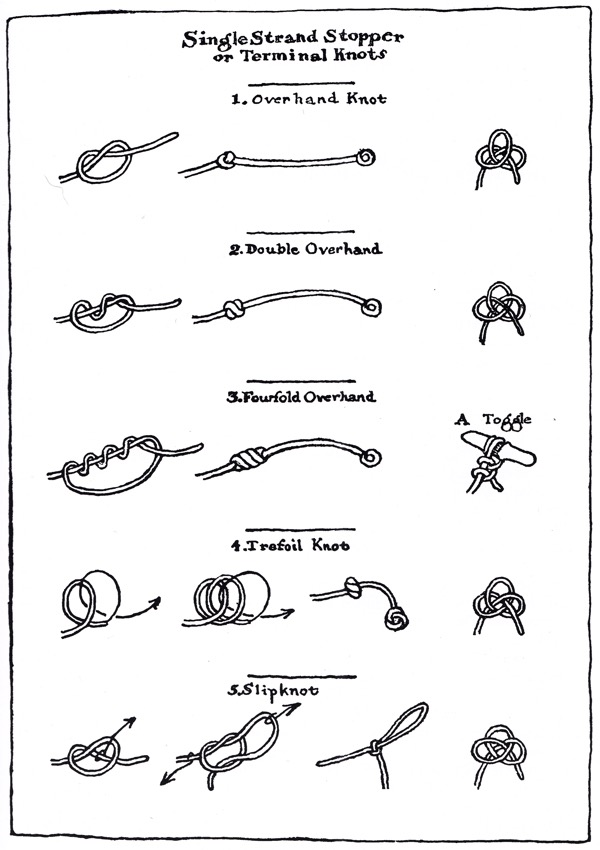


Terry with one he tied earlier
You might like to find out more at International Guild of Knot Tyers
You may also like to read about
Ron McCormick’s Whitechapel
Ron McCormick photographed Whitechapel & Spitalfields in the early seventies and these pictures were exhibited at the Whitechapel Gallery in 1973.

Hessel St

Royal Oak, Whitechapel Rd

Old Montague St

Blooms, Whitechapel High St

Old Montague St

Old Montague St

Princelet St

Black Lion Yard

Fournier St

Brick Lane

Club Row

Brick Lane

Settle St, Whitechapel

Great Eastern Buildings, Quaker St

Woodseer St

Great Eastern Buildings, Quaker St

Sandys Row

Brick Lane Market

Christ Church School

Settle St, Whitechapel
Photographs copyright © Ron McCormick
You may also like to take a look at
Philip Marriage’s Spitalfields
In Search Of ‘Sparrows Can’t Sing’
Dame Barbara Windsor died on Thursday aged eighty-three. I shall always think of her wistfully as the Spitalfields Life interview that I should love to have done but which never happened. My favourite performance of hers was in Sparrows Can’t Sing, the greatest East End film, and in tribute to her I publish my account of going in search Cowley Gardens, one of the primary locations.

This is what happens when you try to carry a ladder the wrong way down a narrow alley, as Roy Kinnear is discovering in this frame from Joan Littlewood’s film Sparrows Can’t Sing.
You can see through the arch to Cowley Gardens in Stepney as it was in 1962. This is where Fred (Roy Kinnear’s character) lived with his mother in the film and here his brother Charlie (James Booth) turned up after two years at sea to ask the whereabouts of his wife Maggie (Barbara Windsor), finding that the old terrace in which he lived with Maggie had been demolished in his absence.
The drama revolves around Charlie’s discovery that Maggie has moved into a new tower block with a new man, and his attempts to woo her back. Perhaps there are too many improvised scenes, yet the film has a rare quality – you feel all the characters have lives beyond the confines of the drama, and there is such spirit and genuine humour in all the performances that it communicates the emotional vitality of the society it portrays with great persuasion. In supporting roles, there is Harry H. Corbett, Yootha Joyce, Brian Murphy and several other superb actors who came to dominate television comedy for the next twenty years. Filmed on location around the East End, many locals take turns as extras, including the Krays – Barbara was dating Reggie at the time – who can be seen standing among the customers in the climactic bar room scenes.
My favourite moment in the film is when Charlie searches for Maggie in an old house at the bottom of Cannon St Rd. On the ground floor in an empty room sits an Indian at prayer with his little son, on the first floor some Afro-Caribbeans welcome Charlie into their party and on the top floor Italians are celebrating too. Dan Jones, who lives round the corner in Cable St, told me that this was actually Joan Littlewood’s house where she and Stephen Lewis wrote the screenplay.
I once met Joan Littlewood at an authors’ party hosted by her publisher. She was a frail old lady then but I recognised her immediately by her rakish cap. She was sitting alone in a corner, being ignored by everyone, and looking a little lost. I pointed her out discreetly to a couple of fellow writers but, too awestruck by her reputation, they would not dare approach. Yet I loved her for her work and could not see her neglected, so I walked over and asked if I could kiss her. She consented graciously and, once I had explained why I wanted to kiss her – out of respect and gratitude for her inspirational work – I waved my pals over. We enjoyed a lively conversation but all I remember is that as we said our goodbyes, she took my hand in hers and said ‘I knew you’d be here.’ Although she did not know me or my writing, I understood what she meant and I shall always remember the night I kissed Joan Littlewood.
Watching Sparrows Can’t Sing again recently, I decided to go in search of Cowley Gardens only to discover that it is gone. The street plan has been altered so that where it stood there is not even a road anymore. Just as James Booth’s character returned from sea to find his nineteenth century terrace gone, the twentieth century tower where Barbara Windsor’s character shacked up with the taxi driver has itself also gone, demolished in 1999. Thus, the whole cycle of social and architectural change recorded in this film has been erased.
I hope you can understand why I personally identify with Roy Kinnear and his ladder problem, it is because I too want to go through this same arch and I am also frustrated in my desire – since nowadays there is a solid wall filling the void and preventing me from ever entering. The arch is to be found beneath the Docklands Light Railway between Sutton St and Lukin St. Behind this brick wall, which has been constructed between the past and the present, Barbara Windsor and all the residents of Cowley Gardens are waiting. Now only the magic of cinema can take me there to join them.

The arch from Sparrows Can’t Sing today
The Battle For Brick Lane

Brick Lane 1978 by Dan Jones
Since September, I have been working behind the scenes to curate an exhibition for the Spitalfields Trust about the culture and history of Brick Lane and the Truman Brewery. It opens tomorrow at 25 Princelet St, E1 6QH, a breathtaking unrestored eighteenth century house and you are all invited to visit under socially-distanced conditions. Dan Cruickshank will cut a ribbon at noon. For those unable to make the journey, some of the contents can be viewed at www.battleforbricklane.com
Exhibition opens noon – 6pm on Saturday 12th, Sunday 13th, Wednesday 16th, Thursday 17th, Friday 18th, Saturday 19th and Sunday 20th December.
It includes a show of Phil Maxwell’s photographs of Brick Lane over the past thirty years, a specially-commissioned model of the Truman Brewery by Sebastian Harding and a diorama of Brick Lane from the Bishopsgate Institute collection.
This opening launches a campaign by the Spitalfields Trust to stop a proposal to build an ugly shopping mall with four floors of corporate offices on top at the Old Truman Brewery. Instead of this arbitrary scheme, the Trust seeks to raise a wide debate to create a plan for the whole brewery site.

Phil Maxwell has photographed Brick Lane for over thirty years

Part of Sebastian Harding’s model

Diorama of Brick Lane from Bishopsgate Institute collection

The ugly big block proposed for the corner of Brick Lane & Woodseer St
HELP US SAVE BRICK LANE
* This development will undermine the authentic cultural quality of Brick Lane.
* The generic architecture is too tall and too bulky, ruining the Brick Lane & Fournier St Conservation Area.
* It offers nothing to local residents whose needs are for genuinely affordable homes and workspaces.
* It is an approach that is irrelevant to a post-Covid world, with more people working from home and shopping locally or online.
* Where it meets the terraces of nineteenth century housing, the development is out of scale and causes up to 60% loss of light.
* Instead of this arbitrary scheme, we need a plan for the entire brewery site that reflects the needs and wishes of residents.
HOW TO OBJECT EFFECTIVELY
You can help us stop this bad proposal by writing a letter of objection to the council as soon as possible.
Please write in your own words and head it OBJECTION.
Quote Planning Application PA/20/00415/A1
Anyone can object wherever they live.
Members of one household can each write separately.
You must include your postal address.
Send your objection by email to Patrick.Harmsworth@towerhamlets.gov.uk
Or by post to Planning Department, Town Hall, Mulberry Place, 5 Clove Crescent, London, E14 2BG
An Astonishing Photographic Discovery
Today is the last day of our ADVENT BOOK SALE with all titles in our online shop including Horace Warner’s SPITALFIELDS NIPPERS at half price until midnight. Enter code ADVENT at checkout.
CLICK HERE TO VISIT THE SPITALFIELDS LIFE BOOKSHOP
Below you can read my account of how we found Horace Warner’s photographs and brought them to publication.

These breathtaking photographs were taken by Horace Warner in Spitalfields at the turn of the nineteenth and twentieth centuries. Before I published them on Spitalfields Life, they had hardly been seen by anyone outside his immediate family. We were granted permission personally by Horace Warner’s grandson, Ian McGilvray.
Previously, only a handful of Warner’s sympathetic portraits of the children who lived in the courtyards off Quaker St – known as the Spitalfields Nippers – were believed to exist, but through some assiduous detective work by researcher Vicky Stewart and a stroke of good luck upon my part, we were able to make contact with his grandson who keeps two albums comprising more than one hundred of his grandfather’s pictures of Spitalfields, from which the photographs published here are selected.
Many of the pictures in these albums are photographic masterpieces and, after I published the book, David Bailey contacted me to say he believed they are the most significant set of portraits ever taken in the East End.
There is a rare clarity of vision in the tender photography of Horace Warner that brings us startling close to the Londoners of 1900 and permits us to look them in the eye for the first time. You can imagine my excitement when I met Ian McGilvray and opened Horace Warner’s albums to discover so many astonishing pictures. I experienced a sensation almost of vertigo, like looking down the dark well of time and being surprised by these faces in sharp focus, looking back at me.
It was no straightforward journey to get there. I first published a series of Horace Warner’s Spitalfields Nippers in these pages in 2011, reproduced from a booklet accompanying a 1975 exhibition of the handful of pictures once published in fund-raising leaflets by the Bedford Institute in 1912. When I sought to reproduce these pictures in The Gentle Author’s London Album, Vicky Stewart established that the photographic prints were held in the Quaker archive at Friends House in the Euston Rd.
This discovery which permitted me to include those pictures in my Album was reward enough for our labours. The story might easily have ended there, if we had not been shown a 1988 letter from Horace Warner’s daughter Gwen McGilvray that accompanied the prints. In this letter, Gwen mentions the ‘albums’ – this was the first tantalising evidence of the existence of more of Horace Warner’s Spitalfields photographs.
Even as our hopes of finding these other pictures were raised, we were disappointed to realise that Gwen was unlikely to be still alive. Yet through online research and thanks to his unusual surname, Vicky was able to find an address for one of Gwen’s four children, her son Ian, in Norfolk. It was a few years out of date but there was a chance he was still there, so we sent off a copy of The Gentle Author’s London Album to Ian McGilvray.
Within weeks, Ian wrote back to ask if I would like to visit him and see the ‘albums.’ It was my good fortune that the one of Horace Warner’s grandchildren we had been able to reach was also the guardian of the photographic legacy. And so it was that on a bright winter’s day I made a journey to Norfolk to meet Ian and see the complete set of Horace Warner’s Spitalfields Nippers for the first time. My fear was that I had seen the most important images among those already known, but my shock was to recognise that the best pictures have not yet been seen.
These wonderful photographs revolutionise how we think about East Enders at the end of the nineteenth century since, in spite of their poverty, these are undeniably proud people who claim a right to existence which transcends their economic status. Unlike the degraded photographic images created by charitable campaigners or the familiar middle-class studio portraits, Horace Warner’s relaxed intimate pictures draw us into a personal relationship with his subjects whom we meet as our equals. The Spitalfields Nippers are a unique set of photographs, that witness a particular time, a specific place, a discrete society, and an entire lost world.
As a designer managing the family wallpaper-printing business, Horace Warner had the income and resources to explore photography in his spare time and produce images of the highest standard technically. As superintendent of the charitable Bedford Institute, he was brought into close contact over many years with the families who lived nearby in the yards and courts south of Quaker St. As a Quaker, he believed in the equality of all and he was disturbed by the poverty he witnessed in the East End. In the Spitalfields Nippers these things came together for Horace Warner, creating compassionate images that gave dignity to his subjects and producing great photography that is without parallel in his time.

 Excerpt of 1988 letter from Horace Warner’s daughter Gwen McGilvray referring to the ‘albums’ and giving the name of his grandson, Ian McGilvray. (Reproduced courtesy of Friends House)

Sisters Wakefield

Walter Seabrook


Celia Compton

Photo referred to by Gwen McGilvray with headlines at the end of the Boer War, dating it to 1902


At the Whitechapel Gallery to see the Burne Jones exhibition 1901

In Pearl St (now Calvin St)

See the man looking over the wall in Union Place

Jagir Kaur’s Recipes
We are having an ADVENT BOOK SALE with all titles in our online shop including Suresh Singh’s A MODEST LIVING, MEMOIRS OF A COCKNEY SIKH at half price until midnight. Enter code ADVENT at checkout.
CLICK HERE TO VISIT THE SPITALFIELDS LIFE BOOKSHOP
In the book, chapters of biography are alternated with Jagir Kaur’s traditional recipes from the Punjab, as cooked in Spitalfields over the last seventy years at 38 Princelet St.


Prashad is made using butter, semolina, sugar, and water – four simple ingredients. Dad used to make this ‘gracious gift’ and we still make it today. It is always given out at gurdwaras whenever Sikhs gather, served to everyone irrespective of rank or caste. The offering must be served with and accepted with hands only. At 38 Princelet St, Dad said we could use plates. Before anyone eats, five portions of prashad representing each of the five beloved gurus, are taken out of the bowl and laid aside. Dad used to make us put these into the fire.
Traditionally, the person receiving prashad must be seated or low on the ground to humbly accept the offering with two hands. Both the person giving and the one receiving the offering should try to cover their heads. (At home, we used to have to run off to find something to cover ours.)
Makes about twenty portions
1 cup ghee or unsalted butter
1 cup coarse semolina
1 cup sugar
3 cups water
Add the sugar to the water in a pot and bring to the boil.
In another pan, melt the ghee or unsalted butter.
When the butter is melted, add the semolina to the melted butter and stir the mixture continuously to lightly toast the flour.
Continue stirring the flour and butter mixture while the sugar and water mixture boils to make a light syrup. The butter will separate from the toasted flour, turning a deep golden colour and emanating a godly aroma.
Pour the boiling sugar syrup into the toasted flour and butter, mixing it with a wooden spoon. Stir rapidly until the water is absorbed. Keep stirring the prashad as it thickens into a firm mix.
The prashad is ready when it slides easily from the pan into a bowl. We like serving each portion with a few raisins and then the blessing is complete.

Sarson Da Saag is served in gurdwaras. Dad and all the family loved it because it is a distinctively Punjabi recipe and a glorious green colour. Yellow rotis are traditionally eaten with this dish.
Makes about twenty generous portions
FOR THE VEGETABLE BASE
4 bunches of saag (mustard leaves) 2 bunches of spinach
1 bunch of bathua (pigweed)
2 bunches of methi ( fenugreek)
1 leek
1 bunch of large spring onions, cleaned and chopped 1 bulb of garlic, (about 6–8 cloves) peeled, not chopped
FOR THE CARAMELISED ONION MIXTURE
mustard oil
butter/ghee
1 small onion, finely chopped
1 bulb of garlic (about 6–8 cloves), finely chopped 8–10 green chillies, finely chopped
salt
3 inch piece of ginger
1 teaspoon cumin seeds
1 cup makki atta (corn flour)
Wash and finely chop the mustard and spinach leaves, piling them into a large pot. Add the chopped onions and the whole garlic cloves. Add one litre of hot water to the greens and bring to a boil. Simmer for about half an hour until tender.
Meanwhile, in a smaller pan, add the onions, then the mustard oil, butter/ghee, garlic, ginger, green chilli and cumin seeds. Cook until the onions are caramelised and the mixture turns a golden brown (when I was young, the National Front used to beat me up for smelling of caramelised onion).
Add the onion mixture to the large pot with the greens and mix well together. Add the makki atta gradually, mixing thoroughly.
When everything is combined, blend the whole mixture in a blender, being careful not to make it too mushy and leaving some of the texture intact. Once the mixture is blended, simmer for another fifteen minutes, stirring occasionally.
Serve with yellow rotis.


Kahdi – this Punjabi gurdwara yogurt fills you up. Turmeric gives it a beautiful yellow colour. When asked, I always say that this is our curry. The lovely thing about our yogurt is that you can add as many vegetables as you please to it.
Makes about twenty generous portions
FOR THE BASE
400g full fat yogurt
3–3.5 litres of hot water
1 cup besan flour (gram/chickpea flour) 1 teaspoon of turmeric powder
75g butter
FOR THE CARAMELISED ONION MIXTURE
butter/ghee or mustard oil
1 large onion, finely chopped
1 tomato, diced
1 can of tomatoes
1 whole bulb of garlic, finely chopped
7 green chillies, finely chopped
1 teaspoon of salt
1 pinch Hing-Asafoetida
1 teaspoon of cumin seeds
3 inch piece of ginger, finely chopped
5 curry leaves, rinse them under water if you use dried ones
1 teaspoon of turmeric powder
First make the base. In a large bowl, mix the yogurt, turmeric, besan flour and butter. Gradually add the water – do this slowly and mix well to make sure there are no lumps.
Pour this mixture into a large pot on a medium heat and bring to a boil. You need to stir the mixture all the time (I used to love doing this job for my mum). If you do not stir the mixture continuously, it will become lumpy and stick to the bottom of the pot. Once the mixture has come to the boil, reduce the heat. The base mixture must simmer for about two hours, and you need keep stirring it regularly.
To make the caramelised onion mixture, cook all the ingredients in the butter/ghee or mustard oil until golden brown.
Once the base mixture has been simmering for about two hours, add the caramelised onion mixture and simmer, stirring occasionally, for another fifteen minutes.
For added flavour, you can sprinkle some Garam Masala on top. Jagir uses a teaspoon each of jeera (cumin), coriander seeds, cardamom seeds, green cardamon, sunth (dried ginger powder), and two whole cloves of garlic, one cinnamon stick and three black peppercorns. She mixes and grinds this all together.


Suresh Singh & Jagir Kaur at 38 Princelet St
Photographs copyright © Patricia Niven

Click here to order a copy of A MODEST LIVING

Some Favourite John Claridge Photographs
We have extended our ADVENT BOOK SALE with all titles in our online shop including John Claridge’s EAST END at half price until midnight on Wednesday. Enter code ADVENT at checkout.
CLICK HERE TO VISIT THE SPITALFIELDS LIFE BOOKSHOP

Lady with Gumball Machine, Spitalfields 1967
Perhaps no-one took more photographs of the East End in the sixties than John Claridge? Here are just a few of my all-time favourites from his classic volume EAST END. The book has been so popular that we only have a few copies left.

Hotdog van, Spitalfields 1961

The Daily Message in E3, 1972

Corsetiere, Whitechapel 1961. “A man came up to me while I was photographing this and asked, ‘What are you doing?’ ‘I’m taking a picture,’ I said. ‘There’s something wrong with you, lad,’ he replied.”

Man with jobs poster, Spitalfields 1963. “I asked him, ‘Are you alright for a couple of bob?’ and he sat in the sun for me for a moment.”

Butchers, Spitalfields 1966. “I had just finished taking a picture next door, when this lady came out with a joint of meat and asked me to take her photograph with it.”

Groundsman, E15 1965. “This is the groundsman at the Memorial Ground where I played football aged ten in 1954.”

Ear piercing, Spitalfields 1964. Is this ear piercing done to people over five years of age, or has the jeweller been piercing ears since five years of age?

E16, 1982. “He’s going home to his dinner.”

Plaistow, John Claridge’s neighbours Mr & Mrs Jones, 1968

Clocking in at the Truman Brewery, 1964

Spitalfields 1960. “I came across this lady sitting on an orange box, there was nothing else around. Then she got up and walked off with her box.”

At the ’59 Club, 1973

Princelet St, 1962. “Just a man and a pigeon.”

Mass x-ray to eliminate tuberculosis, 1966

Michael Ferrier, Breaker’s Yard, E16 1975. “He looks like the artful dodger.”

Whitechapel Bell Foundry, 1982
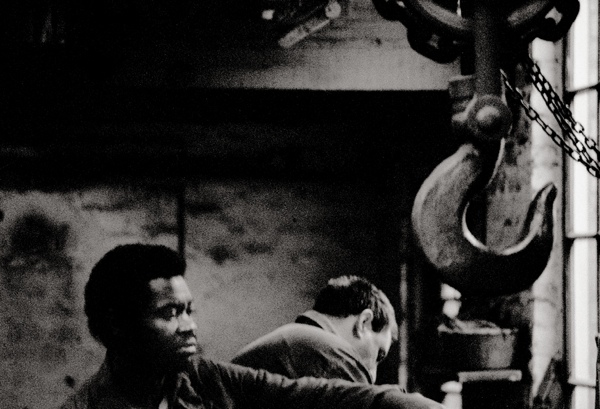
Whitechapel Bell Foundry, 1982

E9, 1964.

E1, 1968. “My mum and dad read the Stratford Express.”

Dray horse grazing next to the Truman Brewery, 1964

Newsagent, Spitalfields, 1966. “I said, ‘Shame about Walt Disney dying, can I take your picture next to it?’ and he said, ‘Alright.’”

Brick Lane, 1966

Strudel, E2 1962. “You’ll like this, boy!’ I had just taken a photograph outside this lady’s shop. I said, ‘I think your window looks beautiful.’ and she asked me in for a slice of apple strudel. It was fantastic! But she would not accept any money, it was a gift. She said, ‘You took a picture of my shop.’”

Sammy Fishoff, Old Montague St, 1964

Tubby Isaac’s, Spitalfields 1982. “Aaahhh Tubby’s, where I’ve had many a fine eel.”

John Claridge taking a photo in Old Montague St, 1964

My Mum & Dad, Plaistow 1964. “Taken in the backyard.”

John Claridge’s childhood home in Plaistow, 1964


