
Dhanji Patel, Men’s Outfitter
All our titles are half price in our SUMMER SALE. Simply add code ‘SUMMER’ at check out. Click here to visit the SPITALFIELDS LIFE BOOKSHOP

‘I love my shop,’ declared Dhanji Patel with a beatific smile, standing behind his counter at Omram Menswear in Sicilian Avenue, before confessing ‘sometimes I even come in on Sunday for a couple of hours just to tidy up.’
When I remind you that in Hinduism ‘Om’ is all encompassing, the essence of ultimate reality which unifies everything in the universe, you will appreciate this is a very special shop. Indeed, for the last forty-one years, Dhanji has been coming every day to maintain it in a state of perfection.
Not so long ago, Sicilian Avenue was a favoured destination in which Omram Menswear nestled between the celebrated Onion Cafe and Skoob Books, where I have whiled away more hours than I care to admit. Yet now it is mostly vacant, pending refurbishment by the corporate owners prior to the introduction of upmarket chains, and Dhanji has been given only a few months notice before he must depart.
When I arrived Dhanji was sheltering under an awning, contemplating the rain falling upon the emptiness in Sicilian Avenue. The West End is a quiet place these days and most of the offices are closed.
Despite the melancholy of the circumstance, I was overjoyed to meet Dhanji and encounter his miniature temple to menswear, filled with high quality garments all manufactured by British companies at breathtakingly cheap prices. In a more just world, Dhanji’s tiny shop would be cherished for the charm, the individuality and the civility that it brings to this otherwise soulless corner of Holborn, where traffic clatters past to get to somewhere else.
Once upon a time, Dhanji worked at a menswear shop in Bayswater where – he confided to me – he was too shy to serve the customers and hid in the basement. But this admission only makes his story all the more remarkable, as a testament of success won through hard work, honesty and perseverance.
“In my whole community, I am the only one working in clothing. I am a qualified book-keeper and I can do it really nicely. I live in Harlesden and I come each day to work by bus, it is a forty-five minute ride to Euston and then I walk here to Holborn.
In 1979, I worked for Unique Boutique menswear in Queensway. I was their book-keeper but there was a shortage of staff so they told me to help out in the shop. I was too scared to serve customers, I used to go downstairs when they arrived. I was very shy. I thought I was going to get the sack, but instead I got promotion to chief accountant.
My luck turned and my boss, Mr Mirchandani, was very nice, he said, ‘Please try to serve the customers.’ So when he went away, I used to go on the shop floor and try to sell to customers and I became the top salesman. Once I got used to it, I liked serving customers. Whenever I had any free time in accounts, I went into the shop, tidying up the shirts and jeans. The customers loved me because I was so small. When they came back, they asked for me to serve them! My boss told me I was one of his best salesmen and I was very happy. Even now, my ex-boss comes to see me because he really admires me.
Unique Boutique had quite a few shops until they went into liquidation. My boss told me to go into partnership with the man who ran this shop in Sicilian Avenue, he was my boss’ driver and his name was Manji. We had two shops, here and in Knightsbridge Underground Station but this shop was not doing very well. So then we got another shop, in Leicester Sq Underground Station. Both those shops in stations did well.
After three years, Manji told me he wanted to break the partnership. I agreed, saying ‘Give me one of the good shops and you can have the other two.’ He went to a solicitor but I did not have money to do that, so I ended up with this shop. It was difficult, until one day a gentleman from Double Two Shirts came in and advised me to sell better quality clothes. I grew in confidence with that and attracted more customers too. One day, the chairman of Ben Sherman was having lunch at Spaghetti House in Sicilian Avenue, he came in and told me to open an account with them. From there, trade started picking up. I was doing more business and getting better customers.
It was busy and there were really nice shops in Sicilian Avenue when I came here, a bookshop, a travel agency, a stamp and coin dealer and a regimental tie shop. Now I am longest tenant in the avenue. I love this shop and I have been here forty-one years. I have always paid my rent on time. I had a tough time when I started but I have had good times too. I have the loveliest customers. I have emailed them and they are all upset that I have to go. I do not know much about the internet and all that, so I am looking for somebody who might help me set up an online shop.
I have too much stock because last December before the second lockdown I bought a lot of winter stock, believing that there would not be another lockdown, so I got stuck with a lot of Harris tweed jackets and masonic clothing. Now the landlords are telling me that they want this shop back and it is very difficult for me to get rid of my stock. I cannot fit it all into my home.
The landlords are saying I have to go in August but I am begging them for a couple more months to sell my stock, otherwise what will I do? I am hoping they will be nice and give me time to clear the stock when everyone comes back. There are so many empty shops in the avenue, one has been empty for fifteen years. Hogarth Properties are billionaires so they are not bothered about it, but I do not want to vacate my shop and see it empty for a couple of years while my stock is dead. What can I do? I would love to stay here. I am crying inside.
I have a really nice customer base. I have so many overseas customers – from Australia, New Zealand, Canada, Nigeria and Uganda – who are coming to see me in the autumn. I am sending them clothes by post. They are supporting me and trying to help me out, which is really very kind of them.
I love this job and I love talking with my customers. As soon as anyone walks in the door, I can guess their size. They like it and they tell their friends. I want them to feel at home. If the customer is happy, he is going to come back.
Honesty is very important in business. There are certain things which are very cheap in this shop and I will tell the customer ‘This is what it is.’ A regular customer bought some trousers and there was a cheap shirt that he liked, but I told him ‘I had one customer complain that one of those shirts shrank.’ When he came to collect his trousers after alteration yesterday, he said ‘Whether it shrinks or not, I will buy the shirt.’
I do all the alterations myself by hand without a machine. If somebody wants a pair of trousers and they need to be altered, I will do it in half an hour.
My longest standing customer is Prince Apugo of Nigeria, he has visited me three to four times every year since 1982. We have become so friendly and, whenever he comes to London, he has to come to my shop.
A judge from Australia is a good customer of mine. He first came here on a Saturday, at five o’clock fifteen years ago, to buy one shirt from me yet I convinced him to buy another and a suit. After six months, he came back for another six shirts and he told me, ‘I’ve bought so many suits at other places but yours was the best!’ He cannot come to London because of the pandemic, so we have been swapping emails and he ordered £800 worth of things from me recently.
There was a black woman who used to pass my window every day on her way to study at the London School of Economics. One evening at five o’clock I was standing outside and she asked ‘Can I enter the shop?’ She explained she wanted to buy something for her fiancé. When she spoke, I asked her if she was from East Africa and she said ‘Yes.’ So I asked, ‘Which part?’ and she said ‘Uganda.’
I told her I had one of the nicest customers from Uganda. A lovely gentleman who came every year until he passed away. She asked me his name and, when I told her, she started crying. I did not know what was wrong. She said, ‘That was my dad.’ I showed her the handwriting of her father in my order book. She was so surprised. She never knew that her father came to my shop, and now she was in the same shop.”

‘As soon as anyone walks in the door, I can guess their size’

‘If somebody wants a pair of trousers altered, I will do it in half an hour’
Omram Menswear, 5 Sicilian Avenue, Off Southampton Row, London, WC1A 2QH
You may also like to read about
The Anniversary Of Saving Epping Forest
All our titles are half price in our SUMMER SALE. Simply add code ‘SUMMER’ at check out. Click here to visit the SPITALFIELDS LIFE BOOKSHOP

Mark Gorman, author of Saving the People’s Forest: open spaces, enclosure and popular protest in Victorian London celebrates the anniversary of the decisive battle to save Epping Forest as public open space which took place on Wanstead Flats.
One hundred and fifty years ago today, on 8th July 1871, thousands gathered on Wanstead Flats, the southern boundary of Epping Forest. They were there to protest against the fencing-off of a large section of the Flats by Lord Cowley, the Lord of Wanstead Manor and a major landowner in the forest.
Cowley’s action was just another in a series of enclosures of Epping Forest as local landowners sought to cash in on the rising value of land near London. Commerce and industry were driving a huge expansion of the city and villages like Walthamstow and Leytonstone were being transformed into bustling suburbs. London’s population, which had been just over one million in 1800, reached seven million by the eve of the Great War.
This unprecedented growth proved a mixed blessing for Londoners. The new suburbs provided affordable housing for many better-off workers but it was not just the affluent middle classes who were new residents of the growing outer London districts. Many who lived in the inner east London parishes also aspired to houses with gardens and the arrival of the railways made living at a distance from work a possibility.
At the same time, London’s spread was swallowing up the green spaces which for centuries people been able to enjoy. One after another urban commons were eaten away by housing and industrial development. By the mid-nineteenth century, even the once-remote Epping Forest was under threat. For East Enders “the People’s Forest” was their time-honoured playground. Summer weekends and holidays saw thousands take the roads eastward to the forest. Wanstead Flats, just north of the village of Forest Gate, was the closest part of the forest, with a railway station that opened in the eighteen-forties giving direct access from inner London.
The enclosures were a direct threat to this freedom to roam and not something Londoners accepted easily. On a wet February night in 1866, a meeting in Mile End formed a local branch of the Commons Preservation Society. While the committee was made up of prominent businessmen and politicians, the core group were all local political radicals, veterans of campaigns calling for the right to vote for the working class.
In the face of enormous odds, at a time of economic crisis, the campaigners mobilised local support for efforts to save the forest from development. A series of meetings across east London and in the forest promoted the cause. Workers at Truman, Hanbury & Buxton, local schoolchildren and many other East Enders raised funds. Nevertheless, as the enclosures continued, outrage was increasing and it was clear that direct action was required.
In the summer of 1871, the enclosures of Wanstead Flats proved to be a watershed. East Londoners gained a powerful ally in the City of London Corporation which, sensing the public mood, sided with the popular cause. Using their position as Epping Forest commoners, with the right to graze cattle across the forest, they warned Lord Cowley against infringing this right with his fences.
The City’s motives were mixed. At a time when they were being widely criticised as self-interested and unaccountable, this was a calculated effort to burnish their image. Yet it was also an act of altruism whose motivation was summed up by J T Bedford, the City’s leading campaigner for Epping Forest. By helping to save the forest, he said, ‘they would get the whole population with them. It would extend their influence, and it would be a gracious thing to do for the East End of London’.
While the City of London threatened legal action, campaigners called a mass demonstration on Wanstead Flats for July 1871. In the week before, public meetings were held in Hackney, Mile End, Stratford and Shoreditch. Though distant from the forest, these meetings were packed by those determined to defend their open space at all costs. “Shoreditch to the Rescue!” was the clarion call advertising the meeting there.
On 8th July, thousands descended on Wanstead Flats. By this stage, the gentleman leaders were increasingly nervous about the box they had opened and posters appeared warning against damaging the cause by destroying the fences. The formal meeting was moved off the Flats to the grounds of a local house. This was not to the crowd’s liking and, amidst a storm of booing, the wagon on which the speakers stood was manhandled onto the Flats.
A police presence seemed enough to keep order and, after polite speeches and appeals not to break the law, the leaders left. But hours later a single fence rail was broken and, within minutes, a huge crowd was laying waste to hundreds of yards of fencing. The police were hastily recalled, made one arrest – Henry Rennie, a Bethnal Green cabinet-maker – and fended off the crowd’s efforts to free him.
The press condemned the destruction of the fences, though some pointed out that the action grew out of frustration at the failure of the government to protect open spaces from rapacious landowners. Indeed, within a month parliament had enacted the first of a series of Acts to protect the forest.
Parliamentary and legal action was played out amidst vociferous public protest. A new campaigning group, the Forest Fund, organised petitions, lobbied MPs and held public meetings to keep the “Epping Forest Question” alive. The Fund’s annual meetings, often held in Shoreditch Town Hall, “the finest public building east of Temple Bar” were opportunities to highlight the campaign locally.
Local radicals continued to play a key role. In particular, Shoreditch vestrymen (forerunners of local councillors) were prominent vocally at meetings and in organising petitions. They helped create a groundswell of protest which could not be ignored. One local politician who did so, the Tower Hamlets MP Acton Ayrton, was heavily defeated in the 1874 General Election, blamed for his inaction over Epping Forest.
Finally in 1878, the last of the Epping Forest Acts was passed and it was revolutionary. It was the first legal declaration of the right of the public at large to use an open space for leisure. This had implications not just for Epping Forest but for all threatened open spaces across the country. It is hard to argue with the conclusion of the great ecologist and historian Oliver Rackham that “the modern conservation movement began with the campaign for Epping Forest”.
Yet the role played by ordinary Londoners in this campaign has been forgotten or ignored by history. The focus has been on the efforts of elite campaigners to save open spaces such as Epping Forest, which tells only part of the story. It misses out the grass-roots activism of working class people whose protests played a decisive role in the defence of their green spaces.
The sheer number and determination of the crowd on Wanstead Flats one hundred and fifty years ago created a groundswell of protest that pressured government into challenging landowners’ rights to enclose land and exclude the public. This and other campaigns contributed significantly to what has become our modern-day “right to roam.”
The story of one hundred and fifty years ago is also today’s story, as struggles for open spaces continue, all too often against the very public bodies who should be their guardians. Indeed a warning from history is contained in a leaflet issued by a successful 1946 campaign against an attempt to build housing on Wanstead Flats by a local council. “Once done” it said, “it can never be undone, and history will condemn the folly of those who allowed it to happen”.

Leytonstone c1870 (courtesy Walthamstow Vestry House Museum)

Poster for the 1871 demonstration (courtesy Newham Heritage Service)

From The Leisure Hour, 1860

City of London warning against enclosures (courtesy Newham Heritage Service)

Police on Wanstead Flats, July 1871 (courtesy Essex Field Club)

Poster warning against fence destruction, July 1871 (courtesy Essex Field Club)
You may also like to read about
John Thomas Smith’s Cries Of London
Treat yourself while all titles are half price in our SUMMER SALE. Simply add code ‘SUMMER’ at check out.
Click here to visit the SPITALFIELDS LIFE BOOKSHOP
John Thomas Smith is featured in The Gentle Author’s Cries of London which is included in the sale.

John Thomas Smith also known as ‘Antiquary Smith’ (1766–1833)
My interest in the Cries of London originally stemmed from writing about market traders in Spitalfields and thus I was fascinated to discover that – two hundred years ago – John Thomas Smith drew the street hawkers in London and it led him to look back at images from earlier centuries too. Similarly, Samuel Pepys collected prints of the Cries of London of his own day and from the past, which makes me wonder about my illustrious predecessors in this particular cultural vein and whether they also shared my passion for these prints as the only historical record of the transient street life of our ancient city.
A colourful character who claimed to have been born in the back of a Hackney carriage, John Thomas Smith became keeper of prints at the British Museum and demonstrated a superlative draftsmanship in his vivid street portraits – with such keen likenesses that, on one famous occasion, his subjects became suspicious he was working for the police and a mob chased him down the street in Whitechapel.
The prints shown here are Smith’s drawings of prints from the seventeenth century which especially appealed to him, and that he discovered in the course of his work as an archivist.
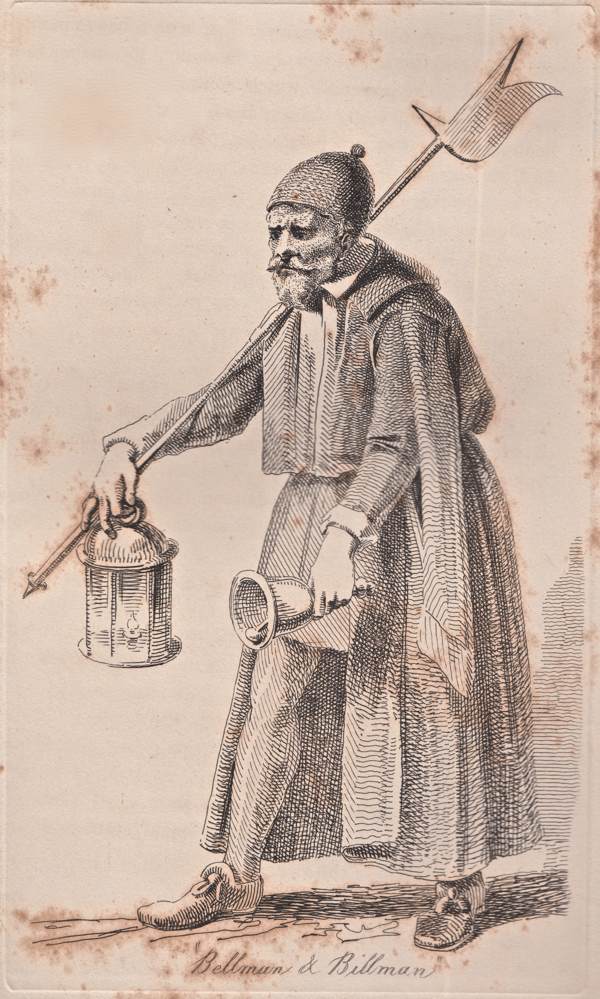
Bellman (Copied from a print prefixed to ‘Villanies discovered by Lanthorne and Candlelight’ by Thomas Dekker 1616)
“The Childe of Darkness, a common Night-walker, a man that had no man to wait upon him, but onely a dog, one that was a disordered person, and at midnight would beate at men’s doores, bidding them ( in mere mockerie) to look to their candles when they themselves were in their dead sleeps, and albeit he was an officer, yet he was but of light carriage, being known by the name of the Bellman of London.”
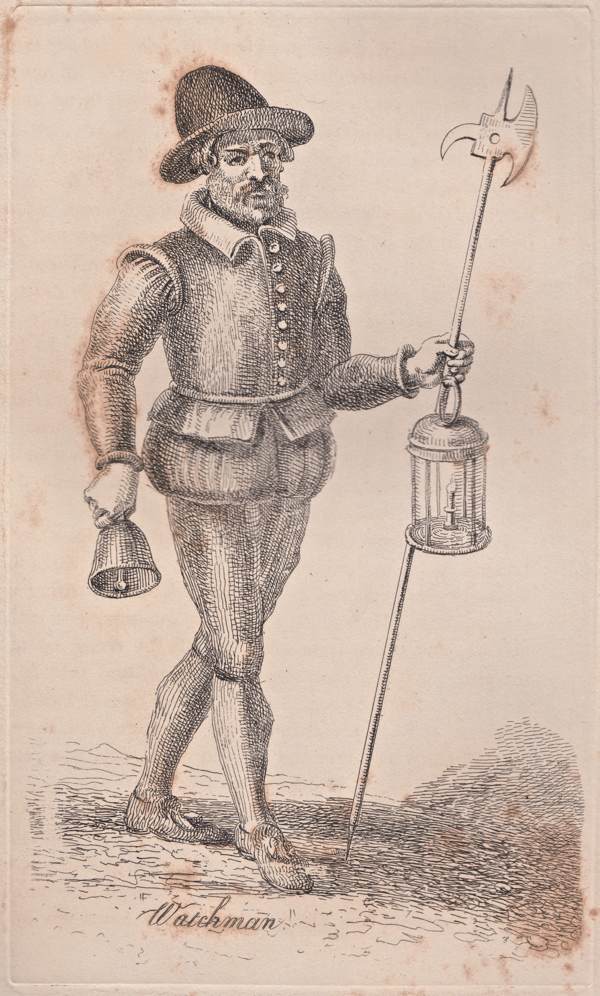
Watchman (Copied from a woodcut sheet engraved at the time of James I)
“The marching Watch contained in number two thousand men, part of them being old souldiers, of skill to be captaines, lieutenants, serjeants, corporals &c. The poore men taking wages, besides that every one had a strawne hat, with no badge painted, and his breakfast in the morning.”

Water Carrier (Copied from a set of Cries & Callings of London published by Overton)
“When the conduits first supplied the inhabitants, there were a number of men who for a fixed sum carried the water to the adjoining houses. The tankard was borne upon the shoulder and, to keep the carrier dry, two towels were fastened upon him, one to fall before him and the other to cover his back.”

Corpse-Bearer
“When the Plague was at its height, it was the business of the Corpse-Bearers to give directions to the Car-Men who went through the City with bells, which they rang at the same time crying, ‘Bring out your Dead.'”

Hackney Coachman (Copied from a print published by Overton in the reign of Charles II)
The early Hackney Coachman did not sit upon the box as the present drivers do, but upon the horse, like a postilion – his whip is short for that purpose, his boots which have large open broad tops, must have been much in the way when exposed to the weight of the rain. His hat was pretty broad and so far he was screened from the weather. In 1637, the number of Hackney Coaches in London was restricted to fifty but by 1802 it was eleven hundred.”

Jailor (Copied from Essayes & Characters of a Prison & Prisoners by Geffray Mynshul of Grays Inn, 1638)
“If marble-hearted Jaylors were so haplesse happy as to be mistaken and be made Kings, they would, instead of iron to their grates, have barres made of men’s ribs.”

Prison Basket Man (Copied from a print published by Overton in the reign of Charles II)
“One of those men who were sent out to beg broken meat for the poor prisoners. This custom which perhaps was as ancient as our Religious Houses has long been done away by an allowance of meat and bread having been made to those prisoners who are destitute of support. It was the business of such men to claim the attention of the public by their cry of ‘Some broken breade and meate for ye poore prisonors! For the Lord’s Sake, pitty the poore!'”

Rat Catcher (Copied from Cries of Bologna, etched by Simon Guillain from drawings by Annibal Carracci, 1646)
“There are two types of rats in this country, the black which was formerly very common but is now rarely seen, bring superseded by the large brown kind, called the Norway rat. The Rat Catcher had representations of rats and mice painted upon a square cloth fastened to a pole like a flag, which he carried across his shoulder.”

Marking Stones (Copied from a woodcut engraved in the time of James I)
“The marking stones were either of a red colour or comprised of black lead. They were used in the marking of linen so that washing could not take the mark out.”

Buy A Brush (Copied from a print published by Overton in the reign of Charles II)
“In those days, floors were not wetted but rubbed dry, even until they bore a very high polish, particularly when it was the fashion to to inlay staircases and floors of rooms with yellow, black and brown woods. These floors were rubbed by the servants who wore the brushes on their feet and they are in some instances so highly polished that they are dangerous to walk upon.”

Fire Screens (Copied from a print published by Overton in the reign of Charles II)
“It appears from the extreme neatness of this man and the goods which he exhibits for sale, that they were of a very superior quality, probably of foreign manufacture and possibly from Leghorn, from whence hats similar to those on his head were first brought into England”

Sausages (Copied from a print published by Overton in the reign of Charles II)
“The pork shops of Fetter Lane have been for upwards of one hundred and fifty years famous for their sausages, but those wretched vendors of sausages who cared not what they made them of in cellars in St Giles were continually persecuting their unfortunate neighbours, to whom they were as offensive as the melters of tallow, bone burners, soap boilers and cat gut cleaners.”
Take a look at John Thomas Smith’s drawings of nineteenth century street traders
John Thomas Smith’s Vagabondiana I
John Thomas Smith’s Vagabondiana II

A Walk With Clive Murphy
All our titles are half price in our SUMMER SALE. Simply add code ‘SUMMER’ at check out. Click here to visit the SPITALFIELDS LIFE BOOKSHOP

Clive Murphy 1936-2021
Readers are invited to attend Clive Murphy’s funeral next Tuesday 13th July 1pm at East London Crematorium, Grange Road, Plaistow, E13 0HB.
One day, I enjoyed the privilege of accompanying Clive Murphy – the distinguished oral historian and writer of ribald rhymes – on a stroll around Spitalfields visiting some of his favourite haunts. He emerged from his red front door, having descended the stairs from his flat above the Aladin restaurant on Brick Lane where he had lived since 1974, sporting a raffish brown fedora and raincoat, and we headed directly to his usual morning destination, Nude Espresso in Hanbury St.
“It’s the best cafe I know because you don’t meet English people, only Australians and New Zealanders. They’re all so young and fresh and not at all buttoned-up,” Clive explained enthusiastically, as we were seated at a prominent table. And I felt like James Boswell accompanying Samuel Johnson, as the great raconteur let loose his celebrated gift for rhetoric, causing everyone in the small cafe to crane in attention. “I tried to congratulate them on their vocabulary, in the use of ‘titillate’ on the board outside, but then they informed me the actual wording was “open ’til late.'” Clive informed me with a sly smile of self-deprecation.“I remember when they opened and I was the only customer. The owner is Dickie Reed and the food and the coffee are good, and I do hand it to him, because he started here with nothing and now he’s got this place and a roastery and another one in Soho.” said Clive, continuing his eulogy, and only breaking off as a plate of complimentary muffins was placed in front of him.
Then we popped round to Grenson shoes next door where Martha Ellen Smith, the manager, had been working on a linocut portrait of Clive. Despite his uncertainty about the likeness, I gave the picture my approval and congratulated Martha on capturing the spirit of the man. “A friend of mine who spends all day drinking and watching porn says I am becoming a cantankerous old git,” confessed Clive, turning vulnerable suddenly as we left the shop, and requiring vigorous persuasion on my part to convince him of the lack of veracity in such an observation.
Energised by caffeine, our spirits lifted as we strode off down Brick Lane when, to my amazement, I noticed another fellow coming towards us with the same mis-matched shoes as Clive – wearing one brown shoe and one black shoe – which I had been too polite to mention until then. In fact, it was a complete coincidence and, although they were unknown to each other prior to this meeting, both men explained it was because they had problems with ill-fitting shoes, becoming at once affectionate brothers of mis-matched footwear. Yet such is the nature of Brick Lane, this could quickly become an emergent trend in international street style.
We arrived at Sweet & Spicy on the corner of Chicksand St, Clive’s favourite restaurant, where he had been coming regularly for curry since 1974. Here, in the cool of the peaceful dining room, we were greeted by proprietor Omar Butt, wrestler and boxer, who ran this popular curry house started by his father in 1969. Clive recommended the hot spicy lamb and the pilau rice with saffron to me, enquiring the secret of the rice from Omar who revealed the distinctive quality was in the use of raisins, almonds and butter ghee. Pointing out the weight-lifting posters on the wall, Clive informed me that Omar had been preceded by his brother Imran Butt who was “mad for bodybuilding.”
“We used to have useful things like a laundrette, an ironmonger and an electrical shop in Brick Lane,” announced Clive, turning morose as we retraced our steps, “now one half of it is arty-farty shops and the other half curry houses, and there’s nothing else.” Yet his complaint was cut short as we were greeted by the cheery Sanjay, Clive’s friend who worked as waiter in the Aladin restaurant below his flat. “I told him I was going to the supermarket one day and he asked me to bring him a present, so I got him a packet of biscuits,” recalled Clive fondly, humbled by Sanjay’s open-heartedness, “it’s amazing what a packet of biscuits can do.”
Leaving Brick Lane, we turned down Buxton St towards the rear of the brewery where Clive lived for a year in the headmaster’s study of the derelict St Patrick’s School in 1972, when he first came to Spitalfields. “I had a hurricane lamp, a camp bed and a tea chest.” he said as we reached the threshold of the Victorian Schoolhouse, “There was only electricity three days a week and I had a single cold tap on the floor below. I was scared of the meths drinkers who sat outside on the step because I was all alone, I had never been in the East End before and I had never met meths drinkers before. But then three painters moved in and we became a colony of artists, until I was flooded out.”
“I think would have made a go of it anywhere,” acknowledged Clive, in a measured attempt to sum up his years in the East End, “I don’t think Spitalfields has been especially generous to me, except it was where I met my heroes Alexander Hartog, the tenor and mantle presser, and Beatrice Ali, the Salvation Army Hostel Dweller, and I am grateful because they were both absolute treasures.” These individuals became the subjects of two of the most memorable of Clive’s oral histories.
By now, a blustery wind had blown up in Buxton St. It had been accumulating all morning and caused me to run down the street more than once to retrieve Clive’s hat, but now it required him to hold his fedora in place with his left hand. Yet before we went our separate ways, heading for home, Clive presented me with a packet of liquorice allsorts that he had secreted in his raincoat pocket, and I was delighted to accept them as a souvenir of our walk.


Clive and antipodean friends at Nude Espresso

Clive at Grenson Shoes with Martha and Nathan

Martha Ellen Smith’s lino cut portrait of Clive

The beginning of a trend on Brick Lane, Clive meets Mark who shares his taste in mis-matched footwear

Clive with Omar Butt at Sweet & Spicy in Brick Lane where Clive had been dining since 1974

Clive with his friend Sanjay, waiter at the Aladin Curry House, Brick Lane.

Clive at Old St Patrick’s School in Buxton St where he first lived in Spitalfields in 1972. – “I only had a hurricane lamp, a camp bed and a tea chest.”

Clive encounters a blustery corner in Buxton St.

Clive in his flat above the Aladin curry house on Brick Lane where he lived from 1974.
You may also like to read
Clive Murphy, Oral Historian & Writer of Ribald Rhymes
The Markets Of Old London
Treat yourself while all titles are half price in our SUMMER SALE. Simply add code ‘SUMMER’ at check out.
Click here to visit the SPITALFIELDS LIFE BOOKSHOP
The Markets of Old London is featured in The Gentle Author’s London Album which is included in the sale.

Clare Market c.1900
I never knew there was a picture of the legendary and long-vanished Clare Market – where Joseph Grimaldi was born – until I came upon this old glass slide among many thousands in the collection of the London & Middlesex Archaeological Society, housed at the Bishopsgate Institute. Scrutinising this picture, the market does not feel remote at all, as if I could take a stroll over there to Holborn in person as easily as I can browse the details of the photograph. Yet the Clare Market slum, as it became known, was swept away in 1905 to create the grand civic gestures of Kingsway and Aldwych.
Searching through this curious collection of glass slides, left-overs from the days of educational magic lantern shows – comprising many multiple shots of famous landmarks and grim old church interiors – I was able to piece together this set of evocative photographs portraying the markets of old London. Of those included here only Smithfield, London’s oldest wholesale market, continues trading from the same building, though Leather Lane, Hoxton Market and East St Market still operate as street markets, but Clare Market, Whitechapel Hay Market and the Caledonian Rd Market have gone forever. Meanwhile, Billingsgate, Covent Garden and Spitalfields Fruit & Vegetable Market have moved to new premises, and Leadenhall’s last butcher – once the stock-in-trade of all the shops in this former cathedral of poultry – closed last year.
Markets fascinate me as theatres of commercial and cultural endeavour in which a myriad strands of human activity meet. If you are seeking life, there is no better place to look than in a market. Wherever I travelled, I always visited the markets, the black-markets of Moscow in 1991, the junk markets of Beijing in 1999, the Chelsea Market in Manhattan, the central market in Havana, the street markets of Rio, the farmers’ markets of Transylvania and the flea market in Tblisi – where, memorably, I bought a sixteenth century silver Dutch sixpence and then absent-mindedly gave it away to a beggar by mistake ten minutes later. I often wonder if he cast the rare coin away in disgust.
Similarly in London, I cannot resist markets as places where society becomes public performance, each one with its own social code, language, and collective personality – depending upon the nature of the merchandise, the location, the time of day and the amount of money changing hands. Living in Spitalfields, the presence of the markets defines the quickening atmosphere through the week, from the Thursday antiques market to the Brick Lane traders, fly-pitchers and flower market in Bethnal Green every Sunday. I am always seduced by the sense of infinite possibility when I enter a market, which makes it a great delight to live surrounded by markets.
These old glass slides, many of a hundred years ago, capture the mass spectacle of purposeful activity that markets offer and the sense of self-respect of those – especially porters – for whom the market was their life, winning status within an elaborate hierarchy that had evolved over centuries. Nowadays, the term “marketplace” is sometimes reduced to mean mere economic transaction, but these photographs reveal that in London it has always meant so much more.

Billingsgate Market, c.1910
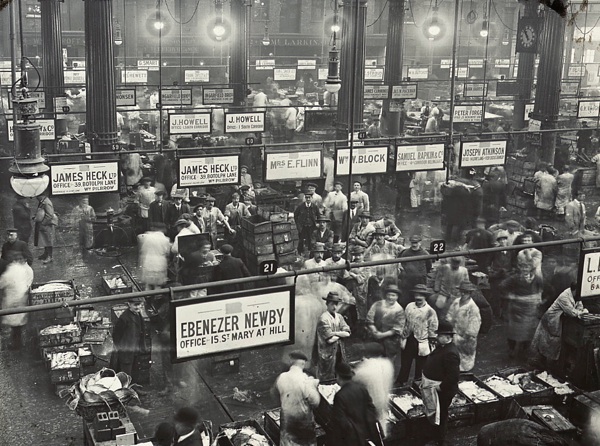
Billingsgate Market, c.1910

Whitechapel Hay Market c.1920 (looking towards Aldgate)

Whitechapel Hay Market, c.1920 (looking east towards Whitechapel)

Porters at Smithfield Market, c.1910

Caledonian Rd Market, c.1910

Book sale at Caledonian Rd Market, c.1910

Caledonian Rd Market, c.1910

Caledonian Rd Market, c.1910

Covent Garden Market, c.1920

Covent Garden Market, c.1910

Covent Garden, c.1910

Covent Garden Market, 1925

Covent Garden Market, Floral Hall, c.1910

Leadenhall Market, Christmas 1935

Leadenhall Market, c.1910

East St Market, c.1910

Leather Lane Market, 1936
 Hoxton Market, Shoreditch, 1910

Spitalfields Market, c.1930
Images courtesy Bishopsgate Institute
You may like to look at these old photographs of the Spitalfields Market by Mark Jackson & Huw Davies
Alfred Daniels, Artist
Treat yourself and your friends and family while all our titles are half price in our SUMMER SALE. Simply add code ‘SUMMER’ at check out.
Click here to visit the SPITALFIELDS LIFE BOOKSHOP
Alfred Daniels is featured in EAST END VERNACULAR, Artists Who Painted London’s East End Streets in 20th Century which is included in the sale.

The Gramophone Man, Wentworth St
“I’m not really an East Ender, I’m more of a Bow boy,” asserted Alfred Daniels with characteristic precision of thought, when I enquired of his origin. “My parents left the East End, because they were scared of the doodlebugs and bought this house in 1945,” he explained, as he welcomed me to his generous suburban residence in Chiswick. Greeting me while dressed in pyjamas and dressing gown in the afternoon, no-one could have been more at home than Alfred in his studio occupying the former living room of his parents’ house. I found him snug in the central heating and just putting the finishing touches to a commission that his dealer was coming to collect at six.
I met Alfred at the point in life where copyright payments on the resale of works from his sixty-year painting career meant he no longer has to struggle. “I’ve done hundreds of things to make a living,” he confessed, rolling his eyes in amusement, “Although my father was a brilliant tailor, he was a dreadful business man so we were on the breadline for most of the nineteen thirties – which was a good thing because we never got fat …”
Smiling at his own bravado, Alfred continued painting as he spoke, adding depth to the shadows with a fine brush. “This is the way to make a living,” he declared with a flourish as he placed the brush back in the pot with finality, completing the day’s work and placing the painting to one side, ready to go. “The past is history, the future is a mystery but the present is a gift,” he informed me, as we climbed the stairs to the upstairs kitchen over-looking the garden, to seek a cup of tea.
Alfred had spent the morning making copious notes on his personal history, just it to get it straight for me. “This has been fun,” he admitted, rustling through the handwritten pages.
“My grandfather came from Russia in the 1880s, he was called Donyon, and they said, ‘Sounds like Daniels.’ My grandfather on the other side came from Plotska in Poland in the 1880s, he didn’t have a surname so they said ‘Sounds like a good man’ and they called him Goodman. My parents, Sam and Rose, were both born in the 1890s and my mother lived to be ninety-two. I was born in Trellis St in Bow in 1924 and in the early thirties we moved to 145 Bow Rd, next to the railway station. I can still remember the sound of the goods wagons going by at night.
One good thing is, I gave up the Jewish religion and thank goodness for that. It was only when I was twelve and I read about the Hitler problem that I realised I was Jewish. Fortunately, we weren’t religious in my family and we didn’t go to the synagogue. But I went to prepare for my Bar Mitzvah and they tried to harm me with Hebrew. We were taught by these Russians and if you didn’t learn it they bashed you. That put me off religion there and then. Yet when we got outside the Black Shirts were waiting for us in the street, calling ‘Here look, it’s the Jew boys!’ and they wanted to bash me too. Fortunately, I could run fast in those days.
My mother used to do all the shopping in the Roman Rd market. She hated shopping, so she sent me to do it for her in Brick Lane. It was a penny on the tram, there and back. But they all spoke Yiddish and I couldn’t communicate, so I thought, ‘I’d better listen to my grandmother who spoke Yiddish.’ I learnt it from her and it is one of the funniest languages you can imagine.
Although my parents were poor, my Uncle Charlie was rich. He was a commercial artist and my father said to him, ‘The boy wants to learn a craft.’ So Charlie got me a place at Woolwich Polytechnic to learn signwriting but I spent all day trying to sharpen my pencil. Then he took me out of the school and got me a job as a lettering artist at the Lawrence Danes Studio in Chancery Lane. It was wonderful to come up to the city to work, and his nephew befriended me and we went to art shops together to look at art books. We drew out letters and filled them in with Indian Ink, mostly Gill Sans. Typesetters usually got the spacing wrong but if you did it by hand you could get it right. It was all squares, circles and triangles.
When Uncle Charlie started his own studio in Fetter Lane above the Vogue photo studio, he offered me a job at £1 a week. Nobody showed me how to do anything, I worked it out for myself. He got me to do illustrations and comic drawings and retouching of photographs. At night, we went down in the tube stations entertaining people sheltering from the blitz. I played my violin like Django Reinhardt and he played like Stefan Grappelli, and one day we were recorded and ended up on Workers’ Playtime.
I had been doing some still lifes but I wanted to paint the beautiful old shops in Campbell Rd, Bow, so I went to make some sketches and a policeman came up and asked to see my identity card. ‘You can’t do this because we’ve had complaints you’re a spy,’ he said. It was illegal to take photographs during the war, so I sat and absorbed into memory what I saw. And the result came out like a naive or primitive painting. When Herbert Buckley my tutor at Woolwich saw it, he said, ‘Would you like to be a painter? I’ll put you in for the Royal College of Art. To be honest, I should rather have done illustration or lettering. At the Royal College of Art, my tutors included Carel Weight – he said, ‘I’m not interested in art only in pictures.’ – Ruskin Spear – ‘always drunk because of the pain of polio’ – and John Minton – ‘ a lovely man, if only he hadn’t been so mixed up.'”
Alfred was keen to enlist, “I wanted to stop Hitler coming over and stringing me up !” – though he never saw active service, but the discovery of painting and of his signature style as the British Douanier Rousseau stayed with him for the rest of his life. After Alfred left the East End in 1945, he kept coming back to make sketchbooks and do paintings, often of the same subjects – as you see below, with two images of the Gramophone man in Wentworth St painted fifty years apart.
With natural generosity of spirit, Alfred Daniels told me, “Making a painting is like baking a cake, one slice is for you but the rest is for everyone else.”

The Gramophone Man in Wentworth St, 1950

Sketchbook pages – Cable St, April 1964

Sketchbook pages – Old Montague St, March 1964

Sketchbook pages – Hessel St, April 1964

Sketchbook pages – Old Montague St & Davenant St, March 1964

Sketchbook pages – Fruit Seller in Hessel St, March 1964

Leadenhall Market, drawing, 2008

Billingsgate Market

Tower Bridge, 2008

The Royal Exchange, 2008

Crossing London Bridge, 2008

In Alfred’s studio


Alfred Daniels, Artist (1924-2015)
You may also like to read about
A Return Visit to Alfred Daniels
Happy 90th Birthday, Alfred Daniels!

Click here to buy a copy for half price
Summer Book Sale

We are celebrating the joys of the season with a SUMMER SALE, selling all our books at half price so you can treat yourself and your friends and family. Simply add code ‘SUMMER’ at checkout to claim your discount.
CLICK HERE TO VISIT THE SPITALFIELDS LIFE BOOKSHOP


