
Wilful Destruction At The Truman Brewery

“What has happened is unquestionably vandalism” – Dan Cruickshank
Last year, Dan Cruickshank made a survey of the historic fabric of the Old Truman Brewery to ensure that these elements would be preserved in any redevelopment of the site, which sits within the Fournier St and Brick Lane Conservation Area. The owners have responded by destroying a large area of old granite paviours and setts in the large yard east of Brick Lane that Dan identified as original, thus avoiding the possibility of any restriction upon their future development plans in this area.
The work was undertaken covertly on Thursday 28th and Friday 29th January when the yard was cordoned off by security guards while mechanical diggers removed the surface and the debris was hastily taken away on trucks.
When the Spitalfields Trust contacted Tower Hamlet Council on Thursday 28th to halt the destruction, the owners of the brewery justified their action as ‘repair.’ The enforcement officers accepted this explanation and took no action.
On Monday 1st February, when the Trust supplied photographic evidence, Planning Enforcement acknowledged that “the works appear to go beyond that which may be considered a repair.”
On Tuesday 2nd February, when the Trust formally requested the reinstatement of the historic paving, Planning Enforcement admitted that what had taken place was unlawful – “the extent of the work that has been carried out is such that there is a breach of planning control.” By this point the entire surface of the yard had gone.
The owners of the Old Truman Brewery are currently seeking planning permission to build an ugly shopping mall with four floors of corporate offices on top at the corner of Brick Lane and Woodseer St. The Spitalfields Trust are campaigning to halt this development and advocating the creation of a Planning Brief for the entire brewery site which takes into account both conservation and the needs of the local community, especially for housing.
Through their destructive action, the brewery owners have revealed themselves to be unscrupulous with no respect for history or the community. These pitiful events emphasise the importance of stopping their proposed development and the necessity of a Planning Brief for the entire brewery site that will curb their greedy profit-driven ambitions.
Please register your objection to the redevelopment if you have not yet done so. You will find instructions below.

Original granite paving dug up and removed
“The central square, now once again largely open, also retains some remarkable areas of paving… This combination of materials gives this area something of the beauty and mystery of an antique ruin, like parts of Pompeii, with the well judged and skilful laying of the setts reminiscent of a Roman tessellated pavement. The central area of the court also retains large areas of early and well laid setts, their form and location marking, to a degree, the location of lost brewery buildings. These historic and well-crafted surfaces possess great beauty.” Dan Cruickshank
Click here to read Dan Cruickshank’s Survey of the Truman Brewery

Workshop in the eastern yard of the brewery with granite setts

Joiner’s shop in the eastern yard of the brewery with granite setts

The former cooperage in the eastern yard with granite setts

The large pale grey areas in this aerial view are the granite paving that has ben removed

Will these granite surfaces marked with centuries of use by drays be dug up next?

These original granite setts from when this was once part of Wilkes St are at risk of destruction


Photographs by Dan Cruickshank

THE BLOCK ON BRICK LANE
The owners of the Old Truman Brewery want to build an ugly shopping mall with four floors of corporate offices on top at the corner of Woodseer St and Brick Lane.
- It will undermine the authentic cultural quality of Brick Lane.
- The generic architecture is too tall and too bulky, ruining the Brick Lane & Fournier St Conservation Area.
- It offers nothing to local residents whose needs are for genuinely affordable homes and workspaces.
- It is an approach that is irrelevant to a post-Covid world, with more people working from home and shopping locally or online.
- Where it meets the terraces of nineteenth century housing, the development is out of scale and causes up to 60% loss of light.
HOW TO OBJECT
Lodge an objection to the Old Truman Brewery development by writing a personal letter to Tower Hamlets Council as soon as possible.
Please write in your own words and head it OBJECTION.
Quote Planning Application PA/20/00415/A1
Anyone can object wherever they live. Members of one household can each write separately. You must include your postal address.
Send your objection by email to Patrick.Harmsworth@towerhamlets.gov.uk
Or by post to:
Planning Department,
Town Hall, Mulberry Place,
5 Clove Crescent,
London, E14 2BG
Frank Merton Atkins, Photographer
A collection of photographs by Frank Merton Atkins – including these splendid pictures of City churches – were given to the Bishopsgate Institute by his daughter Enid Ghent who had kept them in her loft since he died in 1964.
‘My father worked as a cartographer for a company of civil engineers in Westminster and he drew maps of tram lines,’ Enid recalled, ‘Both his parents were artists and he carried a camera everywhere. He loved to photograph old pubs, especially those that were about to be demolished. Sometimes he got up early in the morning to take photographs before work and at other times he went out on photography excursions in his lunch break. He was always looking around for photographs.’
Captions by Frank Merton Atkins

Christ Church, Spitalfields, 1 October 1957

All Hallows Staining Tower, 25 June 1957, 1.22pm

Cannon Street, looking west from corner of Bush Lane, 7 June 1957, 8.21am

St Botolph Aldgate, from Minories, 31 May 1960, 1.48pm

St Bride from Carter Lane, 31 May 1956, 8.20am

St Clement Danes Church, Strand, from Aldwych, 14 October 1958, 1.22pm

St Dunstan in the East (seen from pavement in front of Custom House), 13 June 1956, 1.14pm

St George Southwark, from Borough High Street, 14 August 1956, 8.15am

St James Garlickhithe, from Queenhithe, 20 May 1957, 8.23am

St Katherine Creechurch, 27 May 1957, 8.32am

St Magnus the Martyr, from the North, 26 June 1956, 8.17am

St Magnus the Martyr, Lower Thames Street, 26 June 1956, 8.23am

St Margaret Lothbury, 2 August 1957, 1.12pm

St Margaret Pattens, from St Mary At Hill, 13 June 1956, 1pm

St Mary Woolnoth, 8 August 1956, 5.49pm

St Pauls Church, Dock Street, Whitechapel, 3 September 1957, 1.09pm

St Pauls and St Augustine from Watling Street, 7 May 1957, 8.25am

St Vedast, from Wood Street, 30 July 1956, 8.17am
Photographs courtesy Bishopsgate Institute
You may also like to look at
List Of Local Shops Open For Business

Rabbits! Who will buy my nice fat rabbits?
This is the list of essential shops that are open in Spitalfields and vicinity during the current lockdown. Readers are especially encouraged to support small independent businesses who offer an invaluable service to the community. This list confirms that it is possible to source all essential supplies locally without recourse to supermarkets.
Be advised many shops are operating limited opening hours at present, so I recommend you call in advance to avoid risking a wasted journey. Please send any additions or amendments for next week’s list to spitalfieldslife@gmail.com
This week’s illustrations are by William Craig Marshall’s from his ‘Itinerant Traders of London in their Ordinary Costume with Notices of Remarkable Places given in the Background’ of 1804. Click here to see more

Mackerel, Billingsgate
GROCERS & FOOD SHOPS
The Albion, 2/4 Boundary St
Ali’s Mini Superstore, 50d Greatorex St
AM2PM, 210 Brick Lane
Planet Organic, 132 Commercial St
Banglatown Cash & Carry, 67 Hanbury St
Breid Bakery, Arch 72, Dunbridge St
Brick Lane Minimarket, 100 Brick Lane
The Butchery Ltd, 6a Lamb St
City Supermarket, 10 Quaker St
Costprice Minimarket, 41 Brick Lane
Faizah Minimarket, 2 Old Montague St
JB Foodstore, 97 Brick Lane
Haajang’s Corner, 78 Wentworth St
Leila’s Shop, 17 Calvert Avenue
Nisa Local, 92 Whitechapel High St
Pavilion Bakery, 130 Columbia Rd
Rinkoff’s Bakery, 224 Jubilee Street & 79 Vallance Rd
Sylhet Sweet Shop, 109 Hanbury St
Taj Stores, 112 Brick Lane
Zaman Brothers, Fish & Meat Bazaar, 19 Brick Lane

Cats & Dogs Meat, outside Bethlem Hospital, Moorfields
TAKE AWAY FOOD SHOPS
Before you order from a delivery app, why not call the take away or restaurant direct?
Absurd Bird Fried Chicken, 54 Commercial St
Al Badam Fried Chicken, 37 Brick Lane
Allpress Coffee, 58 Redchurch St
The Association, 10-12 Creechurch Lane
Band of Burgers, 22 Osborn St
Beef & Birds, Brick Lane
Beigel Bake, 159 Brick Lane
Beigel Shop, 155 Brick Lane
Bellboi Coffee, 104 Sclater St
Bengal Village, 75 Brick Lane
Big Moe’s Diner, 95 Whitechapel High St
Burro E Salvia Pastificio, 52 Redchurch St
Cafe 388, 388 Bethnal Green Rd
China Feng, 43 Commercial St
Circle & Slice Pizza, 11 Whitechapel Rd
Crosstown Doughnuts, 157 Brick Lane
Dark Sugars, 45a Hanbury St (Take away ice cream and deliveries of chocolate)
Donburi & Co, Korean & Japanese, 13 Artillery Passage
Eastern Eye Balti House, 63a Brick Lane
Enso Thai & Japanese, 94 Brick Lane
Exmouth Coffee Shop, 83 Whitechapel High St
Grounded Coffee Shop, 9 Whitechapel Rd
Holy Shot Coffee, 155 Bethnal Green Rd
Hotbox Smoked Meats, 46-48 Commercial St
Jack The Chipper, 74 Whitechapel High St
Jonestown Coffee, 215 Bethnal Green Rd
Laboratorio Pizza, 79 Brick Lane
La Cucina, 96 Brick Lane
Leon, 3 Crispin Place, Spitalfields Market
Madhubon Sweets, 42 Brick Lane
Mooshies Vegan Burgers, 104 Brick Lane
Nude Expresso, The Roastery, 25 Hanbury St
E. Pellicci, 332 Bethnal Green Rd
Pepe’s Peri Peri, 82 Brick Lane
Peter’s Cafe, 73 Aldgate High St
Picky Wops Vegan Pizza, 53 Brick Lane
Polo Bar, 176 Bishopsgate
Poppies, 6-8 Hanbury St
Quaker St Cafe, 10 Quaker St
Rajmahal Sweets, 57 Brick Lane
Rosa’s Thai Cafe, 12 Hanbury St
Shawarma Lebanese, 84 Brick Lane
Shoreditch Fish & Chips, 117 Redchurch St
Sichuan Folk, 32 Hanbury St
String Ray Globe Cafe, 109 Columbia Road
Sushi Show, 136 Bethnal Green Rd
Vegan Yes, Italian & Thai Fusion, 64 Brick Lane
The Watch House, 139 Commercial St
White Horse Kebab, 336 Bethnal Green Rd
Yuriko Sushi & Bento, 48 Brick Lane

Hair & Hearth Brooms, outside Shoreditch Church
OTHER SHOPS & SERVICES
Brick Lane Bookshop, 166 Brick Lane (Books ordered by phone or email are delivered free locally)
Brick Lane Bikes, 118 Bethnal Green Rd
Day Lewis Pharmacy, 14 Old Montague St
E1 Cycles, 4 Commercial St
Eden Floral Designs, 10 Wentworth St (Order fresh flowers online for free delivery)
Flashback Records, 131 Bethnal Green Rd (Order records online for delivery)
GH Cityprint, 58-60 Middlesex St
Harry Brand, 122 Columbia Road (Order gifts online for delivery)
Leyland Hardware, 2-4 Great Eastern St
Newman’s Stationery, 324 Bethnal Green Rd (Call for local delivery)
Post Office, 160a Brick Lane
Rose Locksmith & DIY, 149 Bethnal Green Rd
Sid’s DIY, 2 Commercial St

Bellows to Mend, Smithfield
ELSEWHERE
E1 Dry Cleaners, Cannon Street Rd, E1 2LY
E5 Bakehouse, Arch 395, Mentmore Terrace, London Fields (Customers are encouraged to order online and collect in person)
Gold Star Dry Cleaning & Laundry, 330 Burdett Rd
Hackney Essentials, 235 Victoria Park Rd
Quality Dry Cleaners, 16a White Church Lane
Newham Books, 747 Barking Rd (Books ordered by phone or email are posted out)
Rajboy, 564 Commercial Rd, E14 7JD (Take away service available)
Region Choice Chemist, 68 Cambridge Heath Rd
Symposium Italian Restaurant, 363 Roman Road (Take away service available)
Thompsons DIY, 442-444 Roman Rd

Hot Spiced Gingerbread
Images courtesy Bishopsgate Institute
You may also like to take a look at
Derek Brook’s East End
Take a walk around the East End on a foggy day in the sixties with Derek Brook.
Brook was a commercial photographer who came from Australia to London and photographed the explosion in fashion and music, including The Beatles. Yet he also recorded political protests, and came one day to capture his impressions of the East End in these considered and atmospheric pictures.

Whitechapel Rd

Whitechapel Rd

Whitechapel Rd

Whitechapel Rd with Royal London Hospital in the distance

Whitechapel Rd

Whitechapel Station

Whitechapel Station

Whitechapel Market

Mile End

Mile End

Mile End

The Anchor, Mile End Rd

The Railway Tavern, Commercial Rd, Limehouse

The Oporto Tavern, West India Dock Rd

The Prince Alfred, Poplar High St

Wood St, off Cheshire St

Great Eastern Buildings, Quaker St

Brick Lane

On the steps of the synagogue, Brick Lane

Spitalfields

Middlesex St

Middlesex St

Middlesex St with The Bell

Middlesex St
Photographs courtesy Bishopsgate Institute
You may also like to take a look at
So Long, Tony Burns
Legendary East End Boxing Coach, Tony Burns MBE, died on Monday at eighty years old

You passed under the sign that said “No guts, no glory,” then walked through the humid air laced with sweat, and the clamor of the boxing gym where youths were sparring and slugging at punchbags, until you reached the tiny office in the corner – barely more than a cupboard – where Tony Burns had his lair. Once upon a time in the old East End, Tony came here to this former bathhouse for a wash but in recent years he was the head coach at the Repton Boxing Club, Britain’s most famous amateur club, which occupies the building today.
Tony took my hand with a boxer’s grip and cast his intense blue eyes upon me with a gentle yet incisive gaze from beneath thick, straggly brows. It was as if he was looking out at me from inside a cave. “You’re not a boxing person, are you?” he queried with a derisive smile, getting the sum of me in an instant. Yet in spite of my shortcoming, Tony indulged me magnificently, bringing out two pages of handwritten lists of boxing triumphs at Olympic and Commonwealth Games which may be attributed to the noble Club, before tantalising me with enigmatic old black and white photographs of unidentified men in suits, some of which turned out to be illustrations of stories that I shall never be party to.
“It was a public school, Repton, what started this in 1884,” Tony explained, turning historian suddenly and gesturing around the atmospheric tiled spaces, lined with faded bills for the boxing bouts of yesteryear. “I often speak to the people at Repton School and they say ‘Couldn’t you bring a dozen boys up to Derbyshire for an education?’ But I don’t think you could take a kid from the East End and put him in a public school in Derbyshire, where all the pupils are the children of high ranking generals and such. He would bash everybody up”.
“When I was a kid you either kicked a ball or you hit someone. So, when I was twelve, I became a boxer,” continued Tony with faultless logic. “My mum died when I was a kid and if you lived in a place like this years ago, you was very fortunate to have a loving family. We all lived in Bacon St and Charlie Burns was the eldest, and they was a pain in the arse that family, but when I boxed all the family and friends would come, so I used to have quite a following.”
Then Tony looked at me critically. “I knew the Krays,” he confessed with an implacable gaze, returning to the pile of photos and searching my face for a reaction while showing me a picture,”We grew up together. I used to go round to their house in Valance Rd all the time, but I chose one path in life and they chose another.” The photograph was Tony with Reggie Kray, on the occasion of Reggie Kray’s wedding in 1997 at which Tony was best man. “He looks more dead than alive,” quipped Tony with a grimace before resigning the thought as he put the picture away again, closing the subject.
“The Repton was a club where East End boys could do all kinds of sports and they had around a thousand members when I joined,” Tony recalled, “but then it got closed down and Albert Jacob, the Mayor of Tower Hamlets, gave us this building on a thousand year lease. He saw the future of the East End – by putting this club here where it is – getting the kids off the streets and getting them off everything. The asset of the Repton is the area, it’s packed with talent out there.”
Tony was eager to tell me about his coaching, without filling in the details of his own distinguished boxing career which included winning the Amateur World Championship. “For some unexplained reason I had three gold medallists in the Olympics the first year I was here as coach in 1968,” he said, and at first I thought this statement was another expression of reserve on Tony’s part but then I realised it was something more intangible. “People do come along,” he puzzled, shaking his head in wonderment, as we walked through the gym to examine the photographs that lined the wall of fame extending around the corner. “We’ve had three hundred and fifty champions here – that’s national titles not championships – which is really quite unbelievable in forty years, roughly about ten a year,” he said.
“I can fall in love with a lad the minute he walks through the door, and make a fuss of him and build him up and make him think he’s a big talent,” admitted Tony, speaking tenderly, “The beauty of it is that I am at a club like this where maybe sixty or eighty youths come every weekend and you see them developing.” And he turned and cast his eyes around at the enthusiastic crew of young boxers of different races that filled the gym, all dripping with perspiration, full of fight and eager for glory.

Freddie Mills presents a clock to fifteen year old Tony Burns of Bethnal Green, who won his contest against R.Brice of Kingston, whilst Sammy McCarthy congratulates the young boxer during the recent amateur tournament at the Kingston Baths, October 31st 1955

Tony Burns as a young boxer of twenty years old in 1960

Tony Burns, Amateur World Champion Boxer, with Howard Winston, Professional World Champion

Tony Burns with Mohammed Ali

Tony Burns with Reggie Kray in 1997

Tony is best man at Reggie Kray’s wedding in 1997

Tony Burns with Frank Bruno

Tony Burns, Head Coach at the Repton Boxing Club
You may also like to read about
A Brief History Of Coborn Street
Andrew Sargent sent me his account of Coborn St in Bow. If anyone else would like to submit a history of their street, please drop me line.

Every street London has a story to tell and Coborn St is no exception. It is a short thoroughfare leading north from Bow Rd, mid-way between Mile End and Bow Rd underground stations. On the west side are pairs of handsome Georgian houses and, on the east side, school buildings and a former sorting office.
Coborn St and the adjoining Coborn Rd were constructed in the eighteen-twenties by the trustees of the Coborn Estate. Prisca Coborn, the widow of a rich seventeenth century brewer, had left a large sum for the education of local boys and girls. A school was built and, in 1813, larger premises were opened where the former Bryant & May factory now stands. But the Trustees had overreached themselves and the money ran out, so an Act of Parliament was passed to allow them to sell and lease land from the Coborn Estate for building purposes. Thus by 1830, Coborn St and Coborn Rd (once Cut Throat Lane) had been developed.
What made Coborn St distinctive was the decision to build pairs of houses rather than terraces, like those along Bow Rd and ubiquitous throughout London for the previous hundred and fifty years. We presume the developers wanted the street to look and feel a bit special, and attract a respectable class of resident. The 1851 census reveals they were successful. Several of the residents had connections with the docks and in particular – to judge from their places of birth – with the North East collier trade. Every house had at least one live-in servant, many of whom were young girls were from the Home Counties. A reminder that rural poverty in the South East was one of the social problems of the age.
In 1871, the most common occupation in the census was “clerk.” We know from Dickens that many clerks were woefully paid yet those living in Coborn St appear to have been several rungs above that. There were also merchants, insurance and estate agents, auctioneers, teachers and an engineer with the Hudson’s Bay Company.
Several residents were famous in their day. On the east side lived William Gibbs Rogers, “formerly sculptor to the late Duke of Sussex and subsequently the Queen,” whose finest work drew comparisons with Grinling Gibbons. James Meadows, who died at 12 Coborn St in 1863, had been one of London’s top stage set designers who took to maritime painting in later life. 30 Coborn St was once the home of the formidable James Hudson Taylor, founder of the China Inland Mission. Renamed the Overseas Missionary Fellowship in 1964, the mission today claims 1,400 missionary workers in forty nations. And it was because of Hudson Taylor and the CIM that the young Dr Barnardo came to lodge in Coborn St in 1866, though whether at No 30 or No 33 remains unknown.
One of Music Hall’s biggest stars, Colin Whitton McCallum, that is to say Charlie Coborn, adopted his stage name after passing Coborn Street on a tram. His most famous song was The Man Who Broke the Bank at Monte Carlo which he reckoned to have sung a quarter if a million times and could perform in forty languages.
By 1880, almost all of north Bow had been filled with streets of houses. Near Coborn St, there was now Holy Trinity, a new Anglican church, as well as a Methodist chapel and, rather wonderfully, a railway station in Coborn Rd. Built in 1865, this was given the name “Coborn Rd for Old Ford” in 1883 and was finally closed in 1946.
Almost directly opposite Coborn St stood a remarkably grand workhouse now redeveloped into housing, originally built in 1849 at the huge cost of £55,000. How could the local Poor Law guardians afford such expenditure? The answer is the workhouse was built by the City of London Poor Law Union for the destitute from the Square Mile. In 1909, the workhouse became a hospital, later christened St Clement’s prior to its current identity as a luxury residential quarter.
A rapidly expanding population meant that more schools were needed and it would be heartening to record that, when the London School Board wanted to build a new school in Coborn St, the residents were supportive. Not a bit of it. The matter even reached the House of Commons where, in June 1883, the Minister was asked whether consent had been given to build the new school.
“…notwithstanding the remonstrances made by a large number of inhabitants, whether he was aware that the district consisted almost entirely of private houses inhabited by people in a good position in life, and such as was likely to be seriously depreciated in value by the erection of the proposed school”
Despite objections, the school was built and the street did not suffer unduly. Certainly when Charles Booth and his team came to map the incidence of poverty, Coborn St was coloured red, “fairly comfortable, good ordinary earnings”. Only yellow streets were better – indicating “upper middle and upper classes” – and there were none of these in the whole East End.
Another contemporary mapping exercise was undertaken to establish the extent of the Jewish East End. It is fascinating to see that, although two miles or so from Whitechapel, the streets around Tredegar Square were shown as having a majority of Jewish inhabitants. Although the mapping did not reach Coborn St, we may assume that it was a similar demographic. It is certainly possibly to name many Jewish inhabitants of Coborn Street from public records.
In the twentieth century, most of the houses on the east side of Coborn St were demolished as Malmesbury Primary School expanded southwards, a new building for Coborn Girls School was opened at the corner of Bow Rd and a postal sorting office was built in between. Light industry arrived in the buildings on the east side, and in some of the Georgian houses opposite. Spiro Naphtali manufactured waterproof clothing for a time, and Sophie Cockerton’s sausage factory lasted, in various incarnations, for a hundred years. By then, owners and landlords of the remaining houses were renting rooms to short-term tenants, skilled artisans rather than the white-collar workers who had once lived there.
Coborn St is different today. After the demolition of the depot at the junction with Bow Road, a blocks of flats in the style of the Georgian houses was built. In 1995, “Delenco Meat Products” moved to Leyton and a century of sausage making in the street came to an end. Then the last old buildings on the east side of the street were lost to the expansion of what had now become Central Foundation School.
One by one, the Georgian houses in the street have been modernised, often expensively so. Built originally with a view to attracting professional residents, Coborn St gradually became more socially mixed and light industry arrived but, over time, many of the properties fell into disrepair. In a sense, the street has gone full circle in two hundred years.

At the south end of Coborn St

At the north end of Coborn St

Malmesbury School built in 1883 despite residents’ objections

Pairs of Regency villas in Coborn Rd

Terrace in Coborn Rd

Coborn Street is shown almost fully developed in this map of 1829

Ecclesiastical Sculptor William Gibbs Rogers lived in Coborn St (Image courtesy British Museum)

Kentish Harbour painted by James Meadows of 12 Coborn St in 1865
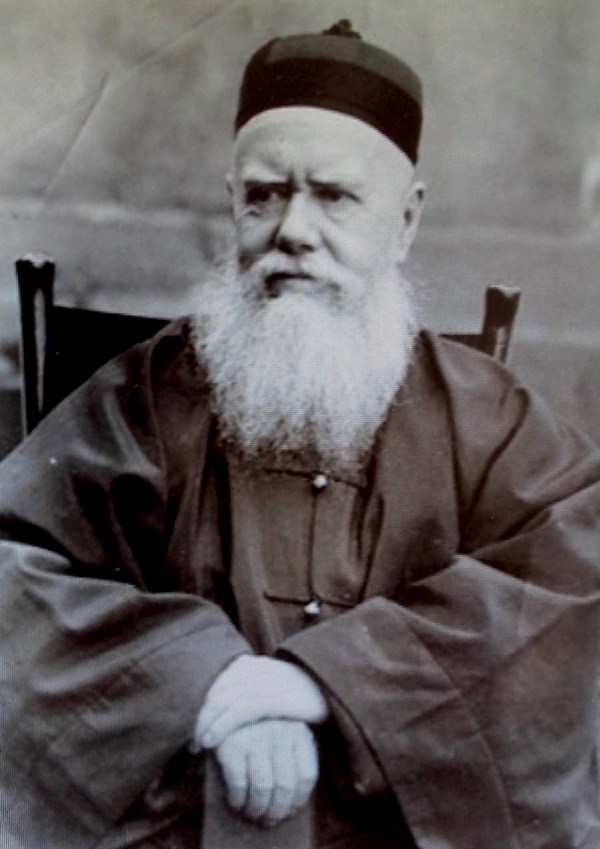
James Hudson Taylor, founder of the China Inland Mission, lived at 30 Coborn St

Dr Barnado lodged in Coborn St in 1866

Coborn Rd Station

Only the entrance of Coborn Rd Station has survived

On this map of the Jewish East End from 1899, blue shading indicates that between 50% and 75% of the residents were Jewish

Harold Steggles’ 1931 painting of Coborn St (courtesy Estate of Harold Steggles)

House on the east side of Coborn St before demolition

Coborn St in the eighties

The last days of Delenco Meat Products

Coborn Motors (established 1960), Coborn Rd
You may also like to take a look at
Alf Rubinstein, The Purse King
Ghost signs expert Sam Roberts tells the forgotten story of Alf Rubinstein, The Purse King, drawing upon the research of Faith Carpenter

It is easy to miss this ghost sign on Stoke Newington Church St, fading up high on a Georgian terrace. Yet – once noticed – it is hard to forget, not least for the faint proclamation of ‘Alf, the Purse King’ under the top two windows on the left. Although he was only present in this building for a few years in the middle of the twenties, Alf Rubinstein enjoyed a successful life in the leather trade with an East End empire that stretched as far afield as Great Yarmouth.
Alf’s story may have been lost to history had he not commissioned this painted sign. He was born around 1876 to Marks and Sarah Rubinstein who had arrived from Poland in the early eighteen-seventies. His birth name was Abraham but he later adopted Alf, a common transition among the Jewish community at that time. In fact, his second wife’s family took a step further, adopting the surname King in honour of the business Alf built.
Marks and Sarah’s young family lived first at Goodmans Fields in Aldgate and then Commercial Rd where, in 1891, Marks was working as a ‘money purse manufacturer.’ He was assisted in this endeavour by a sixteen-year-old Alf and a lodger, the ‘fancy purse cutter,’ Wolf Lipperlitz. By the turn of the century, this cottage industry had expanded and Alf was selling their wares on a stall at Petticoat Lane Market which continued until long after his death in 1941.
Alf married his first wife, Lena, in the last years of the nineteenth century and by 1901 they were living with their two children on Anthony St, near to his parents’ home on Commercial Rd. A year later they set up in an eight-bedroom house on Paradise Row in Bethnal Green where the family eventually grew to seven children. After Lena’s death Alf married again, this time to Ninka, a dancer with whom he had more children, the last of which was Samuel, born in 1934 when Alf was in his late-fifties.
The leather trade suited Alf and he made a great success of it with shops in Brighton, Luton, Sutton, Victoria and Wood Green, in addition to Petticoat Lane. The factory in Stoke Newington was a relatively short-lived affair but the ghost sign references a shop much further away in Great Yarmouth where Alf opened a kosher guesthouse and an outlet selling his leather goods. That shop was managed by his youngest son Samuel well into this century although the premises were destroyed by fire in 2016, four years after Samuel’s death.
Since this last outpost of the firm’s hundred-and-twenty-year history went up in flames five years ago, the faded sign Alf commissioned in the twenties is all that remains as testimony to the family business he built in his father’s footsteps. Alf Rubinstein is eternally the Purse King.

A close-up of the sign

A reconstruction by Roy Reed of how the sign once looked

Alf Rubinstein behind his stall c.1920
You may also like to take a look at


