
Winter At Spitalfields City Farm
On the last day of February, I introduce the first of four features in collaboration with Contributing Photographer Rachel Ferriman, documenting the seasons of the year at Spitalfields City Farm

It was at the end of a long winter that I came to Spitalfields City Farm, the snow had only just thawed and the trees were still barren of leaves. There is a compelling poetry in the unexpected presence of agriculture in the city and it always makes my heart leap to hear animal cries in this urban setting, connecting me to the rural landscape beyond and reminding us how these fields once were before they were built up.
This has been a quiet and lonely winter at the farm without any school groups or visitors during the lockdown but, in spite of this, the life and work of the place goes on with farmhands coming every day, whatever the weather, to tend to their charges both animal and vegetable. Last Christmas, the donkeys did not get to feature in local nativity plays as they usually do, instead this has been a time for the farmhands to concentrate on mundane tasks of maintenance. Thus I felt especially privileged to be let in through the tall gates to visit the farmyard for my report and pay my respects to its inhabitants.
The Spitalfields City Farm is not large, just the size of the small city block between Allen Gardens and Thomas Buxton School to the east of Brick Lane. Yet once inside, it is all encompassing within a maze of pathways leading off between ramshackle sheds and greenhouses to paddocks and ponds where the resident menagerie are to be found. In the hazy distance, the towers of the City of London can be seen piercing the horizon but they recede into irrelevance when viewed from the vegetable garden.
It was the responsibility of Jenny Bettenson, Farmyard Manager, to care for the livestock during the recent cold snap. ‘We had to take buckets and kettles of drinking water to the animals when the temperature dropped below freezing,’ she revealed to me. ‘It got down to minus seven one night – the coldest I have known it in the thirteen years I have been here – so we had to do extra work insulating the animal houses and keeping them draught free. We made sure they had extra hay and extra food. We gave the chickens extra corn because if they have full bellies, they are going to be digesting and creating their own warmth. Some of the older animals have coats, the goats wear winter jackets and the elderly ferrets have heat pads that we put in the microwave to warm them up.’
I was fascinated to learn there is a parallel lockdown going on in the animal kingdom. ‘While we have our pandemic of coronavirus,’ Jenny explained, ‘the ducks and poultry have their own pandemic of avian influenza, brought in by migratory flocks, so we have had to keep our birds under lockdown to protect them. It started in December at the same time as the human lockdown and the government will decide when they are allowed out again, so it really does mirror what’s going on with us. As the season progresses and the migratory birds leave, the risk will go down and the lockdown will be lifted.’
‘It has been tough not having visitors,’ Jenny admitted to me. ‘We are here to educate, to teach students about animal welfare, how to grow plants and mend fences, so we are looking forward to when we can offer those opportunities again. We can’t promise anything, but are hoping to hatch some rare breed chicks for Easter.’
While I am looking forward to spring and the end of lockdown – both human and avian – now I shall also be looking forward to my next visit to the farm to report to you on the progress of the seasons and the arrival of new life.

Distant towers of the City of London beyond

On a snowy morning, Holmes the pig only came out of his warm sty when he heard the voices of the farm team

A goat in a coat

Yurt in the snow

Sweeping the henhouse where the poultry live safe from foxes


Goats munching on Christmas trees


Tanya checking on vegetable seedlings in the polytunnels


Tess winter weeding the polytunnels

Tess harvesting the last of the Kohlrabi


Winter salad leaves – chard, kohlrabi, kale and fennel – aromatic and delicious

Bella the farm cat

Volunteer Yanne digging the manure heap, used in rotation once well rotted

Yanne adding compost to the raised beds in the polytunnels in preparation for sowing seeds

Yanne visits one day a week and volunteers with the team

Gold Sebright hens – the farm champions rare and rescue breeds


Goat keeping an eye on passersby in the farm yard which is quieter without visitors


The sheep in their ‘Worshipful Company of Woolmen’ shelter


Beatrix the one-eared sheep


Holmes the pig is very affectionate and likes to chat with people passing

Photographs copyright © Rachel Ferriman
Support the work of the Spitalfields City Farm
You may also like to read about
Lutfun Hussain, the Coriander Club
Spinach & Eggs from the City Farm
Spires Of City Churches

Spire of St Margaret Pattens designed by Christopher Wren in the medieval style
I took my camera and crossed over Middlesex St from Spitalfields to the City of London. I had been waiting for a suitable day to photograph spires of City churches and my patience was rewarded by the dramatic contrast of strong, low-angled light and deep shadow, with the bonus of showers casting glistening reflections upon the pavements.
Christopher Wren’s churches are the glory of the City and, even though their spires no longer dominate the skyline as they once did, these charismatic edifices are blessed with an enduring presence which sets them apart from the impermanence of the cheap-jack buildings surrounding them. Yet they are invisible, for the most part, to the teeming City workers who come and go in anxious preoccupation, barely raising their eyes to the wonders of Wren’s spires piercing the sky.
My heart leaps when the tightly woven maze of the City streets gives way unexpectedly to reveal one of these architectural marvels. It is an effect magnified when walking in the unrelieved shade of a narrow thoroughfare bounded on either side by high buildings and you lift your gaze to discover a tall spire ascending into the light, and tipped by a gilt weathervane gleaming in sunshine.
While these ancient structures might appear redundant to some, in fact they serve a purpose that was never more vital in this location, as abiding reminders of the existence of human aspiration beyond the material.

In the porch of St James Garlickhythe

St Margaret Pattens viewed from St Mary at Hill

The Monument with St Magnus the Martyr
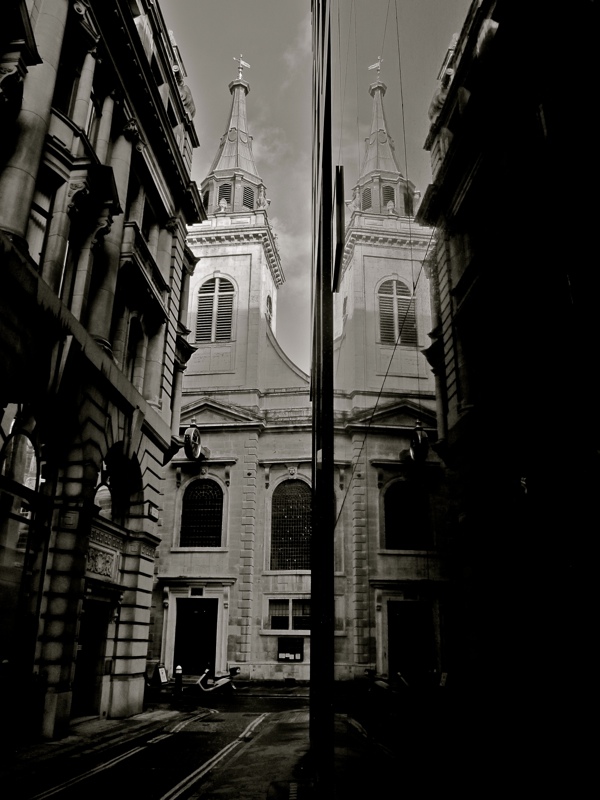
St Edmund, King & Martyr, Lombard St

St Michael Paternoster Royal, College Hill

Wren’s gothic spire for St Mary Aldermary

St Augustine, Watling Street

St Brides, Fleet St

In St Brides churchyard

St Martin, Ludgate

St Sepulchre’s, Snow Hill

St Michael, Cornhill

St Mary Le Bow, Cheapside

St Alban, Wood St

St Mary at Hill, Lovat Lane

St Peter Upon Cornhill

At St James Garlickhythe
You may also like to take a look at
Remembering East End Jewish Bookshops
When I published photographs of the Antiquarian Bookshops of Old London, Paul Shaviv from New York sent me this poignant personal memoir of two celebrated Jewish bookshops

Jacob Nirenstein outside Shapiro, Vallentine in Wentworth St (c.1900)
Of all the bookshops serving the Jewish population of the East End, by the nineteen-sixties only a handful remained. Of those, two in particular were remarkable to me – Cailingold in Old Montague St and Shapiro, Vallentine in Wentworth St.
‘M. L. Cailingold’ was owned by Moshe Leib Cailingold who came from a bookselling family in Warsaw and died in 1967. He arrived in England in 1920 to establish a branch of the family business and opened a tiny shop in Old Montague St, but what few people knew was that opposite the shop he had a narrow, ramshackle, five-storey warehouse which housed his stock. Moshe dealt in rare and scholarly books, maintaining an office at 37 Museum St, where he kept his most valuable items and from where he functioned, too, as Hebraica and Judaica adviser to the British Museum. As he got older, Moshe could no longer negotiate the stairs up to the upper floors of his East End warehouse and the stock lay undisturbed for years.
At the age of twenty-two, Moshe’s daughter, Esther, had gone to Jerusalem to teach English at the Evelina de Rothschild School, headed for years by the legendary Miss Annie Landau, the aunt of Oliver Sacks. Esther was killed fighting in defence of the Old City of Jerusalem during the 1948 Israeli War of Independence and Moshe’s other daughter, Miriam (‘Mimi’) married the distinguished Israeli diplomat and civil servant Yehudah Avner who at one time was Israeli ambassador to London.
So, in June 1967 when Moshe’s health deteriorated, it was his son, Asher, who came to Spitalfields from Israel to care for him. “I returned from the battle on the Golan Heights on June 18th 1967 and soon heard that my dad’s health had taken a turn for the worst,” Asher told me, “and by the end of the month I was in London with my wife and children.”
Moshe Leib Cailingold passed away in August 1967 and, soon after, Asher and a cousin arranged a sale. It was an international event. Before the building was open to the public, it was open for collectors and dealers who flew in from Israel, America and Europe. At the time, I was a young, impecunious university student, just beginning a lifetime’s collecting obsession with Judaica and I knew that by the time the building opened to the public, the best books would be gone – not that I imagined that I would be able to afford any of the rarities, but I wanted the experience of seeing them! So I made my way to the East End and offered to work at the sale, carrying books in return for access to the warehouse. Asher Cailingold agreed and I enjoyed a magical couple of days roaming the warehouse in Old Montague St. I was assigned to individual buyers as they went through the stock and they gave me piles of books to carry down to the bookseller’s son to assess and price.
On the ground floor of the warehouse was a lean-to outhouse which no-one had paid any attention to until the last day of the private sale, when a well-known collector from Manchester asked if anyone knew what was inside it. The contents were a mystery and I was dispatched to find a crowbar to prise open the padlocked door. When we opened the lean-to, it was stacked with books. The collector from Manchester reached inside and snatched one book at random. He opened it, turned to Asher and said, “I’ll buy the whole contents.” The book he held in his hand was a rare antiquarian Hebrew tome printed in Venice and it turned out that the outhouse contained the stock from Moshe’s father’s bookshop in Warsaw, untouched for decades. Although, I could afford to buy only a few ephemeral pamphlets and books, it was a great experience for me.
Osborn St was home to another well-known bookseller and general Judaica store, R. Golub, and across from there was Wentworth St containing the small shopfront of ‘Shapiro, Vallentine’. Shapiro, Vallentine was a publisher and bookseller with roots that went back into the nineteenth century. Originally owned by the Nirenstein family, in 1940 their daughter, Miriam, married a young Russian émigré, Chimen Abramsky, and he took over the store. Chimen, who passed away in 2010 at the age of ninety-three, was an astonishing, if diminutive, personality. He was the son of Rabbi Yechezel Abramsky (1866-1976), one of the great Talmudical scholars and Jewish legal authorities of the twentieth century, and in the thirties the rabbi of the great ‘Machzike Hadass’ (“Upholders of the Faith”) synagogue on the corner of Brick Lane and Fournier St – which, famously, had been built as a Huguenot Chapel, became a synagogue and is now a mosque.
Although Chimen greatly respected his father, he did not share his beliefs and was a dedicated Communist until after 1956. His life story and his twin bibliophilic obsessions of Marxism and Judaica have become the subject of a recent biography written by his grandson, Sasha Abramsky, entitled ‘The House of Twenty Thousand Books.’
Shapiro, Vallentine was a trove of scholarly, academic and rare Judaica and rare, left-wing and radical literature and ephemera. Chimen knew his subject and served for years as Sotheby’s consultant and expert on Judaica and Hebraica, and later as adviser to Jack Lunzer who created the Valmadonna Trust collection. Eventually, Chimen closed the shop in the late sixties when he was appointed to the faculty of University College, London, later becoming Professor of Jewish Studies. As a leading theoretician of the London Left, an expert on Marx and Marxism, and on Jewish history, Chimen had a brilliant, polymathic mind, and an encyclopedic knowledge of books, printing, and manuscripts. He and his wife Miriam had two children – Jack, a mathematician and their daughter, the distinguished cultural figure, Dame Jenny Abramsky, formerly of the BBC.
Let me conclude by acknowledging my own East End roots – my late father grew up between the wars, in poverty, in the tenements of Thrawl St in Spitalfields. When I was a child, he used to take me occasionally on a sentimental excursion “down the Lane” on Sunday mornings and show me where he had been brought up, and the Machzike Hadass synagogue where his family attended. We always stopped at Marks delicatessen or Barnett’s, for kosher delights or pickled cucumbers, and to shake hands with ‘Prince Monolulu’. My father belonged to a vanished East End. He died young, at only forty-nine years old, in 1968 – as they say, “May his memory be for a blessing.”

Chimen Abramsky of Shapiro, Vallentine
Photos courtesy Abramsky Family Archive
You may also like to take a look at
Alan Dein’s East End Shopfronts
List Of Local Shops Open For Business

This is the list of essential shops that are open in Spitalfields and vicinity during the current lockdown. Readers are especially encouraged to support small independent businesses who offer an invaluable service to the community. This list confirms that it is possible to source all essential supplies locally without recourse to supermarkets.
Be advised many shops are operating limited opening hours at present, so I recommend you call in advance to avoid risking a wasted journey. Please send any additions or amendments for next week’s list to spitalfieldslife@gmail.com
This week’s photographs are by Phil Maxwell.

GROCERS & FOOD SHOPS
The Albion, 2/4 Boundary St
Ali’s Mini Superstore, 50d Greatorex St
AM2PM, 210 Brick Lane
Planet Organic, 132 Commercial St
Banglatown Cash & Carry, 67 Hanbury St
Breid Bakery, Arch 72, Dunbridge St
Brick Lane Minimarket, 100 Brick Lane
The Butchery Ltd, 6a Lamb St
City Supermarket, 10 Quaker St
Costprice Minimarket, 41 Brick Lane
Faizah Minimarket, 2 Old Montague St
JB Foodstore, 97 Brick Lane
Haajang’s Corner, 78 Wentworth St
Leila’s Shop, 17 Calvert Avenue
Nisa Local, 92 Whitechapel High St
Pavilion Bakery, 130 Columbia Rd
Rinkoff’s Bakery, 224 Jubilee Street & 79 Vallance Rd
St John Bread & Wine, 94-96 Commercial St (Fridays & Saturdays 11-5pm)
Sylhet Sweet Shop, 109 Hanbury St
Taj Stores, 112 Brick Lane
Zaman Brothers, Fish & Meat Bazaar, 19 Brick Lane

TAKE AWAY FOOD SHOPS
Before you order from a delivery app, why not call the take away or restaurant direct?
Absurd Bird Fried Chicken, 54 Commercial St
Al Badam Fried Chicken, 37 Brick Lane
Allpress Coffee, 58 Redchurch St
The Association, 10-12 Creechurch Lane
Band of Burgers, 22 Osborn St
Beef & Birds, Brick Lane
Beigel Bake, 159 Brick Lane
Beigel Shop, 155 Brick Lane
Bellboi Coffee, 104 Sclater St
Bengal Village, 75 Brick Lane
Big Moe’s Diner, 95 Whitechapel High St
Burro E Salvia Pastificio, 52 Redchurch St
Cafe 388, 388 Bethnal Green Rd
China Feng, 43 Commercial St
Circle & Slice Pizza, 11 Whitechapel Rd
Crosstown Doughnuts, 157 Brick Lane
Dark Sugars, 45a Hanbury St (Take away ice cream and deliveries of chocolate)
Donburi & Co, Korean & Japanese, 13 Artillery Passage
Eastern Eye Balti House, 63a Brick Lane
Enso Thai & Japanese, 94 Brick Lane
Exmouth Coffee Shop, 83 Whitechapel High St
Grounded Coffee Shop, 9 Whitechapel Rd
Holy Shot Coffee, 155 Bethnal Green Rd
Hotbox Smoked Meats, 46-48 Commercial St
Jack The Chipper, 74 Whitechapel High St
Jonestown Coffee, 215 Bethnal Green Rd
Laboratorio Pizza, 79 Brick Lane
La Cucina, 96 Brick Lane
Leon, 3 Crispin Place, Spitalfields Market
Madhubon Sweets, 42 Brick Lane
Mooshies Vegan Burgers, 104 Brick Lane
Nude Expresso, The Roastery, 25 Hanbury St
E. Pellicci, 332 Bethnal Green Rd
Pepe’s Peri Peri, 82 Brick Lane
Peter’s Cafe, 73 Aldgate High St
Picky Wops Vegan Pizza, 53 Brick Lane
Polo Bar, 176 Bishopsgate
Poppies, 6-8 Hanbury St
Quaker St Cafe, 10 Quaker St
Rajmahal Sweets, 57 Brick Lane
Rosa’s Thai Cafe, 12 Hanbury St
Shawarma Lebanese, 84 Brick Lane
Shoreditch Fish & Chips, 117 Redchurch St
Sichuan Folk, 32 Hanbury St
String Ray Globe Cafe, 109 Columbia Road
Sushi Show, 136 Bethnal Green Rd
Vegan Yes, Italian & Thai Fusion, 64 Brick Lane
The Watch House, 139 Commercial St
White Horse Kebab, 336 Bethnal Green Rd
Yuriko Sushi & Bento, 48 Brick Lane

OTHER SHOPS & SERVICES
Brick Lane Bookshop, 166 Brick Lane (Books ordered by phone or email are delivered free locally)
Brick Lane Bikes, 118 Bethnal Green Rd
Day Lewis Pharmacy, 14 Old Montague St
E1 Cycles, 4 Commercial St
Eden Floral Designs, 10 Wentworth St (Order fresh flowers online for free delivery)
Flashback Records, 131 Bethnal Green Rd (Order records online for delivery)
GH Cityprint, 58-60 Middlesex St
Harry Brand, 122 Columbia Road (Order gifts online for delivery)
Leyland Hardware, 2-4 Great Eastern St
Newman’s Stationery, 324 Bethnal Green Rd (Call for local delivery)
Post Office, 160a Brick Lane
Rose Locksmith & DIY, 149 Bethnal Green Rd
Sid’s DIY, 2 Commercial St

ELSEWHERE
E1 Dry Cleaners, Cannon Street Rd, E1 2LY
E5 Bakehouse, Arch 395, Mentmore Terrace, London Fields (Customers are encouraged to order online and collect in person)
Gardners Market Sundriesmen, 78 Ruckholt Road (Order by phone)
Gold Star Dry Cleaning & Laundry, 330 Burdett Rd
Hackney Essentials, 235 Victoria Park Rd
Quality Dry Cleaners, 16a White Church Lane
Newham Books, 747 Barking Rd (Books ordered by phone or email are posted out)
Old Bank Vault Gallery, 283 Hackney Rd (Order online)
Rajboy, 564 Commercial Rd, E14 7JD (Take away service available)
Region Choice Chemist, 68 Cambridge Heath Rd
Symposium Italian Restaurant, 363 Roman Road (Take away service available)
Thompsons DIY, 442-444 Roman Rd

Images copyright © Phil Maxwell
You may also like to take a look at
Adam Dant’s London Squares
As an antidote to the current loneliness of the empty streets, Adam Dant sent me these drawings of celebrated London squares teeming with life.

Click to enlarge and explore Soho Square
If any part of London is entitled to bandy around the phrase ‘… has a reputation for…’ it is probably Soho. Beyond its reputation for vice and debauchery, it has many other reputations to uphold, some of which are embodied here in living form at its apex in Soho Square.
At the time this panorama was created, Soho Square was the biggest, noisiest, most disruptive construction site in London. Crossrail was busy demolishing, excavating and tramping mud through all through Theatreland to build the Elizabeth Line. Meanwhile, Berwick Street Market was being eviscerated by high-end apartments.
Those responsible for Soho’s ‘seedy’ reputation – the addicts, sex-workers, tooth-picking pimps, louche club proprietors, as well as the occasional artist, devotee of Hare Krishna and terrified-looking tourist – continued to scamper around the raucous rat run of Soho’s streets during all these ‘renovations,’ in search of illicit pleasures still to be found at every corner.

Click to enlarge and explore Leicester Sq
‘There is nothing a Londoner relishes more than spending a spare hour or two whiling away time in their beloved Leicester Square’ is a statement somewhere near the top of that famous list of lies to tell tourists about London.
Aside from scurrying at pace to lunch at The Beefsteak, or (when it was still there) picking up ski passes for Val d’Isère from the Swiss Centre, the sticky, gum-spotted, tallow-fumed, Puffa jacket congested environs of Hogarth’s former residence are no more than a convenient cut through from the bookshops of Piccadilly to the bookshops of Cecil Court.
Many of the reasons for this state of affairs are depicted here in a view from the south-east corner, where at the famous Ticket Booth one can snaffle cut-price seats to be entertained by serious actors singing whilst dressed in big furry cat suits or else eulogising their slutty youth through the medium of song and dance on the quayside of a Greek fishing village.
As a curriculum of what is on offer to dislike about the world in general, Leicester Square goes all the way past PhD level, ranging from trivial annoyances such as… people standing vacantly in the way, the reek of burning sucrose, pepperoni slices in your path, being mistaken for a tourist, cellophane-wrapped single rosebuds, the eternally tiresome phenomena of gambling as a supposedly glamorous pursuit, vexatious religious press gangs, cooked-from-frozen short-order pasta, and portraiture in which the sitter will always look like Leonardo deCaprio.
The dubious reputation of Leicester Square in this sense may be part of a continuum as the location of dubious activities throughout history, such as being the best site to conduct a duel, being a de-facto rubbish dump during a bin men’s strike, and hosting the premieres of Tom Cruise movies.
Viewed from the terrace of your luxury Theatreland Citybreak hotel – as in my picture – the scene may have you opting for a round of special lychee-daiquiris to enjoy a pleasant night watching the action from afar, unlike the average Londoner who must wade through this awful fray while pretending that none of it is even happening.

Click to enlarge and explore Berkeley Square
The salubrious plains of Berkeley Square are best viewed in this panorama from south to north, as if from the prestigious Lansdowne House, whose gardens would have provided the original prospect of this perennially desirable London address.
On the west side, a ‘nameless thing’ closely resembling some kind of octopus by those who have had the misfortune of encountering this resident of London’s most haunted building, slithers from the doorway of the former HQ of Maggs’ bookshop. Young rakes who have accepted the challenge of staying in the house overnight as a wager have been discovered in the morning, dead from heart failure.
Further north, the latest incarnation of Annabel’s, the super-trendy hangout for the nouveaux riche, Ukranian asset managers wives, the O.P.M wranglers and the generally ‘leisured louche,’ is guarded by liveried doormen in ‘peaky blinder’ flat caps and the lurid tweeds of celebrity ‘ratters.’
Speeding round the corner to Farm St is an e-type jag from the recent ‘Man from Uncle,’ no doubt en route to Guy Ritchie’s pub ‘The Punchbowl.’ Shops on Mount Street are indicated by their products on the street corner, such as a Porsche outside their dealership and a fountain pen and envelope for ‘Mount Street Stationers’ .
On the north side is Phillip’s auction house who are hosting a sale of Barry Flanagan’s hare sculptures, which a couple of porters are having trouble coaxing through the big glass doors. Next door is Morton’s, the private club most famously patronised by the dashing early lovers of speed and the internal combustion engine, where two ‘Bentley Boys’ vehicles are parked outside.
The south end of the square is where the locals leave their rubbish for collection, this is comprised of a skip full of unwanted banknotes and a couple of wheelie bins labelled for surplus sushi.
Inside the square, care-worn by retail therapy on Bond Street or striving for wealth creation in the Georgian townhouses of Curzon Street, the Berkeley Square types depicted in the border of the map relax and enjoy the arts committee’s sculptural offerings, including the return of the equine statue of George lll as Marcus Aurelius. It had been removed when, due to faulty bronze casting, the legs of the horse started to bow.
The two elegantly-clad ladies from the thirties entering the gates on the south side have stepped straight out of a painting of the square by Stanislawa De Karlowska. Their presence is redolent of more genteel times in Mayfair as captured in the song which made it famous throughout the world and, hanging on the railings is a poster for “A Nightingale Sang in Berkeley Square’ as performed tonight by Judy Campbell” (muse of Noel Coward and mother of Jane Birkin).

Click to enlarge and explore St James’ s Square
Unlike many other public squares in London, St James’s Square is in possession of a certain aloof, upper crust aura in keeping with the private finance offices and gentlemen’s clubs that hide behind its well attended facades.
Dirty, smelly dogs are no more permitted into the gardens here than they would be in The London Library, The East India Club or the headquarters of British Petroleum, although my own dog is welcomed as a regular visitor at the nearby Christie’s auction house, possibly by dint of his diminutive size, impeccable manners and Scottish heritage.
Whilst sketching from a bench in the square beneath the statue of King William III, I noticed that not very much appeared to be going on in this square. Such an atmosphere of restraint in a public arena prompts all manner of fanciful notions as to the real identities, activities and motivations of passers-by. Much in the same vein as a novel by London Library habitué Grahame Greene, visitors to St James’s square assume the mantle of the Russian spy visiting a dead letterbox, the covert couple conducting an illicit love affair or the minor royal jogging incognito. The real action here has to be invented as nobody is giving anything away.
Secrecy is the order of the day at The Royal Institute of International Affairs, better known as Chatham House whose famous ‘Chatham House Rules’ guarantee speakers at their events the requisite anonymity to encourage the sharing of sensitive information. Until recently, the church of Rome managed to keep their ownership of a handsome townhouse in the square under wraps, having purchased it with money from Mussolini.
It is in the same spirit that this topographical depiction of the square prompts the viewer to speculate as to the general goings-on of the characters portrayed and animate their stories, according to the roster of St James’s ‘types’ shown around the border.

Click to enlarge and explore Sloane Square
Within seconds of exiting Sloane Square Underground Station, one will be able to spot a group of impossibly tall girls, a pack of over-groomed, small yappy dogs, an elderly gent in flaming red corduroy trousers, or all three, and many more ‘types’ who circle this trottoir of London’s beau monde daily.
In Sloane Square, everything appears to happen on cue, as if all were part of a deftly-choreographed Mary Poppins type movie number. It feels like a slightly cosmetic, faux-nostalgic, self-conscious spectacle, and is best viewed from the terrace of Cafe Colbert with a kir and a notebook.
The denizens of the most expensive postcode whom we ogle in the glossy advertorial pages of How to Spend It or the Tatler, are less Made in Chelsea more ‘Made for Chelsea.’

Click to enlarge and explore Hoxton Square
Whether you celebrate it as an exuberant libertarian paradise or whether you condemn it as the nadir of unpleasantness is a matter of mere opinion, but there is no doubt that in recent years Hoxton Square has become a phenomenon – a crowded playground where those who so desire are may lose their inhibitions and their wallets with ease.
Hoxton Square is the East End’s Garden of Earthly Delights, peopled with Dog Walkers, Art Collectors, Art World Dilettantes, Art Dealers, Haircuts, Cycle Couriers, Trustafarians, Hen/Stag Nights, Estate Ped-Heads, Bengali Boys, Postcode Gangstas, Shrouded Girls, Eccentric Designers, Foreign Students, Smartphone Addicts, Vertical Drinkers, Light Industry Dregs, VVV Stupid Fashions, Scruffy Journos, Graffiti Tourists, Lost Travellodgers, Italian Anarchists, Polish Labourers, Polish Benchdwellers, Homeless/Drugs, Homeless/Dogowners, Homeless/Chirpy, Hoxton Elderly, Fast Food Barons, Hippy Circus Parents, Shh! Lesbians, Brooklyn Hipsters, Tribally Tattooed Folk, Out of Place Parents, Trashy Waitresses, A.D.D. Children, Ladettes, Japanese Stylists, Drunk Bankers, General Dickheads, Clowns, Sanctioned Graffitists, Fixi Bores, Rentokill Workers, Ukranian Pole Dancers, Strip Club Patrons, Media Nodes, Screwtop Rosé Girls, Interns, Coffee Bores, BBC Drama Shoot Participants, Tamagotchi Billionaires, Fashion Shoots, Nigerian Shoe Vendors, Incongruous Joggers, Plain Clothes Cops, Fried Food Schoolkids, Flash Restaurateurs, Pissers, Sterodial Bouncers, Flower Shoppers, Sticky Tape Artists, Performance Artists, Tai Chi Beginners, Architecture Students, Council Planning Officers, Bicycle Thieves, Drugs Vendors – and Joseph Markovitch, and Martin Usborne and his dog Moose.

CLICK TO ORDER A COPY OF MAPS OF LONDON & BEYOND
Adam Dant’s MAPS OF LONDON & BEYOND is a mighty monograph collecting together all your favourite works by Spitalfields Life‘s Contributing Cartographer in a beautiful big hardback book.
Including a map of London riots, the locations of early coffee houses and a colourful depiction of slang through the centuries, Adam Dant’s vision of city life and our prevailing obsessions with money, power and the pursuit of pleasure may genuinely be described as ‘Hogarthian.’
Unparalleled in his draughtsmanship and inventiveness, Adam Dant explores the byways of London’s cultural history in his ingenious drawings, annotated with erudite commentary and offering hours of fascination for the curious.
The book includes an extensive interview with Adam Dant by The Gentle Author.
Adam Dant’s limited edition prints are available to purchase through TAG Fine Arts
Costume Of The Lower Orders Of The Metropolis
Now the streets are empty of people, I can more easily imagine the presence of those from the past who passed through these same spaces long ago. In these circumstances, it would not entirely surprise me to encounter one of Thomas Lord Busby’s pedlars from 1820 upon my daily walk through the deserted city.


Images courtesy Getty Research Institute
You may also like to take a look at
Vanishing London

Four Swans, Bishopsgate, photographed by William Strudwick & demolished 1873
In 1906, F G Hilton Price, Vice President of the London Topographical Society opened his speech to the members at the annual meeting with these words – ‘We are all familiar with the hackneyed expression ‘Vanishing London’ but it is nevertheless an appropriate one for – as a matter of fact – there is very little remaining in the City which might be called old London … During the last sixty years or more there have been enormous changes, the topography has been altered to a considerable extent, and London has been practically rebuilt.’
These photographs are selected from volumes of the Society’s ‘London Topographic Record,’ published between 1900 and 1939, which adopted the melancholy duty of recording notable old buildings as they were demolished in the capital. Yet even this lamentable catalogue of loss exists in blithe innocence of the London Blitz that was to come.

Bell Yard, Fleet St, photographed by William Strudwick

Pope’s House, Plough Court, Lombard St, photographed by William Strudwick

Lambeth High St photographed by William Strudwick

Peter’s Lane, Smithfield, photographed by William Strudwick

Millbank Suspension Bridge & Wharves, August 1906, photographed by Walter L Spiers

54 & 55 Lincoln’s Inn Fields and the archway leading into Sardinia St, demolished 1912, photographed by Walter L Spiers

Sardinian Chapel, Lincoln’s Inn Fields, August 1906, demolished 1908, photographed by Walter L Spiers

Archway leading into Great Scotland Yard and 1 Whitehall, September 1903, photographed by Walter L Spiers

New Inn, Strand, June 1889, photographed by Ernest G Spiers

Nevill’s Court’s, Fetter Lane, March 1910, demolished 1911, photographed by Walter L Spiers

14 & 15 Nevill’s Court, Fetter Lane, demolished 1911

The Old Dick Whittington, Cloth Fair, April 1898, photographed by Walter L Spiers

Bartholomew Close, August 1904, photographed by Walter L Spiers

Williamson’s Hotel, New Court, City of London

Raquet Court, Fleet St

Collingwood St, Blackfriars Rd

Old Houses, North side of the Strand

Courtyard of 32 Botolph Lane, April 1905, demolished 1906, photographed by Walter L Spiers

32 Botolph Lane, April 1905, demolished 1906, photographed by Walter L Spiers

Bird in Hand, Long Acre

Houses in Millbank St, September 1903, photographed by Walter L Spiers

Door to Cardinal Wolsey’s Wine Cellar, Board of Trade Offices, 7 Whitehall Gardens

Old Smithy, Bell St, Edgware Rd, demolished by Baker St & Edgware Railway

Architectural Museum, Cannon Row, Westminster
Images courtesy Bishopsgate Insitute
You may also like to look at


