
In Old Bow

Mid-ninenteenth century Gothic Cottages in Wellington Way
Taking advantage of the spring sunshine, Antiquarian Philip Mernick led me on a stroll around the parishes of Bromley and Bow last week so that I might photograph just a few of the hidden wonders alongside the more obvious sights.
Edward II granted land to build the chapel in the middle of the road at Bow in 1320 but the nearby Priory of St Leonard’s in Bromley was founded three centuries earlier. These ecclesiastical institutions were the defining landmarks of the villages of Bromley and Bow until both were absorbed into the expanding East End, and the precise locations of these lost territories became a subject of unending debate for residents. More recently, this was the location of the Bryant & May factory where the Match Girls won landmark victories for workers’ rights in manufacturing industry and where many important Suffragette battles were literally fought on the streets, outside Bow Rd Police Station and in Tomlin’s Grove.
Yet none of this history is immediately apparent when you arrive at the handsome tiled Bow Rd Station and walk out to confront the traffic flying by. In the nineteenth century, Bow was laced with an elaborate web of railway lines which thread the streets to this day and wove the ancient villages of Bromley and Bow inextricably into the modern metropolis.

Bow Rd Station opened in 1902

Bow Rd Station with Wellington Buildings towering over

Wellington Buildings 1900, Wellington Way

Wellington Buildings

Suffragette Minnie Lansbury was imprisoned in Holloway and died at the age of thirty-two

Eighteen-twenties terrace in Bow Rd

Bow Rd

Bow Rd

Bow Rd Police Station 1902

Under the railway arches in Arnold Rd

The former Great Eastern Railway Station and Little Driver pub, both 1879

This house in Campbell Rd was built one room thick to fit between the railway and the road

Arnold Rd once extended beyond the railway line

Arnold Rd

Former Poplar Electricity Generating Station

Railway Bridge leading to the ‘Bow Triangle’

In the ‘Bow Triangle,’ an area surrounded on three sides by railway lines

Handsome nineteenth century villas for City workers in Mornington Grove

Former coach house in Mornington Grove

Bollard of Limehouse Poor Commission 1836 in Kitcat Terrace

Last fragment of Bow North London Railway Station in the Enterprise Rental car park

Edward II gave the land for this chapel of ease in 1320

In the former Bromley Town Hall, 1880

Former Bow Co-operative Society in Bow Rd, 1919

The site of St Leonard’s Priory founded in the eleventh century and believed to have been the origin of Chaucer’s Prioress in the ‘Canterbury Tales’ – now ‘St Leonard’s Adventurous Playground’

Kingsley Hall where Mahatma Ghandi stayed when he visited the East End in 1931

Arch by William Kent (c. 1750) removed from Northumberland House on the Embankment in 1900

Draper’s Almshouses built in 1706 to deliver twelve residences for the poor

The refurbished Crossways Estate, scene of recent alleged election skullduggery
You may also like to take a look at
Viscountess Boudica’s Easter
On Easter Monday, we celebrate our dearly beloved Viscountess Boudica of Bethnal Green who once entertained us with her seasonal frolics and capers but is now exiled to Uttoxeter

She may be no Spring chicken but that never stopped the indefatigable Viscountess Boudica of Bethnal Green from dressing up as an Easter chick!
As is her custom at each of the festivals which mark our passage through the year, she embraced the spirit of the occasion wholeheartedly – festooning her tiny flat with seasonal decor and contriving a special outfit for herself that suited the tenor of the day. “Easter’s about renewal – birth, life and death – the end of one thing and the beginning of another,” she assured me when I arrived, getting right to the heart of it at once with characteristic forthrightness.
I felt like a child visiting a beloved grandmother or favourite aunt whenever I call round to see Viscountess Boudica because, although I never knew what treats lie in store, I was never disappointed. Even as I walked in the door, I knew that days of preparation preceded my visit. Naturally for Easter there were a great many fluffy creatures in evidence, ducks and rabbits recalling her rural childhood. “When my uncle had his farm, I used to put the little chicks in my pocket and carry them round with me,” she confided with a nostalgic grin, as she led me over to admire the wonder of her Easter garden where yellow creatures of varying sizes were gathering upon a small mat of greengrocer’s grass, around a tree hung with glass eggs, as if in expectation of a sacred ritual.
I cast my eyes around at the plethora of Easter cards, testifying to the popularity of the Viscountess, and her Easter bunting and Easter fairy lights that adorned the walls. There could be no question that the festival was anything other than Easter in this place. “As a child, I used to get a twig and spray it with paint and hang eggs from it,” she explained, recalling the modest origin of the current extravaganza and adding, “I hope this will inspire others to decorate their homes.”
“Cadbury’s Dairy Milk is my favourite,” she confessed to me, chuckling in excited anticipation and patting her waistline warily, “I probably will eat a lot of chocolate on Easter Monday – once I start eating chocolate, I can’t stop.” And then, just like that beloved grandmother or favourite aunt, Viscountess Boudica kindly slipped a chocolate egg into my hands, as I said my farewell and carried it off under my arm back to Spitalfields as a proud trophy of the day.


Viscountess Boudica writes her Easter cards


“yellow creatures of varying sizes were gathering upon a small mat of greengrocer’s grass, around a tree hung with glass eggs, as if in expectation of a sacred ritual”

Viscountess Boudica turns Weather Girl to present the forecast for the Easter Bank Holiday – “I predict a dull start with a few patches of sunshine and some isolated showers. In the West Country, it will be nice all day with temperatures between sixty and eighty degrees Farenheit. There will be a small breeze on the coast and sea temperature of around fifty-nine degrees Farenheit.”


Easter blessings to you from Viscountess Boudica!

Viscountess Boudica and her fluffy friends
Be sure to follow Viscountess Boudica’s blog There’s More To Life Than Heaven & Earth
Take a look at
The Departure of Viscountess Boudica
Viscountess Boudica’s Domestic Appliances
Viscountess Boudica’s Halloween
Viscountess Boudica’s Christmas
Viscountess Boudica’s Valentine’s Day
Viscountess Boudica’s St Patrick’s Day
Read my original profile of Mark Petty, Trendsetter
and take a look at Mark Petty’s Multicoloured Coats
Bluebells At Bow Cemetery

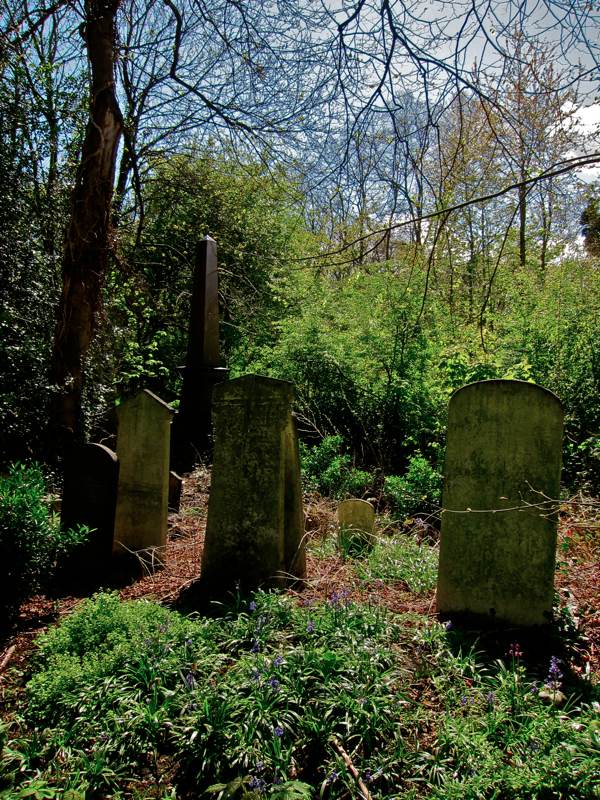
With a few bluebells in flower in my garden in Spitalfields, I was inspired make a visit to Bow Cemetery and view the display of bluebells sprouting under the tall forest canopy that has grown over the graves of the numberless East Enders buried there. In each season of the the year, this hallowed ground offers me an arcadian refuge from the city streets and my spirits always lift as I pass between the ancient brick walls that enclose it, setting out to lose myself among the winding paths, lined by tombstones and overarched with trees.
Equivocal weather rendered the timing of my trip as a gamble, and I was at the mercy of chance whether I should get there and back in sunshine. Yet I tried to hedge my bets by setting out after a shower and walking quickly down the Whitechapel Rd beneath a blue sky of small fast-moving clouds – though, even as I reached Mile End, a dark thunderhead came eastwards from the City casting gloom upon the land. It was too late to retrace my steps and instead I unfurled my umbrella in the cemetery as the first raindrops fell, taking shelter under a horse chestnut, newly in leaf, as the shower became a downpour.
Standing beneath the dripping tree in the half-light of the storm, I took a survey of the wildflowers around me, primroses spangling the green, the white star-like stitchwort adorning graves, a scattering of palest pink ladies smock highlighting the ground cover, yellow celandines sharp and bright against the dark green leaves, violets and wild strawberries nestling close to the earth and may blossom and cherry blossom up above – and, of course, the bluebells’ hazy azure mist shimmering between the lines of stones tilting at irregular angles. Alone beneath the umbrella under the tree in the heart of the vast graveyard, I waited. It was the place of death, but all around me there was new growth.
Once the rain relented sufficiently for me to leave my shelter, I turned towards the entrance in acceptance that my visit was curtailed. The pungent aroma of wild garlic filled the damp air. But then – demonstrating the quick-changing weather that is characteristic of April – the clouds were gone and dazzling sunshine descended in shafts through the forest canopy turning the wet leaves into a million tiny mirrors, reflecting light in a vision of phantasmagoric luminosity. Each fresh leaf and petal and branch glowed with intense colour after the rain. I stood still and cast my eyes around to absorb every detail in this sacred place. It was a moment of recognition that has recurred throughout my life, the awe-inspiring rush of growth of plant life in England in spring.




You may also like to read about
Find out more at www.towerhamletscemetery.org
Easter Procession In Stepney
Bookings are open until the end of May: www.thegentleauthorstours.com

Every Easter, George & Dunstan, donkeys at Stepney City Farm enjoy an outing when they join the Parishioners of St Dunstan’s for the annual procession around the vicinity on Palm Sunday – and, one year, Contributing Photographer Colin O’Brien & I joined the enthusiastic throng on a cold and grey spring morning.
Walking down from Whitechapel, Colin & I followed Stepney Way, which was once a path across the fields used by worshippers when St Dunstan’s was the parish church for the whole of Tower Hamlets. St Dunstan founded it in 952 and it stands today as earliest surviving building after the Tower on this side of London.
At the old stone church, we discovered the wardens were eager to show us their ancient silver, a mace and a staff, with images of St Dunstan, the Tower and a Galleon referring to the days when this was the parish of seafarers. Once, all those who were born or died at sea were entered here in the parish register.
Curate Chris Morgan led off across the churchyard along the fine avenue of plane trees, swinging incense and followed by church wardens, sidesmen, George & Dunstan the donkeys, members of the parish and a solo trumpeter, with the Rector Trevor Critchlow bringing up the rear.
Anyone still nursing a hangover from Saturday night might have been astounded to be awoken by the sound of a heavenly host, and parted the curtains to discover this rag tag parade. Yet it was a serious commemoration of Christ’s entry into Jerusalem in which the streets of Stepney became transformed into the Via Sacra for a morning.
They marched through the empty terraced streets, past the large development site, turned left at the curry restaurant, passing the pizza takeaway and the beauty parlour, before turning left again at the youth centre to re-enter the churchyard. Then there was just time to pet the donkeys before they filed into the church to warm up again and begin Sunday morning prayers. And this was how Easter began in Stepney.

St Dunstan with his metalworkers’ tongs on top of the seventeenth century mace

A galleon upon an eighteenth century staff is a reminder St Dunstan’s was the parish of seafarers

Tower of London upon the reverse of the staff

Sidesmens’ batons from the era of George IV

Julian Cass, Sidesman

Jenny Ellwood, Sidesperson, and Sarah Smith, Parish Clerk

Trevor Critchlow, Rector of St Dunstan’s


Curate Chris Morgan leads the procession


Photographs copyright © Estate of Colin O’Brien
You may also like to read about
Nativity Procession In Spitalfields
Easter Flowers At St Dunstan’s
Tony Bock’s East Enders

Clock Winder at Christ Church, Spitalfields
Here are the East Enders of the nineteen seventies as pictured by photographer Tony Bock in the days when he worked for the East London Advertiser – the poncy dignitaries, the comb-over tories, the kids on the street, the market porters, the fascists, the anti-fascists, the shopkeepers, the sheet metal workers, the unions, the management, the lone dancers, the Saturday shoppers, the Saturday drinkers, the loving family, the West Ham supporters, the late bride, the wedding photographer, the clock winder, the Guinness tippler, the solitary clown, the kneeling politician and the pie & mash shop cat.
Welcome to the teeming masses. Welcome to the infinite variety of life. Welcome to the exuberant clear-eyed vision of Tony Bock. Welcome to the East End of fifty years ago.

Dignitaries await the arrival of the Queen Mother at Toynbee Hall. John Profumo kneels.

Children playing on the street in Poplar.

On the steps of St Paul’s Cathedral.

National Front supporters gather at Brick Lane.

Watching a National Front march in Hackney.

Shopkeepers come out to watch an anti-racism march in Hackney.

A family in Stratford pose in their back yard.

Wedding photographer in Hackney – the couple had been engaged many years.

West Ham fans at Upton Park, not a woman to be seen.

Sports club awards night in Hackney.

Dancers in Victoria Park.

Conservative party workers in the 1974 electoral campaign, Ilford.

Ted Heath campaigns in Ilford for the General Election of 1974.

Ford workers union meeting, Dagenham.

Ford managers, Dagenham.

Press operator at Ford plant, Dagenham.

At Speakers’ Corner, Hyde Park.

Mr East End Contest at E1 Festival.

The shop cat at Kelly’s Pie & Mash Shop, Bethnal Green Rd.

At the White Swan in Poplar.

Enjoying a Guinness in the Royal Oak, Bethnal Green.

Boy on demolition site, Tiller Rd, Isle of Dogs.

Brick Lane Sunday Market.

Clown in Stratford Broadway.

Saturday morning at Roman Rd Market.

Saturday night out in Dagenham.

Spitalfields Market porter in the workers’ club
Photographs copyright © Tony Bock
You may like to see these other photographs by Tony Bock
The Ceremony Of The Widow’s Sixpence

While my tours start tomorrow afternoon in Spitalfields at 2pm, over in Smithfield tomorrow morning at 11:30am hot cross buns will be distributed at St Bartholomew the Great.

Distribution of buns to widows in the churchyard of St Bartholomew the Great
St Bartholomew the Great is one of my favourite churches in the City, a rare survivor of the Great Fire, it boasts the best Norman interior in London. Composed of ancient rough-hewn stonework, riven with deep shadow where feint daylight barely illuminates the accumulated dust of ages, this is one of those rare atmospheric places where you can still get a sense of the medieval world glimmering. Founded by Rahere in 1123, the current structure is the last vestige of an Augustinian Priory upon the edge of Smithfield, where once martyrs were burnt at the stake as public entertainment and the notorious St Bartholomew Fair was celebrated each summer from 1133 until 1855.
In such a location, the Good Friday tradition of the distribution of charity in the churchyard to poor widows of the parish sits naturally. Once known as the ‘Widow’s Sixpence,’ this custom was institutionalised by Joshua Butterworth in 1887, who created a trust in his name with an investment of twenty-one pounds and ten shillings. The declaration of the trust states its purpose thus – “On Good Friday in each year to distribute in the churchyard of St. Bartholomew the Great the sum of 6d. to twenty-one poor widows, and to expend the remainder of such dividends in buns to be given to children attending such distribution, and he desired that the Charity intended to be thereby created should be called ‘the Butterworth Charity.'”
Those of use who gathered at St Bartholomew the Great on the Good Friday I visited were blessed with sunlight to ameliorate the chill as we shivered in the churchyard. Yet we could not resist a twinge of envy for the clerics in their heavy cassocks and warm velvet capes as they processed from the church in a formal column, with priests at the head attended by vergers bearing wicker baskets of freshly buttered Hot Cross Buns, and a full choir bringing up the rear.
In the nineteen twenties, the sum distributed to each recipient was increased to two shillings and sixpence, and later to four shillings. Resplendent in his scarlet robes, Rev Martin Dudley, Rector of St Bartholomew the Great climbed upon the table tomb at the centre of the churchyard traditionally used for that purpose and enacted the motions of this arcane ceremony – enquiring of the assembly if there were a poor widow of the parish in need of twenty shillings. To his surprise, a senior female raised her hand. “That’s never happened before!” he declared to the easy amusement of the crowd, “But then, it’s never been so cold at Easter before.” Having instructed the woman to consult with the churchwarden afterwards, he explained that it was usual to preach a sermon upon this hallowed occasion, before qualifying himself by revealing that it would be brief this year, owing to the adverse meteorological conditions. “God’s blessing upon the frosts and cold!” he announced with a grin, raising his hands into the sunlight, “That’s it.”
I detected a certain haste to get to the heart of the proceedings – the distribution of the Hot Cross Buns. Rev Dudley directed the vergers to start with the choir, who exercised admirable self-control in only taking one each. Then, as soon as the choir had been fed, the vergers set out around the boundaries of the yard where senior females with healthy appetites, induced by waiting in the cold, reached forward eagerly to take their allotted Hot Cross Buns in hand.
The tense anticipation induced by the chill gave way to good humour as everyone delighted in the strangeness of the ritual which rendered ordinary buns exotic. Reaching the end of the line at the furthest extent of the churchyard, the priests wasted no time in satisfying their own appetites and, for a few minutes, silence prevailed as the entire assembly munched their buns.
Then Rev Martin returned to his central position upon the table tomb. “And now, because there is no such thing as free buns,” he announced, “we’re going to sing a hymn.” Yet we were more than happy to oblige, standing replete with buns on Good Friday.

The Priory Church of St Bartholomew the Great, a century ago


John Betjeman once lived in this house overlooking the churchyard.


The ceremony of the Widow’s Sixpence in the nineteen twenties.

“God’s blessing upon the frosts and cold!”

A crowd gathers for the ceremony a hundred years ago

Hungry widows line up for buns

The churchyard in the nineteenth century


Rev Martin Dudley BD MSc MTh PhD FSA FRHistS AKC is the 25th Rector since the Reformation

Testing the buns


The clerics ensure no buns go to waste

Hymns in the cold – “There is a green hill far away without a city wall…”


The Norman interior of St Bartholomew the Great at the beginning of the twentieth century

The Gatehouse prior to bombing in World War I and reconstruction

Archive images courtesy Bishopsgate Institute
You may also like to read about
Udham Singh, The Patient Assassin
A few tickets are left for my tours this weekend: www.thegentleauthorstours.com

Udham Singh
On this day, we remember the victims of the mass shooting of 13th April 1919 at Jallianwala Bagh, known as the Amritsar Massacre, in which between four hundred (low estimate) and fifteen hundred (high estimate) were shot by British soldiers at the instruction of Sir Michael O’Dwyer, Lieutenant Governor of the Punjab.
Although this event of a century ago might appear remote, there is a direct connection with Spitalfields because Udham Singh, who survived the massacre as a child, came to London in the thirties and lodged in Artillery Passage before taking action in 1940 to avenge the atrocity.
Udham Singh is widely remembered in his home country but in here in Spitalfields, and indeed throughout Britain, he almost unknown. In common with many figures of such renown, myths have grown up around Udham Singh, fuelled by multiple films and representations in popular culture, yet his story is real and this is how I understand it.
During World War I, a significant number of Indian soldiers fought for Britain. Yet British rulers were increasingly concerned by anti-colonial activities, in particular by the pro-independence Ghadar party, and they recognised a need to suppress them.
On 13th April 1919, over twenty thousand unarmed people were assembled at Jallianwala Bagh, Amritsar, to celebrate the sikh festival of Baisakhi. At the instruction of Sir Michael O’Dwyer, Lieutenant Governor of the Punjab, soldiers were sent under the command of Brigadier General Reginald Dyer and they shot the crowd of men, women and children, indiscriminately.
Udham Singh was an orphan of seven years old and he claimed to have been present serving water to the picnicking crowd, witnessing the massacre and receiving a bullet wound in his arm. Although this was contested by the British authorities for lack of proof, what is certain is that he joined Ghadar party in response to the events of that day and made it his life’s purpose to seek revenge.
The Amritsar Massacre was a turning point that led moderate Indians to turn against British rule and was one of the darkest moments in the history of the British in India, but Rudyard Kipling justified it. In 1927, at the death of Brigadier General Reginald Dyer – known as the Butcher of Amritsar – who ordered the soldiers to shoot at the crowd in the park, Kipling wrote, ‘He did his duty as he saw it.’
Udham Singh came to London in 1934, aged twenty-two, and led a transient existence. He told Scotland Yard he lived at Nayyar’s warehouse, 30 Back Church Lane, Whitechapel, and 4 Duke St, Spitalfields, yet he was registered on the electoral roll at 4 Crispin St where he shared with thirteen pedlars. Another pedlar believed he lived with them in Adler St, Aldgate, as well as at 15 Artillery Passage.
On 13th March 1940, Sir Michael O’Dwyer gave a speech at the Caxton Hall to a meeting of the East India Association and the Central Asian Society. Udham Singh attended, carrying a book in which he had cut out the pages to conceal a gun and, at the end of the meeting, he shot O’Dwyer twice, killing him.
After a hunger strike and force-feeding at Brixton Prison, Udham Singh came to trial on 4th June at the Old Bailey where he explained his motive eloquently, ‘I did it because I had a grudge against him. He deserved it. He was the real culprit. He wanted to crush the spirit of my people, so I have crushed him. For full twenty-one years, I have been trying to seek vengeance. I am happy that I have done the job. I am not scared of death. I am dying for my country. I have seen my people starving in India under the British rule. I have protested against this, it was my duty.’
After being declared guilty, Udham Singh made a speech which the judge ruled could not be made public and that was not published until 1996, in which Singh declared, ‘I say down with British Imperialism. You say India do not have peace. We have only slavery. Generations of so-called civilisation has brought us everything filthy and degenerating known to the human race. All you have to do is read your own history.’
On 31st July, Udham Singh was executed by hanging at Pentonville Prison. In 1974, his remains were exhumed and repatriated to India where they were received by Indira Gandhi and today he is revered as a martyr in his homeland.
I learnt of the presence of Udham Singh in Spitalfields from Parkash Kaur who lives on the Holland Estate beside Petticoat Lane. Suresh Singh, author of A Modest Living, Memoirs of a Cockney Sikh, introduced me to Parkash who told me how she ran the first sikh grocers in the East End with her late husband Jarnail Singh at 5 Artillery Passage.
She recalled Suresh’s father Joginder who came to London in 1947 and became a close friend of her husband, saying ‘They often spoke of the assassin Udham Singh who lodged in 15 Artillery Passage in the thirties.’

Udham Singh lodged on the first floor at 15 Artillery Passage in the thirties

Jarnail Singh outside his grocery shop at 5 Artillery Passage

Portrait of Parkash Kaur by Sarah Ainslie
You may also like to read about


