
The Custom House Is Saved
Tickets are available for my tour this coming weekend and throughout July.
Click here to book your ticket for THE GENTLE AUTHOR’S TOUR OF SPITALFIELDS

Custom House by Robert Smirke, 1825, with elements by David Laing, 1817
I am delighted to report that, further to the Public Inquiry into the future of the Custom House in the City of London, the Planning Inspector has refused permission for conversion to a boutique hotel. Significantly, this verdict contradicts Historic England’s disappointing approval of the hotel scheme.
The Planning Inspector’s decision paves the way for this magnificent building and the waterfront to become public spaces for cultural use in the manner of Somerset House. Thank you to all the readers to who wrote to the Planning Inspectorate in January urging the rejection of the boutique hotel and contributing to this happy outcome.
Meanwhile, the Judicial Review into Tower Hamlets Council’s approval of the Truman Brewery Shopping Mall took place at the High Court this week. We will publish the verdict here as soon as it is given.
One day, I walked down from Spitalfields to the Custom House. For years, I was unaware of the nature of this enormous austere building which presents an implacable front of Portland stone to the Thames between the Tower of London and old Billingsgate Market. Once I understood its purpose, then its commanding position over the Pool of London became evident.
For more than seven hundred years, this is where all cargoes passing through the Port of London were declared and duties paid, as well as serving as a passport office for migrants, registering upon arrival and departure. Perhaps no building is as central to our history as a seafaring nation than the Custom House. In recent years, we have come to re-evaluate the morality of the creation of Empire and the wealth it delivered. London was the financial capital of the system of slavery and the centre of the sugar trade, and the Custom House was part of this.
The evolution of the Custom House through the centuries follows the growth of Britain’s status as a trading nation, which makes this a pertinent moment to reflect upon the history of the building and the legacy it embodies.
In the eighteenth and nineteenth centuries, the epic Long Room – claimed to be the longest in Europe – at the heart of the Custom House was renowned as a wonder in its own right. Londoners came to observe the variety of races of traders from across the globe who attended to fulfil their obligations in the form of tariffs and taxes.
When Geoffrey Chaucer worked as Comptroller of the Customs of Wools, Skins and Tanned Hides in the Custom House, constructed by John Churchman in 1382, duties had formerly been collected since 1203 at Wool Quay just to the east. Tudor expansionism was reflected in an enlarged Custom House of 1559, destroyed a century later by the Great Fire.
Afterwards, the rebuilding of the Custom House was the first priority and it was Christopher Wren who established the pattern of the central Long Room surrounded by smaller offices, which has been maintained in the subsequent buildings each larger than the one before. It is a template that has been replicated in Custom Houses around the world.
Wren’s Custom House was destroyed by fire in 1717, initiating a series of ill-fated replacements that suffered multiple calamities. The next Custom House, designed by Thomas Ripley, caught fire in 1814, resulting in an explosion of gunpowder and spirits that dispersed paperwork as far as the Hackney Marshes. Simultaneously, the unfinished replacement, designed by David Laing, foundered when builder John Peto died unexpectedly leaving the project with insufficient financial backing.
Within two years of completion, Laing’s new Custom House developed structural problems, revealed when the ceiling of the Long Room partially collapsed in 1824. Canny architect Robert Smirke advised occupants to move out of the Long Room two days before it fell down and undertook an investigation which exposed shoddy workmanship and unstable riverfront foundations done on the cheap.
Unsurprisingly, Smirke was employed to rebuild and repair the Custom House, and he replaced the entire central section containing the Long Room in 1825. It is Smirke’s sober sensibility that prevails today, incorporating Laing’s east and west wings into an authoritative frontage of uniformity with an institutional restraint in embellishment and a spare, sombre proportion throughout.
For decades, the Custom House has been inaccessible to the public which is why a building of such central significance has become relatively unnoticed, yet it is publicly-owned. Now Her Majesty’s Revenue & Customs has vacated it and it has been leased to an offshore property developer based in the Bermuda tax haven. Their rejected planning application was for an unsympathetic conversion to a luxury hotel that was destructive to the fabric of the grade I listed building, erasing its meaning and significance.
Meanwhile, SAVE Britain’s Heritage and The Georgian Group have prepared an imaginative alternative scheme which takes advantage of its spectacular location. The Long Room should be returned as a space for Londoners and south-facing quayside opened for permanent public access with riverside cafes, restaurants and bars, like a square in Venice.
The obvious precedents of Somerset House and Tate Modern demonstrate how the Custom House could be put successfully to public use again.

Christopher Wren’s Custom House

“The Custom House, in the uppermost of which is a magnificent room running the whole length of the building. On this spot is a busy concourse of nations who pay their tribute towards the support of Great Britain. In front of this building, ships of three hundred and fifty tons burthen can lie and discharge their cargoes.” From The Microcosm of London by Augustus Pugin & Thomas Rowlandson 1805 (Image courtesy Bishopsgate Institute)

Thomas Ripley’s Custom House from The Microcosm of London by Augustus Pugin & Thomas Rowlandson, 1805

David Laing’s Custom House, 1817

Plan of Laing’s Custom House

“Between London Bridge and the Tower, and – separating it from the Thames – a broad quay that was for long almost the only riverside walk in London open to the public, is the Custom House. Five earlier buildings on the same site were destroyed by fire, and the present structure was erected in 1814-17, the fine facade being designed by Sir R. Smirke. Some 2,000 officials are employed at the Custom House, and in its famous Long Room alone -190 ft by 66 ft – eighty clerks are habitually engaged. This is not surprising, for the trade of the Port of London is by far the greatest of any port in the world. The building, which is entered from Lower Thames St, contains an interesting Smuggling Museum.”
From The Queen’s London: a Pictorial & Descriptive Record of the Streets, Buildings, Parks & Scenery of the Great Metropolis, 1896

Custom House c. 1910 (Image courtesy LAMAS Collection, Bishopsgate Institute)


Boundaries of the parishes of All Hallows by the Tower and St Dunstan in the East, marked on the river wall which was designed by John Rennie, 1819

The Lower Thames St frontage with the main entrance


The Custom House as it appeared before the Great Fire by Wenceslas Hollar, 1647
Neville Turner Of Elder St
Neville Turner is one of the many local people you will meet on my tour. Tickets are available this coming weekend and throughout July, so come along and let me show you Neville’s old haunts.
Click here to book your ticket for THE GENTLE AUTHOR’S TOUR OF SPITALFIELDS

This is Neville Turner sitting on the step of number seven Elder St, just as he used to when he was growing up in this house in the nineteen forties and fifties. Once upon a time, young Neville carved his name upon a brick on the left hand side of the door, but that has been removed and replaced now that these are prized houses of historic importance.
When Neville lived here, the landlords did no maintenance and the building was dilapidated. But Neville’s Uncle Arthur wallpapered the living room with attractive wisteria wallpaper, which became the background to the happy family life they all enjoyed, in the midst of the close-knit community in Elder St during the war and afterwards. Subsequently, the same wisteria wallpaper appeared as a symbol of decay, hanging off the wall, in photographs taken to illustrate the dereliction of Elder St when members of the Spitalfields Trust squatted it to save the eighteenth century houses from demolition.
It was only when an artist appeared – one Sunday morning in Neville’s childhood – sketching the pair of weaver’s houses at number five and seven, that Neville became aware that he was growing up in a dwelling of historic importance. Yet to this day, Neville protests he carries no sentiment about old houses. “This affection for the Dickensian past is no substitute for hot and cold running water,” he admitted to me frankly, explaining that the family had to go the bathhouse in Goulston St each week when he lived in Elder St.
However, in spite of his declaration, it soon became apparent that this building retains a deep personal significance for Neville on account of the emotional history it contains, as he revealed to me when he returned to Spitalfields this week.
“My parents moved from Lambeth into number seven Elder St in 1931 and lived there until they were rehoused in 1974. The roof leaked and the landlords let these houses fall into disrepair, I think they wanted the plots for redevelopment. But then, after my parents were rehoused in Bethnal Green, the Spitalfields Trust took them over in 1977.
I was born in 1939 just before the war began and my mother called me Neville after Neville Chamberlain, who she saw as the bringer of peace. I got a lot of stick for that at school. I had two elder brothers, Terry born in 1932 and Douglas born in 1936. My father was a firefighter and consequently we saw a lot of him. I felt quite well off, I never felt deprived. In the house, there was a total of six rooms plus a basement and an outside basement, and we lived in four rooms on the ground floor and on the first floor, and there was a docker and his wife who lived up on the top floor.
My earliest memory is of the basements of Elder St being reinforced as air raid shelters in case the buildings collapsed – and of going down there when the sirens sounded. Even people passing in the street took shelter there. Pedlars and knife-grinders, they would bang on the door and come on down to the basement. That was normal, we were all part and parcel of the same lot. I recall the searchlights, I found it interesting and I wondered what all the excitement was about. War seemed quite mad to me and, when it ended, I remember the street party with bonfires at each end of the street and everybody overjoyed, but I couldn’t understand why they were all so happy. None of the houses in Elder St were damaged.
We used to play out in the street, games like Hopscotch and Tin Can Copper. All the houses had a door where you could go up onto the roof and it was normal for people in the terrace to walk along the roof, visiting each other. You’d be sitting in your living room and there’d be a knock on the window from above, and it was your neighbours coming down the stairs. As children, we used to go wandering in the City of London, and I remember seeing typists typing and thinking that they did not actually make anything and wondering, ‘Who makes the cornflakes?’ Across Commercial St, it was all manufacturing, clothing, leather and some shoemaking – quite a contrast.
After the war, my father worked as a bookie’s runner in the Spitalfields Market, where the porters and traders were keen gamblers, and he operated from the Starting Price Office in Brushfield St. He never got up before ten but he worked late. They were not allowed to function legally and the police would often take them in for a charge – the betting slips had to be hidden if the police came round. At some parts of the year, we were well off but other parts were call the ‘Kipper Season’ which was when the horse-racing stopped and the show-jumping began, then we had very little. I knew this because my pocket money vanished.
I joined the Vallance Youth Club in Chicksand St run by Mickey Davis. He was only four foot tall but he was quite a strong character. He was attacked a few times in the street on account of being short and a few of us used to call up to his flat above the Fruit & Wool Exchange, so that he could walk with us to the club, but then he got ill and died. Tom Darby and Ashel Collis took over running the club, one was a silversmith and the other was a passer in the tailoring trade. We did boxing, table tennis and football, and they took us camping to Abridge in Essex. We got a bus all the way there and it only cost sixpence.
I moved on to the Brady Club in Hanbury St – it changed my outlook on life. They had a music society, a chess society, a drama society and we used to go to stay at Skeate House in Surrey at weekends. If you signed up to pay five shillings a week, you could go on a trip to Switzerland for £15. Yogi Mayer was the club captain. He called me in and said, ‘This is a private chat. We are asking every boy – If you can’t manage the £15, we will make up the shortfall. But this is between you and I, nobody else will know. I believe that everybody in the East End should be able to have an overseas holiday each year.’ It endeared him to me and made a big impression. When I woke in Switzerland, the sight of the lakes and the mountains was such a contrast to Elder St, and when we came back from our fortnight away I got very down – depressed, you would say now. I was the only non-Jewish person in the Brady Club, only I didn’t realise it. On one of the weekends at Skeate House, I did the washing up and dried it with the yellow towel on a Saturday. But Yogi Mayer said, ‘I won’t tell anyone.’
A friend of my brother’s worked in Savile Row and I thought it would be good for me too. I went to French & Stanley just behind Savile Row and they said they did need somebody but not just yet. So then I went to G.Ward & Co and asked if they wanted anybody, and there was this colonel type and he said, ‘Start tomorrow!’ I was fifteen and a bit, I had left school that Christmas-time. It lasted a couple of years and they were good to me. The cutter would give you the roll of work to be made up and say, ‘It’s for a friend of yours, Hugh Gaitskell.’ When I asked the manager what this meant, he said, ‘We’re Labour and they’re not.’
In 1964, I left Elder St for good, when I got married. I met my wife Margaret at work, she was the machinist and I was the cutter. She used to bring in Greek food and I liked it, and she said, ‘Would you like to come and have it where I live? You’ll have no excuse for forgetting the address because it’s Neville Rd!’
When I started in tailoring, the rateable value of the houses in Elder St was low because of the sitting tenants and low rents, and nobody ever moved. We thought it was good, it was a kind of security. The money people had they spent on decorating and, in my memory, it was always warm and brightly decorated. There was a good sense of well-being, that did seem generally to be the case. We were offered to buy both the houses, five and seven Elder St, for eighteen hundred quid but my father refused because we didn’t want them both.”

Neville with his grandmother.

Neville’s mother Ada Sims.

Neville’s father Charles Turner was in the fire service during the war (fourth from left in back row).

Neville as a schoolboy.

Neville’s ration book.

Coker’s Dairy in Fleur de Lis St used to take care of their regular customers – “If you were loyal to them, they’d give you an extra piece of cheese under the counter.”

Neville aged eleven in 1951, photographed by Griffiths of Bethnal Green.
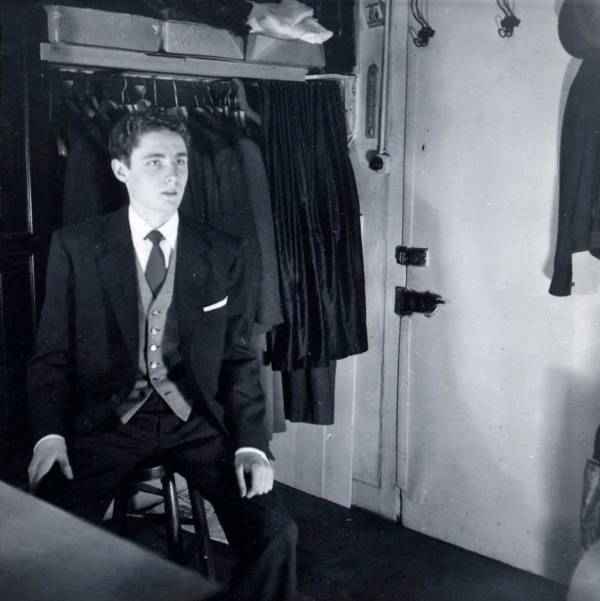
Neville at Saville Row when he began his career as a pattern cutter at sixteen.

Neville’s friend Aubrey Silkoff, photographed when they hitched to Amsterdam in 1961.

Neville’s father Charles owned the only car in Elder St – “We had a car in Elder St when nobody had a car in Elder St, but it vanished when we had no money.”

Neville as a young man.

A family Christmas in Elder St, 1968 – Neville sits next to his father at the dinner table.

Neville’s father, Charles.

Neville and Margaret.

Margaret and Minas.

Neville, Margaret and their son Minas.


Neville’s Uncle Arthur who hung the wisteria wallpaper.

Minas and Terry.

The living room of number seven photographed by the Spitalfields Trust in 1977 with Uncle Arthur’s wisteria wallpaper hanging off the walls.

Dan Cruickshank and others staged a sit-in at number seven to save the house from demolition in 1977.

Neville Turner outside number seven Elder St where he grew up.
You may also like to read about Neville’s childhood friend
Audrey Kneller Of Elder St
Audrey Kneller is one of the many local people you will meet on my tour. Tickets are available this coming weekend and throughout July, so come along and let me show you Audrey’s old haunts.
Click here to book your ticket for THE GENTLE AUTHOR’S TOUR OF SPITALFIELDS

Audrey on trip to Epping Forest, aged twelve in 1957
Audrey Kneller sent me this evocative memoir of her years in Spitalfields describing her life in Elder St.
Elder St was not a pretty place in spite of its name. No buds burst forth each spring to awaken our spirits and no birds sang merrily to remind us of the wonders of nature. Instead soot lay unmolested in every crevice of the ancient brickwork, while the clanking and hissing of steam trains shunting reminded us of the presence of the large London terminus. Poverty was a mantle we refused to wear, but it lurked menacingly on every street corner.
Early in 1953, my Auntie Sophie happened to bump into Millie Berman, an old school friend of my mother’s. This chance meeting was to bring great changes. Millie lived with her daughter on the upper floors of a rented house in Elder St and was looking for someone to take over the tenancy as she was intending to move. Clearly this was an opportunity not be missed.
Shortly after the Coronation in June 1953, we left the comfort of our temporary home in Edgware and moved into the four-storey terraced house at 20 Elder St, Norton Folgate, E1. Our first impressions were far from favourable. The tallness of the houses and total absence of trees or even a blade of grass was very forbidding. However we gradually settled and discovered the bizarre fascinations of an urban existence.
At the back, towards Bishopsgate, there was a large bomb site where I joined some boys playing cowboys and indians, and had a lovely time amid the dirt and rubble. My mother, being a genteel person, was quite horrified when I returned home looking the worse for wear. Thereafter I played more civilised games with my sister and the other refined children of the neighbourhood inside the safe confines of the street. The bomb site, however, came into its own on Guy Fawkes Night when the sky was lit up with the flames of a huge bonfire and accompanying fireworks, watched by us from a third floor bedroom window.
Our part of Elder St was an ideal playground, not only because it sheltered us from traffic but also because of the numbers of children living in the surrounding houses and tenements, so we were seldom short of playmates. In those days, the threat of the motor car was almost non-existent, leaving us to play unrestricted and unhampered, a freedom children cannot enjoy today.
In fact, I cannot remember ever, in the early days of our life in Elder St, seeing a car impinge on our games of higher and higher, piggy in the middle and others too numerous to mention. We played in the road outside our door and no-one ever prevented us from chalking out our squares on the pavement for hopscotch. The black-painted iron bars above the basement in front of the some of the houses could easily be squeezed behind, if a side bar was missing, in order to retrieve a lost ball. These hump-shaped grills were nicknamed “airies,” and a cry would often go up, “It’s gone down the airy!” It was up to the smallest and bravest of us to crawl down into the tiny space below, and once down there you had an awful feeling of being trapped in a cage until you emerged triumphant with the lost ball.
I remember long summer evenings spent playing in the street and the man who came along on his three-wheeler, peddling ices. “Yum Yum” was the brand name and yum yum his ice lollies were, delicious and creamy. A good selling point was that every so often one of the lolly sticks would have the name “YUM YUM” printed on it and whoever had such a stick could have another lolly free on presenting it to the ice cream man. Once this fact became known, some of us sat in the gutter scratching the words “YUM YUM” on our spare sticks. But the ice cream man was not fooled and, some time later, when he came round again after an unexpectedly long interval, the name of the product had been changed to “WHIM”. The lollies were the same but somehow the gilt had gone from the gingerbread.
I recall with affection the Josephs family. Simon Josephs was my age and lived with his parents, two maiden aunts and an elderly grandmother around the corner in Fleur-de-Lis St. Their house was much smaller than ours and poorly built but they were a happy family. They even had a television set, which we did not have, and we lost no opportunity when invited to view. We also spent happy hours playing with Simon and his games, especially my favourite one of Monopoly.
Next door to the Josephs lived an elderly spinster and her bachelor brother who was disabled, having been afflicted with shell shock in the First World War, and I remember sitting with them one Yom Kippur evening waiting for the fast to end. One by one, the tiny houses and the dark overcrowded tenements in Fleur-de-Lis St became empty and boarded up awaiting demolition. The Josephs, we heard later, were re-housed in a new flat on the Ocean Estate in Mile End.
Number 26 Elder St was a tall narrow house accommodating two families, one Jewish and the one Gentile. My sister Yvonne and I would sometimes sit on the steps of the house playing gobs or five stones with the daughters of the respective families. Avril Levy from the Jewish family had a famous auntie, Adele Leigh a renowned opera singer, who would often call round, leaving her sporty two-seater Sunbeam Rapier outside the house.
In Blossom St lived a family that to me epitomised poverty both materially and spiritually. The children were neglected and ran around with bare feet and bare bottoms. I was very shocked because they were so different from us yet lived almost on our doorstep. One day, Christine, a little girl who lived at 16 Elder St, decided that we should venture into the house in Blossom St. We peered inside what seemed to be a dark hole with no semblance of what I considered to be the trappings of a home. Dirt and decay lay all around and I caught a glimpse of a man lying asleep on an old armchair which, instead of cushions, was covered with sacks filled with horse hair. Overcome by feelings of horror, disbelief and the foul stench that pervaded the building, we stepped backwards into the street, and quickly walked back to the welcome ‘civilisation’ of Elder St, never to set foot again in Blossom St.
As to the past history of our house, we were led to believe that it was built in the early eighteen-hundreds. I cannot support the validity of this but the house certainly contained some unusual features.
Looking through the windows at the back, high walls surrounded the yard which was no more than ten feet in depth, just enough space for a coal storage area and a washing line to be strung across. Our convenient position near Liverpool St Station could also be a disadvantage, if the wind was blowing in the wrong direction our clean laundry would be showered with a fine layer of soot.
Ours was the only house in Elder St – and for all we knew anywhere else in Norton Folgate – to have a bathroom. The fittings were brass and, instead of having a normal plughole, there was a tall brass post affair which had to be lifted up to let the water run away. Hot water came from an ancient geyser on the wall above the bath but woe betides anyone who fell foul of the delicate lighting-up procedure. I did once and was greeted with a loud bang. The secret was to run the water first and then ignite the gas. Henceforth, unless my mother or sister were there to do the honours, I felt it safer to spend my bath times in an old zinc tub in front of the fireplace in the living room.
Nevertheless, it was handy to have a bathroom, especially as a connecting door led into the back bedroom thereby giving us a bathroom en suite! The toilet was situated next to the bathroom on the first floor landing. To have an inside toilet was again untypical of the area, most toilets being situated outside in the backyard, as I found at our cousin’s house in Buxton St.
A house of this size required regular maintenance and my mother employed a spare-time handyman to keep the interior in a good state of repair. He came and went for six years, painting, papering, plumbing and fixing, and no sooner had he finished on the top floor than it was time to start again at the bottom, rather like the Forth Bridge.
An interesting feature of the house was a long speaking tube with a whistle at one end, extending from the top floor right down to the basement. Presumably a device once used by servants, this was a source of amusement. Another source of great amusement to us, as well as to other children in our street, was the wall panelling. We succeeded in convincing them that one on the first floor landing slid back to reveal a secret passageway, such as the ones used by Cavaliers to escape the Roundheads during the Civil War.
One day, my sister told some children playing in the street that there was something strange in our basement and they immediately came to investigate. Meanwhile, I had dressed up a tailor’s dummy in an old red frock and hid behind it. As the children descended the basement stairs, I slowly moved the dummy forward, calling out in an eerie voice. The inquisitive children scattered in haste, believing me to be a headless ghost!
Not long after we moved into Elder St, we discovered the presence of unwelcome lodgers lurking behind the skirting boards. After mousetraps failed to catch them, we acquired the services of a cat. One day, one of our cousins from Buxton St called round with a tabby who had the perfect markings of a tiger, so the name stuck. Tiger was a wonderfully docile pet but he lived up this name in keeping the rodent community at bay.
One day I found him sitting on the landing and tried to pick him to carry him downstairs but he would not budge. I could not understand it until my mother pointed out that he was standing guard over a small hole in the skirting board. We left him there all that day and eventually he returned to us of his own accord, presumably having accomplished his mission.
As to the other houses in Elder St, I am sure that none of us children had any idea of their historic value. As far as I could see, we were surrounded by decaying walls and we had to make the best of the situation until circumstances improved.
Although we may have been devoid of pastoral pleasures in Spitalfields, life was far from dull. We were living on the fringes of a great nucleus of Jewish enterprise and culture – consisting of delicatessens, bakeries, butcher shops and kosher restaurants, intermingled with other Jewish-owned businesses in the garment, jewellery and shoe trades, bookshops, a Yiddish theatre and numerous synagogues – stretching from Brick Lane southward to Houndsditch and eastward as far as Bow. This was our heritage, we had returned to the roots set down by our grandparents and thousands of other immigrants fifty years earlier.

Audrey’s tenth birthday tea in 1955
Harry Landis, Actor
Harry Landis is one of the many local people you will meet on my tour. Tickets are available this coming weekend and throughout July, so come along and let me show you Harry’s old haunts.
Click here to book your ticket for THE GENTLE AUTHOR’S TOUR OF SPITALFIELDS

“I was born and brought up in the East End, then I went away for fifty years and came back eight years ago – but I returned to a very different East End from the one I left,” admitted Harry Landis, as we stood together outside the former Jewish Soup Kitchen in Brune St.
“When I was four years old, I came here with my mother holding me in one hand and a saucepan in the other, to get a dollop of soup and a loaf of bread.” Harry confided to me, “When I returned, the soup kitchen had been converted into flats, and I thought it would be great to buy a flat as a reminder – but the one for sale was on the top floor with too many stairs, so I didn’t buy it. Yet I’d have loved that, living in the soup kitchen where I went as a child.”
“I don’t feel any sense of loss about poverty and the bad old days and people suffering,” Harry declared with a caustic grin, as we ambled onward down Brune St. And when Harry revealed that growing up in Stepney in the nineteen thirties, he remembers taking refuge in his mother’s lap at the age of ten when a brick came smashing through their window – thrown by fascists chanting, “Get rid of the Yids! Get rid of the Yids!” – I could understand why he might be unsentimental about the past.
We walked round into Middlesex St to the building that was once the Jewish Board of Guardians where Harry’s mother came to plead her case to get a chit for soup at the kitchen. “I hate those jumped up Jews who blame poor Jews for letting down the race,” Harry exclaimed to me, in a sudden flash of emotion as we crossed the road, where he accompanied his mother at four years old to face the Board of Guardians sitting behind a long table dressed in bow ties and dinner jackets.
When she told the Board she had two children – even though she only had Harry – in hope of getting more of the meagre rations, the Guardians unexpectedly challenged Harry, requiring evidence of his mother’s claim. With remarkable presence of mind for a four year old, he nodded in confirmation when asked if he had a sister. But then the Guardians enquired his sister’s name, and – in an extraordinary moment of improvisation – Harry answered, “Rosie,” and the Board was persuaded. “She used to break her loaf of bread and give half to the poor Christians waiting outside the soup kitchen,” he told me later, in affectionate recognition of his mother’s magnanimous spirit, even in her own state of poverty.
Yet the significance of Harry’s action reverberated far beyond that moment, because it revealed he had a natural talent for acting. It was a gift that took him on a journey out of the East End, gave him a successful career as an actor and director, and delivered him to the Royal Court Theatre where he originated the leading role in one of the most important post-war British plays, Arnold Wesker’s masterpiece “The Kitchen.” Although, ironically, at Stepney Jewish School where Harry was educated, the enlightened headmistress, Miss Rose, made the girls do woodwork and the boys learn cooking – and when Harry left at fourteen he wanted to become a chef in a kitchen, but discovered apprenticeships were only available to those of sixteen.
“They sent me to work in a cafe pouring tea but I didn’t last very long there, I did several jobs, window cleaner and milkman. And I used to go to the Hackney Empire every week, first house on a Monday because that was the cheapest – the company had just arrived, rehearsed with the band once and they were on at six, but the band weren’t sure what they were doing, so I enjoyed watching it all go wrong.
Being a cheeky little sod, I used to perform the show I’d seen on the Monday night next day at the factory where I worked – Max Miller’s jokes, the impersonators and Syd Walker who did a Rag & Bone act. 95% of them nobody knows now. “The shop steward, who was my mentor said, “You ought to be on the stage.”I’d never seen a play. I said, “Where do I go to see a play?” He said, “If you go the West End, the play will be about the tribulations of the upper classes, the problems of posh people. But there is one theatre in Kings Cross called the Unity Theatre, the theatre of the Labour & Trade Union Movement that does plays about ordinary people. I’m going there next Sunday night with my wife, if you’d like to come.” And I went. And at the Unity Theatre, that’s where my life changed.
It knocked me out because the people on the stage could have been living in my street and the language they spoke was the language we all spoke down the East End. The shop steward said, “You should be here, I’ll get you an audition.” I did my audition and I showed them my acting of bits I’d seen at the Hackney Empire, and they put me in the variety group. We performed shows in air raid shelters and parks. But then they transferred me to the straight acting section because I was fifteen and there was a shortage of men since they were all away at war. I was playing above my years but learning to act.
After two or three years of this and doing my military service, I returned to the Unity Theatre and the headmaster of a South London school saw me and said, “You should be professional, why don’t you apply for a grant from the London County Council to go to drama school?” I was twenty. He got me the form and we filled it out, and I was given a grant and money to live on. How times have changed! I did three years at Central School of Speech & Drama. You learnt RP (Received Pronunciation) but you never lost your own speech. I was considered a working class actor.
“I got cast in a wonderful play at the Royal Court Theatre, run by George Devine where they did the plays of John Osborne. It was “The Kitchen” by Arnold Wesker, and I played the part of Paul, the pastry cook – which is the Arnold Wesker character – that’s what he did when he worked in a kitchen. It was about himself. Arnold wrote without any knowledge of theatre, which is to say a play with twenty-five actors in it which only lasts seventy-five minutes. People said they could see the food we were cooking but it was all mimed…”
So Harry fulfilled his childhood ambition to become a chef – on stage – through his work as an actor in the theatre. To this day, he gratefully acknowledges his debt to the Unity Theatre and those two individuals who saw his potential – “I was going to be an amateur but I was pushed to the next stage,” he accepts. Harry enjoyed success as one of a whole generation of talented working class actors that came to prominence in the post-war years bringing a new energy and authenticity to British drama. Now Harry Landis has returned to his childhood streets and laid the ghosts of his own past, he is happy to embrace the changes here today, although he does not choose to forget the East End he once knew.
“It’s a different East End. The bombs got rid of a lot and it’s all been rebuilt. The Spitalfields Market is full of chains and it’s been gentrified, and you’ve got your Gilbert & Georges and your Tracey Emins, and the place is full of art studios and it’s become the centre of the world. It’s the new Chelsea. I sold my house in Hammersmith where I lived for forty years (that I bought for £2,000 with 100% mortgage from the LCC) and I came back and bought a flat here in Spitalfields with the proceeds. And the rest I put in the bank for when I am that constant thing – an out of work actor!”

Outside the soup kitchen in Brune St where Harry came with his mother at the age of four

At the former Jewish Board of Guardians in Middlesex St

Harry as Private Rabin in “A Hill in Korea,” 1956


Harry Landis
Linda Carney, Machinist
Linda Carney is one of the many local people you will meet on my tour. Tickets are available this coming weekend and throughout July, so come along and let me show you Linda’s old haunts.
Click here to book your ticket for THE GENTLE AUTHOR’S TOUR OF SPITALFIELDS

This is Linda Carney working at her machine in Spitalfields in 1963 and looking glamorous in the same way Lynn Redgrave, Julie Christie, Rita Tushingham and Barbara Windsor did playing happy-go-lucky girls in those films of London in the sixties. Linda’s combination of kooky glasses, stylish outfit and optimistic humorous attitude in a mundane workplace was an act of youthful defiance in itself.
Linda worked in factories making clothes all over Spitalfields, in Brune St above the Jewish soup kitchen, in Fournier St in what is now Gilbert & George’s studio and in Fleur de Lys St. It was at the latter address, she once spotted the long-haired seventeen-year-old Dan Cruickshank giving an interview to reporters on the doorstep, explaining why he was squatting an old building in Elder St, “I’m saving our heritage,” he declared. But Linda, with irrepressible anarchic ebullience, wagged her finger and called out, “You just don’t want to pay rent!” It was a scene worthy of a whimsical sixties comedy and I can imagine Linda, tottering off, arm in arm with her girlfriends, all laughing like drains.
When I met Linda outside the Jewish soup kitchen on Brune St, she described the neighbourhood in her time. “It still is busy here, but it was much more busy then because people started out earlier and worked longer hours,” said Linda, excited to return to her former workplace.”If you worked all night, you never felt on your own because you had all-night cafes servicing the market.” Looking up and down Brune St, Linda got quite carried away describing the characters among those coming to the soup kitchen from the surrounding streets of derelict tenements.
In those days – she told me – bales of cotton were carried in and out of the warehouse next door, supplies were delivered to the food warehouses in Tenterground, trucks caused chaos around Spitalfields Market at night, pubs opened at dawn, furriers in Whites Row compared pelts by daylight, Coles’ poulterers in Leyden St slaughtered fowls to order, hatters and button makers and purveyors of ribbons and trimmings worked frantically, while – further afield – the shoemakers of Hoxton and the furniture makers of Bethnal Green were all busy too. Obviously this was only a fraction of the activity but I think you can understand what Linda meant by saying Spitalfields was busier then.
Linda earned three pounds a week doing piecework for companies in Cutler St who provided the cloth, cut ready to sew. She and her co-workers made a hundred pairs of trousers in a day in the factory on the top floor of the soup kitchen. Assembling the clothes, one would sew the seams, another the buttonholes, another the buttons, the zipper and so on. “You couldn’t let anybody down. You couldn’t even go to the toilet” admitted Linda with a frown, showing me the scar where she caught her finger in a machine once and recalling in wry amusement that, in spite of her injury, the others were reluctant to stop the belt that drove all the machines, crying out, “Don’t turn it off! I haven’t finished my piecework yet!” “And that’s what made you a machinist” said Linda, in robust summary of her occupation.
“My mother was a seamstress for Savile Row, a tailoress from home, collecting her work from the West End. My grandmother rolled cigars at home, there was a big industry. It was a skill. Those skills are coming back, I think, because you see the girls today that are making their own clothes and selling them in the market. We used to make our own clothes too, because you need to have something a little different.”
Although Linda’s father worked in the Truman Brewery, his family were all dockers. She told me about the two floors of vaults beneath Wapping High St that stretch as far as Tobacco Dock, built by French prisoners of war imprisoned at the Tower of London. Apparently these cellars were sealed up just as they were when the docks closed and remain untouched to this day, full of a vast stock of the best wine and champagne waiting to be discovered. “We’d go down to the lock-ups,” said Linda with a rapturous grin, “All the best stuff was there, cinnamon, paprika, saffron, rum, ivory, tea and champagne. I’ve drunk all the best teas in the world. If some spilt from a broken chest, you could get a handful for yourself.”
At this point in our pavement chat, an African-American gentleman, who lived in the ground floor flat of the converted soup kitchen, came outside for a cigarette and joined the conversation – which prompted Linda to raise the subject of race. “We always had mixed race here because it was a port,” she declared audaciously, producing a photo of her multiracial school netball team from 1959. “So we all got brought up together. I used to go to clubs to listen to ska and reggae, where coloured groups like the Stylistics were playing to a mixed audience, which the musicians liked because they couldn’t do it in America. We mixed a lot more than our parents thought, because we were enjoying life and we didn’t have any money. We had stop-overs, and a lot of us married Afro-Caribbeans, Asians and Chinese. We were a melting pot.”
Touched by Linda’s monologue, our new friend generously invited us into his flat to take a look. We entered the central door that once led to the factory floors up above, rented out to support the soup kitchen. This was the door Linda passed through when she came to work every day. She was entranced, “It feels strange but homely, because it is so familiar” she said. Clasping her hands in delight and raising her eyes to explore the space, Linda explained that, when it was the soup kitchen, one side of his flat was used for distributing clothes and the other side for food.
To my surprise, Linda recalled the smell of bacon here in the early mornings, as the Jewish workers in the kitchen used to enjoy making themselves illicit bacon sandwiches. Then before we left, completing the sentimental pilgrimage, Linda revealed that she last walked through this hallway in 1968. Mesmerised by each other, as Linda and the bemused contemporary resident shook hands in farewell, two worlds met for a fleeting moment, distant by birth yet united in sympathy and mutual curiosity.


Linda Carney in Brune St

Linda’s netball team (Linda is on the left)

Linda Carney
Portraits © Sarah Ainslie
You may also like to read about
Adam Dant’s Map Of Chaucer’s London

It is my pleasure to introduce Adam Dant’s map of Chaucer’s London – click on the map to enlarge it and explore further
I often think of Geoffrey Chaucer. I think of when he lived above the gatehouse at Aldgate. I think of how he witnessed bell-founding to the east of the City. I think of how he observed the hordes of the ‘peasants’ revolt’ stream the through the gate into the City of London. I think of how he was forced to listen to his noisy neighbours who imposed themselves upon him and, as a consequence, he wrote the first portraits of East Enders in our literature. I think of how he dreamed of being an astronaut, propelled up into the atmosphere to look down upon the earth below. I think of how he struggled with the unruly polar bear under his charge when Master of Armaments at the Tower of London. I think of him as Comptroller at the Custom House and how he would have laughed at the idea of it becoming a boutique hotel. I think of him at the Savoy, strutting in his scarlet paltocks and striped hose in the days before they had a cocktail bar. I think of his recurring dream, waking in a magical garden where he encountered ecstatic visions. I think of him in Navarre, where me met Islamic and Jewish poets, and how he became the first to introduce their literary forms into the English language. I think about the design of his little woollen hat. Every year, I think of him in April when I get the urge to go a pilgrimage. But most of all I think of him writing so many stories, day after day, in his ambitious attempt to create cycles of tales to rival Boccaccio and the Arabian Nights.

Adam Dant’s woodcut of The Reeve, after the cut in Caxton’s edition of Chaucer’s Works

Adam Dant’s Map of Chaucer’s London was commissioned by The Critic, Adam Dant’s Political Maps is published by Batsford on 30th June, and prints of his maps are available from TAG Fine Arts.
Bloomsbury Jamboree Tomorrow!
Tickets are available for my tour of Spitalfields next Thursday 30th June and throughout July

We are looking forward to welcoming you to the Bloomsbury Jamboree at the Art Workers Guild tomorrow from 10:30am. If you would like to volunteer with setting up and running the event, please come along from 9:00am.

Click here to book for Rob Ryan’s talk, ‘You Can Still Do A Lot With A Small Brain’


