
Richard Dighton’s City Characters
Thanks to everyone who has contributed, we are now a third of the way towards my crowd-funder to launch a COMMUNITY TOURISM PROJECT in Spitalfields as a BETTER ALTERNATIVE to the serial killer tours that monetise misogyny. We still have a way to go to reach our target, so please help by spreading the word.
CLICK HERE TO SUPPORT THIS PROJECT

Map of The Gentle Author’s Tour of Spitalfields designed by Adam Dant

At the end of the week in which bumper bonuses for bankers were celebrated in the City of London, I thought I would publish Richard Dighton’s cartoons of their Regency counterparts from 1824 in the archive at the Bishopsgate Institute, thus testifying that fat cats are not a new phenomenon.


Images courtesy Bishopsgate Institute
You may also like to take a look at
A Walk Through Time In Spitalfields Market
Thanks to everyone who has already contributed towards my crowd-funder to launch a COMMUNITY TOURISM PROJECT in Spitalfields as a BETTER ALTERNATIVE to the serial killer tours that monetise misogyny. Please help me by spreading the word.
CLICK HERE TO SUPPORT THIS PROJECT
Map of The Gentle Author’s Tour of Spitalfields designed by Adam Dant

Once upon a time, the Romans laid out a graveyard along the eastern side of the road leading north from the City of London, in the manner of the cemetery lining the Appian Way. When the Spitalfields Market was demolished and rebuilt in the nineteen-nineties, stone coffins and funerary urns with copper coins were discovered beneath the market buildings – a sobering reminder of the innumerable people who came to this place and made it their own over the last two thousand years. Outside the City, there is perhaps no other part of London where the land bears the footprint of so many over such a long expanse of time as Spitalfields.
In his work, Adam Tuck plays upon this sense of reverberation in time by overlaying his own photographs upon earlier pictures to create subtly modulated palimpsests, which permit the viewer to see the past in terms of the present and the present in terms of the past, simultaneously. He uses photography to show us something that is beyond the capability of ordinary human vision, you might call it God’s eye view.
Working with the pictures taken by Mark Jackson & Huw Davies in 1991, recording the last year of the nocturnal wholesale Fruit & Vegetable Market before it transferred to Leyton after more than three centuries in Spitalfields, Adam revisited the same locations to photograph them today. The pictures from 1991 celebrate the characters and rituals of life within a market community established over generations, depicted in black and white photographs that, at first glance, could have been taken almost any time during the twentieth century.
In Adam Tuck’s composites, the people in the present inhabit the same space as those of the past, making occasional surreal visual connections as if they sense each others presence or as if the monochrome images were memories fading from sight. For the most part – according to the logic of these images – the market workers are too absorbed in their work to be concerned with time travellers from the future, while many of the shoppers and office workers cast their eyes around aimlessly, unaware of the spectres from the past that surround them. Yet most telling are comparisons in demeanour, which speak of self-possession and purpose – and, in this comparison, those in the past are seen to inhabit the place while those in the present are merely passing through.
Although only thirty years have passed since the market moved out, the chain stores and corporate workers which have supplanted it belong to another era entirely. There is a schism in time, since the change was not evolutionary but achieved through the substitution of one world for another. Thus Adam’s work induces a similar schizophrenic effect to that experienced by those who knew the market before the changes when they walk through it today, raising uneasy comparisons between the endeavours of those in the past and the present, and their relative merits and qualities.

Brushfield St, north side.

Lamb St, south side.

Brushfield St, looking east.

In Brushfield St.

In Gun St.

Brushfield St, looking south-east.

Looking out from Gun St across Brushfield St.

In Brushfield St.

Market interior.

Northern corner of the market.

In Lamb St.

Lamb St looking towards The Golden Heart.
Photographs copyright © Mark Jackson & Huw Davies & Adam Tuck
Mark Jackson & Huw Davies photographs courtesy Bishopsgate Institute
You may like to look at more of Adam Tuck’s work
A Walk Through Time in Spitalfields
and Mark Jackson & Huw Davies pictures of the Spitalfields Market
Spitalfields Market Portraits, 1991
Night at the Spitalfields Market, 1991
Mark Jackson & Huw Davies’ Photographs of the Spitalfields Market
Spitalfields Market Portraits, 1991
Thanks to everyone who contributed yesterday to help me launch a COMMUNITY TOURISM PROJECT in Spitalfields as a BETTER ALTERNATIVE to the serial killer tours that monetise misogyny. Please help by spreading the word to your family, friends and workmates.
CLICK HERE TO SUPPORT THIS PROJECT
Map of The Gentle Author’s Tour of Spitalfields designed by Adam Dant

It is my pleasure to publish this gallery of portraits of Spitalfields Market traders chosen from more than three thousand photographs taken by Mark Jackson & Huw Davies in the last year of the Fruit & Vegetable Market in Spitalfields in 1991.
When Mark and Huw arrived at the market, they often separated to pursue different lines of inquiry, convened regularly through the night to compare results. Huw, the more more experienced photographer of the two, might set up the ambitious wide shots of the market and wait for figures to walk into the frame, while Mark, who did not even know how to load a camera at first, would chat with traders and snap portraits. And thus their different qualities complemented each other, so that today the body of pictures detailing the life of market exists as a totality in which the work of each photographer cannot be disentangled from the other.
All these portraits were the result of conversations as the photographers came to know their subjects. Always, conversation came first and once both parties were comfortable, the pictures were taken. As the traders came to appreciate the project, more were keen to have their portraits done, waving the photographers over and demanding a picture. It was an event that grew more frequent as the closure approached, and those who had spent their working lives there were desirous of being photographed in their market. They wanted their existence recorded along with their fellows.
There was a rigor imposed upon the endeavour by the cost of the film and the limitation of the budget, giving value to every single frame. At first, Mark & Huw bought cheap second hand cameras that broke and then they saved for months to buy new Nikon cameras and lenses, including a precious 35mm lens for portraits which they shared between them. And, to save money they bought great rolls of film and wound it into their cameras, but it quite often got damaged by fingerprints in the process.
Then, each weekend when the market was closed, Mark & Huw filled the bath in their tiny flat with smelly chemicals mixed up from powder and developed the week’s films, hanging them with clothes pegs on strings to dry – and sometimes the mix of the developer was wrong and the pictures came out too dark. Yet in spite of all these limitations, and the resultant pitfalls and mishaps, Mark & Huw were able to produce the splendid, emotionally-charged portraits which you see here and, thanks to them, we are able to meet the Spitalfields Market traders of 1991 face to face.


Photographs copyright © Mark Jackson & Huw Davies
You can see the original selection of
Mark Jackson & Huw Davies’ Photographs of the Spitalfields Market
and read about
Save Spitalfields From The Serial Killer!
Help me launch a COMMUNITY TOURISM PROJECT as a BETTER ALTERNATIVE to the serial killer tours that monetise misogyny.

Map of The Gentle Author’s Tour of Spitalfields designed by Adam Dant
There are so many other stories of the people of Spitalfields over the past two thousand years which deserve to be told. Through the past twelve years, writing Spitalfields Life daily, I have published hundreds of the tales of the people – both past and present – who make this place so fascinating.
Now I am taking these stories onto the street to create tours that are more more engaging, more entertaining, more fun, more surprising, better storytelling – and do not trade off violence against women.
I am appalled that educational institutions send classes of students and school children on the exploitative serial killer tours which display autopsy photographs of women in the street, indulging in ghoulish humour at the expense of these victims.
Instead, I am offering visitors the opportunity to meet a member of the local community and learn something of the infinite variety of life that has evolved in London’s first suburb over two millennia. For the past two years, I have been developing and road-testing THE GENTLE AUTHOR’S TOUR OF SPITALFIELDS which I plan to launch this spring.
I am raising £20,000 to create a booking website, train local tour guides, print maps and buy targeted online advertising to reach tourists planning a visit. If everyone who reads Spitalfields Life daily gives just a few pounds we can reach our target in no time. Anyone who contributes £100 or more gets two complimentary tickets to experience the tour for themselves.
CLICK HERE TO SUPPORT THIS PROJECT
This project is a means to create local employment, draw attention to the distinctive wonders of the place and reclaim the true stories of our living community.
I want to celebrate a rich and diverse history of resourcefulness, driven by successive waves of migration from across the world – Huguenots, Jews, Irish and Bengalis, among many others – which tells the story of how modern Britain was created.
Help me SAVE SPITALFIELDS FROM THE SERIAL KILLER!

Here are some comments by people who have been on my trial tours:
“What a winner! The Gentle Author’s Tour is in a category of its own, illustrated by the historic buildings of Spitalfields and illuminated by stories of its residents uniquely brought to life by their friend and biographer, The Gentle Author. Book immediately, to avoid disappointment.” MP
“The walking tour felt like being invited into a very special “family gathering”! The pace and places we stopped were perfect, with so many stories, both personal and historical with the emphasis on the very humanity that has made this area what it is over so many centuries. It was such an antidote to the disconnection I’ve felt over the last eighteen months, thank you.” KB
“As an East Ender born and bred, I thoroughly enjoyed The Gentle Author’s Spitalfields walking tour. An excellent mixture of history and individual stories bringing alive the vibrant past and present of Spitalfields’s streets – in all its darkness and many triumphs of the human spirit. The tour is a magnificent counterblast to those tours and stories of the East End focusing only on the Ripper horrors and statistics of poverty. The Gentle Author takes you on a journey into what the real East End has always been about – survival, defiance, community, change. Listen and marvel.” MOL
“I spent almost two hours walking with The Gentle Author and twelve other people in the streets of Spitalfields. I am passionate about literature and history so it was the best combination of little vignettes from local people and, historical reflection on poverty, social classes and architecture. The Gentle Author is a specialist and I am very lucky I managed to spend some time listening to these stories in good company. Walking hors des sentiers battus felt like a privilege to me, as if our guide was able to lift off the veils of history and let us peep underneath to discover the real London.” MW
“From Roman times to the land of bones, to Henry VIII’s Brexit, to the waves of immigrants who have made Spitalfields so distinctive, The Gentle Author covered 2,000 years of history, with a personal twist in the tail at the end of the talk. Not only the past was covered, but also the present day – ghastly facadism and the plans for the Truman Brewery. A considerable amount of social history was covered during the walk. The duration of the tour was just right, the ending with tea & homemade cake in one of the houses in Fournier Street was a civilised way to conclude the visit to the ‘Hospital Fields’.” CE
“The Gentle Author’s Spitalfields Tour is a real treat. Resplendent storytelling brings the people and places of this magnificent blog to life with a quiet passion and humility. It’s a colourful journey through times past and present, provoking thought about the London we live in today and how we should preserve its history, characters and communities. To quote from Dickens Jnr’s Dictionary of London 1888 “it is something that no student of London life should miss seeing”. A wonderful experience that helps to reconnect us with the spirit of humanity and to cherish this wonderful city.” LW
“This is a must-do activity for London visitors and residents alike if you are keen to absorb the history of former generations as you walk around the cobbled streets of Spitalfields. From the Jewish soup kitchen to the site of the theatre where Chaplin trod the boards as a ten year old, The Gentle Author brings history to life over a very memorable two hours and I’m so glad that I experienced this.“ KU
“This brilliant, incisive walking tour with The Gentle Author around Spitalfields was packed with fascinating detail and well woven narratives about some of the people who’ve given this area its rich and singular history over the centuries. I would highly recommend this tour for anyone with the faintest interest in the area on the basis that it revealed much I didn’t know while being a perfect length and sufficiently succinct to maintain one’s interest throughout.” BG
“What a privilege to take part in your wonderfully evocative tour of an area we thought we knew pretty well. The tour gave us something really precious – a personal connection with people whose stories might otherwise be forgotten in a part of London that is in danger of becoming a theme park. We are very touched, and will be recommending the tour far and wide.Thank you.” NW
“What makes your tour so special is the weaving in of the history of people with that of buildings and streets, named people whose stories you knew. I loved seeing their photos and hearing what happened to them. I think that helped bring the group together, looking at all the photos (which worked very well) and reflectively on the human dimension. I honestly haven’t got any suggestions for improvements.” SL
“The Gentle Author’s walks are highly recommended for their informative content about the characterful pocket of London’s Spitalfields which should never be allowed to be swept away by major corporate developments and ghastly facadism!”. CJ
Vinegar Valentines
On Valentine’s Day when readers are contemplating billets-doux, perhaps some might like to consider reviving the Victorian culture of Vinegar Valentines?
When I met inveterate collector Mike Henbrey in the final months of his life, he showed me his cherished collection of these harshly-comic nineteenth century Valentines which he had been collecting for more than twenty years.
Mischievously exploiting the expectation of recipients on St Valentine’s Day, these grotesque insults couched in humorous style were sent to enemies and unwanted suitors, and to bad tradesmen by workmates and dissatisfied customers. Unsurprisingly, very few have survived which makes them incredibly rare and renders Mike’s collection all the more astonishing.
“I like them because they are nasty,” Mike admitted to me with a wicked grin, relishing the vigorous often surreal imagination manifest in this strange sub-culture of the Victorian age. Mike Henbrey’s collection of Vinegar Valentines were acquired by Bishopsgate Institute, where they are preserved in the archive as a tribute to one man’s unlikely obsession.

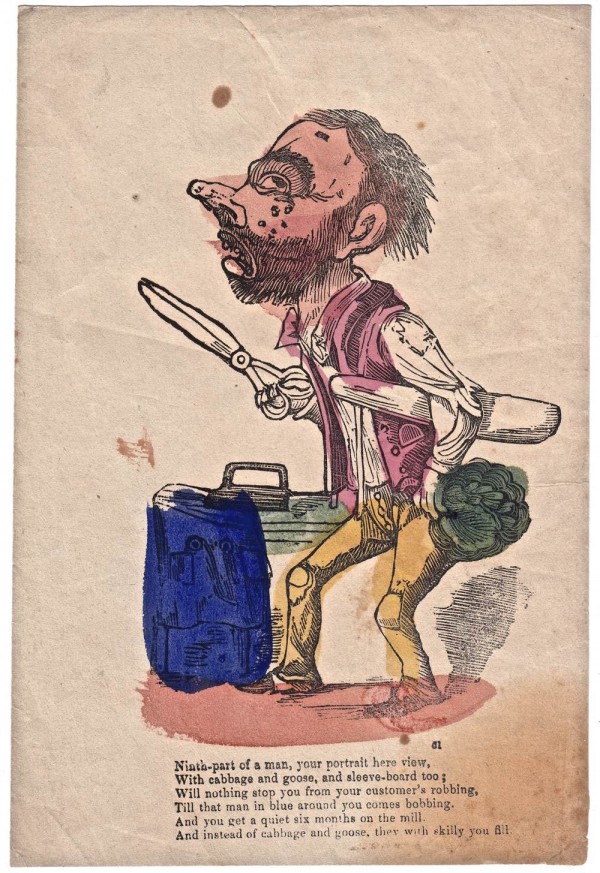


Images courtesy Mike Henbrey Collection at Bishopsgate Institute
You might also like to look at
At The Custom House Public Inquiry
The Public Inquiry into the future of the Custom House has been running for two weeks now and today I publish this statement by Stepney resident and former-Director of the National Gallery, the National Portrait Gallery and the Royal Academy, Charles Saumarez Smith, which he delivered at the end of last week.

Custom House c. 1910 (Image courtesy LAMAS Collection, Bishopsgate Institute)
I have been following the battle which has been going on about the future development of the Custom House into – how did you guess ? – another luxury hotel.
Last week, I was allowed to give evidence to the Planning Inquiry which is currently taking place about the future of the Custom House. Most of the evidence is about the technicalities of planning law. I tried to address the broader issues of the protection of historic architecture as the City develops post-lockdown and what sort of City we want. Here is my submission.
CUSTOM HOUSE PLANNING INQUIRY, SUBMISSION OF THIRD-PARTY EVIDENCE BY SIR CHARLES SAUMAREZ SMITH
• I’m grateful for the opportunity to submit evidence to the Inquiry, having been encouraged to do so by the Gentle Author, whose daily blog, Spitalfields Life, has done such a good job in drawing attention to the amount of change and development which is currently going on in East London.
• I speak as someone who was trained as an architectural historian, writing a PhD. at the Warburg Institute on the architecture of Castle Howard, and who, since retiring from the Royal Academy of Arts as its Secretary and Chief Executive, has taken an increasing interest in issues of urban development. I live not so far away in East London, so have been watching what has been happening in the fringes of the City with increasing concern at its speed and its lack of regard for the history of the City.
• What I want to do is not so much discuss the merits and demerits — the detailed rights and wrongs — of the two proposals in front of you for the development of the Custom House. The first, from Cannon Capital Developments, is to turn the majority of the historic building into a commercial development, dominated, like the nearby Trinity House Building, by a big hotel: the scheme is, as described on the website, ‘hotel-led’. The second scheme, as put forward by the Georgian Group, is to ensure that there is proper public access to the building, particularly to the Long Room in the centre of the building, as has happened, for example, so successfully at Somerset House not far away, where you have such a successful combination of public and private use, opening up William Chambers’ central courtyard to public enjoyment; and, indeed, as has happened nearby at St. Bartholomew’s Hospital, where its Great Hall is now vested in a separate trust, so is much more freely available to public use.
• Instead of looking at the detail of the two schemes, I would like to consider three broad contexts for understanding and looking at what is currently proposed.
• The first context is the way that access to the River Thames and the riverside more generally has been opened up to the public in the last twenty years: most obviously and most successfully in the stretch of the river from Tower Bridge to the Royal Festival Hall, where, for example, the conversion of the old industrial power station into Tate Modern has totally transformed that part of London for the better. We now take this development and its pleasures for granted, as if it has always been there, but I think it needs to be remembered that it was only Mark Fisher and the late Richard Rogers who effectively proposed opening up public access to the river in their book The New London, published in 1991, a proposal which then became public policy.[1]
• So far, the City has not in any way benefitted from a similar change, apart from the straggling Thames Path, which is currently the only way of actually seeing the Custom House — a building of vastly much greater historical interest and significance than Giles Gilbert Scott’s power station. Those of you who have tried walking the stretch of the Thames Path north of the river from Blackfriars Station to the Tower will have discovered that it is currently not a pleasant experience. It seems to me that, with a more imaginative and more publicly-oriented scheme which is devoted more than Cannon’s proposal currently is to opening up the Custom House to public access and public use, particularly on the river side, it might be possible to make a significant transformation to the public’s enjoyment of this part of the north side of the river, enabling people — not just tourists, not just guests at a luxury hotel, but city workers — to enjoy the riverbank west of the Tower of London.
• The last twenty years have seen London change from a city dominated by traffic into one where it is becoming easier to walk and explore; but not, I reiterate, in the part of the City round the Custom House. There is a great and historic opportunity to make the Custom House into a public amenity, not just another private hotel.
• The second context is a more obvious one, which is the history of the Custom House and its immense interest and importance as a historic building. Built immediately adjacent to the site of Christopher Wren’s Custom House, it represents that period of public architecture immediately after the Battle of Waterloo: a period of grand public buildings, including the National Gallery, University College and the British Museum, which was designed by Robert Smirke, who did the renovation of the Custom House in the 1820s. I am not going to pretend that David Laing, who designed the New Custom House in 1813, is an architect of equivalent interest and importance to Robert Smirke or William Wilkins. But, as you will all know, he was trained by Sir John Soane, the greatest architect of this period, and he designed the New Custom House in Soane’s style of very restrained and monumental classicism as first recorded by Sir Albert Richardson in his book Monumental Classic Architecture in Great Britain and Ireland, first published in 1914.[2]
• The third context I want to draw attention to and get you to think about is the world of work. Of course, none of us quite know what is going to happen in the future to the world of work. It is fairly obvious that the City is trying as hard as possible to ignore the fact that the pattern of work is changing, partly as a result of the last two years of the Coronavirus pandemic and lockdown, but not just because of lockdown. The City has carried on building huge great monolithic skyscrapers at incredible speed, particularly over the last two years, when we have seen 22, Bishopsgate absolutely dominate this part of the City. But the pattern of work is changing: becoming more casual, less 9 to 5, less insulated from the surrounding City, as much about meeting people as about sitting in front of a computer screen, perhaps a reversion to the world of the seventeenth-century coffee house.
• In early November, I visited Oslo, which has opened up its harbour area with the creation of three new public buildings: an opera house; a museum devoted to the work of Norway’s greatest artist, Edvard Munch; and a new public library. I visited the public library quite early in the morning. It was already absolutely full of people working on their laptops in small clusters. If you have visited the British Library recently, much of its activity is outside the reading rooms where the moment the Library opens, large numbers of workers occupy the public spaces, because people now need and want to work on their laptops in public spaces.
• So, having now considered these three broad contexts, I want to look back at what is currently proposed at the Custom House.
• On the one hand, you have plans for a commercial development by Cannon: as it is described on their website, the plan is for ‘a hotel-led scheme, with a museum, restaurants, cafes, meeting and event space and spa’. The plan is essentially for a hotel, equivalent perhaps to the Ned, close to the Bank of England, which in theory is publicly accessible for anyone willing to pay fifty pounds for lunch, but you are greeted by a man in uniform whose job it is to keep the broader public out.
• On the other hand, you have the proposals by the Georgian Group which are necessarily broader brush and less fully worked out in any detail, But the general underlying motive behind the Georgian Group’s proposals is abundantly clear: it is for mixed use — some offices in the east and west wing, but keeping the two great public spaces in the centre open for public access and public use, to be enjoyed by the citizens of this great capital city, as well as by tourists.
• I very much hope that the plans by Cannon will be turned down.
[1] Richard Rogers and Mark Fisher, The New London (London: Penguin Books, 1991).
[2] A.E. Richardson, Monumental Classic Architecture in Great Britain and Ireland (London: B.T. Batsford, 1914).

Charles Saumarez Smith © Rii Schroer
You may also like to read about
The Staircases Of Old London

Mercers’ Hall, c.1910
It gives me vertigo just to contemplate the staircases of old London – portrayed in these glass slides once used for magic lantern shows by the London & Middlesex Archaeological Society at the Bishopsgate Institute. Yet I cannot resist the foolish desire to climb every one to discover where it leads, scaling each creaking step and experiencing the sinister chill of the landing where the apparition materialises on moonless nights.
In the Mercers’ Hall and the Cutlers’ Hall, the half-light of a century ago glimmers at the top of the stairs eternally. Is someone standing there at the head of the staircase in the shadows? Did everyone that went up come down again? Or are they all still waiting at the top? These depopulated photographs are charged with the presence of those who ascended and descended through the centuries.
While it is tempting to follow on up, there is a certain grandeur to many of these staircases which presents an unspoken challenge – even a threat – to an interloper such as myself, inviting second thoughts. The question is, do you have the right? Not everybody enjoys the privilege of ascending the wide staircase of power to look down upon the rest of us. I suspect many of these places had a narrow stairway round the back, more suitable for the likes of you and I.
But since there is no-one around to stop us, why should we not walk right up the staircase to the top and take a look to see what is there? It cannot do any harm. You go first, I am right behind you.

Cutlers’ Hall, c.1920.

Buckingham Palace, Grand Staircase, c.1910.

4 Catherine Court, Shadwell c.1900.

St Paul’s Cathedral, Dean’s staircase, c.1920.

House of Lords, staircase and corridor, c.1920.

Fishmongers’ Hall, marble staircase, c.1920.

Girdlers’ Hall, c.1920.

Goldsmiths’ Hall, c.1920.

Merchant Taylors’ Hall, c.1920.

Cromwell House Hospital, Highgate Hill, c.1930.

Ironmongers’ Hall, c.1910.

Cromwell House Hospital, Highgate Hill, c.1930.

Stairs at Wapping, c.1910.

Cromwell House Hospital, Highgate Hill, c.1930.

Staircase at the Tower of London, Traitors’ Gate, c.1910.

Hogarth’s “Christ at the Pool of Bethesda” on the staircase at Bart’s Hospital, c.1910.

Lancaster House, c.1910.

2 Arlington St, c.1915.

73 Cheapside, c.1910.

Dowgate stairs, c.1910.

Crutched Friars, 1912.

Grocers’ Hall, c.1910.

Cromwell House Hospital, Highgate Hill, c.1930.

Salters’ Hall, Entrance Hall and Staircase, c.1910.

Holy Trinity Hospital, Greenwich, c.1910.

Salter’s Hall, c.1910.

Skinners’ Hall, c.1910.

1 Horse Guards Avenue, 1932.

Ashburnham House, Westminster, c.1910.

Buckingham Palace, c.1910.

Home House, Portman Sq, c.1910.

St Paul’s Cathedral, Dean’s Staircase, c.1920.
Glass slides courtesy Bishopsgate Institute
You may also like to take a look at


