
Phyllis Bray, Artist
David Buckman author of Artists of the East London Group recalls the forgotten artist, Phyllis Bray. Celebrated for her murals at the People’s Palace in Mile End, Bray was a significant talent and an integral part of the lost history of one of the major artistic movements to come out of the East End in the last century.
Phyllis Bray, Myth & Nature, a retrospective exhibition, runs until 21st June at Batsford Gallery, 266 Hackney Rd, E2 7SJ.

Detail of mural ‘The Drama’ by Phyllis Bray at the People’s Palace
Many artists enter a twilight period after death while their work is reassessed. Some recover and others do not, yet one enjoying a positive reassessment at present is the artist Phyllis Bray, with two events spotlighting her work.
The first is the refurbishment of the People’s Palace in Mile End, where part of her large mural The Drama has been restored and is on permanent display. The other is her current retrospective exhibition, at Batsford Gallery in Hackney Rd, where many of her finest paintings are on display.
Phyllis Bray was born in 1911 and, after studying at Queenwood, Eastbourne, attended the Slade School of Fine Art between 1927-31, where she was fortunate to catch the end of Henry Tonks’ distinguished professorship. He had a reputation for acerbic comments upon the work of female students, occasionally reducing them to tears, but Bray was a gifted favourite. She won a string of awards and, at the strawberry tea honouring Tonks on the day of his departure in 1930, she was one of those chosen to wait on him.
Bray gained her fine art diploma in 1931 and that summer married John Cooper, who had been a teacher of evening classes since he left the Slade in 1922. It was his second marriage, after an unsuccessful one to another Slade student, Helen Taylor. By 1931, Cooper had established the East London Group through classes he taught at the Bow & Bromley Evening Institute in Coborn Rd from the mid-twenties onwards. The debut exhibition of work by the East London Art Club at the Whitechapel Art Gallery in December 1928, part of which was shown at what is now the Tate Britain in early 1929, led in November of that year to the first of eight annual East London Group exhibitions at Alex. Reid & Lefevre patronised by wealthy collectors.
The show was an astonishing success and had to be extended for several weeks, described by the Manchester Guardian as “one of the most interesting and significant things in the London art season.” It was there that Cooper and other East London Group stalwarts, including as William Coldstream, Murroe FitzGerald, Archibald Hattemore, Elwin Hawthorne, Harold and Walter Steggles, and Albert Turpin established their careers.
Phyllis Bray began her participation by showing two paintings at the second exhibition in December 1930, among a total of ninety catalogued works, and each year after that her paintings and drawings became important features of these shows. She was also a valuable additional teacher at Bow, as Cooper struggled to cope with his commitment of three nights a week while also holding classes in Lambeth and Shoreditch and, eventually, at the Central School of Art too. By the 1937-38 academic season, Cooper was no longer at Bow and Bray took responsibility for overseeing the students with the support of another teacher.
But by then her marriage to the volatile Cooper had collapsed. The crisis came in 1936, the year of the last East London Group winter show at Alex Reid & Lefevre and Bray’s commission to paint murals for the New People’s Palace. It was during this work in Mile End that she formed an emotional attachment to the architect George Coles.
The old People’s Palace had long been a centre of East End cultural life. Its creation was due to the beneficence of painter, property owner and philanthropist John Barber Beaumont who donated money to found a Philosophical Institution in Mile End that would provide educational and recreational facilities for working men. In 1887, Queen Victoria opened the Queen’s Hall as part of her Golden Jubilee celebrations but a fire had destroyed the building in 1931. Construction of a New People’s Palace proceeded in 1936, with the front of the building enhanced by five sculpted reliefs by Eric Gill of Drama, Music, Fellowship, Dancing, Sport and Recreation.
Architect George Coles oversaw the interior and fellow architect Victor Kerr advocated the inclusion of Phyllis Bray’s murals. Coles was a master of the Art Deco style, and his works included the Gaumont State Cinema in Kilburn, the Carlton Cinema in Islington, the Troxy in Stepney and several Odeons. At the Queen’s Hall, it was decided that instead of painting direct onto plaster as she originally proposed, Bray would undertake three panels on canvas, each twelve feet by ten feet, and the subjects would be The Dance, The Drama and The Music.
A contemporary photograph shows Bray, elegantly balanced upon a precarious stepladder, busy painting The Dance. She was always athletic, and later in life famously strode early in the morning to plunge at dawn into the ladies’ pool near her home in Hampstead and turned a cartwheel on the Heath in celebration of her sixtieth birthday.
King George VI and Queen Elizabeth performed the opening ceremony at the New Queen’s Hall on 13th February 1937. Previously, in November of 1936, Queen Mary had seen Bray at work and been impressed by her painting and, several months after the opening, the Queen returned again, requesting to view the completed murals. Yet, although the New People’s Palace enjoyed some success before the war, by 1953 it was put up for sale and Queen Mary University acquired it.
The fate of the murals was unknown until restoration began on the building and the mystery was uncovered by Eoin O’Maolalai, Senior Estates Project Manager at Queen Mary, after a researcher at Tate Britain inquired whether the paintings had survived. Although the lower half of the murals had been destroyed when the hall was converted to a lecture theatre, O’Maolalai realised that the top half still existed in a storeroom above the theatre. “I found the wall and ran my fingers over the painted surface. What I felt wasn’t plaster, it was more like fabric. I looked more closely, found a tear in the fabric, peeled off some of the paint and below it I could see the vague outlines of what could be one of the murals.” O’Maolalai told me,”I peeled off some more of the paint and realised that I had found the top half of the murals. It was clear that the bottom half had been removed, possibly in the 1950s when a suspended ceiling was installed in the Small Hall.”
Restoration concentrated on the central panel, The Drama. Paint specialist Catherine Hassall scraped flecks of the covering paint off with scalpel, millimetre by millimetre, to reveal Bray’s work underneath. Hassall also carried out paint analysis during restoration work in the Great Hall, to match the redecoration to its original colour scheme. Once the overpaint was scraped off, the Bray canvas was carefully removed from the wall, lined and stretched – and a decision was made not to touch up the picture, to avoid losing original paint. The fragment was put on display at the official reopening of the People’s Palace, after a £6.3 million renovation. Alongside it, are displayed photographs of the building and murals from the venue’s thirties heyday.
After her failed marriage to John Cooper, Bray married Eric Phillips, a top civil servant. She died in 1991 after a successful career as an artist, with multiple mixed and solo exhibitions. As well as commercial work, including a string of book illustrations, she employed her talents as a muralist in assisting Hans Feibusch, a collaboration lasting over forty years – creating paintings in Chichester Cathedral, Dudley Town Hall in Worcestershire, the Civic Centre in Monmouth and many parish churches. London examples are St Crispin’s in Bermondsey, with a fine ceiling by Bray, and St Alban the Martyr in Holborn.

Phyllis Bray, c. 1936

At work on the People’s Palace murals, 1936

The completed murals – The Dance, The Drama and The Music

The Dance, watercolour study

Elwin Hawthorne, Phyllis Bray, John Cooper and Brynhild Parker at the Lefevre Galleries, c. 1932

Temple of Juno Agrigento, gouache (courtesy of Louise Kosman, Edinburgh)

Selinunte, Sicily, gouache (courtesy of Louise Kosman, Edinburgh)

Landscape, gouache (courtesy of Louise Kosman, Edinburgh)

French Harbour, gouache (courtesy of Louise Kosman, Edinburgh)

Landscape near Brockweir, gouache (courtesy of Louise Kosman, Edinburgh)

The Mill, oil on canvas, 1933

The Lobster & The Lighthouse, oil on canvas

Phyllis Bray sketching in Bow by Hannah Cohen, c. 1932, crayon drawing
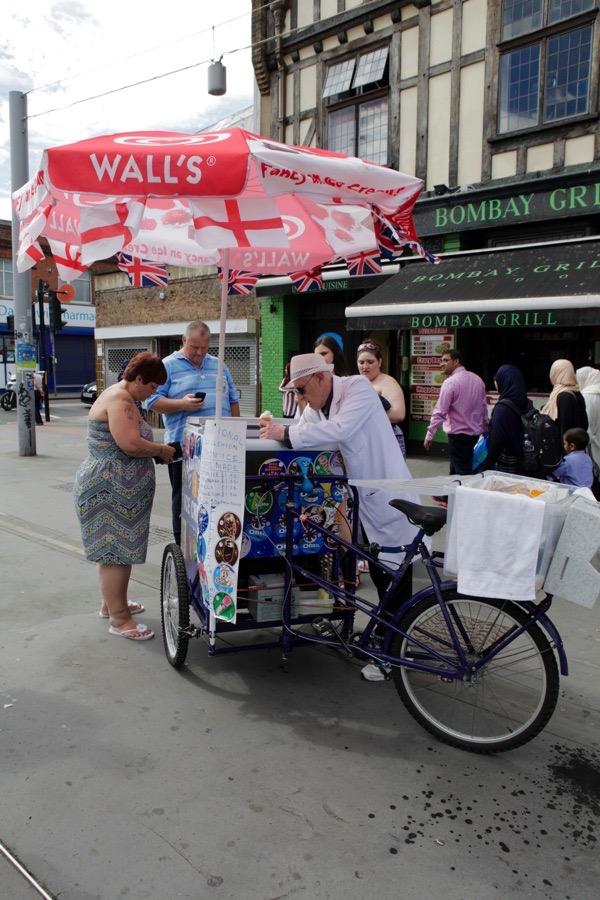
George Parrin, Ice Cream Seller

Please keep your eyes open for my old friend George Parrin, the Ice Cream Seller, who is cycling around the East End now and, if you see George, stop him and buy one – and he will tell you his story.

‘I’ve been on a bike since I was two’
I first encountered Ice Cream Seller, George Parrin, coming through Whitechapel Market on his bicycle. Even before I met him, his cry of ‘Lovely ice cream, home made ice cream – stop me and buy one!’ announced his imminent arrival and then I saw his red and white umbrella bobbing through the crowd towards us. George told me that Whitechapel is the best place to sell ice cream in the East End and, observing the looks of delight spreading through the crowd, I witnessed the immediate evidence of this.
Such was the demand on that hot summer afternoon that George had to cycle off to get more supplies, so it was not possible for me to do an interview. Instead, we agreed to meet next day outside the Beigel Bakery on Brick Lane where trade was a little quieter. On arrival, George popped into the bakery and asked if they would like some ice cream and, once he had delivered a cup of vanilla ice, he emerged triumphant with a cup of tea and a salt beef beigel. ‘Fair exchange is no robbery!’ he declared with a hungry grin as he took a bite into his lunch.
“I first came down here with my dad when I was eight years old. He was a strongman and a fighter, known as ‘Kid Parry.’ Twice, he fought Bombardier Billy Wells, the man who struck the gong for Rank Films. Once he beat him and once he was beaten, but then he beat two others who beat Billy, so indirectly my father beat him.
In those days you needed to be an actor or entertainer if you were in the markets. My dad would tip a sack of sand in the floor and pour liquid carbolic soap all over it. Then he got a piece of rotten meat with flies all over it and dragged it through the sand. The flies would fly away and then he sold the sand by the bag as a fly repellent.
I was born in Hampstead, one of thirteen children. My mum worked all her life to keep us going. She was a market trader, selling all kinds of stuff, and she collected scrap metal, rags, woollens and women’s clothes in an old pram and sold it wholesale. My dad was to and fro with my mum, but he used to come and pick me up sometimes, and I worked with him. When I was nine, just before my dad died, we moved down to Queens Rd, Peckham.
I’ve been on a bike since I was two, and at three years old I had my own three-wheeler. I’ve always been on a bike. On my fifteenth birthday, I left school and started work. At first, I had a job for a couple of months delivering meat around Wandsworth by bicycle for Brushweilers the Butcher, but then I worked for Charles, Greengrocers of Belgravia delivering around Chelsea, and I delivered fruit and vegetables to the Beatles and Mick Jagger.
At sixteen years old, I started selling hot chestnuts outside Earls Court with Tony Calefano, known as ‘Tony Chestnuts.’ I lived in Wandsworth then, so I used to cycle over the river each day. I worked for him for four years and then I made my own chestnut can. In the summer, Tony used to sell ice cream and he was the one that got me into it.
I do enjoy it but it’s hard work. A ten litre tub of ice cream weighs 40lbs and I might carry eight tubs in hot weather plus the weight of the freezer and two batteries. I had thirteen ice cream barrows up the West End but it got so difficult with the police. They were having a purge, so they upset all my barrows and spoilt the ice cream. After that, Margaret Thatcher changed the law and street traders are now the responsibility of the council. The police here in Brick Lane are as sweet as a nut to me.
I bought a pair of crocodiles in the Club Row animal market once. They’re docile as long as you keep them in the water but when they’re out of it they feel vulnerable and they’re dangerous. I can’t remember what I did with mine when they got large. I sell watches sometimes. If anybody wants a watch, I can go and get it for them. In winter, I make jewellery with shells from the beach in Spain, matching earrings with ‘Hello’ and ‘Hola’ carved into them. I’m thinking of opening a pie and mash shop in Spain.
I am happy to give out ice creams to people who haven’t got any money and I only charge pensioners a pound. Whitechapel is best for me. I find the Asian people are very generous when it comes to spending money on their children, so I make a good living off them. They love me and I love them.”




Photographs copyright © Estate of Colin O’Brien
You might also like to read about
Matyas Selmeczi, Silhouette Artist
At The House Of Dreams

A number forty bus took me from Aldgate to the House of Dreams and it only took half an hour to arrive at the front door. Once across the threshold, an alternative cosmos of colour and eye-popping surreal fantasy awaits, transporting you far from the London rain.
Perhaps one of the happiest people I have met, Stephen Wright delights to share the strange but joyous world of his personal subconscious, peopled with a universe of outlandish celestial beings – all made tangible within the interior of a modest Victorian terrace.
For this ever-growing endeavour is no random installation, but an endearingly intimate diary of Stephen’s emotional and spiritual life in sculptural form – as he was eager to explain when I dropped by.
“There is no plan – it’s just evolving, like life itself! My house is like a baby that needs constant feeding. It says, ‘Mama, I need more food!’ and I say, ‘Oh, give me a break.’
It began as a response to a series of programmes by Jarvis Cocker about ‘Outsider Art.’ When I saw those, I thought, ‘I’ve found my family, I’ve found where I fit in.’ So I visited a lot of Outsider Artists in France, they were mostly elderly, and then I began work on my House of Dreams in 1999/2000.
At first it was purely decorative, but then it became a response to the death of my partner Donald, and when – two years into it – both my parents died, I found that difficult to deal with. So my work changed and it became a way of grieving and dealing with loss – because I didn’t have a family this became my way of life. I want to leave something behind. Since then I met Michael, ten years ago, and he’s been very supportive. It’s important to have someone on your side.
I’m from the North and I found it difficult to put down roots in London, so I live in this safe house behind a high wall with a gate where I feel free to be me. All the objects in my house carry a meaning or memory for me and many are from places I consider sacred, like Cornwall, Paris, Barcelona, Madrid & Amsterdam.
The design has a South American style because I’m in touch with spirits from a former life when I was a grave digger in Oaxaca. I’ve been to Mexico to visit the place where I was born.
I’m always amazed that anybody wants to come to my House of Dreams but I love it. People come round all the time to visit and I’ve made a living out of being me. I get up and I’m me. I’m me everyday!”


Adrian Amos, Architectural Salvage Dealer

Adrian Amos with his son Harry
Anyone who ever goes through Vauxhall cannot fail to notice Brunswick House, the eighteenth century pile that was the former home of the exiled Duke of Brunswick in 1811, still holding firm with dignity despite the incursion of cheap and nasty towers that overwhelm the place these days.
It is the last fragment of old Vauxhall, when this was the location of pleasure gardens and fine country houses with estates stretching down to the river. Here Contributing Photographer Rachel Ferriman and I visited Adrian Amos, the current resident of this Palladian mansion which serves as showroom for London Architectural Salvage & Supply Company (LASSCO) that he founded fifty years ago.
As if Brunswick House were not wonder enough, it is crammed now with precious architectural artefacts enjoying safe harbour until they find new permanent homes. In the seventies, Adrian was a pioneer of recycling who saw a way to rescue and repurpose the fabric of condemned buildings when almost on-one else cared. I found him sitting happily in his magnificent study surrounded by a trove of gleaming antiquities – at the the heart of the empire he has built over the past half century – upon which he presides today with his two sons, George and Harry, the royal family of salvage.
Through all these years, Adrian has acquired stories and knowledge as enthusiastically as he has collected architectural artefacts, making him a wily and charismatic raconteur on the subject of old London with an infinite repertoire of tales – which I discovered when I sat down with him.
“George Amos, my grandfather, had a furniture factory in Bow, Old Ford Rd. It wasn’t really a factory, it was just four brothers who were forced to work for their father. A lot happened between the demise of that business around 1963 and my starting this in 1979.
I was brought up in Colchester surrounded by an awareness of the age of the town and the built environment, so I developed an interest in antiquarian stuff but I also inherited some sort of business acumen or drive from my grandfather, I’m assuming.
It’s very difficult to separate out the cheeky anecdotes that one uses to justify things, but I found in North London, Hampstead particularly, there were skips at one end of the street and stuff going into the skips, being torn out of houses, and within walking distance there’d be someone anxious to acquire these original materials, like sash windows and shutters and what have you. So between the two there was a business to be made, taking things out of skips and selling them to the neighbour ten houses away.
I became part of the antiques trade, that was the closest activity to which you could nail it. On the other hand, it was a lot to do with the scrap metal business too, and what we would now call ‘recycling’. Dan Cruickshank coined the term ‘architectural salvage’ in an article in the Architects Journal. That was 1976. I hung around demi-monde of NW1 and before that I’d been running a joinery shop in Hampstead. I was steeped in my father Sydney Amos’ involvement with cabinet making. When I was a boy, I remember him straightening nails out, he was very economical as a lot of people were in those days. After George Amos & Son closed when the East London furniture industry died, he worked in Covent Garden and Spitalfields Market. So I was given a wide choice of careers because I couldn’t go back into cabinet making.
In the seventies, people were encouraged to simply go in and rescue artefacts from buildings irrespective of title of ownership. It’s radically different today. Sometimes people sell us things and we return them to the owners at a loss. Two of our favourite family of street operators came round with some old panelling in the back of their van one day. I asked them where they got it from, there were only two places it could have come from in East London, one was Sutton House and the other was Walthamstow old village. They said it wasn’t Walthamstow so it had to be Sutton House. At that point you have to be careful what you say because if you say the wrong thing, they take fright and take it away and sell it to some utter scoundrel. So I said, ‘You leave it with us and we’ll let the dust settle.’ Then I got on the phone to the National Trust and they discovered that their contractors had whipped it off the wall because they had no idea of its value or significance. Thus we saw that it went back to them. Virtue emanates from every pore when I tell that story.
One day, we got a call to Holy Trinity Church, Finchley Rd, to clear it out before it was demolished. That’s what the business was then, you got called out to places before they were pulled down. We met a chap there who was redundant furnishings officer for the Church of England. ‘Oh jolly good,’ he said, ‘Is this what you do?’ He wasn’t interested in the material, he simply wanted a solution to his problems. He gave me a list of churches that he was keen to see cleared out, pews and all sorts, usually staffed by a single rector who was verging on a nervous breakdown – no congregation. I said, ‘We are going to need a bit of assistance with somewhere to put this stuff.’ So he said, ‘I’ve got this giant church in Shoreditch, St Michael & All Angels. Here’s the key, let yourself in and fill it up with all the bits you are pulling out.’
We were there for forty years. I thought it was too big a prospect for me to handle by myself so I approached Geoff Westland. He was involved in Fine Art transport, so we each used half of the church, a great cavernous unheated place. It gradually filled up and chaps came from the City of London. I suppose they get a bit bored dealing stocks and bonds, they like tangible things. Quite often they’d turn up smoking a cigar after lunch which meant they were in a good mood and they’d see something and get seized with imagination, buying a marble fireplace or a fountain.
We got the job to clear Willesden Cemetery because they had too many marble memorials. So we loaded them up onto the back of our ancient Bedford lorry from 1947 and placed them in the park at the back of the church in Shoreditch where they still are today. The York paving there came from a pepper warehouse near Borough Market. We did the church up piece by piece over the years.
Eventually, we ran out of space because the nature of architectural salvage then was that the supply overwhelmed demand, we had acres of doors that people were pulling out of old houses. So we occupied a yard in Pitfield St on the site of Raymond’s Music Hall where Laurel & Hardy once performed. It was demolished before our eyes, in those days there was a pathological tendency to destroy things and replace them with NCP car parks.
There are thankfully fewer large-scale demolitions these days, although there was a period of facade retentions when we received a glut of decent stuff, floorboards, joinery and other building materials. Today we can drive around London and there isn’t a street without a building that has gone that we were involved with. We have a vast archive of photographs.
Yesterday, I was down in Wapping in Scandrett St, near the Bluecoat School, and I was asked to come there by a Mr Scandrett who has an old yard there, and I thought, ‘That’s remarkable. Here is a true relic, the street is named after the family.’
Twenty years ago, we happening to be passing through Vauxhall and there was a ‘For Sale’ sign outside this place, Brunswick House. It used to be the British Railwaymen’s Staff Association Club, when all the railway lines were cut through Vauxhall they kept it as their club house. The place was due to be disassembled brick by brick and moved to Camberwell so a developer could put a tower on this spot but Historic England said, ‘Over our dead bodies,’ because it is grade II* listed. Instead they got consent for covering the building with enormous advertising hoardings. We came along at the time the developers were getting fed up, we saw that it was for sale and asked, ‘What do you want?’ They gave us quite a reasonable price. After forty years wallowing around in gothic gloom in Shoreditch, we were delighted to be offered a south-facing Palladian mansion.
I couldn’t wished for a better career with my inclinations and upbringing. If you are excited by the aesthetic aspects what could be better than to be surrounded by stuff that fascinates you. Now I live here up on the top floor, it has wonderful light.”

George Amos and family of Bow

George Amos & Son, Old Ford Rd, Bow 1917

Adrian Amos’ first shop in New End Sq, Hampstead

Adrian Amos in his showroom ‘a favourite of the Spitalfields set’

St Michael & All Angels, Shoreditch

Adrian Amos in Shoreditch

St Michael & All Angels

Staff photo by Harry Diamond, 1978 (Adrian Amos is second from left in back row)

Adrian Amos (left) with John Cousans, Shoreditch

The gardens of Brunswick House in Vauxhall no longer extend to the Thames


‘I couldn’t wished for a better career with my inclinations and upbringing’


The framing workshop up in the roof
Brunswick House photographs copyright © Rachel Ferriman
London Architectural Salvage & Supply Company, Brunswick House, 30 Wandsworth Rd, SW8 2LG
John Claridge’s Working People & A Dog
Remembering John Claridge who died on Sunday 24th May aged eighty-one.

Groundsman, E.15 (1965)
“This is the groundsman at the Memorial Ground where I played football aged ten in 1954.”
Some of my favourite people are the shopkeepers and those that do the small trades – who between them have contributed the major part to the identity of the East End over the years. And when I see their old premises redeveloped, I often think in regret, “I wish someone had gone round and taken portraits of these people who carried the spirit of the place.” So you can imagine my delight and gratitude to see this splendid set of photos and discover that during the sixties photographer John Claridge had the insight to take such pictures, exactly as I had hoped.
When John went back ten years later to the pitch near West Ham Station where he played football as a child, he found the groundsman was just as he remembered, with his cardigan and tie, and he took the photograph you see above. There is a dignified modesty to this fine portrait – a quality shared by all of those published here – expressed through a relaxed demeanour.
These subjects present themselves to John’s lens as emotionally open yet retaining possession of themselves, and this translates into a vital relationship with the viewer. To each of these people, John was one of their own kind and they were comfortable being photographed by him. And, thanks to the humanity of John’s vision, we have the privilege to become party to this intimacy today.

Kosher Butcher, E2 (1962) – “The chicken was none too happy!”

Brewery, Spitalfields (1964) Clocking in at the Truman Brewery, Brick Lane.

Lady with Gumball Machine, Spitalfields (1967) – “She came out of her kiosk and asked, ‘Will you photograph me with my gumball machine?'”

Saveloy Stall, Spitalfields (1967) – “It was a cold day, so I had two hot dogs.”

Whitechapel Bell Foundry, E1 (1982) Established in 1598, where the Liberty Bell and Big Ben were cast.

Rag & Bone Man, E13 (1961) – “Down my street in Plaistow, there were not many cars about – all you could hear was the clip-clop of the horse on the wet road.”

Shoe Repairs Closed Saturday, Spitalfields (1969) – “I asked, ‘Why are you open on Saturday?’ He replied, ‘I was just busy.'”

Spice, E1 (1976) – “Taken at a spice warehouse in Wapping. The smells were fantastic, you could smell it down the street.”

Portrait, Spitalfields (1966) – “This is a group portrait of friends outside of their shop. The two brothers who ran the shop, the lady who worked round the corner and the guy who worked in the back.”

Anglo Pak Muslim Butcher, E2 (1962)

Butchers, Spitalfields (1966) -“I had just finished taking a picture next door, when this lady came out with a joint of meat and asked me to take her photograph with it.”

Fishmongers, E1 (1966) Early morning, unloading fish from Grimsby.

Beigel Baker, E2 (1967) -“After a party at about four or five in the morning, we used to end up at Rinkoff’s in Vallance Rd for smoked salmon beigels.”

Newsagent, Spitalfields (1966) -“I said, ‘Shame about Walt Disney dying, can I take your picture next to it?’ and he said, ‘Alright.'”

Selling Shoes, Spitafields (1963) – “My dad used to tell me what his dad told him, ‘If you’ve got a good pair of shoes, you own the world.'”

Strudel, E2 (1962) – “You’ll like this, boy!’ I had just taken a photograph outside this lady’s shop. I said, ‘I think your window looks beautiful.’ and she asked me in for a slice of apple strudel. It was fantastic! But she would not accept any money, it was a gift. She said, ‘You took a picture of my shop.'”

Number 92, Spitalfields (1964)

Tubby Isaac’s, Spitalfields (1982) – “Aaahhh Tubby’s, where I’ve had many a fine eel.”

Junkyard Dog, E16 (1982) – “I was climbing over the wall into this junkyard. All was quiet, when I noticed this pair of forbidding eyes – then I made my exit.”
Photographs copyright © John Claridge
You may also like to take a look at
Along the Thames with John Claridge
At the Salvation Army with John Claridge
John Claridge’s Boxers
Remembering John Claridge who died on Sunday 24th May aged eighty-one. In 2012, John & I visited the monthly meetings of London Ex-Boxers Association to take portraits of the members. Coming from a family of boxers and being an ex-boxer himself, John possesses a natural empathy with these spirited men who were once the fiercest of opponents but are now the closest of friends.

Johnny Barnham (First fight 1950 – last fight 1955)

Ron Whittham (First fight 1950 – last fight 1961)

Joey Khan (First fight 1950 – last fight 1955)

Dynamo Colin Dunne (First fight 1993 – last fight 2003)

Peter Cragg (First fight 1966 – last fight 1970)

Sylvester Mittee (First fight 1977 – last fight 1988)

Ronnie Smith (First fight 1956 – last fight 1966)

Sammy McCarthy (First fight 1946 – last fight 1957)

Billy Graydon (First fight 1949 – last fight 1960)

Ron Cooper (First fight 1944 – last fight 1953)

Dave Cooper (First fight 1966 – last fight 1972)

Paul Fairweather, Committee Member of London Ex-Boxers ( fought in 1965)
Photographs copyright © John Claridge
Take a look at the entire series
John Claridge’s Boxers (Round One)
John Claridge’s Boxers (Round Two)
John Claridge’s Boxers (Round Three)
John Claridge’s Boxers (Round Four)
John Claridge’s Boxers (Round Five)
John Claridge’s Boxers (Round Six)
John Claridge’s Boxers (Round Seven)
John Claridge’s Boxers (Round Eight)
John Claridge’s Boxers (Round Nine)
John Claridge’s Boxers (Round Ten)
John Claridge At The Whitechapel Bell Foundry
Remembering John Claridge who died last Sunday aged eighty-one

John Claridge first visited the Whitechapel Bell Foundry in 1982 to photograph the life of Britain’s oldest manufacturing company, founded in 1570. He returned in 2016, just before it closed, to take another set of pictures. Remarkably, little changed in the intervening years.
‘It was like walking through a time portal,’ John told me. ‘There was a very tactile feeling about the place, where craftsmanship held sway, and my pictures pay testament to that feeling.’
A decade after it closed, the developers have abandoned their ludicrous plan to convert the foundry to a bell-themed boutique hotel and today it hosts property guardians while sinking into decay and acquiring graffiti. Meanwhile the London Bell Foundry continues its campaign to buy the building and reopen it as a working foundry.


You may also like to read about
So Long, Whitechapel Bell Foundry
The Fate of the Whitechapel Bell Foundry


