
In Search Of Flower & Dean St
Contributing Writer, Gillian Tindall, went in search of Flower & Dean St

Fishman’s Tobacconist, Flower & Dean St, seventies, by Ron McCormick
It is a disappointing fact that some dwellings are built to be poor, you can find examples all over Britain. But in parts of London, once desirable streets had poverty imposed upon them. The streets of Spitalfields, whose early Georgian houses are now expensive and desirable, were from the Victorian period until well after the Second World War under this shadow. It is only thanks to the energies and determined actions of a few in the sixties and seventies that a number of these streets have survived, but many have not and one of these is Flower and Dean St.
In Tudor times, Spitalfields was actually fields beyond the City wall, though by the late Elizabethan days a sprinkle of individual wealthy gentleman’s houses began to dot the roadside up to Shoreditch and, by the reign of Charles I, there were more of them – typical ribbon development. This ceased during the Civil War but once peace was established, even before the Cromwells were seen off and Charles II was restored, builders got busy again in this desirable-almost-rural setting.
In 1655 two brothers called Fossan, one of whom was a goldsmith, acquired an odd-shaped chunk of land not far from an ancient, muddy track to brick fields, now Brick Lane. Much of the ground was used for tenter fields, where woollen cloth woven locally was hung up to dry. Already the City clothing industry was impinging on the rural land. The Fossans leased the land for ninety-nine years to two builders, John Flower and Gowan Dean. Such was the system under which most of Greater London was created over the next two hundred years. There they built Fossan St, whose name a generation later came to be misunderstood as ‘Fashion St,’ and gave their own surnames to the street just south of it.
Fashion St still exists with the handsome early eighteenth century Christ Church, Spitalfields, and its graveyard just to the north, but its present buildings are of a later date. The original Flower & Dean St is gone as if it had never been.
It must have been a pretty street and a respectable one for much of the next century, when it was mainly occupied by Huguenot silk-spinners. These were protestants who had come to England to find a more welcoming society than the Catholic France of Louis XIV. They arrived in far greater numbers in the 1680s when Louis tore up a legal agreement tolerating Protestantism and real persecution set in. Some arrived across the Channel in dangerously small boats, making their way into the Thames estuary and up the river by night. Nothing in the life of nations really changes.
These hard-working spinners and weavers flourished, and by the mid-eighteenth century many had established themselves in other businesses, entering prosperous British society. Those who remained began to do less well, imports of silk and cotton from India were damaging the home trade. By the middle of the century the houses in Flower & Dean St were being sub-divided into smaller lodgings. There were also questions about their stability, the brickies employer by Flower & Dean were said to have used inadequate mortar.
Fifty years later, the land east of Whitechapel was entirely built up with houses and these were extending further along the Mile End Rd. Within another generation, the hamlets set in countryside that was visible from the Tower of London would be turning inexorably into the great mass of the East End. To the prosperous residents of expanding West London, this might as well have been a foreign country.
In reality, of course, much of the East End was filled with decent hard-working people who themselves regarded such places as Flower & Dean St as dangerous slums. It was now where lodging houses offered a bed for a few pence a night and where, it was said, thieves felt at ease and prostitutes plied their trade, though it is unclear who would seek them out there.
Ford Maddox Brown, the painter, described it as ‘a haunt of vice… full of cut-throats’, and it was a place where policemen were said only to venture in pairs. But the street acquired a sudden and much more general fame when, in 1888, two women who lodged in there in different houses met their demise in the Whitechapel Murders. Enough was enough. With the not-entirely rational logic that has often been applied to places that get a bad reputation, it was decided the street should be pulled down.
Just to add to the drama, during demolition in 1892, two skulls and some bones were found in a box under the yard. More murder victims, it was at once assumed. In reality, the examination of the bones seems to have been cursory and it is likely these relics were from a field-burial hundreds of years earlier.
What rose in the place of Flower & Dean St was Rothschild Buildings, a massive tenement block bestowed on the large newly-arrived population of Jewish people from Eastern Europe. The bestowers were the Rothschild banking family, and it was a classic example of ‘four percent philanthropy’ – a charitable cause, yet one which nevertheless brought in a modest but steady income.
Moral views change and the improvements of one era attract the disapproval of later times. By the seventies, many of the descendants of the original Jewish occupants of the Rothschild Buildings were established in more salubrious northern suburbs and Bangladeshis arrived to take their place. The Buildings were steeped in soot and the lack of bathrooms in the flats was considered unacceptable. They were pulled down leaving only the grandiose brick archway. Today, the site is a dug-out games pitch at the end of the short stub of Lolesworth Close off Commercial St.
Just to the south is Flower & Dean Walk, a modern low-rise pedestrianised development, looking oddly out of place amidst the complex of old alleys and new tower blocks, with the raucous salesmanship of Petticoat Lane a few minutes away. I went for a stroll down there recently on a snowy day. There was a thin mist floating above the whiteness and it seemed as if the monstrously tall constructions that have transformed the City were dissolving into the sky, as if they were disappearing while the older, traditional buildings remained. Would that it were so!

Rothschild Buildings by John Allin, seventies

This bollard in Lolesworth Close is all that remains of Flower & Dean St

Entrance to the former Rothschild Buildings

Flower & Dean Walk

Flower & Dean Walk

Flower & Dean Estate opened by HRH The Prince of Wales on 18th July 1984
Gillian Tindall’s The House by the Thames is available from Penguin
You may like to read these other stories by Gillian Tindall
Memories of Ship Tavern Passage
At Captain Cook’s House in Mile End
The Costume & Mantle Worker
I spent an afternoon in the Bishopsgate Institute archive studying copies of The Costume & Mantle Worker, a bilingual journal in English and Yiddish for members of the United Ladies Tailors Trade Union. In Spitalfields, we are still aware of the former textile trade and I was especially fascinated by these adverts, reproduced below, which set me on a quest to discover which of these premises are still standing.


Formerly B. Weinberg, Printer, 138 Brick Lane


Formerly Folman’s Hotel & Restaurant, 128 Whitechapel Rd, Opposite Pavilion Theatre


The Gentle Author’s tailors’ stool


Formerly M. S. Rosenbloom & Co for sewing machines, 50 Brick Lane


Pages of The Costume & Mantle Worker courtesy Bishopsgate Institute
You may also like to read about
James Mackinnon, Artist

Twilight at London Fields, 2012
James Mackinnon’s streetscapes of the East End in general and London Fields in particular have captivated me for years. The seductive sense of atmosphere and magical sense of possibility in these pictures is matched by the breathtaking accomplishment of their painterly execution to powerful effect.
Remarkably, James is a third generation artist, with his uncle Blake and grandfather Hugh before him – which perhaps accounts for the classical nature of his technique even if his sensibility is undeniably contemporary.
We sat outside Christ Church, Spitalfields, one day and chatted about the enduring allure of the East End for artists. I was sorry learn that James had been forced to leave due to a combination of the rising rents and lack of recognition for his work.
Like several others I met while researching my book East End Vernacular, he is an artist who is genuinely deserving of appreciation by a much wider audience. It is very disappointing that the rewards for such a prodigiously talented painter as James Mackinnon are so little that he can no longer afford to be in the East End, and the East End is lesser for it.
“I grew up in South London in Lee Green and I used to go to the Isle of Dogs through the foot tunnel under the Thames and I was mystified by the area north of the river. Sometimes I would bunk off school with a sketchbook and go wandering there. It seemed a mysterious land, so I thought ‘What’s further up from the Isle of Dogs?’ I was a kid and I had been taken up to the West End, but I had never been to the East End and I sensed there was something extraordinary over that way.
I had always loved drawing and I got a scholarship in art to Dulwich College when I was eleven. The art department was wonderful and I got massive support, so I used be in the art block most of the time.
Later on, having left home and gone through college, there was a big recession and it was tough, all the students were scrabbling around for work, I had an epiphany. I was sat next to the Thames and I realised I just wanted to look at buildings and paint them. Since I was a child, buildings and their atmosphere, the feeling of buildings always had this resonance that I could not put my finger on.
As a kid, I was painting with poster paint and drawing with felt tips, and I was obsessed with the Post Office Tower. There was an art deco Odeon in Deptford that was derelict for years and it was demolished at the end of the eighties, and that had a huge effect on me. I sat in the back of my dad’s car and we drove past on the way up to London, and I would see this building and almost have a heart attack, I had such strong feelings about it. My God this thing is extraordinary, I am in love with it! It was falling to bits, it had pigeons sitting in the roof and it had wonderful art deco streamlining but it had this atmosphere, an elegance and a sadness. Even with the Post Office Tower, I felt it had this presence as though it were a person. That comes to the fore when you paint and you feel the place. You are not just concentrating on the architecture, it’s an emotional thing.
So with painting and drawing skills, I wanted to explore the landscape and often the hinterland. There is something compelling about going to a place you do not really know about – the mysterious world of places. The atmosphere of places is borne out of people and their residue, it’s about people living in a place.
By exploring, I was slowly drawn to where my heart was guiding me. In the early nineties, I moved to the East End because it was affordable and I had always wanted to explore there. And I was there until around 2013. I lived in Hackney and had a great time there, and made some great friends.
I was struggling as an artist, there was a lot of signing on the dole, but it was an act of faith, I knew it was what I had to do. I had always painted buildings.
I lived near London Fields and there is this little terrace of Georgian houses with a railway line and overhead electric wires, and there are some tower blocks in the distance, and you have all this grass. That was at the bottom of my road, it was such an interesting juxtaposition. A lot of East London landscapes have that, you might get a church sitting next to a railway line, next to tower block, next to the canal and a bit of old railing and some graffiti. That funny mixture. So I would just go and paint what I wanted. I painted what I was drawn to. For a long time, I was obsessed with Stratford. No-one had done anything to it at that time and I would go round the back streets and I roamed the hinterlands. I walked through to Plaistow and it is all part of a certain landscape that you find in the East End. To make a picture, you have got to find something that moves you and it can be something at the bottom of your road that resonates for you and makes the right composition for a painting. It’s hard to explain.
I had a go at having a studio but I was always a struggling artist so, when it came to rent day, it got tricky. It’s lovely having a studio but I could not afford it. I tried living in my studio for a bit to save money on the rent but the landlord found out and there was a cat and mouse game.
By the time I left, I think I had found myself. There is something in the painting that says it is me rather than anyone else and that has evolved from having done it for twenty years. I just about managed to survive. I realised I have got the tenacity and self belief. This is what I love. You find your path after a lot of struggle but it only comes by doing it. You realise that a great painting can come from something very ordinary, you can go for a walk and there might be something round the corner that knocks you out. There was a lot of that in the East End and I am still obsessed by it though it is changing hugely. Some of the landscapes have changed and some of the shops have gone. I miss Hackney in many ways but I do not miss struggling and rents going up. The area has changed.
So now I have moved to Hastings. I had a little boy and it became untenable to carry on living in the East End. I had no choice.”

Homage to James Pryde, 2009 (The Mole Man’s House)

Broadway Market

Shops in Morning Lane, 2014

Hackney Canal near Mare St, 2012

Canal, Rosemary Works 2014

Savoy Cafe, Hackney, 2012

James Tower, London Fields, 2012

Alphabeat, 2007
Paintings copyright © James Mackinnon
At Paul Rothe & Son, Delicatessen
It is my pleasure to co-publish this piece by Julia Harrison, author of the fascinating literary blog THE SILVER LOCKET. I am proud that Julia is a graduate of my blog-writing course.
There are only a few places available now on my course HOW TO WRITE A BLOG THAT PEOPLE WILL WANT TO READ on 25th & 26th March. Email spitalfieldslife@gmail.com to enrol.

Portrait of Paul Rothe by Sarah Ainslie
I have known Paul Rothe’s Delicatessen & Cafe in Marylebone Lane for as long as I can remember. Back in the late sixties and early seventies, my mother used to travel up to town from Putney with me and my sister for a lunchtime treat at Paul Rothe’s before having our haircut by Mr John of ‘Charles, Bruno and John’ in their salon round the corner in Hinde St. I still have my hair cut by Andrew, who was a young apprentice in those days and now has his own salon, ‘Andrew K’, nearby on Marylebone St. He told me on my recent visit that during the salon’s heyday they used to cater for their clients and would often order sandwiches from Paul Rothe. I think it is these connections and the continuity they represent which make Paul Rothe so special to me.
Today, I work at Daunt Books on Marylebone High St and often, seeking a moment to myself at lunchtime, my footsteps lead me in Paul Rothe’s direction. Whether I am having a good day or a bad one, I know when I walk through the door a sense of inner peace will descend. Paul and his son Stephen will be there in their smart white grocer’s coats, lively smiles combined with looks of concentration on their faces as they deal expertly with the lunchtime rush. Office workers will be ordering take-aways, together with locals settling down for a bowl of homemade soup, while a happy customer chooses their favourite jam, chutney or sauce from the colourful range lining the shelves.
In the summer, snatches of music and occasionally operatic voices drift over from the rehearsal rooms across the road. Then I am drawn back to those innocent days long ago when my sister and I would look forward to window shopping at the Button Queen opposite, before ordering our homemade Liptauer and cucumber sandwiches at Paul Rothe, eating at the iconic fifties flip up seats and Formica tables where I sit today.
On a recent visit, in the company of Spitalfields Life Contributing Photographer Sarah Ainslie, I sat down with Paul to learn the story of his shop.
“Rothe is a German name. I am named after my grandfather who came from Saxony and worked his way over on a coal barge in 1898. Most German people at the end of the nineteenth century thought that the streets of London were paved with gold. My father didn’t know a lot about his father’s early life in Germany, except he met my grandmother in London. There was a flower shop in Jason’s Court called Schillers, they were German, and they introduced my grandmother and grandfather to each other. They got married and my father was born in 1915.
Paul started in partnership in Soho. The reason he opened there was that the man he was in partnership with was meant to open early, then they overlapped in the middle of the day and my grandfather would stay open late. But a lot of the customers were saying that his partner wasn’t in the store until about two hours after he should have been, so my grandfather decided to come here to Marylebone Lane and open on his own instead.
In my grandfather’s day, it was purely a retail shop, much smaller than you see now. There was a parlour at the back with a fireplace. My grandmother didn’t want the shop made bigger but my dad was always moaning that it was too small. After my grandfather had passed away, when his mother was on holiday, my father knocked the wall down and made that area part of the shop.
The shop opened on August 2nd 1900. We traded as a German deli. In one of the old photographs of the shop, you can see the words ‘Deutsche Delicatessen.’ We still make Liptauer, which is an Austrian cheese, and my dad made a cheese of his own invention with caraway seeds called ‘Kummelkase.’ A lot was imported from Germany and most of the staff spoke German. My grandfather was in the German army before he came over here and then he served in the British army.
In the Second World War, my father was a conscientious objector, he worked in the Middlesex Hospital on Mortimer St. He never heard his parents speak to each other in German, they only spoke in English. There was quite a German community round here then and we used to get a lot of customers coming to us because they felt at home. Until the First World War, we had ‘Deutche Delicatessen’ on the windows but they took that off. Now we have evolved and trade as an ordinary deli but at Christmas time we still have stollen and lebkuchen.
We lived in Harrow when I was a child and I will always remember coming in to the shop. We had the freestanding tables in those days. Dad had a pole attached to the ceiling which is still there, hidden behind the wooden beam where customers hang their coats, and we used to play ‘Here we go round the mulberry bush.’ I had a great time with my sisters dancing round the shop.
After the Second World War, we started becoming what you see today. A lot of other food stores opened up nearby and we had to change the way we operate. There was a Europa food store in Marylebone High St and, in recent years, Waitrose. Rather than having a general store where you could buy cornflakes and self-raising flour, we reduced our stock but specialised a lot more, so now we do every single jam and marmalade that Tiptree makes, for example, and all the sauces too. The brands that we stock, we have every option available. ‘Cottage Delight’ from Staffordshire is another one and ‘Thursday Cottage,’ which is a separate entity within Tiptree. They’ve got their own little factory and their own manufacturing process. We do well with Regent’s Park honey when it is in season in the summer.
The biggest change in how we operate was when we had parking restrictions imposed. In my dad’s day, anyone could pull up their car and do a week’s grocery shop but, because of the lack of parking, we don’t have that trade now. At Christmas time, we provide stocking fillers, little gifts that people will take home on the train. We don’t do a vast range, we specialise in particular things. My son is very artistic and he gets the aesthetics of the displays just right. He is computer literate too, which I am not, and looks after the social media side of things, putting the soup of the day up so people know what it is.
My father was very fortunate to buy the freehold of the shop when it came up for sale.There was an auction and no one else was bidding that day. Apparently, someone else had been interested but they got caught in traffic!”
Quite reluctantly, I leave Paul and his son Stephen to go back to my late shift at the bookshop. I am captivated by the stories he has shared. In his breezy, good-natured way, he brought to life not just the history of his family but a century of shopkeeping. Our bookshop has been in existence since 1910 and still has its original fittings, so I like to imagine book lovers of the Edwardian era choosing the latest volume, before walking down Marylebone Lane to buy their groceries at the Deutsche Delicatessen.

A photograph from 1914 showing ‘Deutsche Delicatessen’ on the windows. The girls were from the newsagents next door.

Paul Rothe’s grandfather in the early twenties, with his assistant Ernie

Robert, Karoline, Helmut and Thomas, c.1956
‘We stayed open during the war – my aunt ran the shop with one other member of staff called Thomas. As a young boy I remember we had Helmut who was a German prisoner of war who stayed over here – he always wore a little bow tie and we had a German student here. I would have been about ten and my grandmother was serving behind the counter.’

Robert Rothe, 1961
‘My dad was full of adrenaline, trying to serve quickly at lunchtime, he didn’t like anything that slows things down, so he didn’t do toast, wouldn’t do lettuce, he wanted everyone served quickly, he didn’t want a long queue.’

Three generations of the Rothe family on the shop’s hundredth anniversary

Stephen & Paul Rothe today

Stephen & Paul Rothe

Stephen demonstrates the fine art of a pastrami sandwich

Adding the pickles

The complete sandwich

Wrapping the sandwich expertly

A magnificent sandwich

David prepares the soup of the day freshly in the kitchen

‘At some point after the Second World War, my father started doing catering on the premises and we had freestanding tables with four chairs round each table, but you would get a group of six in and they would move the chairs around. We were already getting long queues and dad would have to stop serving and put it all back to where they belonged. So he ordered these that were screwed down to the floor so that people couldn’t move them. They are very fifties with their Formica tops. We had two more put in in 1964 and they’ve been here ever since.’


Stephen & Paul Rothe
Photographs copyright © Sarah Ainslie
PAUL ROTHE & SON, 35 Marylebone Lane, W1U 2NN
You may also like to read about
David Hoffman’s East End
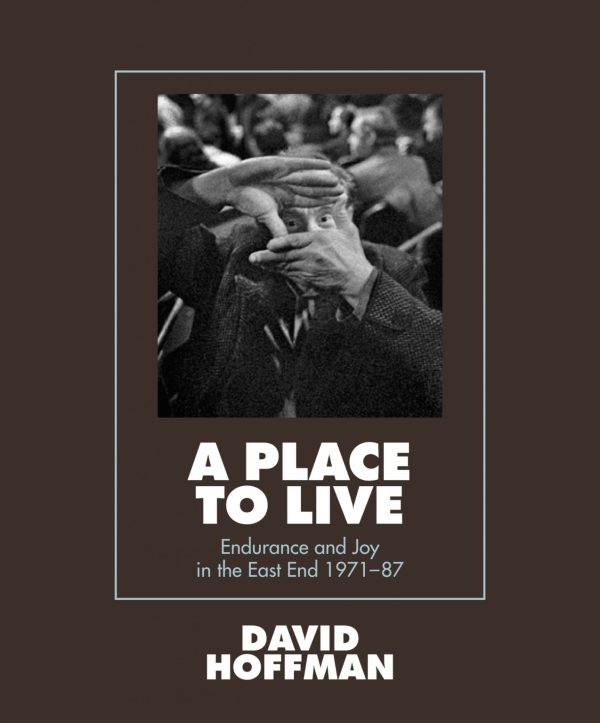
David Hoffman undertook a significant body of photography documenting the East End in the seventies and eighties that I plan to publish this year as a book entitled, A PLACE TO LIVE, Endurance & Joy in Whitechapel, accompanied by a major photographic exhibition at House of Annetta in Spitalfields.
I believe David’s work is such an important social document, distinguished by its generous humanity and aesthetic flair, that I must publish a collected volume. I have a growing list of supporters for this project now, so if you share my appreciation of David’s photography and might consider supporting this endeavour, please drop me a line at spitalfieldslife@gmail.com
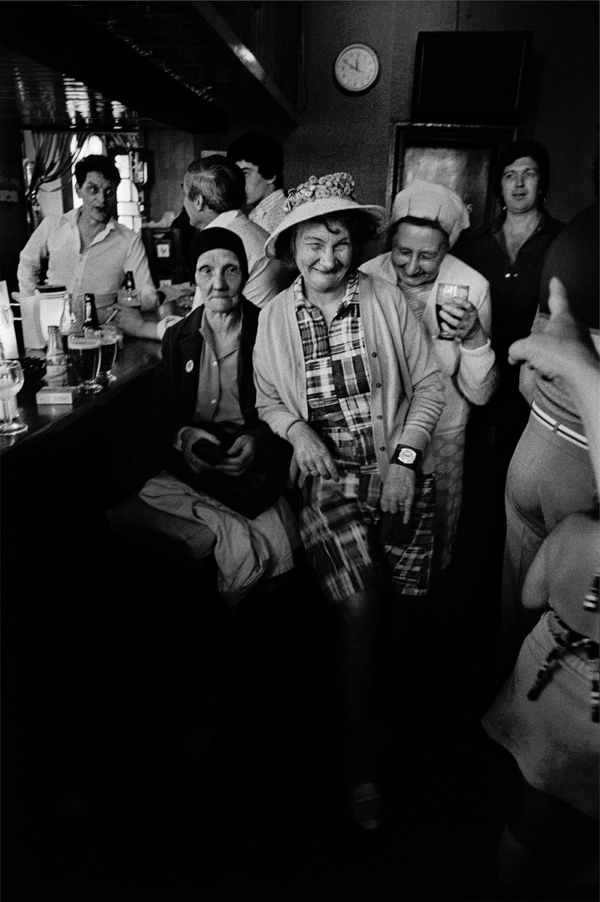
“I took these photographs thirty to forty years ago – they are all from the East End, mostly around Whitechapel and Spitalfields.
I was born in the East End, but my parents’ upward mobility whisked me out to suburbia and it was only in my twenties that I gravitated back to my roots. I was immediately entranced by the atmosphere of joy and dilapidation. It was the spirit of the people you see in these pictures that lifted my spirits and showed me the direction which my career has followed ever since.” – David Hoffman


Photographs copyright © David Hoffman
You may also like to take a look at
Harry Harrison’s East Enders
David – universally known as ‘Harry’ – Harrison or ‘Harry the Pencil’ (1947-2023) came to Mile End in 1979, and liked it so much he never left. An artist who became an architect, he died at the age of seventy-six last Wednesday 15th February. Here are some of his portraits.

‘Tom was a gentle, polite and humble soul. His patch was between Mile End Station and the Roman Road and could be found most days in that area. He told me he was fifty-three years old when I painted him in 2014.
He wore a camel coat over a sleeping bag, over a denim jacket, over a fleece, over a jumper. I last saw Tom a couple of years ago outside Mile End Station and he looked very poorly.
I would love to hear that he survives somewhere still but I fear it is unlikely. I am moved by the depth of feeling in his forlorn expression. His obviously broken nose made me wonder if he may have once been a boxer?’

‘Andrew inhabited a similar patch to Tom and, although seen as frequently, I never saw them together or at the same time. This painting also dates from 2014 and is in Mile End Park.
Unlike Tom, there was something defiant and angry about Andrew – even when offered money he could respond abusively. Yet he did once offer my wife a swig of his White Stripe, so he was not without chivalry.
Andrew would sometimes disappear for a few weeks and re-appear with a make-over, a haircut, clean shaven and with a set of new clothes. I was told that he was once a long distance lorry driver.’

‘I saw Angus sitting on a bench in the evening sunshine in Old Street in 2017. What attracted me, apart from his extraordinary mane and facial hair was that he had a chess set set up on the pavement in front of him.
After striking up conversation, he challenged me to a game which I accepted. I am a poor player and out of practice, and I was hoping I may have stumbled upon an out of luck chess master.
I beat him rather quickly and easily, to my great disappointment and guilt – and Angus was gracious in defeat which made it even worse.’

‘Anyone visiting Brick Lane in recent years could not fail to notice the stylish and urbane Mick Taylor. After completing this portrait I gave it to Mandi Martin who lives by Brick Lane and was a friend of Mick’s.
Mandi volunteers at St Joseph’s Hospice. In 2017, she spent some of Mick’s last few hours talking and reminiscing with him about their shared experiences of the East End.’

‘In 2015, I met Tim sitting on a blanket and begging outside a cash machine in Shoreditch. He seemed young, sad and vulnerable, sitting eating crisps and surrounded by plastic bags of his belongings. Tim was reluctant to talk and seemed embarrassed by his situation. I have not seen him since.’

‘This is my portrait of Gary Arber whose former printworks in the Roman Rd is a short walk from my home. Gary’s grandparents opened the shop in 1897 and Gary ran it for sixty years after after sacrificing a career as a flying ace in the Royal Air Force in 1954.’
Paintings copyright © Estate of Harry Harrison
You may also like to read about
So Long, Harry The Pencil
I was very sorry to learn of the death of Harry Harrison (1947-2023) – also known as Harry the Pencil – at the age of seventy-six last Wednesday 15th February.
When I visited him in Mile End once, he showed me this modest little sketchbook that he filled when he was working in Great Sutton St, Clerkenwell, undertaking a single half hour drawing each lunch hour – most are nearby his office but you will spot a few further afield in Soho, Kings Cross, Hatton Garden & Spitalfields.


Drawings copyright © Estate of Harry Harrison


