
David Hoffman’s East End

David Hoffman undertook a significant body of photography documenting the East End in the seventies and eighties that I plan to publish this year as a book entitled, A PLACE TO LIVE, Endurance & Joy in Whitechapel, accompanied by a major photographic exhibition at House of Annetta in Spitalfields.
I believe David’s work is such an important social document, distinguished by its generous humanity and aesthetic flair, that I must publish a collected volume. I have a growing list of supporters for this project now, so if you share my appreciation of David’s photography and might consider supporting this endeavour, please drop me a line at spitalfieldslife@gmail.com
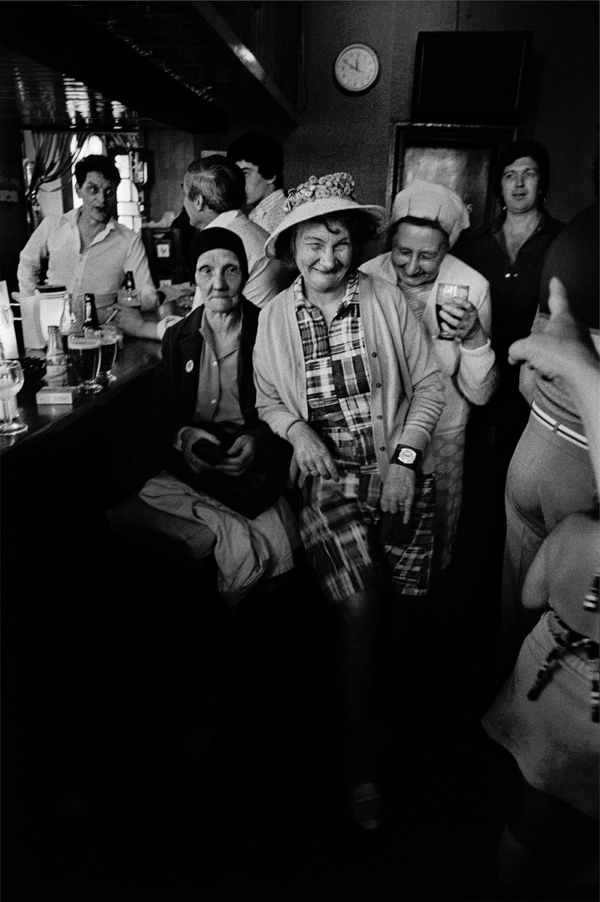
“I took these photographs thirty to forty years ago – they are all from the East End, mostly around Whitechapel and Spitalfields.
I was born in the East End, but my parents’ upward mobility whisked me out to suburbia and it was only in my twenties that I gravitated back to my roots. I was immediately entranced by the atmosphere of joy and dilapidation. It was the spirit of the people you see in these pictures that lifted my spirits and showed me the direction which my career has followed ever since.” – David Hoffman


Photographs copyright © David Hoffman
You may also like to take a look at
Harry Harrison’s East Enders
David – universally known as ‘Harry’ – Harrison or ‘Harry the Pencil’ (1947-2023) came to Mile End in 1979, and liked it so much he never left. An artist who became an architect, he died at the age of seventy-six last Wednesday 15th February. Here are some of his portraits.

‘Tom was a gentle, polite and humble soul. His patch was between Mile End Station and the Roman Road and could be found most days in that area. He told me he was fifty-three years old when I painted him in 2014.
He wore a camel coat over a sleeping bag, over a denim jacket, over a fleece, over a jumper. I last saw Tom a couple of years ago outside Mile End Station and he looked very poorly.
I would love to hear that he survives somewhere still but I fear it is unlikely. I am moved by the depth of feeling in his forlorn expression. His obviously broken nose made me wonder if he may have once been a boxer?’

‘Andrew inhabited a similar patch to Tom and, although seen as frequently, I never saw them together or at the same time. This painting also dates from 2014 and is in Mile End Park.
Unlike Tom, there was something defiant and angry about Andrew – even when offered money he could respond abusively. Yet he did once offer my wife a swig of his White Stripe, so he was not without chivalry.
Andrew would sometimes disappear for a few weeks and re-appear with a make-over, a haircut, clean shaven and with a set of new clothes. I was told that he was once a long distance lorry driver.’

‘I saw Angus sitting on a bench in the evening sunshine in Old Street in 2017. What attracted me, apart from his extraordinary mane and facial hair was that he had a chess set set up on the pavement in front of him.
After striking up conversation, he challenged me to a game which I accepted. I am a poor player and out of practice, and I was hoping I may have stumbled upon an out of luck chess master.
I beat him rather quickly and easily, to my great disappointment and guilt – and Angus was gracious in defeat which made it even worse.’

‘Anyone visiting Brick Lane in recent years could not fail to notice the stylish and urbane Mick Taylor. After completing this portrait I gave it to Mandi Martin who lives by Brick Lane and was a friend of Mick’s.
Mandi volunteers at St Joseph’s Hospice. In 2017, she spent some of Mick’s last few hours talking and reminiscing with him about their shared experiences of the East End.’

‘In 2015, I met Tim sitting on a blanket and begging outside a cash machine in Shoreditch. He seemed young, sad and vulnerable, sitting eating crisps and surrounded by plastic bags of his belongings. Tim was reluctant to talk and seemed embarrassed by his situation. I have not seen him since.’

‘This is my portrait of Gary Arber whose former printworks in the Roman Rd is a short walk from my home. Gary’s grandparents opened the shop in 1897 and Gary ran it for sixty years after after sacrificing a career as a flying ace in the Royal Air Force in 1954.’
Paintings copyright © Estate of Harry Harrison
You may also like to read about
So Long, Harry The Pencil
I was very sorry to learn of the death of Harry Harrison (1947-2023) – also known as Harry the Pencil – at the age of seventy-six last Wednesday 15th February.
When I visited him in Mile End once, he showed me this modest little sketchbook that he filled when he was working in Great Sutton St, Clerkenwell, undertaking a single half hour drawing each lunch hour – most are nearby his office but you will spot a few further afield in Soho, Kings Cross, Hatton Garden & Spitalfields.


Drawings copyright © Estate of Harry Harrison
Restoring The Leonard Montefiore Fountain

Leonard Montefiore Fountain at Stepney Green
Sadly, the streets of our capital are punctuated with neglected drinking fountains that have run dry long ago, dismissed mostly as unsanitary relics of another age. Yet thanks to the inspirational work of the Heritage of London Trust, some will now have a new life, restored as refill stations for water bottles, thereby fulfilling an environmental purpose by reducing plastic waste as well as reinstating historic landmarks that enrich the urban landscape.
Over the winter, Contributing Photographer Rachel Ferriman & I followed the restoration of the Leonard Montefiore Fountain in Stepney Green which will be unveiled and switched on by Rabbi Julia Neuberger at a public ceremony at 1:15pm on Sunday 26th February followed by refreshments from Rinkoffs Bakery. All readers are welcome to attend.
Leonard Montefiore (1853 – 1879) who died at the age of just twenty-six was nephew of the famous Sir Moses Montefiore. Leonard counted Oscar Wilde and Arnold Toynbee among his friends, and during his short life was Secretary of the Society for the Extension of University Teaching in Tower Hamlets, a member of the Jewish Board of Guardians and a supporter of the women’s suffrage movement.
In 1878, Leonard moved to America ‘in order to see for himself what could be learned from the political and social condition of the people…’ There he died of rheumatic fever and was mourned as a man of ‘deep thought and energetic action’. The fountain in Stepney that commemorates him bears the inscription, ‘in affectionate remembrance of Leonard Montefiore who loved children and whom all children loved.. with clear brain and sympathetic heart, a spirit on flame with love for man, hands quick to labour, slow to part, if any good since time began, a soul can fashion, such souls can’.
My first sight of the fountain was in pieces at Fisher’s Court, the yard of Taylor Pearce, architecture and sculpture conservators, last October, where the marble and granite blocks were being cleaned to remove the grime of ages, while the lead plumbing was replaced and inset metal lettering restored. We were entertained by the dramatic spectacle of steam cleaning in action and I met Matt Nation, the conservator who is supervising the project.
‘I’ve been working with Taylor Pearce for just over thirty years as a sculpture conservator – we clean, repair and install artefacts,’ Matt explained to me. ‘We have worked in Buckingham Palace, Windsor Castle, Houses of Parliament, Westminster Abbey, Victoria & Albert Museum and the British Museum. We have already restored a number of fountains, and stone is robust but the hardest part is the plumbing. We have to take the whole thing apart to get access to the pipes. Most waterworks in London before the sixties were lead and all that has to come out. The working parts were long gone from the Stepney fountain, so we replicated those by looking at old photographs and other fountains. It has a decorative, lily-shaped spout with a push-button mechanism. We cast these bespoke bronze elements and then we machined parts to connect them to modern plumbing. It feels good to get them going again.’
In December, I walked over to Stepney Green to see the obelisk winched back into position on top of the fountain again and watched the mortar put in place to hold it all together. The handsome fountain occupies the apex at the triangular junction of Stepney Green and Redmans Rd sympathetically, creating a pleasing landmark that reflects the form of the war memorial clock nearby and the colour of the industrial dwellings across the road. It is the central element in the landscape at this south end of Stepney Green and, now the water flows again, it animates the place with new life.
The Leonard Montefiore Fountain is one of ten fountains currently under restoration by Heritage of London Trust, including the one at the entrance to Altab Ali Park in Whitechapel, and we live in the hope that we shall see all London’s fountains flowing with water again in years to come.
 Matt Nation of Taylor Pearce who supervised the conservation of the fountain

The marble basin under restoration

The central cube that contains the waterworks

Inset lettering commemorating Leonard Montefiore with missing letters replaced

The obelisk prior to cleaning

Kyriacos with the steam cleaner

Cleaning the obelisk

Replacement bronze waterspouts in the form of waterlilies

Toolkit for installing the fountain

Rigging the obelisk to lift it

Winching the obelisk up

Steering the obelisk towards the cube

Setting the obelisk in place

Levelling off the obelisk

Tim, James and Pablo of Taylor Pearce who installed the fountain


T. Heygate Vernon, Architect
Photographs copyright © Rachel Ferriman
You may also like to read about
The Trade Of The Gardener
It is my pleasure to publish this piece by Sian Rees from her fascinating horticultural blog PLANTING DIARIES, Gardens, Planting Styles & Their Origins . I am proud that Sian is a graduate of my blog writing course.
There are only a few places available now on my course HOW TO WRITE A BLOG THAT PEOPLE WILL WANT TO READ on 25th & 26th March.

The Gardener, 1814
Stories about the real world and real lives were considered as interesting and exciting as fiction in children’s books of Georgian England. Trades were a popular subject – what people did and how things were made were described and illustrated with woodcuts, bringing these occupations to life for the young reader.
One such example is Little Jack of all Trades (1814) from Darton & Harvey, publishers of many children’s books from the later eighteenth century into the Victorian era. Author William Darton begins by likening workers in the various trades to bees in a hive, where everyone has their specific role to play within a larger inter-connected structure:
‘all are employed – all live cheerfully and whilst each individual works for the general good, the whole community works for him. The baker supplies the bricklayer, the gardener and the tailor with bread; and they, in return, provide him with shelter, food and raiment: thus, though each person is dependent on the other, all are independent.’
I was delighted to see that the book includes a profile of a gardener, who appears alongside other practical tradespeople such as the carpenter, blacksmith, cabinet maker, mason, bookbinder, printer and hatter – to cite but a few.
The gardener is portrayed handing a large bouquet of flowers to a well-dressed woman – most probably the wife of his employer. Our gardener is a manager – his two assistants behind him are engaged in digging over the soil and watering a bed of plants – while we learn his specialist skills include grafting and pruning.
In the background, a heated greenhouse extends the season for the production of fruits and other crops. Smoke from the building’s stove is visible rising from the chimney on the right. All the tools of the gardeners’ trade remain familiar to us today:
‘the spade to dig with, the hoe to root out weeds, the dibble to make holes which receive the seed and plants, the rake to cover seeds with earth when sown, the pruning hook and watering pot.’
From a contemporary perspective, it is interesting that Darton’s description of the gardener makes the connection between gardening and well-being:
‘Working in a garden is a delightful and healthy occupation; it strengthens the body, enlivens the spirits, and infuses into the mind a pleasing tranquillity, and sensations of happy independence.’
William Darton (1755 – 1819) was an engraver, stationer and printer in London and with partner Joseph Harvey (1764 – 1841) published books for children and religious tracts. His sons Samuel & William Darton were later active in the business.
Darton & Harvey’s books for children always contain plentiful illustrations, packed with details of clothes, buildings and interiors, that convey a powerful sense of working life in the early nineteenth century.
More recently, the status of gardening as a skilled trade has been undermined and eroded – so it is pleasing to see the gardener in this book taking his place on equal terms alongside other tradesmen.


The Basket Maker

The Carpenter

The Black Smith

The Wheelwright

The Cabinet Maker

The Boatbuilder

The Tin Man

The Mason
Images from The Victorian Collection at the Brigham Young University courtesy of archive.org

HOW TO WRITE A BLOG THAT PEOPLE WILL WANT TO READ: 25th-26th March 2023
Spend a weekend in an eighteenth century weaver’s house in Spitalfields and learn how to write a blog with The Gentle Author.
This course is suitable for writers of all levels of experience – from complete beginners to those who already have a blog and want to advance.
We will examine the essential questions which need to be addressed if you wish to write a blog that people will want to read.
“Like those writers in fourteenth century Florence who discovered the sonnet but did not quite know what to do with it, we are presented with the new literary medium of the blog – which has quickly become omnipresent, with many millions writing online. For my own part, I respect this nascent literary form by seeking to explore its own unique qualities and potential.” – The Gentle Author
COURSE STRUCTURE
1. How to find a voice – When you write, who are you writing to and what is your relationship with the reader?
2. How to find a subject – Why is it necessary to write and what do you have to tell?
3. How to find the form – What is the ideal manifestation of your material and how can a good structure give you momentum?
4. The relationship of pictures and words – Which comes first, the pictures or the words? Creating a dynamic relationship between your text and images.
5. How to write a pen portrait – Drawing on The Gentle Author’s experience, different strategies in transforming a conversation into an effective written evocation of a personality.
6. What a blog can do – A consideration of how telling stories on the internet can affect the temporal world.
SALIENT DETAILS
Courses will be held at 5 Fournier St, Spitalfields on 25th-26th March, running from 10am-5pm on Saturday and 11am-5pm on Sunday.
Lunch will be catered with and tea, coffee & cakes by the Townhouse included within the course fee of £300.
Email spitalfieldslife@gmail.com to book a place on a course.

Comments by students from courses tutored by The Gentle Author
“I highly recommend this creative, challenging and most inspiring course. The Gentle Author gave me the confidence to find my voice and just go for it!”
“Do join The Gentle Author on this Blogging Course in Spitalfields. It’s as much about learning/ appreciating Storytelling as Blogging. About developing how to write or talk to your readers in your own unique way. It’s also an opportunity to “test” your ideas in an encouraging and inspirational environment. Go and enjoy – I’d happily do it all again!”
“The Gentle Author’s writing course strikes the right balance between addressing the creative act of blogging and the practical tips needed to turn a concept into reality. During the course the participants are encouraged to share and develop their ideas in a safe yet stimulating environment. A great course for those who need that final (gentle) push!”
“I haven’t enjoyed a weekend so much for a long time. The disparate participants with different experiences and aspirations rapidly became a coherent group under The Gentle Author’s direction in a gorgeous house in Spitalfields. There was lots of encouragement, constructive criticism, laughter and very good lunches. With not a computer in sight, I found it really enjoyable to draft pieces of written work using pen and paper.Having gone with a very vague idea about what I might do I came away with a clear plan which I think will be achievable and worthwhile.”
“The Gentle Author is a master blogger and, happily for us, prepared to pass on skills. This “How to write a blog” course goes well beyond offering information about how to start blogging – it helps you to see the world in a different light, and inspires you to blog about it. You won’t find a better way to spend your time or money if you’re considering starting a blog.”
“I gladly traveled from the States to Spitalfields for the How to Write a Blog Course. The unique setting and quality of the Gentle Author’s own writing persuaded me and I was not disappointed. The weekend provided ample inspiration, like-minded fellowship, and practical steps to immediately launch a blog that one could be proud of. I’m so thankful to have attended.”
“I took part in The Gentle Author’s blogging course for a variety of reasons: I’ve followed Spitalfields Life for a long time now, and find it one of the most engaging blogs that I know; I also wanted to develop my own personal blog in a way that people will actually read, and that genuinely represents my own voice. The course was wonderful. Challenging, certainly, but I came away with new confidence that I can write in an engaging way, and to a self-imposed schedule. The setting in Fournier St was both lovely and sympathetic to the purpose of the course. A further unexpected pleasure was the variety of other bloggers who attended: each one had a very personal take on where they wanted their blogs to go, and brought with them an amazing range and depth of personal experience. “
“I found this bloggers course was a true revelation as it helped me find my own voice and gave me the courage to express my thoughts without restriction. As a result I launched my professional blog and improved my photography blog. I would highly recommend it.”
“An excellent and enjoyable weekend: informative, encouraging and challenging. The Gentle Author was generous throughout in sharing knowledge, ideas and experience and sensitively ensured we each felt equipped to start out. Thanks again for the weekend. I keep quoting you to myself.”
“My immediate impression was that I wasn’t going to feel intimidated – always a good sign on these occasions. The Gentle Author worked hard to help us to find our true voice, and the contributions from other students were useful too. Importantly, it didn’t feel like a ‘workshop’ and I left looking forward to writing my blog.”
“The Spitafields writing course was a wonderful experience all round. A truly creative teacher as informed and interesting as the blogs would suggest. An added bonus was the eclectic mix of eager students from all walks of life willing to share their passion and life stories. Bloomin’ marvellous grub too boot.”
“An entertaining and creative approach that reduces fears and expands thought”
“The weekend I spent taking your course in Spitalfields was a springboard one for me. I had identified writing a blog as something I could probably do – but actually doing it was something different! Your teaching methods were fascinating, and I learnt a lot about myself as well as gaining very constructive advice on how to write a blog. I lucked into a group of extremely interesting people in our workshop, and to be cocooned in the beautiful old Spitalfields house for a whole weekend, and plied with delicious food at lunchtime made for a weekend as enjoyable as it was satisfying. Your course made the difference between thinking about writing a blog, and actually writing it.”
“After blogging for three years, I attended The Gentle Author’s Blogging Course. What changed was my focus on specific topics, more pictures, more frequency, more fun. In the summer I wrote more than forty blogs, almost daily from my Tuscan villa on village life and I had brilliant feedback from my readers. And it was a fantastic weekend with a bunch of great people and yummy food.”
“An inspirational weekend, digging deep with lots of laughter and emotion, alongside practical insights and learning from across the group – and of course overall a delightfully gentle weekend.”
“The course was great fun and very informative, digging into the nuts and bolts of writing a blog. There was an encouraging and nurturing atmosphere that made me think that I too could learn to write a blog that people might want to read. – There’s a blurb, but of course what I really want to say is that my blog changed my life, without sounding like an idiot. The people that I met in the course were all interesting people, including yourself. So thanks for everything.”
“This is a very person-centred course. By the end of the weekend, everyone had developed their own ideas through a mix of exercises, conversation and one-to-one feedback. The beautiful Hugenot house and high-calibre food contributed to what was an inspiring and memorable weekend.”
“It was very intimate writing course that was based on the skills of writing. The Gentle Author was a superb teacher.”
“It was a surprising course that challenged and provoked the group in a beautiful supportive intimate way and I am so thankful for coming on it.”
“I did not enrol on the course because I had a blog in mind, but because I had bought TGA’s book, “Spitalfields Life”, very much admired the writing style and wanted to find out more and improve my own writing style. By the end of the course, I had a blog in mind, which was an unexpected bonus.”
“This course was what inspired me to dare to blog. Two years on, and blogging has changed the way I look at London.”
The Match Girls At The Hanbury Hall
It is commonly known that brave female employees of Bryant & May – known as the Match Girls – met in the Hanbury Hall in Spitalfields to form one of the very first trade unions in 1888.
There is now a rare opportunity to learn more of this auspicious event when Samantha Johnson great-granddaughter of Sarah Chapman, one of the prime movers, gives a lecture in the Hanbury Hall as part of the Spitalfields Series.
Below Samantha Johnson introduces her great-grandmother

Sarah Chapman (1862 – 1945)
My great-grandmother was born on 31st October in 1862 to Samuel Chapman and Sarah Ann Mackenzie. At the time of her birth, her father was employed as a Brewer’s Servant and was also known to have worked in the docks. The fifth of seven children, Sarah’s early years were spent at number 26 Alfred Terrace in Mile End but, by the time she was nine, the family had moved to 2 Swan Court (now the back of the American Snooker Hall on Mile End Rd), where they stayed for the next seventeen years. For a working class family at this time to stay in one place for such a long time was uncommon. Other evidence of the stability of the Chapman family is that Sarah and her siblings were educated, as they were listed as Scholars in the census and could all read and write.
At the age of nineteen, Sarah was working alongside her mother and her older sister, Mary, as a Matchmaking Machinist, and by 1888 she was an established member of the workforce at the Bryant & May factory in Bow. At the time of the Strike, Sarah is listed as working in the patent area of the business, as a Booker, and was on relatively good wages, which perhaps placed her in a position of esteem among other workers. She was certainly paid more than most and this may have been because of her position as a Booker, or perhaps because she just managed to avoid the liberal fines which were meted out by the employers.
There was a high degree of unrest in the factory due to the low wages, long hours, appalling working conditions and the unfair fines system, which caused the women at the factory to grow increasingly frustrated. External influences, particularly the Fabian Society, also provided an impetus for the Strike. Ultimately, 1400 girls and women marched out of the factory, en masse, on that fateful day of 5th July 1888. The next day some 200 girls marched from Mile End down to Bouverie St in the Strand to see Annie Besant, one of the Fabians and a campaigner for women’s rights. A deputation of three (my great-grandmother Sarah Chapman, Mrs Mary Cummings and Mrs Naulls) went into her office to ask for her support. Although Annie was not an advocate of strike action, she did agree to help them organise a Strike Committee.
“We’d ‘ave come out before only we wasn’t agreed”
“You stood up for us and we wasn’t going back on you”
The first meeting of the striking Matchgirls was held on Mile End Waste on 8th July and both the Pall Mall Gazette and The Star provided positive publicity. This was followed by meetings with Members of Parliament at the House of Commons. The Strike Committee was formed and the following Match Girls were named as members: Mrs Naulls, Mrs Mary Cummings, Sarah Chapman, Alice Francis, Kate Slater, Mary Driscoll, Jane Wakeling and Eliza Martin.
Following further intervention by Toynbee Hall and the London Trades Council, the Strike Committee was given the chance to make their case. They met with the Bryant & May Directors and by 17th July, their demands were met and terms agreed in principle. It was agreed that:
- All fines should be abolished.
- All deductions for paint, brushes, stamps, etc., should be put an end to.
- The 3d. should be restored to the packers.
- The “pennies” should be restored or an equivalent advantage given in the system of payment of the boys who do the racking.
- All grievances should be laid directly before the firm, before any hostile action was taken.
- All the girls to be taken back.
It was also agreed that a union be formed, that Bryant & May provide a room for meals away from where the work was done and that barrows be provided to transport boxes, replacing the practice of young girls having to carry them on their heads. The Strike Committee put the proposals to the rest of the workforce and they enthusiastically approved. Thus the inaugural meeting of the new Union of Women Match Makers took place at Stepney Meeting Hall on 27th July and twelve women were elected, including Sarah Chapman.
An indicator of the belief her fellow workers put in Sarah’s ability, was her election as the first TUC representative of the Match Makers’ Union. Sarah was one of seventy-seven delegates to attend the 1888 International Trades Union Congress in London and at the 1890 TUC she is recorded as having seconded a motion.
On the night of the 1891 census, Sarah was still a Booker at the match factory and living with her mother in Blackthorn St, Bromley by Bow, but in December of that same year, she married Charles Henry Dearman, a Cabinet Maker. By this time she had ceased working at Bryant & May.
Sarah and Charles had their first child, Sarah Elsie in 1892. They had five more children, one was my grandfather, William Frederick, born in 1898 when they had moved to Bethnal Green. Sarah’s two youngest sons, William and Frederick lived with her, on and off, into the thirties and she lived out her years there, dying in Bethnal Green hospital on 27th November 1945 aged eighty-three. She was survived by three of her six children, Sarah, William and Fred.
Sarah was buried alongside five other elderly people in a pauper’s plot at Manor Park Cemetery. It was a sad end to a brave life filled with challenges, not least a leading role in a Strike that was the vanguard of the New Labour Movement and helped establish Trade Unionism in this country.
It is thanks to Anna Robinson, Poet & Lecturer at the University of East London, who chose Sarah Chapman as the topic of her MA thesis, Neither Hidden Nor Condescended To: Overlooking Sarah Chapman, that I discovered the story of my great-grandmother. I contacted Anna in 2016 after I discovered her post on a family history forum appealing for information. Until then, I had no idea about Sarah’s story.

Sarah as a member of the Match Girls Union Committee

Sarah with her husband Charles Henry Dearman

Sarah with her grandson, Frederick William

Sarah in later years
You may also like to take a look at
In Old Bermondsey

The horse’s head upon the fascia reveals that RW Autos was once a farrier
Thirty years ago I had reason to visit Bermondsey St frequently but I have hardly been there since, so I thought it was time to walk down across the river and take a look. Leaving the crowds teeming like ants upon the chaotic mound that is London Bridge Station, I ventured into Guy’s Hospital passing the statue of Thomas Guy, who founded it in 1721, to sit with John Keats in a stone alcove from old London Bridge now installed in a courtyard at the back.
From here, I turned east through the narrow streets into Snowsfields, passing the evocatively named Ship & Mermaid Row, and Arthur’s Mission of 1865 annotated with “Feed my Lambs” upon a plaque. An instruction that has evidently not been forgotten, as the building adjoins the Manna Day Centre which offers refuge and sustenance to more than two hundred homeless people each day.
At the end of Snowsfields is the crossroads where Bermondsey St meets the viaduct carrying the railway to and from London Bridge, and the sonorous intensity of the traffic roaring through, combined with the vibration from the trains rattling overhead, can be quite overwhelming. Yet the long narrow street beckons you south, as it has done for more than a thousand years – serving as the path from the Thames to the precincts of Bermondsey Abbey, a mile away, since the eleventh century. When I first came here, I never ventured beyond Bermondsey Sq. Only when I learned of the remains of the medieval gatehouse in Grange Walk beyond, with the iron hinges still protruding from the wall today, did I understand that Bermondsey St was the approach to the precincts of the Abbey destroyed by Henry VIII in 1536.
There is an engaging drama to Bermondsey St with its narrow frontages of shops and tall old warehouses crowded upon either side, punctuated by overhanging yards and blind alleys. Thirty years ago, everything appeared closed down, apart from The Stage newspaper with its gaudy playbill sign, a couple of attractively gloomy pubs and some secondhand furniture warehouses. I was fascinated by the mysteries withheld and Bermondsey St lodged in my mind as a compelling vestige of another time. Nowadays it appears everything has been opened up in Bermondsey St, and the shabbiness that once prevailed has been dispelled by restoration and adaptation of the old buildings, and the addition of fancy new structures for the Fashion & Textile Museum and the White Cube Gallery.
Yet, in spite of the changes, I was pleased to discover RW Autos still in business in Morocco St with the horses’ heads upon the fascia, indicating the origin of the premises as a farrier. Nearby, the massive buildings of the former London Leather Exchange, now housing dozens of small businesses, stand as a reminder of the tanning industry which occupied Bermondsey for centuries, filling the air with foul smells and noxious fumes, and poisoning the water courses with filth.
The distinctive pattern of streets and survival of so many utilitarian nineteenth and eighteenth century structures ensure the working character of this part of Bermondsey persists, and you do not have to wander far to come upon blocks of nineteenth century housing and old terraces of brick cottages, interspersed by charity schools and former institutes of altruistic endeavour, which carry the attendant social history. Thus Bermondsey may still be appreciated as an urban landscape where the past is visibly manifest to the attentive visitor, who cares to spend a quiet afternoon exploring on foot.

John Keats at Guy’s Hospital

Arthur’s Mission in Snow’s Fields seen from Guinness Buildings 1897


In Bermondsey St

At the Woolpack

Old warehouses in Bermondsey St


St Mary Magdalen Bermondsey – the medieval tower is the last remnant of the Abbey founded in the eleventh century


In St Mary’s Bermondsey St

In St Mary Magdalen Graveyard

This plaque marks the site of the abbey church

Old houses in Grange Walk – the house on the right is claimed to be the Abbey gatehouse with hinges of the gates still visible

Bermondsey United Charity School for Girls in Grange Walk, 1830

In Grange Walk

Bermondsey Sq Antiques Market every Friday

A cottage garden in Bermondsey

The Victoria, a magnificent tiled nineteenth century pub with its original spittoon, in Pages Walk


London Leather, Hide & Wool Exchange built 1878 by George Elkington & Sons, next to the 1833 Leather Market, it remained active until 1912.
You may also like to take a look at


