
Libby Hall, Photographer

Click here to book for my tours from March to September
When Libby Hall (1941-2023) was a press photographer in the sixties, based in Clerkenwell and travelling back and forth from her home in Clapton, she occasionally photographed her immediate surroundings as a diversion from her daily work. Yet half a century later these almost inconsequential outtakes have transformed into a powerful evocation of a lost era.

Libby Hall’s desk In Farringdon Rd
‘These photographs were mostly just lens tests, or moments of light that appealed to me on my journeys back and forth to work as a press photographer. The bookstalls were immediately across the street from the newspaper I worked for. I do miss those wonderful bookstalls even though they used up a considerable chunk of my then meagre wages. It was impossible to pass by without having a look – but then what treasures there were to be found!’ – Libby Hall

Looking down onto Farringdon Rd

Looking across to Turnmills St, Clerkenwell Session House and Booth’s Gin Distillery

Bookstalls in Farringdon Rd


Farringdon Station

Liverpool St Station

Clapton Station


Photographs copyright © Estate of Libby Hall
You may also like to take a look at
The Relics Of Old St Paul’s

Looking through into the whispering gallery
Sir Christopher Wren’s success at St Paul’s Cathedral is to have envisaged architecture of such absolute assurance that it is impossible to imagine it could ever have been any different than it is today. Yet Wren was once surveyor of Old St Paul’s, confronted daily with a tottering gothic pile and carrying the onerous responsibility for this vast medieval shambles upon his shoulders, until the Great Fire took it away three hundred and sixty years ago.
The spire of Old St Paul’s collapsed in 1561 and, in Wren’s, time wooden scaffolding was necessary to hold up the poorly-built Cathedral. Parts of the cloister were carried off to build Somerset House and even a fancy new portico designed in the classical style by Inigo Jones failed to ameliorate the general picture of decay and dereliction.
When the Great Fire of London began in the summer of 1666, the Stationers Company stored their books and paper in the crypt of the Cathedral for safe-keeping and residents piled their precious furniture in the churchyard – one of the few open spaces in the City – so that it might be safe even if they lost their homes in the conflagration. These prudent measures only exacerbated the catastrophe when a spark set fire to the wooden roof of the Cathedral which collapsed into the crypt, sending a river of molten lead running down Ludgate Hill, igniting a violent inferno of paper that brought down the entire building and consumed all the furniture in the churchyard as well.
After the pyre of Old St Paul’s was at last extinguished in September, weeks after the Fire had been quenched elsewhere in the City, it became a popular pastime to scavenge through the ruins for souvenirs. You might assume nothing survived but, if you know where to look and what to look for, there are relics scattered throughout New St Paul’s.
There are Roman tiles, an Anglo-Saxon hog’s back tomb, a Viking grave marker and multiple stone fragments of the Cathedral itself, catalogued in the nineteenth century – although I was most fascinated by seventeenth-century effigies that withstood the Fire.
Medieval monuments and statuary were destroyed in the Reformation, and Oliver Cromwell famously stabled his horses in the Cathedral at the time of the English Revolution, but there was a brief period when new monuments and figures were installed prior to the Great Fire of London and a handful of these remain today.
John Donne would have conjured an astute sonnet upon the metaphysical irony of his monument being the only one surviving intact. In his last days, he insisted upon modelling for his own effigy, wrapped in a shroud, and the resultant sculpture is distinguished by remarkably naturalistic drapery. Yet, in spite of this, I can only see it as an image of a flame in which the great poet glimmers eternally.
A small collection of seventeenth-century human effigies rest down in the crypt, burnt black by the Fire. Carved from pale marble or alabaster, they have been transfigured by the furnace-like temperature of the conflagration and emerged charcoal-black, glistening and broken, as if they had been excavated like coal – as if they were creatures of another time, as remote as prehistoric creatures. But, even as they were ravaged by apocalyptic lfire and damaged beyond recognition, some have retained fine detail of armour and clothing, and all have acquired presence. These compelling fragmentary forms are worthy of Henry Moore, charmed stones that manifest an eternal spirit forged in fire.
Unsurprisingly, Christopher Wren had little interest in the relics of Old St Paul’s because he was looking to the future. Wary of medieval foundations, he had his New St Paul’s re-aligned to avoid them. Yet, although Wren had most of the ancient stone broken up to use as infill for New St Paul’s, there are a couple of spots in the crypt where you can see fragments of detailed Romanesque carving sticking out from the wall, hidden in plain sight, to remind us that – even though Old St Paul’s has gone – it is still with us.

Roman tiles and Anglo-Saxon grave cover in the triforium

Hogback grave cover, dating from 1000-1050 AD, possibly from the grave of King Athelstan

Viking grave marker, dating from 1125-50AD, dug up in 1852 in the churchyard

Twelfth century Romanesque carving of foliage in the wall of the crypt

Twelfth century Romanesque carving of foliage in the wall of the crypt

Ledger stone of Brian Walton, Bishop of Chester, died 1661

Sir John & Eliza Wolley

Sir John Wolley, Latin Secretary to Elizabeth I, died 1596

Eliza Wolley, Lady of the Privy Chamber to Elizabeth I, died 1600

Sir Thomas Heneage Vice-Chamberlain to Elizabeth I, died 1594, & Anna Heneage, died 1592

Unknown effigy

Unknown effigy

William Cokain, Mayor of London 1619, died 1626

William Cokain, Mayor of London 1619, died 1626

John Donne, Poet & Dean of St Paul’s (1572-1631), monument by Nicholas Stone

Caen & Reigate stones from Old St Paul’s (1180-1666 AD) excavated by Francis Penrose, Cathedral Surveyor in the nineteenth century


This lion is a fragment of Inigo Jones portal to St Paul’s which inspired Christopher Wren


Click to enlarge this comparative plan of 1872 which superimposes the outlines of Old and New St Paul’s (Reproduced courtesy of St Paul’s)
You may also like to read my other stories of St Paul’s Cathedral
A Revelation In The Mile End Road
It is my pleasure to publish this extract from Gillian Tindall’s novel Journal of a Man Unknown which describes a nocturnal vision that is granted to the protagonist in Mile End
CLICK HERE TO ORDER JOURNAL OF A MAN UNKNOWN FOR £10

‘It was a fine night, though chill, and the stars were out. I went walking on, beyond the Spital Fields and Brick Lane, out into the countryside to Mile End and beyond, to where there were few houses along the highway, out to where the Jews have made a burial ground. (I had met a few, newcomers to London like to the Huguenots, and they were very much the same manner of decent, hard-working people, for all their Spanish names). I had my knife in my belt as usual, but there was nothing to fear that far east out of Town: no-one about at all.
The moon was shining over St Dunstan’s, out at Stepney, and I lent a while against the dead Jews’ wall, watching it. I even contemplated walking yet further, so full of a strange energy did I feel. It was as if something that had been in the bottom of my mind for years, vaguely troubling me from time to time but ever quietly dismissed, had suddenly risen to the top that evening like liquid over a fire in a pan.
Jews, I know, have their own God whose son has yet to appear on earth. The Saracens have another one, of much the same kind by all accounts. The Huguenots, Protestants, Puritans, Catholics, Greek Christians and all the rest are supposed to believe in One God and His Son, but that has not stopped them from fighting and killing each other in the most un-Christian way in every century of which I have heard account. They were at it here in England all my childhood years.
How much fervent, angry, desperate praying goes on by all sides, many of the prayer-sayers wishing damnation on the others. And how little of it ever truly produces a result, except by ordinary life chances that are then falsely claimed as ‘prayers answered’?
And in that moment I knew, in a burst of freedom, like a man before whom a door that he believed firmly locked and forbidden is suddenly open – that I did not believe in any of it, and had not done so for many years.
And as for the idea that the great Maker of the construction is perpetually watching each of us separate persons, intent on testing every one of his multitudinous subjects’ loyalty with particular troubles and griefs, like a bad tempered and unjust King doling out unmerited torments to some on purpose to ‘try them’, while occasionally and unexpectedly bestowing blessings on others no more deserving – this was suddenly revealed to me as a story for badly behaved children.
And I strongly suspected in that same moment, that a number of the men whom I had met in London, and whom I most respected, had secretly come to the same never-to-be-spoken conclusion. Unbelief is contrary to the Law of both God and Man. But surely honest.
I went on standing there for quite a while, I think, trying to take in my new-found freedom. It felt right and just. But lonely, if – from – henceforth, there were none but myself in charge of my fate. Also a sense of my consequent, helpless separation in my secret heart from all others. For a few minutes my desolation recalled my first weeks alone in London. And I had no one at that time with whom I felt intimate enough to admit my new conviction.
And then something odd happened while I stood there. One of those moments, like the one in the night before I left the Forest (which I had dismissed as a dream). Although the Mile End Road was deserted, the few cottages around shuttered and none about but a half-grown fox in the Jews’ cemetery, who had caught sight of me over the wall and had scampered away, I suddenly became convinced that I was surrounded. By houses and people that I could sense but could not see. The moon at that moment had gone behind a thick cloud, a country-dark descended. Yet I felt as if I were standing in a City street. Voices, passing by, that I could not hear properly, and footsteps on stone and other sounds of rushing or roaring that I could not identify. Such as the sound of machines. But my strongest sensation was that I was hemmed in, crowded.
Cravenly fearful, as if my ungodly thoughts were somehow visiting on me a revenge, I clutched the top of the brick cemetery wall with my hands. That at least seemed solid and of all time. Fearful of what the returning moon might reveal, I shut my eyes for a while. I believe that by habit I even cravenly and illogically prayed ‘Keep me safe, Lord!’
I opened my eyes again at last when the sounds had faded away. The moon had returned. The Mile End Road was its peaceful, deserted, night-time self. The clock of St Dunstan’s struck twelve.
Suddenly very tired, I must have made my way back to the Spital Fields, though that I do not remember.’

CLICK HERE TO ORDER JOURNAL OF A MAN UNKNOWN FOR £10

At The West India Docks Impounding Station

This is one of three monster pumps whose purpose is to maintain the water level in the West India Dock at Canary Wharf. Coiled up like giant sea serpents, these mysterious green creatures inhabit an impounding station built where the dock meets the Thames at Limehouse. From the exterior, this old brick shed reveals nothing of its function, yet once you step inside you enter another realm where the pumps line up dutifully to serve their purpose, like cows in a milking shed or horses in a stable. It is quite an adventure to climb down the stairs into the vast industrial space that houses the mighty pumps and discover that the building is much larger than it looks on the outside.
Built in the twenties and opened in 1930, the West India Docks Impounding Station is a shining marvel of engineering that is maintained in constant good working order today by the Canal & River Trust. Gauges measure the water in the dock and, if it drops below the desired level, the electric pumps automatically whirr into action to top it up, drawing water from the Thames. Usually only one of the pumps is required, with another as a back-up and a spare in case one of the others breaks down. All eventualities are covered.
Long ago, when the constant to-and-fro of the ships into the tidal Thames caused the water level in the docks to fall, the impounding station became necessary to ensure that the water was kept at sufficient level to prevent grounding of vessels in the dock. On the day I visited, our guide took us first to gaze in wonder upon the great expanse of water in the dock hemmed on all sides by tall towers and explained – to my alarm – that if all the water drained out of the dock then the buildings might fall down. I was marginally relieved when it was explained to me later that, when the docks were constructed two centuries ago, they were built with bevelled brick walls which make them exceptionally robust structurally.
I do wonder if the guide had been pulling my leg about the towers at Canary Wharf collapsing if the water drained out, but I take reassurance in the continued existence of the impounding station to ensure that I will never find out the truth, or otherwise, of this apocalyptic supposition.

The anonymous exterior of the West India Docks Impounding Station

‘You climb down the stairs into an industrial space and discover that the building is much larger than it looks on the outside’

‘The pumps line up dutifully to serve their purpose, like cows in a milking shed or horses in a stable’

‘Coiled up like giant sea serpents’


These contain blades that may be lowered or raised to control the ingress of water into the dock

Maintenance tools from 1930

Entrance to West India Docks, originally built as the City Canal in 1805 and then sold to West India Dock Company in 1829 to construct the dock.

Carved numerals indicate the water level at the entrance to the dock

Looking west up the Thames from the dock entrance at Limehouse

West India Docks is surrounded by tall towers today
Contact the Canal & River Trust to find out when the Impounding Station my be visited
Stanley Rondeau At The V&A
Remembering Stanley Rondeau who died on 13th January aged ninety-two
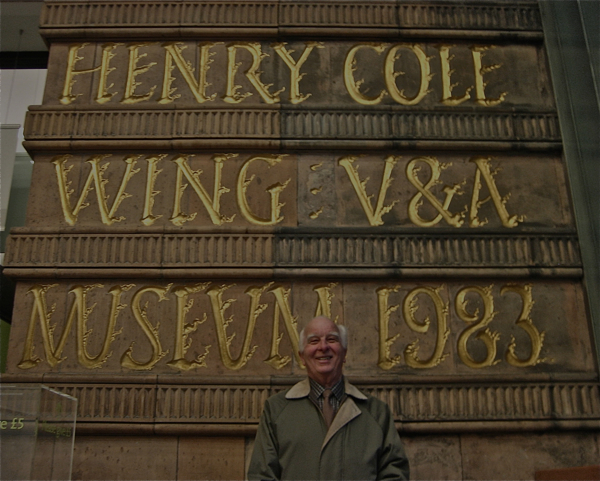
Stanley Rondeau’s great-great-great-great-great-great-grandfather Jean Rondeau was a Huguenot silk weaver who came to Spitalfields in 1685 as a refugee fleeing religious persecution in Paris. Jean’s son prospered in Spitalfields, becoming Sexton at Christ Church, having eleven children, building a new house at 4 Wilkes St and commissioning designs in the seventeen-forties from the most famous of silk designers, Anna Maria Garthwaite, who lived almost next door, in the house on the corner with Princelet St.
Since Anna Maria Garthwaite’s designs were exceptionally prized both for their aesthetic appeal and their functional elegance as patterns for silk weaving, hundreds of her original paintings have survived to this day. So Stanley & I went along to the Victoria & Albert Museum in Kensington to take a look at those done for Stanley’s ancestor Jean the Sexton, nearly three centuries ago. We negotiated our way through the labyrinths of the vast museum, teeming with school children, with a growing sense of anticipation because although Stanley had seen one of the designs reproduced in a book, he had never cast his eyes upon the originals. And up on the fourth floor, we entered a sanctuary of peace and quiet where curator Moira Thunder awaited us in a lofty room with a long table and large flat blue boxes containing the treasured designs that were the objects of our quest.
Moira – chic in contrasting tones of plum and navy blue, and with a pair of fuchsia lenses which hinted at a bohemian side – welcomed us with scholarly grace, and duly opened up the first box to reveal the first of Anna Maria Garthwaite’s designs. Drawn in the wide margin at the top of a large sheet containing an elaborate floral number, this design was the epitome of restraint with a repeated motif that resembled a bugle flower in subdued tones of purplish brown, labelled Mr Rondeau, Feb 5 174 1/2, and intended as a pattern to be woven into the body of a vellure used for men’s suiting.
Stanley was instinctively drawn towards his own name revealed before him, leaned forward to touch the piece of paper – which caused Moira’s eyes to pop, though fortunately for all concerned the priceless design was protected by a layer of transparent conservator’s plastic. Once smiles of amelioration had been exchanged after this faux-pas, Stanley enjoyed a quiet moment of contemplation, gazing with his deep-set chestnut eyes from beneath his bushy white eyebrows upon the same piece of paper that his ancestor saw. I think Stanley would have preferred it if ‘Mr Rondeau’ had been written beside the fancy design below, because he asked Moira whether the other design for Jean Rondeau in the collection was more colourful but, with an unexpectedly winsome smile, Moira refused to be drawn.
Yet while Stanley’s curiosity was understandably focussed upon those designs attributed to his ancestor, I was enraptured by the myriad pages of designs by Anna Maria Garthwaite, whose house I walk past every day. Kept from the daylight, the colours in these sketches remain as fresh as the day she painted them in Spitalfields three centuries ago. The accurate observation of both cultivated and wild flowers in these works suggests they were painted from specimens which permits me to surmise that she had access to a garden, and picked her wild flowers in the fields beyond Brick Lane. I especially admired the sparseness of these sprigged designs, drawing the eye to the lustrous quality of the silk, and Moira, who worked as assistant to Natalie Rothstein – the ultimate authority on Spitalfields silk – pointed out that weavers rarely deviated from Garthwaite’s designs because they were conceived with such thorough understanding of the process.
And then, Moira opened the second box to reveal the second design by Anna Maria Garthwaite for Jean Rondeau, which Stanley had never seen before. Larger and more complex than the previous, although monochromatic, this was a pattern of pansy or violet flowers divided by scalloped borders into a repeated design of lozenges. Again drawn in the margin, at the top of a piece of paper above a multicoloured design, this has the name ‘Mr Rondeau’ written in feint pencil beside it. It was a design for a damask, either for men’s suiting or a woman’s dress, which Moira suggested would be appropriate to be worn at the time of half-mourning. A degree of formalised grief that is unfamiliar to us, yet would have been the custom in a world where women bore many more babies in the knowledge that only those chosen few would survive beyond childhood.
Moira took the unveiling of this second design as the premise to outline the speciality of Master Silk Weaver Jean Rondeau, who appears to have built his fortune, and company of fifty-seven employees, upon the production of cheaper silks for men, unlike his Spitalfields contemporary Captain Lekeux – for whom Anna Maria Garthwaite also designed – who specialised in the most expensive silks for women. In response to Moira’s erudition, Stanley began to talk about his ancestor and the events of the seventeen forties in Spitalfields with a familiarity and grasp of detail that made it sound as if he were talking about a recent decade. And as he spoke, with the unique wealth of knowledge that he had gathered over a lifetime of research, I could see Moira becoming drawn in to Stanley’s extraordinary testimony, revealing new information about this highly specialised milieu of textile production which is her particular interest. It was a true meeting of minds, and I stood by to observe the accumulation of mutual interest, as with growing delight Moira and Stanley exchanged anecdotes about their shared passion.
Recently, Stanley visited the Natural History Museum to hold the bones of his ancestor Jean the Sexton which were removed there from Christ Church for study, and by seeing the designs at the Victoria & Albert Museum that once passed before Jean’s eyes in Spitalfields, he had completed his quest.
‘It was a big day,’ Stanley admitted to me afterwards, his eyes shining with emotion, as he began to absorb the reality of what he had seen.

Stanley Rondeau sees the design commissioned by his ancestor in the seventeen-forties for the first time

Design for a vellure for Jean Rondeau, by Anna Maria Garthwaite, Spitalfields, February 5th, 1741

The full page with Jean Rondeau’s design at the top

Design for a damask by Anna Maria Garthwaite for Jean Rondeau, possibly for half-mourning
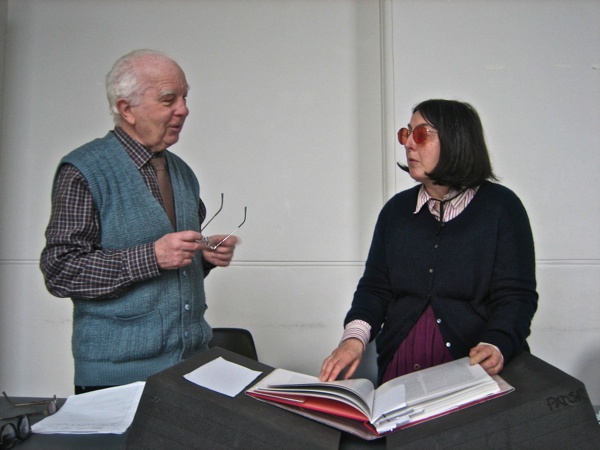
Stanley Rondeau chats with Moira Thunder, Curator, Designs, at the Victoria & Albert Museum, over a copy of Natalie Rothstein’s definitive work “Silk Designs of the Eighteenth Century.”

Anna Maria Garthwaite’s catalogue of designs


Designs by Anna Maria Garthwaite for Spitalfields silks from the seventeen forties in the collection of the Victoria & Albert Museum.
Textile design photographs by Jane Petrie
Textiles copyright © Victoria & Albert Museum
With grateful thanks to Moira Thunder of the Victoria & Albert Museum for making this possible.
You may also like to read about
So Long, Stanley Rondeau
Stanley Rondeau died on 13th January aged ninety-two. His funeral will be on Wednesday 25th February at Edmonton Cemetery, 11.30am

Stanley Rondeau (1933-2026)
If you visited Nicholas Hawksmoor’s Christ Church, Spitalfields on any given Tuesday, you would find Stanley Rondeau – where he volunteered one day each week – welcoming visitors and handing out guide books. The architecture is of such magnificence, arresting your attention, that you might not even have noticed this quietly spoken white-haired gentleman sitting behind a small table just to the right of the entrance, who came here weekly on the train from Enfield.
But if you were interested in local history, then Stanley was one of the most remarkable people you could hope to meet, because his great-great-great-great-great-great-grandfather Jean Rondeau was a Huguenot immigrant who came to Spitalfields in 1685.
“When visiting a friend in Suffolk in 1980, I was introduced to the local vicar who became curious about my name and asked me ‘Are you a Huguenot?'” explained Stanley with a quizzical grin. “I didn’t even know what he meant,” he added, revealing the origin of his life-changing discovery, “So I went to Workers’ Educational Association evening classes in Genealogy and that was how it started. I’ve been at it now for thirty years. My own family history came first, but when I learnt that Jean Rondeau’s son John Rondeau was Sexton of Christ Church, I got involved in Spitalfields. And now I come every Tuesday as a volunteer and I like being here in the same building where he was. They refer to me as ‘a piece of living history’, which is what I am really. Although I have never lived here, I feel I am so much part of the area.”
Jean Rondeau was a serge weaver born in 1666 in Paris into a family that had been involved in weaving for three generations. Escaping persecution for his Protestant faith, he came to London and settled in Brick Lane, fathering twelve children. Jean had such success as weaver in London that in 1723 he built a fine house, number four Wilkes St, in the style that remains familiar to this day in Spitalfields. It is a indicator of Jean’s integration into British society that his name is to be discovered on a document of 1728 ensuring the building of Christ Church, alongside that of Edward Peck who laid the foundation stone. Peck is commemorated today by the elaborate marble monument next to the altar, where I took Stanley’s portrait which you can see above.
Jean’s son John Rondeau was a master silk weaver and in 1741 he commissioned textile designs from Anna Maria Garthwaite, the famous designer of Spitalfields silks, who lived at the corner of Princelet St adjoining Wilkes St. As a measure of John’s status, in 1745 he sent forty-seven of his employees to join the fight against Bonnie Prince Charlie. Appointed Sexton of the church in 1761 until his death in 1790, when he was buried in the crypt in a lead coffin labelled John Rondeau, Sexton of this Parish, his remains were exhumed at the end of twentieth century and transported to the Natural History Museum for study.
“Once I found that the crypt was cleared, I made an appointment at the Natural History Museum, where Dr Molleson showed his bones to me,” admitted Stanley, widening his eyes in wonder. “She told me he was eighty-five, a big fellow – a bit on the chubby side, yet with no curvature of the spine, which meant he stood upright. It was strange to be able to hold his bones, because I know so much about his history,” Stanley told me in a whisper of amazement, as we sat together, alone in the vast empty church that would have been equally familiar to John the Sexton.
In 1936, a carpenter removing a window sill from an old warehouse in Cutler St that was being refurbished was surprised when a scrap of paper fell out. When unfolded, this long strip was revealed to be a ballad in support of the weavers, demanding an Act of Parliament to prevent the cheap imports that were destroying their industry. It was written by James Rondeau, the grandson of John the Sexton who was recorded in directories as doing business in Cutler St between 1809 and 1816. Bringing us two generations closer to the present day, James Rondeau author of the ballad was Stanley’s great-great-great-grandfather. It was three generations later, in 1882, that Stanley’s grandfather left Sclater St and the East End for good, moving to Edmonton when the railway opened. And subsequently Stanley grew up without any knowledge of Huguenots or the Spitalfields connection, until that chance meeting in 1980 leading to the discovery that he was an eighth generation British Huguenot.
“When I retired, it gave me a new purpose,” said Stanley, cradling the slender pamphlet he has written entitled The Rondeaus of Spitalfields. “It’s a story that must not be forgotten because we were the originals, the first wave of immigrants that came to Spitalfields,” he declared. Turning the pages slowly, as he contemplated the sense of connection that the discovery of his ancestry has given him, he admitted, “It has made a big difference to my life, and when I walk around in Christ Church today I can imagine my ancestor John the Sexton walking about in here, and his father Jean who built the house in Wilkes St. I can see the same things he did, and when I am able to hear the great eighteenth century organ, once it is restored, I can know that my ancestor played it and heard the same sound.”
There is no such thing as an old family, just those whose histories are recorded. We all have ancestors – although few of us know who they were, or have undertaken the years of research Stanley Rondeau had done, bringing him into such vivid relationship with his ancestors. It granted him an enviably broad sense of perspective, seeing himself against a wider timescale than his own life. History became personal for Stanley Rondeau in Spitalfields.
The silk design at the top was commissioned from Anna Maria Garthwaite by Stanley’s ancestor, Jean Rondeau, in 1742. (courtesy of V&A)

4 Wilkes St built by Jean Rondeau in 1723. Pictured here seen from Puma Court in the nineteen twenties, it was destroyed by a bomb in World War II and is today the site of Suskin’s Textiles.

The copy of James Rondeau’s song discovered under a window sill in Cutler St in 1936.

Stanley Rondeau standing in the churchyard near his home in Enfield, at the foot of the grave of John the Sexton’s son and grandson (the author of the song) both called James Rondeau, and who coincidentally also settled in Enfield.
The Return Of Walter Donohue’s Screenwriting Course

Walter Donohue by Sarah Ainslie
We are delighted to announce that – due to popular demand – script editor, producer and luminary of the British cinema, Walter Donohue has agreed to teach another two-day screenwriting course at Townhouse in Spitalfields on the weekend of 18th and 19th April.
Here are some comments by students on Walter’s previous course:
“I just want to say thank you for putting on such a fantastic weekend – it was so, so interesting speaking with like-minded people who share such a love for film and to be able to speak to the wonderful Walter and Mike Figgis and glean some of their vast knowledge. The food was delicious and the setting was ideal, I really appreciate the effort that you put into making it such a fantastic weekend.” MN
“The course itself exceeded my expectations – I learned so many invaluable lessons about screenwriting and the film industry itself. I will take all the new skills into my career. Both Mike Figgis and Walter led an incredibly useful course and truly took their time with each student.” GE
“The weekend spent in the Townhouse was nothing short of wondrous. Walter’s passion for writing and storytelling is infectious. For every story that the students had, Walter had suggestions that took that story to a new level. The man’s knowledge of what is needed in screenwriting and how to pitch, for me, was invaluable. The weekend was two days that I will never forget. I now have the tools and ammunition to start my own personal project. The visit by Mike Figgis was insightful. His views on Hollywood and filmmaking were blunt, informative and most importantly, honest! I could have listened to him talk all day.” JL
WALTER’S EXPERIENCE
In the eighties, Walter began working as a script editor, starting with Wim Wenders’ Paris, Texas and Sally Potter’s Orlando. Since then he has worked with some major filmmakers including Joel & Ethan Coen, Wim Wenders, Sally Potter, David Byrne, Mike Figgis, John Boorman, Viggo Mortensen, Alex Garland, Kevin Macdonald, and László Nemes.
For the past thirty years he has been editor of the Faber & Faber film list, publishing Pulp Fiction and Barbie, and screenplays by Quentin Tarantino, Wes Anderson, David Lynch, Sally Potter, and Greta Gerwig & Noah Baumbach, Joel & Ethan Coen, and Christopher Nolan among many others.
Walter also published Scorsese on Scorsese, and edited the series of interview books with David Lynch, Robert Altman, Tim Burton, John Cassavetes, Pedro Almodovar and Christopher Nolan.
THE COURSE
Walter’s course is suitable for all levels of experience from those who are complete beginners to those who have already written screenplays and seek to refresh their practise. The course is limited to sixteen students.
APPROACHES TO SCREENWRITING
Walter says –
“My course is about approaches to writing a screenplay rather than a literal step-by-step technique on how to write.
The objective of my course is to immerse participants in the world of film, acquainting them with a cinematic language which will enable them to create films that are unique and personal to themselves.
There are four approaches – each centred around a particular film which will be the focus of each of the four sessions.
The approaches are –
Structure: Paris, Texas
Viewpoint: Silence of the Lambs
Genre: Anora
Endings: Chinatown
Participants will be required to have seen all four films in advance of the course.”
This is a unique opportunity to enjoy a convivial weekend with Walter in an eighteenth century townhouse in Spitalfields and learn how to approach your screenplay.
Refreshments, freshly baked cakes and lunches are included in the course fee of £350.
Please email spitalfieldslife@gmail.com to book your place.
Please note we do not give refunds if you are unable to attend or if the course is postponed for reasons beyond our control.

Photographs copyright © Sarah Ainslie


