
At Walton On The Naze

Click here to book for my tours through August, September and October

All this time, Walton on the Naze has been awaiting me, nestling like a forgotten jewel cast up on the Essex coast, and less than an hour and a half from Liverpool St Station.
Families with buckets and spades joined the train at every stop, as we made our way eastwards to the point where Essex crumbles into the North Sea at the rate of two metres a year. Yet all this erosion, while reminding us of the force of the mighty elements, also delivers a perfect sandy beach – the colour of Cheddar cheese – that is ideal for sand castles and digging. Stepping from the small train amongst the flurry of pushchairs and picnic bags, at once the sea air transports you and the hazy resort atmosphere enfolds you. Unable to contain yourself, you hurry through the sparse streets of peeling nineteenth century villas and shabby weather-boarded cottages to arrive at a rise overlooking Britain’s third longest pier, begun in 1830.
In spite of the majestic pier, this is a seaside resort on a domestic scale. You will not find any foreign tourists here because Walton on the Naze is a closely guarded secret, it is kept by the good people of Essex for their sole use. At Walton on the Naze everyone is local. You see Essex families running around as if they owned the place, playing upon the beach in flagrant carefree abandon, as if it were their own back yard – which, in a sense, it is.
This sense of ownership is manifest in the culture of the beach huts that line the seafront, layers deep, in higgledy-piggledy terraces receding from the shore. These little wooden sheds are ideal for everyone to indulge their play house and dolls’ house fantasies – painting them in fanciful colours, giving them names like “Ava Rest,” and furnishing the interiors with gas cookers and garish curtains. At the seaside, all are licenced to pursue the fulfilment of residual childhood yearning in harmless whimsy. The seaside offers a place charged with potent emotional memory that we can return to each Summer. It is not simply that people get nostalgic for seaside resorts, but that these seasonal towns become the location of nostalgia itself – because the sea never changes and we revisit our former selves when we come back to the beach.
Walton Pier curls to one side like a great tongue taking a greedy lick from an ocean of ice cream, and the beach curves away in a crooked smile that leads your eye to the “Naze,” or “nose” to give its modern spelling. This vast bulbous proboscis extends from the profile of Essex as if from a patient in need of plastic surgery, provided in the form of relentless abrasion from the sea.
With so many attractions, the first thing to do is to sit down at the tables upon the beach outside Sunray’s Kiosk which serves the best fish & chips in Walton on the Naze. Every single order is battered and cooked separately in this tiny establishment, that also sells paper flags for sandcastles and shrimping nets and all essential beach paraphernalia. From here a path leads past a long parade of beach huts permitting you the opportunity to spy upon these domestic theatres, each with their proud owners lounging outside while their children run back and forth, vacillating between their haven of security and the irresistible wonder of the waves crashing at the shoreline.
Here I joined some girls, excitedly fishing for crabs with hooks and lines off a small jetty. They all screamed when one pulled out a much larger specimen than the tiddlers they had in their buckets, only to be reassured by the woman who was overseeing their endeavour. “Don’t be frightened – it’s just the Mummy!” she declared with a wicked smile, as she held up the struggling creature by a claw. From this jetty, I could see the eighty foot tower built upon the Naze in 1720 as a marker for ships entering the port of Harwich and after a gentle climb up a cliff path, and a strenuous ascent up a spiral staircase, I reached the top. Like a fly perched upon the nose of Essex, I could look North across the estuary of the Orwell towards Suffolk on the far shore and South to the Thames estuary with Kent beyond – while inland I could see the maze of inlets, appealingly known as the Twizzle.
I was blessed with a clear day of sunshine for my holiday. And I returned to the narrow streets of Spitalfields for another year with my skin flushed and buffeted by the elements – grateful to have experienced again the thrall of the shoreline, where the land runs out and the great ocean begins.


Sunray’s Kiosk on the beach, for the best fish & chips in Walton on the Naze.


“On this promontory is a new sea mark, erected by the Trinity-House men, and at the publick expence, being a round brick tower, near eighty foot high. The sea gains so much upon the land here, by the continual winds at S.W. that within the memory of some of the inhabitants there, they have lost above thirty acres of land in one place.” Daniel Defoe, 1722


My Pub Crawl From Smithfield To Holborn
Click here to book for my tours through August, September and October
What could be a nicer way to spend a lazy late summer afternoon than slouching around the pubs of Smithfield, Newgate, Holborn and Bloomsbury?

The Hand & Shears, Middle St, Clothfair, Smithfield

The Hand & Shears – They claim that the term ‘On The Wagon’ originated here – this pub was used for a last drink when condemned men were brought on a wagon on their way to Newgate Prison to be hanged – if the landlord asked ,“Do you want another?” the reply was “No, I’m on the wagon” as the rule was one drink only.

The Rising Sun – reputedly the haunt of body-snatchers selling cadavers to St Bart’s Hospital

The Rising Sun and St Bartholomew, Smithfield.

The Viaduct Tavern, Newgate St– the last surviving example of a Victorian Gin Palace, it is notorious for poltergeist activity apparently.

The Viaduct Tavern, Newgate

The Viaduct Tavern, Newgate

The Viaduct Tavern, Newgate

Princess Louise, High Holborn – interior of 1891 by Arthur Chitty with tiles by W. B. Simpson & Sons and glass by R. Morris & Son
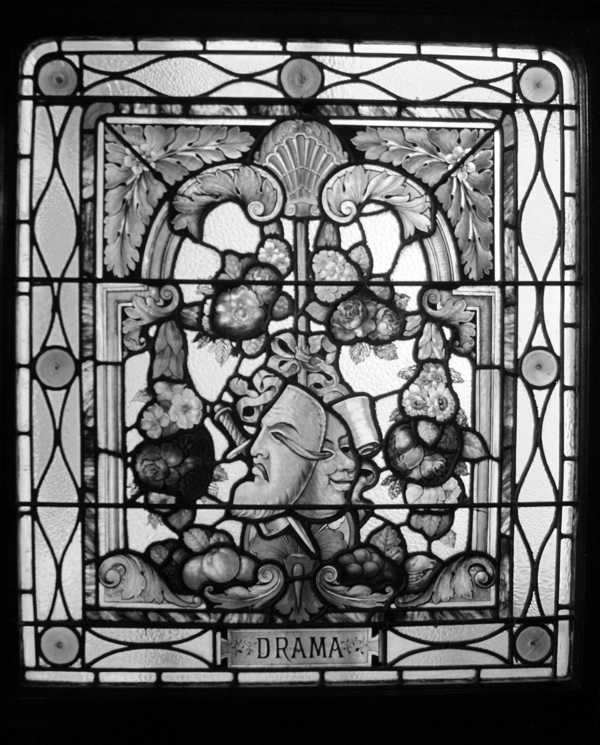
Window at the Princess Louise, Holborn

Princess Louise

Princess Louise

Cittie of Yorke, High Holborn

The Lamb, Lamb’s Conduit St, Bloomsbury – built in the seventeen-twenties and named after William Lamb who erected a water conduit in the street in 1577. Charles Dickens visited, and Ted Hughes and Sylvia Plath came here.

The Lamb

The Lamb
You may also like to look at
David Truzzi-Franconi’s East End
Click here to book for my tours through August, September and October
Photographer David Truzzi-Franconi sent me these pictures that he took in the seventies.
“While I was working in the City of London as an heraldic artist & calligrapher, I discovered on my lunchtime walks that a few paces from the bustle of Bishopsgate led me to another world. I combine a love of the drawing and writing of Geoffrey Fletcher with the photography of Henri Cartier-Bresson. Eventually I bought a Rolleiflex camera and spent my days off exploring the East End with a few rolls of film in my pocket. ” – David Truzzi-Franconi

Derelict House in Bethnal Green


Gunthorpe St, Whitechapel


Shop, E1

Chicksand St, E1

Derelict House, Spitalfields

Knife Grinder, Wilkes St, E1

Street performers at Tower Hill


Three legged dog

Meths drinkers on a bomb site near Brick Lane


Meths Drinkers at the Peabody Buildings


Blending ‘Red Biddy’ – wine and methylated spirits

Blacksmith’s Arms, Isle of Dogs

Thames Foreshore at Low Tide

Three Mills Island, Bow

St Paul’s, Covent Garden
Photographs copyright © David Truzzi-Franconi
Inside The Model Of St Paul’s
Click here to book for my tours through August, September and October

Simon Carter, Keeper of Collections at St Paul’s
In a hidden chamber within the roof of St Paul’s sits Christopher Wren’s 1:25 model of the cathedral, looking for all the world like the largest jelly mould you ever saw. When Charles II examined it in the Chapter House of old St Paul’s, he was so captivated by Wren’s imagination as manifest in this visionary prototype that he awarded him the job of constructing the new cathedral.
More than three hundred years later, Wren’s model still works its magic upon the spectator, as I discovered last week when I was granted the rare privilege of climbing inside to glimpse the view that held the King spellbound. While there is an austere splendour to the exterior of the model, I discovered the interior contains a heart-stopping visual device which was surely the coup that persuaded Charles II of Wren’s genius.
Yet when I entered the chamber in the triforium at St Paul’s to view the vast wooden model, I had no idea of the surprise that awaited me inside. Almost all the paint has gone from the exterior now, giving the dark wooden model the look of an absurdly-outsized piece of furniture but, originally, it was stone-coloured with a grey roof to represent the lead.
At once, you are aware of significant differences between this prototype and the cathedral that Wren built. To put it bluntly, the model looks like a dog’s dinner of pieces of Roman architecture, with a vast portico stuck on the front of the dome of St Peter’s in the manner of those neo-Georgian porches on Barratt Houses. Imagine a fervent hobbyist chopping up models of relics of classical antiquity and rearranging them, and this is the result. It is unlikely that this design would even have stood up if it had been built, so fanciful is the conception. Yet the long process of designing a viable structure, once he had been given instruction by Charles II, permitted Wren to reconcile all the architectural elements into the satisfying whole that we know today.
I had been tempted to visit the cathedral by an invitation to go inside the model but – studying it – I could not imagine how that could be possible. I could not see a way in. ‘Perhaps one end has hinges and Charles II crawled in on his hands and knees like a child entering a Wendy House?,‘ I was thinking, when Simon Carter, Keeper of Collections opened a door in the plinth and disappeared inside, gesturing me to follow. In blind faith, I dipped my head and walked inside.
When I stood up, I was beneath the dome with the floor of the cathedral at my chest height. There was just room for two people to stand together and I imagined the unexpected moment of intimacy between the Monarch and his architect, yet I believe Wren was quietly confident because he had a trick up his sleeve. From the inside, the drama of the architecture is palpable, with intersecting spaces leading off in different directions, and – as your eyes accustom to the gloom – you grow aware of the myriad refractions of light within this intricately-imagined interior.
Just as Wren directed Charles II, Simon Carter told me to walk to the far end of the model and sit on the bench placed there to bring my eye level down to the point of view of someone entering through the great west door. Then Simon left me there inside, just as I believe Wren left Charles II within the model, to appreciate the full effect.
I have no doubt the King was thrilled by this immersive experience, which quickly takes on a convincing reality of its own once you are alone. Charles II discovered himself confronted by a glorious vision of the future in which he was responsible for the first and greatest classically-designed church in this country, with the largest dome ever built. Such is the nature of the consciousness-filling reverie induced by sitting inside the model that the outside world recedes entirely.
How astonishing, once you have accustomed to the scale of the model, when a giant face appears filling the east window. I could not resist a gasp of wonder when I saw it and neither – I suggest – could Charles II when Christopher Wren’s smiling face appeared, grinning at him from the opposite end of the nave, apparently enlarged to twenty-five times its human scale.
In these unforgettable circumstances, the King could not avoid the realisation that Wren was a colossus among architects and – unquestionably – the man for the job of building the new St Paul’s Cathedral. The model worked its spell.

Behold, the largest jelly mould in the world!


The belfry that was never built


The single portico that was replaced by a two storey version


Just a few fragments of paintwork remain upon the exterior

Original paintwork can be seen inside the model

Charles II’s point of view from inside the model

You may like to read my other stories of St Paul’s
Roland Collins, Artist
Click here to book for my tours through August, September and October

My portrait of Roland Collins
At ninety-seven years old, artist Roland Collins lived with his wife Connie in a converted sweetshop south of the river that he crammed with singular confections, both his own works and a lifetime’s collection of ill-considered trifles. Curious that I had come from Spitalfields to see him, Roland reached over to a cabinet and pulled out the relevant file of press cuttings, beginning with his clipping from the Telegraph entitled ‘The Romance of the Weavers,’ dated 1935.
“Some time in the forties, I had a job to design a lamp for a company at 37 Spital Sq” he revealed, as if he had just remembered something that happened last week,“They were clearing out the cellar and they said, ‘Would you like this big old table?’ so I took it to my studio in Percy St and had it there forty years, but I don’t think they ever produced my lamp. I followed that house for a while and I remember when it came up for sale at £70,000, but I didn’t have the money or I’d be living there now.”
As early as the thirties, Roland visited the East End in the footsteps of James McNeill Whistler, drawing the riverside, then, returning after the war, he followed the Hawksmoor churches to paint the scenes below. “I’ve always been interested in that area,” he admitted wistfully, “I remember one of my first excursions to see the French Synagogue in Fournier St.”
Of prodigious talent yet modest demeanour, Roland Collins was an artist who quietly followed his personal enthusiasms, especially in architecture and all aspects of London lore, creating a significant body of paintings while supporting himself as designer throughout his working life. “I was designing everything,” he assured me, searching his mind and seizing upon a random example, “I did record sleeves, I did the sleeve for Decca for the first Long-Playing record ever produced.”
From his painting accepted at the Royal Academy in 1937 at the age of nineteen, Roland’s pictures were distinguished by a bold use of colour and dramatic asymmetric compositions that revealed a strong sense of abstract design. Absorbing the diverse currents of British art in the mid-twentieth century, he refined his own distinctive style at his studio in Percy St – at the heart of the artistic and cultural milieu that defined Fitzrovia in the fifties. “I used to take my painting bag and stool, and go down to Bankside.” he recalled fondly, “It was a favourite place to paint, especially the Old Red Lion Brewery and the Shot Tower before it was pulled down for the Festival of Britain – they called it the ‘Shot Tower’ because they used to drop lead shot from the top into water at the bottom to harden them.”
Looking back over his nine decades, surrounded by the evidence of his achievements, Roland was not complacent about the long journey he had undertaken to reach his point of arrival – the glorious equilibrium of his life when I met him.
“I come from Kensal Rise and I was brought up through Maida Vale.” he told me, “On my father’s side, they were cheesemakers from Cambridgeshire and he came to London to work as a clerk for the Great Central Railway at Marylebone. Because I was good at Art at Kilburn Grammar School, I went to St Martin’s School of Art in the Charing Cross Rd studying life drawing, modelling, design and lettering. My father was always very supportive. Then I got a job in the studio at the London Press Exchange and I worked there for a number of years, until the war came along and spoiled everything.
I registered as a Conscientious Objector and was given light agricultural work, but I had a doubtful lung so nothing much materialised out of it. Back in London, I was doing a painting of the Nash terraces in Regent’s Park when a policeman came along and I was taken back to the station for questioning. I discovered that there were military people based in those terraces and they wanted to know why I was interested in it.
Eventually, my love of architecture led me to a studio at 29 Percy Studio where I painted for the next forty years, after work and at weekends. I freelanced for a while until I got a job at the Scientific Publicity Agency in Fleet St and that was the beginnings of my career in advertising, I obviously didn’t make much money and it was difficult work to like.”
Yet Roland never let go of his personal work and, once he retired, he devoted himself full-time to his painting, submitting regularly to group shows but reluctant to launch out into solo exhibitions – until reaching the age of ninety.
In the next two years, he enjoyed a sell-out show at a gallery in Sussex at Mascalls Gallery and an equally successful one in Cork St at Browse & Darby. Suddenly, after a lifetime of tenacious creativity, his long-awaited and well-deserved moment arrived, and I consider myself privileged to have witnessed the glorious apotheosis of Roland Collins.

Brushfield St, Spitalfields, 1951-60 (Courtesy of Museum of London)

Columbia Market, Columbia Rd (Courtesy of Browse & Darby)

St George in the East, Wapping, 1958 (Courtesy of Electric Egg)

Mechanical Path, Deptford (Courtesy of Browse & Darby)

Fish Barrow, Canning Town (Courtesy of Browse & Darby)

St Michael Paternoster Royal, City of London (Courtesy of Browse & Darby)

St Anne’s, Limehouse (Courtesy of Browse & Darby)

St John, Wapping, 1938

St John, Wapping, 1938

Spark’s Yard, Limehouse
Images copyright © Estate of Roland Collins

Click here to buy a copy of EAST END VERNACULAR
Tex Ajetunmobi, Photographer
Click here to book for my tours through August, September and October

Bandele Ajetunmobi – widely known as Tex – took photographs in the East End for almost half a century, starting in the late forties. He recorded a tender vision of interracial cameraderie, notably as manifest in a glamorous underground nightlife culture yet sometimes underscored with melancholy too – creating poignant portraits that witness an almost-forgotten era of recent history.
In 1947, at twenty-six years old, he stowed away on a boat from Nigeria – where he found himself an outcast on account of the disability he acquired from polio as a child – and in East London he discovered the freedom to pursue his life’s passion for photography, not for money or reputation but for the love of it.
He was one of Britain’s first black photographers and he lived here in Commercial St, Spitalfields, yet most of his work was destroyed when he died in 1994 and, if his niece had not rescued a couple of hundred negatives from a skip, we should have no evidence of his breathtaking talent.
Fortunately, Tex’s photographs found a home at Autograph ABP where they are preserved in the permanent archive and it was there I met with Victoria Loughran, who had the brave insight to appreciate the quality of her uncle’s work and make it her mission to achieve recognition for him posthumously.
“He was the youngest brother and he was disabled as well but he was very good at art, so they apprenticed him to a portrait photographer in Lagos. It suited him yet it wasn’t enough, so he packed up and, without anything much, left for England with my Uncle Chris.
Juliana, my mum had already come from Nigeria and, when I was born, she lived in Brick Lane but, after a gas explosion, we had to move out – that’s how we ended up in Newham. When I was a child, we didn’t come over here much – except sometimes to visit Brick Lane and Petticoat Lane on a Sunday – because we had moved to a better place. I understood I was born in Bethnal Green but I grew up in a better class of neighbourhood.
I knew that she didn’t approve of my uncle’s lifestyle, she didn’t approve of the drinking and probably there were drugs too. They were lots of rifts and falling out that I didn’t understand at the time. When everything became about having jobs to survive, she couldn’t comprehend doing something which didn’t make money. In another life, she might have understood his ideals – but we were immigrants and you have to feed yourself. She thought, ‘Why are you doing something that doesn’t sit comfortably with being poor?’
He did all this photography yet he didn’t do it to make money, he did it for pleasure and for artistic purposes. He was doing it for art’s sake.He had lots of books of photography and he studied it. He was doing it because those things needed to be recorded. You fall in love with a medium and that’s what happened to him. He spent all his money on photography. He had expensive cameras, Hasselblads and Leicas. My mother said, ‘If you sold one, you could make a visit to Nigeria.’ But he never went back, he was probably a bit of an outcast because of his polio as a child and it suited him to be somewhere people didn’t judge him for that.
He used to come and visit regularly when we lived in Stratford and there are family pictures that he took of us. His pictures pop out at me and remind me of my childhood, they prove to me that it really was that colourful. He was fun. Cissy was his girlfriend, they were together. She was white. When Cissy separated from her husband, he got custody of her children because she was with a black man – and her family stopped talking to her. She and Tex really wanted to have children of their own but they weren’t able to. They were Uncle Tex and Aunty Cissy, they would come round with presents and sweets, and they were a model couple to us as children. To see a mixed race couple wasn’t strange to us – where we lived it was full of immigrants and we were poor people and we just got on with life, and helped each other out.
He used to do buying and selling from a stall in Brick Lane. When he died, they found so much stuff in his flat, art equipment, pens, old records and fountain pens. He had a very good eye for things. Everybody knew him, he was always with his camera and they stopped him in the street and asked him to take their picture. He was able to take photographs in clubs, so he must have been a trusted and respected figure. Even if the subjects are poor, they are strutting their stuff for the camera. He gave them their pride and I like that.
He was not extreme in his vices. He died of a heart attack after being for a night out with his card-playing friends. He lived alone by then, he and Cissy were separated. But he was able to go to his neighbour’s flat and they called an ambulance so, although he lived alone, he didn’t die alone.
I thought he deserved more, that he was important. I just got bloody-minded. It wasn’t just because he was my uncle, it’s because it was brilliant photography. He deserved for people to see his work. There were thousands of pictures but only about three hundred have survived. Just one plastic bag of photos from a life’s work.”
Tex was generous with his photographs, giving away many pictures taken for friends and acquaintances in the East End – so if anybody knows of the existence of any more of his photos please get in touch so that we may extend the slim yet precious canon of Bandele “Tex” Ajetunmobi’s photography.

Whitechapel night club, nineteen-fifties


East End, nineteen seventies


On Brick Lane, seventies

Bandele “Tex” Ajetunmobi, self portrait
At Waltham Abbey
Click here to book for my tours through August, September and October
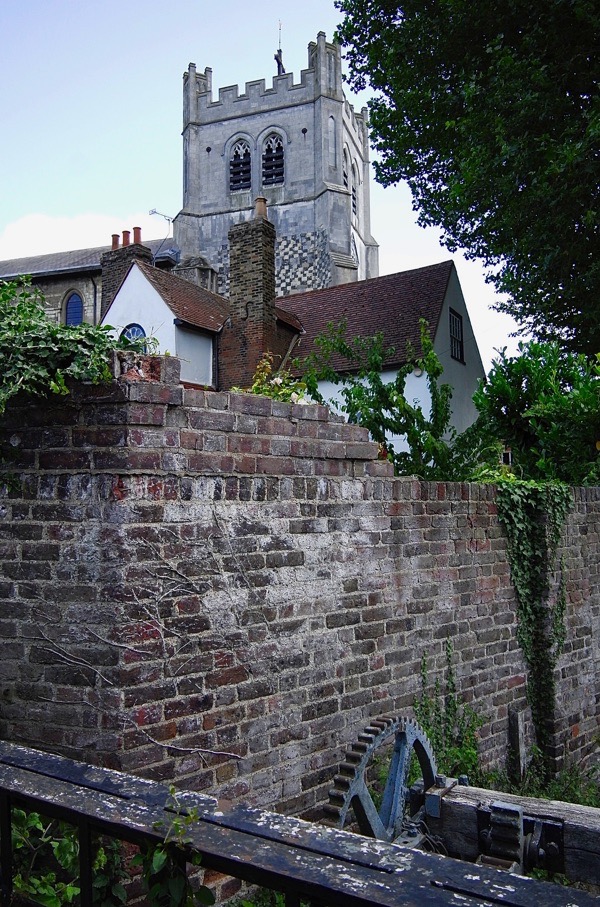
I cycled along the River Lea to Waltham Abbey. On my approach, even from the riverbank, I could see the majestic tower rising over the water meadows as the Abbey has done for the past thousand years, commanding the landscape and undiminished in visual authority.
Once you see it, you realise you are following in the footsteps of the innumerable credulous pilgrims who came here in hope of miraculous cures from the holy cross, which had reputedly relieved Harold Godwinson of a paralysis as a child before he became King Harold.
To the south of the Abbey church lies the market square, bordered with appealingly squint timber frame buildings punctuated by handsome eighteenth and nineteenth additions. Despite the proximity of the capital, the place still carries the air of an English market town.
Yet the great wonder is the Abbey itself, founded in the seventh century, built up by King Harold and destroyed by Henry VIII. Despite the ravages of time, the grandeur and scale of the Abbey is still evident in the precincts which have become a public park. Although the church that impresses today is less than half the size of what it was, it is enough to fire your imagination. An imposing stone gateway greets the visitor to the park where long, battered walls outline the former extent of the buildings. A tantalising fragment of twelfth century vaulting, which formerly served as the entrance to the cloisters, encourages the leap to conjure the cloisters themselves where now is merely an empty lawn. A walled garden filled with lavender and climbing roses draws you closest to the spirit of the place.
The outline of the former Abbey church is marked upon the grass and at the eastern end lies a surprise. A plain stone engraved with the words ‘Harold King of England Obit 1066,’ indicating this is where legend has it that he was laid to rest after the Battle of Hastings. I realised that maybe the remains of the man in the tapestry, killed by the arrow in the eye, lay beneath my feet. Coming upon his stone unexpectedly halted me in my tracks.
This was one of those startling moments when there is a possibility of history being real, something tangible, causing me to reflect upon the Norman Conquest. A thousand years ago, their power found its expression in the vast complex of buildings here, which were destroyed five hundred years ago as the expression of another power.
We too live in a time of dramatic transition, emerging from the shadow of the pandemic and accommodating to our country’s divorce from Europe. I cycled from Spitalfields to Waltham Abbey as a respite from the times, yet here I was confronting it in a mossy green churchyard. The equivocal consolation of the historical perspective is that it reminds us that empires rise and fall, but life goes on.


Effigy of King Harold

Harold cradles Waltham Abbey in his arm


The Lady Chapel

Victorian villa in the churchyard

The Welsh Harp


These vaults are all that is left of the twelfth century cloisters


Here lies Harold, the last Anglo Saxon King of England

Waltham Abbey
You may also like to read about


