
Bug Woman London
We are getting close to our target now after raised an astonishing £33,663 to relaunch Spitalfields Life Books. The crowdfund page remains open until we reach £35,000.
YOU CAN STILL VISIT OUR CROWDFUND PAGE & CONTRIBUTE HERE

I am proud to publish these extracts from BUG WOMAN LONDON – a graduate of my blog writing course who has been publishing posts online for nearly ten years now. The author set out to explore our relationship with the natural world in the urban environment, yet her subject matter has expanded in all kinds of ways. Follow BUG WOMAN LONDON, because a community is more than just people
I am now taking bookings for the next writing course, HOW TO WRITE A BLOG THAT PEOPLE WILL WANT TO READ on November 25th & 26th. Come to Spitalfields and spend a weekend with me in an eighteenth century weaver’s house in Fournier St, enjoy delicious lunches and eat cakes baked to historic recipes, all catered by Townhouse, and learn how to write your own blog. Click here for details
If you are graduate of my course and you would like me to feature your blog, please drop me a line.
THE OWLS’ DUET
Dear Readers, there is something magical about owls and they are often nearer to us than we think. The two chicks above were photographed in Kensington Gardens, of all places, and there are Little Owls there too. And there are Tawny Owls in both of our local cemeteries (St Pancras and Islington and East Finchley) and probably in Coldfall Wood too.
The prime time for owl ‘conversations’ is in the spring, but there is something particularly spine-chilling about hearing them at this time of year, as the nights draw in and Halloween approaches. Of course, for the owls themselves the calls are many things, but mostly they are a way of helping the male and female owls to establish their territories in preparation for the spring breeding season. The ‘tu-whit, tu-whoo’ call is the two owls duetting, and typically it’s thought that the ‘tu-whit’ is the female’s soliciting call, the ‘tu-whoo’ part the male answering.
However, I learnt that male owls can also make the ‘tu-whit’ call (though at a lower pitch than the female does), and both sexes can answer. Which just goes to show that just when I think I have something about the natural world nailed down, it turns out to be more complicated which is a source of some pleasure.
Owls can tell a lot from one another’s calls, not just the sex of the caller but their size, weight, health and level of aggression. These are all important factors in choosing a mate. Will they be able to defend and hold a territory? Are they good hunters? Males with the highest levels of testosterone call more frequently and for longer, and this is often related to the size and quality of their territories.
The combination of the two owl ‘voices’ is a signal to other owls that the partnership is working, and that they are cooperating in defending their territories. It is hard work providing for owlets, so this teamwork is essential.
Although the cry of the owl has been seen as a harbinger of doom since before Shakespeare’s time, for me it signals that something in the ecosystem is working. If it can support two tawny owls, then the rest of the food chain is likely to also be relatively healthy.
The woods at night are an interesting soundscape but note that at this time of year you are most likely to hear the owls just after sunset, rather than at the dead of night. It is definitely worth going for a dusk walk, just to see what you can hear and see.


THE SAD STORY OF THE COMMUNITY VOLE
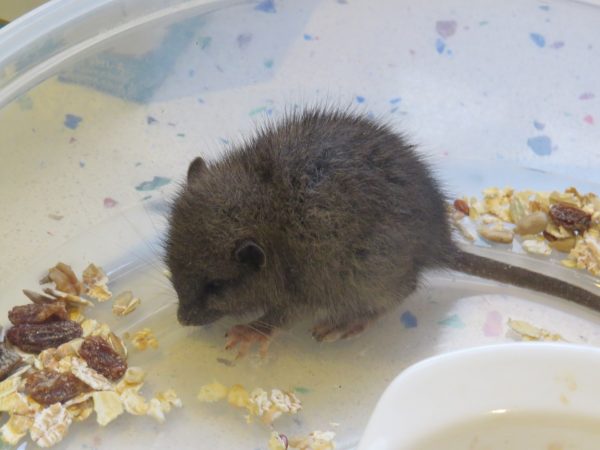
Dear Readers, I was rushing off to a meeting when I was stopped in my tracks by this little rodent all alone in the middle of the pavement. What on earth was s/he? With those tiny ears it was not a mouse and I wondered for a second if s/he was an escaped gerbil but then it clicked. I was looking at an East Finchley bank vole.
Two young women popped out from the house and we all looked at the vole. I was worried because you would never normally get this close to a wild rodent, bank voles are very skittish and can climb trees and shrubs. My Guide to British Mammals says that they ‘walk and run, often in quick stop-start dashes’, but not this one.
“Do either of you girls have a box?” I asked. I knew that the vole would get eaten by a cat or pecked to death by a magpie if s/he was left where she was. Neither girl had a box, so I dashed back home to get one. I thought that we needed to check a) if it was actually some kind of rodent pet and b) if it was a wild animal. I would keep it safe until after dark and then release it if it was well enough.
When I came back, the mother of the girl was also there and all four of us stood and gazed at the oblivious rodent. “He’s rather sweet”, said one of the girls. I always find it heartening when people are not scared of small furry things.
I scooped the vole up and popped them into a box. I got the slightest of nibbles – which did not break the skin – so I felt as if there was still some feistiness left, a good sign. I told my long-suffering husband what was going on and left him to find food/shelter/water etc for our guest.
When a message went out on the Whatsapp for the road, the little rodent was quickly christened ‘the Community Vole’.
When I got back, the Community Vole was having a little nibble at some muesli but clearly they were not well. There was that slight tremor I have seen before in mice that have eaten something poisoned, either by rat/mouse poison, or from their food plants being sprayed with pesticide or herbicide. But bank voles only have a lifespan of a year, so s/he could simply be getting to the end of their natural life. I realised that s/he was much too weak and wobbly to be released into a night-time garden full of cats and foxes. Plus, if s/he was poisoned, anything that ate them would also pick up some of the toxin.
Meantime, the street was full of suggestions for Community Vole’s name.
“Vole-taire”
“Vole-demort”
“Vole-erie”
But in between the jollity there was genuine concern for the well-being of this small animal.
I put some bedding into the box, made sure there were various kinds of food (grass, grapes, cashew nuts, sunflower seeds), covered the box and found a quiet spot for it. If the vole rallied by the next morning, I could release them. If they were still unwell, I would see if I could find a vet. But in my heart I knew that this little one was on its way out.
Next morning, they were tucked up in their bed, dead.
People were genuinely sad that s/he had died. There are an estimated twenty-three million bank voles in the United Kingdom but there is something about seeing an individual animal, or person, that activates our empathy. It is easy to dismiss whole rafts of animals as ‘vermin’ and frighteningly easy to do that to people as well. But when we hear the story of one creature or person we can somehow understand and start to build connections. Maybe that is how we save ourselves, one story at a time?
So Long, John Dolan
We are within £2,000 of our target after raised an astonishing £33,093 to relaunch Spitalfields Life Books. The crowdfund page remains open until we reach £35,000.
YOU CAN STILL VISIT OUR CROWDFUND PAGE & CONTRIBUTE HERE
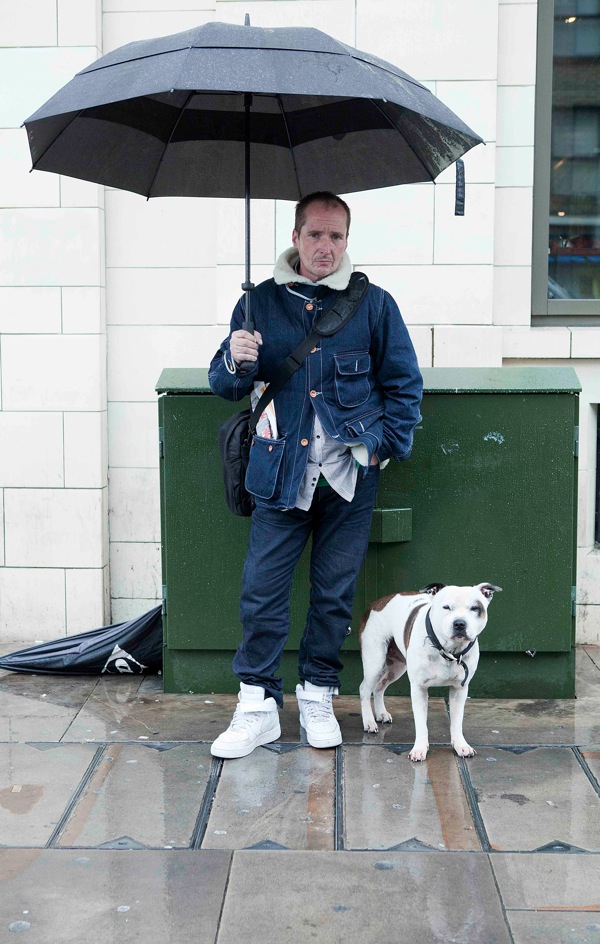
Today we remember artist John Dolan who died a year ago, on 20th October 2022, aged fifty. He is survived by his dog, George.
John Dolan and his thoughtful dog, George, became an East End landmark in recent years, sitting patiently day after day in the same spot opposite the petrol station on Shoreditch High St while the world and the traffic passed by. Yet, all that time, John was watching and, after a year of looking at the same view each day, he picked up a pen and began to draw what he saw before him. Soon after, John’s drawings were published in a local magazine and it proved to be a life-changing moment.
“That’s when I knew in life what I should do,” he assured me, standing in the Howard Griffin gallery where he had his first exhibition. The show was just across the road from the spot where John used to sit and had been a sell-out success, leaving him inundated with commissions and a book deal. Yet George took it all in his stride even if John was rather startled by the attention, gratefully embracing this opportunity to forge a new identity for himself as a artist. “None of this could have happened without the support of Roa, the street artist,” John admitted to me, in relief at this twist of fate, “It’s got me away from breaking into shops to steal money.”
When you met John, you were aware of a restless man with a strong internal life and he looked at you warily, his eyes constantly darting and moving, as if he might leave or take flight at any moment. But although John may have had only one foot on the ground, George planted himself down and surveyed the world peacefully – as the natural counterpoint to his master’s nature.
“I’m from King’s Sq, Goswell Rd, and I could walk from my door to St Paul’s in five minutes when I was a kid,” John revealed, speaking with affection for the neighbourhood in which he spent his life, “From my window I could see the three towers of the Barbican and the dome of St Paul’s. At fourteen, I climbed up the to the top of St James Clerkenwell when it was covered in scaffolding.” John’s minutely detailed urban drawings were equally the result of an observant sensibility and an intimate knowledge of the streets and street life of Shoreditch.
A few years ago, a series of misadventures and spells in Pentonville Prison led to a low point when John found himself bereft. “I was spending my days in day centres and only mixing with homeless people and I couldn’t relate to my family at that time,” he confessed, “but having this exhibition has been a way of getting back to them – when they came on the opening night, they were very impressed. It’s been called ‘a successful debut show’ and you can’t get much better than that.”
“I got rehoused in a flat in Arnold Circus after I had been living in temporary accommodation on Royal Mint St and before that I was homeless,” he explained, “In the recent benefits shake-up, I had my benefit cut to £36 a week and, each time I appealed, they cut it down more until I had nothing. I’ve got arthritis in my legs and I can’t walk very far, so I came down here to Shoreditch High St and started begging to get some money. But I’m no good at it, so I put a cup in front of George like he was begging and people gave him money. Then I got bored and I started drawing the two buildings on the opposite site of the road.”
John outlined to me how he acquired George, the dog that gave him the new focus. “When I was living in Tower Hill, I used to let homeless people come and live with me and there was this couple – and one of them, Sue, she was offered the chance to buy George for the price of a can of lager by a Scottish fellow, so she gave him £20.” John recalled, speaking in almost a whisper, underscored by an emotional intensity, “He was a pretty violent guy who would go round robbing homeless people.”
“George is my first dog in a very long time, I had a dog from the age of ten until I was twenty-three – Butch. He was named after a dog that my grandfather had that was legendary. It was so painful when Butch died, I said I would never have another – but George was such a lovely dog and needed a home. When the Scottish fellow came back and told people he was going to take the dog off me and expecting money every time he saw me, I had to have serious words with him.”
John gave me a significant look that indicated he and George were never to be separated. “I went to Old St Central Foundation School and the only thing I was good at was Art,” he informed me proudly, puffing on his cigarette in excitement, “The teacher said I was so bad at Geography it was a wonder I could find my way home.”
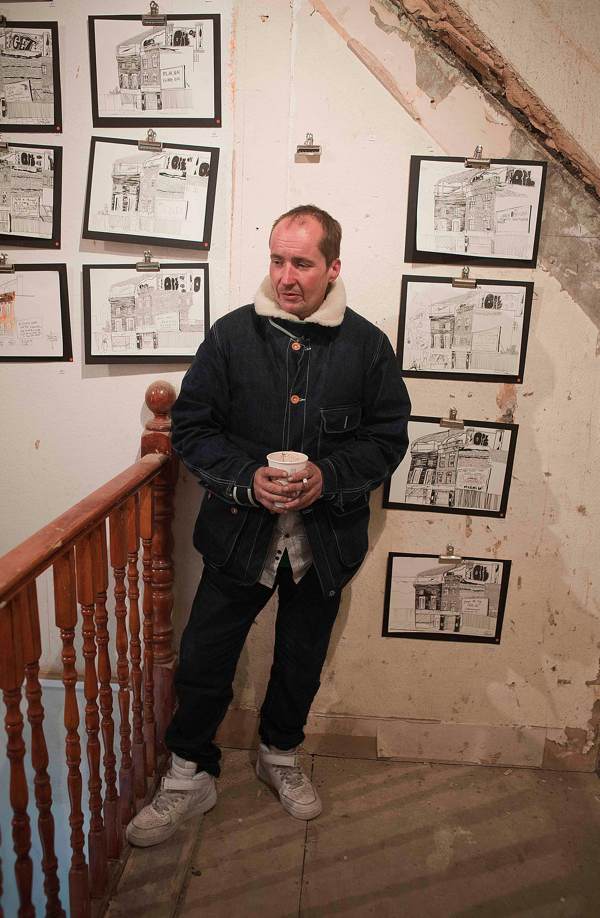
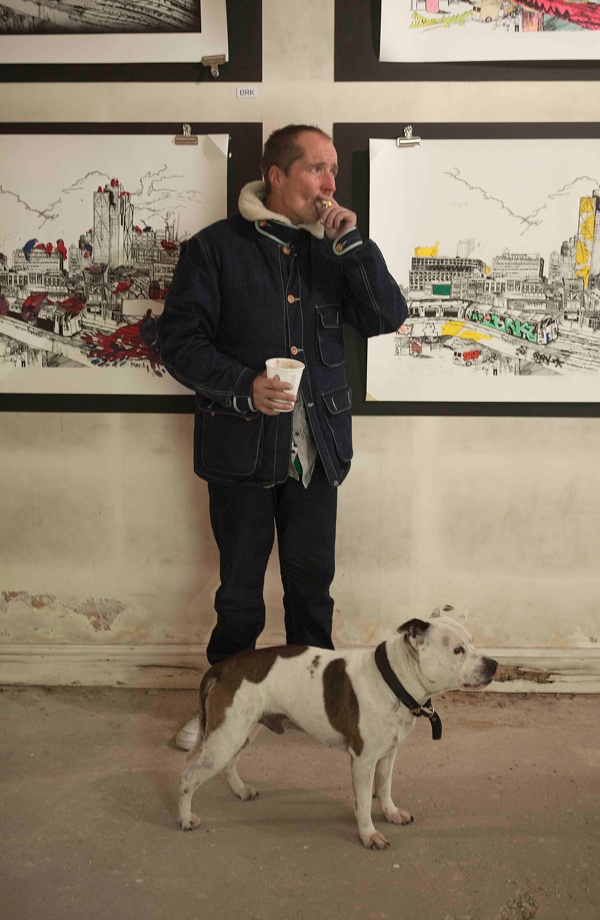

Photographs copyright © Estate of Colin O’Brien
You may also like to read about
The Bread, Cake & Biscuit Walk
We may not have quite hit our target, but we have raised an astonishing £32,1113 to relaunch Spitalfields Life Books. Meanwhile, our crowdfund page will remain open until we reach £35,000.
YOU CAN STILL VISIT OUR CROWDFUND PAGE & CONTRIBUTE HERE

This biscuit was sent home in the mail during World War I
As regular readers will already know, I have a passion for all the good things that come from the bakery. So I decided to take advantage of the fine afternoon yesterday to take a walk through the City of London in search of some historic bakery products to feed my obsession, and thereby extend my appreciation of the poetry and significance of this sometimes undervalued area of human endeavour.
Leaving Spitalfields, I turned left and walked straight down Bishopsgate to the river, passing Pudding Lane where the Fire of London started at the King’s Bakery, reminding me that a bakery was instrumental in the very creation of the City we know today.
My destination was the noble church of St Magnus the Martyr, which boasts London’s stalest loaves of bread. Stored upon high shelves beyond the reach of vermin, beside the West door, these loaves were once placed here each Saturday for the sustenance of the poor and distributed after the service on Sunday morning. Although in the forgiving gloom of the porch it is not immediately apparent, these particular specimens have been there so many years they are now mere emblems of this bygone charitable endeavour. Surpassing any conceivable shelf life, these crusty bloomers are consumed by mould and covered with a thick layer of dust – indigestible in reality, they are metaphors of God’s bounty that would cause any shortsighted, light-fingered passing hobo to gag.
Close by in this appealingly shadowy incense-filled Wren church which was once upon the approach to London Bridge, are the tall black boards tabulating the donors who gave their legacies for bread throughout the centuries, commencing in 1674 with Owen Waller. If you are a connoisseur of the melancholy and the forgotten, this a good place to come on a mid-week afternoon to linger and admire the shrine of St Magnus with his fearsome horned helmet and fully rigged model sailing ship – once you have inspected the bread, of course.
I walked West along the river until I came to St Bride’s Church off Fleet St, as the next destination on my bakery products tour. Another Wren church, this possesses a tiered spire that became the inspiration for the universally familiar wedding cake design in the eighteenth century, after Fleet St baker William Rich created a three-tiered cake based upon the great architect’s design, for his daughter’s marriage. Dedicated today to printers and those who work in the former print trades, this is a church of manifold wonders including the pavement of Roman London in the crypt, an iron anti-resurrectionist coffin of 1820 – and most touching of all, an altar dedicated to journalists killed recently whilst pursuing their work in dangerous places around the globe.
From here, I walked up to St John’s Gate where a biscuit is preserved that was sent home from the trenches in World War I by Henry Charles Barefield. Surrounded by the priceless treasures of the Knights of St John magnificently displayed in the new museum, this old dry biscuit has become an object of universal fascination both for its longevity and its ability to survive the rigours of the mail. Even the Queen wanted to know why the owner had sent his biscuit home in the post, when she came to open the museum. But no-one knows for sure, and this enigma is the source of the power of this surreal biscuit.
Pamela Willis, curator of the collection, speculates it was a comment on the quality of the rations – “Our biscuits are so hard we can send them home in the mail!” Yet while I credit Pamela’s notion, I find the biscuit both humorous and defiant, and I have my own theory of a different nuance. In the midst of the carnage of the Somme, Henry Barefield was lost for words – so he sent a biscuit home in the mail to prove he was still alive and had not lost his sense of humour either.
We do not know if he sent it to his mother or his wife, but I think we can be assured that it was an emotional moment for Mrs Barefield when the biscuit came through her letterbox – to my mind, this an heroic biscuit, a triumphant symbol of the human spirit, that manifests the comfort of modest necessity in the face of the horror of war.
I had a memorable afternoon filled with thoughts of bread, cake and biscuits, and their potential meanings and histories which span all areas of human experience. And unsurprisingly, as I came back through Spitalfields, I found that my walk had left me more than a little hungry. After several hours contemplating baked goods, it was only natural that I should seek out a cake for my tea, and in St John Bread & Wine, to my delight, there was one fresh Eccles Cake left on the plate waiting for me to carry it away.
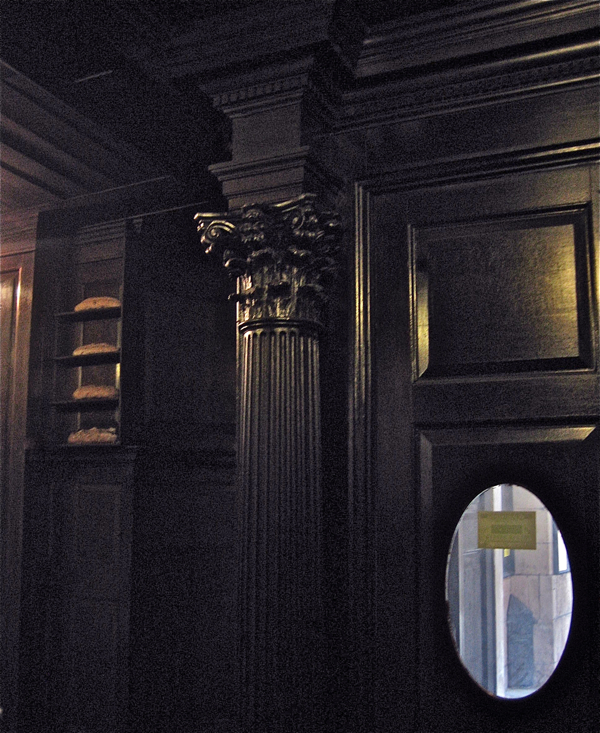
Loaves of bread at St Magnus the Martyr
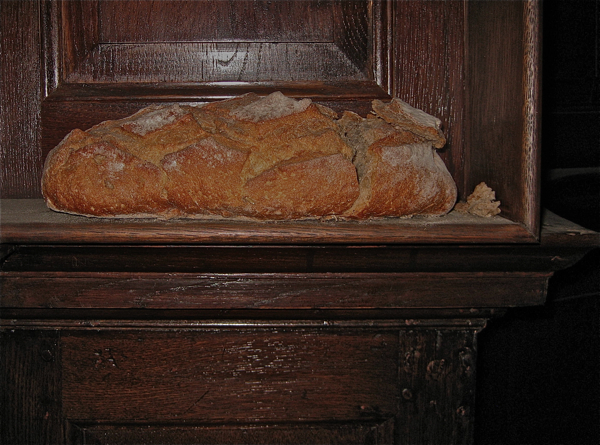
Is this London’s stalest loaf?
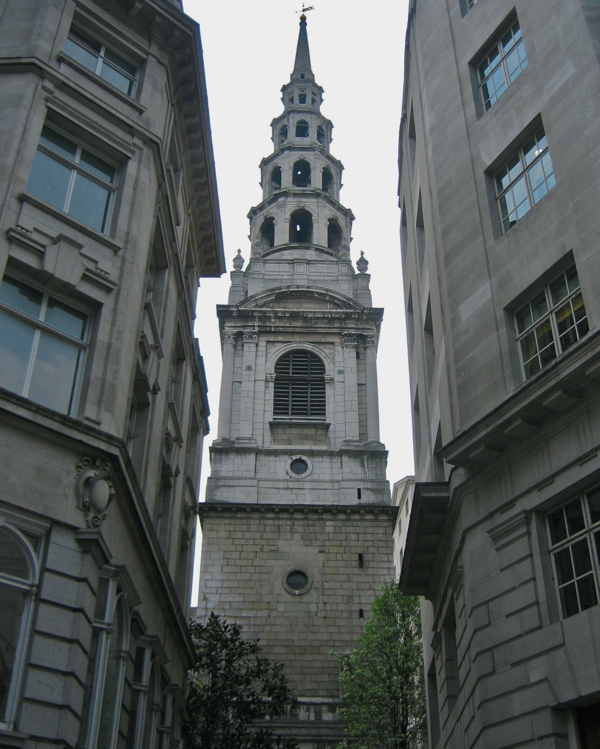
The spire of Wren’s church of St Bride’s which was the inspiration for the tiered design of the wedding cake first baked by Fleet St baker William Rich in the eighteenth century
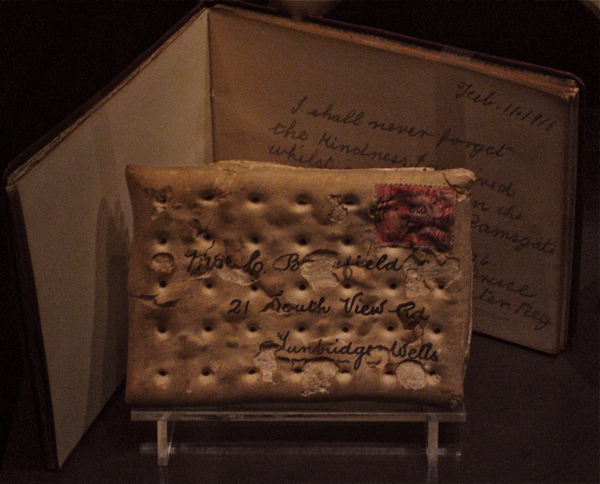
The biscuit in the museum in Clerkenwell
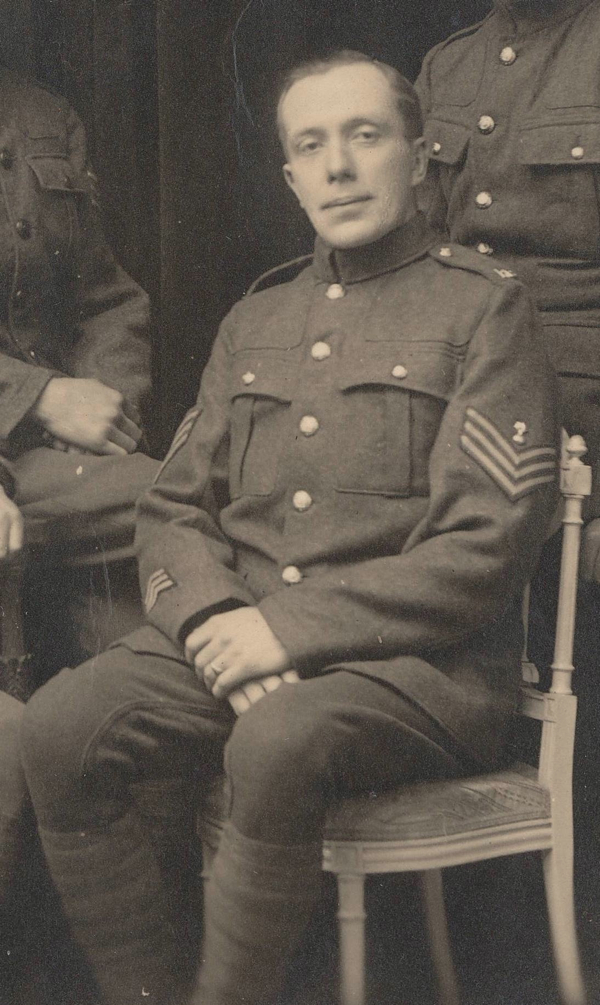
The inscrutable Henry Charles Barefield of Tunbridge Wells who sent his biscuit home in the mail during World War I

The freshly baked Eccles Cake that I ate for my tea
You may like to read these other bakery related stories
On The Beat With PC Lew Tassell Again
We may not have quite hit our target, but we have raised an astonishing £32,033 to relaunch Spitalfields Life Books. Meanwhile, our crowdfund page will remain open until we reach £35,000.
YOU CAN STILL VISIT OUR CROWDFUND PAGE & CONTRIBUTE HERE
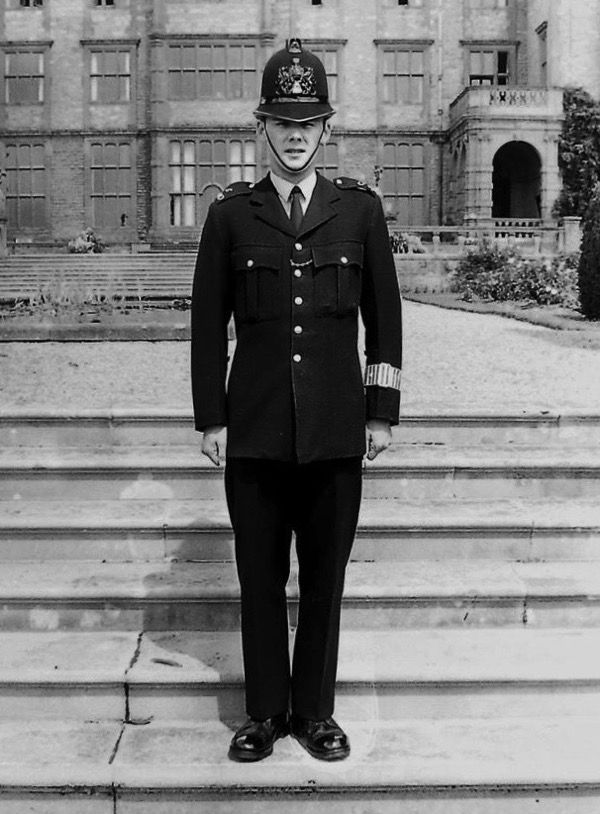
PC Lew Tassell in 1969
My pal Lew Tassell and I decided to take advantage of the October sunlight to enjoy a gentle perambulation around Lew’s old stomping ground from the days when he was an officer in the City of London Police, and he told me stories of his time in the constabulary.
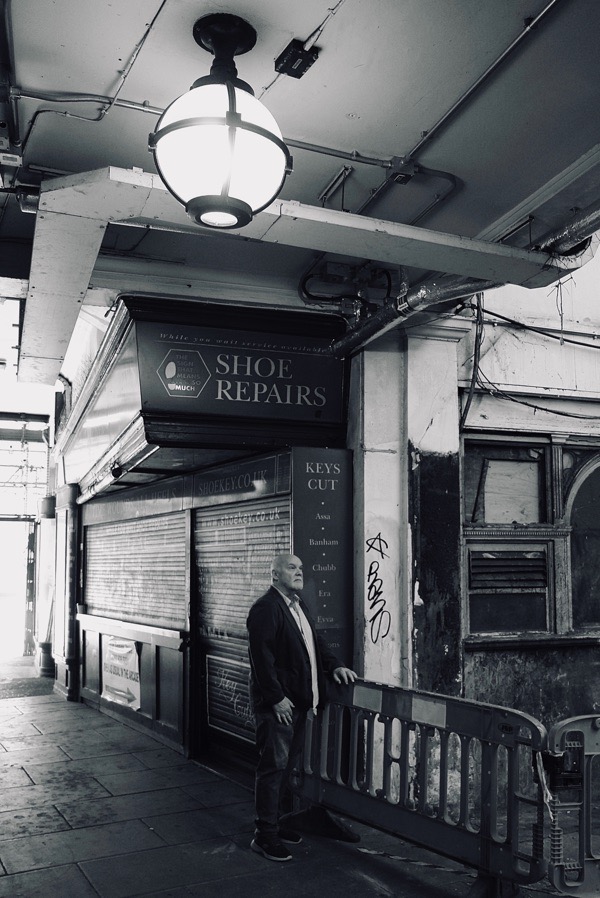
“Until recently Liverpool Street Arcade was a busy cut-through between Old Broad St and Liverpool St but now it is closed for redevelopment. The Arcade sits directly over the Metropolitan line which was originally a steam railway. Once the line switched to electric trains, they built over the station and the Arcade was opened on 11th March 1912. In the eighties, the Arcade was due to be demolished but, due to a petition of over 6,000 people, it was saved.
When I joined the City of London Police in 1969, and throughout my uniform years, one of my duties when working a night duty shift at Bishopsgate Police Station was to inspect the Arcade and it’s glazed roof.
The Arcade was locked from early evening until early morning. At about 2.00am every morning, a pair of officers collected a set of keys at Bishopsgate to open the Liverpool Street entrance, then we unlocked a door halfway down the Arcade with stairs that led to the roof. Next, we searched the whole of the roof above the shops to see if there was anything untoward, not that there ever was.”
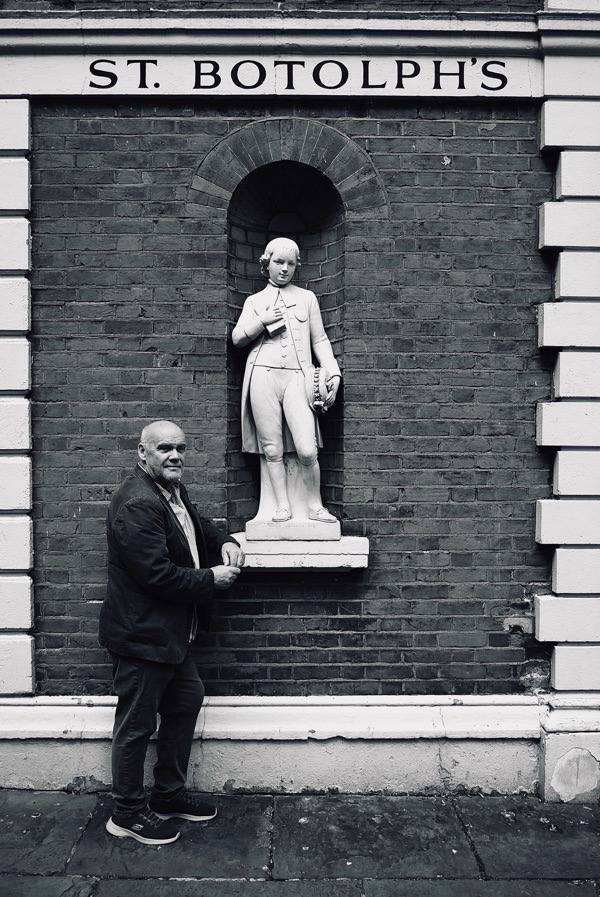
“The church hall for St Botolph-without-Bishopsgate is a nineteenth century school room and former livery hall of the Worshipful Company of Fan Makers. At the front, there are two niches containing painted figures of charity children made of Coade stone.
When I was a detective at Bishopsgate Police Station in the early seventies, I was called to the church hall. The two figures had been stolen. They had been removed from the niches but were fortunately recovered nearby. As the figures had some value, I completed a crime report and the niches remained empty whilst the recovered figures were stripped of paint, cleaned and placed inside the hall. Replicas now stand in the niches at the front.
My other association with St Botolph’s is that my marriage banns were read here since I was living in Bishopsgate Police Station at the time.”
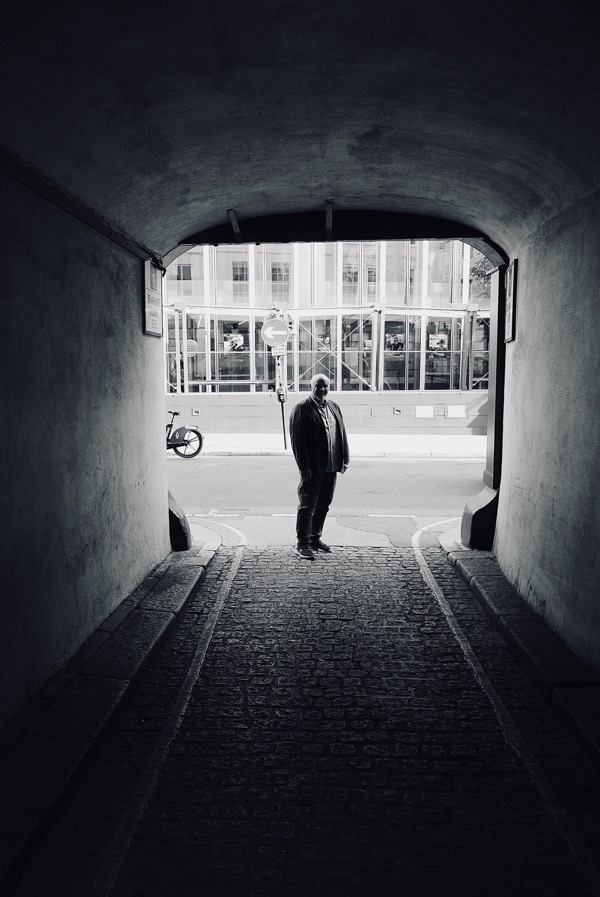
“Quite often when working a night shift at Bishopsgate in the seventies I would be assigned to place ‘cotton marks’ inside the entrance to a courtyard or alleyway that led to a dead end.
I stretched the cotton across the entrance about a couple of feet off the ground and checked later to see if it had been broken during the early hours, before any deliveries were made.
Many burglaries during this period were committed by ‘climbers’ who clamberd up drainpipes to enter buildings at night. They gaind access to all buildings from the roofs in the block by jumping across the narrow gaps between the buildings.
The picture here is of Brabant Court where I remember laying cotton marks. This courtyard houses an old building at no.4 which was built in 1710.”
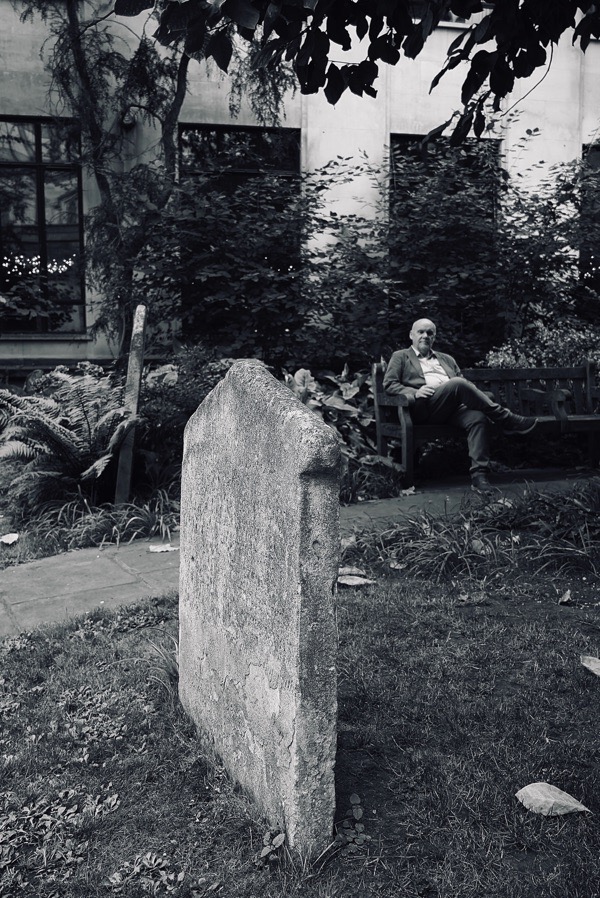
“Walking the beat alone at night can be quite lonely especially in the early hours. I found you make quite a bit of noise in the stillness as you stroll through the empty streets. So I would often find an out of the way spot on my beat to sit and listen.
My favourite spot was the churchyard of St Olave’s where the gateway was usually left unlocked.
The church has a fascinating history. It’s most famous worshipper being Samuel Pepys whose tomb is inside the church. The Great Plague of 1665 is said to have broken out close by and 300 victims were buried in the churchyard, including Mary Ramsay who was widely blamed for bringing the disease to London.
I cannot help thinking that the reason the churchyard is raised, to the degree that you have to walk down steps to enter the church, is due to what lies beneath. Yet I never found it spooky, just peaceful and beautiful.
The church was hit by an incendiary bomb in 1941 and the heat from the fire melted the bells. In the early fifties, this metal was recast into new bells by the same foundry that created the originals, the Whitechapel Bell Foundry.”
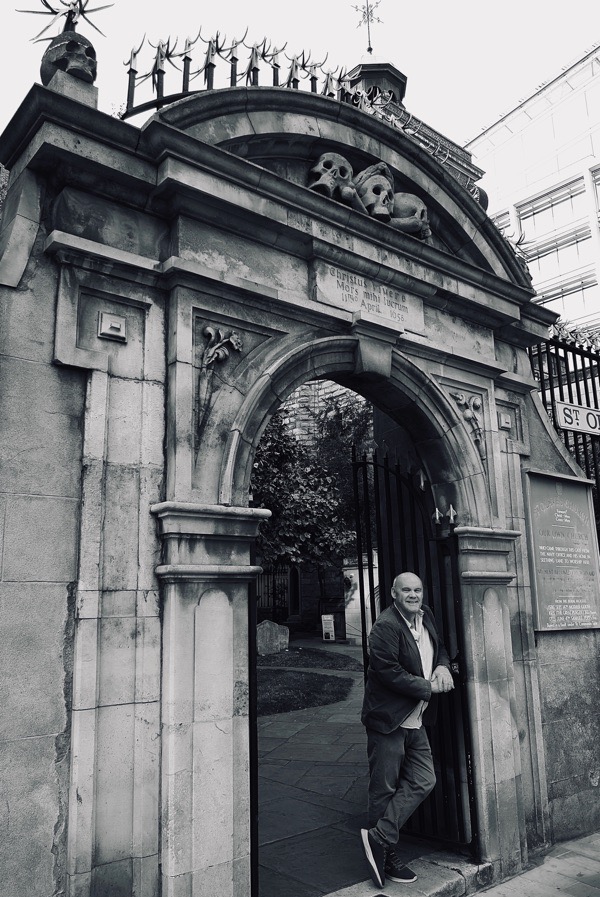
“Charles Dickens in ‘The Uncommercial Traveller’ refers to the gateway and churchyard of St Olave’s as ‘one of my best beloved churchyards, I call the churchyard of Saint Ghastly Grim.’
He recalls visiting the churchyard after midnight during a thunderstorm and seeing the skulls on the gateway ‘having the air of a public execution.'”
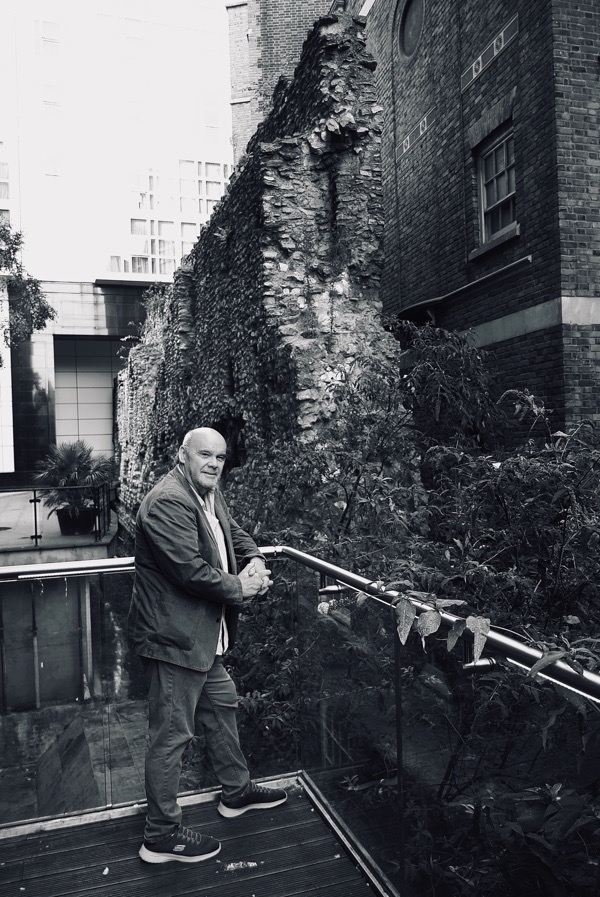
“Close to Tower Hill station stands quite a large section of Roman Wall, although the higher parts were added during medieval times.
In the seventies, the wall was not as appreciated as it is today. Whilst patrolling I often walked through or past it and it was surrounded with what I recall was nothing more than wasteland.
Today it is well preserved with raised walkways and has become a feature of the City of London. But the downside is that it is now surrounded by large buildings, some built within inches of the wall itself.”
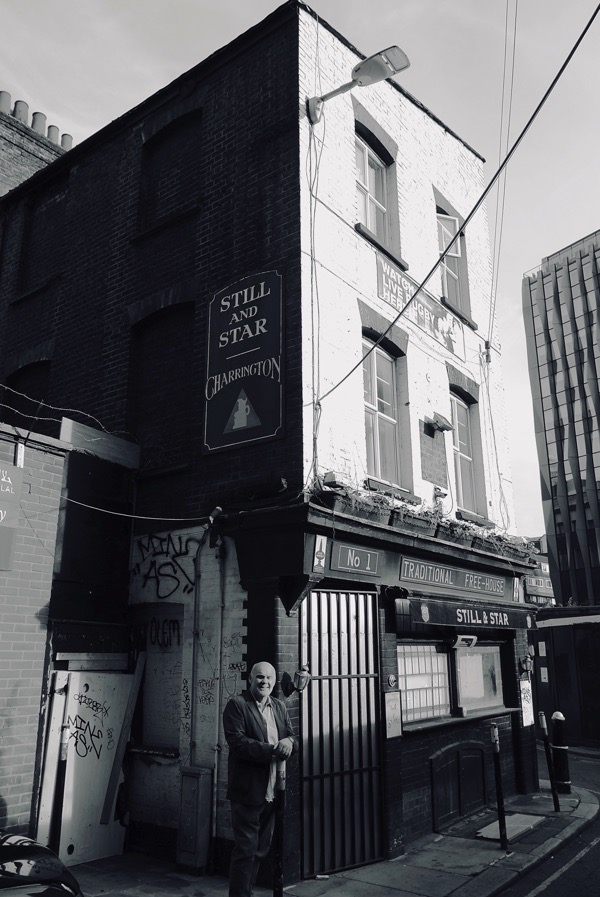
“The Still & Star is boarded up and remains one of the last undeveloped plots in Aldgate. Its future is uncertain. Tucked away from the hustle and bustle, Little Somerset St leads from Aldgate to Mansell St which is the boundary of the City of London. This was where I used to patrol when walking to Tower Bridge or Shorter Street, a traffic control point at the end of the Minories.
I always felt I was in the proper East End when taking this route past the pub and just around the corner was a seedy snooker hall that always seemed to be busy. Both gone now.”
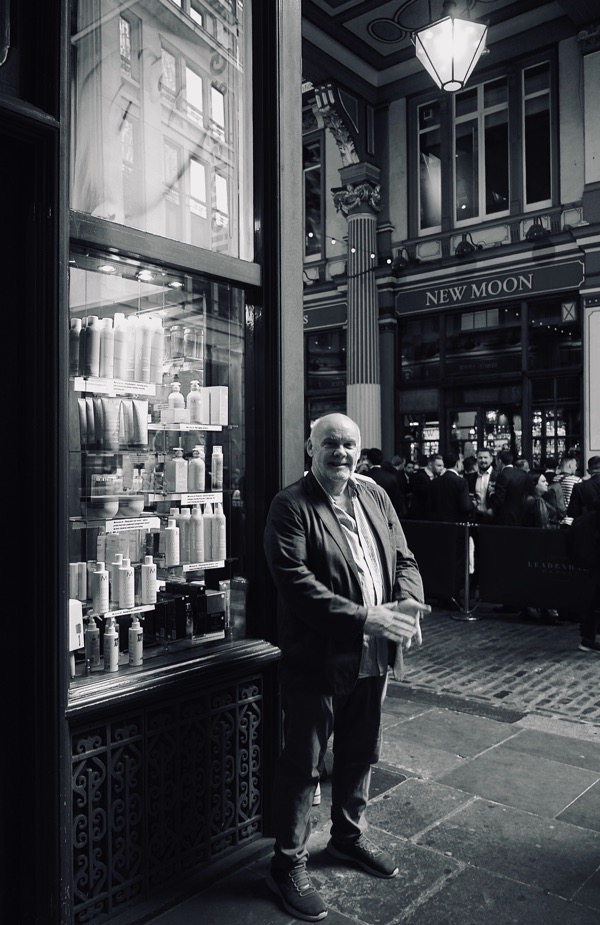
Another tale of burglary in the City, this time at the Aquascutum shop on the corner of Gracechurch St and Leadenhall Market. In the seventies I was called to the shop when there was a break-in.
Whilst examining the crime scene, I noticed a pile of brick foundations in the basement which was being used as a storeroom. Piles of boxes were scattered all around the brickwork.
‘Oh that’s part of the Roman Wall’ I was informed. At the time, I did not know the Wall existed here and it was fascinating to see it. Today the shop is a hair salon.”
You may also like to trace our previous walk
Ed Gray’s Innocence & Experience
We may not have quite hit our target, but we have raised an astonishing £31,833 to relaunch Spitalfields Life Books. Meanwhile, our crowdfund page will remain open until we reach £35,000.
YOU CAN STILL VISIT OUR CROWDFUND PAGE & CONTRIBUTE HERE

Portrait of Ed Gray by Sarah Ainslie
It is my delight to introduce this lively selection of paintings and drawings from Ed Gray’s new exhibition, Scenes of Innocence & Experience, 20th October – 6th November at House of Annetta, 25 Princelet St, E1 6QH.
Ed’s visceral paintings capture the tumultuous street life of the capital superlatively, teeming with diverse characters and delighting in the multiple dramas of daily existence. Despite his mild manners, his is an epic, near-apocalyptic vision that glories in the endless struggle of humanity within the urban stew. Yet the overriding impression is not cynical but rather a life-affirming raucous celebration of the indefatigable vitality of Londoners.
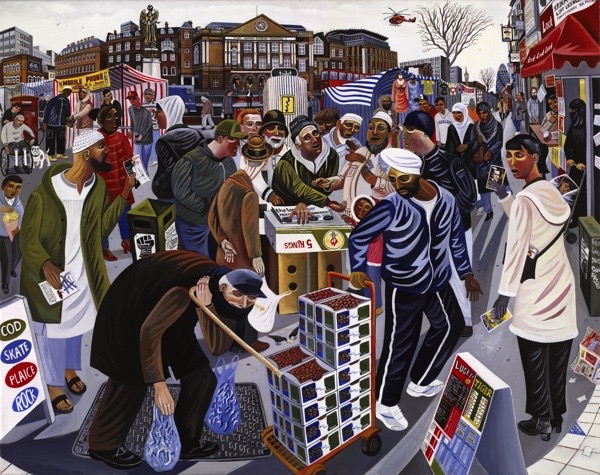
Lucky Tiger, Whitechapel Market, 2008
“I often walk through Whitechapel Market on my way to the studio. From a cafe, I watched the men set up the cardboard boxes and I took out my pencil and I began to draw. There is no ‘Lucky Tiger’ in this painting because there is no luck here, no punter will win. The child senses this and she can see past the man’s arm which is covering the switch he is about to make.”
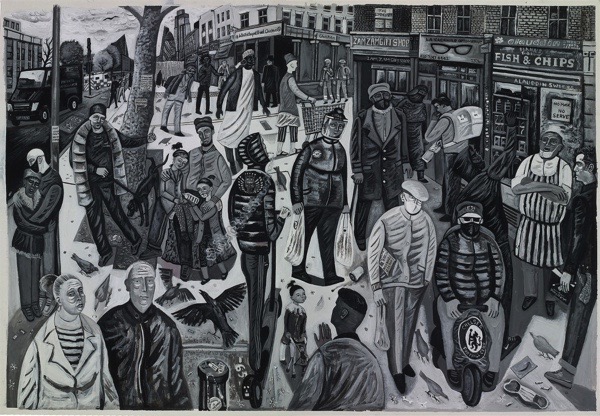
On Whitechapel Waste, 2021
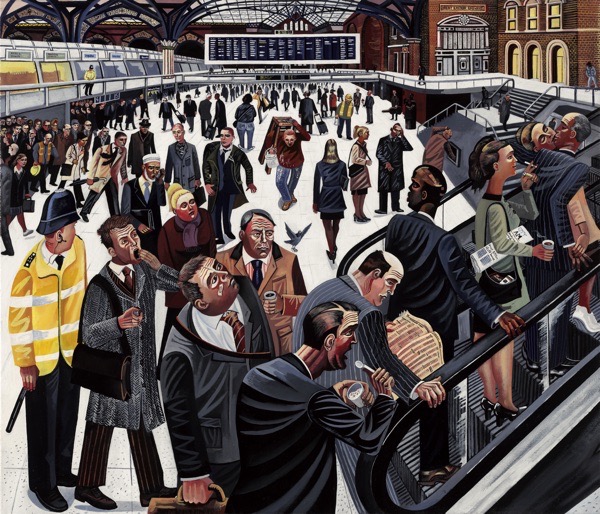
8:48am Liverpool St
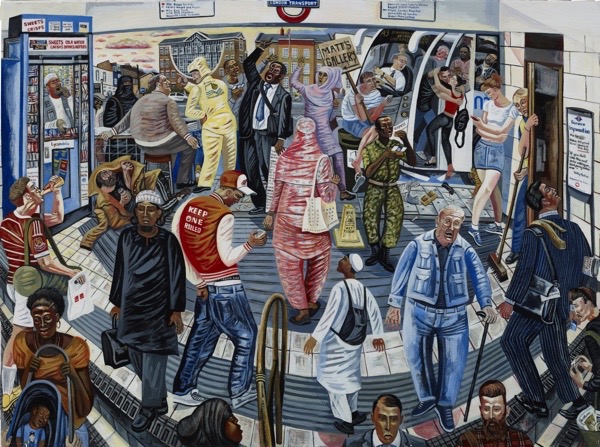
Hellfire and Damnation, Mile End Underground Station, 2014
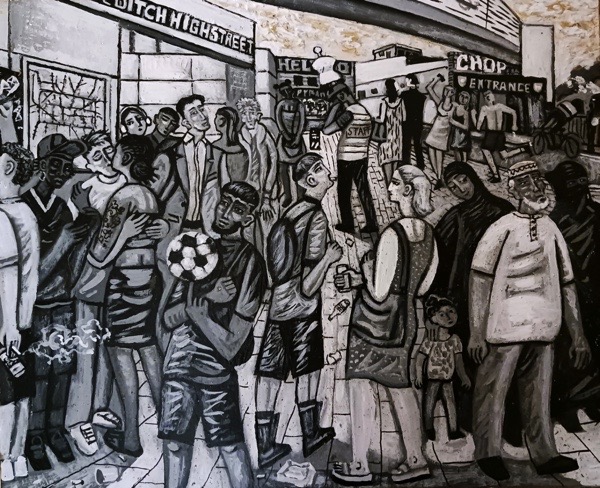
Shoreditch High St Sketch. Late summer evening
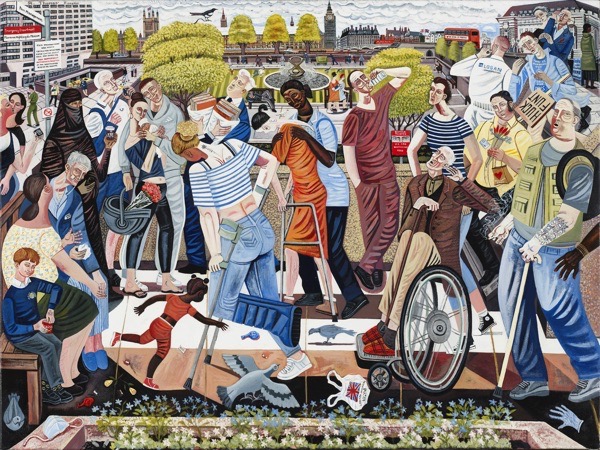
Torsion, St Thomas’s Hospital Lambeth (Huck Funt) 2016-20
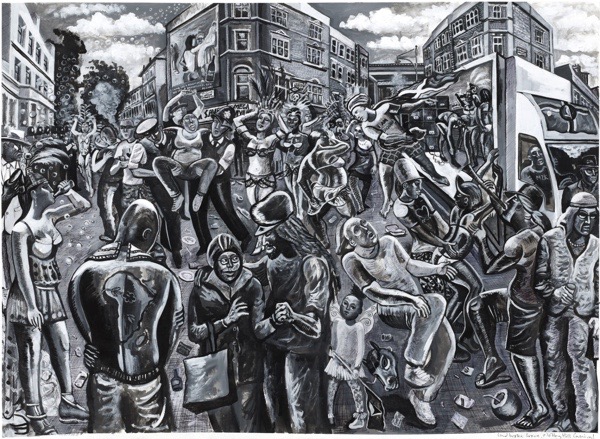
Ladbroke Groovers, Notting Hill Carnival 2011
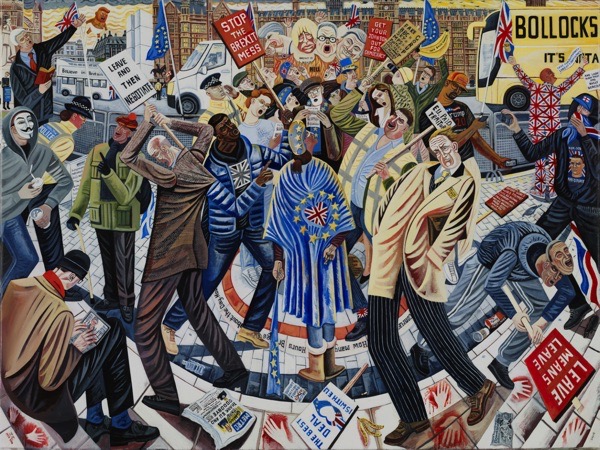
Ode to Joy, Westminster Old Palace Yard 2018-19
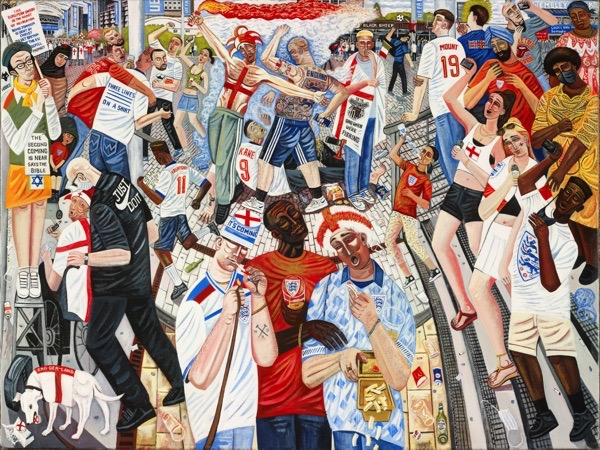
Still Dreaming, Olympic Way Wembley 2021
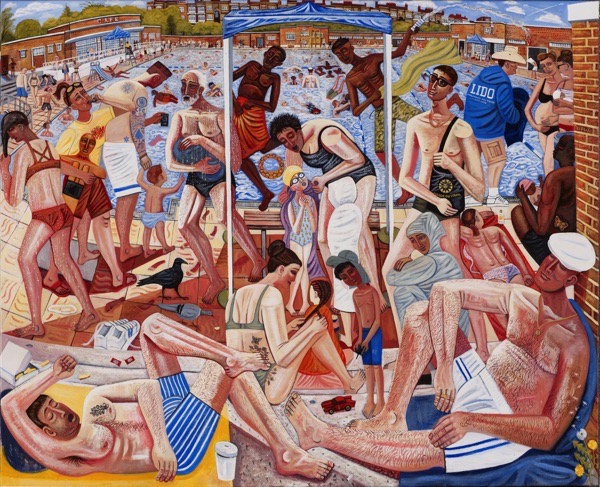
Everybody Loves The Sunshine, Parliament Hill Fields Lido
Paintings copyright © Ed Gray
Portrait copyright © Sarah Ainslie
You may also like to read about
Our Crowdfund Report

We may not have quite hit our target, but – thanks to 265 donors – we raised an astonishing £31,000 which is enough for us to work with creatively and relaunch Spitalfields Life Books. Meanwhile, our crowdfund page will remain open until we reach £35,000.
YOU CAN STILL VISIT OUR CROWDFUND PAGE & CONTRIBUTE HERE
Thanks to you, we can now put the pandemic behind us and step towards the future.
We have been working on David Hoffman’s book, A Place to Live: Endurance & Joy in the East End, 1971-87, for several years and now it can be published next spring. Tessa Hunkin’s Hackney Mosaic Project monograph and Sarah Ainslie’s book of portraits of Women at Work in the East End are both in advanced stages of development too, and they will follow next year.
In the meantime, next month I am bringing out a limited edition of my short story On Christmas Day, published jointly with Burley Fisher Books of Haggerston and designed by David Pearson. All those who supported the crowdfund as patrons, supporters or friends will receive personally inscribed copies in the post.
We are planning a launch celebration at Burley Fisher Books with a special guest to read the story and will publish the details here as soon as they are available.
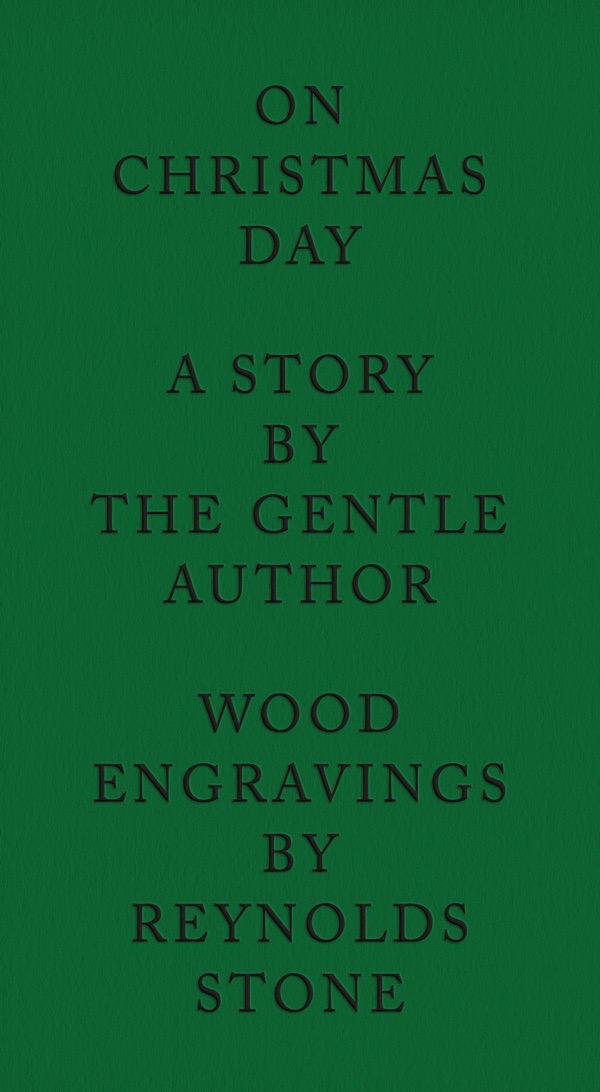
The Gentle Author picks up the threads of Christmas fiction from Charles Dickens, Dylan Thomas and George Mackay Brown to weave a compelling tale of family conflicts ignited and resolved in the festive season.
David Hoffman’s East End Jewish Shops

We have raised £27,000 to RELAUNCH SPITALFIELDS LIFE BOOKS and we have UNTIL MIDNIGHT to reach our target of £35,000.
CLICK HERE TO VISIT OUR CROWDFUND PAGE & CONTRIBUTE
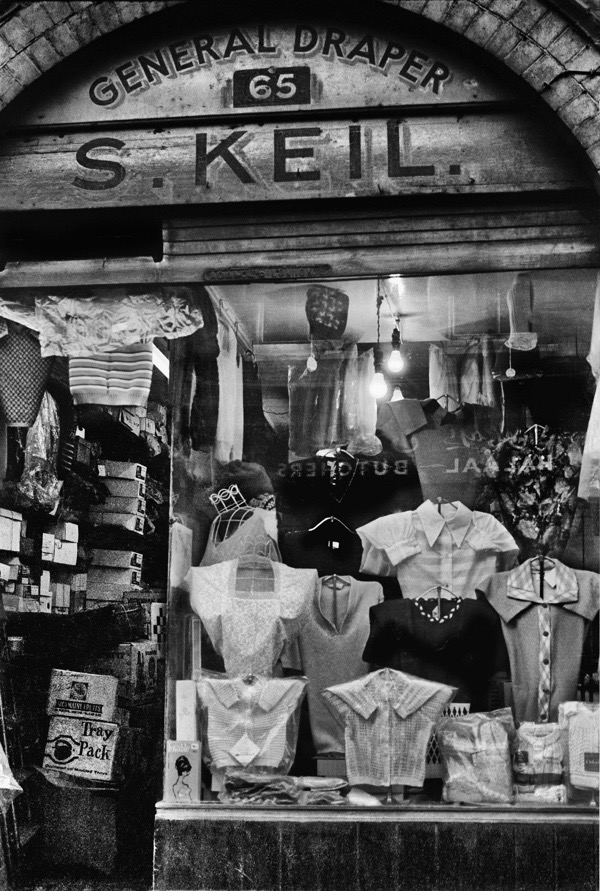
S Keil, Hessel St, 1972
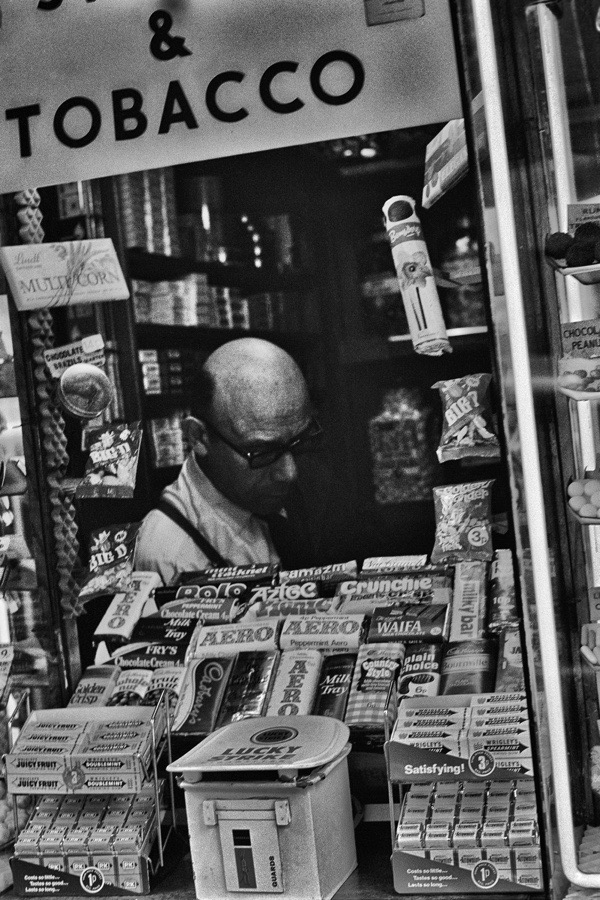
A generation ago, Hessel St and the surrounding streets were the focus of a long-established Jewish community. In 1972, David Hoffman documented the last days of some of the characterful shops and small businesses that once filled this corner of the East End.
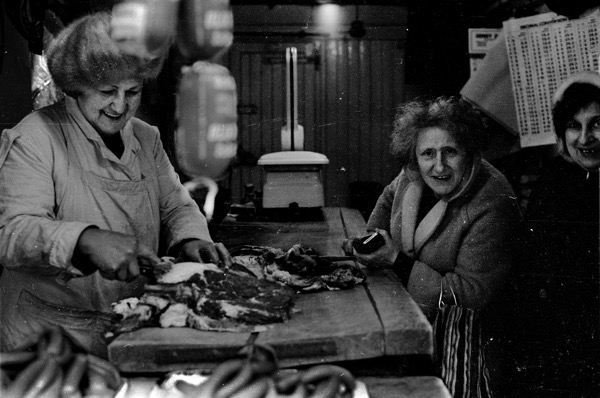
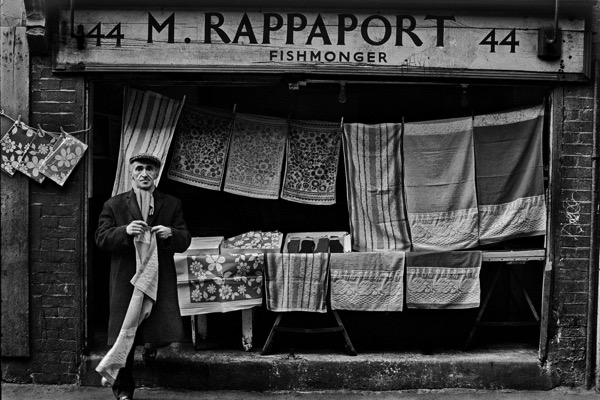
M Rappaport, Fishmonger, Hessel St
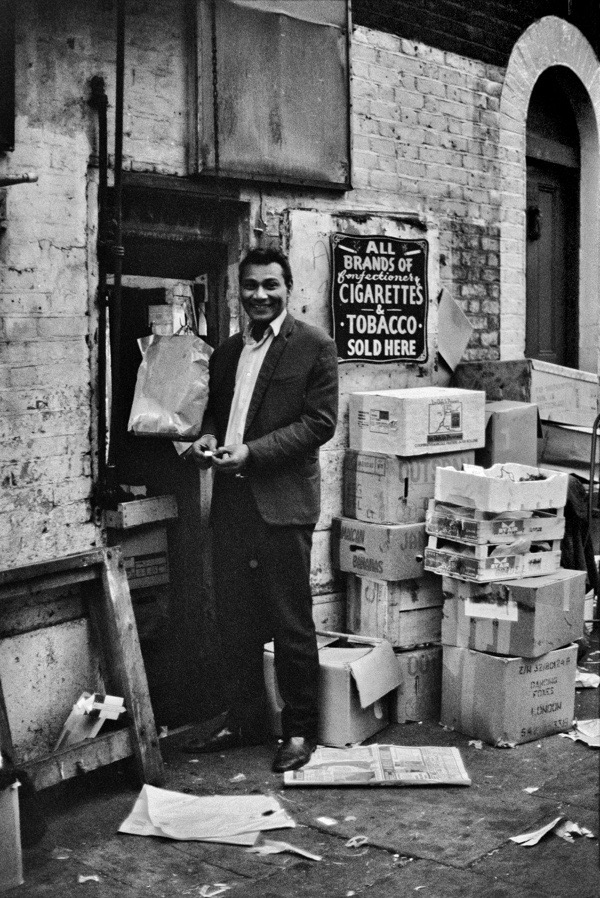
“There was a man who sold sarsaparilla at tuppence a glass from a window in his sweet shop at the top of Cannon St Road until ten o’clock at night. One day, this man was murdered and the police found a box of money under his bed – forty or sixty thousand pounds – he had been saving all the tuppences for forty years. They bricked up the window afterwards.” – Setven Berkoff
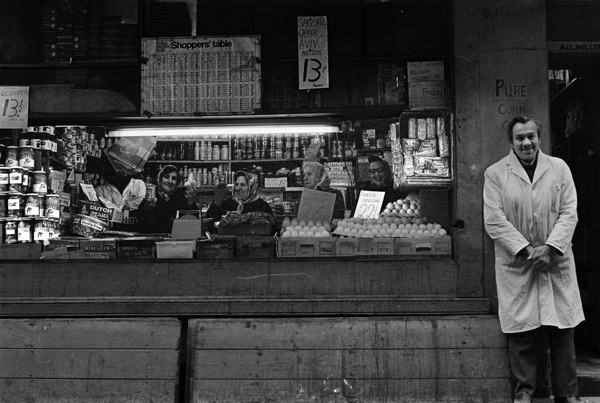
Hessel St
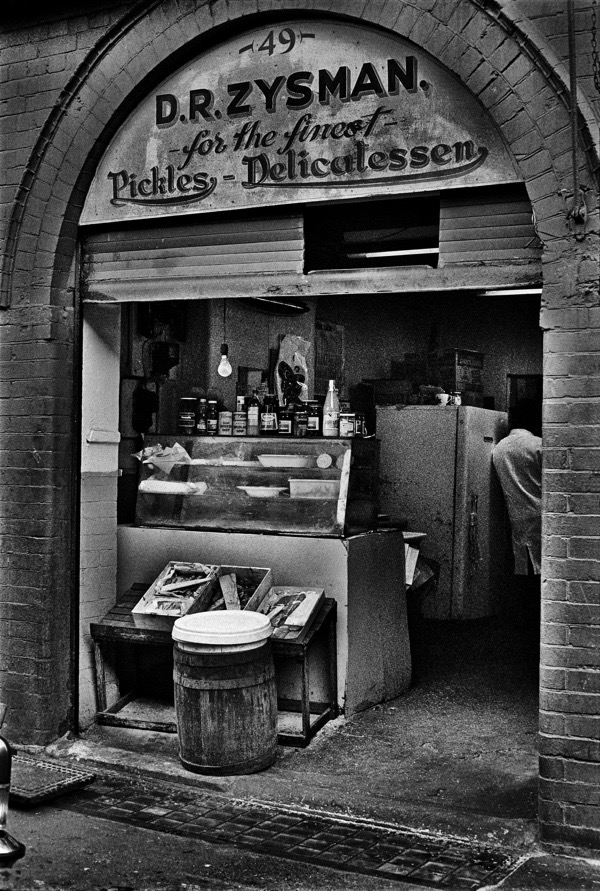
D. R. Zysman’s pickles & delicatessen shop, Hessel St
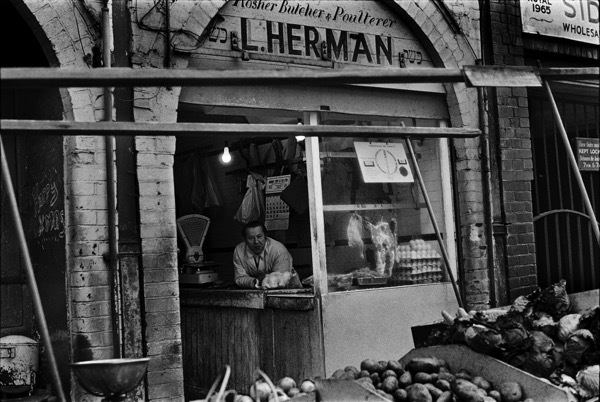
L Herman, Koser Butcher & Poulterer, Hessel St
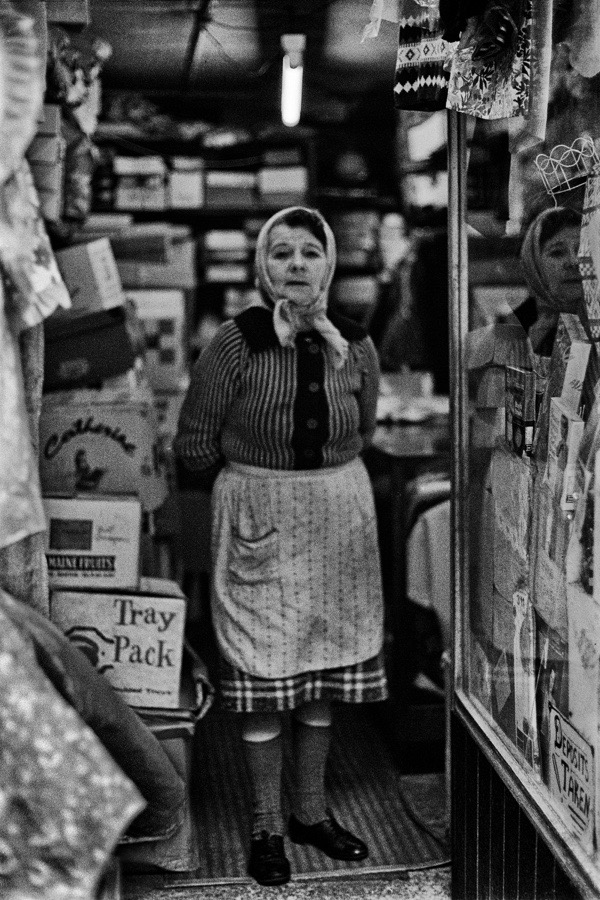
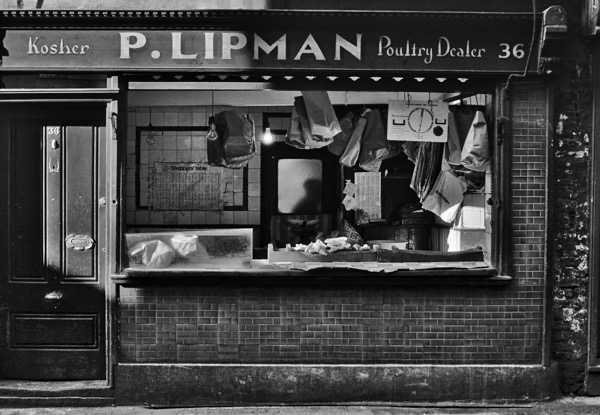
P Lipman, Kosher Poultry Dealer, Hessel St
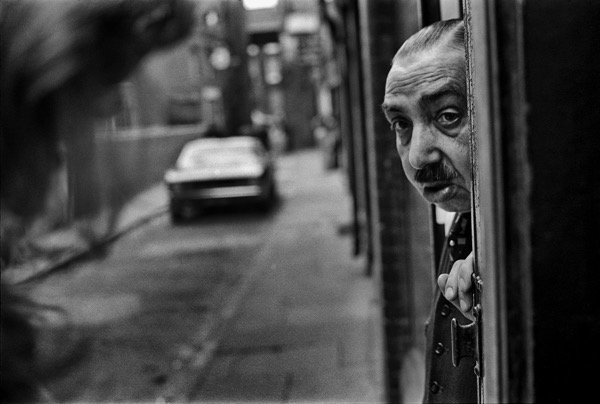
Solly Grannatt in the doorway of his jewellers’s shop at 17 Black Lion Yard
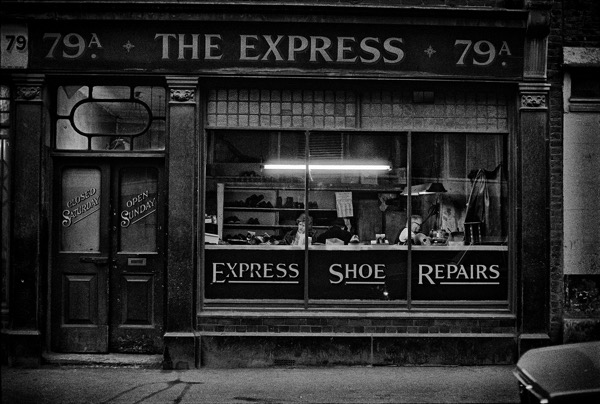 The Express Shoe Repair Shop, Hessel St
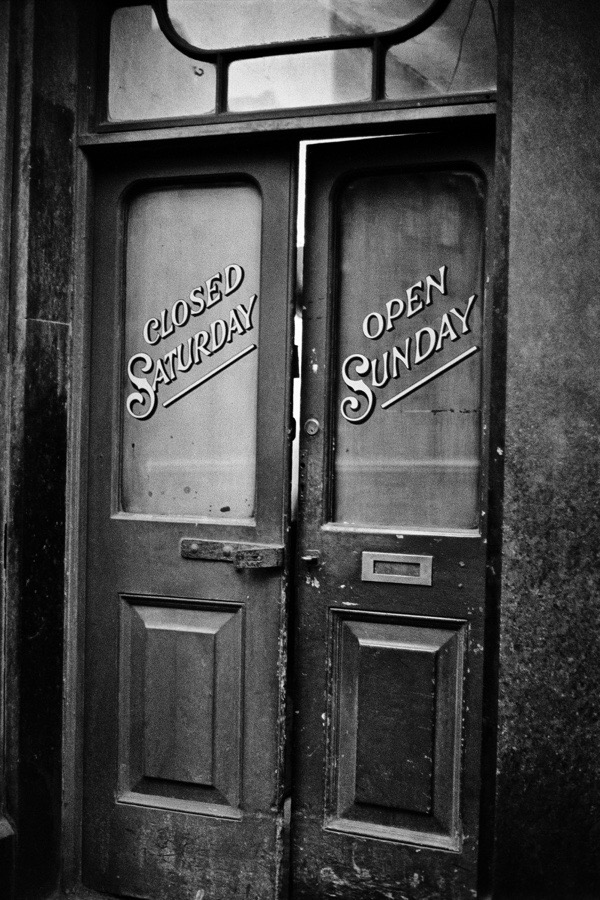
The Express Shoe Repair Shop
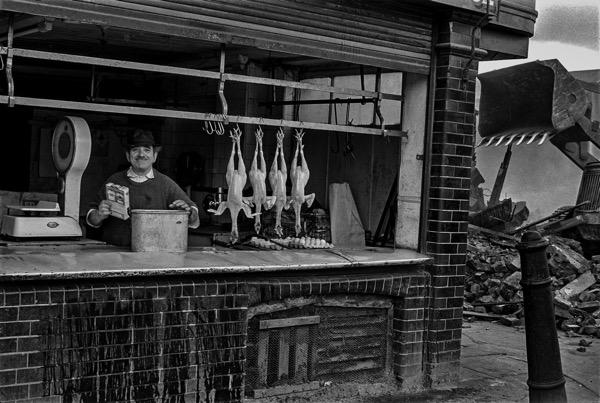
The bulldozer moves in on the kosher poulterer’s shop in Hessel St
Photographs copyright © David Hoffman
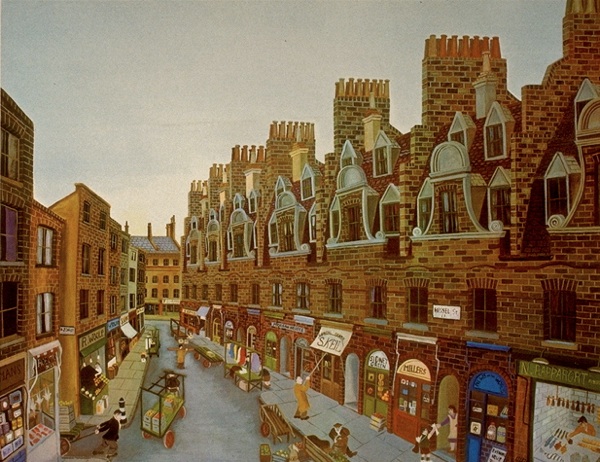
John Allin’s paining of Hessel St
You may also like to take a look at












