
The Nights Of Old London
I am reading my short story ON CHRISTMAS DAY next Saturday 2nd December at 11am as part of the BLOOMSBURY JAMBOREE at the Art Workers’ Guild in Queens Square, WC1N 3AT.
CLICK HERE FOR TICKETS
CLICK HERE TO ORDER A SIGNED COPY FOR £10

The nights are drawing in fast and I can feel the velvet darkness falling upon London. As dusk gathers in the ancient churches and the dusty old museums in the late afternoon, the distinction between past and present becomes almost permeable at this time of year. Then, once the daylight fades and the streetlights flicker into life, I feel the desire to go walking out into the dark in search of the nights of old London.
Examining hundreds of glass plates – many more than a century old – once used by the London & Middlesex Archaeological Society for magic lantern shows at the Bishopsgate Institute, I am in thrall to these images of night long ago in London. They set my imagination racing with nocturnal visions of the gloom and the glamour of our city in darkness, where mist hangs in the air eternally, casting an aura round each lamp, where the full moon is always breaking through the clouds and where the recent downpour glistens upon every pavement – where old London has become an apparition that coalesced out of the fog.
Somewhere out there, they are loading the mail onto trains, and the presses are rolling in Fleet St, and the lorries are setting out with the early editions, and the barrows are rolling into Spitalfields and Covent Garden, and the Billingsgate porters are running helter-skelter down St Mary at Hill with crates of fish on their heads, and the horns are blaring along the river as Tower Bridge opens in the moonlight to admit another cargo vessel into the crowded pool of London. Meanwhile, across the empty city, Londoners slumber and dream while footsteps of lonely policemen on the beat echo in the dark deserted streets.


Glass slides courtesy Bishopsgate Institute
Read my other nocturnal stories
Marion Elliot, Printmaker & Illustrator
I am reading my short story ON CHRISTMAS DAY next Saturday 2nd December at 11am as part of the BLOOMSBURY JAMBOREE at the Art Workers’ Guild in Queens Square, WC1N 3AT.
CLICK HERE FOR TICKETS
CLICK HERE TO ORDER A SIGNED COPY FOR £10

Marion Elliot will giving a lecture about her illustration, use of papercuts, and inspirations at the BLOOMSBURY JAMBOREE, 2nd & 3rd December at Art Workers Guild, 6 Queen Sq, WC1N 3AT.
Click here to book for Marion Elliot’s lecture at 11am on Sunday 3rd December
‘I have a great love of folk culture and popular art. I love shop fronts, fairgrounds, hand-painted signage, advertising imagery and typography, tattoos, workers’ guild banners, mottos, catch-phrases, religious iconography and paper ephemera.
I use printmaking techniques to produce densely-textured papers for my collage work and I am very fond of paper cutting, so my collage has developed from experiments with this technique.
I like collage because it offers me freedom to move all the elements around until I feel that the design looks right. I find creating the collages very contemplative, rather like making a large jigsaw puzzle and I can get lost for hours just moving bits around.’
Marion Elliot

Sailor’s pincushion
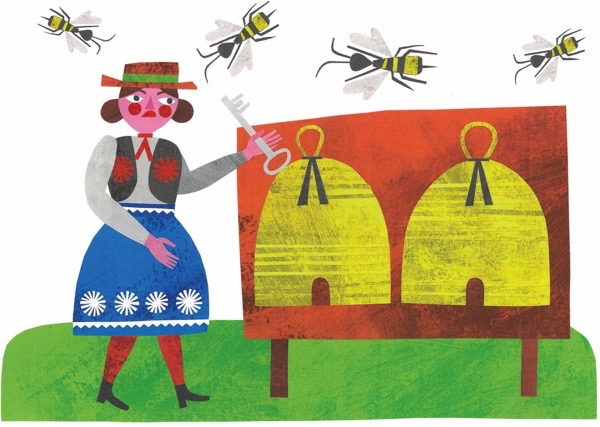
Telling the bees

Lammas Day

The Straw Bear

The ‘Obby ‘Oss

The Wicker Man

Fortune Teller

Wonder Cat

Perseverance

Prepare ye to meet thy God

Judy makes tea

Judy calls the police

Nuits de Paris

Hot Club

Mother and me

Bal-Musette

The sailor’s return
Illustrations copyright © Marion Elliot
No Longer The Last Derelict House

I am reading my short story ON CHRISTMAS DAY next Saturday 2nd December at 11am as part of the BLOOMSBURY JAMBOREE at the Art Workers’ Guild in Queens Square, WC1N 3AT.
CLICK HERE TO ORDER A SIGNED COPY FOR £10

Thirteen years ago I visited, 2 Wilkes St, the last derelict house in Spitalfields but this week I walked passed to discovered it has acquired – as if by magic – a splendid new doorcase, so sensitively made that it looks as if it were always there. This is visible evidence on the street of a long process of repair and now the house can no longer be said to be derelict, thanks to enlightened owner Rupert Hunt and talented architect Chris Williams.
Below you can read my original feature and photographs. I hope to follow this next year with pictures that show the interiors once repairs are complete.
In the meantime, you can follow the progress on Instagram @spitalfields1725

This is the view of Nicholas Hawksmoor’s spire of Christ Church seen from the weaver’s loft at the top of 2 Wilkes St – once the last derelict house in Spitalfields – which is currently in the process of conscientious repair.
Once upon a time people used to wander in these streets surrounding the shabby old church, savouring the romance of these ancient Huguenot houses that had seen better days and were then used as workplaces or left empty, but now those days are long gone
Most recently 2 Wilkes St served as a warehouse for Star Wholesale Cash & Carry. Previously, it had been a workplace with boards nailed over panelling, false ceilings added and layers of flooring concealing the original floorboards. Behind all these accretions, the old structure remained intact and when the additions were removed, along with some of the fabric – in a former abortive restoration attempt – no-one bothered to dispose of any of the timber from the house. The piles that lay around comprised the missing pieces of an enormous three dimensional jigsaw just waiting to be put back together. Elsewhere in Spitalfields, old properties have been turned upside down and stripped out, removing all evidence of the previous occupants, yet as a consequence of benign neglect, 2 Wilkes St existed as an eighteenth-century time capsule.
Stepping through the door, I was amazed by the multilayered textures that were the result of human activity throughout the long history of the building, especially the flaking paint that revealed every single coat through back three centuries. The house has a presence that halts you in your step and you lower your voice without knowing why. You stand and gaze. The reflected light from the street falls upon dusty old floorboards visibly worn beside the windows where people have stood in the same spot to look down upon Wilkes St since the seventeen-twenties – when the house was built by William Taylor, who was responsible for the house next door and several others in the vicinity.
Ten years ago, the central staircase of the house was rebuilt with the original treads on wooden bearers that support each step in the traditional method, starting at the bottom and working all the way up – just as a joiner would have done in the eighteenth-century, when all carpenters did their work on site.
Descended into the dark musty cellar by torchlight, I could see my own breath in the air as I entered a kitchen where the beam of light fell upon eighteenth-century match-boarding and a flag floor. The torchlight caught portions of an old dresser and a stone sink, beneath layers of dust, grit and filth – abandoned since the nineteenth century.
On the first floor, an intermediary space off the stairwell links rooms on either side, divided from them by partitions – this is a rare example of a powder room. Any of Henry Fielding’s characters would recognise this space.
Of all the old houses in Spitalfields, this is the one that has most retained its soul. The house holds its own silence and the din of the contemporary world is drowned out by it. 2 Wilkes St possesses the authentic atmosphere of old London that Fielding and Dickens knew, yet which can all too easily be destroyed forever. All these years it has been waiting for someone with the knowledge, money and patience to repair it and bring it back to life without erasing its history – and now this moment has arrived.


Eighteenth century staircase spindles

The view along the back gardens of Fournier St

2 Wilkes St
You may also like to read about
All Change at 15 & 17 Fournier St
Bloomsbury Jamboree Readings & Talks

You are invited to our annual BLOOMSBURY JAMBOREE which runs from 11am-5pm on Saturday 2nd & Sunday 3rd December at Art Workers’ Guild, 6 Queen Sq, WC1N 3AT.
We are showing the work of twenty of our favourite artists and makers, and we are proud to present this accompanying programme of readings and talks. Tickets are £10 which includes entry to the Jamboree.

Wood engraving by Reynolds Stone
ON CHRISTMAS DAY – A READING BY THE GENTLE AUTHOR
The Gentle Author picks up the threads of Christmas fiction from Charles Dickens, Dylan Thomas and George Mackay Brown to weave a compelling tale of family conflicts ignited and resolved in the festive season.
Click here to book for The Gentle Author’s reading at 11am on Saturday 2nd December

Photo by Sebastian Boettcher
THE GLOBEMAKERS – THE CURIOUS STORY OF AN ANCIENT CRAFT
Peter Bellerby introduces his new book, ‘The Globemakers: The Curious Story of an Ancient Craft’, in conversation with Basil Comely. Peter is founder of Bellerby & Co. Globemakers, the world’s only truly bespoke makers of traditionally handcrafted globes.
Click here to book for The Globemakers at 12:15pm on Saturday 2nd December

Cover by Matt Johnson
MATT JOHNSON, SEASALT & LOBSTER POTS
Matt Johnson recently illustrated ‘Red Sails & Pilchards’ published by Design for Today. Thousands recognise Matt’s lyrical images of Cornish harbours, wildlife and landscapes, featured widely in books and advertising.
Click here to book for Seasalt & Lobsterpots at 1:30pm on Saturday 2nd December

Self portrait by Morris Goldstein
MORRIS GOLDSTEIN – THE LOST WHITECHAPEL BOY
We present a selection of the unseen paintings of Morris Goldstein – contemporary of Mark Gertler and David Bomberg – to mark the publication of a new monograph. The talk will be introduced by Professor Rebecca Beasley and presented by Morris Goldstein’s son Raymond Francis who has been researching his father’s story for the last ten years.
Click here to book for The Lost Whitechapel Boy at 2:45pm on Saturday 2nd December

Tea towel by Marion Elliot
MARION ELLIOT – SAILORS, TEAPOTS & FOLK ART
Marion Elliot, illustrator, collage artist and maker, explores her influences, inspiration and process, creating a unique world where Jaques Tati meets Hank Williams and in which folk art collides with cafe culture.
Click here to book for Sailors, Teapots & Folk Art at 11am on Sunday 3rd December

Print by Mark Hearld
DAVID BUGG – THE PENFOLD PRESS
Printmaker Dan Bugg of The Penfold Press will be in conversation with curator Jane Audas, outlining the journey of the press and their celebrated partnerships with contemporary artists.
Click here to book for The Penfold Press at 12:15pm on Sunday 3rd December
 Lithograph by Lucien Boucher
JAMES RUSSELL – A TIME-TRAVELLER ‘S GUIDE TO PARIS
Art historian James Russell takes a journey into the wonderful world of twenties Paris. Published by the Mainstone Press, the Boutiques trilogy explores the city’s shops, fairgrounds and literary scene with dazzling illustrations by Lucien Boucher and Henri Guilac.
Click here for A Time-Traveller’s Guide to Paris at 1:30pm on Sunday 3rd December

Pollock’s, Scala St
ALAN POWERS – LONDON’S OLDEST TOY MUSEUM
Pollock’s Toy Museum began in 1956 in an attic in Monmouth St, Covent Garden, moving in 1969 to Scala Street, Fitzrovia. Today it is run by the grandson of the founder and since January 2023 this beloved museum has been looking for a new home. Alan will explore the history and reveal the future plans.
Click here to book for London’s Oldest Toy Museum at 2:45pm on Sunday 3rd December

Bloomsbury Jamboree 2023

In gleeful collaboration with Tim Mainstone of Mainstone Press and Joe Pearson of Design for Today, I am hosting our annual BLOOMSBURY JAMBOREE, a festival of books and print, illustration, talks and seasonal merriment next SATURDAY 2nd & SUNDAY 3rd DECEMBER from 10:30am until 4:30pm.
It takes place at the magnificent ART WORKERS GUILD, 6 Queens Sq, WC1, which was founded in 1884 by members of the Arts & Crafts movement including William Morris and C R Ashbee. These oak panelled rooms lined with oil paintings in a beautiful old house in Bloomsbury offer the ideal venue to celebrate our books, and the authors and artists who create them.
There will be book-signings and a programme of ticketed lectures and readings plus we have invited twenty friends to exhibit, including print and paper makers, small press publishers, toy makers, potters, craft workers and importers for food by small producers.
We need volunteers on Friday at 6:30pm and all day Saturday and Sunday. We offer bags of books as rewards – if you can help us, please email hello@inkpaperandprint.co.uk
CLICK HERE FOR DETAILS OF OUR LECTURES


Art Workers Guild

Art Workers Guild

Art Workers Guild

Elizabeth Harbour
From Boutiques by Lucie Bouchier published by Mainstone Press

Plate by Simon Turner

Tea towel by Marion Elliot

The Tiger’s Bride by Clive Hicks-Jenkins published Penfold Press

Elizabeth Harbour

Paper wreath by Clare Dales

Portrait of Dorset by Rena Gardiner published by Design for Today

Provisions imported by Sail Cargo London

Tea Towel by Chris Brown

Folk art from Poland imported by Frank & Luisa

Print by Mandy Doubt

Produce imported by sail power from Sail Cargo London

Hanging decorations by Elizabeth Harbour

Cards by Yes Paper Goods

Illustration by Jonny Hannah

Thomas Onwhyn’s London
CLICK HERE TO ORDER A SIGNED COPY OF ‘ON CHRISTMAS DAY’ FOR £10

Born in Clerkenwell in 1813 as the eldest son of a bookseller, Thomas Onwhyn created a series of cheap mass-produced satirical prints illustrating the comedy of everyday life for publishers Rock Brothers & Payne in the eighteen forties and fifties.
In his time, Onwhyn was overshadowed by the talent of George Cruickshank and won notoriety for supplying pictures to pirated editions of Pickwick Papers and Nicholas Nickleby, which drew the ire of Charles Dickens who wrote of “the singular Vileness of the Illustrations.”
Nevertheless, these fascinating ‘Pictures of London’ that I came upon in the Bishopsgate Institute demonstrate a critical intelligence, a sly humour and an unexpected political sensibility which speaks powerfully to our own times.
In this social panorama, originally published as one concertina-fold strip, Onwhyn contrasts the culture and lives of rich and the poor in London with subtle comedy, tracing their interdependence yet making it quite clear where his sympathy lay.

The Court – Dress Wearers.

Dressmakers.

The Opera Box.

The Gallery.

The West End Dinner Party.

A Charity Dinner.

Mayfair.

Rag Fair.
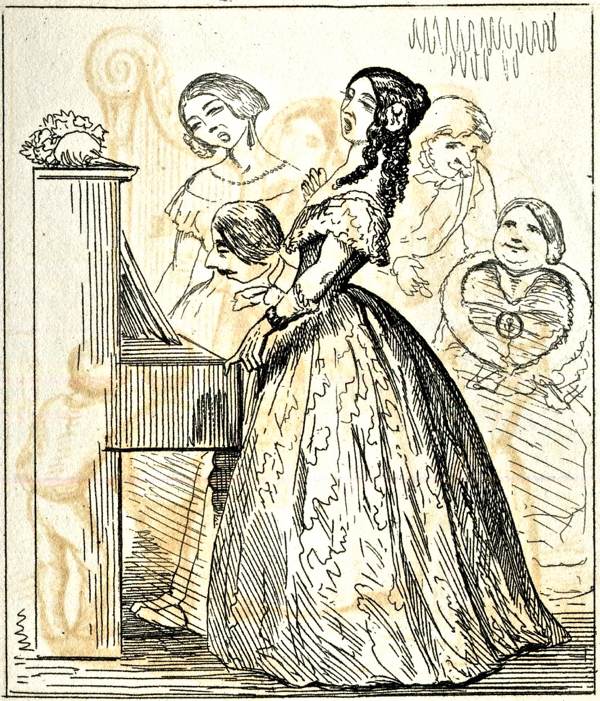
Music of the Drawing Room.

Street Music.

The Physician.

The Medical Student.

The Parks – Day.

The Parks – Night.

The Club – The Wine Bibber.

The Gin Shop – The Dram Drinker.

The Shopkeeper.

The Shirtmaker.

The Bouquet Maker.

The Basket Woman. (Initialled – T.O. Thomas Onwhyn)
Images courtesy Bishopsgate Institute
You may also like to take a look at
Malcolm Tremain’s Spitalfields
Jonathan Pryce will read my short story ‘On Christmas Day’ at the launch at Burley Fisher Books in Haggerston tonight Thursday 23rd November at 6:30pm.
CLICK HERE FOR TICKETS
CLICK HERE TO ORDER A SIGNED COPY FOR £10
In 1981, when Malcolm Tremain was working as a Telephone Engineer in Moorgate, he bought an Olympus 0M1 and set out to explore his fascination with Spitalfields.
‘I used to come over and wander round whenever I felt like it,’ he admitted to me, ‘I never thought I was making a record, I just wanted to take interesting photographs.’ Malcolm’s pictures of Spitalfields in the early eighties capture a curious moment of stasis and neglect before the neighbourhood changed forever.

Passage from Allen Gardens to Brick Lane – ‘I asked this boy if I could take his picture and he said, ‘yes.’ When I looked at the photograph afterwards, I realised he had one buckle missing from his shoe.’

Spital Sq, entrance to former Central Foundation School now Galvin Restaurant

In Spital Sq

In Brune St

In Toynbee St

Corner of Grey Eagle St & Quaker St

In Quaker St

Off Quaker St

Outside Brick Lane Mosque – ‘People dumped stuff everywhere in those days’

In Puma Court

Corner of Wilkes St & Princelet St

In Wilkes St

Outside the Jewish Soup Kitchen in Brune St

Outside the night shelter in Crispin St – ‘He was shuffling his feet, completely out of it’

In Crispin St

In Bell Lane

In Parliament Court

In Artillery Passage

In Artillery Passage

In Middlesex St – ‘note the squint letter ‘N’ in ‘salvation”

In Bishopsgate

In Bishopsgate

Petticoat Lane Market

In Wentworth St

In Wentworth St

In Wentworth St

In Wentworth St

In Wentworth St

In Fort St

In Allen Gardens

In Pedley St

In Pedley St

In Pedley St – ‘Good horse manure available – Help yourself – No charge’

At Pedley St Bridge

In Sun St Passage at the back of Liverpool St – ‘Note spelling ‘NATOINE FORANT”

In Sun St Passage
Photographs copyright © Malcolm Tremain
You may also like to take a look at
David Hoffman at Fieldgate Mansions
Philip Marriage’s Spitalfields


