
The Kiosks Of Whitechapel

Mr Roni in Vallance Rd
As the east wind whistles down the Whitechapel Rd spare a thought for the men in their kiosks, perhaps not quite as numb as the stallholders shivering out in the street but cold enough thank you very much. Yet in spite of the sub-zero temperatures, Contributing Photographer Sarah Ainslie & I discovered a warm welcome when we spent an afternoon making the acquaintance of these brave souls, open for business in all weathers.
I have always marvelled at these pocket-sized emporia, intricate retail palaces in miniature which are seen to best effect at dusk, crammed with confections and novelties, all gleaming with colour and delight as the darkness enfolds them. It takes a certain strength of character as well as a hardiness in the face of the elements to present yourself in this way, your personality as your shopfront. In the manner of anchorites, bricked up in the wall yet with a window on the street and also taking a cue from fairground callers, eager to catch the attention of passersby, the kiosk men embrace the restrictions of their habitation by projecting their presence as a means to draw customers like moths to the light.
In Whitechapel, the kiosks are of two types, those offering snack food and others selling mobile phone accessories, although we did find one in Court St which sold both sweets and small electrical goods. For £1.50, Jokman Hussain will sell you a delicious hot samosa chaat and for £1 you can follow this with jelabi, produced in elaborate calligraphic curls before your eyes by Jahangir Kabir at the next kiosk. Then, if you have space left over, Mannan Molla is frying pakora in the window and selling it in paper bags through the hatch, fifty yards down the Whitechapel Rd.
Meanwhile if you have lost your charger, need batteries or a memory stick in a hurry, Mohammed Aslem and Raj Ahmed can help you out, while Mr Huld can sell you an international calling card and a strip of sachets of chutney, both essential commodities for those on-the-go.
Perhaps the most fascinating kiosks are those selling betel or paan, where customers gather in clusters enjoying the air of conspiracy and watching in fascination as the proprietor composes an elaborate mix of spices and other exotic ingredients upon a betel leaf, before folding it in precise custom and then wrapping the confection into a neat little parcel of newspaper for consumption later.
Once we had visited all the kiosks, I had consumed one samosa chaat, a jalebi, a packet of gummy worms and a bag of fresh pakora while Sarah had acquired a useful selection of batteries, a strip of chutney sachets and a new memory stick. We chewed betel, our mouths turning red as we set off from Whitechapel through the gathering dusk, delighted with our thrifty purchases and the encounters of the afternoon.

Jokman Hussain sells Samosa Chaat

Mohammed Aslem sells phone accessories and small electrical goods

Jahangir Kabir sells Jalebi

Raj Ahmed

Mannan Molla sell Pakora

Mr Duld sells sweets and phone accessories in Court St

Mr Peash

Photographs copyright © Sarah Ainslie
You may also like to read about
William Anthony, The Last Of The Charlies

William Anthony 1789-1863
Behold the face of history! Photographed in 1863, the year of his death, but born in 1789, the year of the French Revolution, seventy-four-year-old William Anthony trudged the streets of Spitalfields and Norton Folgate through the darkest nights and thickest fogs for half a century, with his nose pointed into the wind and his jaw set in determination, successfully guided by a terrier-like instinct to seek out miscreants and prevent the outbreak of any unholy excesses of violence, such as erupted on the other side of the channel at the time of his nascence.
No wonder the Watch Book of Norton Folgate recorded an unbroken sequence of “All’s Well” for his entire tenure. No robbery was reported in fifty years. There was no nonsense with William Anthony. We need him at night on Brick Lane today.
The origin of the term ‘Charley’ for Watchman may originate in the time of Charles I when the monarch improved the watch system, although Jonathon Green, Spitalfields Life Contributing Lexicographer of Slang, who informed me of this possible derivation, can find no subsequent use in print for another one hundred and fifty years, when the term achieved currency in the early nineteenth century.
‘Charley’ as a derogatory term for a foolish person has survived into modern times, yet – as these photographs attest – William Anthony was unapologetic, quite content to be a ‘Charley.’ Behind him stand a long line of ‘Charlies’ stretching back through time for as long as London has existed and I think we may discern a certain dogged pride in William Anthony’s bearing, clutching his dark lantern in one hand and knobbly staff of office in the other, swaddled up in a great coat against the cold, wrapped in an apron against the filth, shod in sturdy boots against the damp and sheltered under his stout hat from the downpour.
Now I know his appearance, I will look out for William Anthony, lest our paths cross in the wintry dusk in Blossom St or Elder St – others might disregard him as another homeless old man walking all night but I shall hail him and pay my respects to the last of the ‘Charlies.’ He is the one of whom you could truly say you would be glad to meet him in a dark alley at night.


In Norton Folgate, the Watchman recorded an unbroken sequence of “All’s Well”

Tom & Jerry “getting the best of a Charley” at Temple Bar engraved by George Cruickshank, 1832

“Past one o’clock and a fine morning!” from Thomas Rowlandson’s ‘Lower Orders’

The Watchman, 1819 from ‘Pictures of Real Life for Children’

“Past Twelve O’Clock and A Cloudy Morning! & Patrol! Patrol!” from ‘Sam Syntax’s Cries of London’
 “Past twelve o’clock and a misty morning! Past twelve o’clock and mind I give you warning!” published by Charles Hindley, Leadenhall Press, 1884
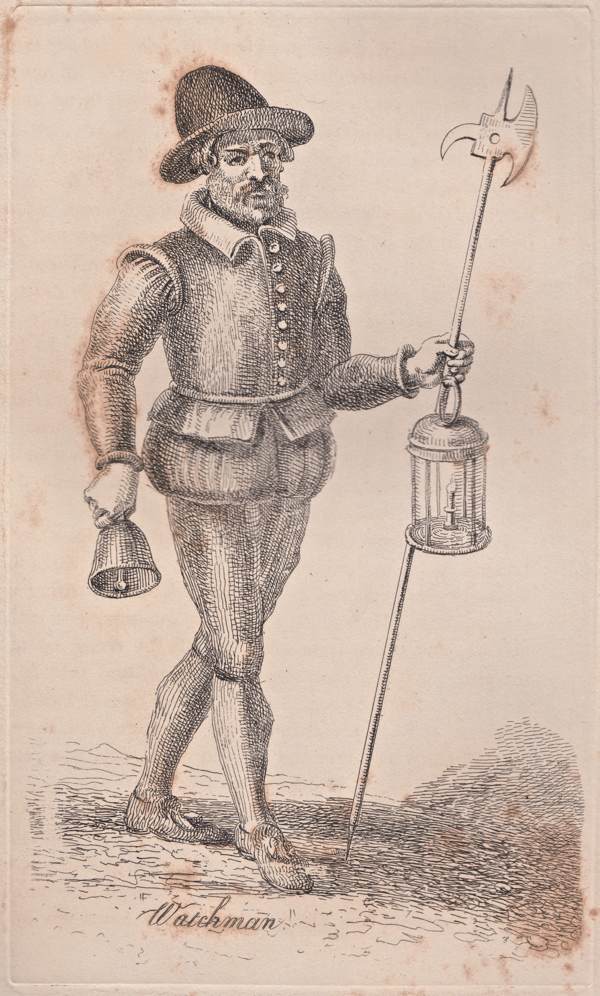
Watchman by John Thomas Smith, copied from a print prefixed to ‘Villanies discovered by Lanthorne and Candlelight’ by Thomas Dekker 1616. “The marching Watch contained in number two thousand men, part of them being old souldiers, of skill to be captaines, lieutenants, serjeants, corporals &c. The poore men taking wages, besides that every one had a strawne hat, with no badge painted, and his breakfast in the morning.”
Images courtesy Bishopsgate Institute
You may also like to read about
Dragan Novaković’s Brick Lane
These Brick Lane photographs from the late seventies by Dragan Novaković. Dragan came to London from Belgrade in 1968 and returned home in 1977, working for the state news agency Tanjug and then Reuters before his retirement in 2011.
‘I printed very rarely and very little, and for the next forty-odd years had these photographs only as contact sheets.’ explains Dragan, ‘I saw them properly as ‘enlargements’ for the first time in 2012, after I had scanned the negatives and post-processed the files.’

“I was introduced to London’s street markets by my friend and fellow countryman Mario who had a stall in Portobello Market specializing in post office clocks and bric-a-brac. I enjoyed sitting there with him amid the hustle and bustle, with people stopping by for a chat or to strike a bargain.
One early winter morning Mario picked me up in his old mini van and told me we were going to Bermondsey Market in search of clocks. It was still dark and foggy when we arrived and what met my eye made me gaze around in wonder – the scene looked to me as something out of Dickens!
The second time we went looking for clocks Mario took me to Brick Lane. Though there were plenty of open-air markets where I came from, I had seen nothing of the kind and size of Brick Lane and was fascinated by the crowds, the street musicians, the wares, the whole atmosphere. I sensed a strong community spirit and togetherness. I was hooked and I knew that I would have to come again in my spare time and take pictures.
Over the years I visited Brick Lane and other East End markets whenever I could spare the time and afford a few rolls of film. Living first in Earl’s Court and then behind Olympia, I would mount my old bicycle, bought in Brick Lane (of course!), and pedal hard across the West End in order to be there where life overflowed with activity.
I took what I consider snapshots without any plan or project in mind but simply because the challenge was too strong and I could not help it. I developed the films and made contact prints regularly but, never having a proper darkroom, made no enlargements to help me evaluate properly what I had done. Now I wish I had taken many more pictures at these locations.” – Dragan Novaković


Photographs copyright © Dragan Novaković
You also might like to take a look at
Oranges & Lemons Wrappers
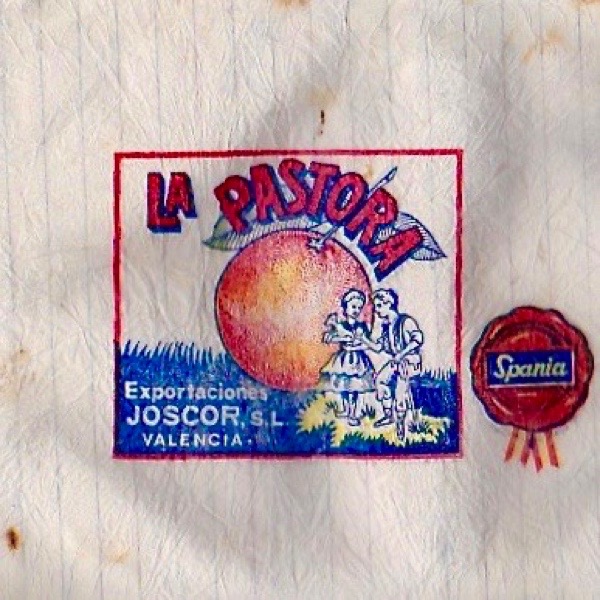
This is the season for oranges and lemons, so I was more than delighted when Keren McConnell kindly sent me her glorious fruit wrapper collection from the seventies to share with you. If any other readers have ephemera collections, please get in touch.
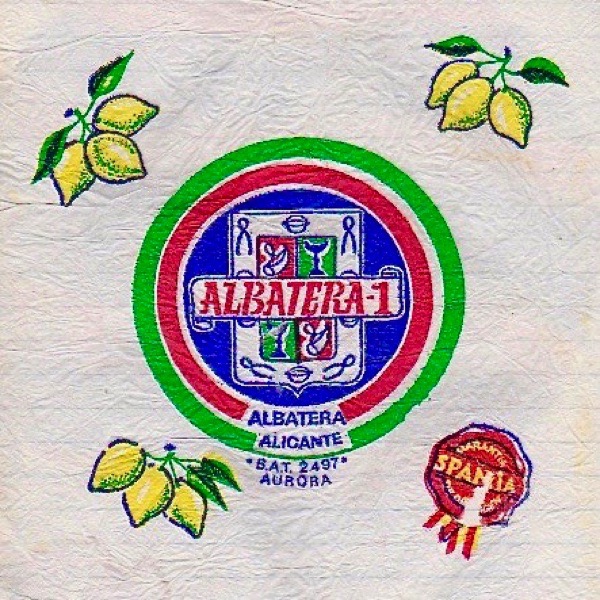
“I started collecting fruit papers when I was six years old, possibly inspired by a holiday in Spain in 1971. Most of the papers stuck in my small scrapbook were picked up while shopping for groceries with my mother at the local greengrocers in Blackheath. I think they reminded me of that holiday with their bright and graphic imagery.
I was drawn to the designs and texture and feel of the crinkly tissue paper. I also collected carrier bags and paper bags for their graphics, but this collection did not survive all our house moves.
Who knows? This book of fruit papers may have even informed my career. I became a print and graphics designer for fashion brands and retailers, sometimes using this scrapbook as reference material to inspire a T-shirt design.
As a child, particular favourites were the designs depicting animals, beautiful ladies and the smiling face on the Sicilian lemon is particularly appealing. I have no idea why the Tower of London was on a fruit paper from Spain. Perhaps the designer thought London was an exotic place, just as I had found Spain so exotic? Some of the designs seem to have been inspired by sport, such as horse racing and Formula One.
Are children today inclined to make collections like this? Mine was born out of boredom, particularly on wet Sundays when the days felt so long.”
Keren McConnell







You may also like to take a look at
A Riverside Walk In the Eighties
David Rees sent me these photographs that he took in the streets within walking distance on either side of the Thames when he worked at Tower Hill in the eighties.

Cathedral St, SE1
“I took these photos when I was working at Trinity House in the early eighties just before the ‘regeneration’ of the London Docks. Crossing the river, it was five minutes’ walk to Shad Thames and ten minutes’ walk to the Liberty of the Clink. Walking east, it was ten minutes via St. Katharine Docks to Wapping where the streets smelt of cinnamon and mace on late summer evenings.” – David Rees


Winchester Sq

Borough Market

Borough Market

Borough Market

Rochester Walk

Nelson’s Wharf from Old Barge House Stairs

Anchor Brewery

Clink St

Mill St

Hays Wharf

Weston St

Church of the English Martyrs seen from Chamber St

Longfellow Rd Mission

Essex Wharf

Holland St

Wapping Old Stairs

Queen Elizabeth St

Billingsgate Market

Chambers Wharf

Crown Wharf

Green Dragon St

Free Trade Wharf

Oliver’s Wharf

Oxo Tower

St Benet’s Wharf
Photographs copyright © David Rees
You may also like to take a look at
‘No Enemy But Winter & Rough Weather’

Archivist Stefan Dickers will be giving a lecture at the Hanbury Hall in Spitalfields next Tuesday 9th January at 7pm entitled THE TREASURES OF THE BISHOPSGATE INSTITUTE. As well as its celebrated London photographic collection featured in these pages, the Bishopsgate Archive houses Britain’s largest LBTQ+ collection.
Click here to book your ticket for THE TREASURES OF THE BISHOPSGATE INSTITUTE

‘No enemy but winter and rough weather…’ As You Like It
Every year at this low ebb of the season, I go to Columbia Rd Market to buy potted bulbs and winter-flowering plants which I replant into my collection of old pots from the market and arrange upon the oak dresser, to observe their growth at close quarters and thereby gain solace and inspiration until my garden shows convincing signs of new life.
Each morning, I drag myself from bed – coughing and wheezing from winter chills – and stumble to the dresser in my pyjamas like one in a holy order paying due reverence to an altar. When the grey gloom of morning feels unremitting, the musky scent of hyacinth or the delicate fragrance of the cyclamen is a tonic to my system, tangible evidence that the season of green leaves and abundant flowers will return. When plant life is scarce, my flowers in pots that I bought for just a few pounds each at Columbia Rd acquire a magical allure for me, an enchanted quality confirmed by the speed of their growth in the warmth of the house, and I delight to have this collection of diverse varieties in dishes to wonder at, as if each one were a unique specimen from an exotic land.
And once they have flowered, I place these plants in a cold corner of the house until I can replant them in the garden. As a consequence, my clumps of Hellebores and Snowdrops are expanding every year and thus I get to enjoy my plants at least twice over – at first on the dresser and in subsequent years growing in my garden.


Staffordshire figure of Orlando from As You Like It
At The Ceremony Of The Baddeley Cake
Archivist Stefan Dickers will be giving a lecture at the Hanbury Hall in Spitalfields next Tuesday 9th January at 7pm entitled THE TREASURES OF THE BISHOPSGATE INSTITUTE. As well as its celebrated London photographic collection featured in these pages, the Bishopsgate Archive houses Britain’s largest LBTQ+ collection.
Click here to book your ticket for THE TREASURES OF THE BISHOPSGATE INSTITUTE

Harry Nicholls cuts the Baddeley Cake with the cast of ‘Babes in the Wood’ in 1908
Last night, an excited throng at Drury Lane celebrated London’s oldest theatrical tradition, the cutting of the Baddeley Cake, which has been taking place on Twelfth Night since 1795.
After the performance, members of the cast gathered for the ceremony in the palatial neo-classical theatre bar dating from 1821, in front of a large party of fellow actors and actresses who have trod the boards of the Theatre Royal Drury Lane in former years, and whoever is currently starring cuts the cake. Liberal servings of strong punch containing wine, brandy and gin, concocted by the Theatre Manager to a secret recipe handed down through the centuries, always ensure that the evening goes with a swing. In recent years, the cake has been themed to the show running at the theatre and when I attended a huge chocolate cake was cunningly baked in the shape of a Wonka bar by a Master Chocolatier.
It is an occasion coloured with sentiment as the performers, still flushed from the night’s performance, recognise their part in this theatre’s long history while retired actors fill with nostalgic emotion to be reunited with old friends and recall happy past times at Drury Lane. This splendid event is organised annually by the Drury Lane Theatrical Fund which was founded by the great actor-manager David Garrick in 1766 to provide pensions to performers from Drury Lane and still functions today, for this notoriously most-uncertain of professions, offering support to senior actors down on their luck.
Twelfth Cake was a medieval tradition that is the origin of our contemporary Christmas Cake. Originally part of the feast of Epiphany, the cake was baked with a bean inside and whoever got the slice with the bean was crowned King of Misrule. The Baddeley Cake is the last surviving example of this ancient custom of the Twelfth Cake and – appropriately enough – owes its name to Robert Baddeley, a pastry chef who became a famous actor, and left a legacy to the Drury Lane Fund to “provide cake and wine for the performers in the green room of Drury Lane Theatre on Twelfth Night.”
A Cockney by origin, Robert Baddeley was pastry chef to the actor Samuel Foote when he grew stage-struck and asked his employer, who was performing at Drury Lane, if he could join him on the stage. “You are a good cook, why do you want to be a bad actor?” queried Foote, dismissing the request, but offering to find him a role on the stage if Baddeley was still keen in a year’s time.
With theatrical daring, Baddeley left his employer, travelled the continent for a year and returned to marry Sophia Snow, the glamorous daughter of George III’s State Trumpeter. On the anniversary of his original request, he presented himself at the Stage Door of the Theatre Royal, Drury Lane, and asked Foote for the job which he had been promised. In fact, Baddeley turned out to be a talented actor and quickly made a name for himself in comic roles, playing foreigners. The attractive Sophia Baddeley was also offered roles, exploiting her musical abilities and natural charms, and her husband arranged with the management to pocket both their salaries himself. Perhaps unsurprisingly, it proved to be a volatile marriage, especially when she took revenge on her husband by working her way through all the male members of the company.
The situation came to crisis in a duel over Sophia Baddeley’s honour between George Garrick (David’s brother) and Robert Baddeley in Hyde Park, yet she managed to reconcile the opponents with a suitably theatrical demonstration of her astonishing powers of persuasion. It appears that the constant tide of marital scandal published in the newspapers did no harm to the careers of either Mr & Mrs Baddeley.
Eventually, Robert Baddeley became a permanent member of His Majesties Company of Comedians at Drury Lane at a salary of twelve pounds a week. He was best known for originating the role of Moses in ‘The School for Scandal’ which premiered at Drury Lane in 1777, and it was in costume for this character that he collapsed on stage on November 19th 1794 and died at home in Store St next morning.
Baddeley’s will extended to seventy pages, including the legacy of his house in Moulsey as an asylum for decayed actors and a three pound annuity for the provision of an annual Twelfth Cake and punch for the performers at Drury Lane. The asylum failed because the old actors did not like being labelled as decayed, so the property was sold and his estate merged with the Drury Lane Theatrical Fund – but the annual ceremony of the cake which bears his name lives on.
Each year before the Baddeley Cake is cut, the Master of the Fund proposes a toast to Robert Baddeley and everyone raises their glasses of punch in celebration of London’s oldest living theatrical tradition and in remembrance of the Cockney pastry chef who fulfilled his dream of becoming an actor.

Robert Baddeley (1733-1794) The pastry chef who became a famous actor

Painted by Zoffany, Robert Baddeley as Moses in Sheridan’s “The School for Scandal,” which premiered at Theatre Royal Drury Lane in 1777

Robert Baddeley “I have taken my last draught in this world” Henry IV Part II

Baddeley’s Twelfth Cake

William Terriss cuts the Baddeley cake in 1883

Cutting the Baddeley Cake on the stage of Drury Lane in 1890

Alex Jennings (starring as Willie Wonka) cuts the Baddeley Cake, accompanied by the cast of “Charlie & The Chocolate Factory”

Theatre Royal Drury Lane
New photographs copyright © Sarah Ainslie
Click here to learn more about the Drury Lane Theatrical Fund


