
Valentine Delights From Dennis Severs’ House
I am thrilled to announce that Rupert Thomas, new director of Dennis Severs’ House and formerly editor of ‘The World of Interiors,’ has asked me to become an Associate Creative Director at the house, involved with devising and creating events including these below.

Photograph by Amy Merrick
Valentine’s Card Workshop
Next Saturday 10th February 2:30pm-4:30pm
Be inspired to make a gorgeous Valentine card for your beloved at a two-hour class in the beautiful eighteenth-century drawing room of Townhouse Spitalfields in Fournier Street overlooking Christ Church.
Introduced by Rupert Thomas, Director of Dennis Severs’ House, with an illustrated lecture on nineteenth-century Vinegar Valentines by The Gentle Author and a tutorial on the making of cards by floral designer and art director, Amy Merrick.

Vinegar Valentine from the Mike Henbry Collection at Bishopsgate Institute
Ticket price covers all materials including blank cards, replica Victorian paper cut-outs and a range of other decorative elements, as well as complimentary tea, coffee and freshly baked cake.
This event is in support of Dennis Severs’ House.
CLICK HERE TO BOOK YOUR TICKET

Photograph by Lucinda Douglas Menzies
Celebrate Valentine’s Day at Dennis Severs’ House
Dennis Severs House is opening from 5pm – 9pm on Wednesday 14th February for a special Silent Night to celebrate St Valentine’s, providing the opportunity for wordless trysts and amorous assignations conducted solely in looks and smiles.

For one night only, Ambrose the pink canary will be guest of honour, trilling songs of love. And stylist Amy Merrick has created some Valentine details throughout the house as evidence of the Jervis family’s flirtatious spirits.
What could be more conducive to romance than exploring Dennis Severs’ House by candlelight with the intimate object of your affections at your side? Advance booking essential.
CLICK HERE BOOK FOR DENNIS SEVERS’ HOUSE ON VALENTINE’S DAY

Photograph by Amy Merrick
Valentine Card by Simon Pettet
This delightfully playful Valentine by ceramicist was designed by Simon Pettet, made when he was in his twenties and living with Dennis at 18 Folgate, creating all the magnificent delftware which adorns the house to this day.
These are large cards.
183mm x 190mm, accompanied by an off-white envelope.
Printed by Calverts of Hackney.
CLICK HERE TO BUY A VALENTINE CARD
Pellicci’s Celebrity Album
This month’s talk in the Spitalfields Series at the Hanbury Hall will be local resident Dame Siân Phillips interviewed by Basil Comely about her life and career, next Tuesday 6th February at 7pm.

Portrait by Lucinda Douglas Menzies

For over fifteen years they have kept a celebrity album behind the counter at E.Pellicci, the Italian family-run cafe in the Bethnal Green Rd that was founded in 1900 by Priamo Pellicci. Salvatore (on the extreme left of the picture above) started the album after Julie Christie came in for a cup of coffee years ago and they did not think to ask for her picture until she had gone. So Salvatore decided that any celebrity who passes through must be recorded for posterity, either in a snapshot or at very least by an autograph on a scrap of paper. Regular customers will be familiar with this fat little album which is brought out frequently, whenever anyone feels like leafing through the pages of treasured images and savouring the memorable moments enshrined there, but now thanks to generosity of the Pellicci family I am able to publish a choice selection here for you to enjoy.
The distinguished gentleman with the stylish glasses who recurs throughout these pictures is Nevio Pellicci senior and the skinny young man who grew up to develop Groucho Marx eyebrows is Nevio Pellicci junior (in the green shirt above) whose glamorous sister Anna Pellicci is also to be seen completing the happy family group in many of the photographs.
Colin Farrell and Anna Friel were photographed at Pelliccis just last July whilst filming “The London Boulevard” and there is no doubt that Colin carries the picture above with his graphic features and charismatic emotional presence, just as we are accustomed to seeing him do with such exuberant success in the cinema. But in this instance, while he makes a plausible show of looking cool at first glance, on closer inspection there is an undeniable element of the-rabbit-caught-in-the-headlights about his expression, whereas on the right hand side of the picture Nevio Pellici junior is hamming it up with gleeful reckless abandon.
In fact, as I examined these pictures in detail, it dawned on me that the real star turn here is not delivered by any of the celebrities, it is Nevio Pellicci junior himself with his outrageous cartoon features who reveals the most potent star quality on display. Scrolling through these images, I was almost blinded by his dazzling grin that has a wattage sufficient to light up the entire Bethnal Green Rd at night. Only hoary old troupers like Michael Gambon and Su Pollard manage to avoid being upstaged by young Nevio’s incandescent smile.
The truth is that I find the open-hearted playfulness of this album irresistible. Here you see the Pellicci family (except Maria Pellicci who is always in the kitchen) at home over the last fifteen years as they participate in the long-running drama enacted daily at their beloved cafe. And by the end of this series, Nevio Pellicci junior has taken over from his father Nevio Pellicci senior in Bethnal Green, just as Michael Douglas took over from Kirk Douglas in Hollywood. Interestingly, a comparison of the images of Nevio senior and Nevio junior reveals that Nevio junior inherited his trademark smile from Nevio junior, just as Michael inherited the dimple from Kirk.
If you want to see the full album for yourself and pore over all the autographs too, you simply have to go round to E.Pellicci at 332 Bethnal Green Rd, and if you are a celebrity you should be aware that you cannot truly claim with any credibility to have arrived until you have got your picture in the Pelliccis’ book. Salvatore confided that he was thinking of getting the famous album insured, which sounds like a wise move to me because it is priceless.

Eastenders star Patsy Palmer, who grew up round the corner in Columbia Rd, experiences an emotional return to the cafe where she once enjoyed spaghetti as a little girl.

David Schwimmer takes a break from filming “Run Fat Boy Run” in Columbia Rd to chill with his new friends at Pelliccis in 2007.

Eager young Frank Lampard in 1998 when he played for West Ham before he transferred to Chelsea.

Better known as Sergeant Lynch from “Z Cars,” James Ellis knows how to froth a coffee.

Dizzee Rascal takes a break from filming a video to hang with his brutha in the hood, Nevio.

Clive Owen enjoyed a slap-up breakfast with all the trimmings.

Boxing legend Sir Henry Cooper is proud to make his mark at Pelliccis.

Michael Gambon, who signed himself as Dumbledore, re-enacts a ham sandwich for the camera.

Coronation St’s Ali King and Nevio Pellicci deny all the rumours.
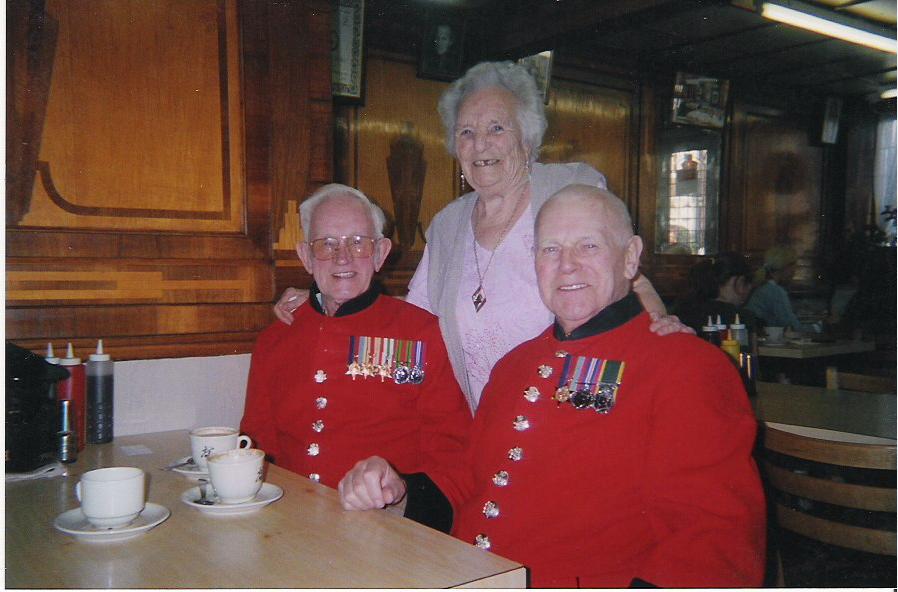
Lil Peters flirts shamelessly with two Chelsea Pensioners.

Ross Kemp and the Pellicci boys.

Jools Holland always pops in when he’s in the East End.

“I’m completely stuffed,” declared Su Pollard.
The Interregnum In Spitalfields
This month’s talk in the Spitalfields Series at the Hanbury Hall will be local resident Dame Siân Phillips interviewed by Basil Comely about her life and career, next Tuesday 6th February at 7pm.
Portrait by Lucinda Douglas Menzies
Today Philip Marriage introduces this series of photographs published for the first time here.
“These photographs were taken almost thirty years ago, 1994-5, during what I think of as ‘The Interregnum’ – the period after the old Spitalfields Market had moved to Leyton but before the wholesale redevelopment of Brushfield St and its inexorable gentrification. A period of quiet, almost emptiness, when traditional businesses serving the old market closed but new businesses had yet to emerge to replace them.”

My favourite photo of an almost empty Brushfield St with a bleached Christ Church, Spitalfields, at the end, resplendent in the sunshine beneath a threatening sky.

Artillery Passage looking towards Widegate St and Bishopsgate with the three traditional bollards, replaced nowadays by two.

Artillery Passage with Grapeshot’s Wine Bar on the left and The King’s Stores pub on Widegate St beyond.

Marsh Mushroom & Salad Sales, Crispin St, for sale before it was transformed into the ‘English Restaurant’.

Brushfield St with, on the right, The London Fruit & Wool Exchange first opened in 1929. This fine building has now gone with only the façade remaining. When this photo was taken the trees outside had yet to be planted and thankfully some of these survive today.

Brushfield St with Christ Church, Spitalfields, and the London Fruit & Wool Exchange. Once the market moved away to Leyton, Brushfield St was much tidier but often near empty when I visited – here with just three people visible and even some empty car parking spaces.

Artillery Lane with, on the left, the old Samuel Stores shop restored by the Spitalfields Trust in the eighties. In the background, across the road, can be seen the ornamental stone scrollwork of the ‘Artillery Tavern’, 1 Gun St, which, prior to 1884, was the ‘Cock A Hoop’ pub. This was the back of the Providence Row Night Refuge, largely demolished in 2004, leaving the grotesque remnants of the pub as a freestanding façade subsequently pinned to the outer wall of the new Lillian Knowles House.

Verde & Company Ltd on the corner Brushfield St junction with Gun St. The Victorian street sign for Gun St has been replaced by a tinpot Tower Hamlets Council substitute leaving the shadow of its predecessor remaining above.

Photographs copyright © Philip Marriage
You may also like to take a look at
Philip Marriage In Spitalfields
In The Winter Garden

A few years ago when the city was shut down and empty, I used to take long lone cycle rides in parts of London that were unknown to me, seeking an escape. One day at January’s end, after cycling around Regent’s Park in the frost to admire John Nash’s terraces, I came to the winter garden.
It was late afternoon, the sun had set and dusk was gathering but, when I came upon the narrow gate leading through a rose arch to the garden, I could not resist exploring. Beyond the entrance lay a large formal garden once attached to a grand Regent’s Park mansion. It was divided by hedges into a series of hidden spaces like a labyrinth. I found the place empty and deserted, save a few lonely blackbirds. In the last light of day, took these photographs.
I intended to publish my pictures and write about my visit then. Yet when I studied the photographs, I grew so enchanted that the experience barely seemed credible anymore. Instead, I kept the evidence of my melancholy pilgrimage to myself. Each year at this time, I revisited the photographs without finding any words to accompany them. On one occasion, I even set out to visit the garden again to verify my experience only to discover it was closed that day.
Contemplating these pictures now, they feel far away and I find it difficult even to remember the lockdown. It no longer seems real to me. Many are still struggling with the after-effects of that time yet when I look at these photographs I realise it is over. My pictures of this cold garden at twilight, with only a few plants showing, are how I shall recall it. The winter garden was where I found solace at the heart of the empty city.

Hylas

In the Rose Garden

The Sunken Lawn at St John’s Lodge

The Shepherdess Border


Snowdrops


The first primroses

‘To all protectors of the defenceless’


The Giant Urn


The Arbour Walk

St John’s Lodge Garden, Inner Circle, Regent’s Park, NW1 4NR
You may also like to take a look at
At Beppe’s Cafe
Guest writer Julia Harrison celebrates Beppe’s Cafe in Smithfield, accompanied with photographs by Contributing Photographer Sarah Ainslie

Daniella Papini
One of my favourite morning walks takes me down Cloth Fair through St Bartholomew’s Churchyard, past the memorial to Sir William Wallace on the wall of St Bartholomew’s Hospital, and across Smithfield to Beppe’s Cafe for breakfast.
The first time I visited, I was drawn by the board outside describing a fine selection of cooked breakfasts and mixed grills. I was struck by the energy inside – bacon frying, coffee brewing, and the nostalgic sound of Bruce Springsteen and Elvis Costello which made me feel very at home.
Behind the counter, Daniella Papini presides over an array of hams, cheeses and fresh produce ready to be made into ciabattas and salads for the lunchtime rush. There were postcards from across the world stuck to the fridge, family photographs, and – most intriguing of all – large sepia photographs in the far corner by my table, showing earlier generations. Clearly, this was a family business and I immediately wanted to know more.
On my next visit, I was distracted from my book by the steady arrival of builders in hard hats, ready for their cooked breakfasts, together with businessmen and women ordering sandwiches and takeaway coffees, and – in one case – a dog walker whose bulldog could not believe his luck when he was given a handful of treats. A break in the flow allowed owner Daniella to come across and tell me about the cafe and its history.
Pointing to a large photograph beside us on the wall of a tall, thin, well-dressed young man, she explained that this was her grandfather Giuseppe Papini – know as Beppe – who came over from a village near Lucca in 1911 and started the cafe with his wife in 1932. ‘That’s why this cafe is called Beppe’s’.
I could hardly begin my plate of scrambled eggs, I was so gripped by the stories Daniella told me, starting with her grandmother who came from the next village in Italy to her future husband.
‘My husband comes from the same village, so we go back there all the time. (His family, not mine – my parents were born here).
My grandmother was on the train with her future mother in law and she was starving and her future mother in law had a big loaf of bread and she asked her for a bit of bread and she said no it’s for my son, and she eventually married that son by some strange stroke of luck when she got to London.’
Daniella and Sergio, who barely moved from his station behind a huge frying pan and grill, are cousins. Pointing to a photograph behind me, of two smiling boys Daniella explains, ‘The two little boys up the top there – the one on the left is my father and the one on the right is my cousin Sergio’s father’ and I know in that instant that here is a family story that deserves to be told. Daniella recounts her father’s terror when a bomb fell on Smithfield Market.
‘My father remembers running through the market – the nurses coming out of St Barts with aprons soaked in blood.
He and his brother were at school at St Peter’s Italian Church on the Clerkenwell Road, and they were crying as they were running because until they got around the corner they didn’t know if the cafe was still standing.’
There is something very moving about observing Daniella and Sergio at work behind the counter, knowing that the cafe has seen three generations of their family.
‘During the Second World War my grandfather got interned on the Isle of Man so his wife was left to run it with her daughter – during the air raids – his daughter was ten years older than my dad so she was a bit more responsible.’
Turning to another photograph Daniella continues, ‘that’s my Uncle (the oldest) and the little one is my dad. They got evacuated to Wootton Bassett but they got split up and my dad was only five – he went to the nicest family in the world but his brother got sent to a terrible family – my dad wouldn’t stop crying so they put them together – she used all their rations, they didn’t have sheets on the bed, so when his sister went down she said look, you’re coming back to London, we will all die together, because you are not getting fed.’
I ask Daniella about the early days of the cafe, assuming – in my ignorance – that they would have been cooking Italian meals. She explains,
‘My cousin and I worked in the cafe on Saturdays when we were young. It wasn’t like now, there was no Italian influence – it wouldn’t have been possible. People wouldn’t have had anything like that. They had to adapt – it was corned beef and ham and and what they could get. It’s different now – we have brought in those influences.
My parents were a bit of both (Italian and English). Everyone expected my dad to speak with an Italian accent and he had this Cockney accent. I know my mum was embarrassed to take anyone home because they wouldn’t have known the food she was eating – it was all so different.
I can’t imagine how they ran the cafe on rations … where did they get the supplies from? I don’t know how they managed. They were part of the Italian community based near the church – they all stuck together. Some of their friends had cafes so they would help each other out.’
As I leave Beppe’s Cafe, a customer next to me at the counter turns to me and says, ‘there aren’t many places like this left: I always come here when I’m in the area’.
Heading back across Smithfield Market towards home, I think about the wealth of family history which is held within the cafe’s walls, and am glad that Daniella is there to tell her father’s stories – tales of love and war which resonate with us today, and form a link across the generations.

Sergio Papini

The serious business of breakfast at Beppe’s

Happy customers

Banknotes brought by customers from across the world

Daniella greets customers

Giuseppe Papini (Beppe) 1894-1962, standing outside the cafe he founded in 1932

Georgia Papini at the cafe

Giuseppe and Georgia Papini

From left, Carlo (Sergio’s father), Georgia (Giuseppe’s wife), Tony, (Daniella’s father), Giuseppe and Bruna (Carlo’s and Tony’s sister who helped keep the cafe going during the difficult war years when their father was interned) photographed by Boris Bennett

Tony and Carlo Papini

Daniella’s father Tony Papini with the plane that he flew in the fifties during his National Service

Account book from the fifties

Sergio and Daniella with Daniella’s father Tony on his ninetieth birthday

Daniella and her cousin Sergio

New photographs copyright © Sarah Ainslie
Beppe’s Cafe, 23 West Smithfield, EC1A 9HY. Mondays to Fridays, 6:30am- 2pm
You may also like to read about
New Threat Of Demolition For Whitechapel’s Theatrical Terrace

3-13 Vallance Rd
It was an early success for the nascent East End Preservation Society in 2014 when this old terrace in Whitechapel, comprising the last fragment of the nineteenth century Pavilion Theatre complex, was saved from demolition.
In response to the number of objections received then, Tower Hamlets Council withdrew their application for demolition in order to explore new options. How disappointing to learn ten years later that the council are now considering a new application for demolition, despite the acknowledged importance of these buildings which sit within the Whitechapel Market Conservation Area.
Please write now to object to the proposed demolition of Whitechapel’s Theatrical Terrace.
Quote Planning Application PA/23/02117/NC and be sure to label your comment as an OBJECTION. You can object from anywhere in the world but you must include a postal address.
Send an email to
development.control@towerhamlets.gov.uk
or a letter to
Planning, Housing and Regeneration
Tower Hamlets Town Hall
160 Whitechapel Road
London
E1 1BJ
Through all the changes in Whitechapel since World War II, this distinctive Victorian terrace has miraculously survived and the exoticism of its architecture with such a strange mixture of styles fascinates me – as it does many others for whom the terrace is also a landmark in this corner of the East End, where so few old buildings remain to tell the story of what once was here.
In fact, I realised these tatty shopfronts and ornate facades have always spoken to me, even before I discovered the nature of the story they were telling. The florid decoration was no whim upon the part of the architect but reflected their association and direct proximity to the adjoining Pavilion Theatre which opened here early in the nineteenth century, at first presenting nautical dramas to an audience from the docks and later becoming a Yiddish theatre to serve the Jewish population in Whitechapel.
Commanding the southern extremity of Vallance Rd, this terrace is almost the last fragment to remind us of the history of one of the East End’s most ancient thoroughfares, linking Bethnal Green and Whitechapel. Built in 1855, the vast and forbidding Whitechapel Union Workhouse once stood a few hundred yards north. In common with most of the nineteenth century buildings in this corner of what was known as Mile End New Town, it has long gone – swept away during the decades following the last war, leaving the streetscape fragmented today. Old Montague St, leading west to Commercial St and formerly the heart of the Jewish commerce in the East End, was entirely demolished.
Even Whitechapel Rd, which retains good sweeps of historic buildings, suffered major post-war casualties, including a fine eighteenth century terrace west of the London Hospital that was demolished in the seventies. Yet there was one building of great importance of which the loss went seemingly unnoticed -The Pavilion Theatre, a favourite resort for East Enders for nearly one hundred and fifty years before it was demolished in 1961.
The New Royal Pavilion Theatre opened in 1827 at the corner of Whitechapel Rd and Baker’s Row (now Vallance Rd) with a production of The Genii of the Thames, initiating its famous nautical-themed productions, pitched at the the maritime community. In 1856, the theatre burnt down and its replacement opened in 1858, boasting a capacity of three-thousand-seven-hundred, which was a thousand more than Covent Garden and included the largest pit in London theatre, where two thousand people could be comfortably accommodated.
‘The Great National Theatre of the Metropolis’ – as it was announced – boasted a wide repertoire including Shakespeare, opera (it became the East London Opera House in 1860) and, of course, pantomime. It gained a reputation for the unpretentious nature of its patrons, with one critic remarking “there is a no foolish pride amongst Pavilion audiences, or, as far as we could see, any of those stupid social distinctions which divide the sympathies of other auditoriums.”
In 1874, the Pavilion was reconstructed to the designs of Jethro T. Robinson, a notable theatre architect who designed two other East End theatres. both of which are now lost – the Grecian Theatre in Shoreditch and the Albion in Poplar, that was oriental in style. It was this rebuilding of the Pavilion which included the construction of a new terrace on Baker’s Row with interwoven Moorish arches evoking the Alhambra. The theatrical design of these buildings, with decorated parapets, panels and window surrounds, and the integration of side entrances to the theatre suggest the authorship or influence of J. T. Robinson himself.
In its later years, the Pavilion became one of the leading theatres in London, offering Yiddish drama, but as tastes changed and the Jewish people began to leave, the audience declined until it closed for good in 1934. In ‘East End Entertainment’ (1954) A. E. Wilson recalls a final visit to the old theatre before it closed.
“Once during the Yiddish period I visited the theatre. What I saw was all shabbiness, gloom and decay. The half-empty theatre was cold and dreary. The gold had faded and the velvet had moulted. Dust and grime were everywhere. And behind the scenes it was desolation indeed. The dirty stage seemed as vast as the desert and as lonely. I realised that there was no future for the Pavilion, that nothing could restore its fortunes, that its day was over.”
The decline of the Pavilion had been slow and painful. After the theatre closed in the thirties, it was simply left to decay after plans to transform it into a ‘super cinema’ failed to materialise. Bomb damage in the war and a fire meant that when a team from the London County Council’s Historic Buildings Division went to record the building in 1961, they found only a shell of monumental grandeur. After the theatre was finally demolished in 1961, the northern end of the terrace was also demolished leaving just number 13 (the former Weavers Arms Pub) and the battered row that has survived to this day.
In the spirit of high theatrical farce, the Council’s consultant wrote of these buildings in Vallance Rd in the 2013 Heritage Report, accompanying the former application for demolition, that ‘… [they] do not contribute to the character or appearance of the Conservation Area,’ directly contradicting the Council’s earlier Conservation Area Appraisal of the area in 2009 which outlined the following priority for action – “Encourage sympathetic redevelopment of gap sites west of Vallance Rd and secure restoration of 3-11 Vallance Rd.”
In 2014, a new proposal was rendered by local conservation practice Jonathan Freegard Architects, commissioned by the Spitalfields Trust, which retains the terrace as part of a mixed-use scheme delivering housing, retail and office space. This remains the best option for these buildings.

5 & 7 Vallance Rd, showing decorative window surrounds and parapet (Alex Pink)

9 & 11 Vallance Rd. With its decorative central panel, number 9 leads through to a courtyard where the theatre’s carpentry workshop once stood (Alex Pink)

3 Vallance Rd with original shopfront (Alex Pink)

Looking north over Vallance Rd (left) and Hemming St (right), 1957 (City of London, London Metropolitan Archives)

Whitechapel Union Workhouse in Vallance Rd, at junction with Fulbourne St, 1913 (City of London, London Metropolitan Archives)

Whitechapel Union Workhouse, Vallance Rd 1913 (City of London, London Metropolitan Archives)

Corner of Vallance Rd and Hereford St, 1965 (City of London, London Metropolitan Archives)

Bricklayers Arms, Vallance Rd and Sale St, 1938 (City of London, London Metropolitan Archives)

Old Montague St and Black Lion Yard, 1961 (City of London, London Metropolitan Archives)

Old Montague St and Kings Arms Court, 1961 (City of London, London Metropolitan Archives)

Old Montague St looking east with Pauline House under construction, 1962 (City of London, London Metropolitan Archives)

The first Royal Pavilion Theatre in Whitechapel, 1856 (East London Theatre Archive)

Playbill 1867, nautical drama was a speciality at the Pavilion (East London Theatre Archive)

Playbill 1854 (East London Theatre Archive)

Playbill 1835 – note reference to gallery entrance in Baker’s Row (Vallance Rd) (East London Theatre Archive)

Playbill 1856 (East London Theatre Archive)

Playbill 1833 (East London Theatre Archive)

Playbill 1851 (East London Theatre Archive)

The Great National Theatre of the Metropolis’ – the rebuilt Pavilion, 1858

Plan of the Pavilion in eighteen-seventies showing how the houses in Baker’s Row (Vallance Rd) are integrated into the theatre

The Pavilion as a Yiddish theatre in the thirties

Pavilion Theatre facade on Whitechapel Rd, 1961 (City of London, London Metropolitan Archives)

Auditorium of Pavilion Theatre, 1961 (City of London, London Metropolitan Archives)

Pit and stage at Pavilion Theatre, 1961 (City of London, London Metropolitan Archives)

Fly tower of Pavilion Theatre, 1961 (City of London, London Metropolitan Archives)

Back wall of the Pavilion Theatre, 1961 (City of London, London Metropolitan Archives)

17-29 Vallance Rd, showing the large scene doors entrance and gallery entrance beyond, all integrated into the terrace, 1961 (City of London, London Metropolitan Archives)

Sketch of the elevation of the Oriental Theatre, Poplar High St, by Jethro T. Robinson, 1873 – note usage of the arch-within-an-arch motif as seen in the Vallance Rd terrace

First sketch by Tim Whittaker of the Spitalfields Trust, proposing courtyard housing behind the terrace which reflects the local vernacular of Whitechapel

Proposal by Jonathan Freegard Architects for restoration of the terrace with a new yard at rear

South-westerly view of proposal by Jonathan Freegard Architects

Rear view of proposal by Jonathan Freegard Architects
Recent photographs of Vallance Rd Terrace © Alex Pink.
John Claridge’s East End Shops

Ross Bakeries, Quaker St, 1966
“I used to go to the shops with my mum every Saturday morning, and she’d meet people she knew and they’d be chatting for maybe an hour, so I’d go off and meet other kids and we’d be playing on a bombsite – it was a strange education!” John told me, neatly illustrating how these small shops were integral to the fabric of society in his childhood.“People had a pride in what they were selling or what they were doing” he recalled,“You’d go into these places and they’d all smell different. They all had their distinct character, it was wonderful.”
Although generations of the family were dockers, John’s father warned him that the London Docks were in terminal decline and he sought a career elsewhere. Consequently, even as a youth, John realised that a whole way of life was going to be swept away in the changes which were coming to the East End. And this foresight inspired John to photograph the familiar culture of small shops and shopkeepers that he held in such affection. “Even then I had the feeling that things were going to be overrun, without regard to what those in that society wanted.” he confirmed to me with regret.
As small shopkeepers fight for their survival, in the face of escalating rents, business rates and the incursion of chain stores, John Claridge’s poignant images are a salient reminder of the venerable tradition of local shops here that we cannot afford to lose.

Shop in Spitalfields, 1964.

C & K Grocers, Spitalfields, 1982 – “From the floor to the roof, the shop was stocked full of everything you could imagine.”

Cobbler, Spitalfields, 1969.

Flo’s Stores, Spitalfields, 1962 – “All the shops were individual then. Somebody painted the typography themselves here and it’s brilliant.”

Fruit & Veg, Bethnal Green 1961 – “I’d been to a party and it was five o’clock in the morning, but she was open.”

W.Wernick, Spitalfields, 1962.

Fishmonger, Spitalfields, 1965.

Corner Shop, Spitalfields, 1961 – “The kid’s just got his stuff for his mum and he’s walking back.”

At W.Wernick Poulterers, Spitalfields, 1962 – “She’s got her hat, her cup of tea and her flask. There was no refrigeration but it was chilly.”

Fiorella Shoes, E2, 1966 – “There’s only four pairs of shoes in the window. How could they measure shoes to fit, when they couldn’t even fit the words in the window? The man next door said to me, ‘Would you like me to step back out of the picture?’ I said, ‘No, I’d really like you to be in the picture.”

Bertha, Spitalfields, 1982 – “Everything is closing down but you can still have a wedding! She’s been jilted at the altar and she’s just waiting now.”

Bakers, Spitalfields, 1959 – “There’s only three buns and a cake in the window.”

Jacques Wolff, E13 1960 – “His name was probably Jack Fox and he changed it to Jacques Wolff.”

Waltons, E13 1960 – “They just sold cheap shoes, but you could get a nice Italian pair knocked off from the docks at a good price.”

Churchman’s, Spitalfields, 1968 – “Anything you wanted from cigarettes to headache pills.”

White, Spitalfields 1967 – “I saw these three kids and photographed them, it was only afterwards I saw the name White.”

The Door, E2 1960.

The Window, E16 1982 – “Just a little dress shop, selling bits and pieces. The clothes could have been from almost any era.”

Victor, E14 1968 – “There’s no cars on the road, the place was empty, but there was a flower shop on the corner and it was always full of flowers.”
Photographs copyright © John Claridge
You may also like to take a look at
Along the Thames with John Claridge
At the Salvation Army with John Claridge


