
Vivian Betts At The Primrose

Vivian & Toto outside The Primrose
You will not meet many who can boast the distinction of being brought up on the teeming thoroughfare of Bishopsgate, but Vivian Betts is one who enjoyed that rare privilege – growing up above The Primrose on the corner of Primrose St where her parents were publicans from 1955 until 1974. Yet it was a different Bishopsgate from that of the present day with its soaring glass towers housing financial industries. In her childhood, Vivian knew a street lined with pubs and individual shops where the lamplighter came each night to light the gas lamps.
Living in a pub on the boundary of the City of London, Vivian discovered herself at a hub of human activity. “I had the best of both worlds,” Vivian confessed to me, when she came up to Spitalfields on a rare visit, “I had the choice of City life or East End life, I could go either way. I had complete freedom and I was never in any danger. My father said to me if I ever had any trouble to go to a policeman. But all my friends wanted to come over to my place, because I lived in a pub!”
Vivian knew Bishopsgate before the Broadgate development swallowed up the entire block between Liverpool St and Primrose St. And as we walked together past the uniform architecture, she affectionately ticked off the order of the pubs that once stood there – The Kings Arms, The Raven and then The Primrose – with all the different premises in between. When we reached the windswept corner of Primrose St beneath the vast Broadgate Tower, Vivian gestured to the empty space where The Primrose once stood, now swallowed by road widening, and told me that she remembered the dray horses delivering the beer in barrels on carts from the Truman Brewery in Brick Lane.
In this landscape of concrete, glass and steel, configured as the environment of aggressive corporate endeavour, it was surreal yet heartening to hear Vivian speak and be reminded that human life once existed there on a modest domestic scale. Demolished finally in 1987, The Primrose had existed in Bishopsgate at least since 1839.
“My brother Michael was born in 1942, while Bill my father was away in the war, and Violet my mother got a job as a barmaid, and when he came back she said, ‘This is how I want to spend my life.’ Their first pub was The Alfred’s Head in Gold St, Stepney, in about 1946, and she told me she was washing the floor there in the morning and I was born in the afternoon. We left when I was three and all I remember of Stepney was walking over a bomb site to look at all the caterpillars.
In 1955, we moved into The Primrose at 229 Bishopsgate, directly opposite the Spitalfields market – you could look out of the window on the first floor and see the market. My first memory of Bishopsgate was lying in bed and listening to the piano player in the pub below. We had three pianos, one in the public bar, one in the first floor function room and one in our front room. On Sunday lunchtimes at The Primrose, it was so busy you could hardly see through the barroom for all the hats and smoke.
I used to go to Canon Barnet School in Commercial St and, from the age of seven, my dad would see me across Bishopsgate and I’d walk through the Spitalfields Market on my way to school where the traders would give me an apple and a banana – they all knew me because they used to come drinking in the pub. It was a completely Jewish school and, because no-one else lived in Bishopsgate, all my friends were over in Spitalfields, mostly in the Flower & Dean Buildings, so I spent a lot of time over there. And I used to come to Brick Lane to go the matinees at the cinema every Saturday. Itchy Park was our playground – in those days, the church was shut but we used to peek through the window and see hundreds of pigeons inside.
My dad opened one of the first carveries in a pub, where you could get fresh ham or turkey cut and made up into sandwiches and, in the upstairs room, my mum did sit-down lunches for three shillings – it was like school dinners, steak & kidney pudding and sausage & mash. She walked every day with her trolley to Dewhurst’s the butchers opposite Liverpool St, she got all her fruit and vegetables fresh from the Spitalfields Market, and she used to go to Petticoat Lane each week to buy fresh fish.
Every evening at 5pm, we had all the banks come in to play darts. On Mondays, it was the ladies of The Primrose darts team and on Wednesdays it was the men’s darts league. And, once each year, we organised the Presentation Dance at the York Hall. Every evening in the upstairs function room, we had the different Freemason’s lodges. Whenever I came out of my living room, I could always see them but I had to look away because it was part of my life that I wasn’t supposed to see. After I left school, I went to work for the Royal London Mutual Insurance Co. in Finsbury Sq – five minutes walk away – as a punchcard operator and, whenever it was anyone’s birthday, I’d say ‘Come on back to my mum’s pub and she’ll make us all sandwiches.’
Then in 1973, Truman’s wrote to my dad and gave him a year’s notice, they were turning the pub over to managers in April 1974, so we had to leave. But I had already booked my wedding for July at St Botolph’s in Bishopsgate, and I came back for that. Eighteen months later, in 1976, my mum and dad asked me and my husband to go into running a pub with them. It was The Alexandra Hotel in Southend, known as the “Top Alex” because there were two and ours was at the top of the hill.
Three months after we moved in, my dad died of cancer – so they gave it to my mum on a year’s widow’s lease but they said that if me and my husband proved we could run it, we could keep it. And we stayed until 1985. Then we had a murder and an attempted murder in which a man got stabbed, and my husband said, ‘It’s about time we moved.’ And that’s when we moved to our current pub, The Windmill at Hoo, near Rochester, twenty-eight years ago. We had a brass bell hanging behind the counter at The Primrose that came off a train in Liverpool St Station which we used to call time and we’ve taken it with us – all these years – but though we don’t call time any more, we still use it to ring in the New Year.
I’ve only ever had two Christmases not in a pub in my life, when you’re born to it you don’t know anything else.”
Vivian told me that she often gets customers from the East End in The Windmill and they always recognise her by her voice. “They say, ‘We know where you come from!'” she confided to me proudly.

The Primrose, 229 Bishopsgate, as Vivian knew it.

Toto sits on the heater in the panelled barroom at The Primrose.

Vivian at Canon Barnet School in Commercial St.

Bill and Vi Betts

“My first Freemason’s Lodge night when I was twelve or thirteen in 1965. My brother Michael with his wife Valerie on the right.”

Vivian stands outside The Primrose in this picture, looking east across Bishopsgate towards Spital Sq with Spitalfields market in the distance.
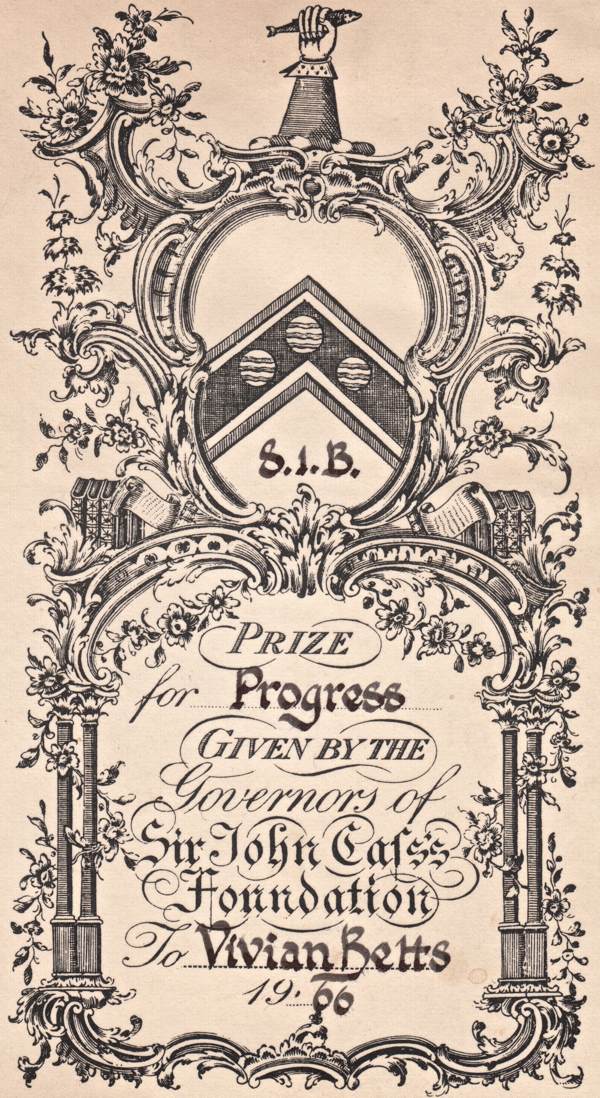
Vivian was awarded this certificate while a student at Sir John Cass School, Houndsditch.

Vivian on the railway bridge, looking west towards Finsbury Sq.

Vivian outside the door which served as the door to the pub and her own front door.

Vivian’s friends skylarking in Bishopsgate – “They always wanted to come over to my place because I lived above a pub!”
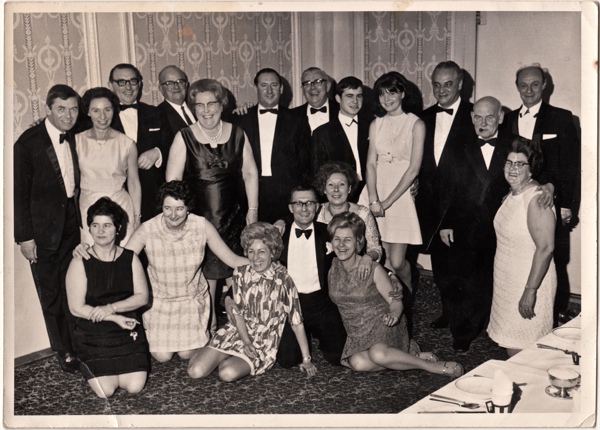
“When I was eight, we went abroad on holiday for the first time to Italy, we bought the tickets at the travel agents across the road and, after that, twelve or fourteen couples would come with us – my parents’ friends – and I was always the youngest there.”

Vivian prints out a policy at the Royal London Mutual Insurance Co. in Finsbury Sq.

“And what do you do?” – Vivian meets Prince Charles on a visit to Lloyd Register of Shipping in Fenchurch St.

“Harry the greengrocer and Tom the horse, they used to get their fruit & vegetables in the Spitalfields Market. My husband Dennis worked for this man when he was about twelve years of age, driving around the Isle of Dogs. He loved horses, and we’ve got a piece of land with our pub now and we’ve kept horses since 1980.”

Bill & Vi Betts in later years.

Vivian Betts at St Botolph’s Bishopsgate where she married her husband Dennis Campbell in 1974.

The Primrose in a former incarnation, photographed in 1912.

Bishopsgate with The Primrose halfway down on the right, photographed in 1912 by Charles Goss.
Archive photographs courtesy Bishopsgate Institute
You might also like to take a look at these other Bishopsgate stories
The Romance of Old Bishopsgate
Joe Lawrence, Butcher & Novelist

Joe Lawrence
There is a legend that Dick Turpin started out as a Butcher’s apprentice in Whitechapel before graduating to the role of Highwayman. Yet only now that I have read Joe Lawrence’s fictionalised memoir The East End Butcher’s Boy can I fully appreciate how one activity could be the natural outcome of such an employment.
In 1972, at fourteen years old, Joe fell into a Saturday job at a Butcher’s shop in East Ham and found himself unwittingly swept up into a criminal underworld only to emerge on the other side at nineteen – fully qualified in butchery and a street-savvy survivor. Joe quickly became complicit as his boss used the premises for trading in all kinds of stolen goods with accumulating success and escalating risk.
Returning to these seminal experiences in the light of maturity, Joe has crafted a compelling account which reads like a thriller and allows us to identify with the innocence of the narrator while also fearing for the consequences as he gets in too deep. The work is an impressive debut, possessing an unmistakeable authenticity and, in its human sympathy and complex moral scheme, recalling the work of Bill Naughton, a favourite writer of mine.
Part of the fascination of the book is how Joe describes an entire illicit subculture with its elaborate codes and relative sense of justice yet, at the end, you realise it has been an unexpected love story – a rite of passage, delivering the protagonist into adulthood and a complex relationship with the society he inhabits.
Photographer Alex Pink accompanied Joe on his daily trip to Smithfield Market before dawn and, later in the morning, I met with them both at The George on the Isle of Dogs where we enjoyed pints and plates of delicious bangers and mash, supplied by Joe. “I’ve always loved getting up early,” he admitted to me fondly, “I’m up at three-thirty, out of the house by four and at Smithfield Market by four-thirty.”
After his volatile start in butchery, Joe forsook the beloved trade for twenty years, working for the Post Office and then running his own courier business from Bermondsey. “In 2010, I realised I’d had enough,” Joe confessed, “I thought, ‘What was it I enjoyed more than anything else in the world?'”
Joe also wrote ‘The East End Butcher’s Boy’ in six months in 2010 and, encouraged by a positive response from a literary agent, set out to get it published. “I have written another book and I am halfway through a third,” he revealed to me enthusiastically. Thus, Joe has reconciled himself to his past through writing and returned to what he always wanted to do.
“I know there is still a market for a traditional English butcher,” he informed me authoritatively, “so people send me their orders and I go down to Smithfield and get it for them, all packaged exactly as they want.” Now Joe is his own man, doing what he loves best, making his daily runs that end up at The George and working on his writing too.


Joe runs a meat raffle on the last Friday of every month at The George


Photographs copyright © Alex Pink
You can obtain a signed copy of THE EAST END BUTCHER BOY from Joe Lawrence for £5 by dropping him an email at eastendbutcher@gmail.com
You may like to read my other stories of butchery
Joan Brown, Secretary at Smithfield Market
Albert Turpin, Painter
Last chance to book for the VALENTINE’S CARD WORKSHOP tomorrow Saturday 10th February 2:30pm – 4:30pm at Townhouse, Spitalfields.
Introduced by Rupert Thomas, Director of Dennis Severs’ House, with an illustrated lecture on nineteenth-century Vinegar Valentines by The Gentle Author and a tutorial on the making of cards by floral designer and art director, Amy Merrick.
Ticket price covers all materials including blank cards, replica Victorian paper cut-outs and a range of other decorative elements, as well as complimentary tea, coffee and freshly baked cake.
CLICK HERE TO BOOK YOUR TICKET

Salmon & Ball, Bethnal Green, c.1948
When the Daily Herald asked Albert Turpin (1900–64) about his motives, he declared his wish “to show others the beauty in the East End and to record the old streets before they go.” Born in Columbia Rd into a family that struggled to feed themselves on his father’s salary, working as variously a tea-cooper, feather sorter and casual docker, Albert walked into Shoreditch Town Hall and enlisted at fifteen, giving his age as nineteen years old.
In the Royal Marines, he won success as a heavyweight boxing champion yet found time to explore his sensitive side too. “Out came my paint box and canvas and, making myself comfortable on the boat deck … I painted away to my heart’s content,” he told the Hackney Gazette in later years.
After the war, Albert married Sally Fellows in 1922, whom he met at the Hackney Empire. He took up window cleaning with the aim of finishing all his windows by lunchtime so he could spend the afternoon painting. He attended classes at Bethnal Green Working Men’s Institute and at the Bow & Bromley Commercial Institute, and showed his paintings at the Bethnal Green Museum.
During the General Strike of 1926, while on the way to such a class, Albert heard a speech by working class activist, Bill Gee. In his autobiography, Albert wrote that Bill Gee “did not teach me anything I did not already know, but what he did do was to make me forget all about my art class and join up with the organised workers right there.” Signing up for the Labour Party, Albert began his long political career by drawing cartoons for local newspapers.
He exhibited ten canvases in the East London Art Club exhibition at the Whitechapel Art Gallery in December 1928. One of these depicted a man eating food scavenged from a bin, entitled Man Must Eat until Albert changed the title to The Dust Bin to avoid offending public sensibilities. This show was so successful that Charles Aitken, Director of the Tate, transferred some pictures to his gallery, including several by Albert – from which the wealthy collector Joseph Duveen bought The Dust Bin. Subsequently, when the Lefevre Galleries in St James launched its annual exhibitions of the East London Group in November 1929, Albert showed three pictures and in following years he contributed regularly to their shows.
During the thirties, Albert became a member of the Bethnal Green Borough Council and an active anti-fascist protester, drawing the wrath of the blackshirts. They issued a poster in 1936 announcing, ‘Turpin responsible for East End disturbances.’ He also joined the Ex-Servicemen’s National Movement for Peace, Freedom & Democracy and supported the Republicans in the Spanish Civil War, writing “On many occasions, I was arrested for offences ranging from rioting and assaulting the police, to chalking anti-war slogans on walls at nights. To me, these incidents were like medals to a good soldier.”
When war came again, Albert joined the London Fire Brigade and became an official Fire Brigade War Artist. Awarded a certificate by the Society for the Protection of Life for saving a child from a blaze in Bethnal Green, Albert was unanimously elected Mayor in 1945. The Evening News reported that he “won’t be wearing the mayorial robes because he thinks it is waste of taxpayers’ money.” As a compromise he “wore a gold chain of office, which competed for glitter with his brightly polished firemen’s buttons.” Always possessing a strong moral sense, Albert disapproved of gambling and loathed drinking, refusing to wash pub windows when he resumed his window cleaning duties after the war.
For the rest of his life he continued to paint the East End and in 1960, he wrote to the East London Advertiser pleading for the importance of preserving people’s memories. ‘Don’t they mean anything to anybody?’ he asked.

Albert Turpin, Artist, Window Cleaner & Mayor of Bethnal Green

Columbia Market, 1952/3

The Arches, Cambridge Heath Rd

Cable St

Marian Sq, Hackney

Three Jolly Butchers, Cabbage Court, Brick Lane, c.1953

Bellevue Place, Cleveland Way

Rebuilding St Matthew’s Church, Bethnal Green, c.1956

Verger’s House, Shoreditch, 1954
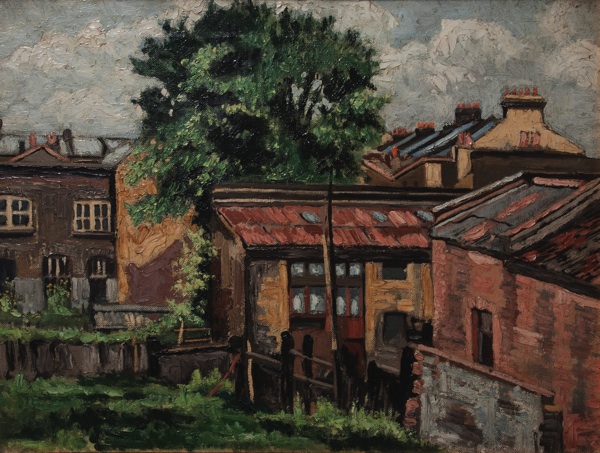
Shakey’s Yard in Winter, c.1952

Hackney Empire
Images copyright © Estate of Albert Turpin

Click here to buy a copy of EAST END VERNACULAR
Looking Down On Old London
Last tickets left for the VALENTINE’S CARD WORKSHOP next Saturday 10th February 2:30pm – 4:30pm at Townhouse, Spitalfields.
Introduced by Rupert Thomas, Director of Dennis Severs’ House, with an illustrated lecture on nineteenth-century Vinegar Valentines by The Gentle Author and a tutorial on the making of cards by floral designer and art director, Amy Merrick.
Ticket price covers all materials including blank cards, replica Victorian paper cut-outs and a range of other decorative elements, as well as complimentary tea, coffee and freshly baked cake.
CLICK HERE TO BOOK YOUR TICKET

In my dream, I am flying over old London and the clouds part like curtains to reveal a vision of the dirty monochrome city lying far beneath, swathed eternally in mist and deep shadow.
Although most Londoners are familiar with this view today, as the first glimpse of home on the descent to Heathrow upon their return flight from overseas, it never ceases to induce wonder. So I can only imagine the awe of those who were first shown these glass slides of aerial views from the collection of the London & Middlesex Archaeological Society at the Bishopsgate Institute a century ago.
Even before Aerofilms was established in 1919 to document the country from above systematically, people were photographing London from hot air balloons, zeppelins and early aeroplanes. Upon first impression, the intricate detail and order of the city is breathtaking and I think we may assume that a certain patriotic pride was encouraged by these views of national landmarks which symbolised the political power of the nation.
But there is also a certain ambivalence to some images, such as those of Horseguards’ Parade and Covent Garden Market, since – as much as they record the vast numbers of people that participated in these elaborate human endeavours, they also reduce the hordes to mere ants and remove the authoritative scale of the architecture. Seen from above, the works of man are of far less consequence than they appear from below. Yet this does not lessen my fascination with these pictures, as evocations of the teeming life of this London that is so familiar and mysterious in equal measure.

Tower of London & Tower Bridge

Trafalgar Sq, St Martin-in-the-Fields and Charing Cross Station

Trafalgar Sq & Whitehall

House of Parliament & Westminster Bridge

Westminster Bridge & County Hall

Tower of London & St Katharine Docks
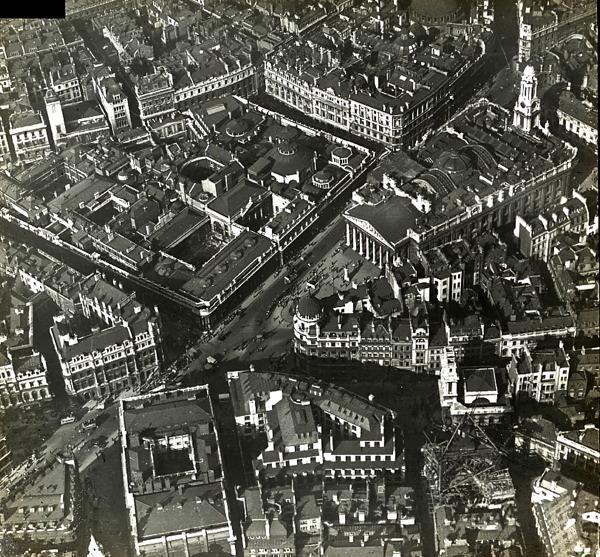
Bank of England & Royal Exchange

Spires of City churches dominate the City of London

Crossroads at the heart of the City of London

Guildhall to the right, General Post Office to the left and Cheapside running across the picture

Blackfriars Bridge & St Paul’s

Hyde Park Corner

Buckingham Palace & the Mall

The British Museum

St James’ Palace & the Mall

Ludgate Hill & St Paul’s

Pool of London & Tower Bridge with Docks beyond

Albert Hall & Natural History Museum

Natural History Museum & Victoria & Albert Museum

Limehouse with St Anne’s in the centre & Narrow St to the right

Reversed image of Hungerford Bridge & Waterloo Bridge

Covent Garden Market & the Floral Hall

Admiralty Arch

Trooping the Colour at Horseguards Parade

St Clement Dane’s, Strand

Peter Pan in Kensington Gardens
Glass slides courtesy Bishopsgate Institute
You may also like to take a look at
The High Days & Holidays of Old London
The Fogs & Smogs of Old London
Vinegar Valentines For Bad Traders
Only a couple of tickets left for the VALENTINE’S CARD WORKSHOP next Saturday 10th February 2:30pm – 4:30pm at Townhouse, Spitalfields.
Introduced by Rupert Thomas, Director of Dennis Severs’ House, with an illustrated lecture on nineteenth-century Vinegar Valentines by The Gentle Author and a tutorial on the making of cards by floral designer and art director, Amy Merrick.
Ticket price covers all materials including blank cards, replica Victorian paper cut-outs and a range of other decorative elements, as well as complimentary tea, coffee and freshly baked cake.
CLICK HERE TO BOOK YOUR TICKET
This selection from the Mike Henbrey collection of mocking Valentines at Bishopsgate Institute illustrates the range of tradespeople singled out for hate mail in the Victorian era. Nowadays we despise Traffic Wardens, Estate Agents, Bankers, Cowboy Builders and Dodgy Plumbers but in the nineteenth century, judging from this collection, Bricklayers, Piemen, Postmen, Drunken Policemen and Cobblers were singled out for vitriol.

Bricklayer

Wood Carver

Drayman

Mason

Pieman

Tax Collector

Sailor

Bricklayer

Trunk Maker

Tailor

Omnibus Conductor

Puddler

Postman

Plumber

Soldier

Policeman

Pieman

Policeman

Cobbler

Railway Porter

House Painter

Haberdasher

Basket Maker

Baker

Housemaid

Guardsman

Chambermaid

Postman

Milliner

Carpenter

Cobbler
Images courtesy The Mike Henbrey Collection at Bishopsgate Institute
You may also like to take a look at
Betty Levy Of Petticoat Lane
There are only a couple of tickets left for the VALENTINE’S CARD WORKSHOP next Saturday 10th February 2:30pm – 4:30pm at Townouse, Spitalfields.
Introduced by Rupert Thomas, Director of Dennis Severs’ House, with an illustrated lecture on nineteenth-century Vinegar Valentines by The Gentle Author and a tutorial on the making of cards by floral designer and art director, Amy Merrick.
Ticket price covers all materials including blank cards, replica Victorian paper cut-outs and a range of other decorative elements, as well as complimentary tea, coffee and freshly baked cake.
CLICK HERE TO BOOK YOUR TICKET

Betty
If you walked through the Petticoat Lane Market in the nineteen-twenties, you would frequently have seen Betty Levy with all her sisters playing hopscotch or skipping games in the street. You could easily have distinguished Betty because she was the baby with the mop of curls, and everyone knew Betty’s mother Hannah – famous as the best fish fryer in the Lane.
But maybe you do not remember, because maybe it is just too long ago for you? Yet that was certainly not the case for Betty herself. At ninety-two years of age, she remembered her childhood as if it were yesterday and given any opportunity she delighted to break into the same songs she sang then, accompanied by the ingenious lyrics she composed herself.
Betty left Petticoat Lane in 1954 but occasionally when speaking of the Lane, she said “And I’m still here,” and you realised it was a statement which transcended immediate reality, because while Petticoat Lane has changed almost beyond recognition, Betty still carried a world and a society and an ethos that incarnated the Petticoat Lane she knew, the place she always counted as home.
“I was born here, in Rosetta Place off Frying Pan Alley and my mother Hannah before me. My grandparents, Mark and Phoebe Harris, lived in Rosetta Place too and if we went in their flat, they always gave us something to eat.
My family have been here for generations, I always understood they were of Dutch descent. My father, Isaac, worked in Smithfield Market, he sold sweets to the porters and we never starved, so he must have made a living. They called him ‘Kosher’ and he sold the sweets from a basket round his neck. He got them from a small warehouse in Commercial St run by Mr Sam. If we were well behaved, he gave us one.
When I left school at fourteen, I went to work making dresses in Middlesex St, we were taught how to do it at school and I moved from one factory to another to better myself. I made all my family’s clothes, my children and grandchildren, and their bride’s dresses. If you spend your life doing something, you get a talent for it – I got to be as good as anyone at it. And I miss it now, I wouldn’t mind doing it again, part-time.
I was only seven years married when my husband Danny died aged thirty-nine, I think he had a heart attack. I met him at a dance at the Hammersmith Palais. We met dancing, we were both good dancers, not fabulous but pretty good. We were married at the Beaumont St Synagogue and we lived with my family at first. Then we found a house in Milward St, Whitechapel, round the back of the London Hospital. Although I was one of a large family, I only had two children – a boy and a girl, Irene and Stephen. After Danny died, my family offered to support me, but I wanted to be independent. If you’ve got to do it, you do it. I worked making dresses and I kept us, because I didn’t want anyone else to bring up my children.
I love the East End, there’s something in the East End that’s nowhere else. It is my home.”

Four of Betty’s sisters in Rosetta Place c. 1925
“We played among the doorsteps, for hours and hours
We never had gardens, so we couldn’t grow flowers.
Some kids they never had shoes, ’cause their dads were on the booze
But, we all lived together the Christians, the Jews
And the Jewish Free School was in dear old Frying Pan Alley.
Now there is not any doorsteps, they’ve knocked them all down,
They built a tower block where we played around.
The kids don’t play now like we used to,
On everybody’s doorsteps, in the East End of town.”
Betty’s new lyrics to the melody of ‘On Mother Kelly’s Doorstep’

The Levy Sisters. Sally, Phoebe, Lily, Carrie, Jennie, Becky and Betty (in front).

The Mitchell Family, neighbours in Rosetta Place. Betty Mitchell standing with Betty Clasper and little RayRay in front and Anita Mitchell, Barnie Mitchell, Siddy Segal and little Jo in line along the wall.

Some of the Levy grandchildren on the steps of St. Botolph’s Church Bishopsgate c. 1945. Alan, Diana, Bobby, Roy, Richard, Sallyann and little David.

Betty’s grandparents, Mark & Phoebe Harris, Spitalfields, c. 1920

Betty’s mother, Hannah Levy, daughter of Mark & Phoebe Harris, and famous as the best fish fryer in Petticoat Lane.

Betty’s father, Isaac in his ARP uniform.

Hannah Levy and friends in Frying Pan Alley around 1940.

Betty as a Land Army Girl in WWII, based at Sawbridgeworth in Hertfordshire.

Three Bettys (Levy, Cohen and Hyams) and three American airman at Westcliff-on-Sea c. 1945

At the centre (in a headscarf) is Betty with family and friends at the Coronation 0f Queen Elizabeth II. They slept out in Piccadilly to be sure of getting a prime position.

Betty sings at her ninetieth birthday party at Beaumont St Synagogue

Betty dances with her daughter Irene at the party.
You may also like to read these other stories of Petticoat Lane
The Wax Sellers of Wentworth St
Pamela Freedmam, The Princess Alice
The Dioramas of Petticoat Lane
The Scholar & His Cat, Pangur Bán
There are just five tickets left for the VALENTINE’S CARD WORKSHOP next Saturday 10th February 2:30pm – 4:30pm at Townouse, Spitalfields.
Introduced by Rupert Thomas, Director of Dennis Severs’ House, with an illustrated lecture on nineteenth-century Vinegar Valentines by The Gentle Author and a tutorial on the making of cards by floral designer and art director, Amy Merrick.
Ticket price covers all materials including blank cards, replica Victorian paper cut-outs and a range of other decorative elements, as well as complimentary tea, coffee and freshly baked cake.
CLICK HERE TO BOOK YOUR TICKET

Schrodinger sitting on my desk
I am very grateful to Chris Miles for drawing my attention this ninth century poem written by an unknown monk in Old Irish at or near Reichenau Abbey in what is now Germany. Unsurprisingly, I cannot help but identify with the author.
The Scholar & His Cat, Pangur Bán
(Translated by Seamus Heaney)

Schrodinger sleeping on my desk

The page of Richenau Primer in which Pangur Bán is written
You may also like to read about
Schrodinger’s First Year in Spitalfields


