
Vinegar Valentines For Bad Traders
Only a couple of tickets left for the VALENTINE’S CARD WORKSHOP next Saturday 10th February 2:30pm – 4:30pm at Townhouse, Spitalfields.
Introduced by Rupert Thomas, Director of Dennis Severs’ House, with an illustrated lecture on nineteenth-century Vinegar Valentines by The Gentle Author and a tutorial on the making of cards by floral designer and art director, Amy Merrick.
Ticket price covers all materials including blank cards, replica Victorian paper cut-outs and a range of other decorative elements, as well as complimentary tea, coffee and freshly baked cake.
CLICK HERE TO BOOK YOUR TICKET
This selection from the Mike Henbrey collection of mocking Valentines at Bishopsgate Institute illustrates the range of tradespeople singled out for hate mail in the Victorian era. Nowadays we despise Traffic Wardens, Estate Agents, Bankers, Cowboy Builders and Dodgy Plumbers but in the nineteenth century, judging from this collection, Bricklayers, Piemen, Postmen, Drunken Policemen and Cobblers were singled out for vitriol.

Bricklayer

Wood Carver

Drayman

Mason

Pieman

Tax Collector

Sailor

Bricklayer

Trunk Maker

Tailor

Omnibus Conductor

Puddler

Postman

Plumber

Soldier

Policeman

Pieman

Policeman

Cobbler

Railway Porter

House Painter

Haberdasher

Basket Maker

Baker

Housemaid

Guardsman

Chambermaid

Postman

Milliner

Carpenter

Cobbler
Images courtesy The Mike Henbrey Collection at Bishopsgate Institute
You may also like to take a look at
Betty Levy Of Petticoat Lane
There are only a couple of tickets left for the VALENTINE’S CARD WORKSHOP next Saturday 10th February 2:30pm – 4:30pm at Townouse, Spitalfields.
Introduced by Rupert Thomas, Director of Dennis Severs’ House, with an illustrated lecture on nineteenth-century Vinegar Valentines by The Gentle Author and a tutorial on the making of cards by floral designer and art director, Amy Merrick.
Ticket price covers all materials including blank cards, replica Victorian paper cut-outs and a range of other decorative elements, as well as complimentary tea, coffee and freshly baked cake.
CLICK HERE TO BOOK YOUR TICKET

Betty
If you walked through the Petticoat Lane Market in the nineteen-twenties, you would frequently have seen Betty Levy with all her sisters playing hopscotch or skipping games in the street. You could easily have distinguished Betty because she was the baby with the mop of curls, and everyone knew Betty’s mother Hannah – famous as the best fish fryer in the Lane.
But maybe you do not remember, because maybe it is just too long ago for you? Yet that was certainly not the case for Betty herself. At ninety-two years of age, she remembered her childhood as if it were yesterday and given any opportunity she delighted to break into the same songs she sang then, accompanied by the ingenious lyrics she composed herself.
Betty left Petticoat Lane in 1954 but occasionally when speaking of the Lane, she said “And I’m still here,” and you realised it was a statement which transcended immediate reality, because while Petticoat Lane has changed almost beyond recognition, Betty still carried a world and a society and an ethos that incarnated the Petticoat Lane she knew, the place she always counted as home.
“I was born here, in Rosetta Place off Frying Pan Alley and my mother Hannah before me. My grandparents, Mark and Phoebe Harris, lived in Rosetta Place too and if we went in their flat, they always gave us something to eat.
My family have been here for generations, I always understood they were of Dutch descent. My father, Isaac, worked in Smithfield Market, he sold sweets to the porters and we never starved, so he must have made a living. They called him ‘Kosher’ and he sold the sweets from a basket round his neck. He got them from a small warehouse in Commercial St run by Mr Sam. If we were well behaved, he gave us one.
When I left school at fourteen, I went to work making dresses in Middlesex St, we were taught how to do it at school and I moved from one factory to another to better myself. I made all my family’s clothes, my children and grandchildren, and their bride’s dresses. If you spend your life doing something, you get a talent for it – I got to be as good as anyone at it. And I miss it now, I wouldn’t mind doing it again, part-time.
I was only seven years married when my husband Danny died aged thirty-nine, I think he had a heart attack. I met him at a dance at the Hammersmith Palais. We met dancing, we were both good dancers, not fabulous but pretty good. We were married at the Beaumont St Synagogue and we lived with my family at first. Then we found a house in Milward St, Whitechapel, round the back of the London Hospital. Although I was one of a large family, I only had two children – a boy and a girl, Irene and Stephen. After Danny died, my family offered to support me, but I wanted to be independent. If you’ve got to do it, you do it. I worked making dresses and I kept us, because I didn’t want anyone else to bring up my children.
I love the East End, there’s something in the East End that’s nowhere else. It is my home.”

Four of Betty’s sisters in Rosetta Place c. 1925
“We played among the doorsteps, for hours and hours
We never had gardens, so we couldn’t grow flowers.
Some kids they never had shoes, ’cause their dads were on the booze
But, we all lived together the Christians, the Jews
And the Jewish Free School was in dear old Frying Pan Alley.
Now there is not any doorsteps, they’ve knocked them all down,
They built a tower block where we played around.
The kids don’t play now like we used to,
On everybody’s doorsteps, in the East End of town.”
Betty’s new lyrics to the melody of ‘On Mother Kelly’s Doorstep’

The Levy Sisters. Sally, Phoebe, Lily, Carrie, Jennie, Becky and Betty (in front).

The Mitchell Family, neighbours in Rosetta Place. Betty Mitchell standing with Betty Clasper and little RayRay in front and Anita Mitchell, Barnie Mitchell, Siddy Segal and little Jo in line along the wall.

Some of the Levy grandchildren on the steps of St. Botolph’s Church Bishopsgate c. 1945. Alan, Diana, Bobby, Roy, Richard, Sallyann and little David.

Betty’s grandparents, Mark & Phoebe Harris, Spitalfields, c. 1920

Betty’s mother, Hannah Levy, daughter of Mark & Phoebe Harris, and famous as the best fish fryer in Petticoat Lane.

Betty’s father, Isaac in his ARP uniform.

Hannah Levy and friends in Frying Pan Alley around 1940.

Betty as a Land Army Girl in WWII, based at Sawbridgeworth in Hertfordshire.

Three Bettys (Levy, Cohen and Hyams) and three American airman at Westcliff-on-Sea c. 1945

At the centre (in a headscarf) is Betty with family and friends at the Coronation 0f Queen Elizabeth II. They slept out in Piccadilly to be sure of getting a prime position.

Betty sings at her ninetieth birthday party at Beaumont St Synagogue

Betty dances with her daughter Irene at the party.
You may also like to read these other stories of Petticoat Lane
The Wax Sellers of Wentworth St
Pamela Freedmam, The Princess Alice
The Dioramas of Petticoat Lane
The Scholar & His Cat, Pangur Bán
There are just five tickets left for the VALENTINE’S CARD WORKSHOP next Saturday 10th February 2:30pm – 4:30pm at Townouse, Spitalfields.
Introduced by Rupert Thomas, Director of Dennis Severs’ House, with an illustrated lecture on nineteenth-century Vinegar Valentines by The Gentle Author and a tutorial on the making of cards by floral designer and art director, Amy Merrick.
Ticket price covers all materials including blank cards, replica Victorian paper cut-outs and a range of other decorative elements, as well as complimentary tea, coffee and freshly baked cake.
CLICK HERE TO BOOK YOUR TICKET

Schrodinger sitting on my desk
I am very grateful to Chris Miles for drawing my attention this ninth century poem written by an unknown monk in Old Irish at or near Reichenau Abbey in what is now Germany. Unsurprisingly, I cannot help but identify with the author.
The Scholar & His Cat, Pangur Bán
(Translated by Seamus Heaney)

Schrodinger sleeping on my desk

The page of Richenau Primer in which Pangur Bán is written
You may also like to read about
Schrodinger’s First Year in Spitalfields
Valentine Delights From Dennis Severs’ House
I am thrilled to announce that Rupert Thomas, new director of Dennis Severs’ House and formerly editor of ‘The World of Interiors,’ has asked me to become an Associate Creative Director at the house, involved with devising and creating events including these below.

Photograph by Amy Merrick
Valentine’s Card Workshop
Next Saturday 10th February 2:30pm-4:30pm
Be inspired to make a gorgeous Valentine card for your beloved at a two-hour class in the beautiful eighteenth-century drawing room of Townhouse Spitalfields in Fournier Street overlooking Christ Church.
Introduced by Rupert Thomas, Director of Dennis Severs’ House, with an illustrated lecture on nineteenth-century Vinegar Valentines by The Gentle Author and a tutorial on the making of cards by floral designer and art director, Amy Merrick.

Vinegar Valentine from the Mike Henbry Collection at Bishopsgate Institute
Ticket price covers all materials including blank cards, replica Victorian paper cut-outs and a range of other decorative elements, as well as complimentary tea, coffee and freshly baked cake.
This event is in support of Dennis Severs’ House.
CLICK HERE TO BOOK YOUR TICKET

Photograph by Lucinda Douglas Menzies
Celebrate Valentine’s Day at Dennis Severs’ House
Dennis Severs House is opening from 5pm – 9pm on Wednesday 14th February for a special Silent Night to celebrate St Valentine’s, providing the opportunity for wordless trysts and amorous assignations conducted solely in looks and smiles.

For one night only, Ambrose the pink canary will be guest of honour, trilling songs of love. And stylist Amy Merrick has created some Valentine details throughout the house as evidence of the Jervis family’s flirtatious spirits.
What could be more conducive to romance than exploring Dennis Severs’ House by candlelight with the intimate object of your affections at your side? Advance booking essential.
CLICK HERE BOOK FOR DENNIS SEVERS’ HOUSE ON VALENTINE’S DAY

Photograph by Amy Merrick
Valentine Card by Simon Pettet
This delightfully playful Valentine by ceramicist was designed by Simon Pettet, made when he was in his twenties and living with Dennis at 18 Folgate, creating all the magnificent delftware which adorns the house to this day.
These are large cards.
183mm x 190mm, accompanied by an off-white envelope.
Printed by Calverts of Hackney.
CLICK HERE TO BUY A VALENTINE CARD
Pellicci’s Celebrity Album
This month’s talk in the Spitalfields Series at the Hanbury Hall will be local resident Dame Siân Phillips interviewed by Basil Comely about her life and career, next Tuesday 6th February at 7pm.

Portrait by Lucinda Douglas Menzies

For over fifteen years they have kept a celebrity album behind the counter at E.Pellicci, the Italian family-run cafe in the Bethnal Green Rd that was founded in 1900 by Priamo Pellicci. Salvatore (on the extreme left of the picture above) started the album after Julie Christie came in for a cup of coffee years ago and they did not think to ask for her picture until she had gone. So Salvatore decided that any celebrity who passes through must be recorded for posterity, either in a snapshot or at very least by an autograph on a scrap of paper. Regular customers will be familiar with this fat little album which is brought out frequently, whenever anyone feels like leafing through the pages of treasured images and savouring the memorable moments enshrined there, but now thanks to generosity of the Pellicci family I am able to publish a choice selection here for you to enjoy.
The distinguished gentleman with the stylish glasses who recurs throughout these pictures is Nevio Pellicci senior and the skinny young man who grew up to develop Groucho Marx eyebrows is Nevio Pellicci junior (in the green shirt above) whose glamorous sister Anna Pellicci is also to be seen completing the happy family group in many of the photographs.
Colin Farrell and Anna Friel were photographed at Pelliccis just last July whilst filming “The London Boulevard” and there is no doubt that Colin carries the picture above with his graphic features and charismatic emotional presence, just as we are accustomed to seeing him do with such exuberant success in the cinema. But in this instance, while he makes a plausible show of looking cool at first glance, on closer inspection there is an undeniable element of the-rabbit-caught-in-the-headlights about his expression, whereas on the right hand side of the picture Nevio Pellici junior is hamming it up with gleeful reckless abandon.
In fact, as I examined these pictures in detail, it dawned on me that the real star turn here is not delivered by any of the celebrities, it is Nevio Pellicci junior himself with his outrageous cartoon features who reveals the most potent star quality on display. Scrolling through these images, I was almost blinded by his dazzling grin that has a wattage sufficient to light up the entire Bethnal Green Rd at night. Only hoary old troupers like Michael Gambon and Su Pollard manage to avoid being upstaged by young Nevio’s incandescent smile.
The truth is that I find the open-hearted playfulness of this album irresistible. Here you see the Pellicci family (except Maria Pellicci who is always in the kitchen) at home over the last fifteen years as they participate in the long-running drama enacted daily at their beloved cafe. And by the end of this series, Nevio Pellicci junior has taken over from his father Nevio Pellicci senior in Bethnal Green, just as Michael Douglas took over from Kirk Douglas in Hollywood. Interestingly, a comparison of the images of Nevio senior and Nevio junior reveals that Nevio junior inherited his trademark smile from Nevio junior, just as Michael inherited the dimple from Kirk.
If you want to see the full album for yourself and pore over all the autographs too, you simply have to go round to E.Pellicci at 332 Bethnal Green Rd, and if you are a celebrity you should be aware that you cannot truly claim with any credibility to have arrived until you have got your picture in the Pelliccis’ book. Salvatore confided that he was thinking of getting the famous album insured, which sounds like a wise move to me because it is priceless.

Eastenders star Patsy Palmer, who grew up round the corner in Columbia Rd, experiences an emotional return to the cafe where she once enjoyed spaghetti as a little girl.

David Schwimmer takes a break from filming “Run Fat Boy Run” in Columbia Rd to chill with his new friends at Pelliccis in 2007.

Eager young Frank Lampard in 1998 when he played for West Ham before he transferred to Chelsea.

Better known as Sergeant Lynch from “Z Cars,” James Ellis knows how to froth a coffee.

Dizzee Rascal takes a break from filming a video to hang with his brutha in the hood, Nevio.

Clive Owen enjoyed a slap-up breakfast with all the trimmings.

Boxing legend Sir Henry Cooper is proud to make his mark at Pelliccis.

Michael Gambon, who signed himself as Dumbledore, re-enacts a ham sandwich for the camera.

Coronation St’s Ali King and Nevio Pellicci deny all the rumours.
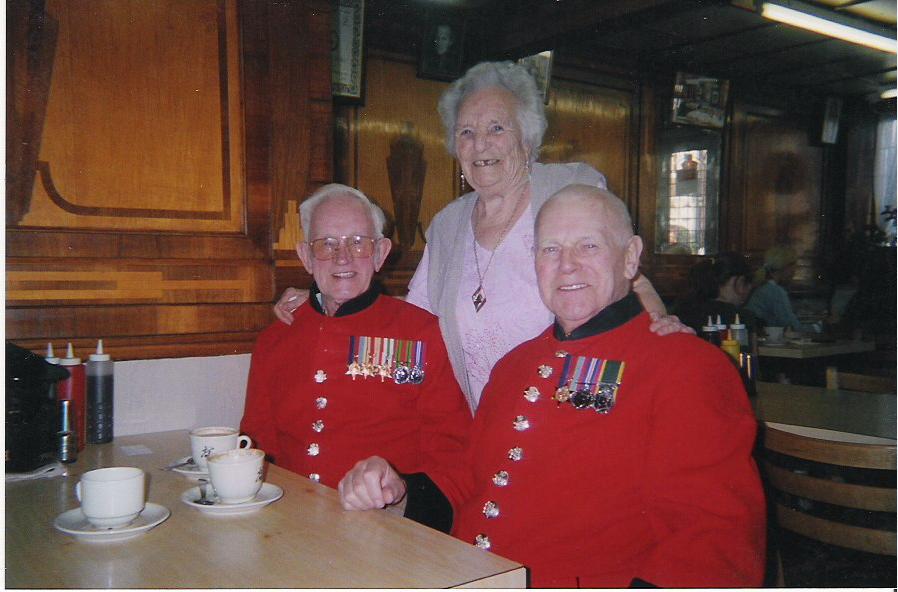
Lil Peters flirts shamelessly with two Chelsea Pensioners.

Ross Kemp and the Pellicci boys.

Jools Holland always pops in when he’s in the East End.

“I’m completely stuffed,” declared Su Pollard.
The Interregnum In Spitalfields
This month’s talk in the Spitalfields Series at the Hanbury Hall will be local resident Dame Siân Phillips interviewed by Basil Comely about her life and career, next Tuesday 6th February at 7pm.
Portrait by Lucinda Douglas Menzies
Today Philip Marriage introduces this series of photographs published for the first time here.
“These photographs were taken almost thirty years ago, 1994-5, during what I think of as ‘The Interregnum’ – the period after the old Spitalfields Market had moved to Leyton but before the wholesale redevelopment of Brushfield St and its inexorable gentrification. A period of quiet, almost emptiness, when traditional businesses serving the old market closed but new businesses had yet to emerge to replace them.”

My favourite photo of an almost empty Brushfield St with a bleached Christ Church, Spitalfields, at the end, resplendent in the sunshine beneath a threatening sky.

Artillery Passage looking towards Widegate St and Bishopsgate with the three traditional bollards, replaced nowadays by two.

Artillery Passage with Grapeshot’s Wine Bar on the left and The King’s Stores pub on Widegate St beyond.

Marsh Mushroom & Salad Sales, Crispin St, for sale before it was transformed into the ‘English Restaurant’.

Brushfield St with, on the right, The London Fruit & Wool Exchange first opened in 1929. This fine building has now gone with only the façade remaining. When this photo was taken the trees outside had yet to be planted and thankfully some of these survive today.

Brushfield St with Christ Church, Spitalfields, and the London Fruit & Wool Exchange. Once the market moved away to Leyton, Brushfield St was much tidier but often near empty when I visited – here with just three people visible and even some empty car parking spaces.

Artillery Lane with, on the left, the old Samuel Stores shop restored by the Spitalfields Trust in the eighties. In the background, across the road, can be seen the ornamental stone scrollwork of the ‘Artillery Tavern’, 1 Gun St, which, prior to 1884, was the ‘Cock A Hoop’ pub. This was the back of the Providence Row Night Refuge, largely demolished in 2004, leaving the grotesque remnants of the pub as a freestanding façade subsequently pinned to the outer wall of the new Lillian Knowles House.

Verde & Company Ltd on the corner Brushfield St junction with Gun St. The Victorian street sign for Gun St has been replaced by a tinpot Tower Hamlets Council substitute leaving the shadow of its predecessor remaining above.

Photographs copyright © Philip Marriage
You may also like to take a look at
Philip Marriage In Spitalfields
In The Winter Garden

A few years ago when the city was shut down and empty, I used to take long lone cycle rides in parts of London that were unknown to me, seeking an escape. One day at January’s end, after cycling around Regent’s Park in the frost to admire John Nash’s terraces, I came to the winter garden.
It was late afternoon, the sun had set and dusk was gathering but, when I came upon the narrow gate leading through a rose arch to the garden, I could not resist exploring. Beyond the entrance lay a large formal garden once attached to a grand Regent’s Park mansion. It was divided by hedges into a series of hidden spaces like a labyrinth. I found the place empty and deserted, save a few lonely blackbirds. In the last light of day, took these photographs.
I intended to publish my pictures and write about my visit then. Yet when I studied the photographs, I grew so enchanted that the experience barely seemed credible anymore. Instead, I kept the evidence of my melancholy pilgrimage to myself. Each year at this time, I revisited the photographs without finding any words to accompany them. On one occasion, I even set out to visit the garden again to verify my experience only to discover it was closed that day.
Contemplating these pictures now, they feel far away and I find it difficult even to remember the lockdown. It no longer seems real to me. Many are still struggling with the after-effects of that time yet when I look at these photographs I realise it is over. My pictures of this cold garden at twilight, with only a few plants showing, are how I shall recall it. The winter garden was where I found solace at the heart of the empty city.

Hylas

In the Rose Garden

The Sunken Lawn at St John’s Lodge

The Shepherdess Border


Snowdrops


The first primroses

‘To all protectors of the defenceless’


The Giant Urn


The Arbour Walk

St John’s Lodge Garden, Inner Circle, Regent’s Park, NW1 4NR
You may also like to take a look at


