So Long, The Gallant
I am sorry to report that The Gallant sank after capsizing in a sudden violent storm early on Tuesday 21st May, twenty-two nautical miles north of the Bahamas island of Great Inagua with eight sailors on board. Six – four men and two women – were rescued from a life raft, but the two other crew members – Emma T (31) and Léa B (28) – were lost at sea.
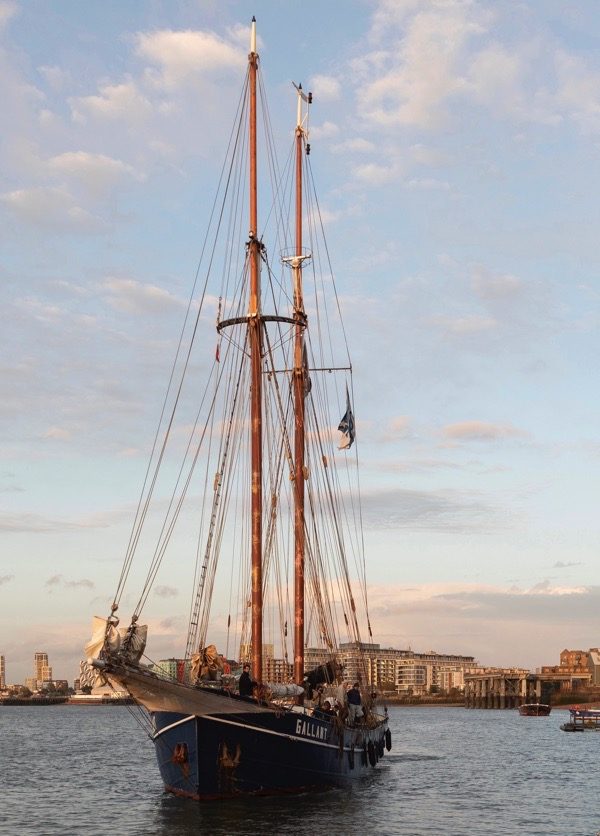
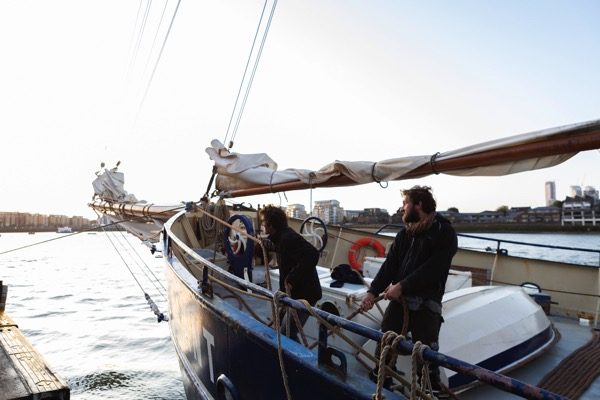
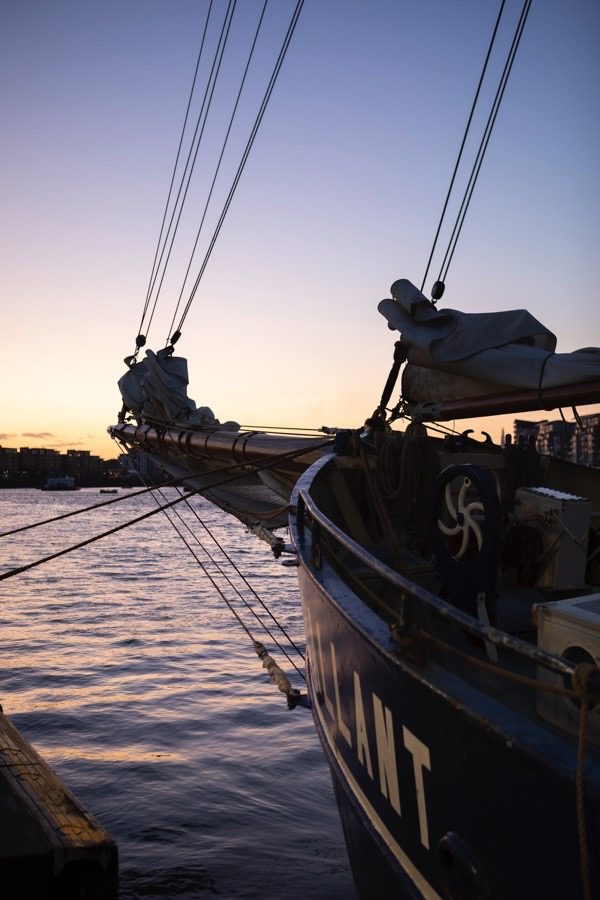
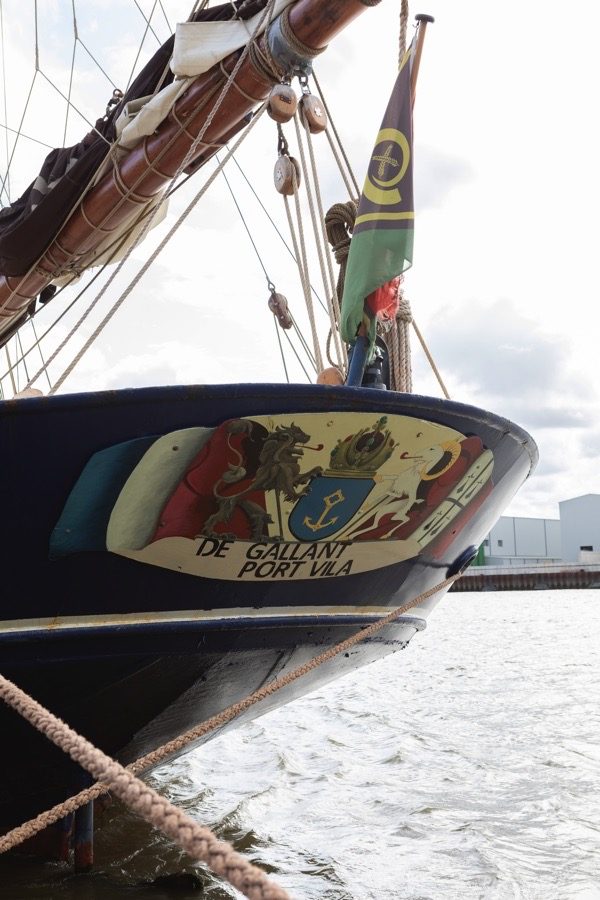
The Gallant arriving in Greenwich
In 2019, photographer Rachel Ferriman & I were at the shore to welcome the first sailing ship in more than a generation arriving at the London Docks with a cargo of provisions from overseas. Over subsequent years, the Gallant became a regular sight on the Thames, bringing produce from Portugal and the Caribbean. Although it was a small beginning, we were inspired by this visionary endeavour which set out to connect farmers directly with customers and make the delivery by sail power.
On board, we met Alex Geldenhuys who explained how she started this unique project.
“We are very excited because this is our first visit to London and we believe this cargo has not been delivered here by sail for forty years or more. We have olive oil, olives, almonds, honey, port wine from Portugal and chocolate and coffee from the Caribbean.
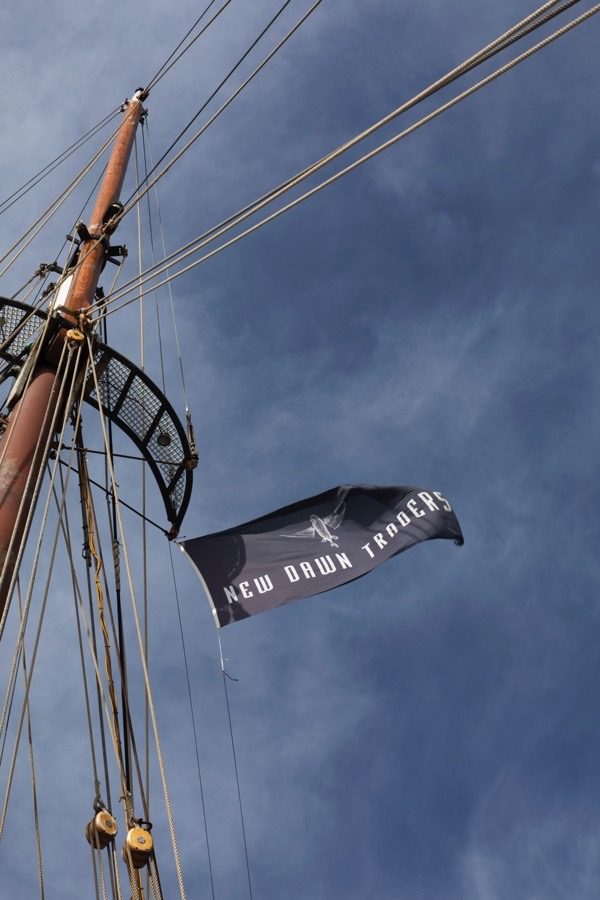
I set up New Dawn Traders in 2013. At first, we were working with ships crossing the Atlantic once a year bringing chocolate, coffee and rum but then I started the European voyages three years ago. We do two or three voyages a year which means we are learning more quickly.
With the captains, we decide when and where we will go and what we will pick up. We started in Portugal and most of our suppliers are based in the north of the country, small family farms producing olive oil. They give the best care for the land and contribute most to the local community. These farmers do mixed agriculture and so they also produce honey, almonds and chestnuts.
Next year, we look forward to working with Thames barges, meeting the Gallant in the estuary after the long distance voyage and delivering the cargo to London, just as they were designed to do. We will be back in the spring and customers can order online and then come down to the dock to collect their produce.”
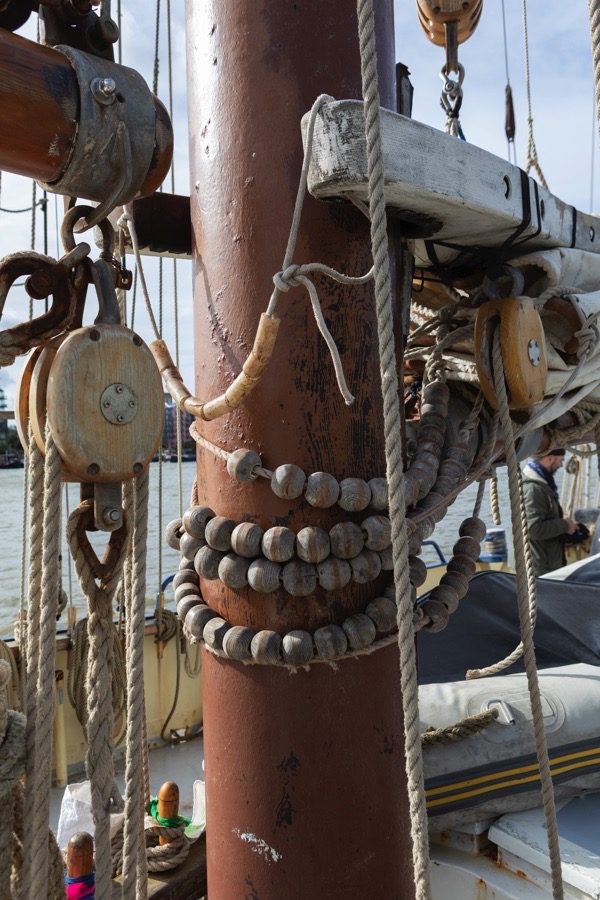
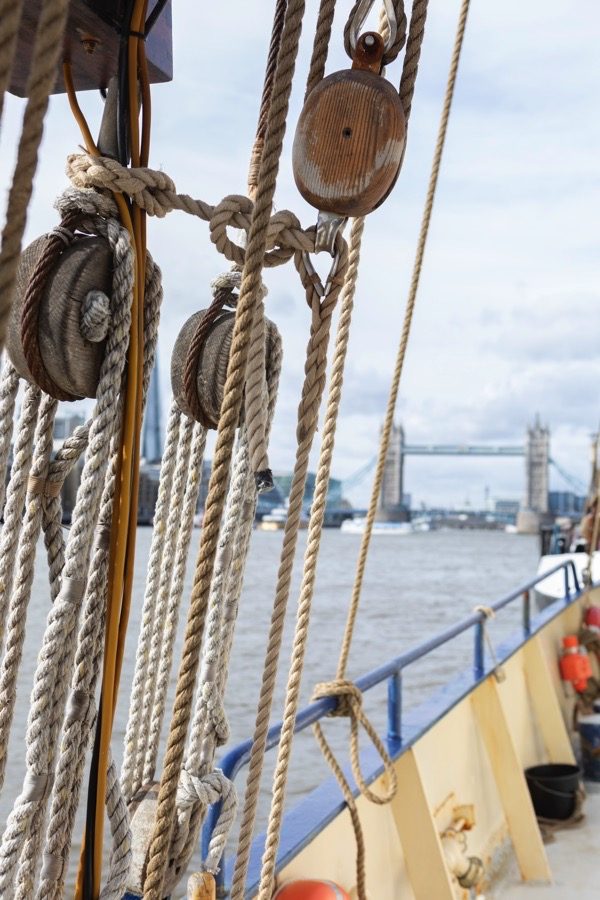
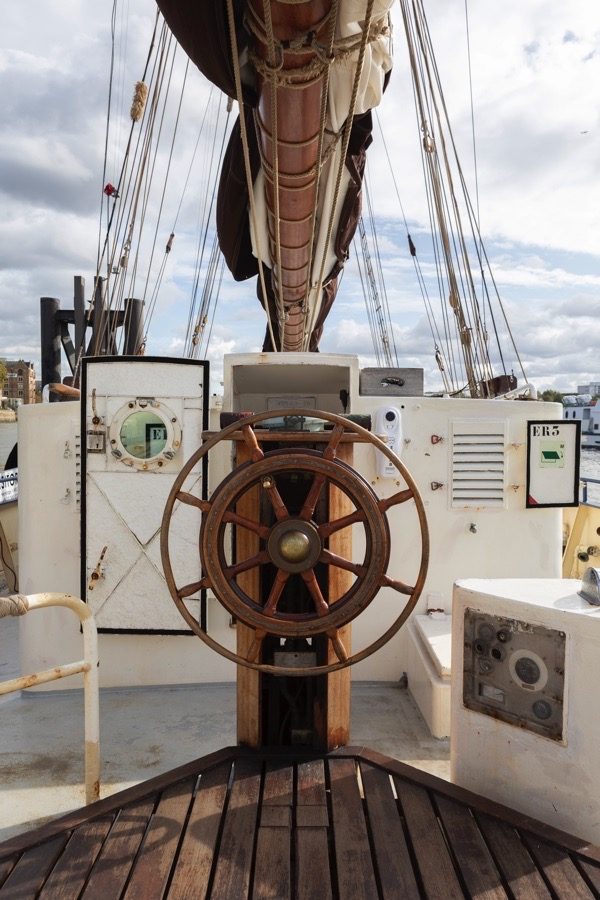
The Gallant was a handsome schooner and we were delighted to explore such a fine vessel moored in the shadow of Tower Bridge while the tanned and scrawny crew were unloading crates of olive oil, coffee and rum, loading them onto bicycle panniers for transport to the warehouse in Euston.
Down in the cabin, we met captains Guillaume Roche & Jean Francois Lebleu, studying charts of the estuary in preparation for their journey to Great Yarmouth, the next port of call. Guillaume began by telling me the story of the Gallant and revealing his ambition and motives for the undertaking.
“I am co-owner of the ship with Jean Francois, we take it in turns to be captain. The Gallant was built as a fishing boat in Holland in 1916, but, when we bought her two years ago to use her as a cargo vessel, she had been converted to carry passengers so we had to build a hatch for loading and enlarge the hold.
We are both professional seamen who have worked on big ships in the merchant navy and we want to do something about Climate Change, but the only thing we know is how to sail a ship. As well as delivering cargo by sail, we want to spread the word to encourage others so this can be the beginning of something bigger.”
Jean Francois outlined the pattern of their working year.
“This summer we did two voyages to northern Europe from Portugal, two ports in France, a lot of ports in England – Bristol, Penzance, Newhaven, Ramsgate, London and Great Yarmouth. Next we go to Holland to deliver cargo there.
Over the winter, we will do maintenance before we sail across the Atlantic to the Caribbean and Central America to load rum, chocolate, coffee, mezcal and spices, and stop off in the Azores on the return voyage to pick up honey and tea. And we will bring this cargo back to London next year.”
The work of The Gallant goes on. You can order produce from Sail Cargo London and learn more by following New Dawn Traders.
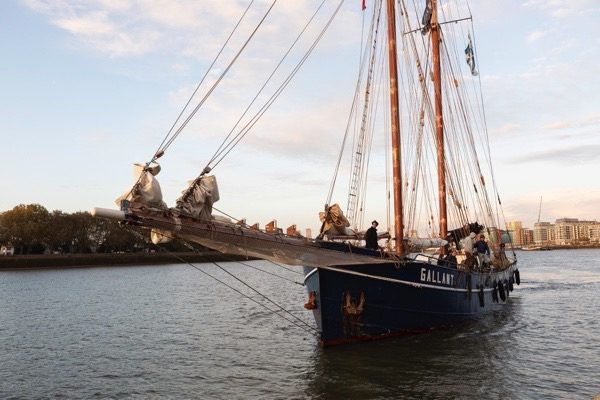
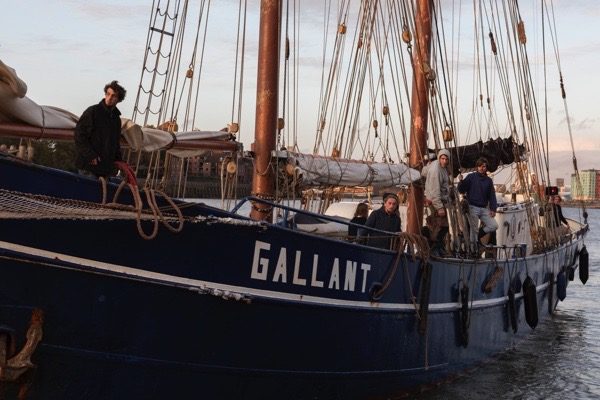
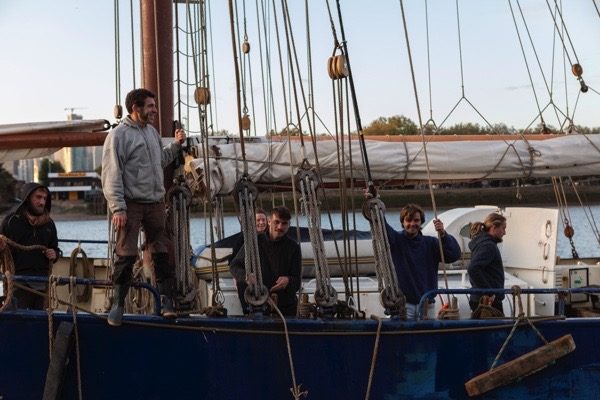
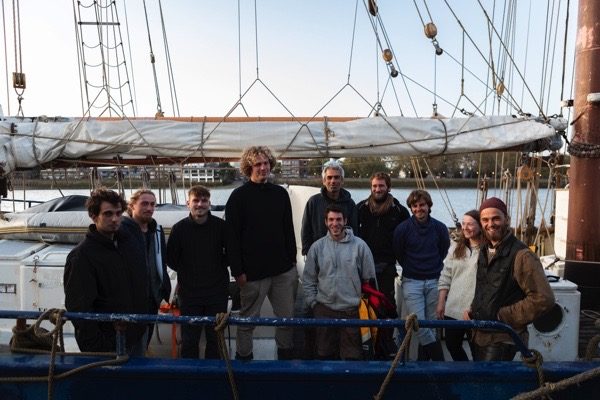
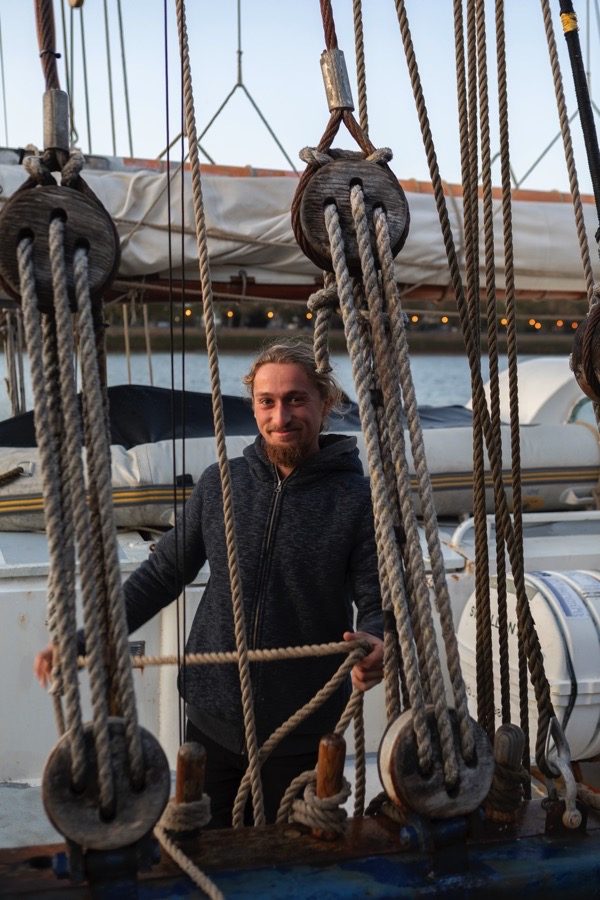
The crew of the Gallant
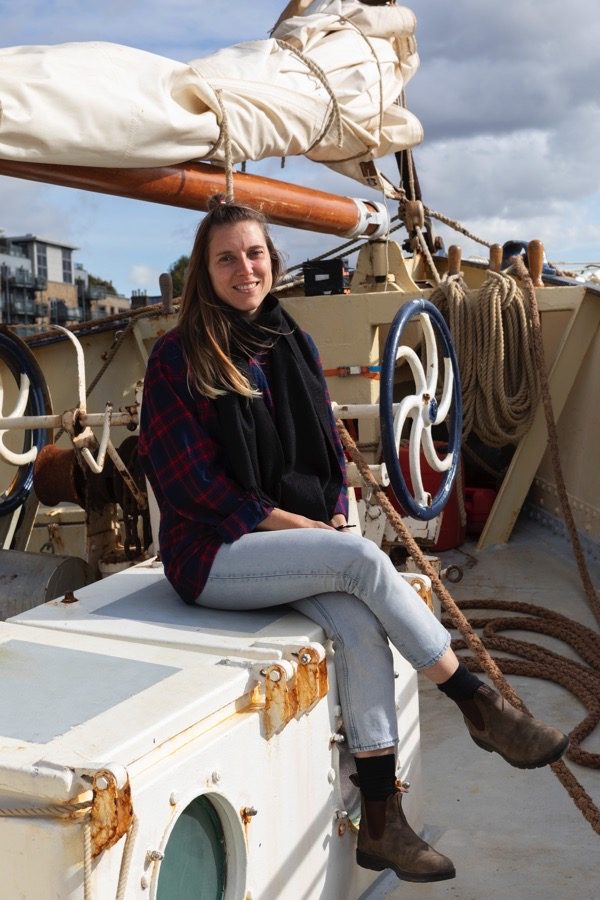
Alex Geldenhuys, founder of New Dawn Traders
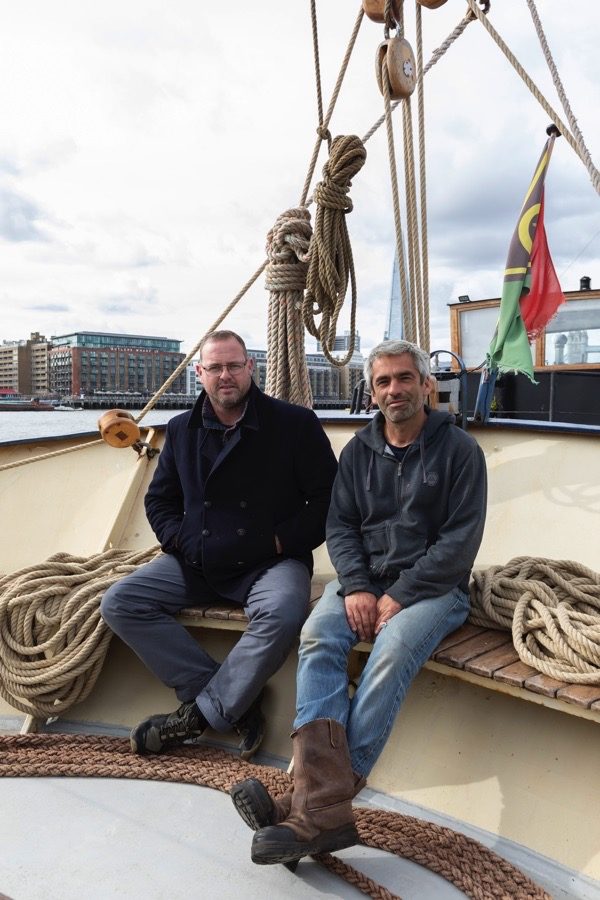
Guillaume Roche & Jean Francois Lebleu, Captains of the Gallant
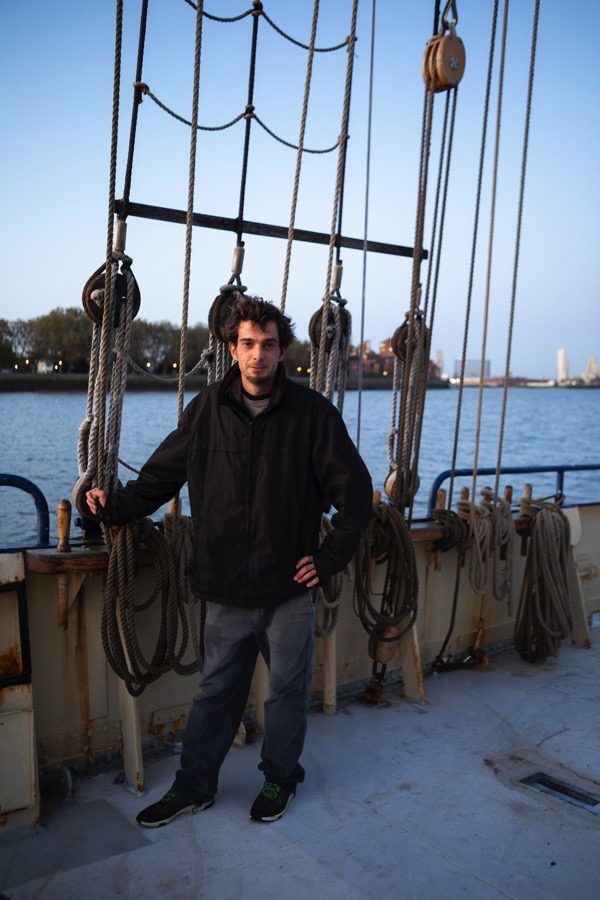
Celestin, First Mate of Gallant
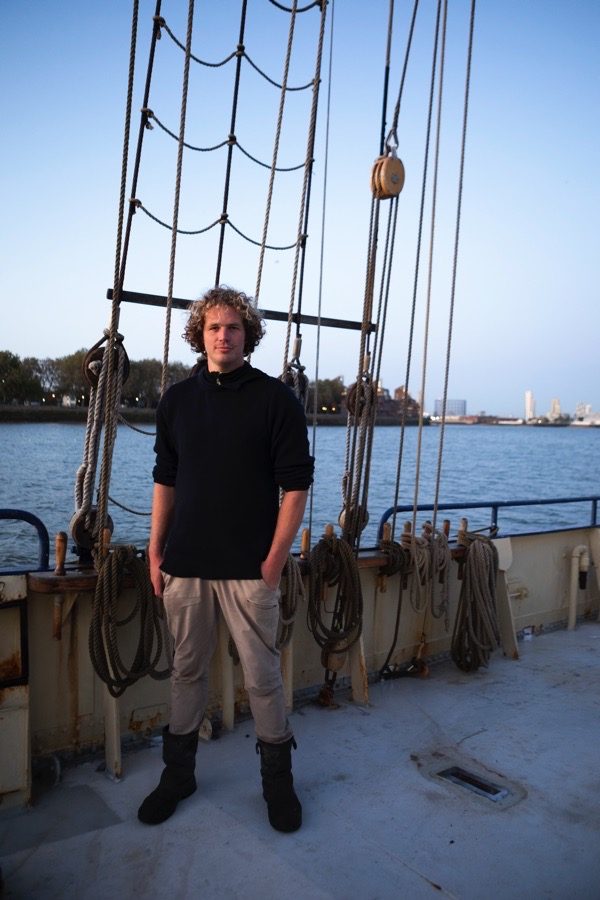
Davide, Deck Hand
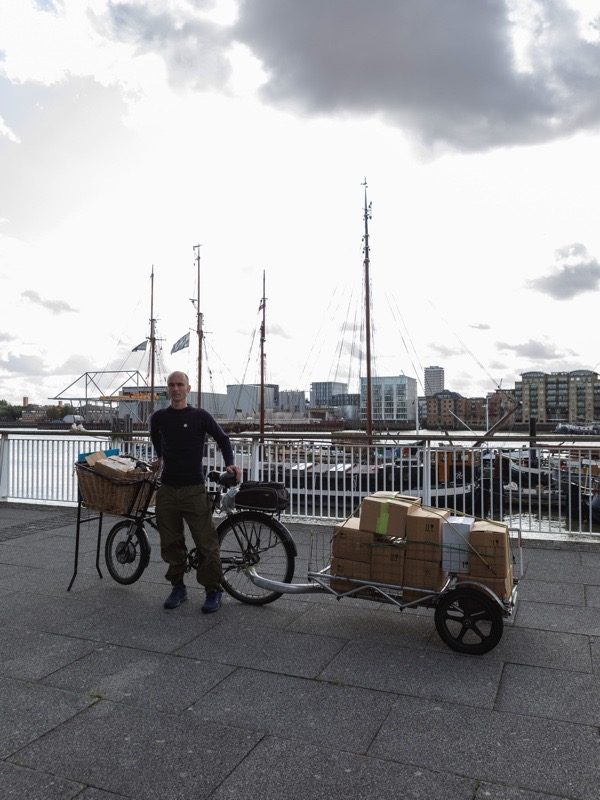
The cargo is delivered to the warehouse by pedal power
Photographs copyright @ Rachel Ferriman
You may also like to read about
Doreen Fletcher’s Spitalfields Paintings
Click for tickets for The Gentle Author’s Tour of Spitalfields
It is my delight to publish Doreen Fletcher‘s paintings of Spitalfields, Bethnal Green and beyond. These new pictures are to be seen in Doreen’s forthcoming exhibition at Townhouse Fournier St, E1 6QE, from next Saturday 8th until Sunday 30th June. Below Doreen introduces her paintings in her own words.
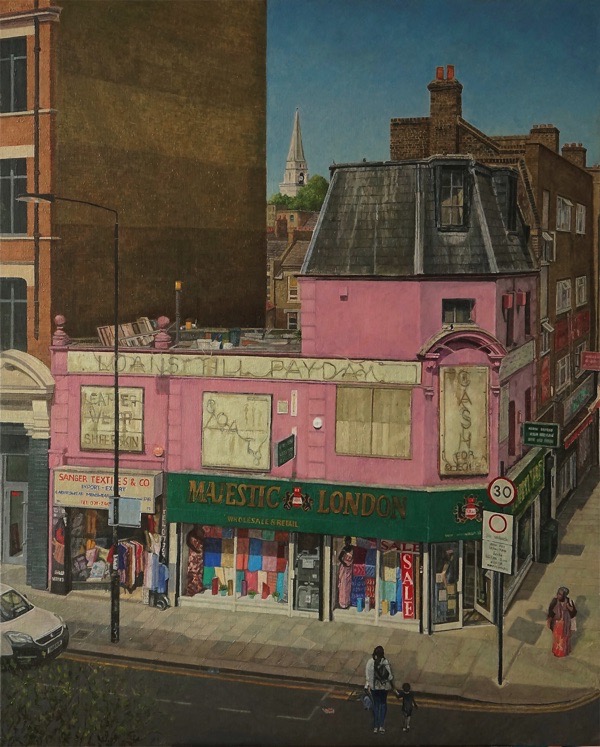
Lost in Spitalfields
“My title refers both to the maze of streets in this neighbourhood and also to the thousands of refugees from all over the world who have found sanctuary here through the centuries.
In my painting you see Christchurch in the distance, yet it does not dominate for this is an area of markets. Wentworth St has packed up for the day, all the traders and customers have gone home but a few lost souls wander, giving the place a melancholy atmosphere.
Despite the brightly painted frontage of Majestic London, Petticoat Lane only becomes truly vibrant on Sunday when the whole world strolls through these streets.”
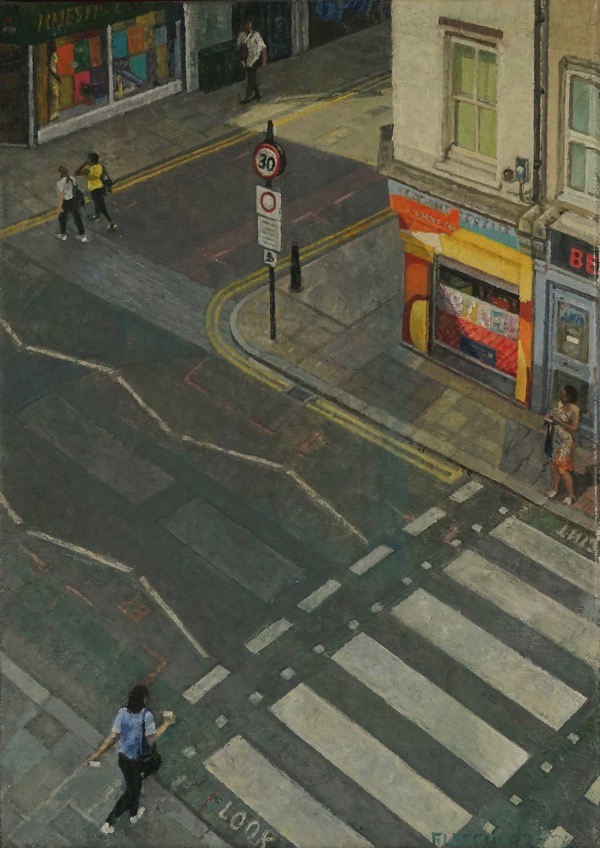
Crossing
“When I was young, I discovered that if I drew my surroundings sitting on top of a ladder, I was able to observe with fresh eyes. Standing on the balcony of the block where a friend lives, I was struck by the geometry and emptiness of the streets once the Petticoat Lane traders had packed up and gone. So I sought to capture this quiet aftermath when the market has closed for the day but office workers are still at their desks.”
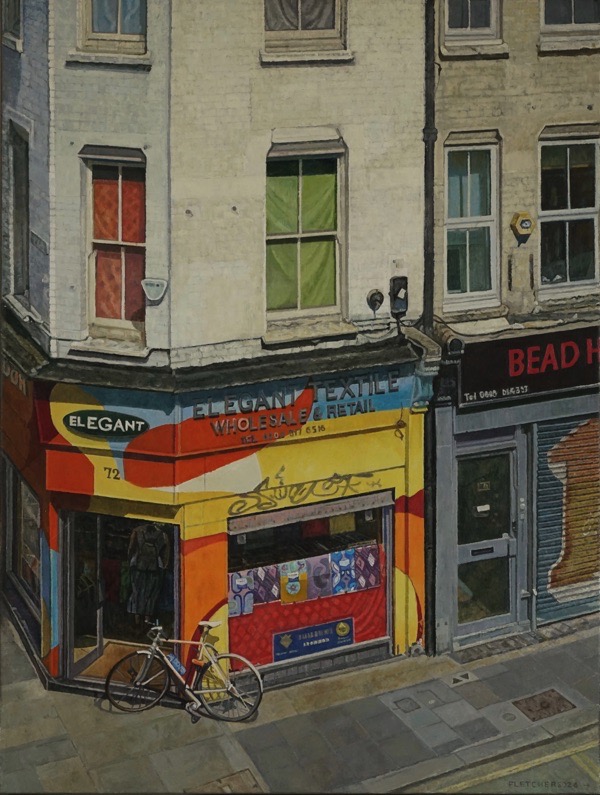
Elegant Corner
“Standing on a the balcony, I was struck by the eccentricity of this shopfront on the corner of Middlesex St and Wentworth St. An enormous amount of effort has gone into creating this eye-catching scheme.
I discovered the shop has been in the same hands since 2004, so perhaps the fact it is still trading twenty years later is down to the undoubted enthusiasm of the proprietor?
Drawn to this corner, I wanted to celebrate the optimism I sensed in the exuberantly exterior and hint at the treasure trove lying in the cool, dark interior.”
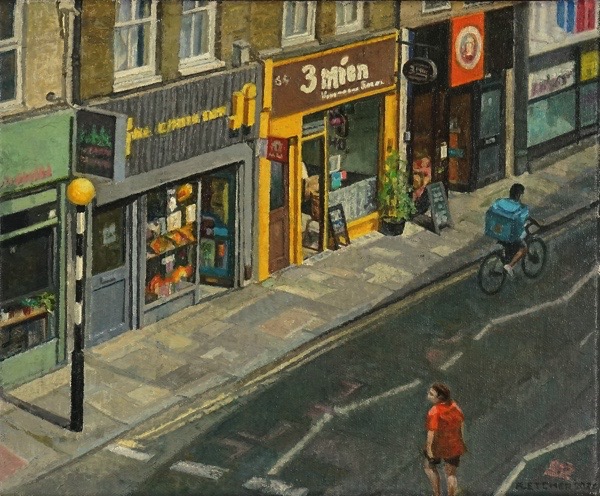
Middlesex St
“It was a hot sunny afternoon and, from my vantage point, Middlesex St appeared sliced in half by shadow. My eye was caught by the flash of an orange t-shirt crossing below, offset by a splash of turquoise from the back pack of a cyclist further up the street.
I prefer to wander these streets when they are deserted with just a few passersby and, recently, I discovered Mien 3, a Vietnamese restaurant with an excellent reputation. The cyclist is not just passing, he has collected an order from this restaurant.”
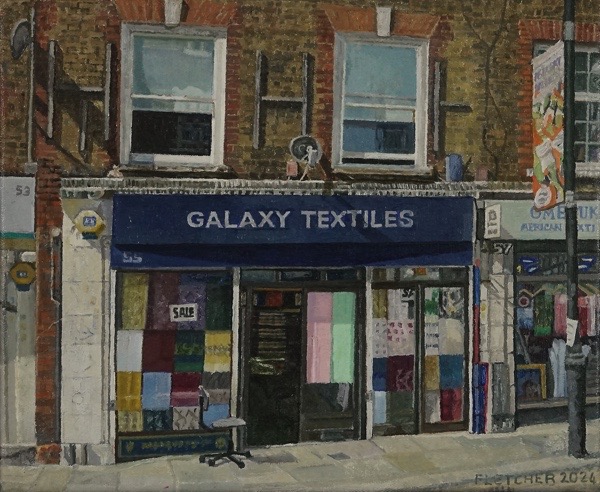
Galaxy Textiles, Wentworth St
“This shop has been here since 2000 and sells wholesale, shipping off merchandise in trucks and lorries. I was drawn to the empty chair on the pavement. Perhaps it is there to allow the proprietor to sit and watch the world go by when business is quiet? Such a rare human touch. “
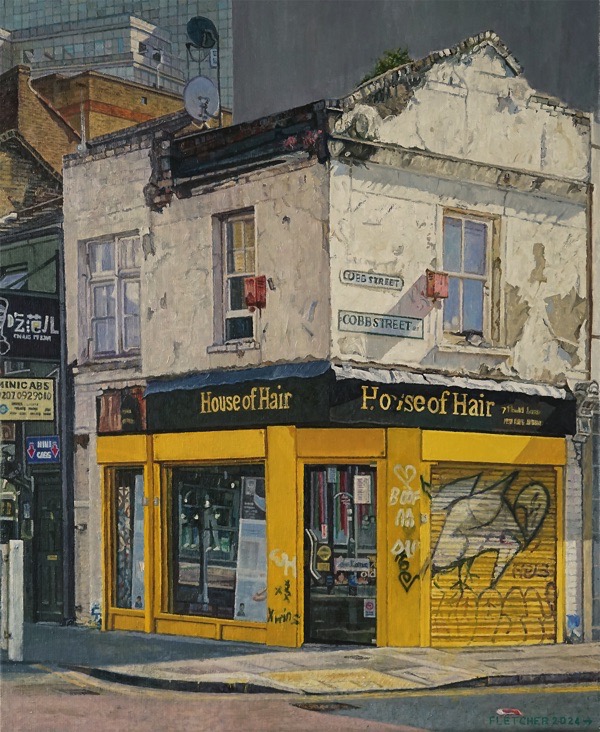
House of Hair
“I was struck by the colours of this façade in bright sunshine and the incongruity of its position, a crumbling edifice dwarfed by towers of concrete and glass.
I chose to paint this scene not only because of its abstract qualities of light, colour and composition, but also because I wanted to record one of the last isolated fragments of ‘old Spitalfields’ that remains.
Bruised and battered but not broken, House of Hair is still in business. A few months ago, the dilapidated signage was replaced by machine-cut letters mounted onto glossy perspex. Progress of a sort, though I have to admit that personally I preferred the previous, crooked lettering.”
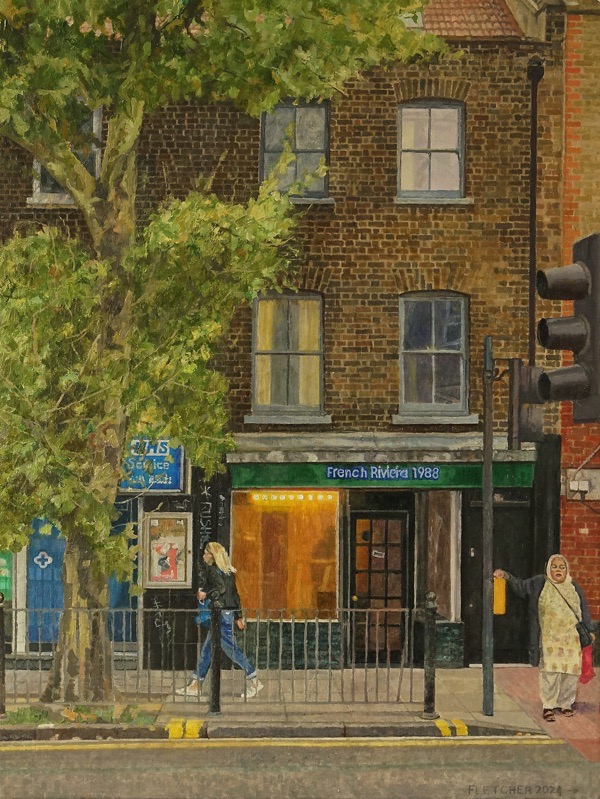
French Riviera
“I first came to Bethnal Green Rd in December 1983, looking for a jacket, and found a bargain in a leather goods shop. Apart from Woolworths, Burger King and McDonalds, I recall the place as mainly butchers with red-and-white awnings and secondhand shops.
Years later, so much has changed. Not one butcher remains and charity shops have replaced the secondhand stores. To me, the curious facade of French Riviera with its ironic signage and paintwork epitomises the transformation of the area. I assumed it was a trendy cafe, although further investigation revealed it to be a contemporary art gallery!“
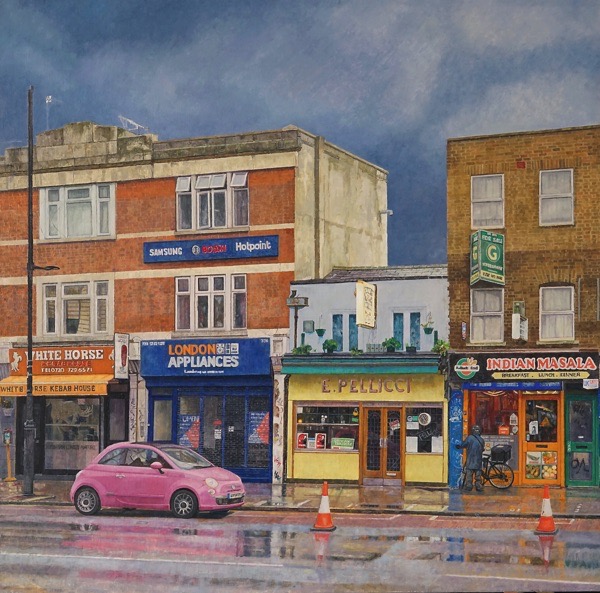
Pink Fiat
“E. Pellicci has been a constant in Bethnal Green Rd since it was opened by the Pellicci family in 1900. Even during the pandemic, it ran a takeaway service, as I discovered during the second lockdown. I was wandering around Bethnal Green in the sleet when everything was closed. The streets felt bleak, lonely and eerily quiet.
Then I spotted this Fiat parked outside Pellicci’s and my spirits lifted at the splash of bright pink in front of the yellow facade. Closer investigation revealed that the cafe was open for hot drinks served through a hatch, which was wonderfully reassuring.
Despite the grim winter’s afternoon, the juxtaposition of these two Italian icons evoked Neapolitan ice cream for me. So I went home and set about planning a painting. Three years passed before I felt satisfied with it, which is quite normal with my work.”
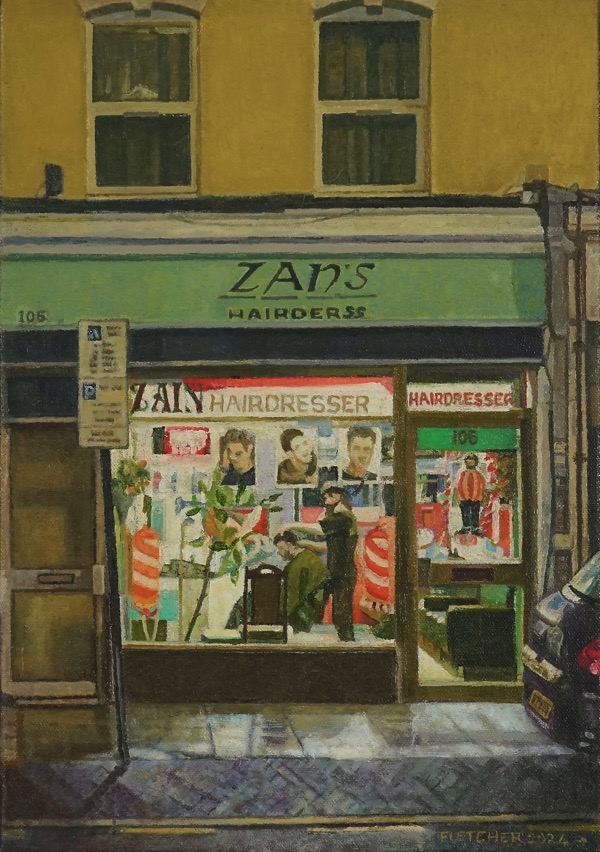
Barber’s Shop
“Woodgrange Rd is next to Forest Gate station and, shortly before the Elizabeth Line opened, the shopfronts were cleaned and repainted. Yet a grittiness remains that is refreshing to encounter after a trip to the West End. It is mostly small shops, including four barbers. This one is always busy with sofas inside for customers to waiting.
My painting was begun during the pandemic and the barber is wearing a mask. Yet there is still an intimacy between barber and client which exists despite the necessity of wearing a mask.”
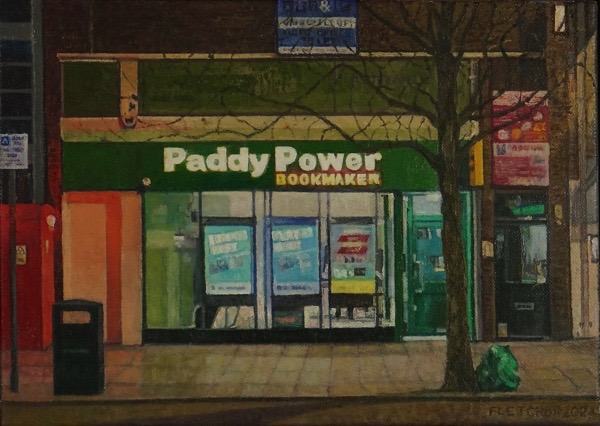
The Bookmakers
“Until 1961 betting shops were illegal and betting took place clandestinely. In the fifties, my gran took bets from punters in her kitchen and even before I was tall enough to see the scribbled bits of paper and money placed on the table, I was told to keep quiet about the frequent comings and goings at her house.
Paddy Power is on Stratford Broadway, opposite a bus stop where I have spent a lot of time over the past fifteen years, waiting for the 308 home after visiting the Picture House. Many years of looking at this view have resulted in The Bookmakers, tempting with the allure of warmth and security within.”
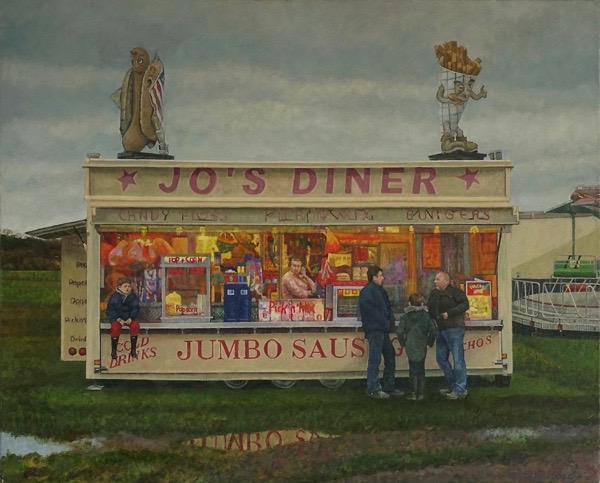
Jo’s Diner
“The funfair always comes to Wanstead Flats at Easter, Whitsun and August Bank Holiday. Every Easter, I marvel at the spirit and optimism of the fairground fraternity as they set up their rides and stalls only to be deluged by the downpour. Nevertheless, these people are resilient and here we see them set up and ready, awaiting visitors.
I made a coloured pencil study of this scene six years ago then made the painting two years ago, inspired the range of emotions present in this moment. When the funfair returned recently, Jo’s Diner had disappeared, replaced by a new food truck and I have not glimpsed it again.”
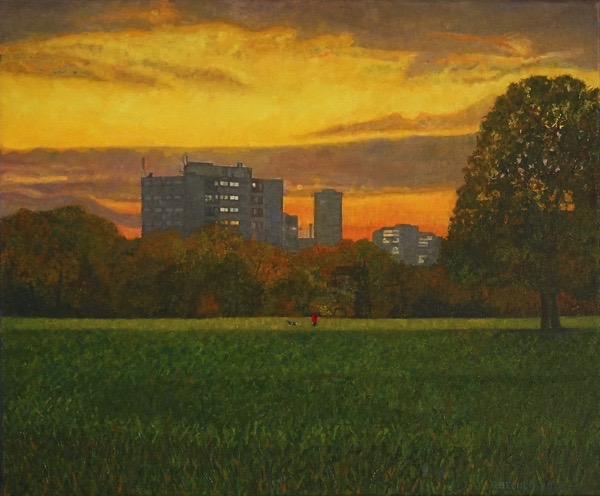
Capel Point
“I have lived near Wanstead Flats since 2007 but this is the first time I have made the Common the subject of a painting. It lies just yards from my house yet I hardly visited. This all changed when the pandemic curtailed our lives and I acquired Charlie, an energetic spaniel puppy.
For the first time, I appreciated how lucky I was to be living next to a vast open expanse where we could roam freely. Slowly I began to appreciate the immense variety of light created by the seasons, weather and time of day. I came to understand that a flat landscape has its own poetry.”
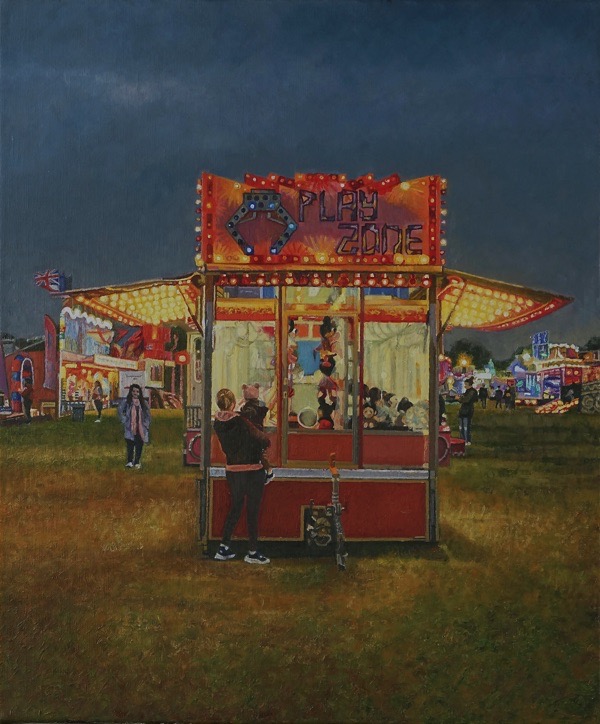
Play Zone
‘This is the funfair on Wanstead Flats at August Bank Holiday when the night is fine although chilly. After a hot summer, the grass is brown and parched.
Expectation is the best part of any adventure – the coloured lights glowing in the dusk, beckoning revellers from the roads nearby even as the music has ceased, the fair is winding down and punters leaving. The stalls may look tired yet there is still a blaze of light and colour that holds a promise for tomorrow.”
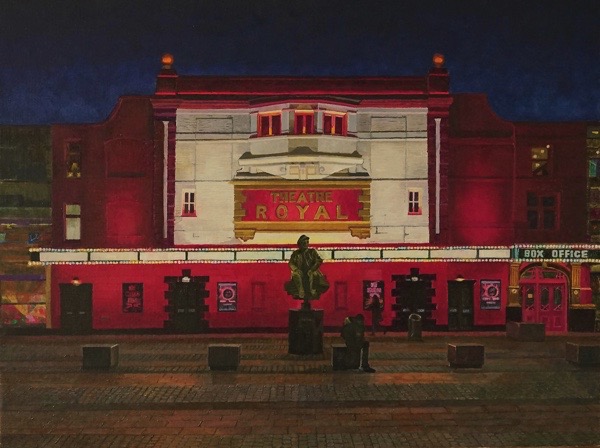
Theatre Royal, Stratford East
“This theatre opened in 1884 and has survived, despite name changes, fires and closures. In 1953, it was famously taken over by Joan Littlewood and her Theatre Workshop.
I have been familiar with the facade of Theatre Royal, Stratford East, for many years, and often sat in the bar upstairs at the Picture House opposite, gazing across at it, glowing like a watchman’s brazier.
About five years ago, the theatre was repainted. Yet the memory of what had been stayed with me – the statue of Joan Littlewood against the backdrop of the facade, with its red and white paintwork glowing in the light. This is Theatre Royal, Stratford East, as I wish to remember it.”
Paintings copyright © Doreen Fletcher
You may also like to take a look at
A Conversation With Doreen Fletcher
The War On Vice In The East End
Click for tickets for The Gentle Author’s Tour of Spitalfields on Saturday 1st June
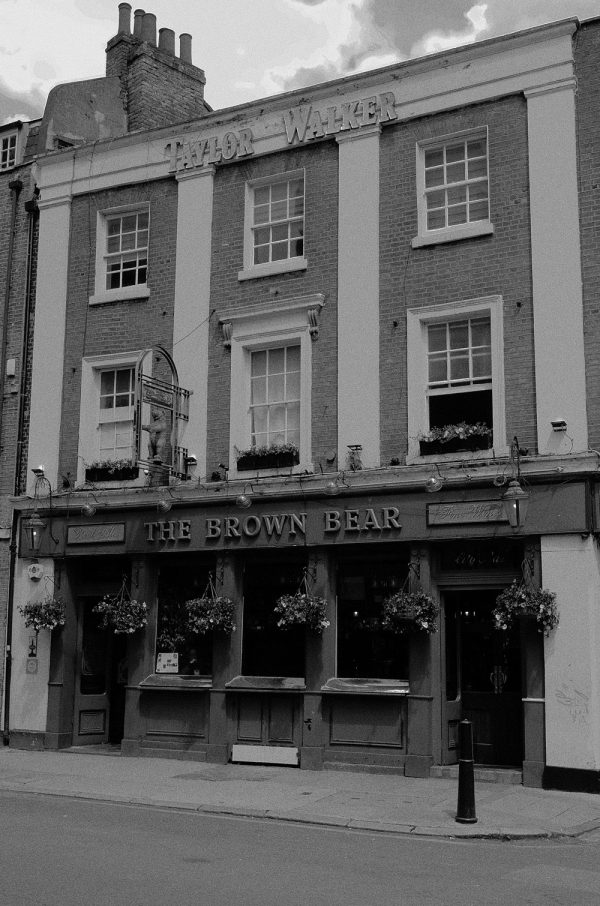
The Brown Bear, Leman St
‘well known as being frequented almost exclusively by homos’
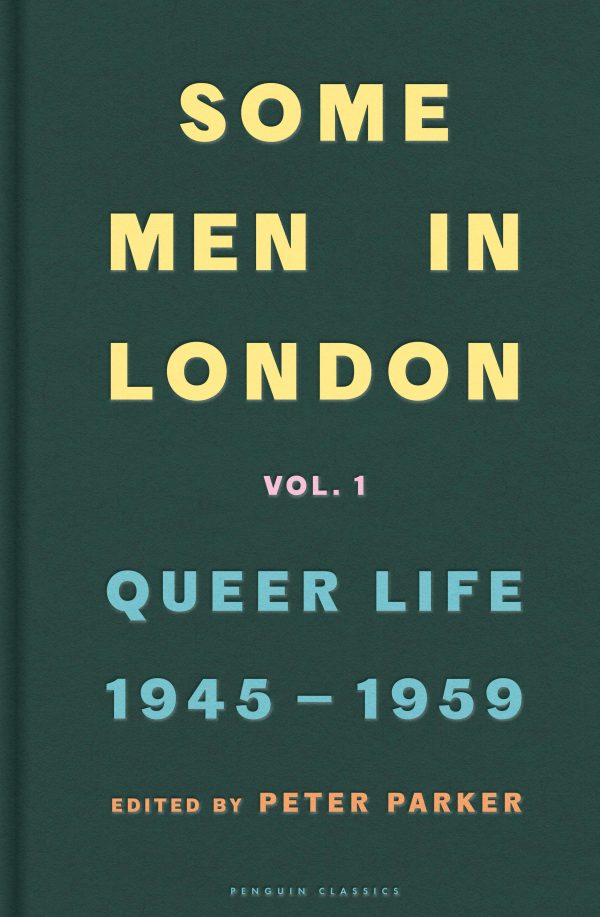
Peter Parker, editor of SOME MEN IN LONDON, Queer Life, 1945-1959 published today by Penguin, explores the roles of Edith Ramsay and Father Joe Williamson who made it their mission to clean up ‘vice’ in the East End.
Introducing a debate in the House of Lords on ‘Magistrates’ Powers and Control of Clubs’ in June 1960, the Labour peer Lord Stonham stated that he wished ‘to draw attention to the sudden growth in London, and other large towns, in the number of so-called ‘clubs’ at which, at great profit to themselves, vicious men exploit with impunity almost every known vice, and, in the process, break almost every legal and social law, written and unwritten.’
Having been born in Whitechapel, Stonham was particularly concerned about the clubs of the East End, a number of which had ‘become notorious for prostitution, homosexuality and drug-trafficking’. Among those supplying Stonham with information about the area’s social problems were Edith Ramsay, a long-serving member of Stepney Council whom he dubbed ‘a Florence Nightingale of the brothels’, and Father Joe Williamson, the well-known High Anglican vicar of St Paul’s Church, Dock St, who was known as ‘the prostitute’s padre’.
The daughter of a Presbyterian minister, Ramsay was born in Highgate in 1895, but moved to Stepney as a young woman to teach vocational skills to young people (from the ages of fourteen to sixteen) at the Day Continuation School in Old Castle St. Her principal career was in education, and in 1931 she became head of the Stepney Women’s Evening Institute, a post she held until she retired in 1960. When she first came to Stepney she also spent time in local women’s hostels in order to understand conditions among the poor, and this led to her volunteering to do social work in the area, particularly among prostitutes, immigrants and homosexual men.
Among Ramsay’s papers in Tower Hamlets’ Bancroft Library are a number of documents relating to the prevalence of ‘male vice’ in Stepney in the late fifties and early sixties. These give a frank and fascinating insight into a queer underworld far removed from that of the rather more soigné clubs and pubs of the West End.
The Wolfenden Report of 1957 is chiefly remembered for its recommendation that homosexuality should, with certain provisos, be decriminalised, but the Wolfenden Committee had been additionally appointed by the government to investigate prostitution. Both ‘vices’ were thought to have grown exponentially in the wake of the Second World War and were widely believed to be threatening the moral fabric of the nation.
As legal and social outcasts, some prostitutes and gay men had a kind of camaraderie, frequenting the same areas and patronising the same pubs, clubs and cafés. This was certainly true of the East End, though some venues gained a particular reputation as homosexual meeting places, as Ramsay explained. ‘There is the clear distinction in Stepney between ‘common pouffes’ and ‘select pouffes’,’ she wrote. ‘They have their own assembly points, and these change. For instance, the Cockney Cafe and the Brown Bear pub were well known as being frequented almost exclusively by homos. But this suddenly changed.’ Such changes were often a result of police raids, after which the clientele simply took their custom elsewhere.
Like pubs, clubs had to be licensed, and until 1954 there were a mere eighteen of them in Stepney, some attached to churches, others catering for medical students, sailors and those employed by breweries or the docks, and all of them ‘respectable’. By 1960 the number of clubs had risen to eighty, twenty-four of which had had their licences revoked – mostly for serving drinks outside licensing hours, though the New Life Club at 102 Commercial Rd was ‘struck off’ for a ‘deplorable record’ that included regular fights, broken windows and organized prostitution. Once a venue had been removed from the register, no new club could be established on the premises for a stipulated period, usually twelve months.
Another infamous establishment was the Creole Club at 72 Cable St, which the Observer journalist Godfrey Hodgson had visited. According to one of Ramsay’s informants, Hodgson was greeted there by a white man, drunk, who apologised for leaving but said he must get back to his wife. (The men in the Club believed this man to be an MP but there is no proof of that.) The man introduced Hodgson to an African who was obviously his ‘boy-friend’, and charged the African to look after Hodgson. The African offered him ‘Men, boys, women, drink after hours, minor and major drugs’.
Some politicians could in fact to be found ‘slumming it’ in the East End, among them the Conservative’s Lord Boothby and Labour’s Tom Driberg, two men who may have been separated by party allegiances but were united in their taste for East End boys.
In 1959 an unidentified social worker was recruited by Ramsay to accompany Father Joe on several guided tours of the East End’s most disreputable haunts and to make written reports. Their first stop on a Saturday night was the aforementioned Brown Bear pub in Leman St, which Williamson declared ‘especially rough’, patronised by female prostitutes but also known as ‘a homosexual rendezvous’.
Passing the pub again on their way home at closing time, they observed a gang of fifteen or so youths ‘larking about outside, breaking milk bottles, very drunk and probably homosexuals from the look of them’. Quite what it was about these youths that identified them as homosexual is not revealed. Apparently bypassing East End Passage, which ran off Leman St and had been reported to Ramsay as the haunt of homosexual prostitutes, Father Joe also called at Wellclose Sq, where in Church House he had set up a rehabilitation hostel for ‘fallen women’. Williamson reported that on the corner of the square he had recently seen ‘four or five men, two of them with their trousers down and the others “driving up them like dogs”’ – not the kind of homosexual act ‘in private’ that the Wolfenden Committee had recommended should be legalised. Not everyone approved of Father Joe’s social work, and some of the East End’s homosexual prostitutes resented what they saw as mere interference. Williamson related how one of them, accompanied by ‘two clients’ had knocked on his door and threatened him.
[Williamson] ‘went outside the door and locked it behind him and said what he says he always says ‘I’m too busy to be frightened of you. Now what have you got to tell me.’ He was really badly cussed; but later the publican from across the road said that he had been waiting in the shadows and that if there had been any trouble he and his friends would have given them a beating up they wouldn’t recover from.’
It is unclear which pub this was, but evidently not one where homosexual patrons would be as welcome as they were at the Brown Bear.
The second tour took place a week later and lasted from 9 to 11.30 pm. It was a Thursday, and so things were quieter than on the previous Saturday, but there were still some awkward encounters. ‘A new feature was a constant hanging-about on the corner of Leman and Dock St, shifting groups of three to six men, white. One as I passed, Irish, delivering a vehement harangue about something. W[illiamson] said he was homosexual, one of the ones who had threatened him the night the publican intervened.’ They then visited Cable St, where there was a ‘gambling joint’ called the Valletta where drugs were peddled. (The club’s name suggests that, like many such places in the East End, it was run by Maltese.) Father Joe said that he thought that ‘some doctors in the district give coloured men drugs, and one good young doctor admits that he has a patient who takes [i.e. steals] them.’
Another patient named in the report was Tony Hyndman, the former boyfriend of Stephen Spender, who appears as ‘Jimmy Younger’ in Spender’s 1951 autobiography World Within World. The report tactfully refers to Spender only as ‘a very famous writer’, adding that he ‘later married and ditched’ Hyndman, who was now living in the area and hopelessly addicted to drugs. ‘He was at one time given to ringing up very early in the morning to get money out of the writer’s wife, who gave it to him, but W claims to have stopped him doing that. He was left alone in the doctor’s surgery by a locum and stole a large amount of narcotics. Most of which he took until he was in a really serious state.’
By 1963, Edith Ramsay felt that there had been ‘a remarkable decrease’ in the homosexual population of Stepney – or at any rate in the area’s visible homosexual activity. She added that ‘both “Maralyn” and “Jezebal”, two famous figures in that underworld, have both married and had children’. This did not lessen her concern for what she always saw as a social problem. Unlike many devout Christians, she believed that the church and society needed to reach out to homosexual men rather than ostracize them. ‘Of course homosexuals need special consideration, and parish priests should be given help to enable them to help the homos,’ she wrote to Kenneth Leech, a Stepney resident who was training for the ministry at Oxford and would become a curate at Holy Trinity, Hoxton. Leech had suggested founding a ‘special ministry’ for gay men, but Ramsay replied that ‘a “special ministry” implies segregating them, when what they need is to be brought into the normal community and helped – those who want help must have it by medical and, psychological experts.’
Of course, many homosexual men didn’t want this kind of help, preferring to be left to lead their lives as they saw fit. Within four years, a step in this direction took place when the Sexual Offences Act, 1967 was finally passed, meaning that ‘homosexual behaviour between consenting adults in private’ was no longer be a criminal offence.
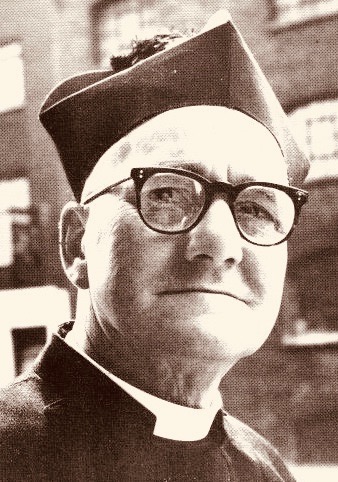
Father Joe Williamson
‘the prostitute’s padre’
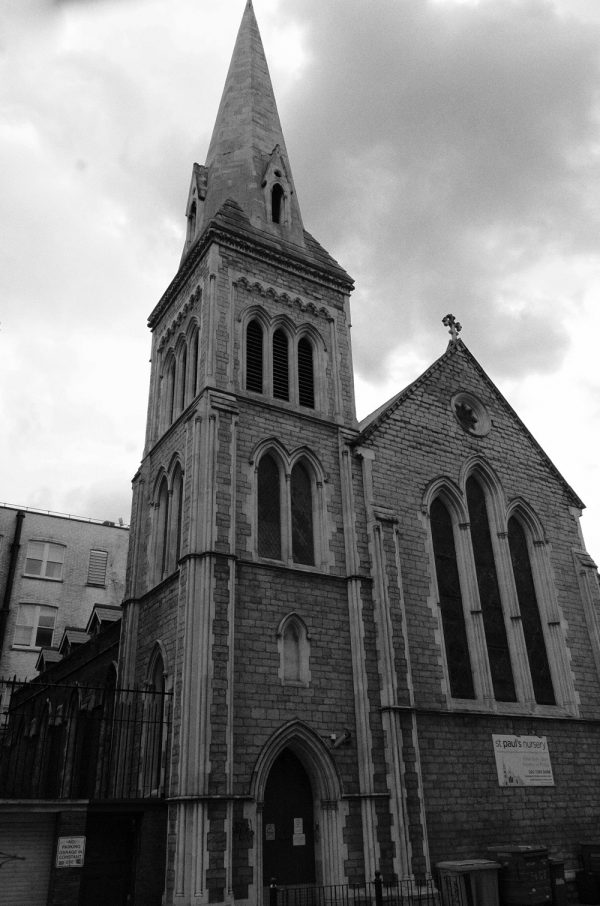
St Paul’s, Dock St
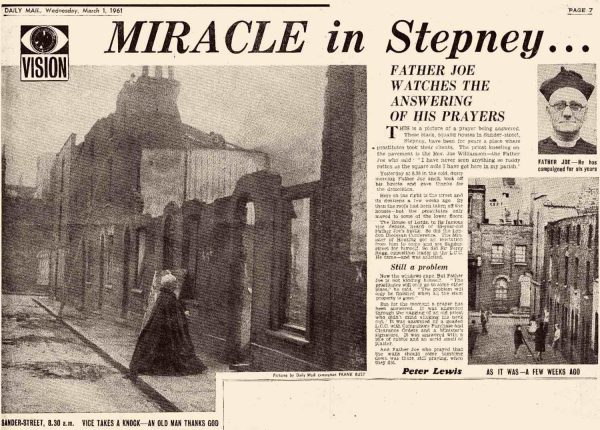
Daily Mail feature of 1961, with Father Joe praying in thanks for the destruction of local housing with the caption, ‘Vice takes a knock – an old man thanks God.’
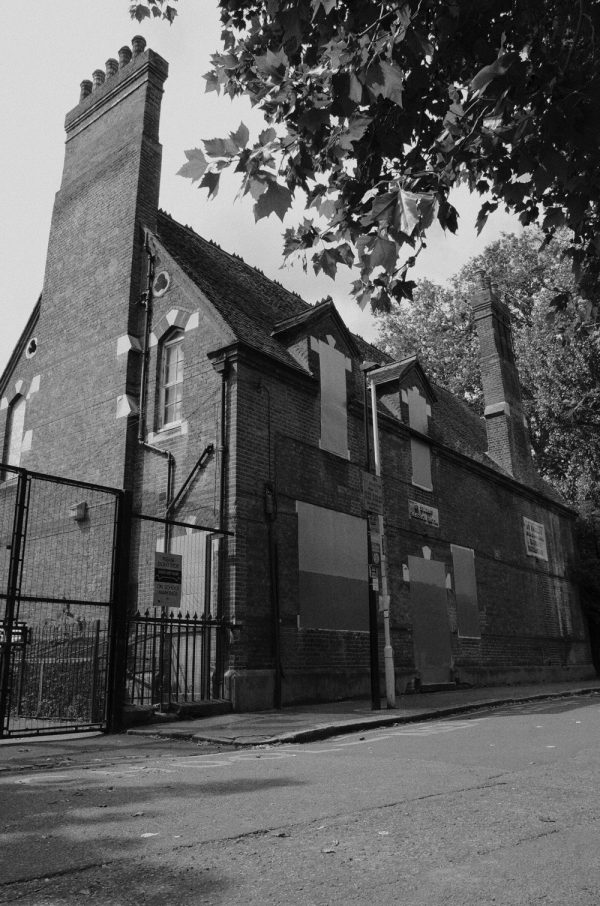
Church House, Wellclose Sq
Father Joe’s rehabilitation hostel for ‘fallen women’
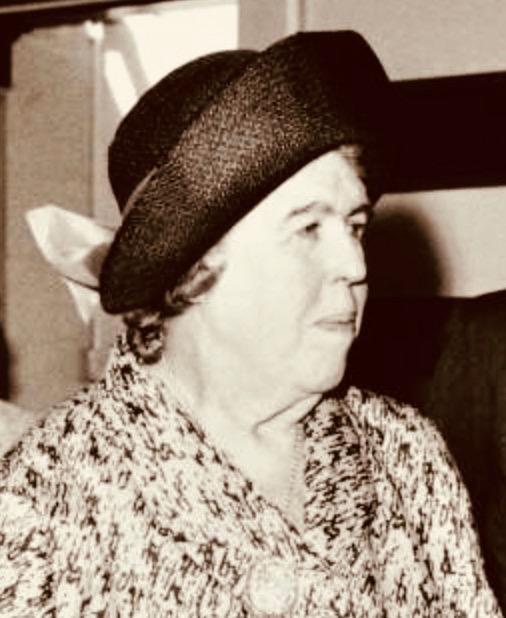
Councillor Edith Ramsay MBE
‘There is the clear distinction in Stepney between ‘common pouffes’ and ‘select pouffes’
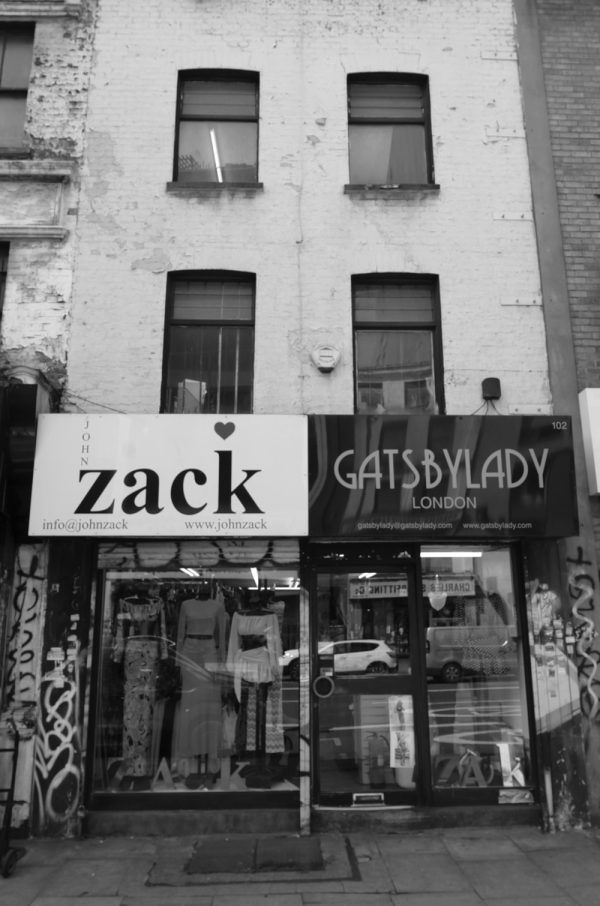
102 Commercial Rd, site of the New Life Club which was ‘struck off’ for a ‘deplorable record’
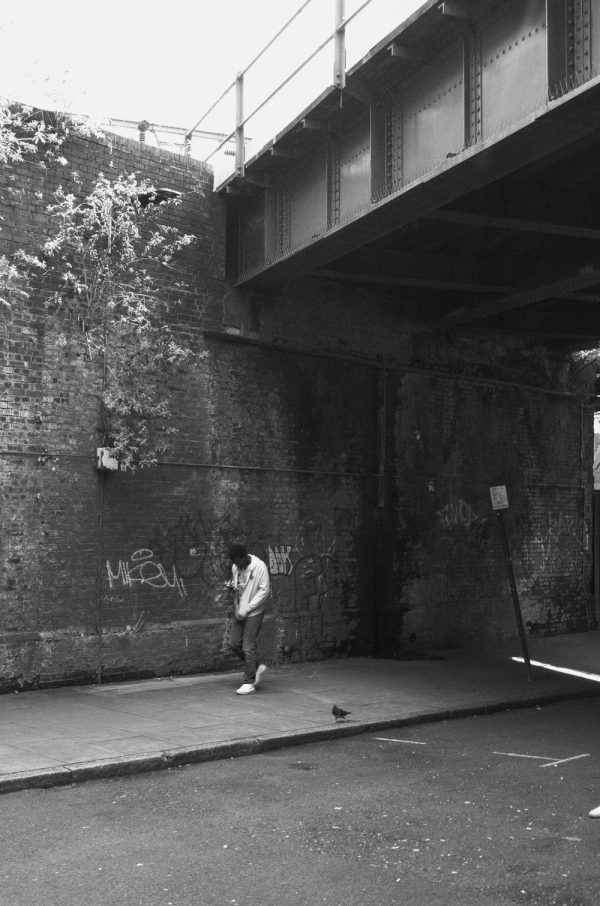
‘A new feature was a constant hanging-about on the corner of Leman and Dock St, shifting groups of three to six men…’
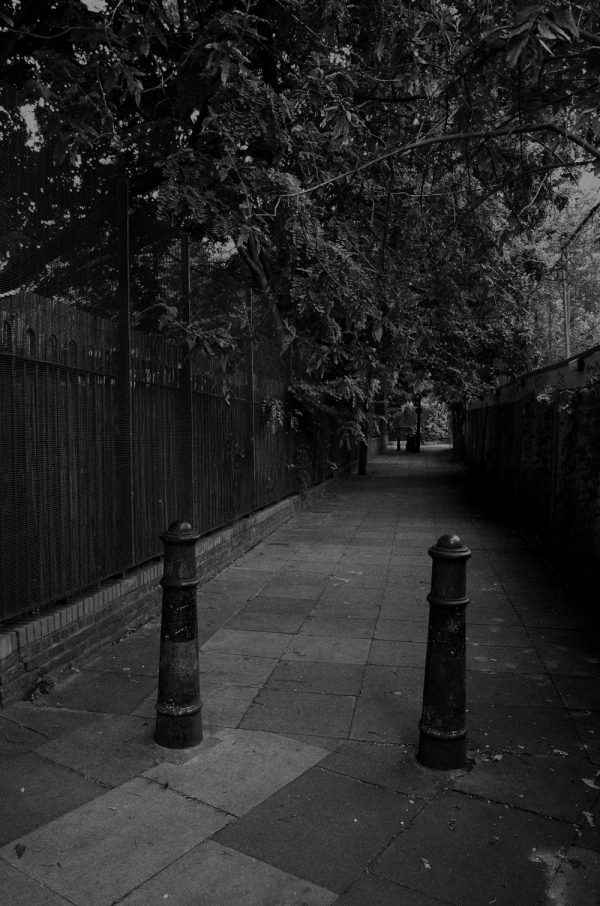
Williamson reported that on the corner of Wellclose Sq he had recently seen ‘four or five men, two of them with their trousers down…’
You may also like to read about
Malcolm Johnson At St Botolph’s
Click for tickets for The Gentle Author’s Tour of Spitalfields
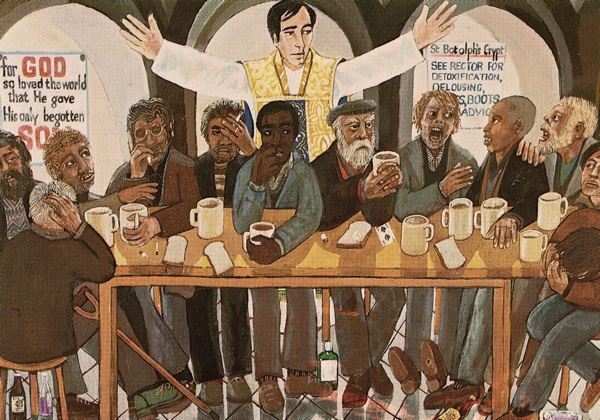
Dan Jones’ painting of Malcolm Johnson at Botolph’s, Aldgate 1982
These days, with his gentle blue eyes and white locks, Reverend Dr Malcolm Johnson is one of the most even-tempered radicals that you could meet, yet the work he did at St Botolph’s in Aldgate was truly extraordinary in its bold and compassionate nature. From 1974 until 1992, Malcolm was responsible for the ‘wet’ shelter that operated in the crypt, offering sustenance, showers and moral support to those that everyone else turned away. While other shelters refused admission to homeless people with alcohol or drugs in their possession, St Botolph’s did not and when I sought further, asking Malcolm to explain the origin of this decision, he simply said, “I believe you have to accept people as they are.”
The project at St Botolph’s was eminently pragmatic, working with people individually to find long-term accommodation in hostels and providing support in establishing a life beyond their homelessness and addiction. But shortly after Malcolm left St Botolph’s in 1992, the shelter was closed by his successor and it has sat unused for the past twenty years, making it a disappointing experience for Malcolm to return and be confronted with the shadow of his former works.
“I can’t tell you how upsetting it is, seeing it like this – it used to be such a wonderful place, full of energy and life, and now its just a store” he admitted to me when Photographer David Hoffman & I accompanied him on a visit to the disused crypt. Yet it proved to be a pertinent moment for reflection, as Malcolm told me the story of how it all happened.
“I had been Chaplain at Queen Mary University for seven years and specialised in counselling gay and lesbian people, so the Bishop thought I needed a quiet City parish where I could get on with my writing next. But, when I arrived. the crypt had been operating for five years and was catering for seventy homeless people each night, and I felt that wasn’t enough. I realised that we were here in the City of London surrounded by big companies, so I went to ask their assistance and I was lucky because they helped me, and I persuaded the City of London Corporation to give us seventy-thousand pounds a year too. The volunteers were all sorts, housewives, city workers after a day at the office and students from the polytechnic. I decided that it would be a wet crypt and we wouldn’t charge for food.
I was the rector upstairs and the director down here in the crypt – I believed the church had to be one outfit, upstairs and down. I went to Eddy Stride at Christ Church Spitalfields to ask what I should do, I had no experience so I had to learn. Over time, we expanded the shelter, we had quite a lot of full-time workers and we established four long-term hostels in Hackney. We were getting about two to three hundred people a night and it was quite an experience, but I was never frightened. Only once did a man take a swing at me, and all the others gathered round and grabbed him.
I missed this place so desperately when I left because you never knew what was going to happen when you walked through the door, it was wonderful, but I felt eighteen years was enough. Then, quite suddenly after I left in 1992, my successor closed the crypt and they said it went bankrupt, although I never understood what happened because we’d done a benefit at the Bank of England shortly before and, if there had been problems, I know my City friends would have come in to save it.”
The crypt of St Botolph’s is still equipped as a homeless shelter, functional but abandoned, pretty much as Malcolm left it and still harbouring emotive memories of those who passed through, many of whom are now dead. Encouragingly, Malcolm told me the current rector is considering whether it could be reopened.
This would itself be sufficient story and achievement for one man, yet there was another side to Malcolm Johnson’s ministry. As one of the first in the Church of England to come out as gay in 1969, he established the office of the Gay & Lesbian Christian Movement at St Botolph’s and even became known as the Pink Bishop for his campaigning work.
“I had always thought that if clergy can bless battleships and budgerigars, we could bless two people in love,” was his eloquent justification for his blessing of gay couples. Unsurprisingly, it was a subject that met opposition within the Church of England but, by the mid-eighties, the subject of AIDS became an unavoidable one and St Botolph’s was the first church to appoint a full-time minister to care for those affected by the HIV virus, as well as opening a dedicated hostel for this purpose.
In spite of his sadness at the closure of his shelter in the crypt, it was inspiring to meet Malcolm Johnson, a man with an open heart and a keen intelligence, who had the moral courage to recognise the truth of his own experience and apply that knowledge to better the lives of others.

“If clergy can bless battleships and budgerigars, we could bless two people in love…”
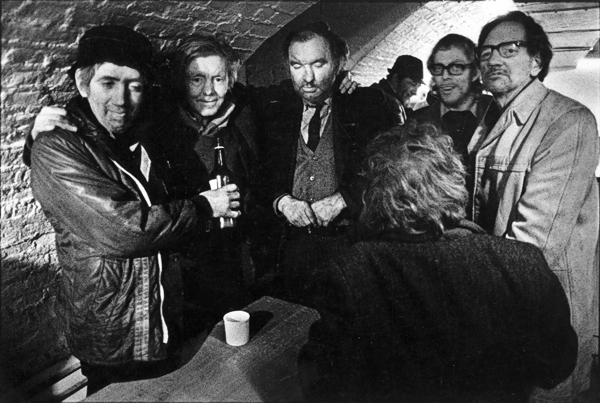
At St Botolph’s, 1978

Malcolm Johnson recalls the wet shelter in the crypt, now disused
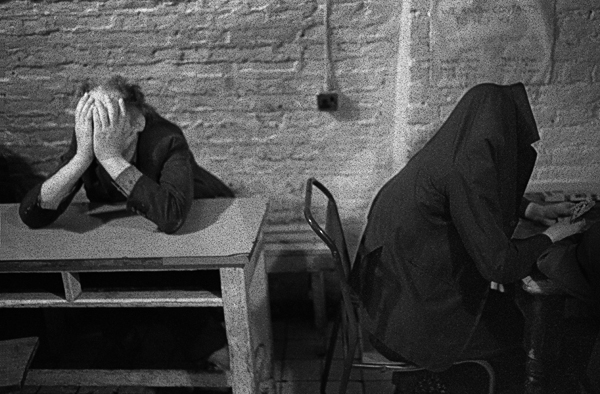
At St Botolph’s, 1978

“I believe you have to accept people as they are.”
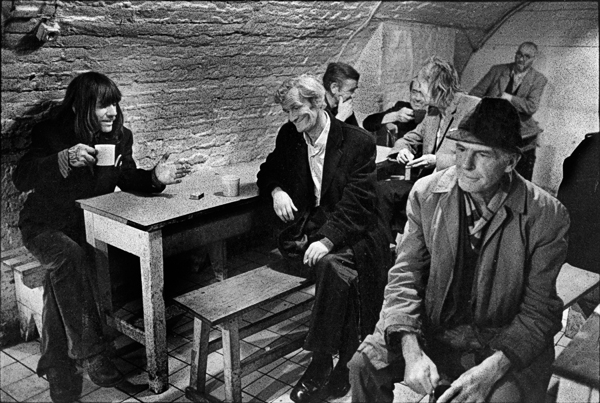
At St Botolph’s, 1978

“I can’t tell you how upsetting it is seeing it like this, it used to be such a wonderful place full of energy and life, and now it’s just a store”

Malcolm Johnson stands left at this midnight mass for the homeless at St Dunstan’s Stepney in 1978
Photographs copyright © David Hoffman
You may also like to take a look at
Tony Bock’s East Enders
Click for tickets for The Gentle Author’s Tour of Spitalfields on Saturday 1st June

Clock Winder at Christ Church, Spitalfields
Here are the East Enders of the nineteen seventies as pictured by photographer Tony Bock in the days when he worked for the East London Advertiser – the poncy dignitaries, the comb-over tories, the kids on the street, the market porters, the fascists, the anti-fascists, the shopkeepers, the sheet metal workers, the unions, the management, the lone dancers, the Saturday shoppers, the Saturday drinkers, the loving family, the West Ham supporters, the late bride, the wedding photographer, the clock winder, the Guinness tippler, the solitary clown, the kneeling politician and the pie & mash shop cat.
Welcome to the teeming masses. Welcome to the infinite variety of life. Welcome to the exuberant clear-eyed vision of Tony Bock. Welcome to the East End of fifty years ago.
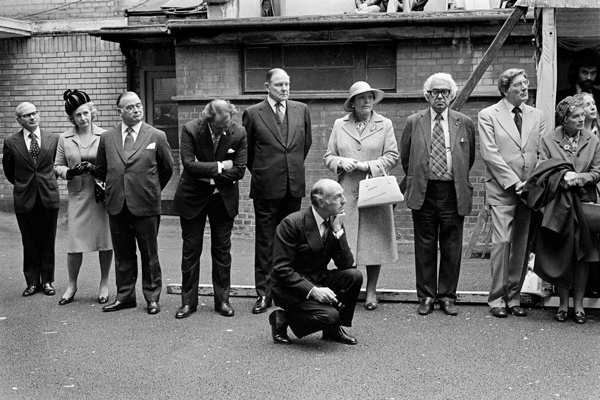
Dignitaries await the arrival of the Queen Mother at Toynbee Hall. John Profumo kneels.
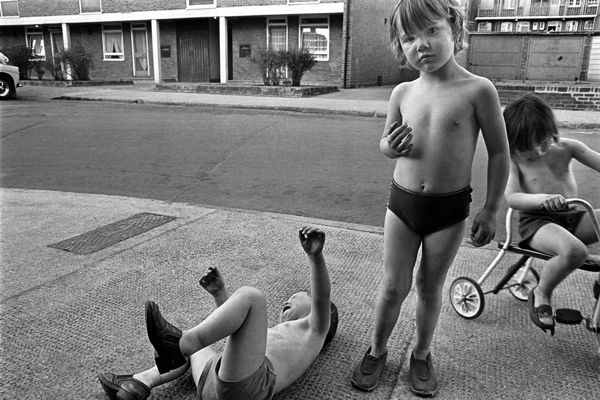
Children playing on the street in Poplar.

On the steps of St Paul’s Cathedral.
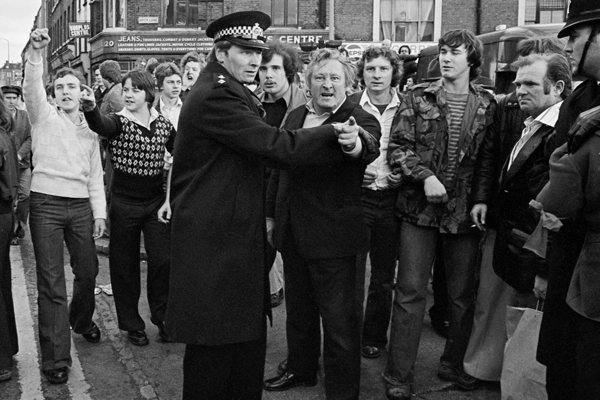
National Front supporters gather at Brick Lane.

Watching a National Front march in Hackney.
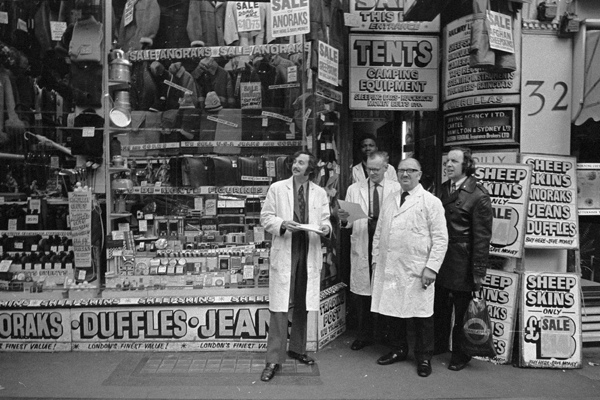
Shopkeepers come out to watch an anti-racism march in Hackney.
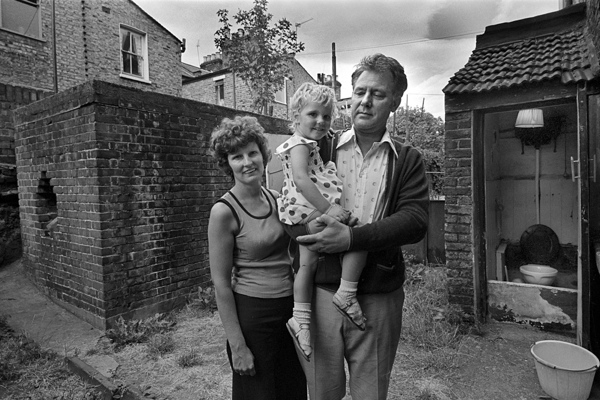
A family in Stratford pose in their back yard.
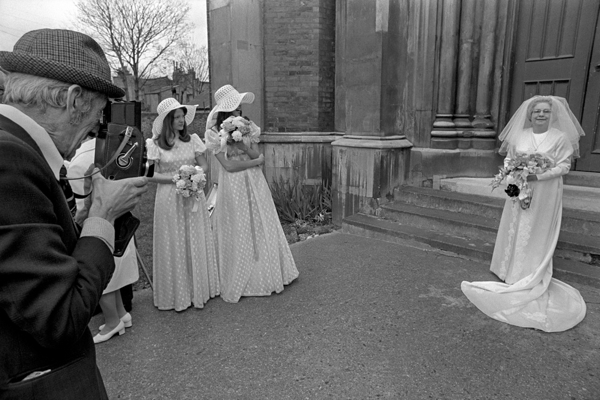
Wedding photographer in Hackney – the couple had been engaged many years.

West Ham fans at Upton Park, not a woman to be seen.

Sports club awards night in Hackney.

Dancers in Victoria Park.
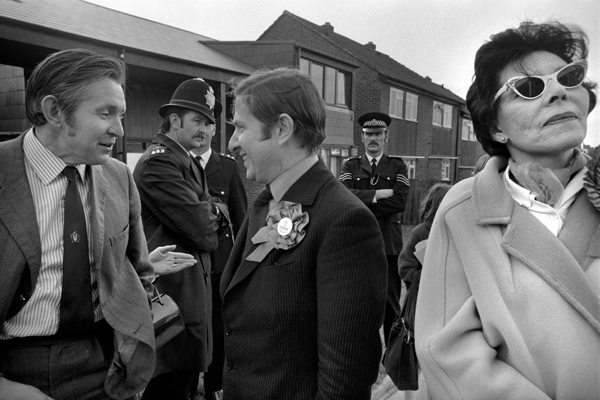
Conservative party workers in the 1974 electoral campaign, Ilford.

Ted Heath campaigns in Ilford for the General Election of 1974.
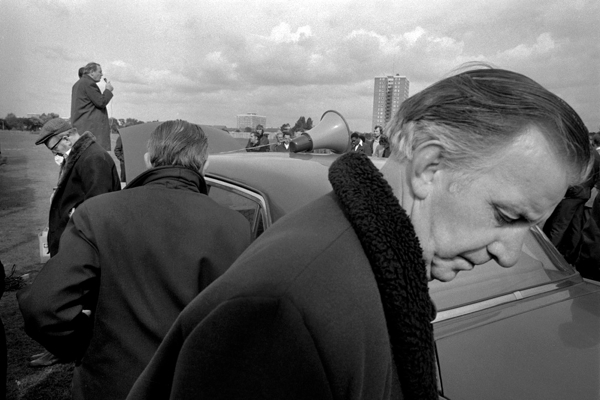
Ford workers union meeting, Dagenham.
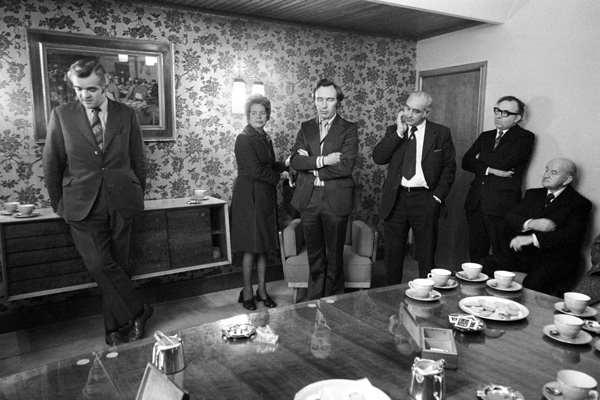
Ford managers, Dagenham.
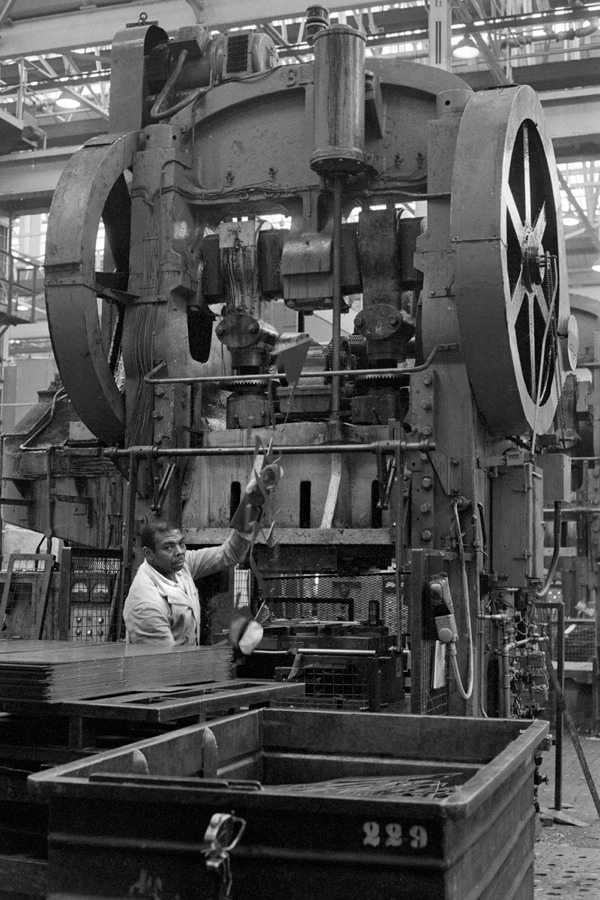
Press operator at Ford plant, Dagenham.
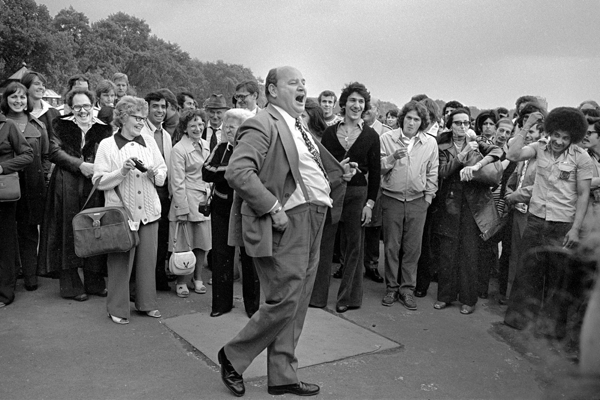
At Speakers’ Corner, Hyde Park.
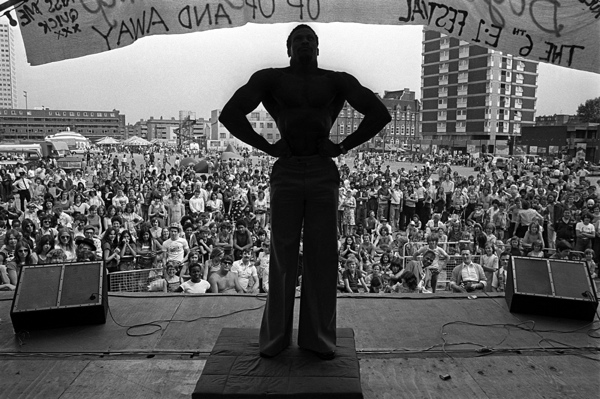
Mr East End Contest at E1 Festival.

The shop cat at Kelly’s Pie & Mash Shop, Bethnal Green Rd.

At the White Swan in Poplar.
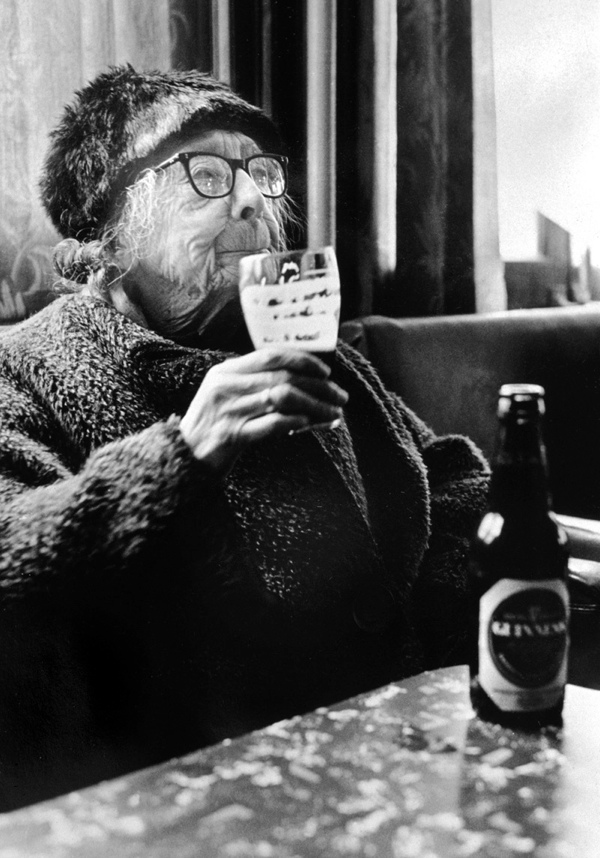
Enjoying a Guinness in the Royal Oak, Bethnal Green.

Boy on demolition site, Tiller Rd, Isle of Dogs.
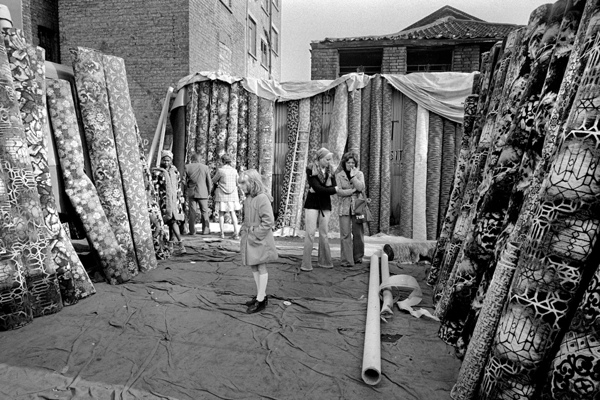
Brick Lane Sunday Market.

Clown in Stratford Broadway.
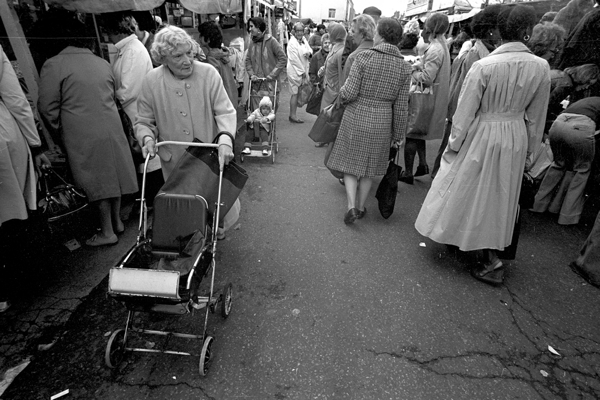
Saturday morning at Roman Rd Market.

Saturday night out in Dagenham.
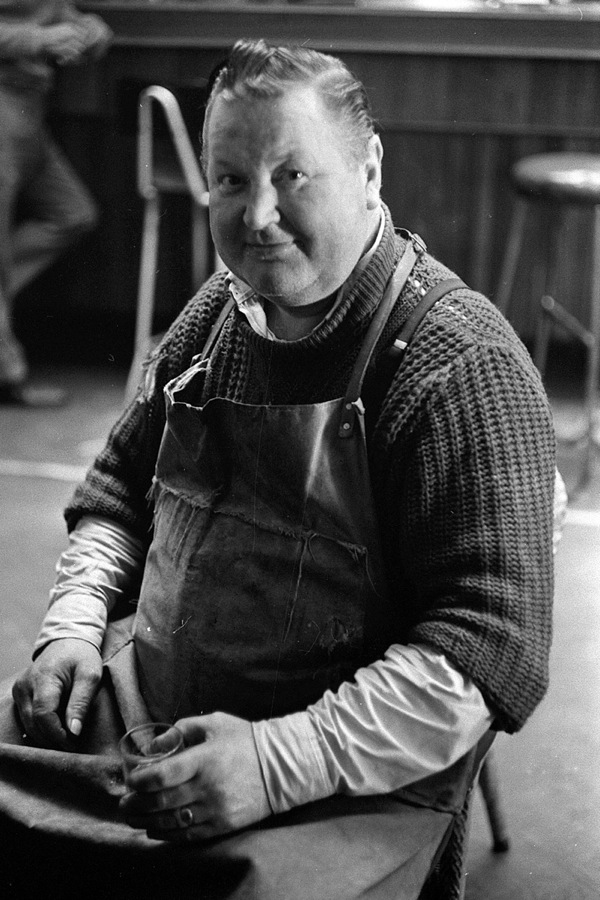
Spitalfields Market porter in the workers’ club
Photographs copyright © Tony Bock
You may like to see these other photographs by Tony Bock
The East End Suffragette Map
Click for tickets for The Gentle Author’s Tour of Spitalfields on Saturday 1st June
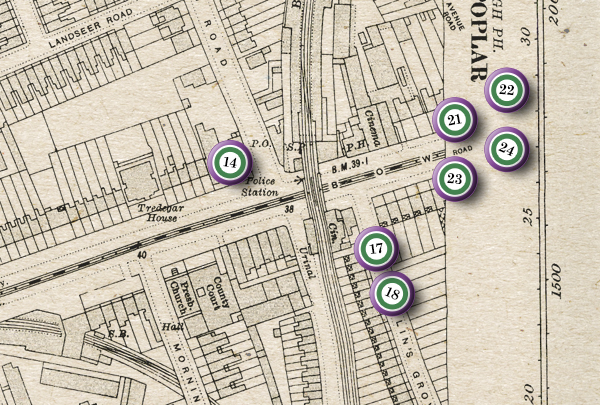
The central contribution of women in the East End to the Suffrage Movement is not always recognised, so we present researcher Vicky Stewart & designer Adam Tuck‘s map of some key events in the struggle in Bethnal Green, Roman Rd & Bow

Click to enlarge and see the map in the detail
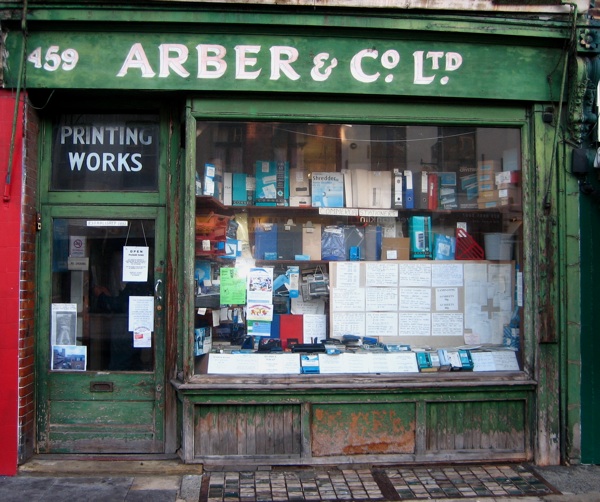
The closure of W F Arber & Co Ltd, after one hundred and seventeen years in the Roman Rd, inspired me to look further at Gary Arber’s story of his grandmother, Emily Arber, organising the free printing of handbills and posters for the Suffragette movement. Just what was going on locally, who were involved, and how were these Suffragettes organised?
Nothing prepared me for what I discovered. My knowledge of Suffragette activity was limited to stories of upper middle class ladies marching behind Mrs Pankhurst, waving ‘Votes for Women’ banners, being imprisoned, getting force-fed, and then eventually securing the vote. In part this was true – Mrs Pankhurst and her daughter Christabel believed middle class women had the education and influence to bring about the necessary change, but Sylvia disagreed and insisted it was only direct action by working class women that could win the vote.
In 1912, Sylvia Pankhurst came to Bow as representative of the Women’s Social and Political Union (WSPU) to campaign for local MP George Lansbury, who had resigned his seat in parliament to fight a by-election on the issue of votes for women. Although Lansbury lost the election, he continued to support Sylvia who decided to stay in the East End and do everything in her power to carry on the fight – not only to champion the cause of Suffrage but also to challenge injustice and alleviate suffering wherever she could.
She opened her first WSPU Headquarters in Bow Rd in 1912 but moved to Roman Rd when forming the East London Federation, whose policy was to “combine large-scale public demonstrations with public militancy… [to attract] immediate arrest.”
In January 1914, Christabel asked Sylvia to change the name of the ELF and separate from the WSPU, and the organisation became the East London Federation of Suffragettes (ELFS) with new headquarters in Old Ford Rd.
What amazes me about this story is the number of women – often with active support of husbands or sons – who, despite harsh poverty and large families, gave huge support to Sylvia and the campaign. They risked assault and often were beaten by policemen at rallies, on marches and at meetings. They risked being sent to Holloway and subjected to force-feeding. They risked the anger and abuse of those who did not support Women’s’ Suffrage.
So who were these women and what do we know of them? Below you can read extracts from Sylvia Pankhurst’s books, ‘The Suffragette Movement’ and ‘The Home Front’, which locate their actions in the East End.
– Vicky Stewart
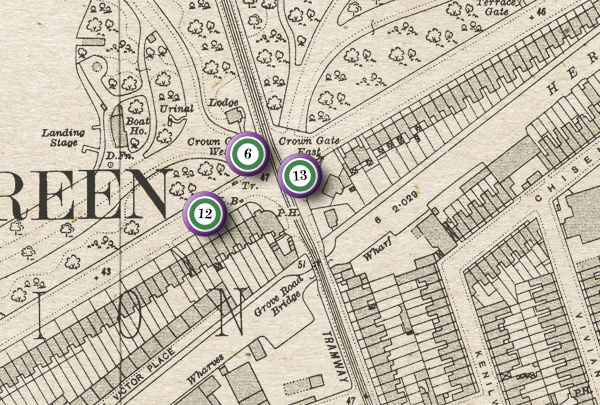
6
Victoria Park “On Sunday, May 25th 1913, was held ‘Women’s May Day’ in East London. The Members of Bow, Bromley, Poplar, and neighbouring districts had prepared for it for many weeks past and had made hundreds of almond branches, which were carried in a great procession with purple, white and green flags, and caps of Liberty flaunting above them from the East India Dock gates by winding ways, to Victoria Park. A vast crowd of people – the biggest ever seen in East London – assembled ….. to hear the speakers from twenty platforms.”
12
288 Old Ford Rd was home to Israel Zangwill, political activist and strong supporter of Sylvia and the Suffragette movement.
13
304 Old Ford Rd was home to Mrs Fischer where meetings were held .
7
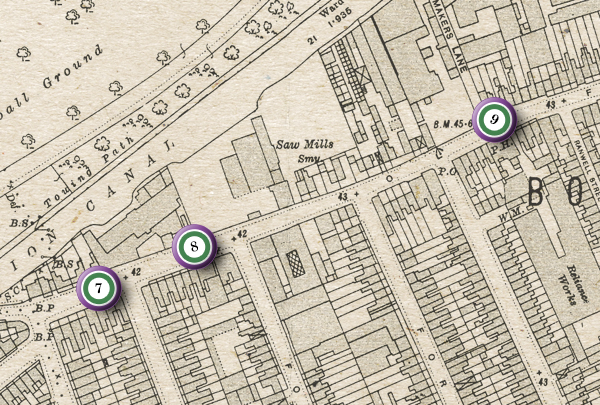
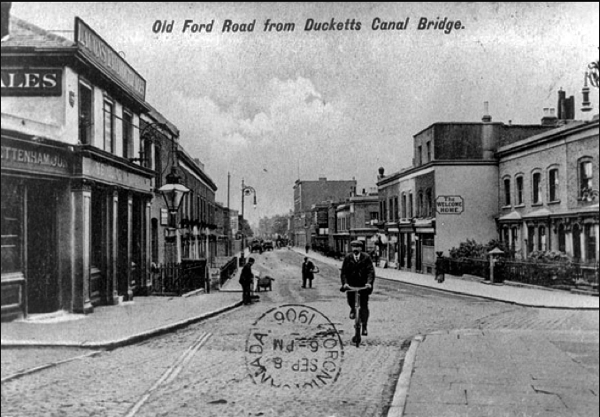
Old Ford Rd was the route taken by the Suffragettes May Day processions to Victoria Park when they met with violence from the police at the gates and suffered many injuries.
8
400 Old Ford Rd became the third headquarters of the East London Federation of Suffragettes in 1914. A Women’s Hall was built on land behind which was used for a cost-price restaurant which provided nutritious meals for a pittance to women suffering from the huge rise in food prices in the early months of the war.
9
438 Old Ford Rd, The Mother’s Arms The ELFS set up another creche and baby clinic on this street, staffed by trained nurses and developed upon Montessori lines. This was housed in a converted pub called The Gunmaker’s Arms, whose name was changed to The Mother’s Arms.
1
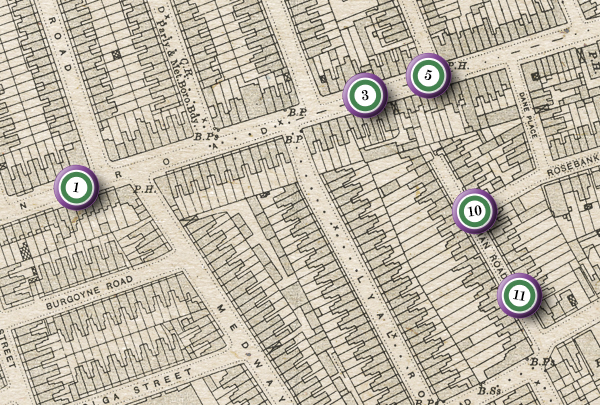
Roman Rd “I decided to take the risk of opening a permanent East End headquarters in Bow … Miss Emerson and I went down there together one frosty Friday morning in February to hunt for an office. The sun was like a red ball in the misty, whitey-grey sky. Market stalls, covered with cheerful pink and yellow rhubarb, cabbages, oranges and all sorts of other interesting things, lined both sides of the narrow Roman Rd. ‘The Roman’ , as they call it, was crowded with busy kindly people. I had always liked Bow. That morning my heart warmed to it for ever.”
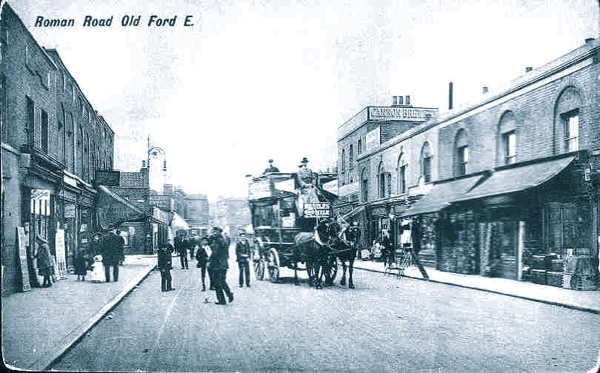
3
159 Roman Rd, (now 459) Arber & Co Ltd, Printing Works where Suffragette handbills were printed under the supervision of Emily Arber.
5
152 Roman Rd In 1912, tickets were available from this house, home of Mrs Margaret Mitchell, second-hand clothes dealer, for a demonstration in Bow Palace with Mrs Pankhurst and George Lansbury.
10 & 11
45 Norman Rd (now Norman Grove) A toy factory was opened in October 1914 to provide women with an income whilst their husbands were at War. They were paid a living wage and could put their children into the nursery further down the road.
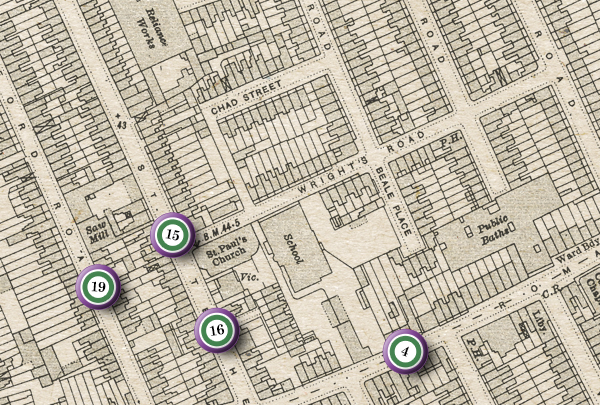
4
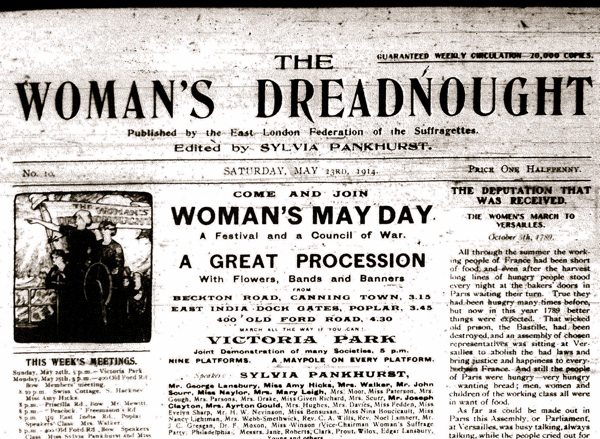
Roman Rd Market The East London Federation of Suffragettes ran a stall in the market, decorated with posters and selling their newspaper, The Women’s Dreadnought – a “medium through which working women, however unlettered, might express themselves and find their interests defended.”
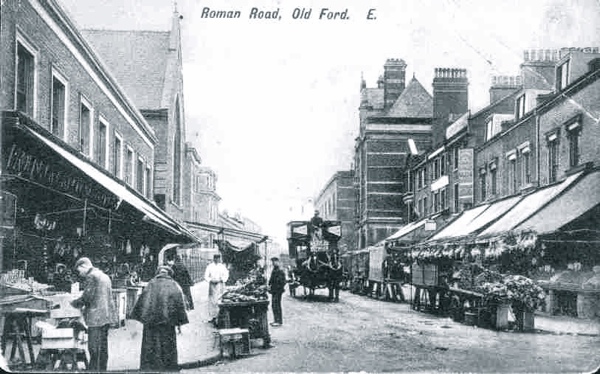
15
103 St Stephen’s Rd was home to George Lansbury and his family.
16
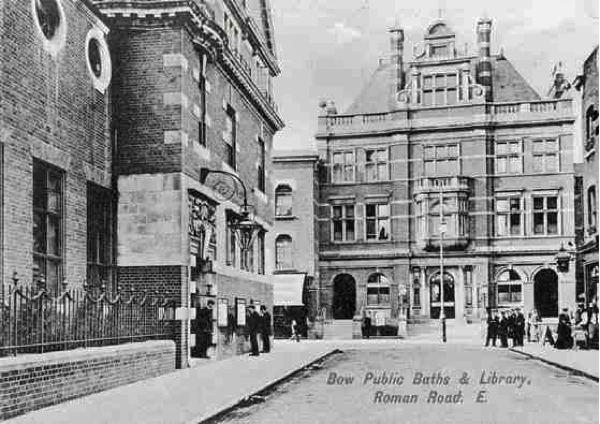
St Stephen’s Rd “On November 5th 1913, on my way to a Meeting to inaugurate the People’s Army, I happened to call at Mr Lansbury’s house in St Stephen’s Rd. The house was immediately surrounded by detectives and policemen and there seemed no possibility of mistake. But the people of Bow, on hearing of the trouble, came flocking out of the Baths where they had assembled. In the confusion that ensued the detectives dragged Miss Daisy Lansbury off in a taxi, and I went free.
When the police authorities realised their mistake, and learnt that I was actually speaking at the Baths, they sent hundreds of men to take me, but though they met the people in the Roman Rd as they came from the Meeting I escaped. Miss Emerson was again struck on the head, this time by a uniformed constable, and fell to the ground unconscious. Many other people were badly hurt. The people replied with spirit. Two mounted policemen were unhorsed and many others were disabled.”
19
28 Ford Rd “The members had begged me, if ever I should be imprisoned under the ‘Cat and Mouse Act’, to come down to them in the East End, in order that they might protect me, they would not let me be taken back to prison without a struggle as the others had been, they assured me.
On the night of my arrest Zelie Emerson had pressed into my hand an address: ‘Mr and Mrs Payne, 28 Ford Rd, Bow.’ Thither I was now driven in a taxi with two wardresses. As the cab slowed down perforce among the marketing throngs in the Roman Road, friends recognised me, and rushed to the roadway, cheering and waving their hands. Mrs Payne was waiting for me on the doorstep. It was a typical little East End house in a typical little street, the front door opening directly from the pavement, with not an inch of ground to withdraw its windows from the passers-by. I was welcomed by the kindest of kind people, shoemaking home-workers, who carried me in with the utmost tenderness.
They had put their double bed for me in the little front parlour on the ground floor next the street, and had tied up the door knocker. For three days they stopped their work that I might not be disturbed by the noise of their tools. Yet there was no quiet. The detectives, notified of my release, had arrived before me. A hostile crowd collected. A woman flung one of the clogs she wore at the wash-tub at a detectives head. The ‘Cats’, as a hundred angry voices called them, retired to the nearby public-houses, there were several of these havens within a stone’s throw, as there usually are in the East End.
Yet, even though the detectives were out of sight, people were constantly stopping before the house to discuss the Movement and my imprisonment. Children gathered, with prattling treble. If anyone called at the house, or a vehicle stopped before it, detectives at once came hastening forth, a storm of hostile voices. Here indeed was no peace. My hosts carried me upstairs to their own bedroom, at the back of the house, hastily prepared, a small room, longer but scarcely wider than a prison cell – my home when out of prison for many months to come. (…)
In that little room I slept, wrote, interviewed the Press and personalities of all sorts, and presently edited a weekly paper. Its walls were covered with a cheap, drab paper, with an etching of a ship in full sail, and two old fashioned colour prints of a little girl at her morning and evening prayers. From the window by my bed, I could see the steeple of St Stephen’s Church and the belfry of its school, a jumble of red-tiled roofs, darkened by smoke and age, the dull brick of the walls and the new whitewash of some of the backyards in the next street.
Our colours were nailed to the wall behind my bed, and a flag of purple, white and green was displayed from an opposite dwelling, where pots of scarlet geraniums hung on the whitewashed wall of the yard below, and a beautiful girl with smooth, dark hair and a white bodice would come out to delight my eyes in helping her mother at the wash-tub. The next yard was a fish curers’. An old lady with a chenille net on her grey hair would be passing in and out of the smoke-house, preparing the sawdust fires. A man with his shirt sleeves rolled up would be splitting herrings, and another hooking them on to rods balanced on boards and packing-cases, till the yard was filled, and gleamed with them like a coat of mail. Close by, tall sunflowers were growing, and garments of many colours hung out to dry. Next door to us they bred pigeons and cocks and hens, which cooed and crowed and clucked in the early hours. Two doors away a woman supported a paralysed husband and a number of young children by making shirts at 8d a dozen. Opposite, on the other side of Ford St, was a poor widow with a family of little ones. The detectives endeavoured to hire a room from her, that they might watch me unobserved. “It will be a small fortune to you while it lasts!” they told her. Bravely she refused with disdain, “Money wouldn’t do me any good if I was to hurt that young woman!” The same proposal was made and rejected at every house in Ford Rd.
Flowers and presents of all kinds were showered on me by kindly neighbours. One woman wrote to say that she did not see why I should ever go back to prison when every woman could buy a rolling pin for a penny.”
2
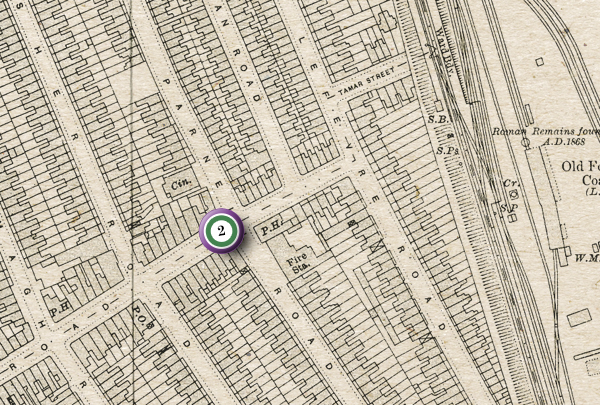
321 Roman Rd, Second Headquarters of the East London Federation “We decided to take a shop and house at 321 Roman Rd at a weekly rental of 14s 6d a week. It was the only shop to let in the road. The shop window was broken right across, and was only held together by putty. The landlord would not put in new glass, nor would he repair the many holes in the shop and passage flooring because he thought we would only stay a short time. But all such things have since been done.
Plenty of friends at once rallied round us. Women …. came in and scrubbed the floors and cleaned the windows. Mrs Wise, who kept the sweetshop next door, lent us a trestle table for a counter and helped us to put up purple, white and green flags. Her little boy took down the shutters for us every morning, and put them up each night, and her little girls often came in to sweep.”
20
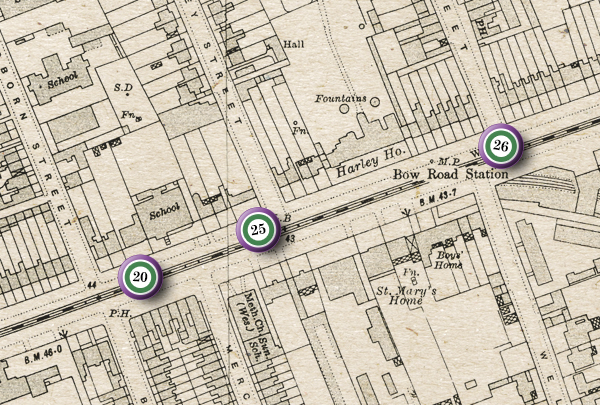
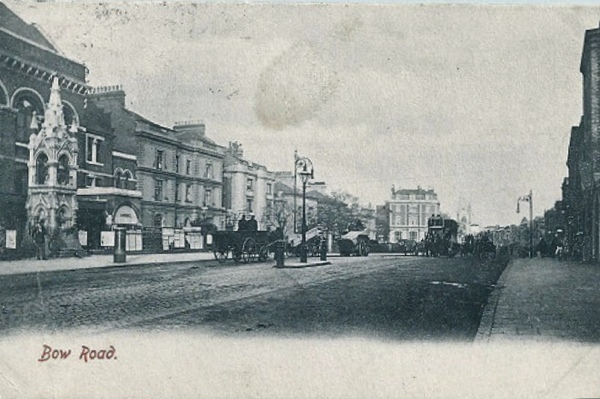
Bow Rd – Sylvia described it as ‘dingy Bow Rd.’
25
The George Lansbury Memorial – Elected to parliament in 1910, he resigned his seat in 1912 to campaign for women’s suffrage, and was briefly imprisoned after publicly supporting militant action.

George Lansbury
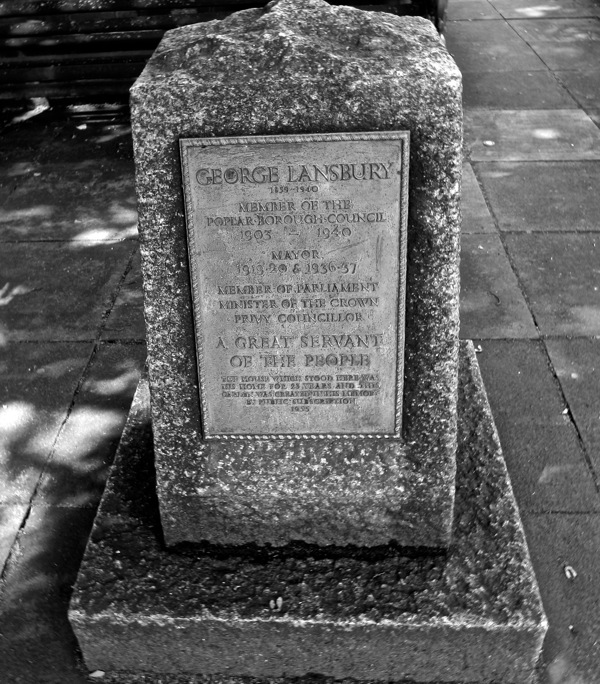
26
The Minnie Lansbury Clock is at the Bow Rd near the junction with Alfred St. Minnie Lansbury was the daughter-in-law of George Lansbury, and very actively supported the campaign and was in Holloway. She died at the age of thirty-two.

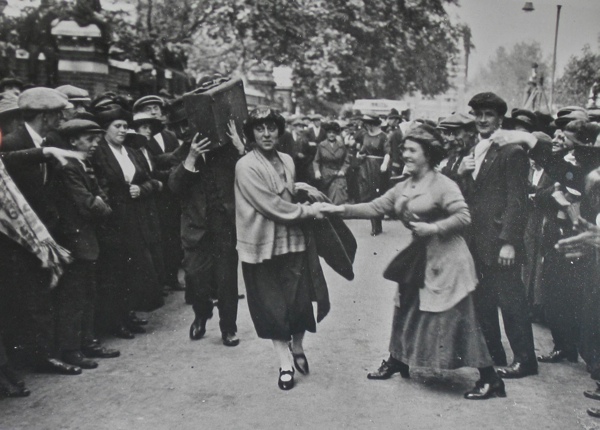
Minnie Lansbury is congratulated on her way to be arrested at Poplar Town Hall
14
Bow Rd Police Station The police were horrifyingly brutal towards Suffragettes when on demonstrations and then, once arrested and tried, they would often receive excessively harsh prison sentences. Hunger striking was in protest against the government’s failure to treat them as political prisoners.
Mrs Parsons told Asquith – “We do protest when we go along in processions that suddenly without a word of warning we are pounced upon by detectives and bludgeoned and women are called names by cowardly detectives, when nobody is about. There was one old lady of seventy who was with us the other day, who was knocked to the ground and kicked. She is a shirtmaker and is forced to work on a machine and she has been in the most awful agony. These men are not fit to help rule the country while we have no say in the matter.” (From the Woman’s Dreadnought.)
Under the ‘Cat and Mouse Act’ hunger strikers were released when their lives was in danger so as to recuperate before returning to finish their sentences. They told tales of dreadful brutality during force-feeding in Holloway.

17 & 18
13 Tomlin’s Grove “When the procession turned out of Bow Rd into Tomlin’s Grove they found that the street lamps were not lighted and that a strong force of police were waiting in the dark before the house of Councillor Le Manquais. Just as the people at the head of the procession reached the house, the policemen closed around them and arrested Miss Emerson, Miss Godfrey and seven men, two of whom were not in the procession, but were going home to tea in the opposite direction.
At the same moment twenty mounted police came riding down upon the people from the far end of Tomlin’s Grove, and twenty more from the Bow Rd. The people were all unarmed. … There were cries and shrieks and people ran panic-stricken into the little front gardens of the houses in the Grove.
But wherever the people stopped the police hunted them away. I was told that an old woman who saw the police beating the people in her garden was so much upset that she fell down in a fit and died without regaining consciousness. A boy of eighteen was so brutally kicked and trampled on that he had to be carried to the infirmary for treatment. A publican who was passing was knocked down and kicked and one of his ribs was broken. Even the bandsmen were not spared. The police threw their instruments over the garden walls. The big drummer was knocked down and so badly used that he is still on the list for sick insurance benefit. Mr Atkinson, a labourer, was severely handled and was then arrested. In the charge room Inspector Potter was said to have blacked his eye.”
21
198 Bow Rd was the first Headquarters of the First Headquarters of the East London Federation, 1912. When Sylvia first arrived in Bow she rented an empty baker’s shop at 198 Bow Rd. She used a platform to paint “VOTES FOR WOMEN” in gold across the frontage and addressed the crowds from here.
22
The Obelisk, Bromley High St “On the following Monday, February 17th (1913) we held a meeting at the Obelisk, a mean-looking monument in a dreary, almost unlighted open space near Bow Church.
Our platform, a high, uncovered cart, was pitched against the dark wall of a dismal council school in the teeth of a bitter wind. Already a little knot of people had gathered; women holding their dark garments closely about them, shivering and talking of the cold, four or five police constables and a couple of Inspectors. We climbed into the cart and watched the crowd growing, the men and women turning from the footpaths to join the mass. … I said I knew it to be a hard thing for men and women to risk imprisonment in such a neighbourhood, where most of them were labouring under the steepest economic pressure, yet I pleaded for some of the women of Bow to join us in showing themselves prepared to make a sacrifice to secure enfranchisement …
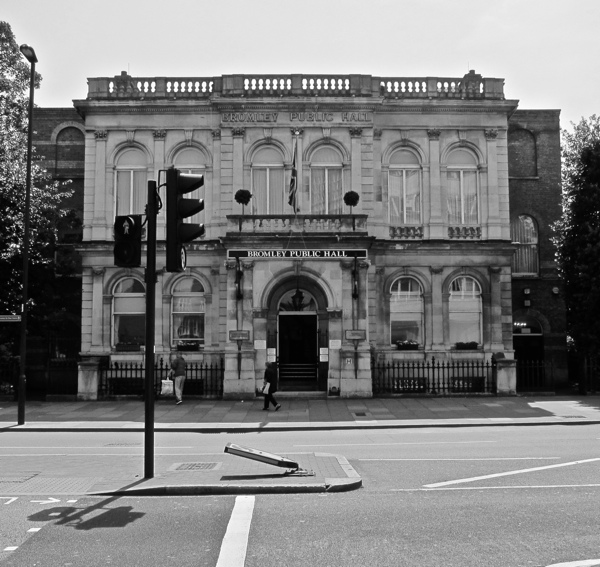
… After it was over Mrs Watkins, Mrs Moore, Miss Annie Lansbury, and I broke an undertaker’s window. Willie Lansbury, George Lansbury’s eldest son, who had promised his wife to go to prison instead of her because she had tubercular tendencies and could not leave their little daughter only two years old, broke a window in the Bromley Public Hall.
I was seized by two policemen, three other women were seized. We were dragged, resisting, along the Bow Rd, the crowd cheering and running with us. We were sent to prison without an option of fine.
There were four others inside with me: Annie Lansbury and her brother Will, pale, delicate Mrs. Watkins, a widow struggling to maintain herself by sweated sewing-machine work, and young Mrs. Moore. A moment later little Zelie Emerson was bundled in, flushed and triumphant – she had broken the window of the Liberal Club.
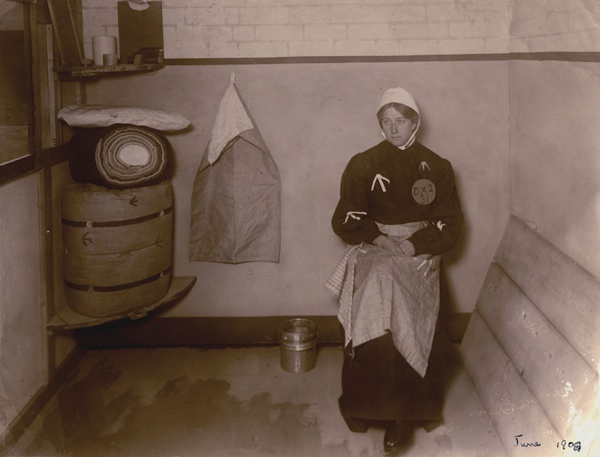
That was the beginning of Militancy in East London. Miss Emerson, Mrs Watkins and I decided to do the hunger-strike, and hoped that we should soon be out to work again. But although Mrs Watkins was released after ten days, Miss Emerson and I were forcibly fed, and she was kept in for seven weeks although she had developed appendicitis, and I for five. When we were once free we found that we were too ill to do anything at all for some weeks.
But we need not have feared that the work would slacken without us. A tremendous flame of enthusiasm had burst forth in the East End. Great meetings were held, and during our imprisonment long processions marched eight times the six miles to cheer us in Holloway, and several times also to Brixton goal, where Mr Will Lansbury was imprisoned. The people of East London, with Miss Dalgleish to help them, certainly kept the purple, white and green flag flying …”
23
Bromley Public Hall, Bow Rd “On February 14th [1913] … we held a meeting in the Bromley Public Hall, Bow Road, and from it led a procession round the district. …To make sure of imprisonment, I broke a window in the police station … Daisy Lansbury was accused of catching a policeman by the belt, but the charge was dismissed. Zelie Emerson and I went to prison … .and began the hunger and thirst strike … On release we rushed back to the shop, found Mrs Lake scrubbing the table, and it crowded with members arranging to march to Holloway Prison to cheer us next day.”
24
Bow Palace, 156 Bow Rd was built at the rear of the Three Cups public house and had a capacity of two thousand.
“One Sunday afternoon I spoke in Bow Palace and marched openly with the people of Bow Rd. When I spoke from the window afterwards, a veritable forest of sticks was waved by the crowd. …
While I was in prison after my arrest in Shoreditch …. a Meeting …. was held in Bow Palace on Sunday afternoon, December 14th. After the Meeting it was arranged to go in procession around the district and to hoot outside the houses of hostile Borough Councillors.”
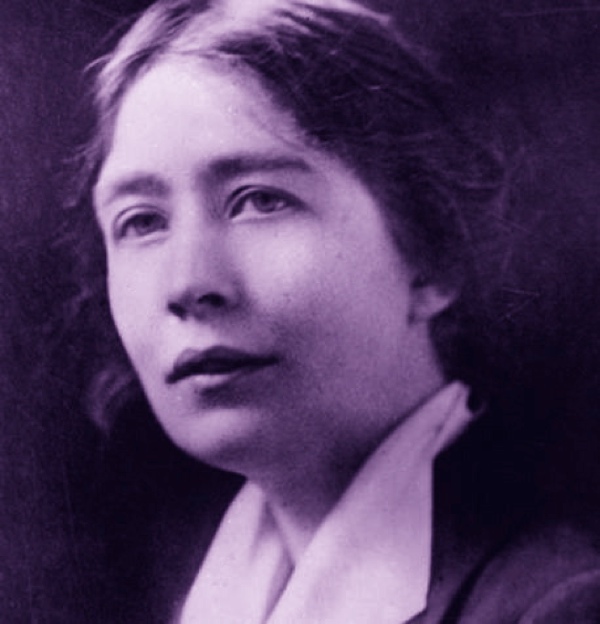
Sylvia Pankhurst – Women over the age of twenty-one were eventually enfranchised in 1928.
Maps reproduced courtesy of Bishopsgate Institute
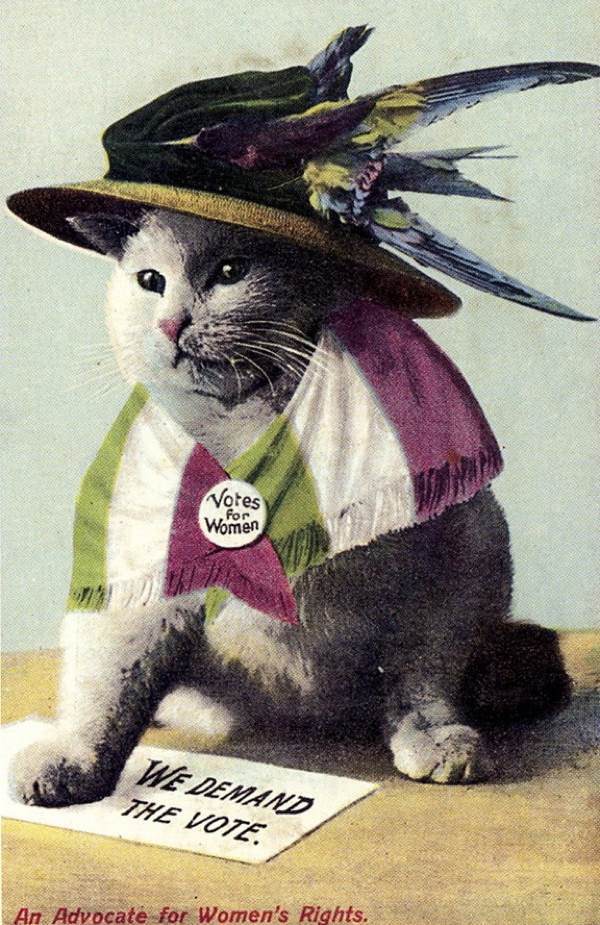
Postcard reproduced courtesy of Libby Hall Collection at Bishopsgate Institute
Photograph of Suffragette in Holloway courtesy of LSE Women’s Library
Copy of The Women’s Dreadnought courtesy of Tower Hamlets Local History Library & Archives
You may also like to read about
In Search Of The Ropemakers Of Stepney
Click for tickets for The Gentle Author’s Tour of Spitalfields on Saturday 1st June

Rope makers of Stepney
In Stepney, there has always been an answer to the question, “How long is a piece of string?” It is as long as the distance between St Dunstan’s Church and Commercial Rd, which is the extent of the former Frost Brothers’ Rope Factory.
Let me explain how I came upon this arcane piece of knowledge. I published a series of photographs from a copy of Frost Brothers’ Album in the archive of the Bishopsgate Institute produced around 1900, illustrating the process of rope making and yarn spinning. As a consequence, a reader of Spitalfields Life walked into the Institute and donated a series of four group portraits of rope makers at Frost Brothers which I publish here.
I find these pictures even more interesting than the ones I first showed because, while the photos in the Album illustrate the work of the factory, in these newly-revealed photos the subject is the rope makers themselves.
There are two pairs of pictures. Photographed on the same day, the first pair taken – in my estimation – around 1900, show a gang of men looking rather proud of themselves. There is a clear hierarchy among them and, in the first photo, they brandish tankards suggesting some celebratory occasion. The men in bowler hats assume authority and allow themselves more swagger while those in caps withhold their emotions. Yet although all these men are deliberately presenting themselves to the camera, there is relaxed quality and swagger in these pictures which communicates a vivid sense of the personality and presence of the subjects.
The other two photographs show larger groups and I believe were taken as much as a decade earlier. I wonder if the tall man in the bowler hat with a moustache in the centre of the back row in the first of these is the same as the man in the bowler hat in the later photographs? In these earlier photographs, the subjects have been corralled for the camera and many regard us with a weary implacable gaze.
The last of the photographs is the most elaborately staged and detailed. It repays attention for the diverse variety of expressions among its subjects, ranging from blank incomprehension of some to the tenderness of the young couple with the young man’s hands upon the young woman’s shoulders – a fleeting gesture of tenderness recorded for eternity.
I was so fascinated by these photographs I wanted to go and find the rope works for myself and, on an old map, I discovered the ropery stretching from Commercial Rd to St Dunstan’s, but – alas – I could discern nothing on the ground to indicate it was ever there. The Commercial Rd end of the factory is now occupied by the Tower Hamlets car pound, while the long extent of the ropery has been replaced by a terrace of house called Lighterman’s Court that, in its length and extent, follows the pattern of the earlier building quite closely. At the northern end, there is now a park where the factory reached the road facing St Dunstan’s. Yet the terraces of nineteenth century housing in Bromley St and Belgrave St remain on either side and, in Bromley St, the British Prince where the rope makers once quenched their thirsts still stands.
After the disappointment of my quest to find the rope works, I cherish these photographs of the rope makers of Stepney even more as the best record we have of their existence.

Gang of rope makers at Frost Brothers (You can click to enlarge this image)

Rope makers with a bale of fibre and reels of twine (You can click to enlarge this image )
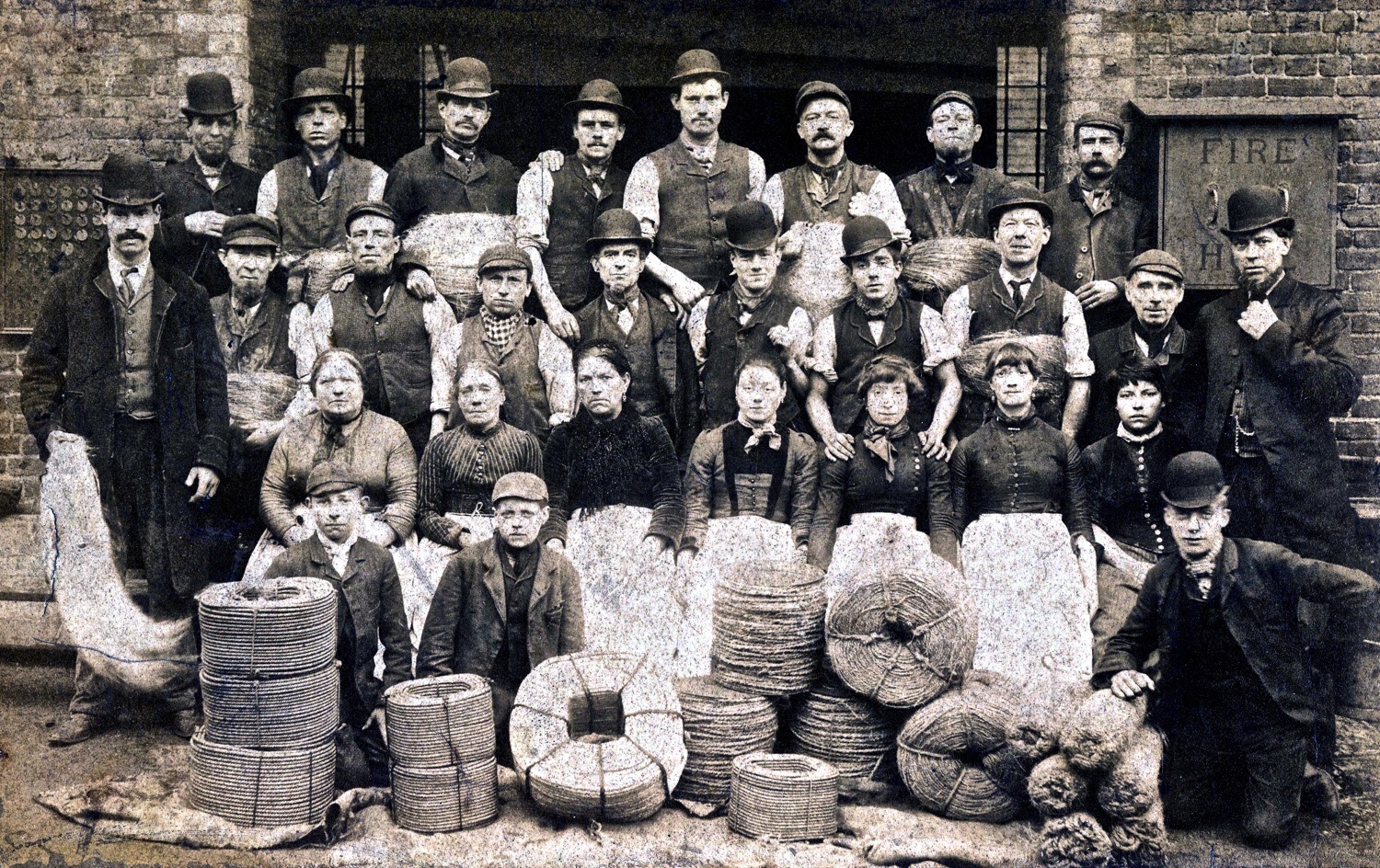
Rope makers including women and boys with coils of rope (You can click to enlarge this image)
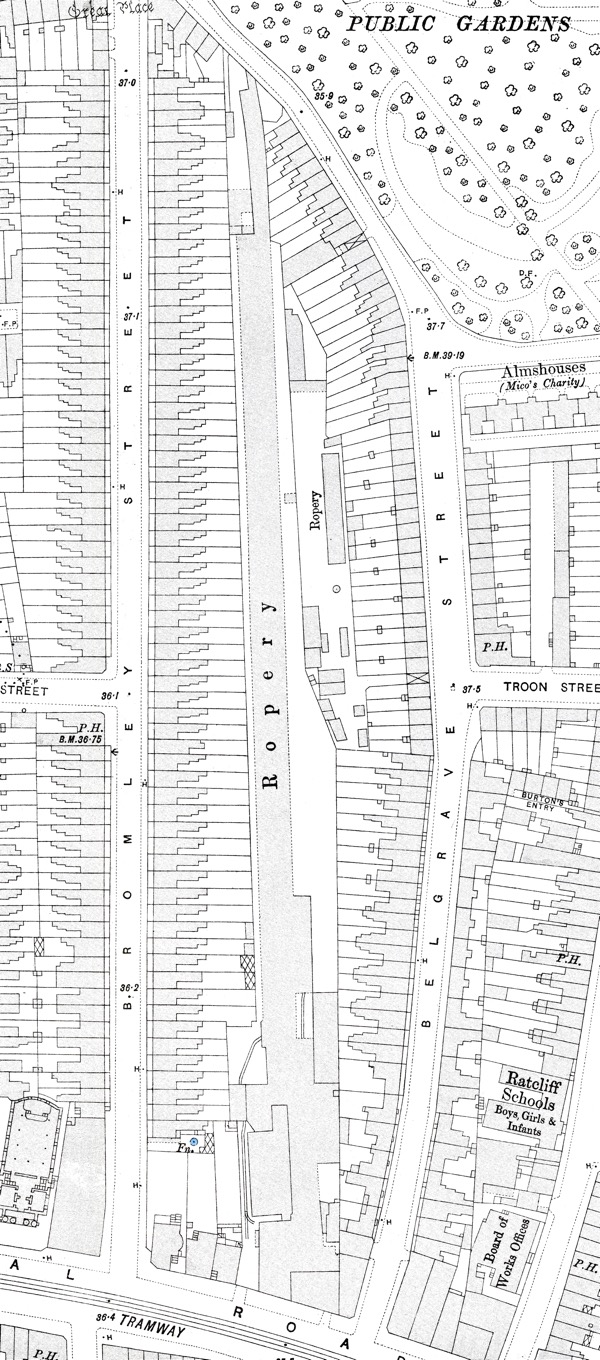
Frost Brothers Ropery stretched from Commercial St to St Dunstan’s Churchyard in Stepney
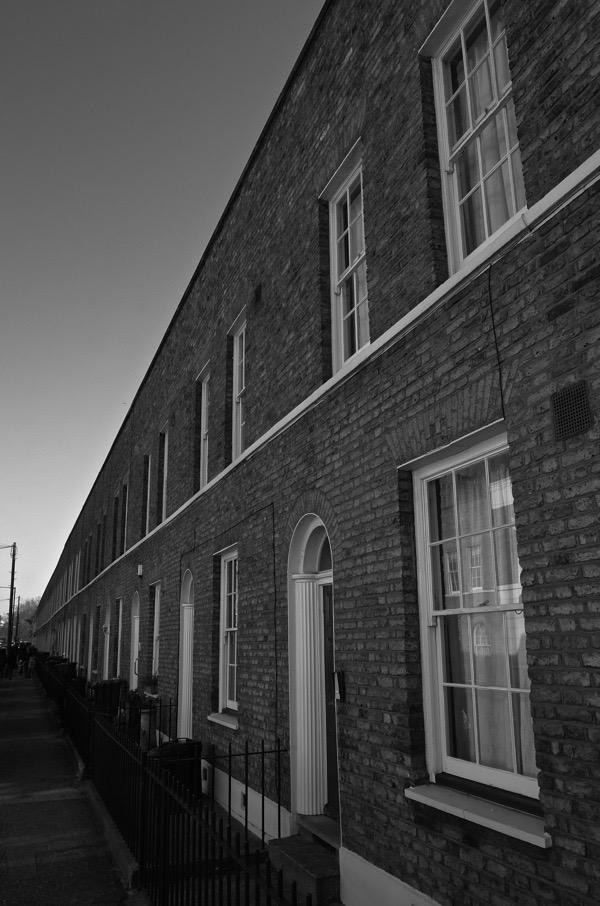
In Bromley St
Images courtesy Bishopsgate Institute
You may like to read the original post