
Markéta Luskačová’s Brick Lane Market

BOOKING NOW THROUGHOUT THE SUMMER

Two women with a cigarette, Cheshire St 1977.
When photographer Markéta Luskačová came from Prague in the mid-seventies, it became her great delight to visit the markets in London since they were forbidden under Communist rule in her own country. It was Brick Lane market in particular that took Markéta’s fancy, both as a subject for photography and a source of cheap produce. In fact, such was the enduring nature of her fascination and need, Markéta continued coming to Spitalfields to take photographs and get her weekly supply of fruit and vegetables for over thirty years.
As a young photographer in Czechoslovakia, Markéta went out to visit remote villages which were so poor that the collectivisation imposed elsewhere by the Communists was not viable, and she recorded a way of life barely changed for centuries in breathtakingly beautiful pictures, first exhibited in Prague in 1971 and later shown at the Victoria & Albert Museum in 1983. By chance, Markéta’s photographs were seen in Prague by Colin Osman, editor of Creative Camera, who was on a visit from London to attend the opera and he published them in his magazine, drawing international recognition for the quality of her vision.
In London, Markéta showed her work to Norman Hall, the renowned picture editor of The Times but when she told him she wanted to photograph markets, he dismissed it as “a subject for beginners” yet she set out undiscouraged.
“I went to Brick Lane and I never left. I fell in love with it.” she admitted to me, “Most of all, I photograph things I like and I was lucky enough that somebody saw my work and supported my photography for a little while.”
A year later, Markéta took her photographs of Brick Lane to Norman Hall and, looking at them, he declared, “This may be a subject for a beginner, but it is not a beginner that took these photographs.”
“I was poor,” recalled Markéta, “so I needed to do my shopping there as it was the cheapest place to buy things. I could identify with the people in Brick Lane because they were immigrants and they were in need of cheap goods. Once I had done my shopping, I would leave my bag with a stallholder while I took my photographs.”
In 1991, Markéta had a one woman show at the Whitechapel Gallery of her photographs of Spitalfields, establishing her reputation as a major photographic talent in this country. Those pictures – of which a selection are published here today – were the result of a two-year residency in which she selected from and printed her pictures taken between 1975 and 1990. Yet it is less widely known that these represent only a portion of those Markéta has taken in Brick Lane as result of her long-term relationship with the market which now extends over thirty years.
In particular, Markéta recorded the last days of the ancient market in birds and animals that existed in Sclater St and Club Row until it was closed down in 1990 as a result of protests by animal rights activists. Markéta shared a natural sympathy with the dealers, observing their affection for their charges, unlike the hard-line protestors, one of whom pushed her in front of a car.
Famously, Markéta photographed the sale of a lion cub in Brick Lane. She remembers that it was first offered at £150 and then the price diminished to £100 and finally £75, over successive weeks, as the cub grew and became less cuddly and more threatening. Eventually, the seller came back one Sunday without the lion but clasping a tray of watches that he had swapped the creature for. In Brick Lane, Markéta found her primary subject as a photographer, offering an entire society in realistic detail and a mythological universe of infinite variety.
“I don’t go to Brick Lane regularly anymore, sometimes six months passes between one visit and another” Markéta confided to me,“I photographed what I saw there and what I thought it was good to record, be it a face or a smile, an animal or a shoe. I believe in the evidential quality of photography, and I know that unless things are done in a visually interesting way they are not remembered.”
A woman with a gentle manner and a piercing gaze, Markéta Luskačová’s magnificent photographs reflect her own personality. They are simultaneously generous in their humanity yet unsentimental in revealing the nature of people.

Lion cub and dog, Club Row Market 1977.

Street musician, Cheshire St 1977.

Man selling trousers, Petticoat Lane 1974.

Woman in front of a poster, Bethnal Green Rd 1990.

Woman in the Bird in the Cage pub, Bethnal Green Rd 1976.

Man with a clock, off Cheshire St 1989.

Street musician, Cheshire St 1979.

Man with kitten, 1977.

Girls from Canon Barnett Primary School in the train on their way back from the seaside, 1988.

Woman and child, Sclater St 1976.

Old man and children with donkey, Sclater St 1980.
Photographs copyright © Markéta Luskačová
The Auriculas Of Spitalfields
Writer & horticultural historian, Margaret Willes, will be giving a lecture on the horticultural history of the East End in the Hanbury Hall on Tuesday 7th May at 7pm. CLICK HERE TO BOOK A TICKET

An Auricula Theatre
In horticultural lore, auriculas have always been associated with Spitalfields and writer Patricia Cleveland-Peck has a mission to bring them back again. She believes that the Huguenots brought them here more than three centuries ago, perhaps snatching a twist of seeds as they fled their homeland and then cultivating them in the enclosed gardens of the merchants’ grand houses, and in the weavers’ yards and allotments, thus initiating a passionate culture of domestic horticulture among the working people of the East End which endures to this day.
You only have to cast your eyes upon the wonder of an auricula theatre filled with specimens in bloom – as I did in Patricia’s Sussex garden – to understand why these most artificial of flowers can hold you in thrall with the infinite variety of their colour and form. “They are much more like pets than plants,” Patricia admitted to me as we stood in her greenhouse surrounded by seedlings,“because you have to look after them daily, feed them twice a week in the growing season, remove offshoots and repot them once a year. Yet they’re not hard to grow and it’s very relaxing, the perfect antidote to writing, because when you are stuck for an idea you can always tend your auriculas.” Patricia taught herself old French and Latin to research the history of the auricula, but the summit of her investigation was when she reached the top of the Kitzbüheler Horn, high in the Austrian Alps where the ancestor plants of the cultivated varieties are to be found.
Auriculas were first recorded in England in the Elizabethan period as a passtime of the elite but it was in the eighteenth and nineteenth centuries that they became a widespread passion amongst horticulturalists of all classes. In 1795, John Thelwall, son of a Spitalfields silk mercer wrote, “I remember the time myself when a man who was a tolerable workman in the fields had generally beside the apartment in which he carried on his vocation, a small summer house and a narrow slip of a garden at the outskirts of the town where he spent his Monday either in flying his pigeons or raising his tulips.” Auriculas were included alongside tulips among those prized species known as the “Floristry Flowers,” plants renowned for their status, which were grown for competition by flower fanciers at “Florists’ Feasts,” the precursors of the modern flower show. These events were recorded as taking place in Spitalfields with prizes such as a copper kettle or a ladle and, after the day’s judging, the plants were all placed upon a long table where the contests sat to enjoy a meal together known as “a shilling ordinary.”
In the nineteenth century, Henry Mayhew wrote of the weavers of Spitalfields that “their love of flowers to this day is a strongly marked characteristic of the class.” and, in 1840, Edward Church who lived in Spital Sq recorded that “the weavers were almost the only botanists of their day in the metropolis.” It was this enthusiasm that maintained a regular flower market in Bethnal Green which evolved into the Columbia Rd Flower Market of our day.
Known variously in the past as ricklers, painted ladies and bears’ ears, auriculas come in different classes, show auriculas, alpines, doubles, stripes and borders – each class containing a vast diversity of variants. Beyond their aesthetic appeal, Patricia is interested in the political, religious, cultural and economic history of the auricula, but the best starting point to commence your relationship with this fascinating plant is to feast your eyes upon the dizzying collective spectacle of star performers gathered in an auricula theatre. As Sacheverell Sitwell once wrote, “The perfection of a stage auricula is that of the most exquisite Meissen porcelain or of the most lovely silk stuffs of Isfahan and yet it is a living growing thing.”

Mrs Cairns Old Blue – a border auricula

Glenelg – a show-fancy green-edged auricula

Piers Telford – a gold-centred alpine auricula

Taffetta – a show-self auricula

Seen a Ghost – a show-striped auricula

Sirius – gold-centred alpine auricula

Coventry St – a show-self auricula

M. L. King – show-self auricula

Mrs Herne – gold-centred alpine auricula

Dales Red – border auricula

Pink Gem – double auricula

Summer Wine – gold-centred alpine auricula

McWatt’s Blue – border auricula

Rajah – show-fancy auricula

Cornmeal – show-green-edged auricula

Fanny Meerbeek – show-fancy auricula

Piglet – double auricula

Basuto – gold-centred alpine auricula

Blue Velvet – border auricula

Patricia Cleveland-Peck in her greenhouse.

You may also like to take a look at
William Kent’s Arch In Bow
Click here to book for this Saturday

‘a curious vestige from a catalogue of destruction’
This fine eighteenth century rusticated arch designed by the celebrated architect and designer William Kent was originally part of Northumberland House, the London residence of the Percy family in the Strand which was demolished in 1874. Then the arch was installed in the garden of the Tudor House in St Leonard’s Street, Bow, by George Gammon Rutty before it was moved here to the Bromley by Bow Centre in 1997, where it makes a magnificent welcoming entrance today.
The Tudor House was purchased in a good condition of preservation from the trustees of George Gammon Rutty after his death in 1898 by the London County Council, who chose to demolish it and turn the gardens into a public park. At this point, there were two statues situated at the foot of each of the pillars of the arch but they went missing in the nineteen-forties. One of the last surviving relics of the old village of Bromley by Bow, the house derived its name from a member of the Tudor family who built it in the late sixteenth century adjoining the Old Palace and both were lovingly recorded by CR Ashbee in the first volume of the Survey of London in 1900.
The Survey was created by Ashbee, while he was living in Bow running the Guild of Handicrafts at Essex House (another sixteenth century house nearby that was demolished), in response to what he saw as the needless loss of the Old Palace and other important historic buildings in the capital.
Ever since I first discovered William Kent’s beautiful lonely arch – a curious vestige from a catalogue of destruction – I have been meaning to go back to Bow take a photograph of it when the wisteria was in bloom and, although for a couple of years circumstances conspired to prevent me, eventually I was able to do so and here you see the result.

William Kent (1685 –1748) Architect, landscape and furniture designer

Northumberland House by Canaletto, 1752

Northumberland House shortly before demolition, 1874

William Kent’s arch in the grounds of the Tudor House, Bow, in 1900 with its attendant statues, as illustrated in the first volume of the Survey of London by CR Ashbee (Image courtesy Survey of London/ Bishopsgate Institute)

William Kent’s arch at St Leonard’s Street, Bromley by Bow
The Northumberland House Arch was restored with the support of the Heritage of London Trust
You may also like to read about
The Horticultural History Of The East End

Writer & horticultural historian, Margaret Willes, introduces her lecture on the horticultural history of the East End which takes place in the Hanbury Hall on Tuesday 7th May at 7pm. CLICK HERE TO BOOK A TICKET

Early twentieth century garden at the rear of WF Arber & C0 Ltd, Printing Works
Today Spitalfields and Shoreditch are intensely urban areas but, four centuries ago, the scene was very different. Maps of this era show that behind the main roads flanked by houses and cottages, there were fields of cattle and, close by the city walls, laundrywomen laying out their washing to dry.
Many craftsmen who needed to be near to the City of London, yet who did not wish to be liable to its trading restrictions, found a home here. At the end of the sixteenth century, Huguenot silk weavers fleeing from religious persecution in the Spanish Netherlands and France, and landing at ports such as Yarmouth, Colchester and Sandwich, made their way to the capital. Records of this first wave of Huguenots and their arrival in Spitalfields are sparse, but there are references to them in the rural village of Hackney for instance.
Just as these ‘strangers’ took up residence east of London, so too did actors and their theatres. William Shakespeare lodged just within the City walls in Silver St, in the fifteen-nineties, in the home of an immigrant family from Picardie, the Mountjoys, who were involved in silk and wire-twisting.
Tradition tells us that these refugees brought with them their love of flowers. Bulbs and seeds may easily be transported, so they could have brought their floral treasures in their pockets. The term ‘florist’ first appears in English in 1623 when Sir Henry Wotton, scholar, diplomat and observer of gardens wrote about them to an acquaintance. He was not using ‘florist’ in its modern sense as a retailer of cut flowers, but rather as a description of an enthusiast who nurtured and exhibited pot-grown flowers such as tulips and carnations. One flower that has been traditionally associated with the Spitalfields silk weavers is the auricula, with its clear-cut colours. Auricalas do not like rain, so those who worked at home were in an ideal position to be able to bring them under cover when inclement weather threatened.
Another ‘outsider’ living in Spitalfields in the mid-seventeenth century was the radical apothecary, Nicholas Culpeper. He set up home in the precincts of the former Priory of St Mary Spital with his wife Alice Ford in 1640, probably choosing to be outside the City in order to able to practise without a licence. A Nonconformist in every sense, he disliked the elitism of the medical profession and in his writings threw down a challenge by offering help to all, however poor they were. He develop his knowledge by gathering wild flowers and herbs, but it is likely he also cultivated them in his own garden. His English Physitian, later known as the Complete Herbal, is one of the most successful books published in the English language and is still available today.
Culpeper’s books are a reminder that the garden has been for centuries the vital source of all medicines and poultices in this country. As London expanded, and private gardens within the City walls were built over, so the supply of medicinal herbs for apothecaries and housewives became of vital importance. Some of the market herbwomen are mentioned by name in the records of 1739-40 of the Fleet Market along with their places of residence. Hannah Smith, for example, came from Grub Sin in Finsbury, but others from further afield, such as Bethnal Green and Stepney Green. The remedies of the period required large quantities of certain herbs, such as wormwood and pennyroyal, and these women cultivated these as market gardeners.
With the Revocation of the Edict of Nantes in 1685 by Louis XIV, a fresh wave of Huguenot refugees arrived, this time from France rather than the Lowlands. We know much more about these people, including their love of flowers, along with singing birds and linnets, which until quite recently could still be bought from Club Row Market. The French king made a mistake in divesting his realm of some of the most talented craftsmen: gunsmiths and silversmiths as well as silk weavers. The skill of the weavers was matched by their love of flowers in the exquisite silks they produced for court mantuas, the ornate dresses made for aristocratic ladies attending the court of St James. In these designs, a genuine attempt was made to produce botanical naturalism rather than purely conventional floral motifs and although today the most famous designer was Anna-Maria Garthwaite, there were others working alongside her in these streets.
As Spitalfields grew more developed in the eighteenth century, so the pressure on land increased and many of the gardens were built over with new houses. Some residents appear to have taken to their rooftops, creating gardens and building aviaries for their birds up there. Thomas Fairchild, who cultivated a famous nursery in Hoxton, recommended the kind of plants that could survive at this height, including currant trees. Others created gardens upon grounds along the Hackney and Mile End roads. A commissioner reporting on the conditions of the handloom weavers in the early nineteenth century described one such area, Saunderson’s Gardens in Bethnal Green.
“They may cover about six acres of ground. There is one general enclosure round the whole, and each separate garden is divided from the rest by small palings. The number of gardens was stated to be about one hundred and seventy: some are much larger than the rest. In almost every garden is a neat summer-house, where the weaver and his family may enjoy themselves on Sundays and holidays …. There are walks through the ground by which access is easy to the gardens.
The commissioner found that vegetables such as cabbages, lettuces and peas were cultivated, but pride of place was given to flowers. “There had been a contest for a silver medal amongst the tulip proprietors. There were many other flowers of a high order, and it was expected that in due time the show of dahlias for that season would not fail to bring glory to Spitalfields. In this neighbourhood are several dealers in dahlias.”
The competitions held for the finest florists’ flowers were fiercely fought. The Old Bailey sessions records include cases where thieves had broken into gardens not only to steal from the summer houses, but to take prize bulbs too. The Lord Mayor’s Day, 9th November, was traditionally the time to plant the bulbs and, in the spring, judges visited the gardens to make their decisions.
But these gardens were doomed, for the eastern parts of London – Bethnal Green, Stepney Green and Hackney – were being overwhelmed by street after street of new terraced houses. The handloom weavers of the area were likewise doomed, as the silk industry was threatened by competition from overseas and by looms powered by machinery in this country. Their love of flowers, however, was not to be dimmed, and a picture of a Spitalfields weaver in 1860 working alongside his daughters in a garret shows plants on the windowsill, while a contemporary account describes a fuchsia in pride of place near a loom, with its crimson pendants swinging to the motion of the treadles.
Root plants could be bought from sellers, especially along the Mile End Rd, and cut flowers from Spitalfields Market. At the beginning of the twentieth century, a market specifically for flowers and plants was established in Columbia Rd in Shoreditch. This followed the failure of an elaborate food market built by the philanthropist, Angela Burdett-Coutts in the nineteenth century. Her project had been based on a prospective railway line to deliver fish, which never materialised, while the traders preferred to sell outdoors and their customers, many of whom were Jewish immigrants, wanted to buy on Sunday. Originally, Columbia Market traded on Saturday but a parliamentary act moved it to Sunday, enabling Covent Garden and Spitalfields traders to sell their leftover stock, and this market thrived, attesting to the persistent love of flowers in the East End of London.

London Herb Woman, late sixteenth century from Samuel Pepys collection of Cries of London

Nicholas Culpeper (1616-1654), the Spitalfields Herbalist
An auricula theatre

The tomb of Thomas Fairchild (1667-1729) the Hoxton gardener

Rue, Sage & Mint – a penny a bunch! Kendrew’s Cries of London

Buy my watercress, 1803

Buy my Ground Ivy, 1803

Chickweed seller of 1817 by John Thomas Smith

This is John Honeysuckle, the industrious gardener, with a myrtle in his hand, the produce of his garden. He is justly celebrated for his beautiful bowpots and nosegays, 1819

Here’s all a Blowing, Alive and Growing – Choice Shrubs and Plants, Alive and Growing, eighteen-twenties

Selling flowers on Columbia Rd in the nineteen seventies Photo by George Gladwell
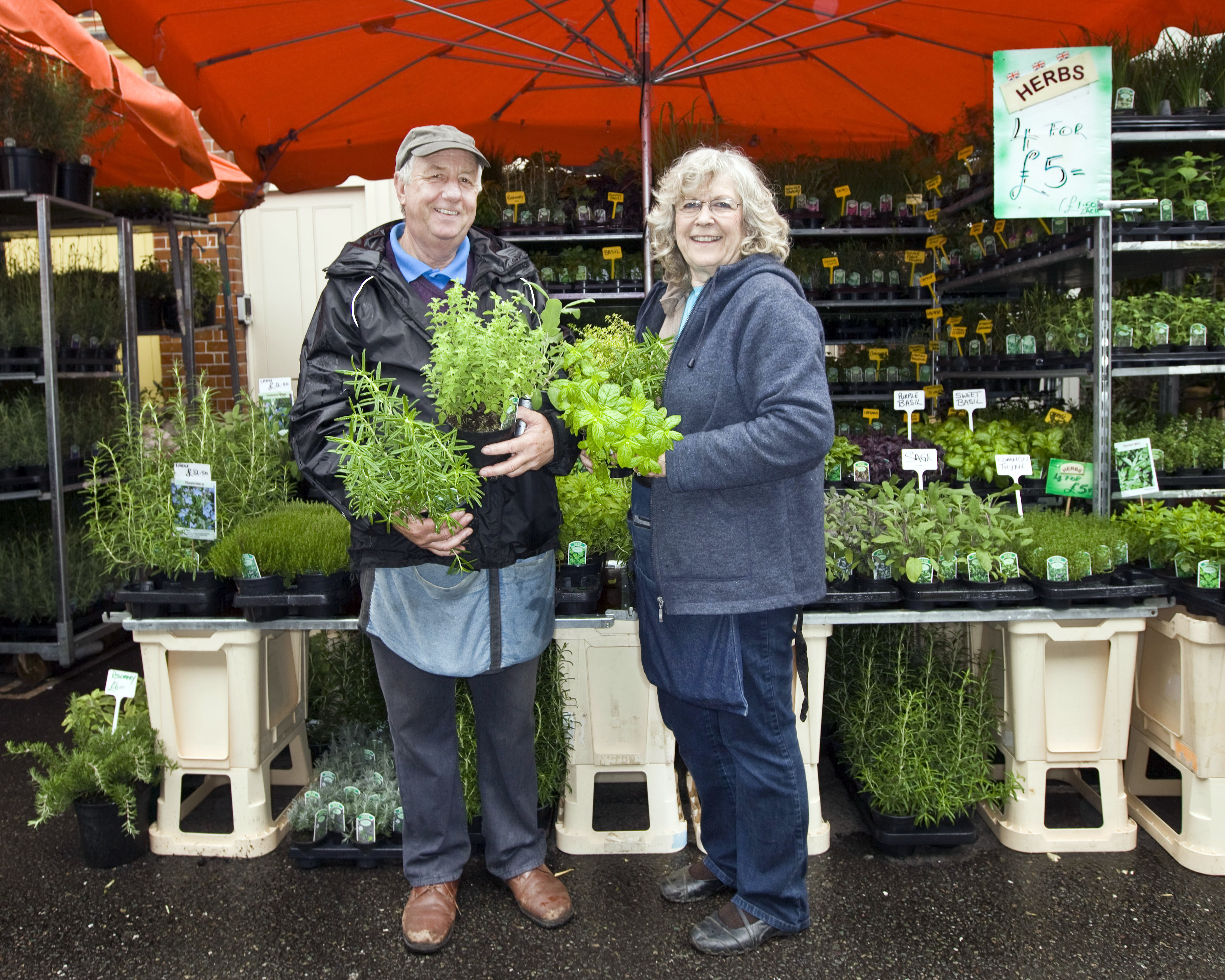
Mick & Sylvia Grover, Herb Sellers in Columbia Rd – Portrait by Jeremy Freedman

Margaret Willes in her garden – Portrait by Sarah Ainslie
The Gardens of the British Working Class by Margaret Willes is published by Yale University Press
You may also like to read about
Nicholas Culpeper, Herbalist of Spitalfields
Thomas Fairchild, Gardener of Hoxton
John Stow’s Spittle Fields

In 1999, I bought this coin that I wear around my neck for £2.60 from a grave robber in the Spitalfields Market at the time of the excavation of the Roman cemetery. Somebody wore this coin in London all those centuries ago and although I will never know who they were, now I wear it for them around my neck, to give me a sense of perspective.
Learn the full story on my tour this Saturday

The Bishopsgate Institute has a 1599 copy of John Stow‘s Survey Of London and it touches me to see the edition that John Stow himself produced, with its delicate type resembling gothic script, and I find it sobering to recognise what a great undertaking it was to publish a book four hundred years ago – requiring every page of type to be set and printed by hand.
Born into a family of tallow chandlers, John Stow became a tailor yet devoted his life to writing and publishing, including an early edition of the works of Geoffrey Chaucer who had lived nearby in Aldgate more than a century earlier. In Stow’s lifetime, the population of London quadrupled and much of the city he knew as a youth was demolished and rebuilt, inspiring him to write and publish his great work – a Survey that would record this change for posterity. Consequently, on the title page of the Survey, Stow outlines his intention to include “the Originall, Antiquity, Increase, Modern estate and description of that citie.”
Yet in contrast to the dramatic changes he witnessed at first hand, John Stow also described his wonder at the history that was uncovered by the redevelopment, drawing consolation in setting his life’s experience against the great age of the city and the generations who preceded him in London .
SPITTLE FIELDS
There is a large close called Tasell close sometime, for that there were Tasels planted for the vse of Clothworkers: since letten to the Crosse-bow-makers, wherein they vsed to shoote for games at the Popingey: now the same being inclosed with a bricke wall, serueth to be an Artillerieyard, wherevnto the Gunners of the Tower doe weekely repaire, namely euerie Thursday, and there leuelling certaine Brasse peeces of great Artillerie against a But of earth, made for that purpose, they discharge them for their exercise.
Then haue ye the late dissolued Priorie and Hospitall, commonly called Saint Marie Spittle, founded by Walter Brune, and Rosia his wife, for Canons regular, Walter Archdeacon of London laid the first stone, in the yeare 1197.
On the East side of this Churchyard lieth a large field, of olde time called Lolesworth, now Spittle field, which about the yeare 1576 was broken vp for Clay to make Bricke, in the digging whereof many earthen pots called Vrnae, were found full of Ashes, and burnt bones of men, to wit, of the Romanes that inhabited here: for it was the custome of the Romanes to burne their dead, to put their Ashes in an Vrna, and then burie the same with certaine ceremonies, in some field appoynted for that purpose, neare vnto their Citie: euerie of these pots had in them with the Ashes of the dead, one peece of Copper mony, with the inscription of the Emperour then raigning: some of them were of Claudius, some of Vespasian, some of Nero, of Anthonius Pius, of Traianus, and others: besides those Vrnas, many other pots were there found, made of a white earth with long necks, and handels, like to our stone Iugges: these were emptie, but seemed to be buried ful of some liquid matter long since consumed and soaked through: for there were found diuerse vials and other fashioned Glasses, some most cunningly wrought, such as I haue not seene the like, and some of Christall, all which had water in them, northing differing in clearnes, taste, or sauour from common spring water, what so euer it was at the first: some of these Glasses had Oyle in them verie thicke, and earthie in sauour, some were supposed to haue balme in them, but had lost the vertue: many of those pots and glasses were broken in cutting of the clay, so that few were taken vp whole.
There were also found diuerse dishes and cups of a fine red coloured earth, which shewed outwardly such a shining smoothnesse, as if they had beene of Currall, those had in the bottomes Romane letters printed, there were also lampes of white earth and red, artificially wrought with diuerse antiques about them, some three or foure Images made of white earth, about a span long each of them: one I remember was of Pallas, the rest I haue forgotten.I my selfe haue reserued a mongst diuerse of those antiquities there, one Vrna, with the Ashes and bones, and one pot of white earth very small, not exceeding the quantitie of a quarter of a wine pint, made in shape of a Hare, squatted vpon her legs, and betweene her eares is the mouth of the pot.
There hath also beene found in the same field diuers coffins of stone, containing the bones of men: these I suppose to bee the burials of some especiall persons, in time of the Brytons, or Saxons, after that the Romanes had left to gouerne here. Moreouer there were also found the sculs and bones of men without coffins, or rather whose coffins (being of great timber) were consumed. Diuerse great nailes of Iron were there found, such as are vsed in the wheeles of shod Carts, being each of them as bigge as a mans finger, and a quarter of a yard long, the heades two inches ouer, those nayles were more wondred at then the rest of thinges there found, and many opinions of men were there vttred of them, namely that the men there buried were murdered by driuing those nayles into their heads, a thing vnlikely, for a smaller naile would more aptly serue to so bad a purpose, and a more secret place would lightly be imployed for their buriall.
And thus much for this part of Bishopsgate warde, without the gate.

The coin from the Spitalfields Roman Cemetery that I wear around my neck beside my mother and grandmother’s wedding rings

Bishopsgate Ward entry by John Stow in his Survey of London


Monument to John Stow in St Andrew Undershaft
Archive images courtesy Bishopsgate Institute
Photograph of Stow’s monument copyright © Estate of Colin O’Brien
You may also like to read about
Ernest George’s London

Click here to book for this Saturday’s tour of Spitalfields

Aldgate
Stefan Dickers, Archivist at Bishopsgate Institute, introduced me to these fine copper plate etchings by Ernest George (1839-1922). In the eighteen-eighties, George set out to immortalise those fragments of London which spoke of times gone by and Londoners long dead, recording buildings and views which have for the most part now disappeared.
I realise that my affection for these images sets me in line with the generations of chroniclers who have made it their business to document the transience of the city, starting with John Stow who wrote the very first Survey of London between 1560 and 1598 to describe the streets of his childhood that were vanishing before his eyes.
Ernest George’s etchings were published by the Fine Art Society in New Bond St in 1884, a magnificent temple of culture designed by Edward William Godwin which survived through the twentieth century only to close five years ago.

Bishopsgate

Wych St, Strand

Fouberts Place, Soho

Crown Court, Pall Mall

St Bartholomew, Smithfield

Warwick Lane, City

Tower of London

London Bridge

Staple Inn, Holborn

Drury Lane

St John’s Gate, Clerkenwell

Limehouse

Shadwell
Images courtesy Bishopsgate Institute
You may also like to look at
Charles Spurgeon’s Londoners
Click here to book for next Saturday’s tour of Spitalfields

Champion Pie Man – W.Thompson, Pie Maker of fifty years, outside his shop in the alley behind Greenwich Church
Charles Spurgeon the Younger, son of the Evangelist Charles Haddon Spurgeon, took over the South St Baptist Chapel in Greenwich in the eighteen-eighties and commissioned an unknown photographer to make lantern slides of the street traders of Greenwich that he could use in his preaching. We shall never know exactly how Spurgeon showed these pictures, taken between 1884 and 1887, but – perhaps inadvertently – they became responsible for the creation of one of the earliest series of documentary portraits of Londoners.

Hokey-Pokey Boy – August Bank Holiday, Stockwell St, Greenwich

Knife Grinder – posed cutting out a kettle bottom from a tin sheet

Rabbit Seller

Toy Seller – King William St outside Royal Naval College, Greenwich

Ginger Cakes Seller – King St, near Greenwich Park

Sweep

Shrimp Sellers – outside Greenwich Park

Crossing Sweeper (& News Boy) – Clarence St, Greenwich

Sherbert Seller – outside Greenwich Park

Third Class Milkman – carrying two four-gallon cans on a yoke, King William’s Walk, Greenwich

Second Class Milkman – with a hand cart and seventeen-gallon churn

Master Milkman – in his uniform, outside Royal Naval College, Greenwich

Chairmender – Corner of Prince Orange Lane, Greenwich

Kentish Herb Woman – Greenwich High Rd

Muffin Man

Fishmongers

Try Your Weight – outside Greenwich Park

Glazier

News Boy (& Crossing Sweeper) – delivering The Daily News at 7:30am near Greenwich Pier

Old Clo’ Man – it was a crime to dispose of infected clothing during the Smallpox epidemics of the eighteen-eighties and the Old Clo’ Man plied a risky trade.

Blind Fiddler – outside Crowders’ Music Hall Greenwich
You may also like to take a look at


