
My Cousin, Ned Despard – Hero Or Traitor?

I am proud to publish these excerpts from CHERRY’S CACHE by Cherry Gilchrist, a graduate of my writing course. Cherry set out to research and bring alive the lives of her forebears and her account of Ned Despard is a fascinating example of this. Ned was a man who through his sense of decency found himself fatally at odds with the spirit of his age.
I am taking bookings for the next writing course, HOW TO WRITE A BLOG THAT PEOPLE WILL WANT TO READ on February 6th & 7th. Come to Spitalfields and spend a winter weekend with me in an eighteenth century weaver’s house in Fournier St, enjoy delicious lunches and eat cakes baked to historic recipes, and learn how to write your own blog.
If you are graduate of my course and you would like me to feature your blog, please drop me a line.
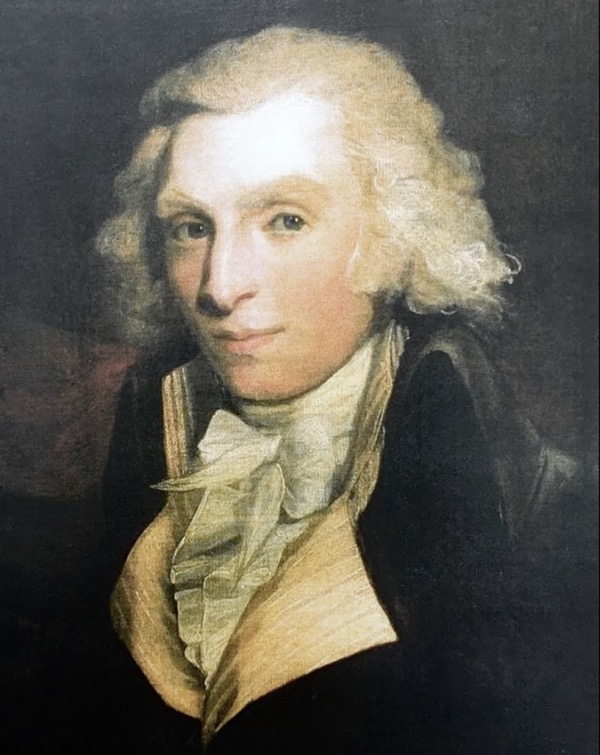
Ned Despard by George Romney
I wanted to learn all that I could about my cousin Colonel Edward Marcus Despard (1751-1803), an Irishman of Huguenot descent whom I shall call ‘Ned’. My role here is to draw your attention to his story and celebrate my discovery of him as a relative. I will begin with the end.
On Monday February 21st, 1803, Ned was executed. A crowd of some twenty thousand people gathered to watch him go to his death on a scaffold erected on what is now the South Bank, condemned as a conspirator against King and Country. He asked permission to make a final speech and spoke passionately on the subject of justice and equality. He was then executed, by hanging and decapitation, on a charge of treason.
The evidence against him was flimsy at best and false at worst. He received small mercy in that his sentence of being ‘hanged, drawn and quartered’ – the last man in legal history to receive this sentence – was repealed at short notice to remove the barbaric ‘drawing and quartering’. Even though he had loyal friends, such as his old comrade-in-arms Horatio Nelson, they could not commute his sentence further.
Ned was condemned as a dangerous revolutionary, the charge against him being that he was planning to kill the King and overthrow the government. Yet this was a man who had been loyal to the British Crown through thick and thin, though since returning to London, he had kept company with radicals and was certainly interested in ideals of equality and reform. And in those days, that proved enough to hang him.
He was singled out for infamy at a time when Britain was gripped with paranoia about a possible revolution. The government feared that the French Revolution of 1789 might be replicated on British soil. Youthful idealism for revolution, embraced by the Romantic poets Shelley, Byron, Coleridge and Wordsworth, was no longer acceptable.
Ned had served the British Government faithfully, fighting bravely as a comrade alongside Nelson in campaigns in the Caribbean and Central America, where they managed to recapture Fort Immaculada from the Spanish. Both men suffered disease and hardship in the process.
Afterwards, Ned proved himself as a responsible and conscientious governor in Honduras, and only came back to England when he was completely out of funds, trying to reclaim the expenses owed to him, which he had subsidised out of his own pocket, including providing hurricane relief to the population.
He married Catherine Gordon, a black woman from Jamaica, a bold act at the time, especially when he returned to London with her. Mixed marriages, as opposed to concubinage, were certainly not the norm at the turn of the nineteenth century. One of the reports against him sneered that when Ned was seized from home to be taken to court, he had been ‘found in bed with a black woman’ without mention that she was his lawful wife. Even some of the Despard family and their descendants spoke of her being a housekeeper rather than acknowledging her true position.
In fact, Catherine was an educated woman, her mother had been a ‘free woman’, so neither she nor her daughter was a slave. And Catherine was capable of mixing in upper circles of society. She petitioned for her husband tirelessly during the years he was kept in prison pending his final trial. One of her letters survives, a plea that he should be kept in better conditions.
During his time as First Commissioner & Governor in what is now Honduras, Ned insisted on fairness for all the peoples of his colony, irrespective of their status or colour. He had some awkward folk to deal with – Baymen guarding their plantations and Shoremen with semi-legal trade. There were Maroons, who were runaway slaves, plus Irish convicts and people of assorted ethnicities, including indigenous peoples, all with their different desires and objectives.
Ned’s insistence that there should be equality between people of different colour and race did not go down well with everyone in the colonies. Ironically, when challenged about this, he said that as British law did not discriminate between races, neither would he in its territories.
So were these his Huguenot values coming to the fore, carried through the generations? And did these values later inform Ned’s gallows speech with which I leave you?
‘Fellow Citizens, I come here as you see, after having served my country, faithfully, honourably, and usefully served it, for thirty years and upwards, to suffer death upon a scaffold for a crime of which I protest l am not guilty. I solemnly declare that I am no more guilty of it than any of you who may be now hearing me. But, though His Majesty’s Ministers know as well as I do, that I am not guilty, yet they avail themselves of a legal pretext to destroy a man, because he has been a friend to truth, to Liberty, and to Justice. Because I have been a friend to the poor, and the oppressed. But, Citizens, I hope and trust, notwithstanding, my fate, and the fate of those, who no doubt will soon follow me, that the principle of Freedom, of Humanity, and of Justice, will finally triumph over Falsehood, Tyranny, and Delusion, and every principle hostile to the interests of the human race.’

A mahogany plantation in Honduras
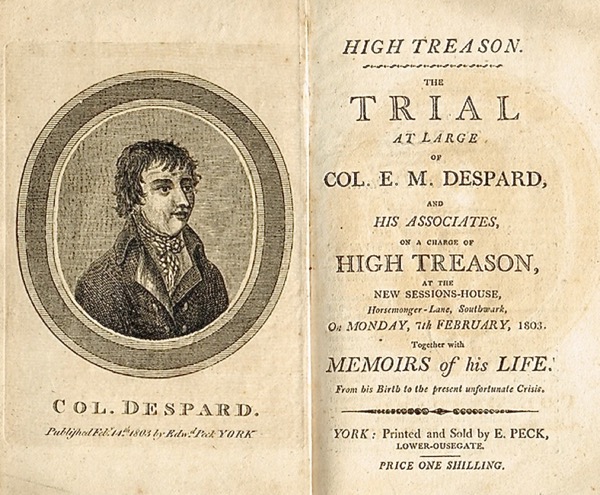
Published account of the trial of Ned Despard
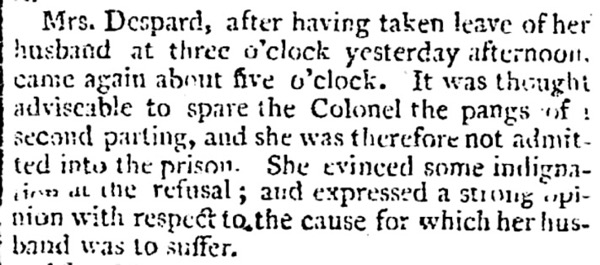
Account from the Aberdeen Press & Journal of Catherine Despard being refused admission to visit her husband
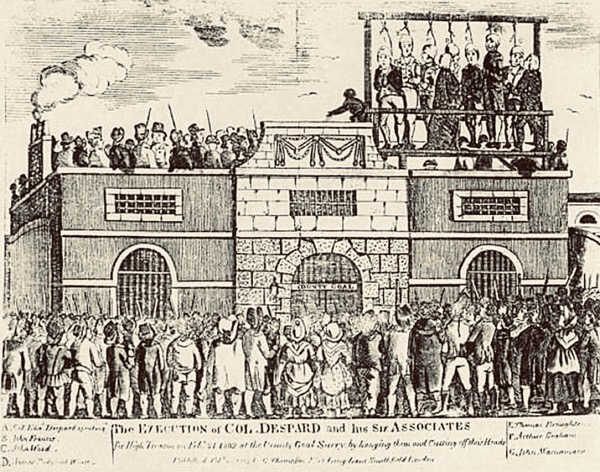
Ned Despard at the gallows
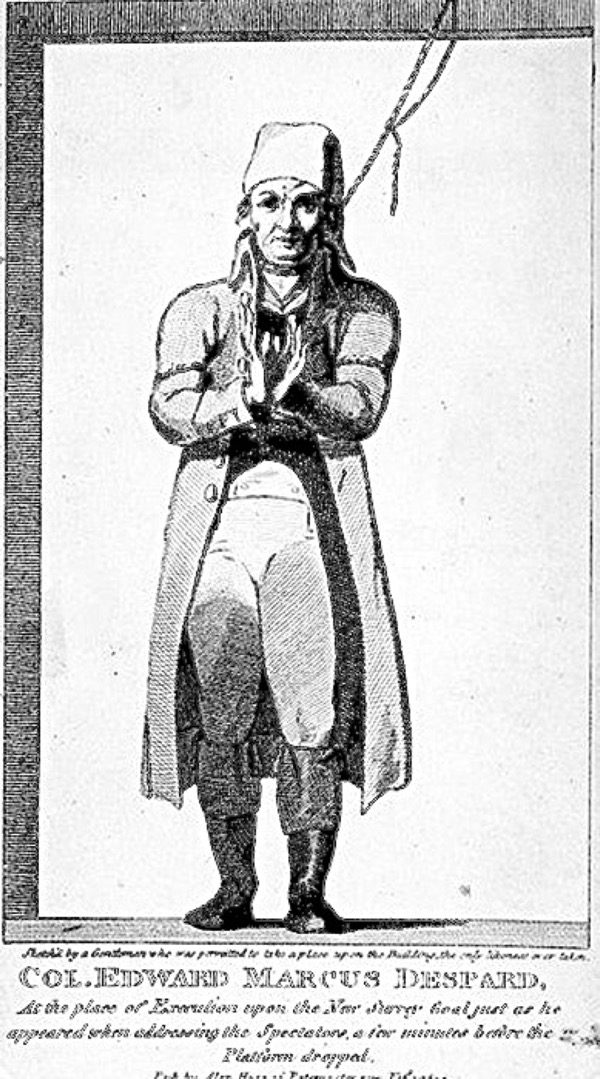
The execution of Ned Despard














This is an exciting and extraordinary example of family history (most of our ancestors didn’t leave much of a paper trail) . I want to know more about Ned & his wife Catherine and I have just subscribed to Cherry’s blog.
I hope that at least some of the 20,000 who watched his execution were supporters raging against the injustice being done. Public executions were banned some 60 years later, not out of a sensibility that death should not not be a form entertainment, but because crowds would give support & encouragement to those waiting execution.
I also wonder if Ned was from Portarlington, my father’s home town in the midlands of Ireland which had a large Huguenot population
Cherry, this has the makings of a good historical novel. Go for it!